
Unit D MERCHANDISE INFORMATION 4 02 Explain the
- Slides: 46
Unit D MERCHANDISE INFORMATION 4. 02 Explain the elements and principles of design.
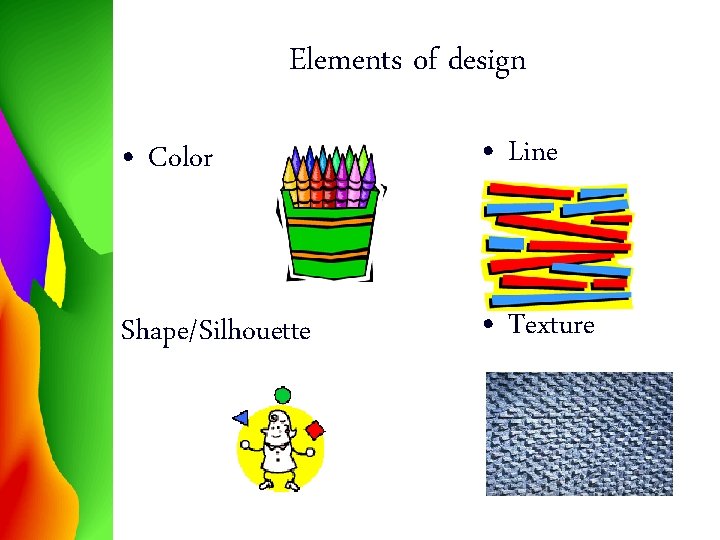
Elements of design • Color • Line Shape/Silhouette • Texture
Principles of design • • Balance Proportion Emphasis Rhythm
• The elements of design are combined in different ways to form designs. • The principles of design are guidelines/rules for using the elements of design. • When the elements of design are used effectively according to the principles of design, harmony results. • Harmony: The pleasing visual effect of a design created by tasteful use of the elements of design following the principles of design.
The Importance of Color • • Creates the greatest visual impact for the consumer Can affect illusions of the size and shape Can reflect the personality of an individual Is associated with psychological traits and emotions
Color Hue: (1) The technical word for color. (2) The name given to a color, such as red or yellow, that distinguishes one color from another.
• Value: The lightness or darkness of a color. • Tint: The lighter hue created when white is added to a color. • Shade: The darker hue created when black is added to a color. Color • Intensity: The brightness or dullness of a color. • Neutrals: Black, white, beige, and gray. Neutrals can be used alone or with any other colors.
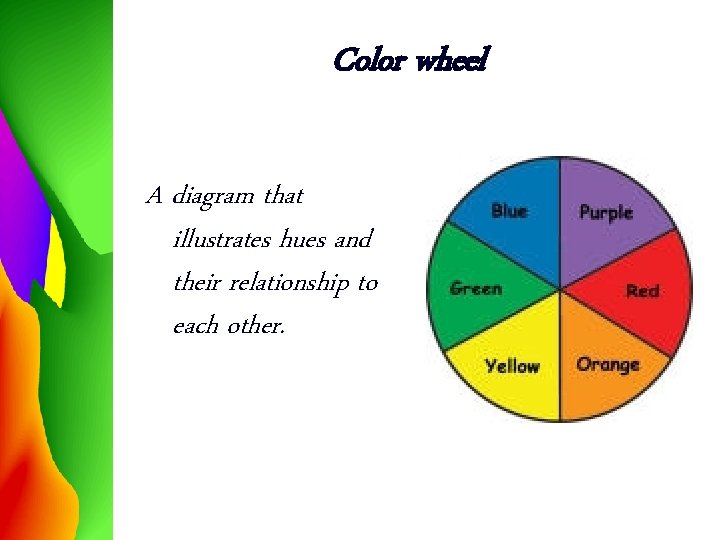
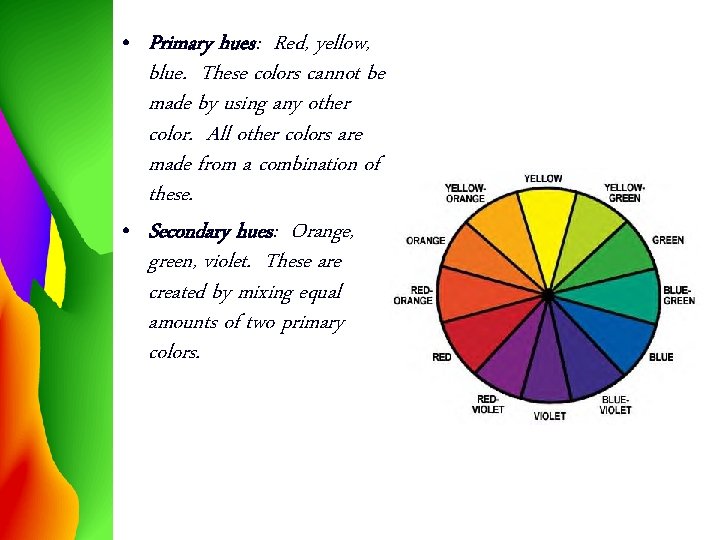
Color wheel A diagram that illustrates hues and their relationship to each other.
• Primary hues: Red, yellow, blue. These colors cannot be made by using any other color. All other colors are made from a combination of these. • Secondary hues: Orange, green, violet. These are created by mixing equal amounts of two primary colors.
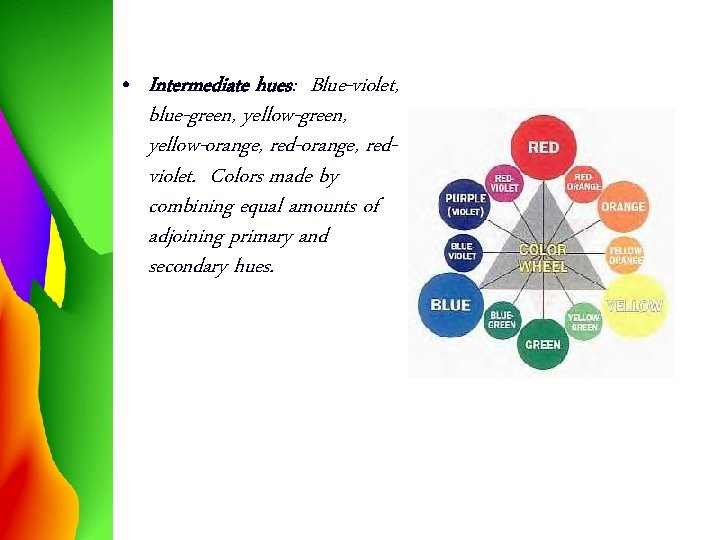
• Intermediate hues: Blue-violet, blue-green, yellow-orange, redviolet. Colors made by combining equal amounts of adjoining primary and secondary hues.
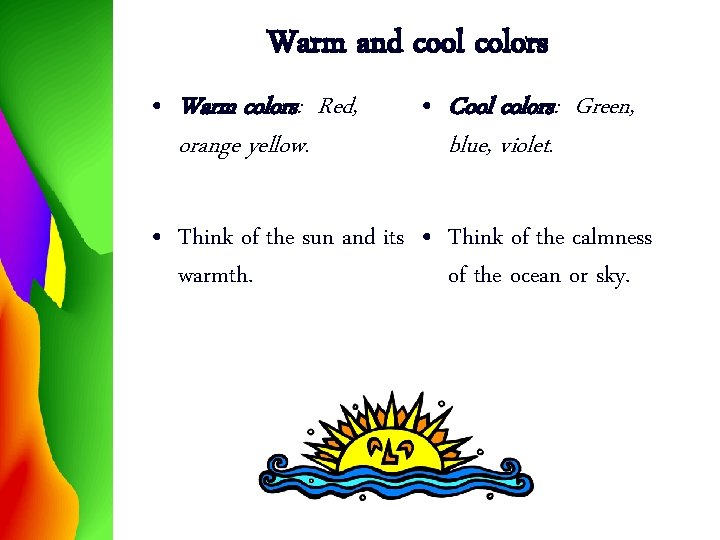
Warm and cool colors • Warm colors: Red, orange yellow. • Cool colors: Green, blue, violet. • Think of the sun and its • Think of the calmness warmth. of the ocean or sky.
Color schemes Plans that can be used to provide harmonious color combinations. • Monochromatic • Split-complementary • Analogous • Triad • Complementary • Accented Neutrals
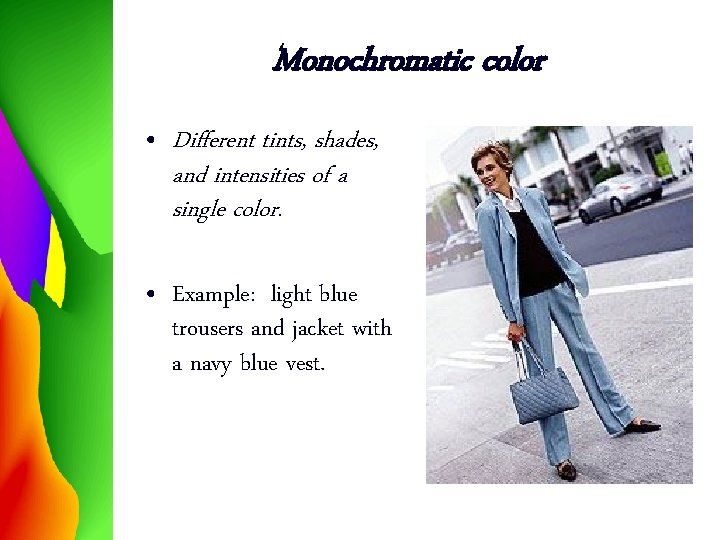
Monochromatic color • Different tints, shades, and intensities of a single color. • Example: light blue trousers and jacket with a navy blue vest.
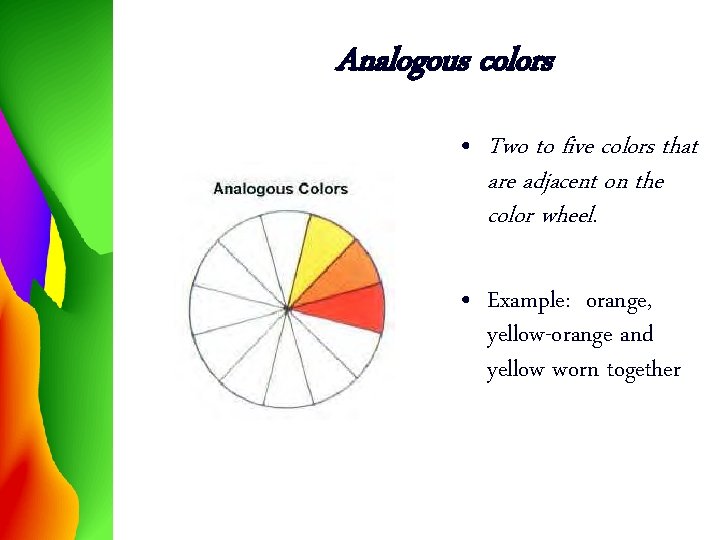
Analogous colors • Two to five colors that are adjacent on the color wheel. • Example: orange, yellow-orange and yellow worn together
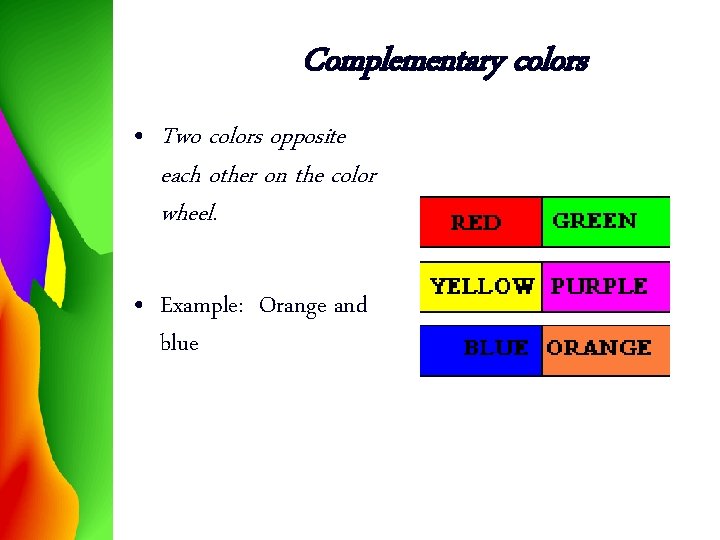
Complementary colors • Two colors opposite each other on the color wheel. • Example: Orange and blue
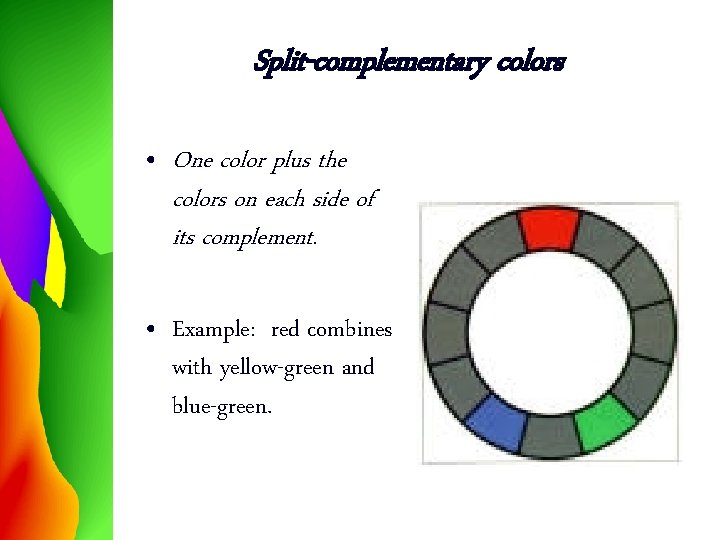
Split-complementary colors • One color plus the colors on each side of its complement. • Example: red combines with yellow-green and blue-green.
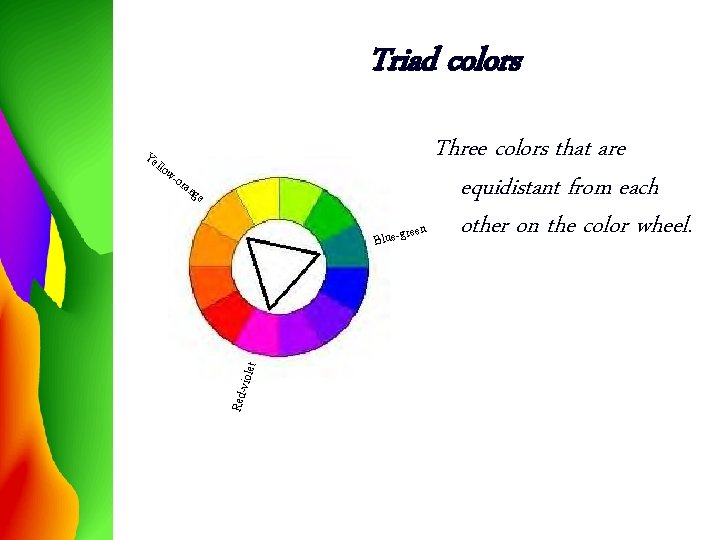
Triad colors or an ge green Blue- let w- -vio llo Red Ye Three colors that are equidistant from each other on the color wheel.
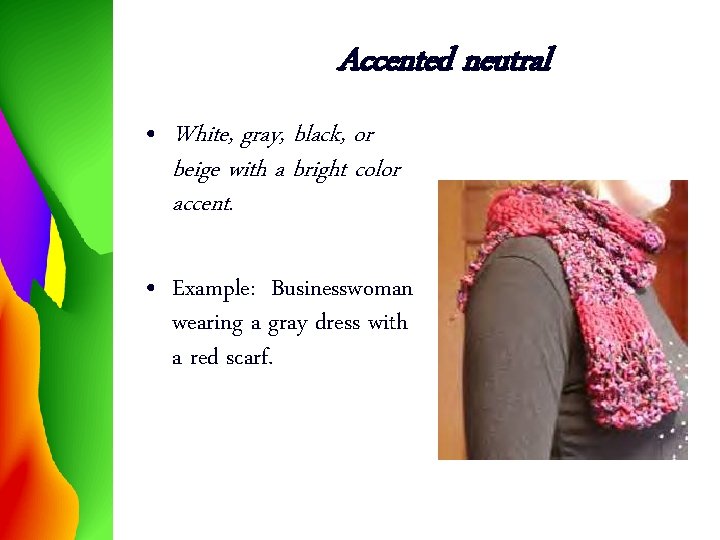
Accented neutral • White, gray, black, or beige with a bright color accent. • Example: Businesswoman wearing a gray dress with a red scarf.
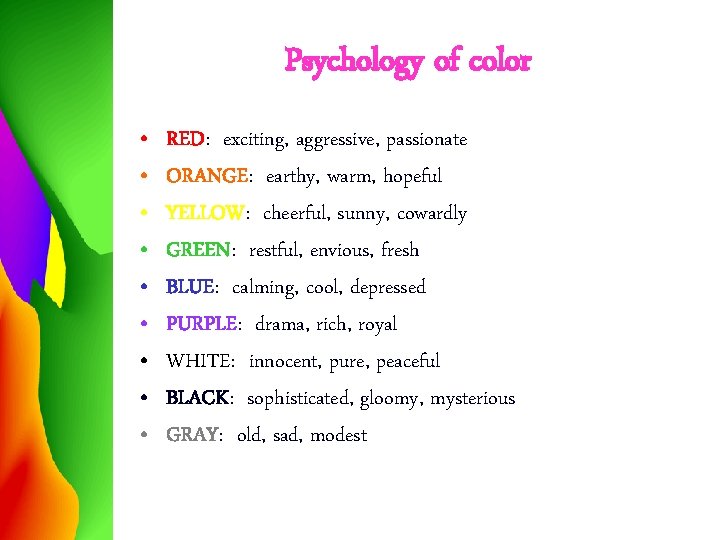
Psychology of color • • • RED: exciting, aggressive, passionate ORANGE: earthy, warm, hopeful YELLOW: cheerful, sunny, cowardly GREEN: restful, envious, fresh BLUE: calming, cool, depressed PURPLE: drama, rich, royal WHITE: innocent, pure, peaceful BLACK: sophisticated, gloomy, mysterious GRAY: old, sad, modest
Wednesday 11/9 • Warm-up # 8 (write worksheet) – Complete the 4. 02 Colors review sheet using your color wheel and notes • Tasks – Warm-up worksheet – Color Handbook
COLOR HANDBOOK • In Microsoft Word, create a handbook with all of the following information: – Color Schemes (definition and outfit example of the scheme) • Monochromatic, Analogous, Complementary, Split. Complementary, Triad, and Accented Neutral – Psychology of colors – Be creative with your font. May use color! We will print these in color. You will be allowed to use your color handbook on Obj. 4 test!
Thursday 11/10 (no school tomorrow) • Warm-up # 9 (turn in tray) – What is the importance of color? • Tasks – Warm-up – Complete 4. 02 notes. – principles of design examples – Fabric Finishing • Dyeing T-shirts!
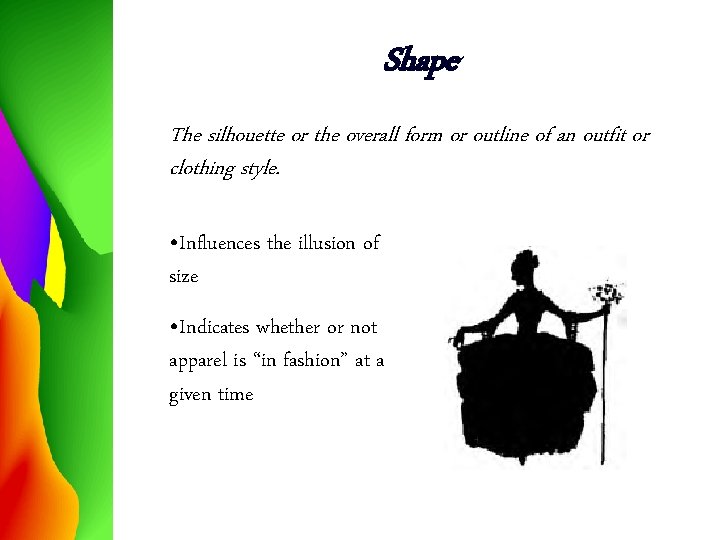
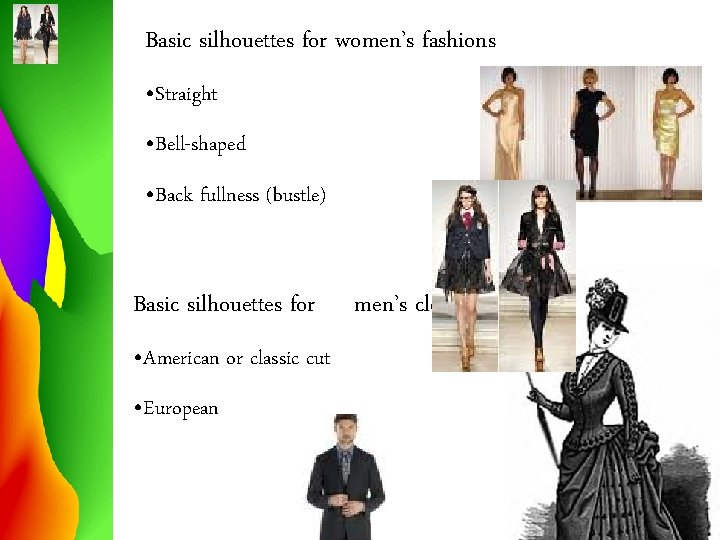
Shape The silhouette or the overall form or outline of an outfit or clothing style. • Influences the illusion of size • Indicates whether or not apparel is “in fashion” at a given time
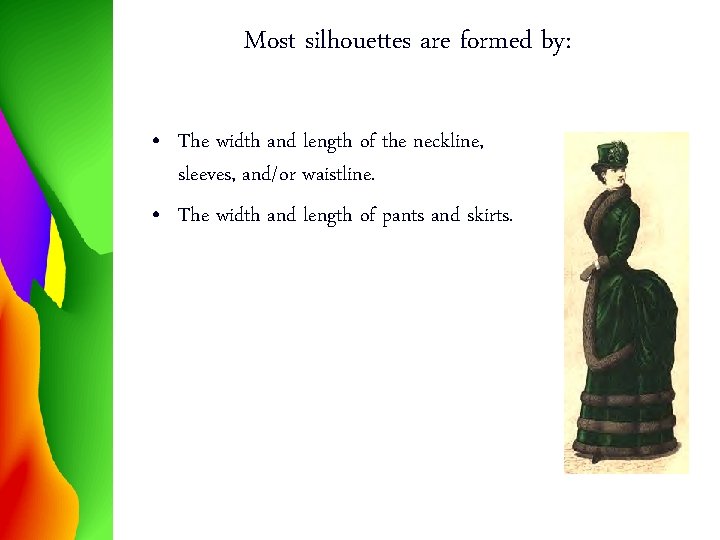
Most silhouettes are formed by: • The width and length of the neckline, sleeves, and/or waistline. • The width and length of pants and skirts.
Basic silhouettes for women’s fashions • Straight • Bell-shaped • Back fullness (bustle) Basic silhouettes for • American or classic cut • European men’s clothing
Silhouettes • Are always changing in fashion • The general direction that a silhouette takes either becoming wider, narrower, longer, or shorter shows a fashion trend. • Examples: varying lengths for women’s skirts, varying widths for men’s neckties
Line A distinct, elongated mark that can lead the path of eye movement up and down, side to side, or around objects. • Give direction, or a feeling of movement • Provides visual direction • Helps draw attention to good points and play down the bad ones
Basic types of lines • Straight lines: Lines without curves or bends. Straight lines are severe and formal and suggest power and dignity. • Curved lines: Circular or gently waved lines. Curved lines add softness and roundness to apparel.
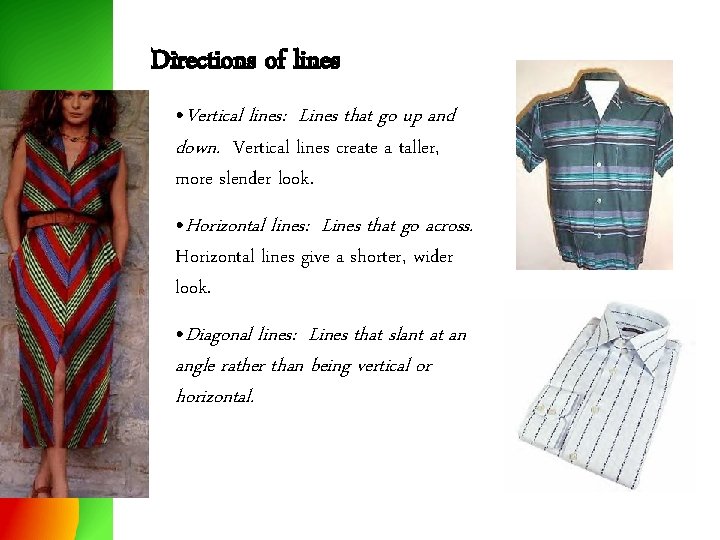
Directions of lines • Vertical lines: Lines that go up and down. Vertical lines create a taller, more slender look. • Horizontal lines: Lines that go across. Horizontal lines give a shorter, wider look. • Diagonal lines: Lines that slant at an angle rather than being vertical or horizontal.
Ways to create lines in garments • Structural lines: Lines formed by the seams, darts, pleats, tucks, and edges when garments are constructed. • Decorative lines: Lines created by details added to the surface of clothing including fabric design and trims such as topstitching, lace, tabs, flaps, and buttons used to decorate the garment.
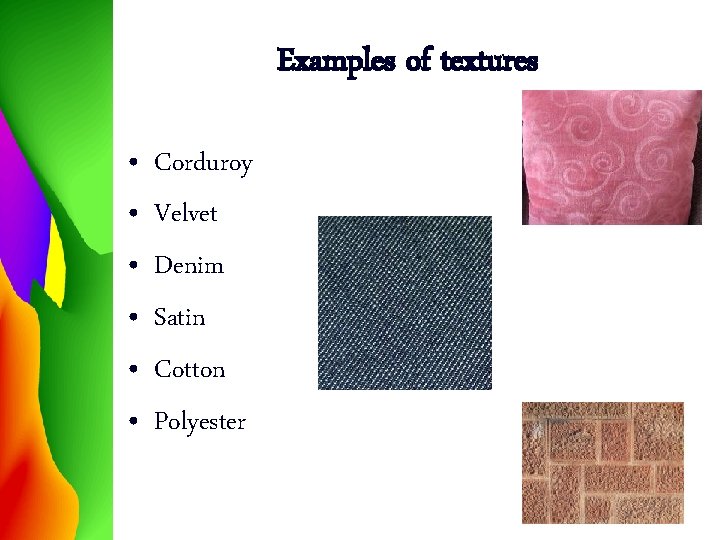
Texture: The look and feel of fabric. • Can create illusions of size • Can disguise figure irregularities • Can add interest to a garment *Textures used in apparel should be suited to the occasions for which the garments will be worn.
Texture can be provided in two ways… • Structural texture: Texture determined by the fibers, yarns, and the method of construction used to produce a garment. Examples: velvet shirt, striped wool pants • Added visual texture: The finishes and designs applied to the surface of the fabric. Examples: The print of the fabric can give the illusion of height or width to the wearer. Shiny textures make people look larger because they reflect light.
Examples of textures • • • Corduroy Velvet Denim Satin Cotton Polyester
Balance The principle of design that implies equilibrium or steadiness among the parts of a design or outfit. • Balance in garments is produced by structural parts and added decoration. • A properly balanced garment appears equal in weight and power of attraction from all sides, from top to bottom, and from front to back.
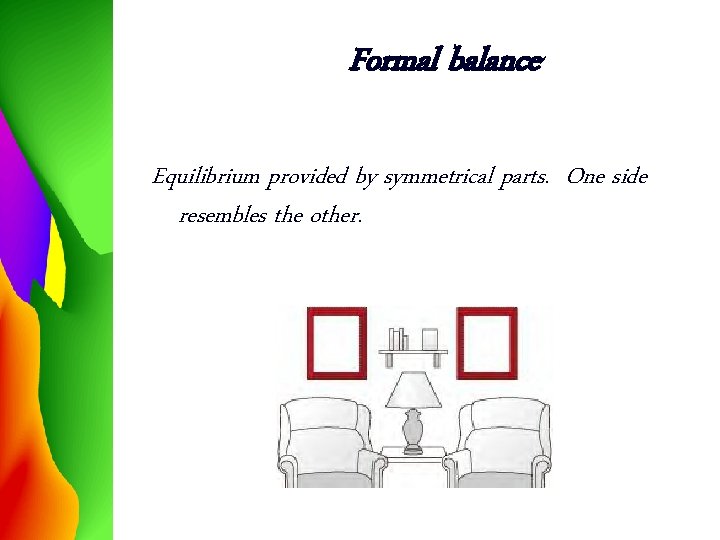
Formal balance Equilibrium provided by symmetrical parts. One side resembles the other.
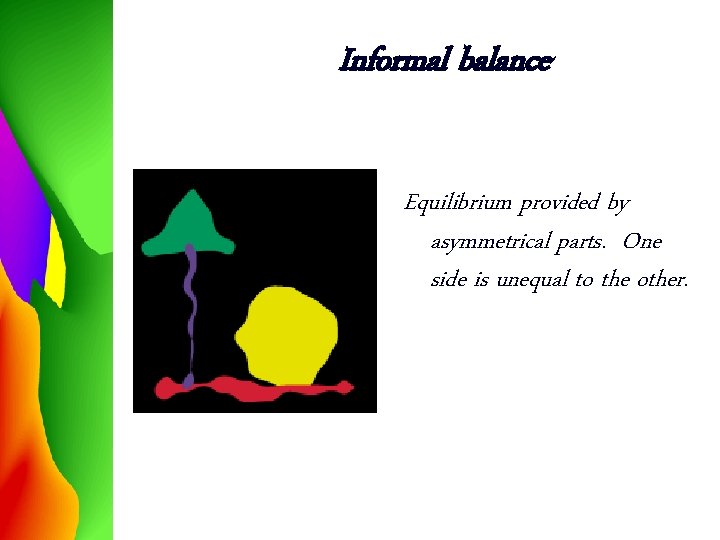
Informal balance Equilibrium provided by asymmetrical parts. One side is unequal to the other.
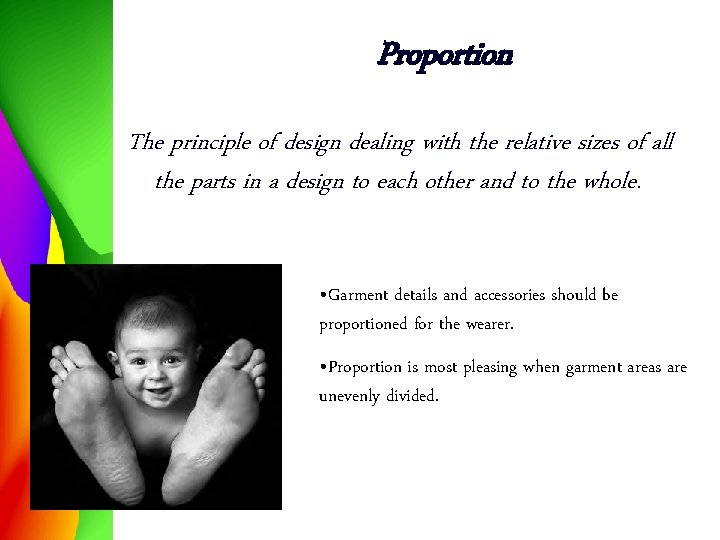
Proportion The principle of design dealing with the relative sizes of all the parts in a design to each other and to the whole. • Garment details and accessories should be proportioned for the wearer. • Proportion is most pleasing when garment areas are unevenly divided.
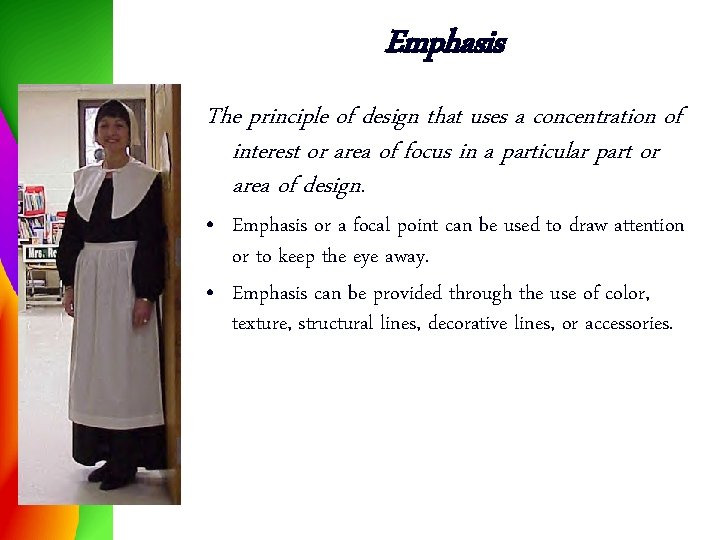
Emphasis The principle of design that uses a concentration of interest or area of focus in a particular part or area of design. • Emphasis or a focal point can be used to draw attention or to keep the eye away. • Emphasis can be provided through the use of color, texture, structural lines, decorative lines, or accessories.
Rhythm The principle of design concerned with the pleasing arrangement of the design elements to produce a feeling of continuity or easy movement of the observer’s eye. • Rhythm is what allows the viewer’s eye to move steadily and smoothly through the lines and spaces of the design.
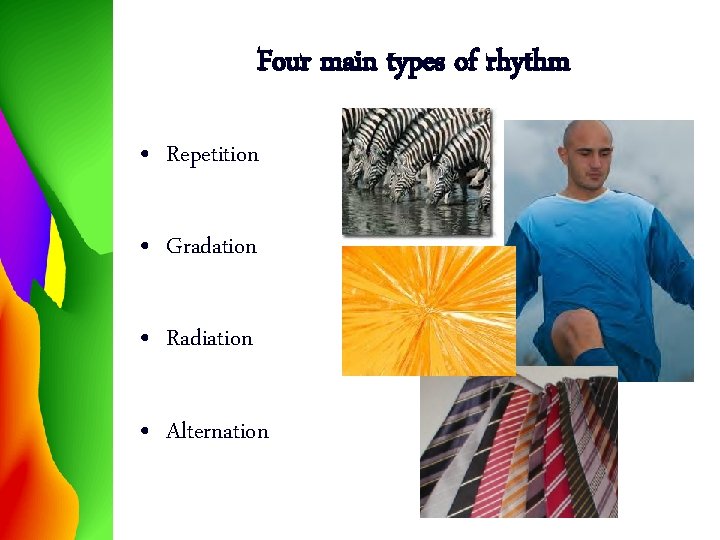
Four main types of rhythm • Repetition • Gradation • Radiation • Alternation
Rhythm • Repetition: Rhythm created by repeated lines, shapes, colors, or textures in a garment. • Gradation: Rhythm created by a gradual increase or decrease of similar design elements.
Rhythm (cont) • Radiation: Rhythm • Alternation: Rhythm created by lines emerging created by alternating from a central point like elements such as light rays, resulting in the parts and dark colors or being an equal distance stripes of two colors or from a given point. sizes.
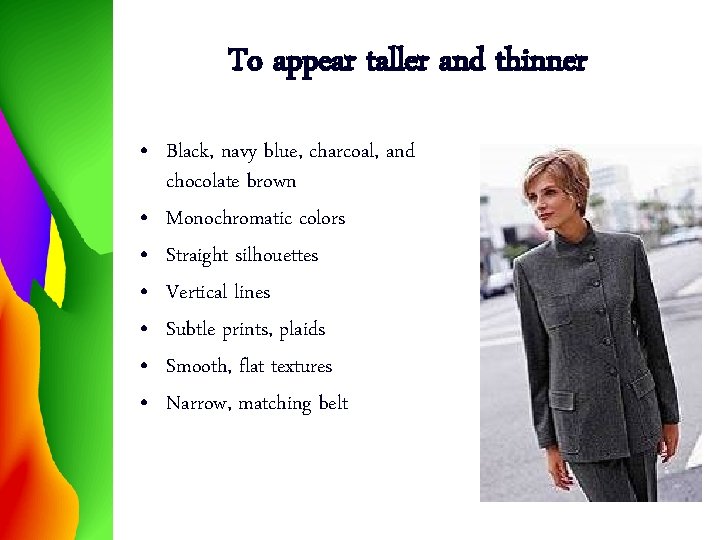
To appear taller and thinner • Black, navy blue, charcoal, and chocolate brown • Monochromatic colors • Straight silhouettes • Vertical lines • Subtle prints, plaids • Smooth, flat textures • Narrow, matching belt
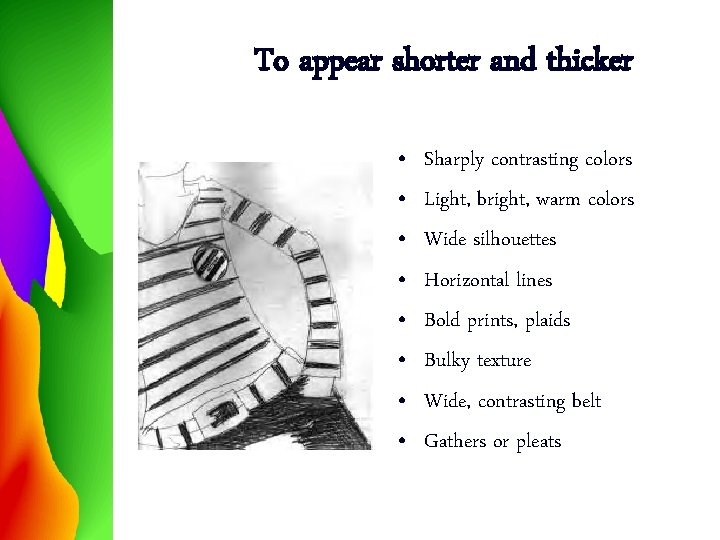
To appear shorter and thicker • • Sharply contrasting colors Light, bright, warm colors Wide silhouettes Horizontal lines Bold prints, plaids Bulky texture Wide, contrasting belt Gathers or pleats
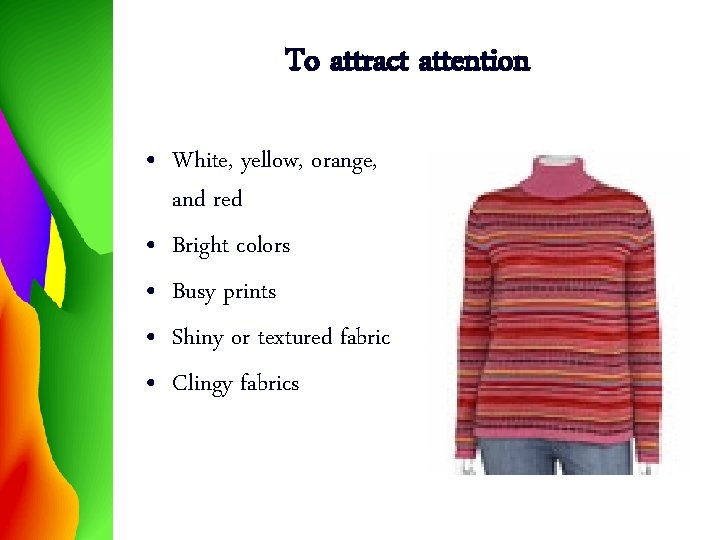
To attract attention • White, yellow, orange, and red • Bright colors • Busy prints • Shiny or textured fabric • Clingy fabrics
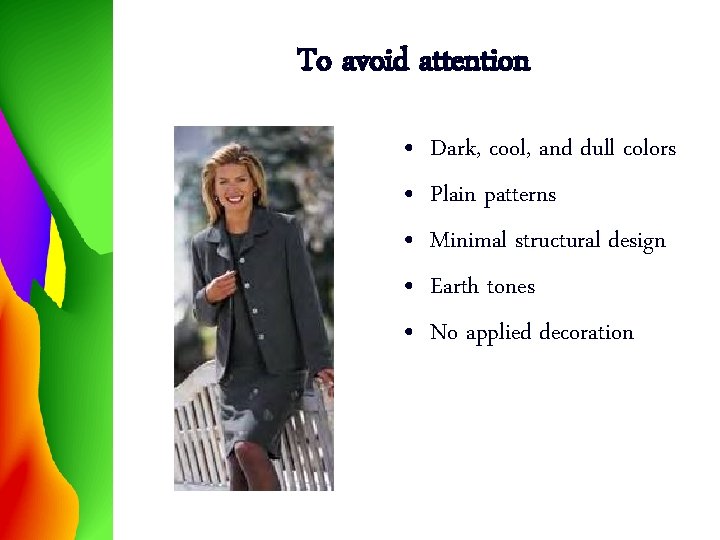
To avoid attention • • • Dark, cool, and dull colors Plain patterns Minimal structural design Earth tones No applied decoration