
Unit Conversions What is a Unit Conversion A


- Slides: 26
Unit Conversions
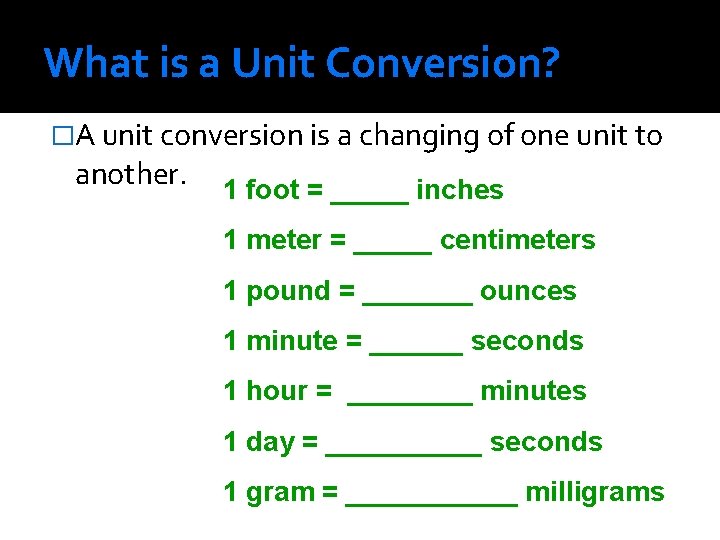
What is a Unit Conversion? �A unit conversion is a changing of one unit to another. 1 foot = _____ inches 1 meter = _____ centimeters 1 pound = _______ ounces 1 minute = ______ seconds 1 hour = ____ minutes 1 day = _____ seconds 1 gram = ______ milligrams
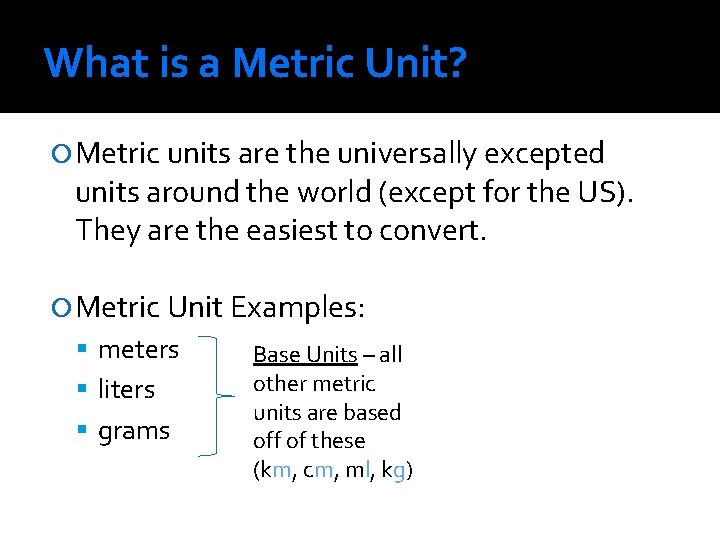
What is a Metric Unit? Metric units are the universally excepted units around the world (except for the US). They are the easiest to convert. Metric Unit Examples: meters liters grams Base Units – all other metric units are based off of these (km, cm, ml, kg)
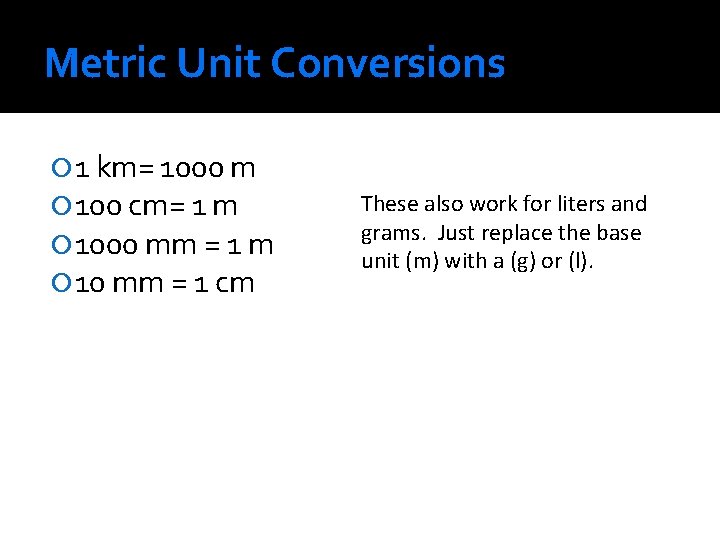
Metric Unit Conversions 1 km= 1000 m 100 cm= 1 m 1000 mm = 1 m 10 mm = 1 cm These also work for liters and grams. Just replace the base unit (m) with a (g) or (l).
CLE. 3231. Math. 1 Graph relationships and functions between manipulated (independent) variables and responding (dependent) variables. CLE. 3231. Math. 2 Solve for variables in an algebraic formula.
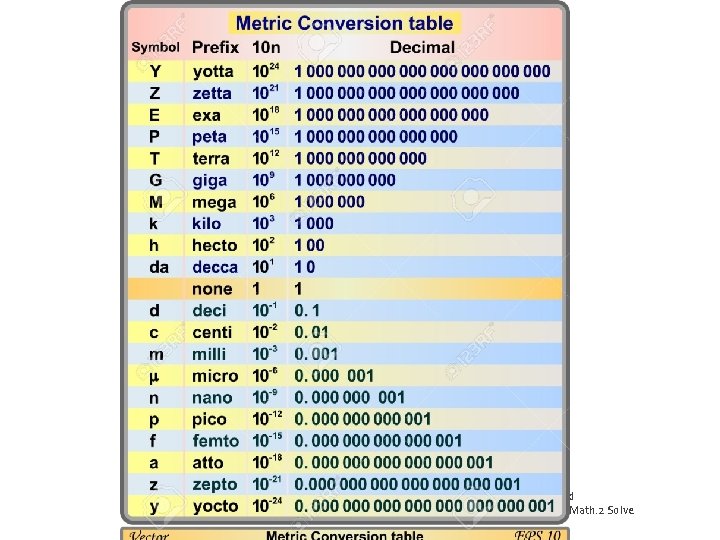
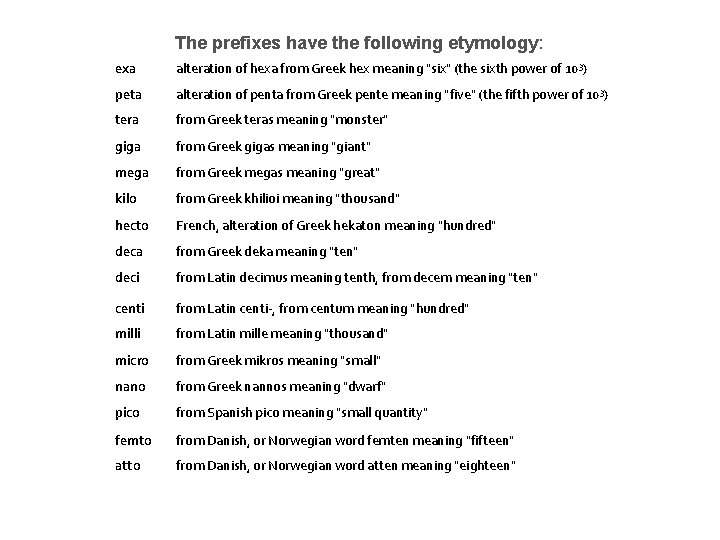
The prefixes have the following etymology: exa alteration of hexa from Greek hex meaning "six" (the sixth power of 10 3) peta alteration of penta from Greek pente meaning "five" (the fifth power of 10 3) tera from Greek teras meaning "monster" giga from Greek gigas meaning "giant" mega from Greek megas meaning "great" kilo from Greek khilioi meaning "thousand" hecto French, alteration of Greek hekaton meaning "hundred" deca from Greek deka meaning "ten" deci from Latin decimus meaning tenth, from decem meaning "ten" centi from Latin centi-, from centum meaning "hundred" milli from Latin mille meaning "thousand" micro from Greek mikros meaning "small" nano from Greek nannos meaning "dwarf" pico from Spanish pico meaning "small quantity" femto from Danish, or Norwegian word femten meaning "fifteen" atto from Danish, or Norwegian word atten meaning "eighteen"
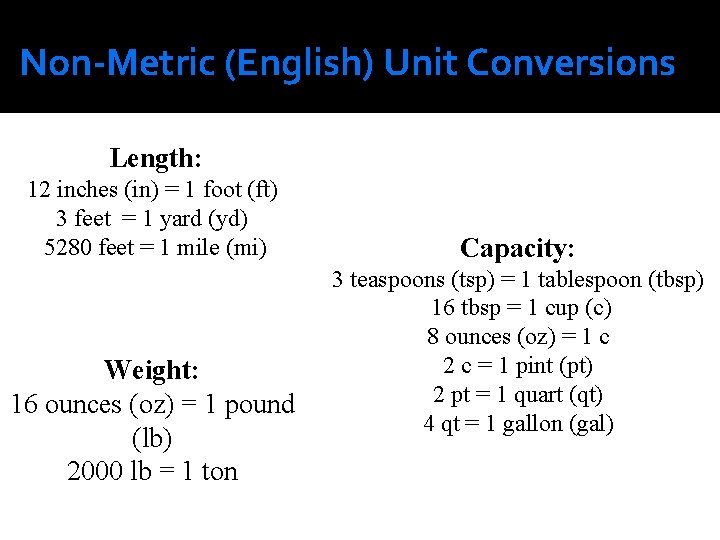
Non-Metric (English) Unit Conversions Length: 12 inches (in) = 1 foot (ft) 3 feet = 1 yard (yd) 5280 feet = 1 mile (mi) Weight: 16 ounces (oz) = 1 pound (lb) 2000 lb = 1 ton Capacity: 3 teaspoons (tsp) = 1 tablespoon (tbsp) 16 tbsp = 1 cup (c) 8 ounces (oz) = 1 c 2 c = 1 pint (pt) 2 pt = 1 quart (qt) 4 qt = 1 gallon (gal)
Dimensional Analysis
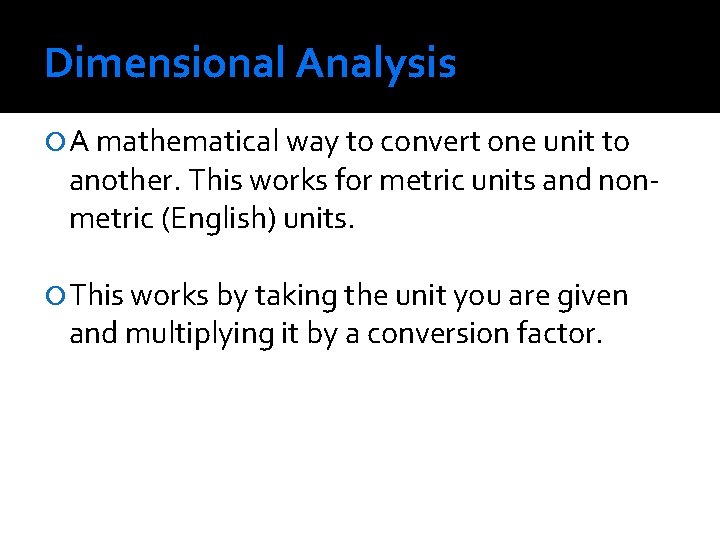
Dimensional Analysis A mathematical way to convert one unit to another. This works for metric units and nonmetric (English) units. This works by taking the unit you are given and multiplying it by a conversion factor.
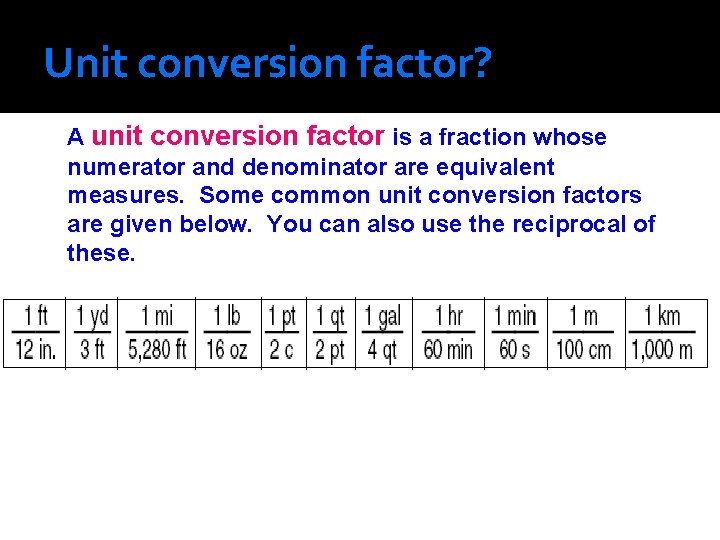
Unit conversion factor? A unit conversion factor is a fraction whose numerator and denominator are equivalent measures. Some common unit conversion factors are given below. You can also use the reciprocal of these.
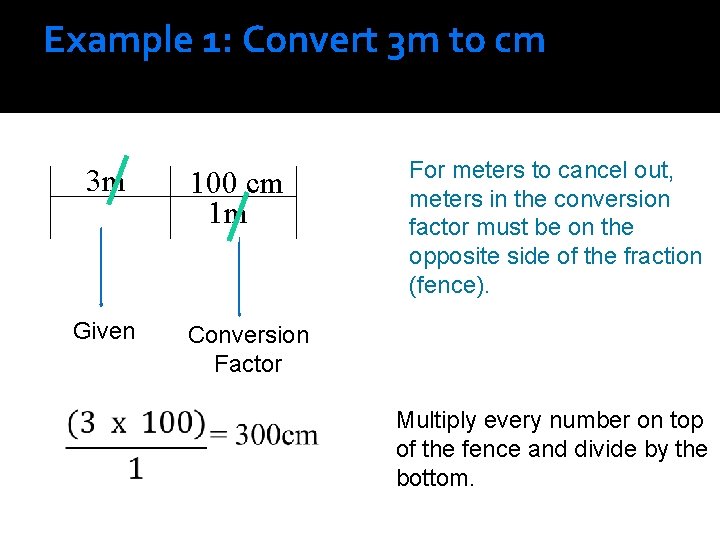
Example 1: Convert 3 m to cm 3 m Given 100 cm 1 m For meters to cancel out, meters in the conversion factor must be on the opposite side of the fraction (fence). Conversion Factor Multiply every number on top of the fence and divide by the bottom.
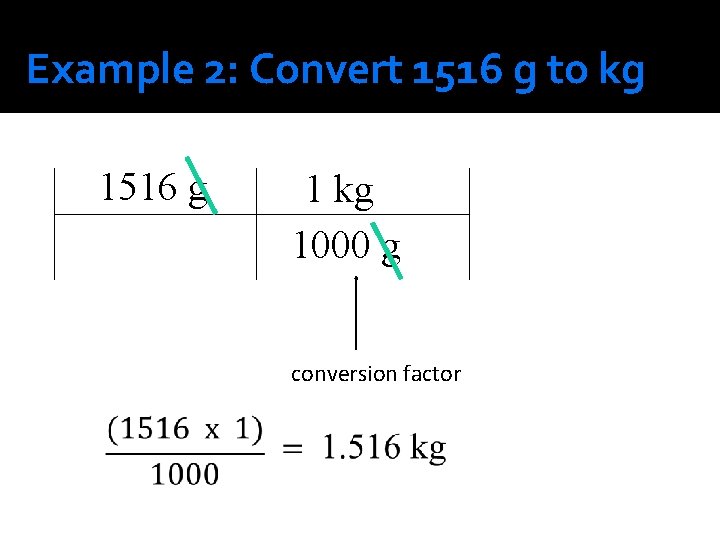
Example 2: Convert 1516 g to kg 1516 g 1 kg 1000 g conversion factor
Whiteboard Problem 1 John runs 5 kilometers a day to stay in shape. How many meters is this?
Whiteboard Problem 2 The volume of Alvin’s drink is 750 m. L. How many liters is this?
Whiteboard Problem 3 Stacey took a jump-shot when she was 7200 mm away from the hoop. Convert this length to km.
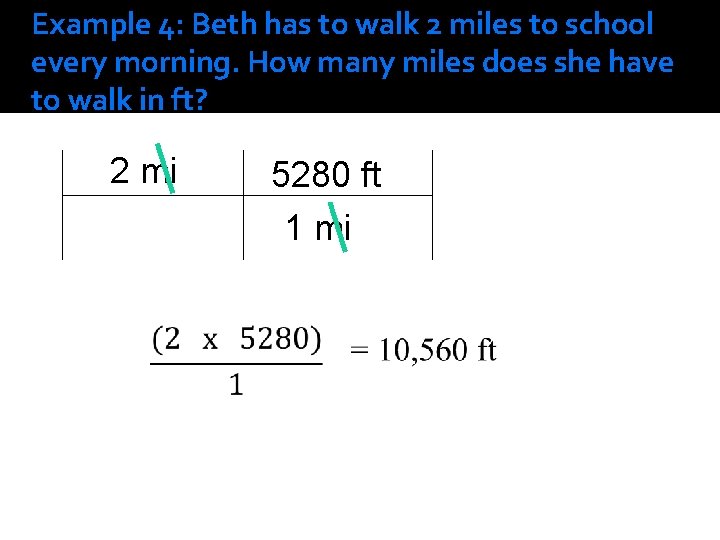
Example 4: Beth has to walk 2 miles to school every morning. How many miles does she have to walk in ft? 2 mi 5280 ft 1 mi
Whiteboard Problem 4 The Reno High School football team is 3. 2 ft away from the goal line. How many inches does the ball have to travel for them to score a touchdown?
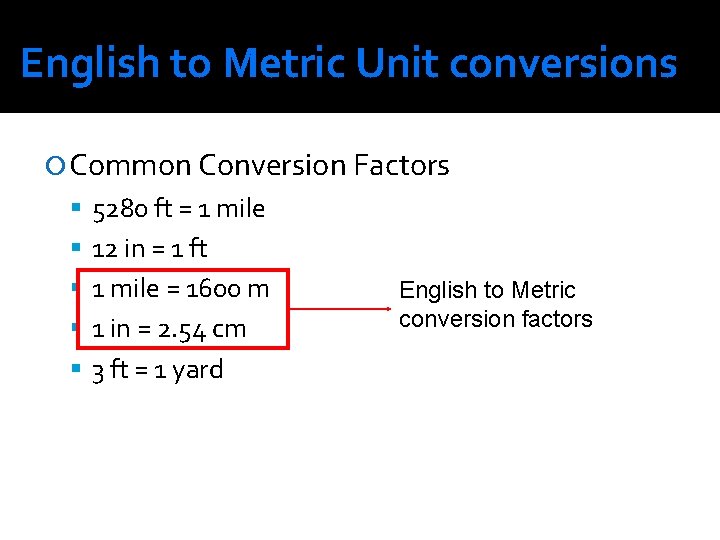
English to Metric Unit conversions Common Conversion Factors 5280 ft = 1 mile 12 in = 1 ft 1 mile = 1600 m 1 in = 2. 54 cm 3 ft = 1 yard English to Metric conversion factors
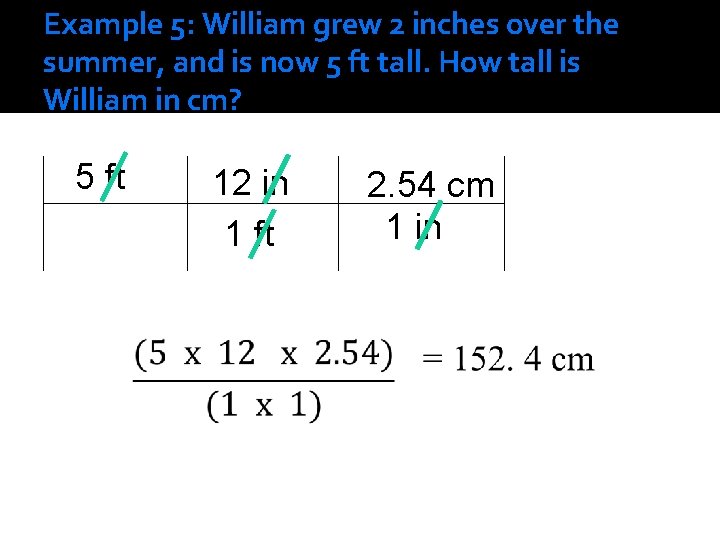
Example 5: William grew 2 inches over the summer, and is now 5 ft tall. How tall is William in cm? 5 ft 12 in 1 ft 2. 54 cm 1 in
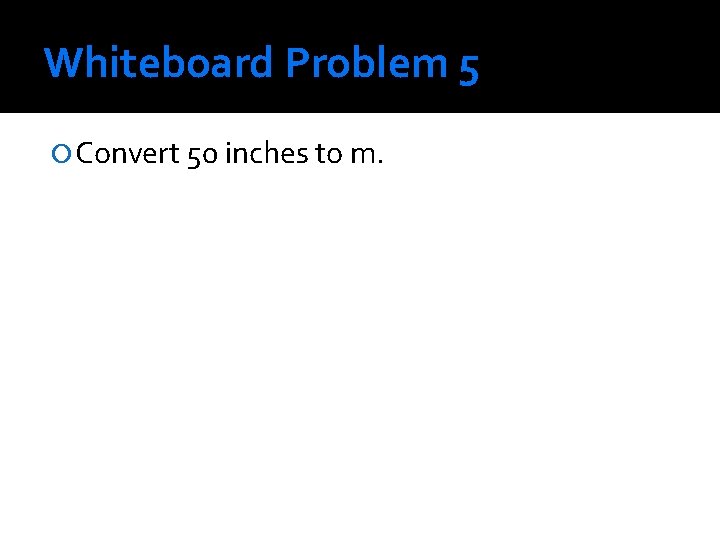
Whiteboard Problem 5 Convert 50 inches to m.
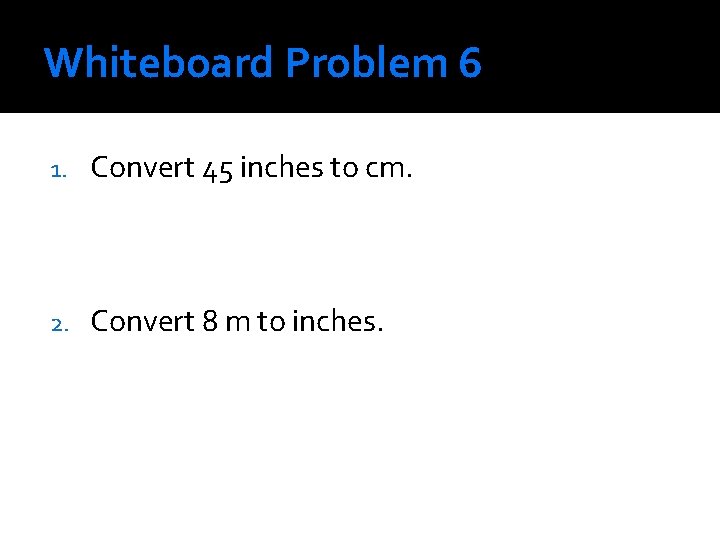
Whiteboard Problem 6 1. Convert 45 inches to cm. 2. Convert 8 m to inches.
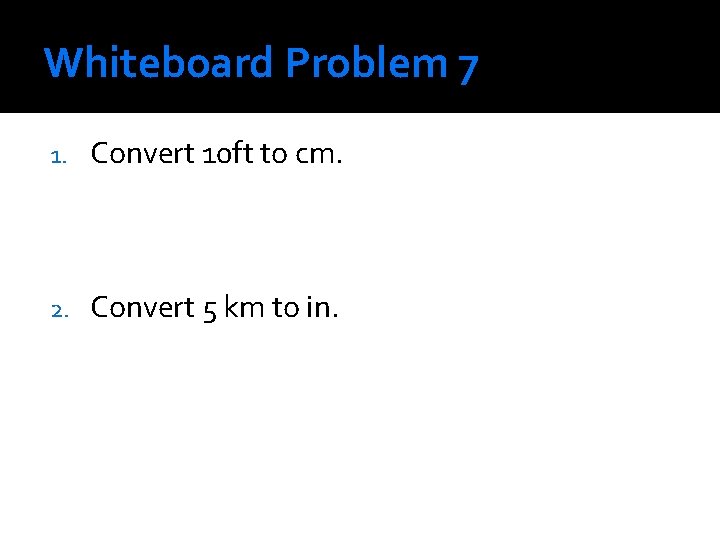
Whiteboard Problem 7 1. Convert 10 ft to cm. 2. Convert 5 km to in.
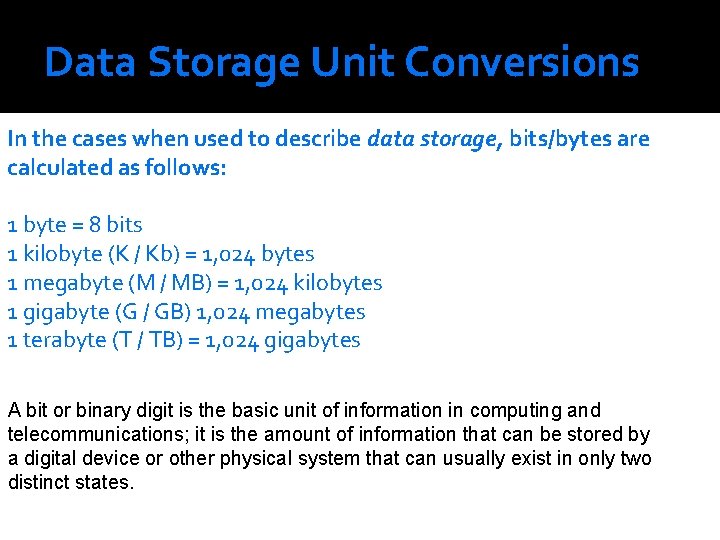
Data Storage Unit Conversions In the cases when used to describe data storage, bits/bytes are calculated as follows: 1 byte = 8 bits 1 kilobyte (K / Kb) = 1, 024 bytes 1 megabyte (M / MB) = 1, 024 kilobytes 1 gigabyte (G / GB) 1, 024 megabytes 1 terabyte (T / TB) = 1, 024 gigabytes A bit or binary digit is the basic unit of information in computing and telecommunications; it is the amount of information that can be stored by a digital device or other physical system that can usually exist in only two distinct states.
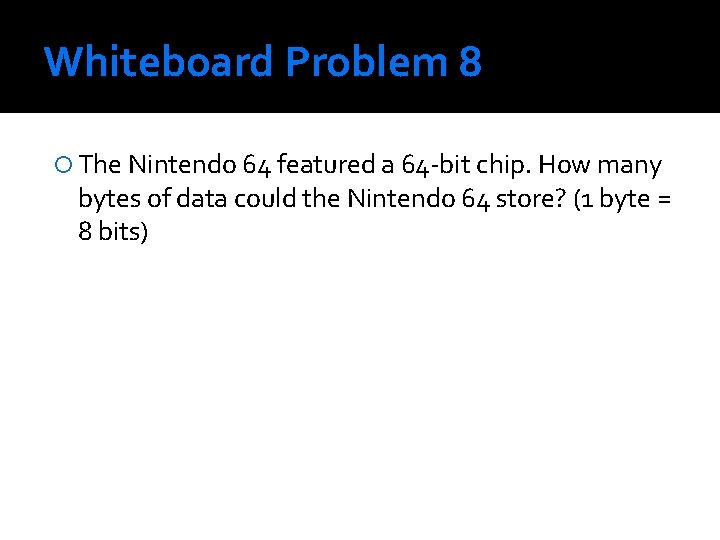
Whiteboard Problem 8 The Nintendo 64 featured a 64 -bit chip. How many bytes of data could the Nintendo 64 store? (1 byte = 8 bits)
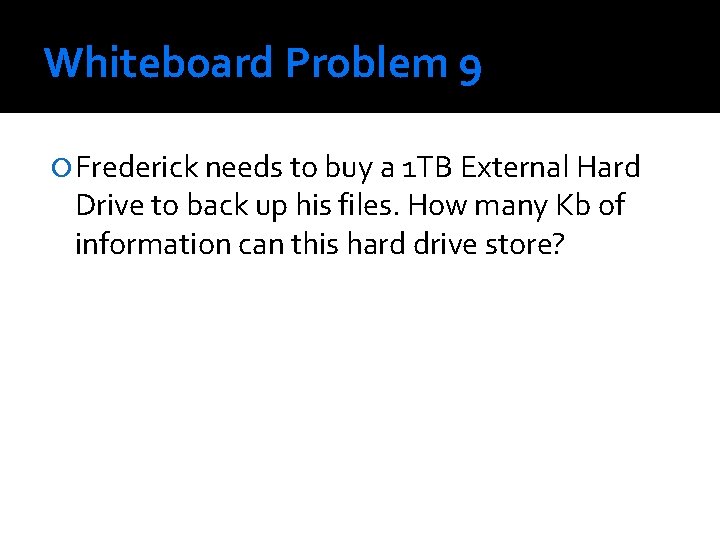
Whiteboard Problem 9 Frederick needs to buy a 1 TB External Hard Drive to back up his files. How many Kb of information can this hard drive store?
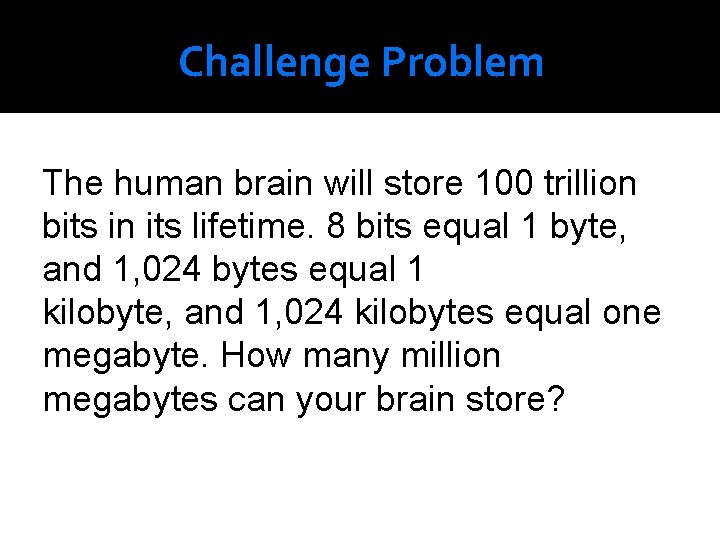
Challenge Problem The human brain will store 100 trillion bits in its lifetime. 8 bits equal 1 byte, and 1, 024 bytes equal 1 kilobyte, and 1, 024 kilobytes equal one megabyte. How many million megabytes can your brain store?