
Unit B Section 2 0 THE CELL C
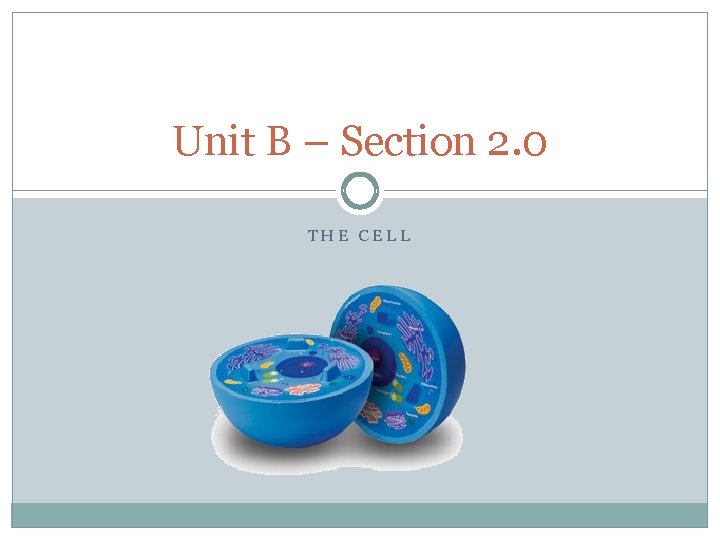
Unit B – Section 2. 0 THE CELL
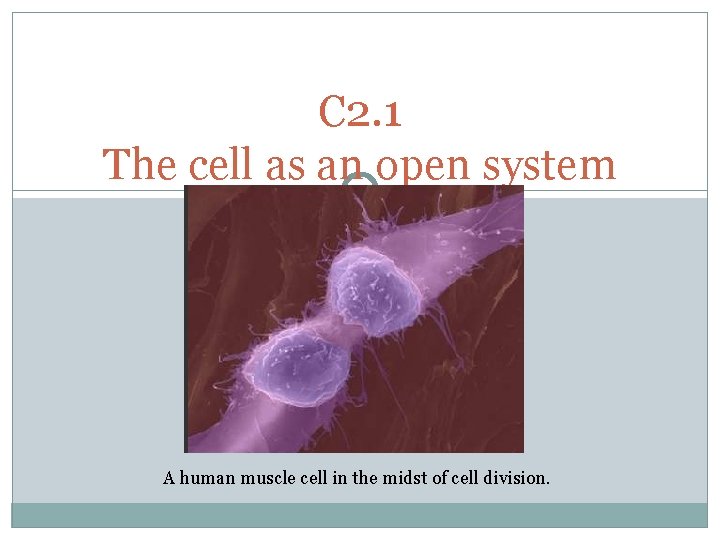
C 2. 1 The cell as an open system A human muscle cell in the midst of cell division.

Systems �A system refers to a set of interconnected parts three types, depending on what is exchanged with the surrounding environment � open system – exchanges both matter and energy with the environment (e. g. human body) � closed system – exchanges energy but not matter (e. g. a sealed glass jar) � isolated system – exchanges neither energy nor matter (does not exist in reality)
Systems – practice problems �Practice problem 1: what type of system would a house be if the windows and doors were open? what about just the windows? what if they were both closed? �Practice problem 2: name two types of matter the human body takes in � food, gases (O 2(g)), water name two types of matter the human body gets rid of � waste, gases (CO 2(g)) name a type of energy the human body takes in � chemical energy name a type of energy the human body produces � thermal energy
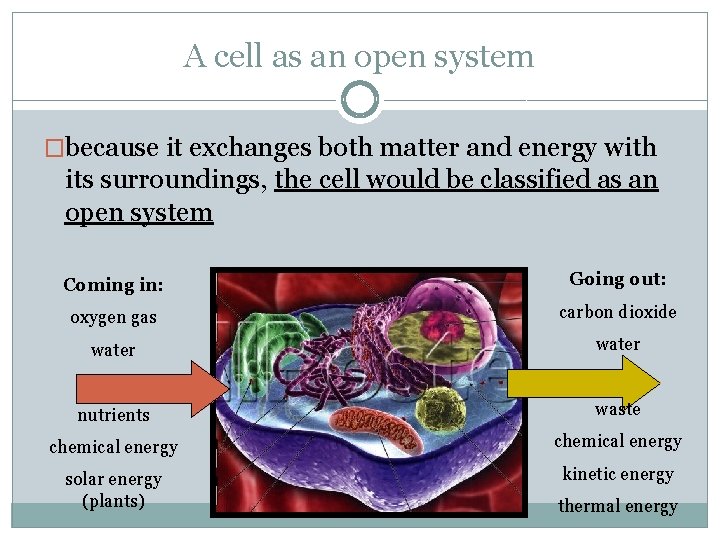
A cell as an open system �because it exchanges both matter and energy with its surroundings, the cell would be classified as an open system Coming in: Going out: oxygen gas carbon dioxide water nutrients waste chemical energy solar energy (plants) kinetic energy thermal energy
Human body vs. cell �Human survival needs & the organ systems that meet those needs: intake and use of nutrients – digestive movement & growth – musculoskeletal response to stimuli – nervous exchange of gases – respiratory, circulatory waste removal – excretory reproduction – reproductive �The cell has tiny organs, called organelles to perform the same set of functions on a smaller scale
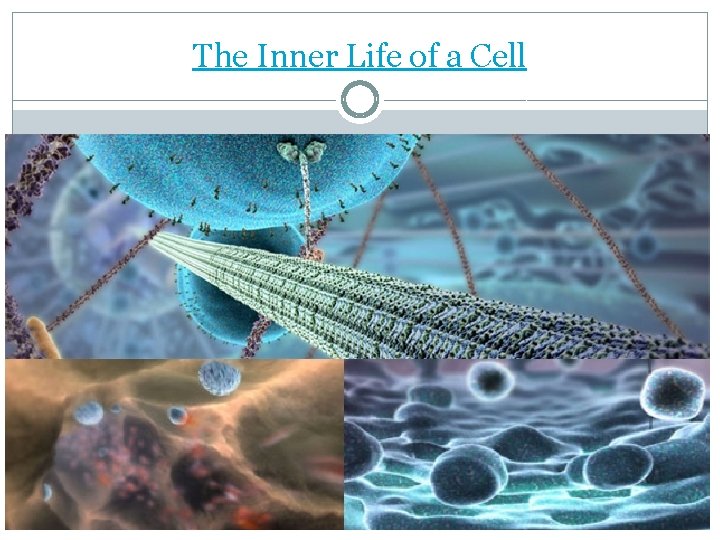
The Inner Life of a Cell
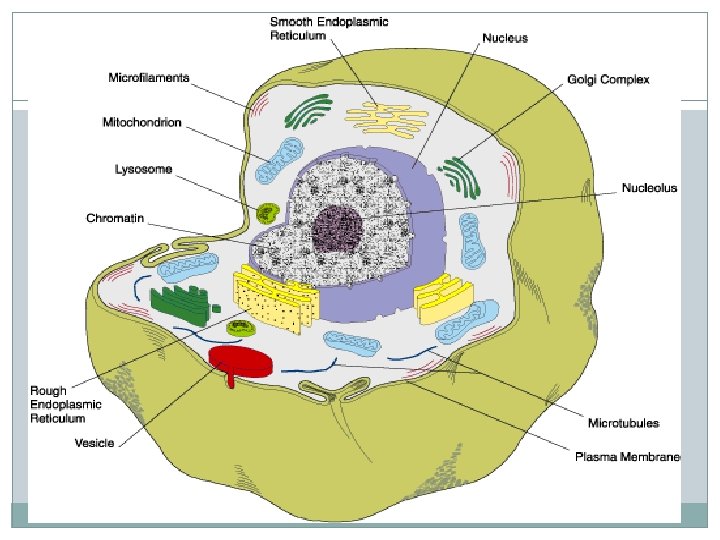
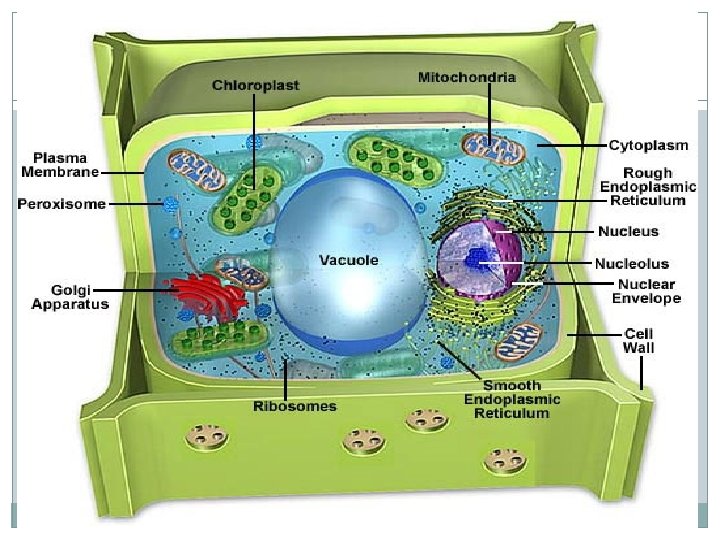
Cell organelles �each organ in your body, (e. g. your heart or lungs) is part of an organ systems (e. g. circulatory, respiratory) �in a similar way, the organelles in your cells can be divided into groups according to major function: structure and support control and cell management storage and transport protein production fat production defense energy conversion
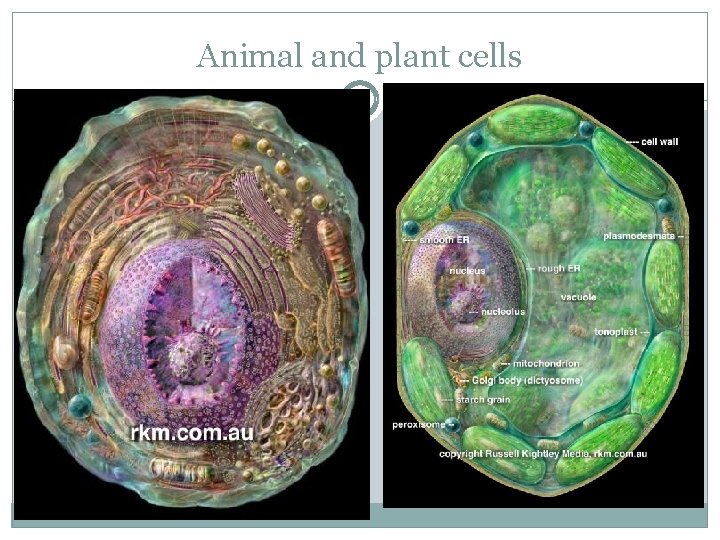
Animal and plant cells
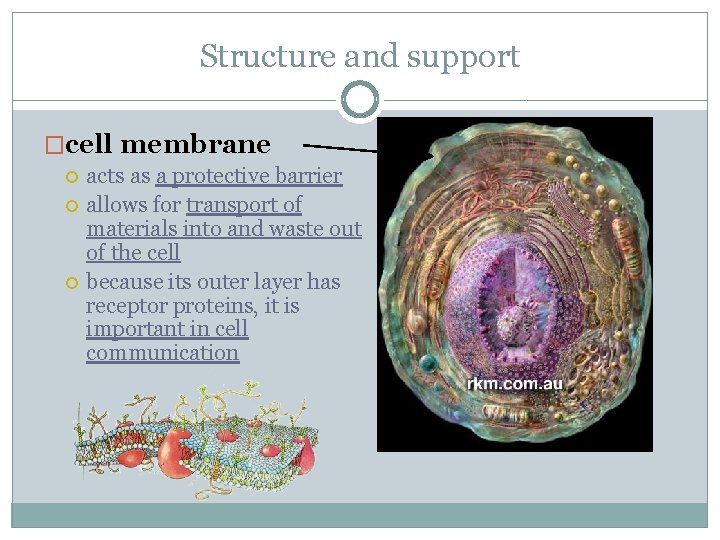
Structure and support �cell membrane acts as a protective barrier allows for transport of materials into and waste out of the cell because its outer layer has receptor proteins, it is important in cell communication
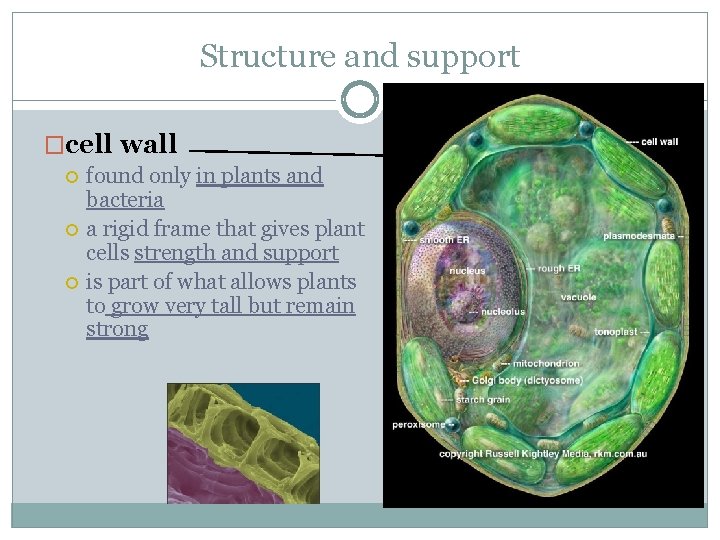
Structure and support �cell wall found only in plants and bacteria a rigid frame that gives plant cells strength and support is part of what allows plants to grow very tall but remain strong
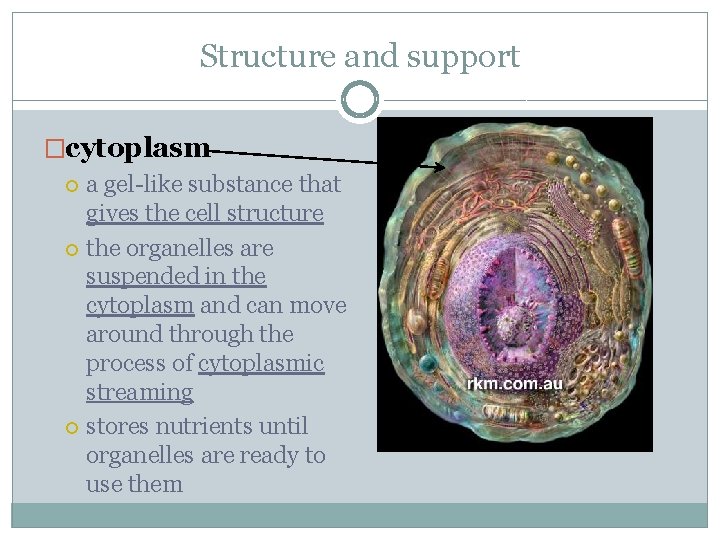
Structure and support �cytoplasm a gel-like substance that gives the cell structure the organelles are suspended in the cytoplasm and can move around through the process of cytoplasmic streaming stores nutrients until organelles are ready to use them
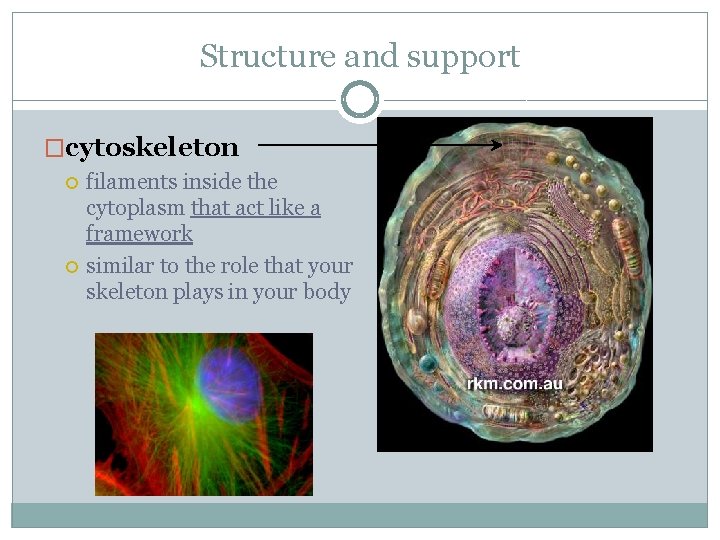
Structure and support �cytoskeleton filaments inside the cytoplasm that act like a framework similar to the role that your skeleton plays in your body
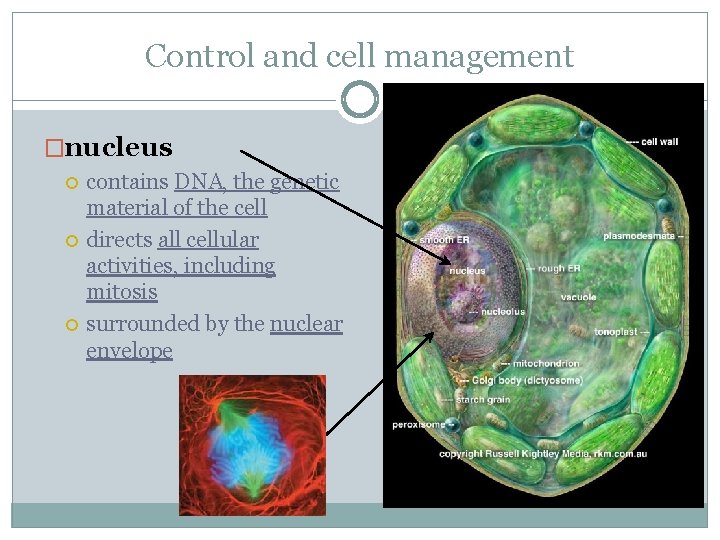
Control and cell management �nucleus contains DNA, the genetic material of the cell directs all cellular activities, including mitosis surrounded by the nuclear envelope
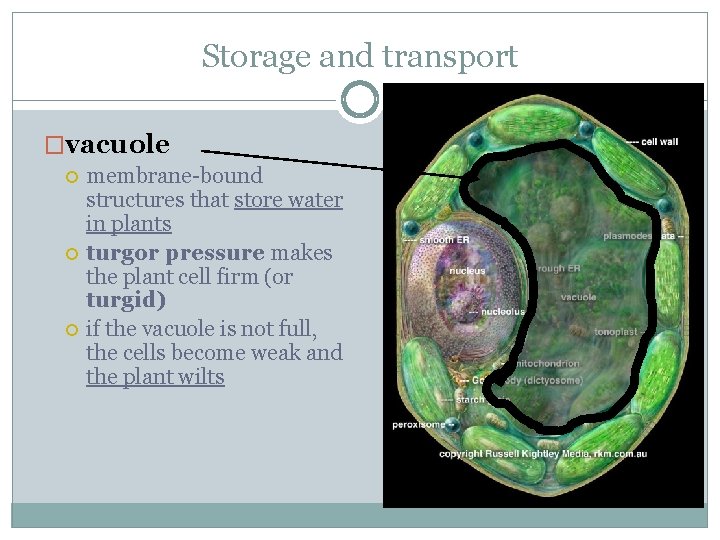
Storage and transport �vacuole membrane-bound structures that store water in plants turgor pressure makes the plant cell firm (or turgid) if the vacuole is not full, the cells become weak and the plant wilts
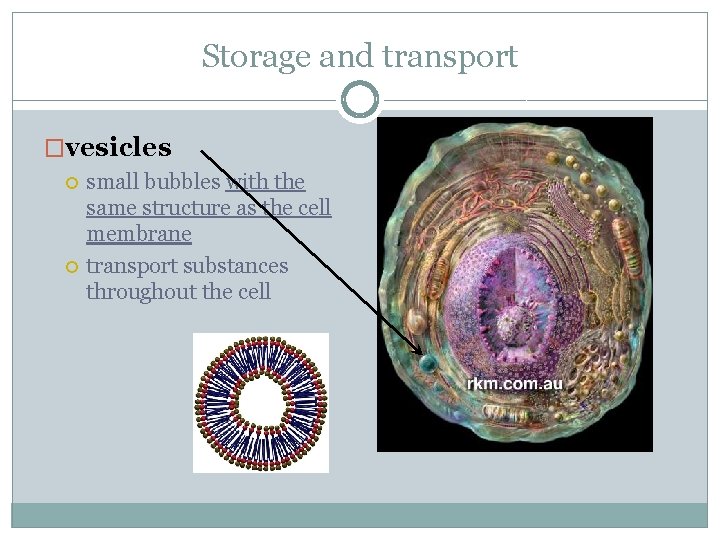
Storage and transport �vesicles small bubbles with the same structure as the cell membrane transport substances throughout the cell
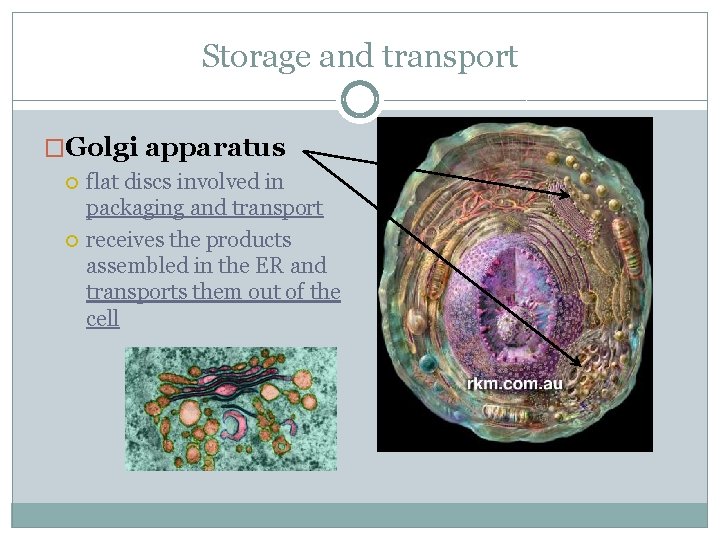
Storage and transport �Golgi apparatus flat discs involved in packaging and transport receives the products assembled in the ER and transports them out of the cell
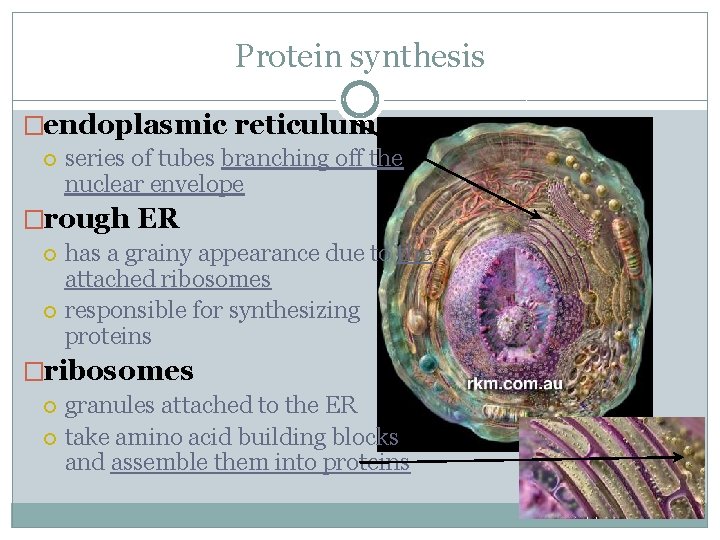
Protein synthesis �endoplasmic reticulum series of tubes branching off the nuclear envelope �rough ER has a grainy appearance due to the attached ribosomes responsible for synthesizing proteins �ribosomes granules attached to the ER take amino acid building blocks and assemble them into proteins
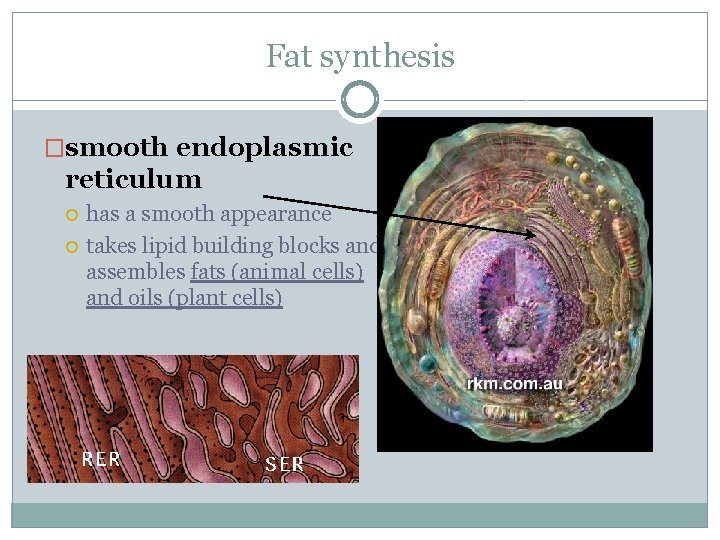
Fat synthesis �smooth endoplasmic reticulum has a smooth appearance takes lipid building blocks and assembles fats (animal cells) and oils (plant cells)
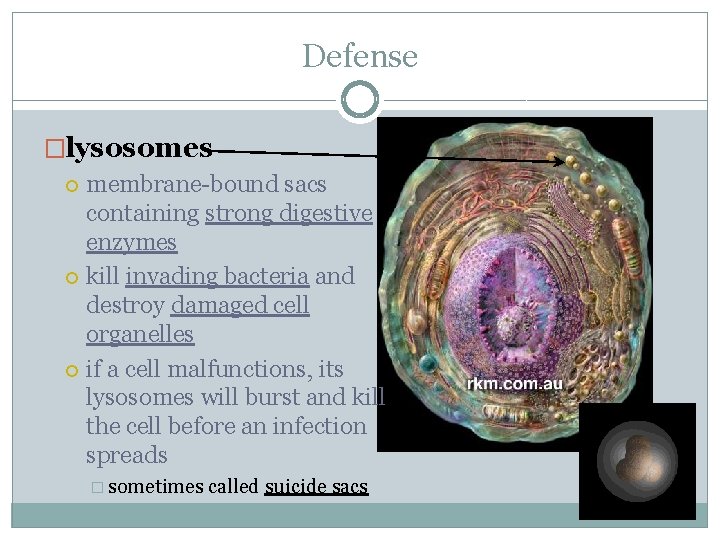
Defense �lysosomes membrane-bound sacs containing strong digestive enzymes kill invading bacteria and destroy damaged cell organelles if a cell malfunctions, its lysosomes will burst and kill the cell before an infection spreads � sometimes called suicide sacs
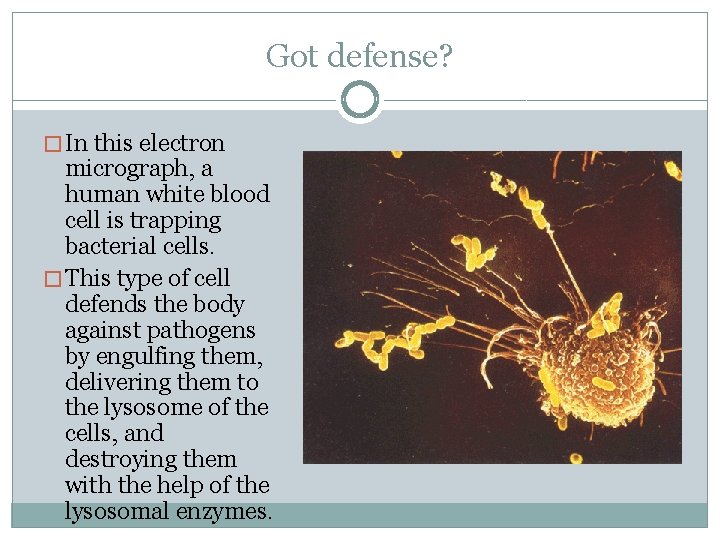
Got defense? � In this electron micrograph, a human white blood cell is trapping bacterial cells. � This type of cell defends the body against pathogens by engulfing them, delivering them to the lysosome of the cells, and destroying them with the help of the lysosomal enzymes.
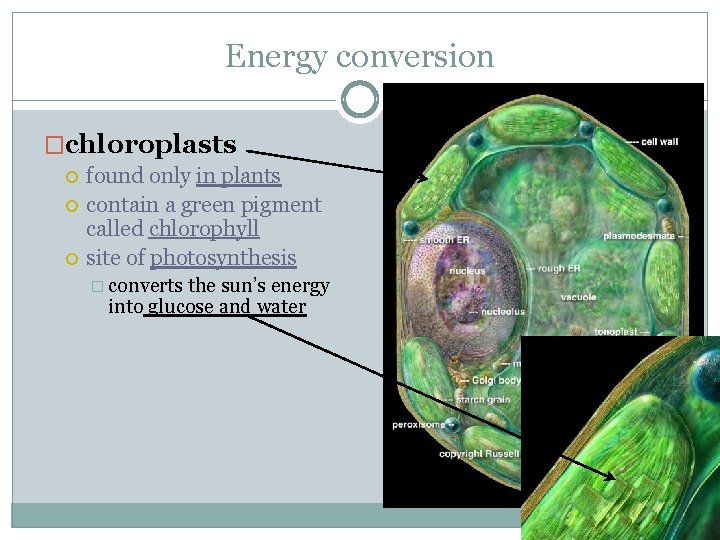
Energy conversion �chloroplasts found only in plants contain a green pigment called chlorophyll site of photosynthesis � converts the sun’s energy into glucose and water
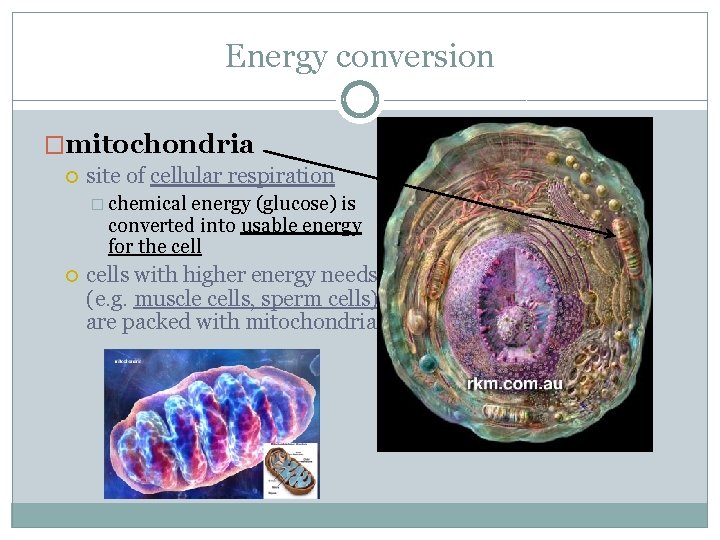
Energy conversion �mitochondria site of cellular respiration � chemical energy (glucose) is converted into usable energy for the cells with higher energy needs (e. g. muscle cells, sperm cells) are packed with mitochondria
Practice problem �Name five differences between plant and animal cells. plants have cells walls plants store energy as starches and oils, animals as glycogen or fats plant cells have a large central vacuole animal cells have more mitochondria because their energy needs are higher Plant cells have chloroplasts & chlorophyll
Chemical composition �all cells are made up of organic compounds, which have carbon as their building block �other common elements found in organic compounds are hydrogen, oxygen and nitrogen �different combinations of these four elements give us four major groups of organic compounds
Four types of organic compound �lipids fats and oils �carbohydrates sugars starches glycogen �protein �nucleic acids make up our DNA (deoxyribonucleic acid)
C 2. 2 – The Role of the Cell Membrane in Transport
Importance of the cell membrane � structure – contains the cell contents � equilibrium (balance) – controls what enters and exits the cell � communication – uses receptor proteins to identify materials and relay messages � protection & defense – recognizes foreign invaders and bars them from entry, or destroys them � transportation – is the barrier through which all material must pass
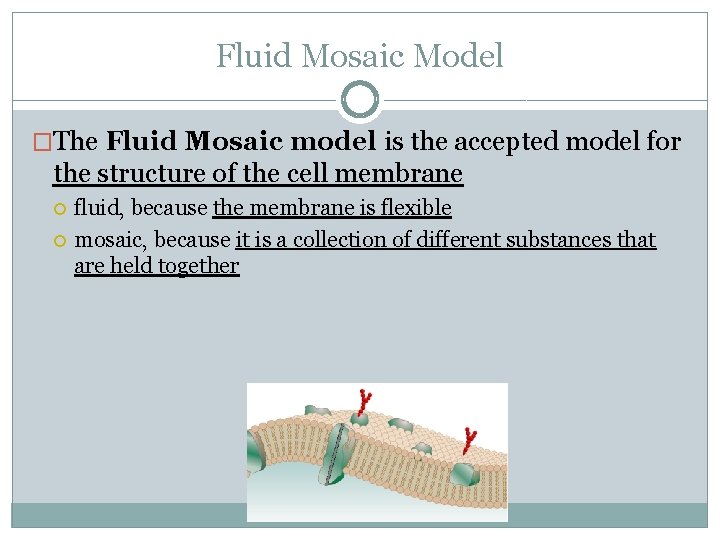
Fluid Mosaic Model �The Fluid Mosaic model is the accepted model for the structure of the cell membrane fluid, because the membrane is flexible mosaic, because it is a collection of different substances that are held together
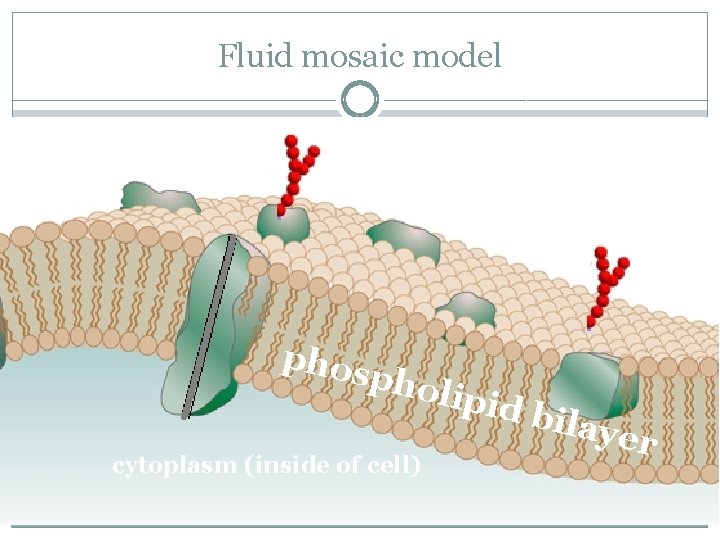
Fluid mosaic model proteins (help in transport) extracellular fluid (outside of cell) sugar molecules (act as receptors) phos phol ipid cytoplasm (inside of cell) bilay er
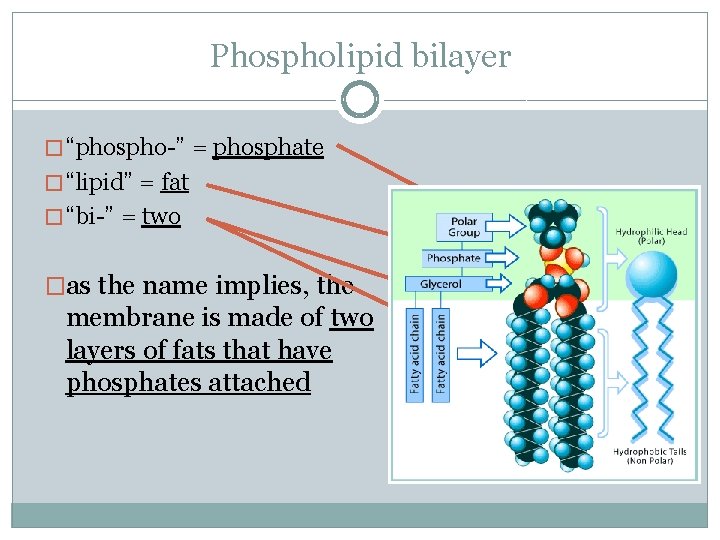
Phospholipid bilayer � “phospho-” = phosphate � “lipid” = fat � “bi-” = two �as the name implies, the membrane is made of two layers of fats that have phosphates attached
Particle model of matter �particles: include any individual molecules of water, nutrients, waste and gases traveling across the membrane the particles of a substance are always moving how far and how fast they move depends on: � the relative concentration of that substance on either side of the membrane � the state of the substance (solid, liquid or gas)
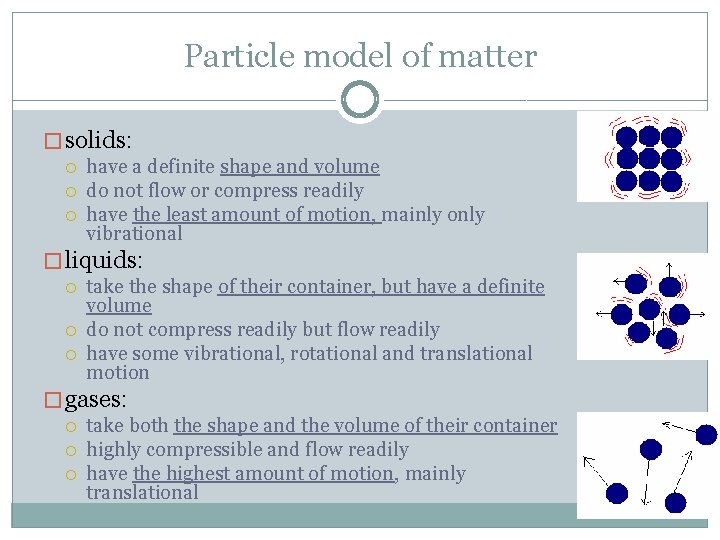
Particle model of matter � solids: have a definite shape and volume do not flow or compress readily have the least amount of motion, mainly only vibrational � liquids: take the shape of their container, but have a definite volume do not compress readily but flow readily have some vibrational, rotational and translational motion � gases: take both the shape and the volume of their container highly compressible and flow readily have the highest amount of motion, mainly translational
Particle model of matter Four main points: � 1. 2. 3. 4. All matter is made of particles, but they may be different in size and composition The particles are constantly moving, and move least in solids and most in gases. Heating particles makes them move faster. The particles of matter are attracted to one another or are bonded together. Particles have spaces between them, and are typically greatest in gases and smallest in solids.
Concentration gradient �concentration refers to the amount of a substance dissolved in a solvent, usually water �a concentration gradient exists when there is a difference in the amount of solute on either side of a membrane solutes naturally move down the gradient, which means from an area of high concentration to an area of low concentration
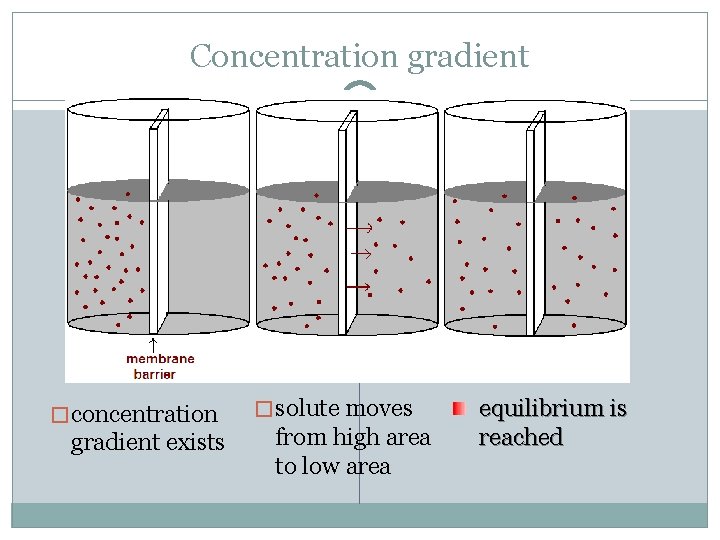
Concentration gradient � concentration gradient exists � solute moves from high area to low area equilibrium is reached
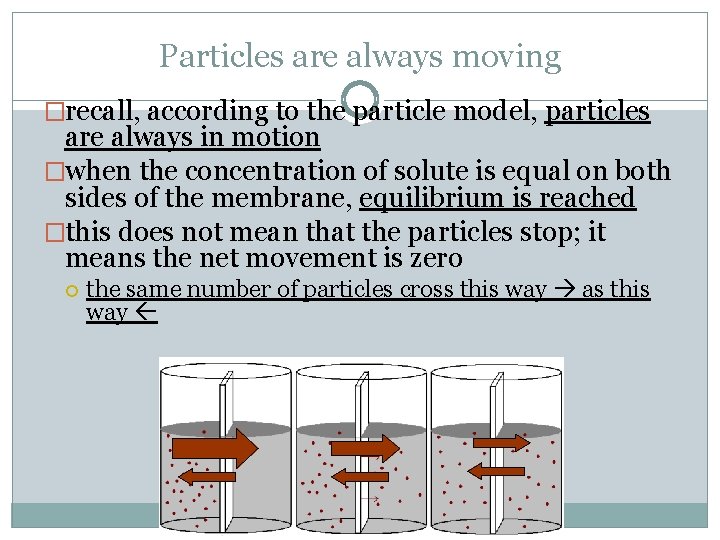
Particles are always moving �recall, according to the particle model, particles are always in motion �when the concentration of solute is equal on both sides of the membrane, equilibrium is reached �this does not mean that the particles stop; it means the net movement is zero the same number of particles cross this way as this way
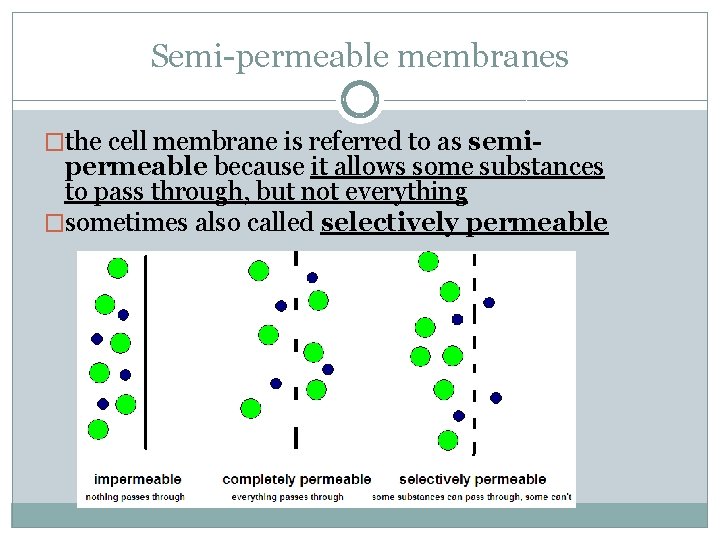
Semi-permeable membranes �the cell membrane is referred to as semi- permeable because it allows some substances to pass through, but not everything �sometimes also called selectively permeable
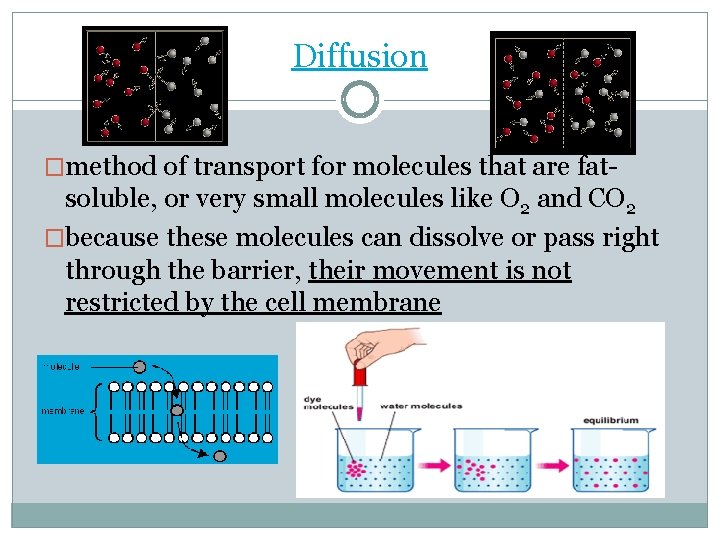
Diffusion �method of transport for molecules that are fat- soluble, or very small molecules like O 2 and CO 2 �because these molecules can dissolve or pass right through the barrier, their movement is not restricted by the cell membrane
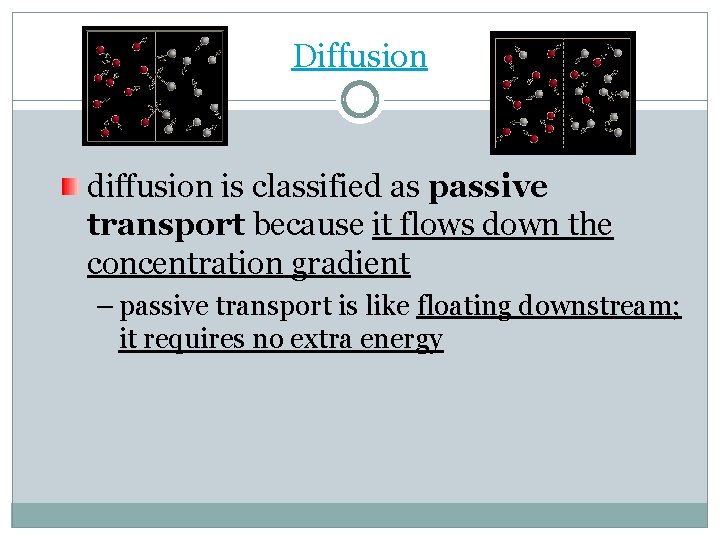
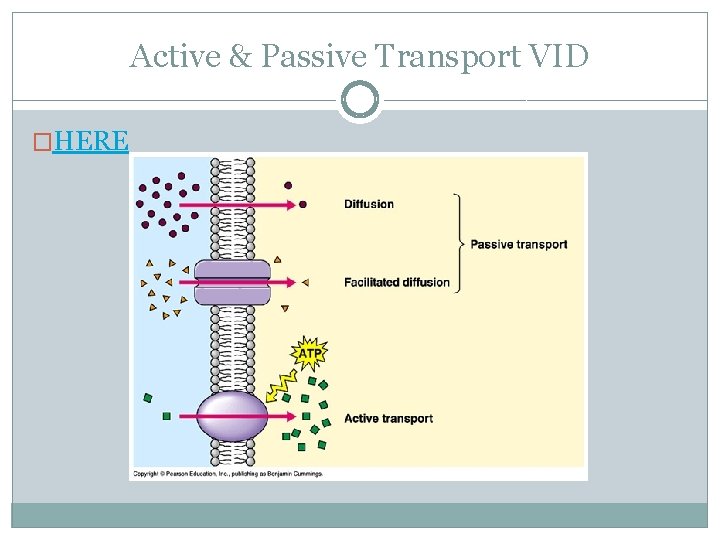
Diffusion diffusion is classified as passive transport because it flows down the concentration gradient – passive transport is like floating downstream; it requires no extra energy
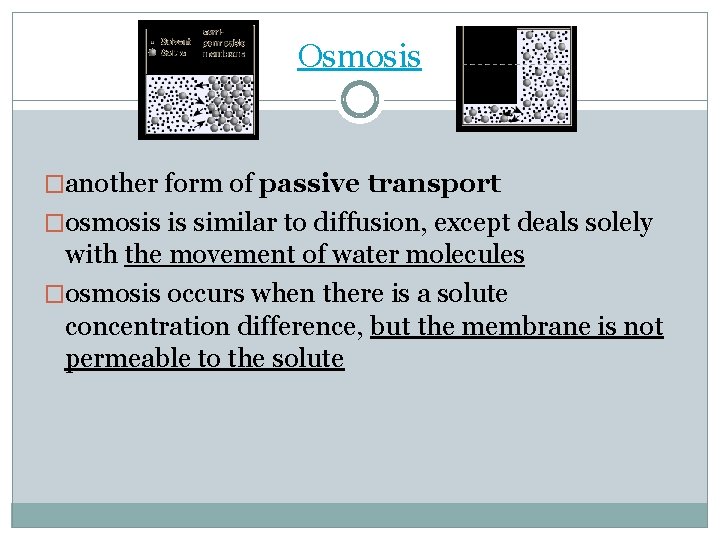
Osmosis �another form of passive transport �osmosis is similar to diffusion, except deals solely with the movement of water molecules �osmosis occurs when there is a solute concentration difference, but the membrane is not permeable to the solute
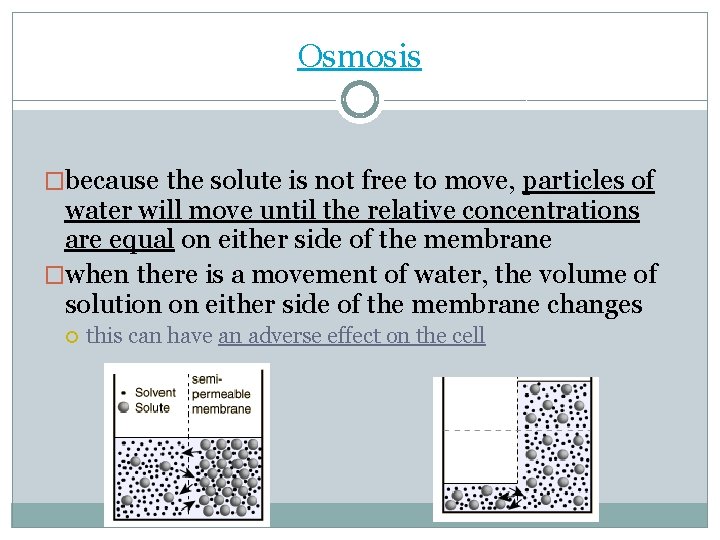
Osmosis �because the solute is not free to move, particles of water will move until the relative concentrations are equal on either side of the membrane �when there is a movement of water, the volume of solution on either side of the membrane changes this can have an adverse effect on the cell
Tonicity �refers to the concentration of solutes outside the cell, relative to the concentration inside the cell � 3 Types: isotonic solution: concentration inside and outside the cell is equal � when a cell is placed in an isotonic solution, there is no net movement of water in and out of the cell � that means water is flowing in at the same rate at it is flowing out � this cell will appear normal and healthy
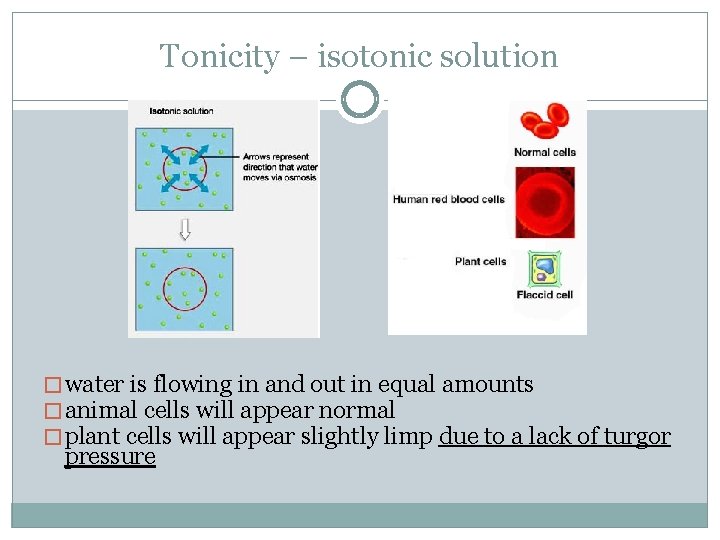
Tonicity – isotonic solution � water is flowing in and out in equal amounts � animal cells will appear normal � plant cells will appear slightly limp due to a lack of turgor pressure
Tonicity hypotonic: the concentration of solutes outside the cell is lower than inside the cell � hypo = “lower” (e. g. hypothermia = low body temperature) � in an effort to find equilibrium, water will flow from the extracellular fluid (ECF) into the cell � the cell becomes bloated and “overfull” and can eventually rupture (called plasmolysis)
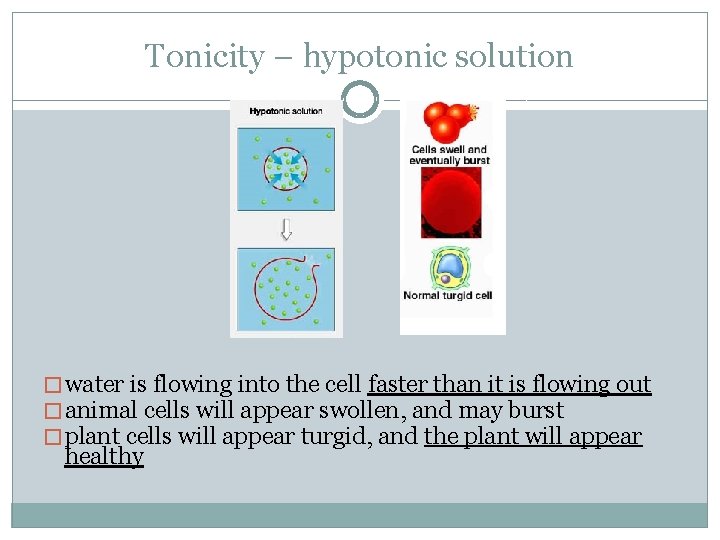
Tonicity – hypotonic solution � water is flowing into the cell faster than it is flowing out � animal cells will appear swollen, and may burst � plant cells will appear turgid, and the plant will appear healthy
Tonicity hypertonic: the concentration of solutes outside the cell is higher than inside the cell � hyper = “higher” (e. g. hyperactive = high energy levels) � in an effort to find equilibrium, water will flow from the cell into the ECF � the cell becomes shriveled and dried up
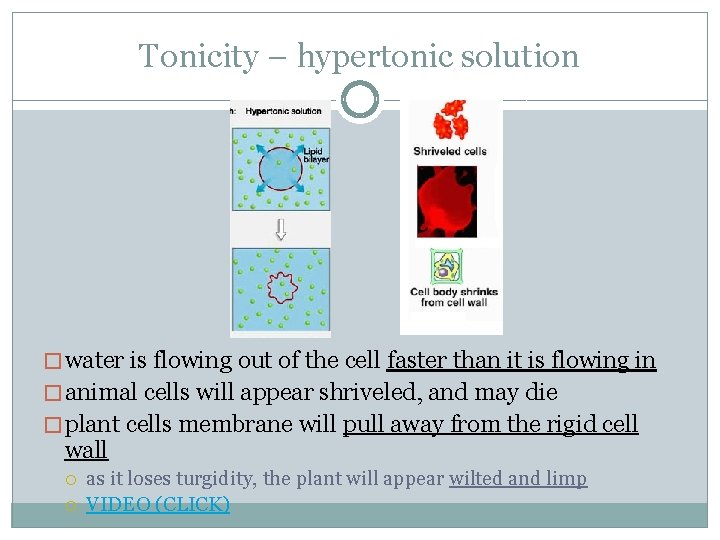
Tonicity – hypertonic solution � water is flowing out of the cell faster than it is flowing in � animal cells will appear shriveled, and may die � plant cells membrane will pull away from the rigid cell wall as it loses turgidity, the plant will appear wilted and limp VIDEO (CLICK)
Facilitated Diffusion �the word “facilitate” means “to assist” facilitated diffusion is diffusion that is helped along by proteins embedded in the cell membrane it is still a form of passive transport – like floating downstream on a raft �facilitated diffusion is for substances that are water soluble, so they can’t pass through the lipid portion of the membrane
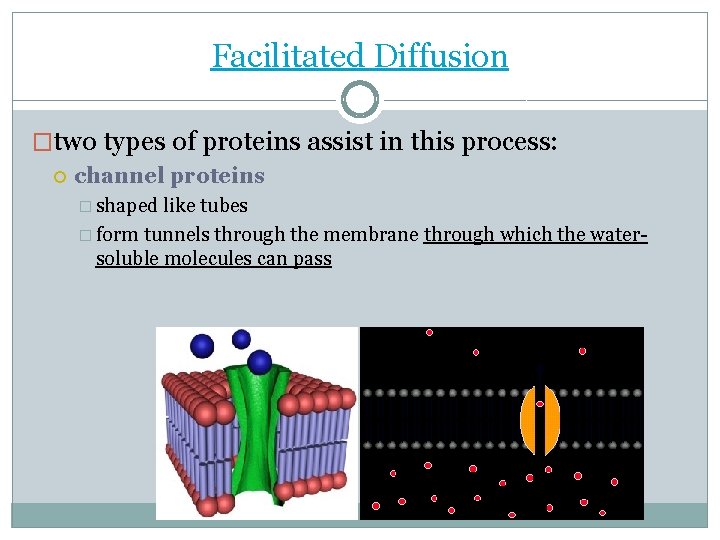
Facilitated Diffusion �two types of proteins assist in this process: channel proteins � shaped like tubes � form tunnels through the membrane through which the watersoluble molecules can pass
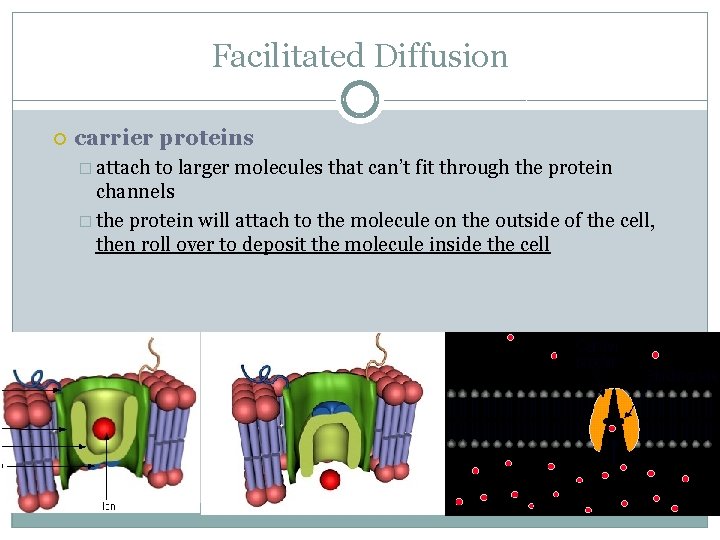
Facilitated Diffusion carrier proteins � attach to larger molecules that can’t fit through the protein channels � the protein will attach to the molecule on the outside of the cell, then roll over to deposit the molecule inside the cell
Active transport �in some cases, it is necessary for the cell to move molecules against the concentration gradient �it is called active transport because it requires extra work and energy by the cell like swimming upstream, against the current it is accomplished by the channel proteins, which pump the molecules from an area of low to high concentration
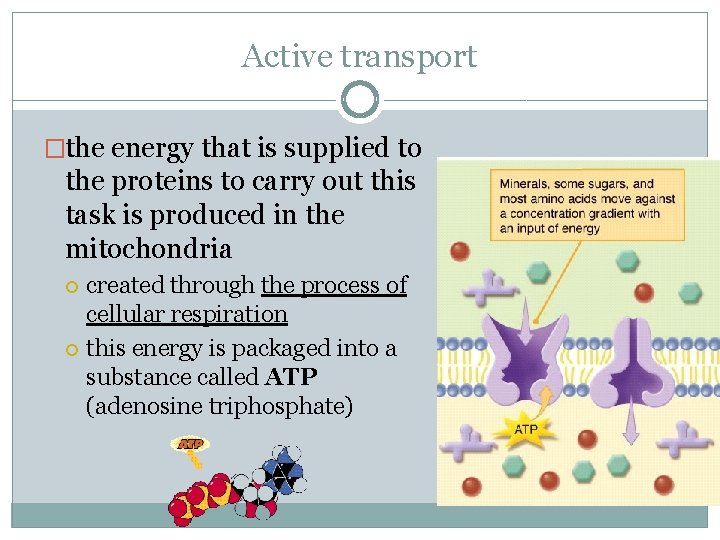
Active transport �the energy that is supplied to the proteins to carry out this task is produced in the mitochondria created through the process of cellular respiration this energy is packaged into a substance called ATP (adenosine triphosphate)
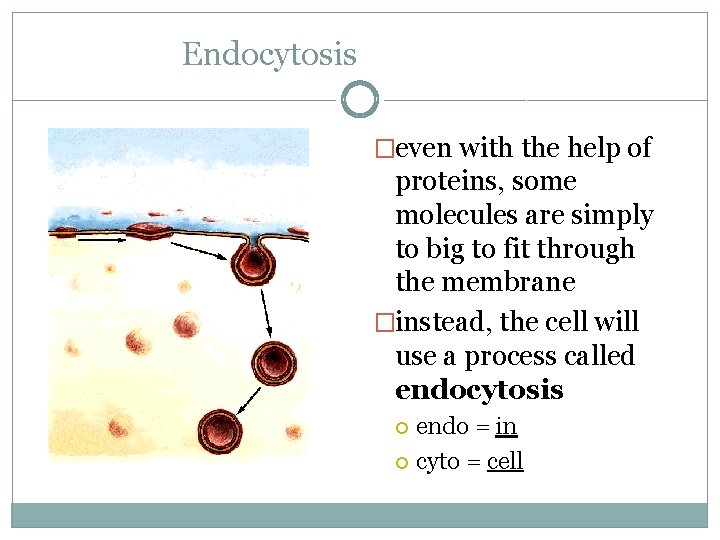
Endocytosis �even with the help of proteins, some molecules are simply to big to fit through the membrane �instead, the cell will use a process called endocytosis endo = in cyto = cell
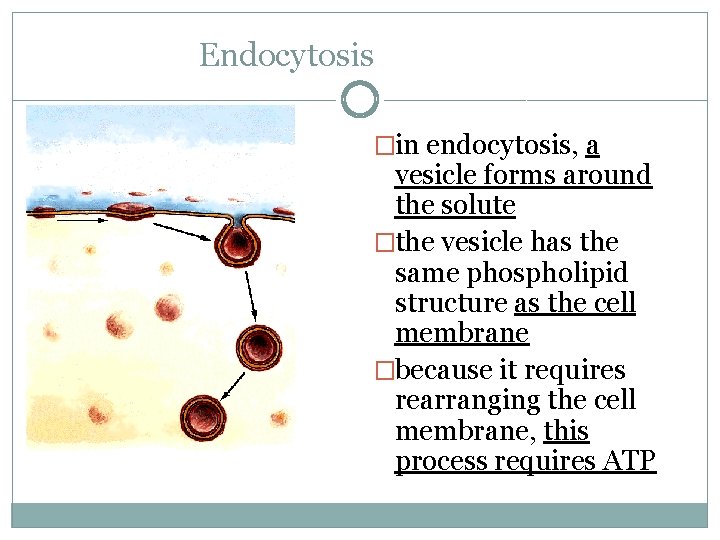
Endocytosis �in endocytosis, a vesicle forms around the solute �the vesicle has the same phospholipid structure as the cell membrane �because it requires rearranging the cell membrane, this process requires ATP
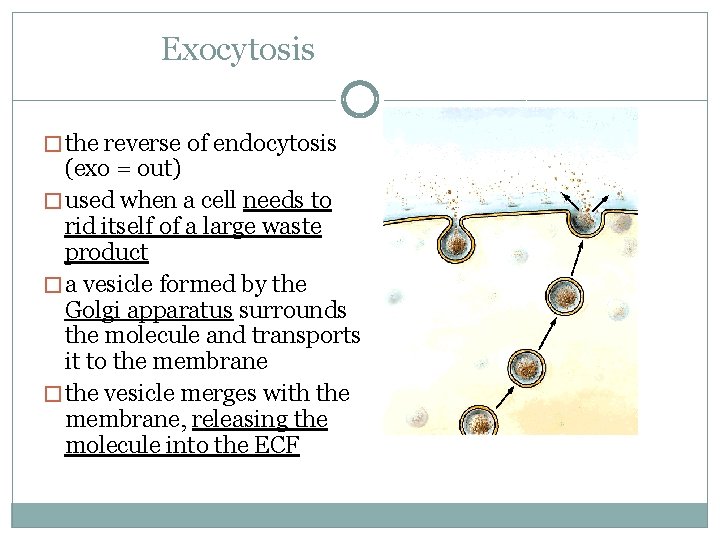
Exocytosis � the reverse of endocytosis (exo = out) � used when a cell needs to rid itself of a large waste product � a vesicle formed by the Golgi apparatus surrounds the molecule and transports it to the membrane � the vesicle merges with the membrane, releasing the molecule into the ECF
Active & Passive Transport VID �HERE
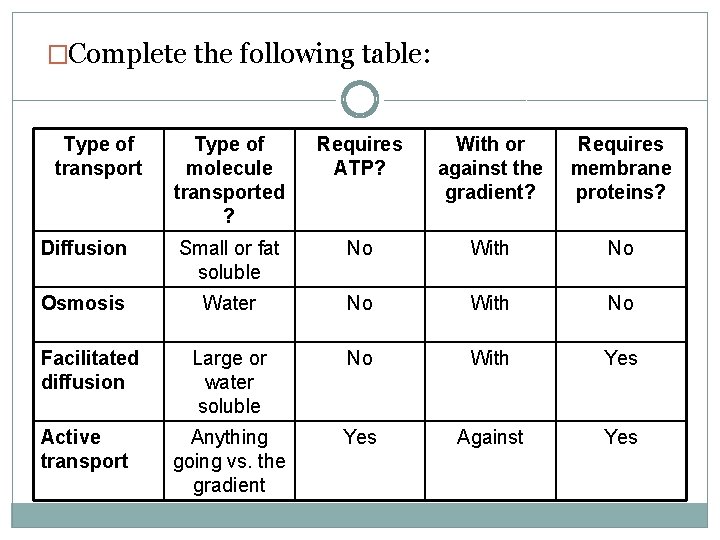
�Complete the following table: Type of transport Type of molecule transported ? Requires ATP? With or against the gradient? Requires membrane proteins? Diffusion Small or fat soluble No With No Osmosis Water No With No Facilitated diffusion Large or water soluble No With Yes Active transport Anything going vs. the gradient Yes Against Yes
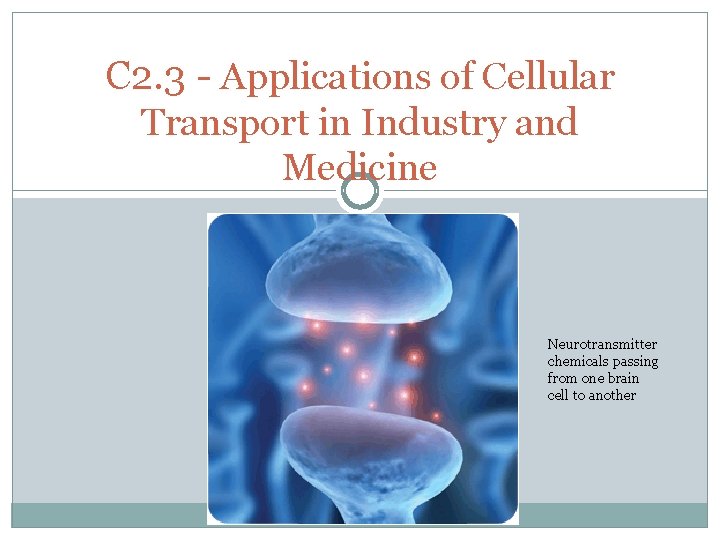
C 2. 3 - Applications of Cellular Transport in Industry and Medicine Neurotransmitter chemicals passing from one brain cell to another
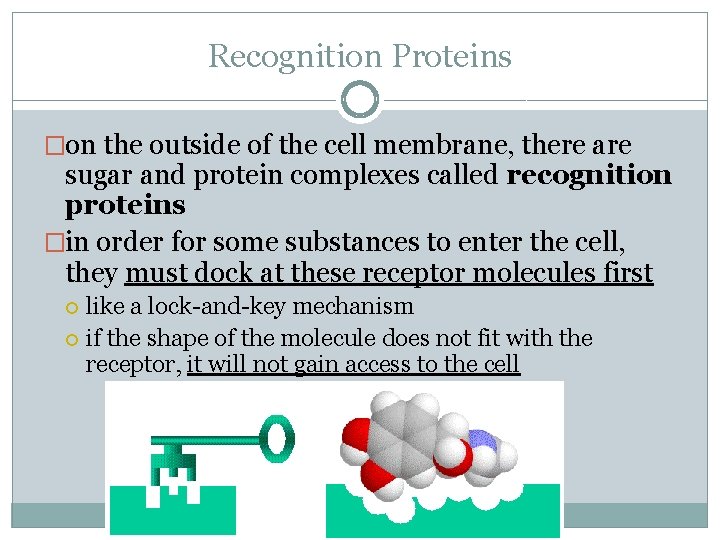
Recognition Proteins �on the outside of the cell membrane, there are sugar and protein complexes called recognition proteins �in order for some substances to enter the cell, they must dock at these receptor molecules first like a lock-and-key mechanism if the shape of the molecule does not fit with the receptor, it will not gain access to the cell
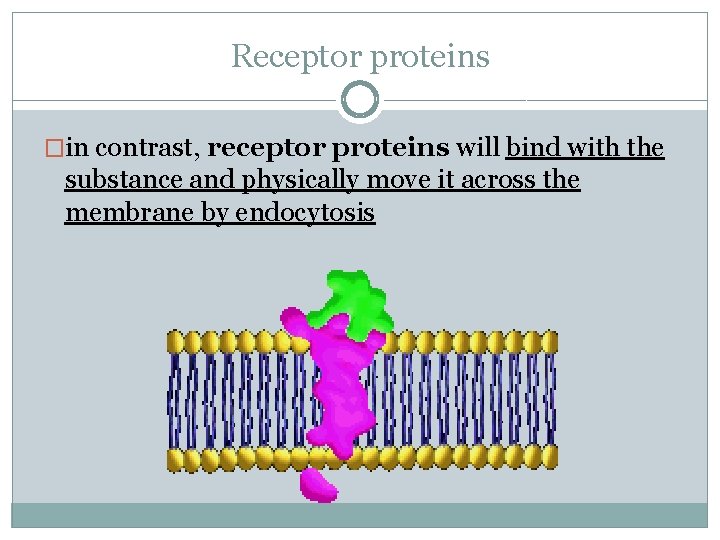
Receptor proteins �in contrast, receptor proteins will bind with the substance and physically move it across the membrane by endocytosis
Receptor proteins �the pharmaceutical industry is interested in these receptor molecules because medication cannot work unless it can get into the cell �the closer the match between the shape of the medication and the receptor molecule, the more targeted the medication can be, and therefore the more effective �for example, new pain relievers that treat migraines instead of providing overall pain relief
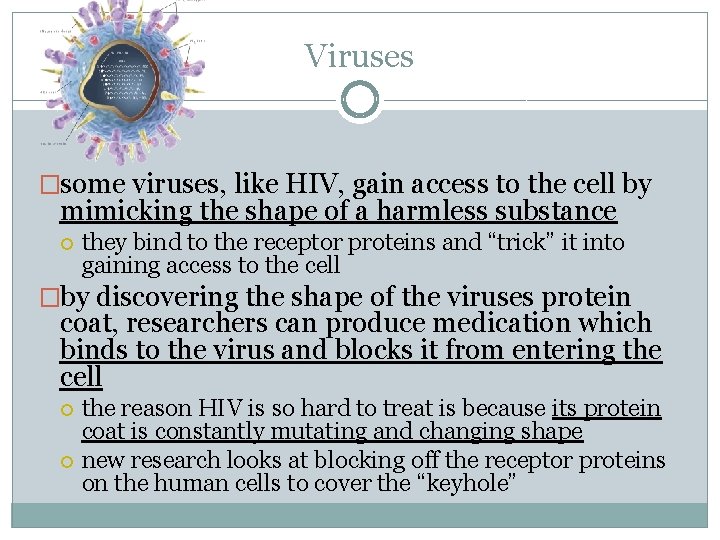
Viruses �some viruses, like HIV, gain access to the cell by mimicking the shape of a harmless substance they bind to the receptor proteins and “trick” it into gaining access to the cell �by discovering the shape of the viruses protein coat, researchers can produce medication which binds to the virus and blocks it from entering the cell the reason HIV is so hard to treat is because its protein coat is constantly mutating and changing shape new research looks at blocking off the receptor proteins on the human cells to cover the “keyhole”
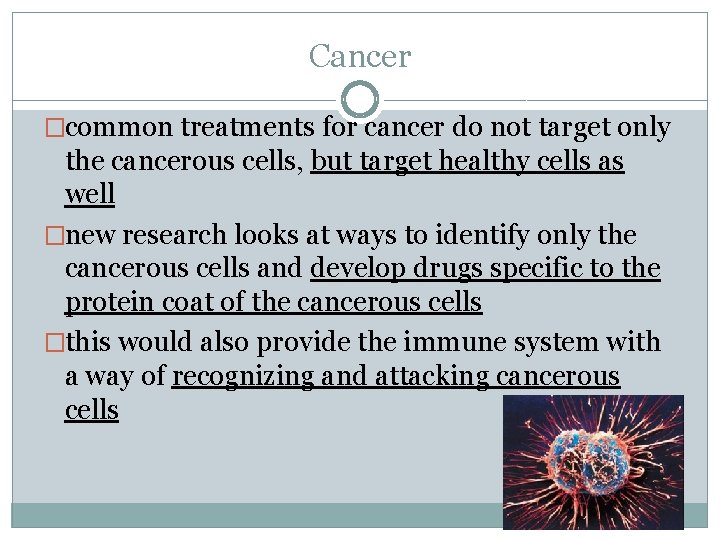
Cancer �common treatments for cancer do not target only the cancerous cells, but target healthy cells as well �new research looks at ways to identify only the cancerous cells and develop drugs specific to the protein coat of the cancerous cells �this would also provide the immune system with a way of recognizing and attacking cancerous cells

Synthetic membrane technology � liposomes a form of medication that surrounds a fluid-filled sac with a phospholipid bilayer this mimics a vesicle produced by the cell – the medicine is able to dissolve directly through the cell membrane liposome medication can be introduced intravenously and are able to deliver the medication much quicker
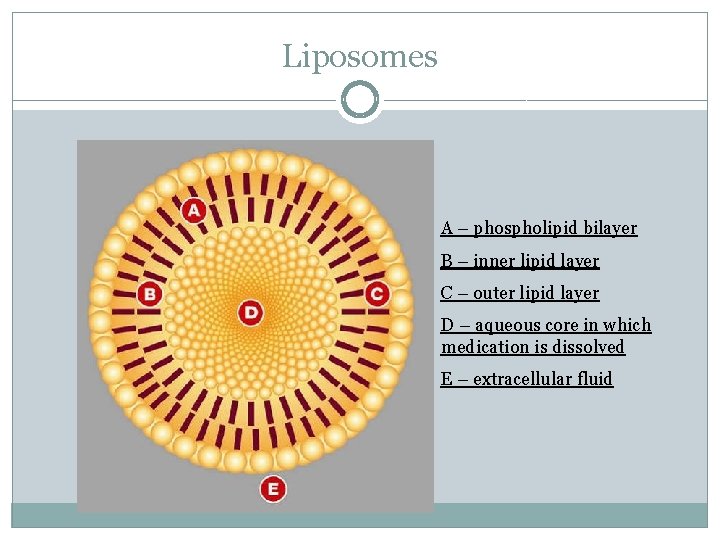
Liposomes A – phospholipid bilayer B – inner lipid layer C – outer lipid layer D – aqueous core in which medication is dissolved E – extracellular fluid
Transport of hormones � hormones are chemical messages produced by one part of the body that act on another part � insulin is produced by the pancreas, and acts on all body cells to tell them to pick up glucose for cellular respiration � diabetics are either not able to produce insulin, or it is not properly used by the body by understanding how hormones are transported and used by cells, diabetes treatments are improved synthetic insulin can now be produced that mimics the shape of human insulin, as an alternative to pig or cow insulin
Dialysis dialysis treatments are used by patients who have malfunctioning kidneys � your kidneys filter your blood and remove excess water and waste, which is then removed from the body in the form of urine � when a patient has kidneys that don’t work, their blood needs to be filtered artificially �
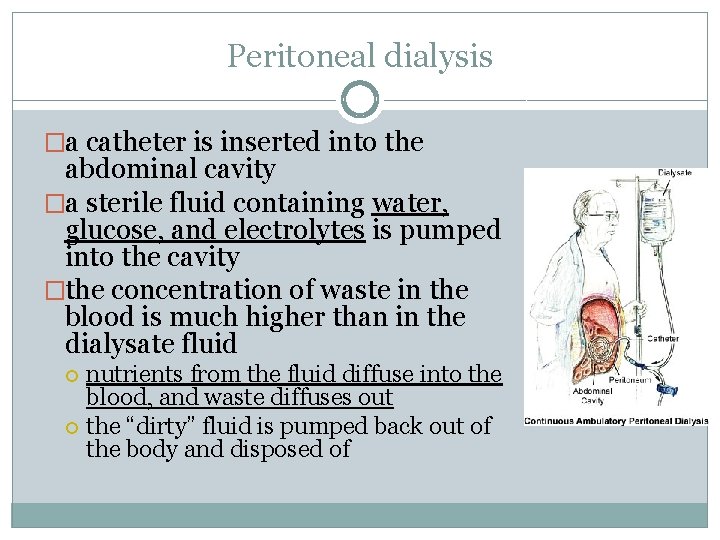
Peritoneal dialysis �a catheter is inserted into the abdominal cavity �a sterile fluid containing water, glucose, and electrolytes is pumped into the cavity �the concentration of waste in the blood is much higher than in the dialysate fluid nutrients from the fluid diffuse into the blood, and waste diffuses out the “dirty” fluid is pumped back out of the body and disposed of
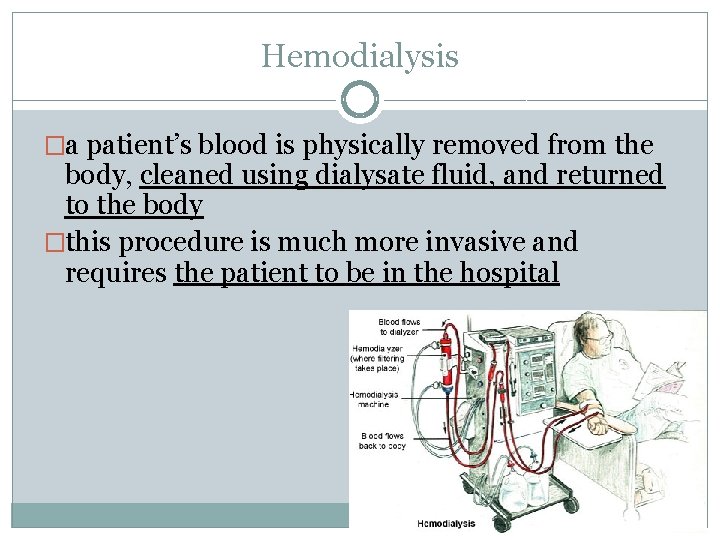
Hemodialysis �a patient’s blood is physically removed from the body, cleaned using dialysate fluid, and returned to the body �this procedure is much more invasive and requires the patient to be in the hospital

C 2. 4 – Is bigger better? The largest known body cell is a giant squid’s neuron.
Questions to answer: �is there a survival advantage for a cell to be large or small? �if a large cell is able to pull in more nutrients through its membrane, why are most cells small?
Surface area �the surface area of a cell refers to the total area of the outside of the cell membrane �a cell with a large surface area will have more membrane in contact with the ECF, so will better be able to pull in nutrients and get rid of waste �calculating surface area involves adding up the area of all sides of the cell typically we assume cells are cubes or rectangular prisms for ease of calculation
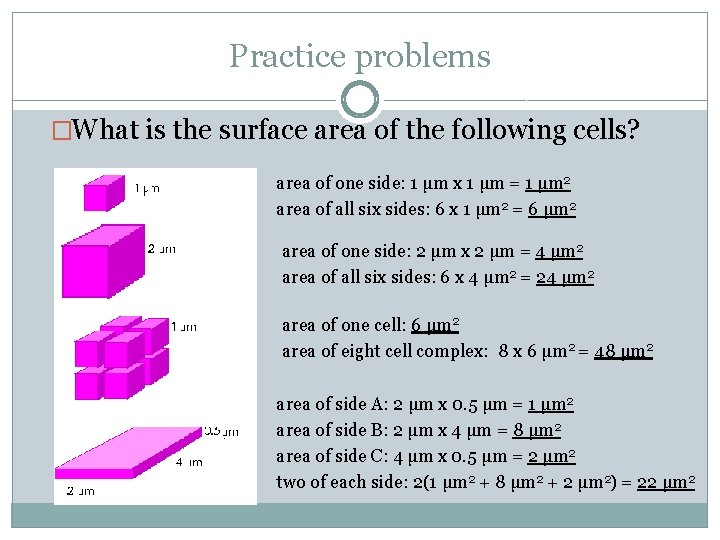
Practice problems �What is the surface area of the following cells? area of one side: 1 μm x 1 μm = 1 μm 2 area of all six sides: 6 x 1 μm 2 = 6 μm 2 area of one side: 2 μm x 2 μm = 4 μm 2 area of all six sides: 6 x 4 μm 2 = 24 μm 2 area of one cell: 6 μm 2 area of eight cell complex: 8 x 6 μm 2 = 48 μm 2 area of side A: 2 μm x 0. 5 μm = 1 μm 2 area of side B: 2 μm x 4 μm = 8 μm 2 area of side C: 4 μm x 0. 5 μm = 2 μm 2 two of each side: 2(1 μm 2 + 8 μm 2 + 2 μm 2) = 22 μm 2
Cell volume �the volume of a cell refers to the volume of the contents of the cell �a larger cell has a larger volume, which means larger nutritional needs and greater waste production �to calculate volume, multiply the dimensions of the sides
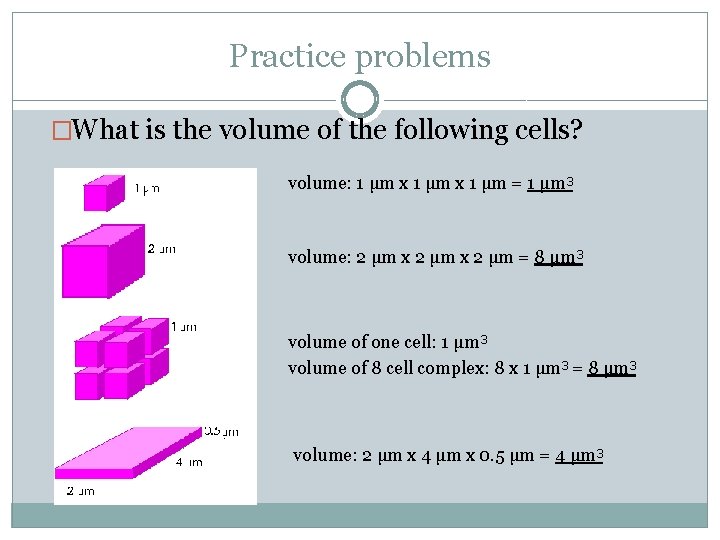
Practice problems �What is the volume of the following cells? volume: 1 μm x 1 μm = 1 μm 3 volume: 2 μm x 2 μm = 8 μm 3 volume of one cell: 1 μm 3 volume of 8 cell complex: 8 x 1 μm 3 = 8 μm 3 volume: 2 μm x 4 μm x 0. 5 μm = 4 μm 3
Surface area to volume ratio �a larger cell has a larger surface area but also a larger volume though it can take in more nutrients, it also has higher nutritional needs though it can get rid of waste faster, it also produced more waste �to predict which cell is favored for survival, you have to look at the surface area to volume ratio
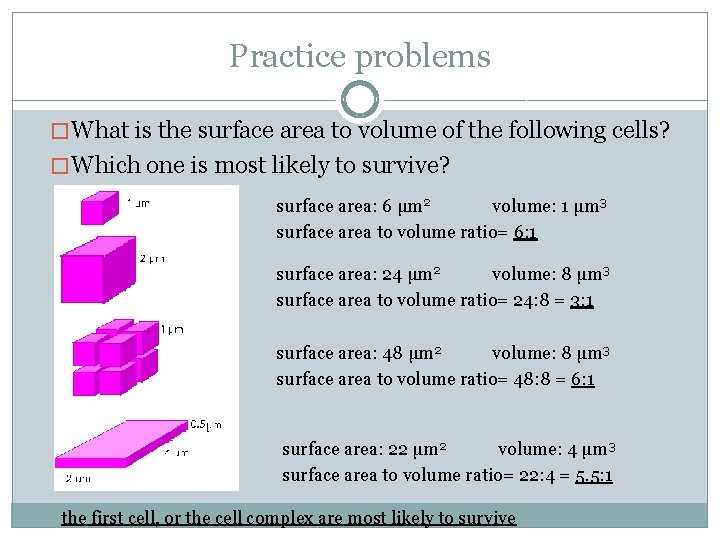
Practice problems � What is the surface area to volume of the following cells? � Which one is most likely to survive? surface area: 6 μm 2 volume: 1 μm 3 surface area to volume ratio= 6: 1 surface area: 24 μm 2 volume: 8 μm 3 surface area to volume ratio= 24: 8 = 3: 1 surface area: 48 μm 2 volume: 8 μm 3 surface area to volume ratio= 48: 8 = 6: 1 surface area: 22 μm 2 volume: 4 μm 3 surface area to volume ratio= 22: 4 = 5. 5: 1 the first cell, or the cell complex are most likely to survive

Surface area to volume ratio �generally speaking, a smaller cell will have a better chance of survival due to a higher surface area to volume ratio �however, in multicellular organisms, some cells perform specialized functions that require them to take on a larger size
Maximizing potential �multicellular organisms have several strategies for maximizing their chance of survival internal transport system � blood in animals and xylem/phloem in plants designed to deliver nutrients to all cells � this reduces the cells’ reliance on diffusion and osmosis
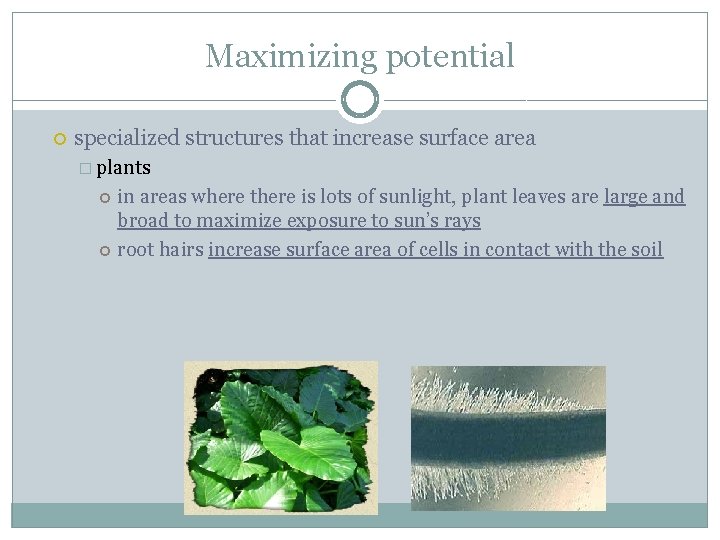
Maximizing potential specialized structures that increase surface area � plants in areas where there is lots of sunlight, plant leaves are large and broad to maximize exposure to sun’s rays root hairs increase surface area of cells in contact with the soil
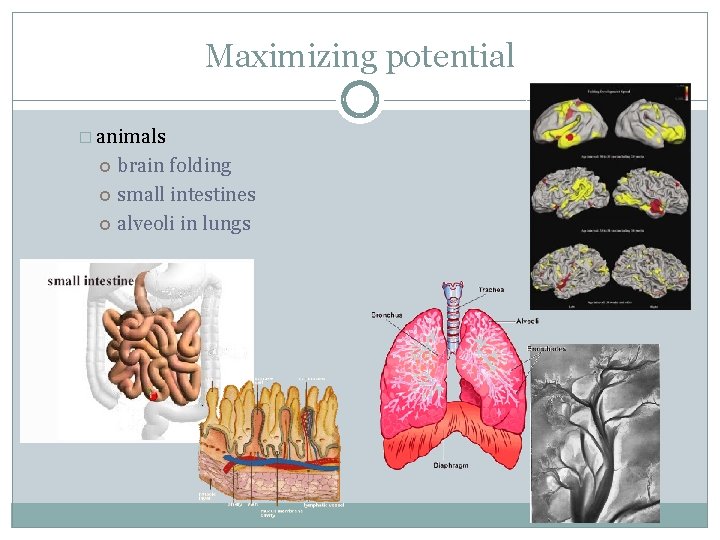
Maximizing potential � animals brain folding small intestines alveoli in lungs
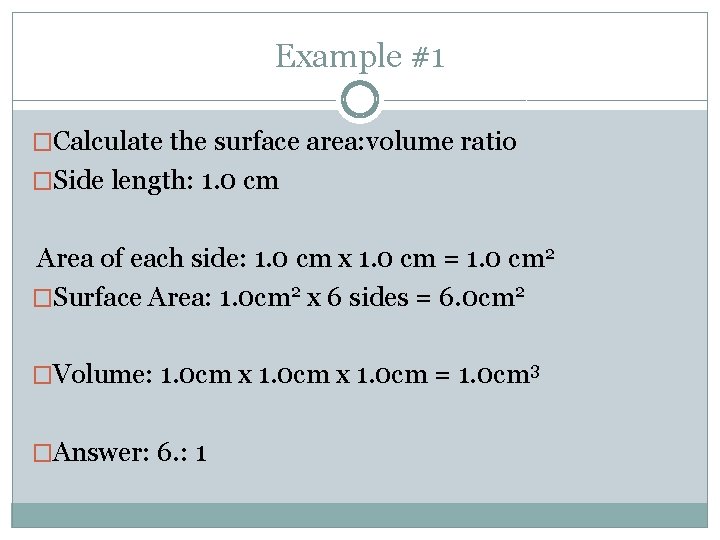
Example #1 �Calculate the surface area: volume ratio �Side length: 1. 0 cm Area of each side: 1. 0 cm x 1. 0 cm = 1. 0 cm 2 �Surface Area: 1. 0 cm 2 x 6 sides = 6. 0 cm 2 �Volume: 1. 0 cm x 1. 0 cm = 1. 0 cm 3 �Answer: 6. : 1
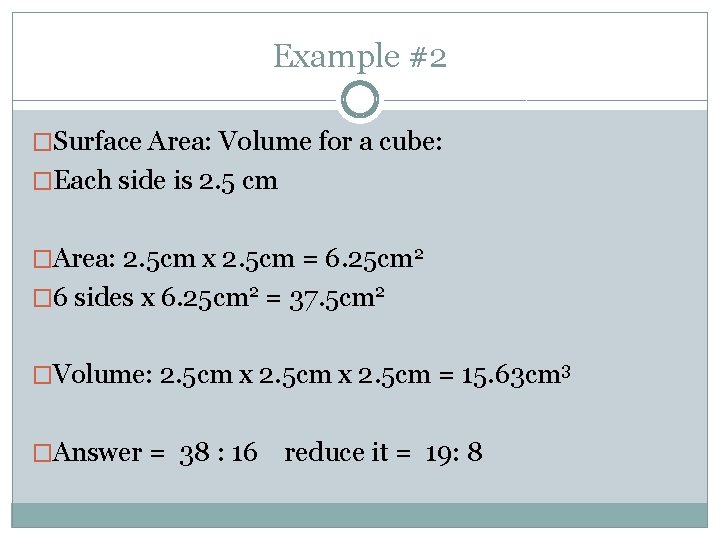
Example #2 �Surface Area: Volume for a cube: �Each side is 2. 5 cm �Area: 2. 5 cm x 2. 5 cm = 6. 25 cm 2 � 6 sides x 6. 25 cm 2 = 37. 5 cm 2 �Volume: 2. 5 cm x 2. 5 cm = 15. 63 cm 3 �Answer = 38 : 16 reduce it = 19: 8
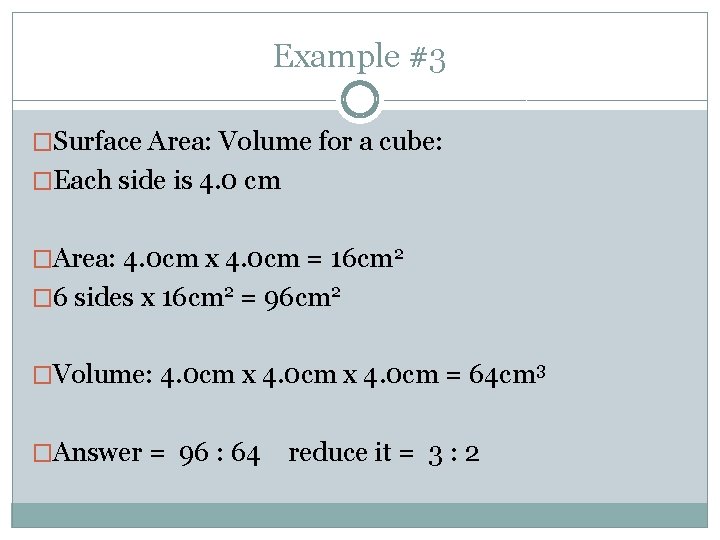
Example #3 �Surface Area: Volume for a cube: �Each side is 4. 0 cm �Area: 4. 0 cm x 4. 0 cm = 16 cm 2 � 6 sides x 16 cm 2 = 96 cm 2 �Volume: 4. 0 cm x 4. 0 cm = 64 cm 3 �Answer = 96 : 64 reduce it = 3 : 2
- Slides: 91