
Unit Atomic Structure Ions Cations Anions and Their
- Slides: 11
Unit: Atomic Structure Ions: Cations, Anions, and Their Abbreviations
After today, you will be able to… • Describe how cations are made. • Describe how anions are made. • Show the appropriate abbreviations for ions with mass, atomic numbers, and charge.
What is an ion? • An atom or group of atoms that has a positive or negative charge. • Ions form when an atom gains or loses electrons.
How to Write Ions • An ionic charge is written as a sign (positive ‘+’ or negative ‘-’) followed by a number. • The number represents the amount of electrons gained or lost.
Cations • An atom or group of atoms with a positive charge. • Metals lose electrons to become cations.
Cations • Have the same name as the element that forms them, but different chemical properties. • Ex: Sodium and Calcium – Na+1 = Sodium cation – Ca+2 = Calcium cation
Anions • Atoms or groups of atoms with a negative charge • Nonmetals tend to form ions by gaining electrons
Anions • The name of the anion is the element name with “-ide” on the end • Ex: Oxygen and Chlorine – O-2 = Oxide anion – Cl– 1 = Chloride anion
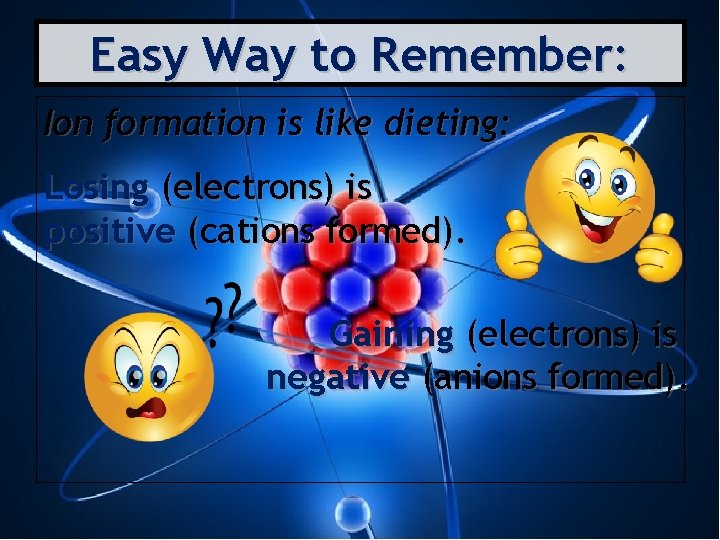
Easy Way to Remember: Ion formation is like dieting: Losing (electrons) is positive (cations formed). Gaining (electrons) is negative (anions formed).
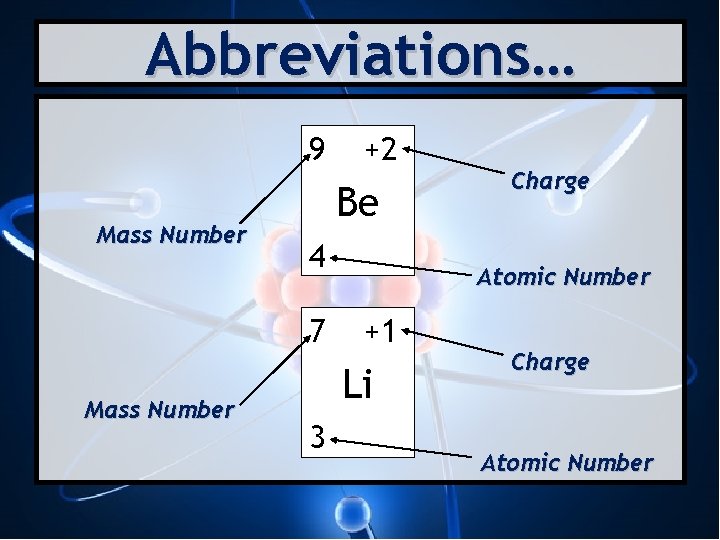
Abbreviations… 9 Mass Number Be 4 7 Mass Number +2 Atomic Number +1 Li 3 Charge Atomic Number
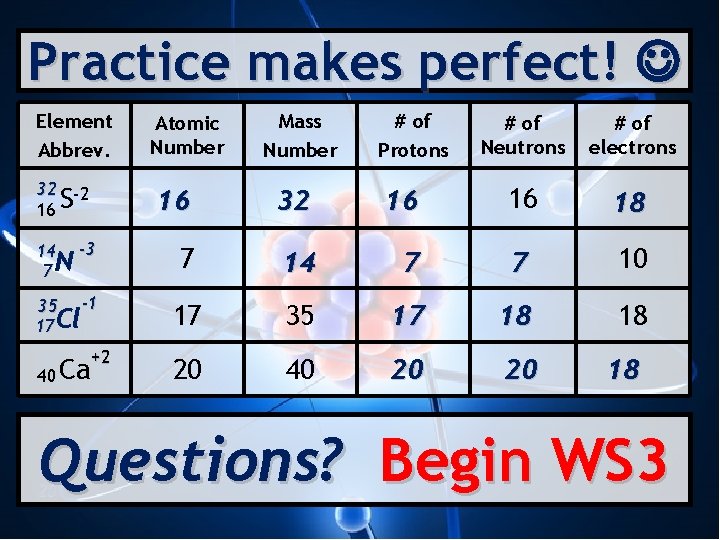
Practice makes perfect! Element Abbrev. 32 -2 16 S Atomic Number Mass Number # of Protons # of Neutrons # of electrons 16 18 16 32 16 14 -3 7 N 7 14 7 7 10 35 -1 17 Cl 17 35 17 18 18 20 40 20 20 18 40 Ca +2 Questions? Begin WS 3 20