
Unit Analysis Supplement to Math 60 Chapter 3

- Slides: 9
Unit Analysis Supplement to Math 60 Chapter 3 Cathy Mulleary Summer 2013
Unit Analysis Alternate names for the same process are: • • Unit Conversions Factor Label Method Unit Factor Method Dimensional Analysis
Unit analysis uses the same concept as “equivalent fractions. ” Multiplying a quantity by a ratio equal to one changes the looks of the quantity without changing its value.
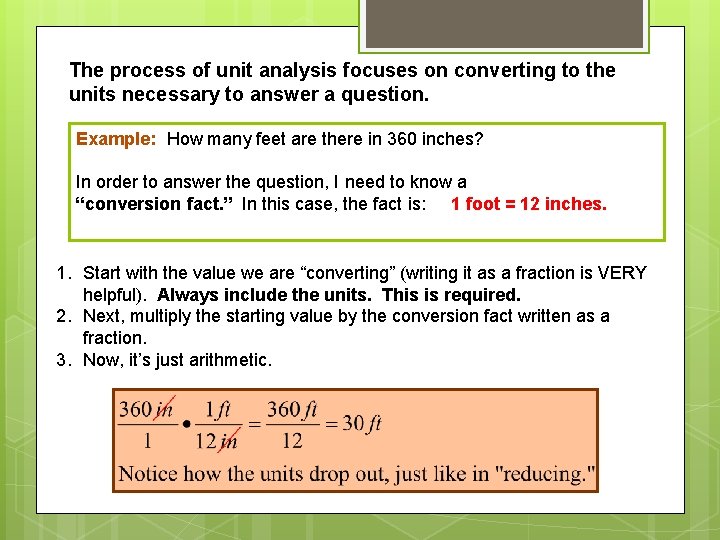
The process of unit analysis focuses on converting to the units necessary to answer a question. Example: How many feet are there in 360 inches? In order to answer the question, I need to know a “conversion fact. ” In this case, the fact is: 1 foot = 12 inches. 1. Start with the value we are “converting” (writing it as a fraction is VERY helpful). Always include the units. This is required. 2. Next, multiply the starting value by the conversion fact written as a fraction. 3. Now, it’s just arithmetic.
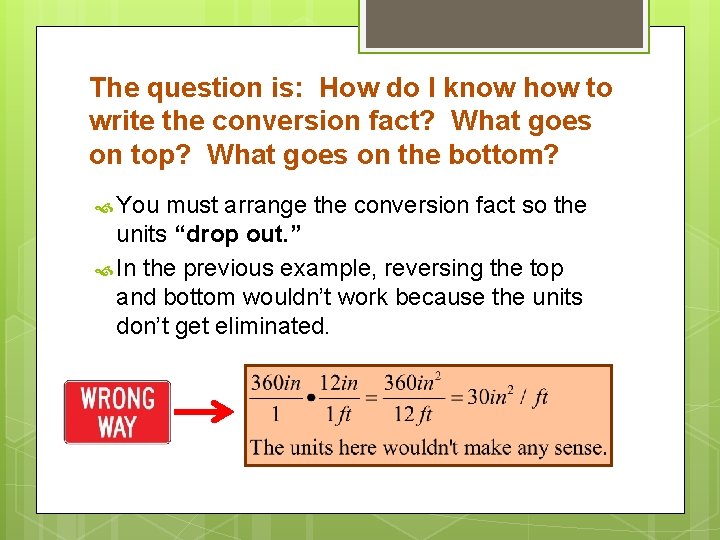
The question is: How do I know how to write the conversion fact? What goes on top? What goes on the bottom? You must arrange the conversion fact so the units “drop out. ” In the previous example, reversing the top and bottom wouldn’t work because the units don’t get eliminated.
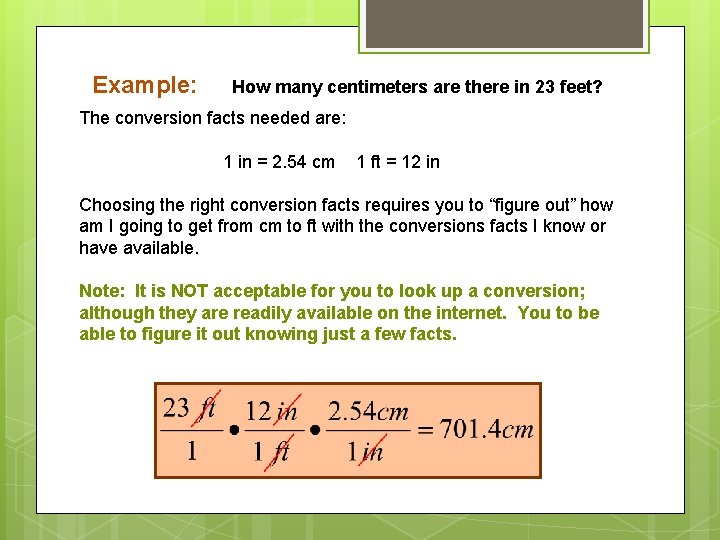
Example: How many centimeters are there in 23 feet? The conversion facts needed are: 1 in = 2. 54 cm 1 ft = 12 in Choosing the right conversion facts requires you to “figure out” how am I going to get from cm to ft with the conversions facts I know or have available. Note: It is NOT acceptable for you to look up a conversion; although they are readily available on the internet. You to be able to figure it out knowing just a few facts.
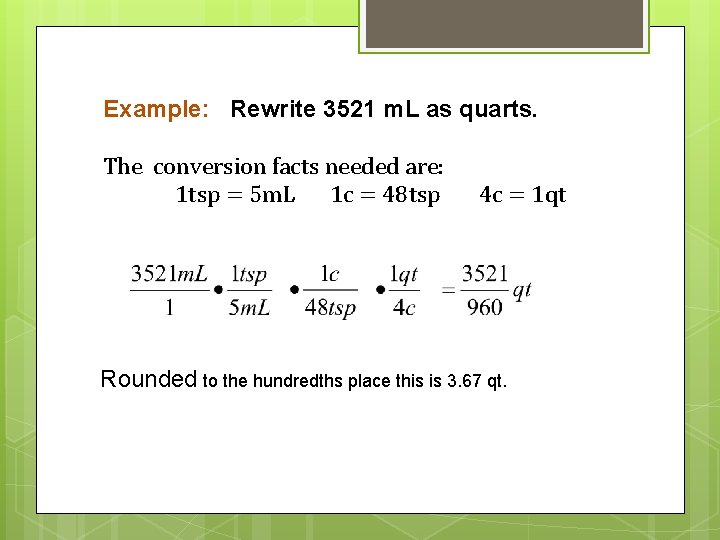
Example: Rewrite 3521 m. L as quarts. The conversion facts needed are: 1 tsp = 5 m. L 1 c = 48 tsp 4 c = 1 qt Rounded to the hundredths place this is 3. 67 qt.
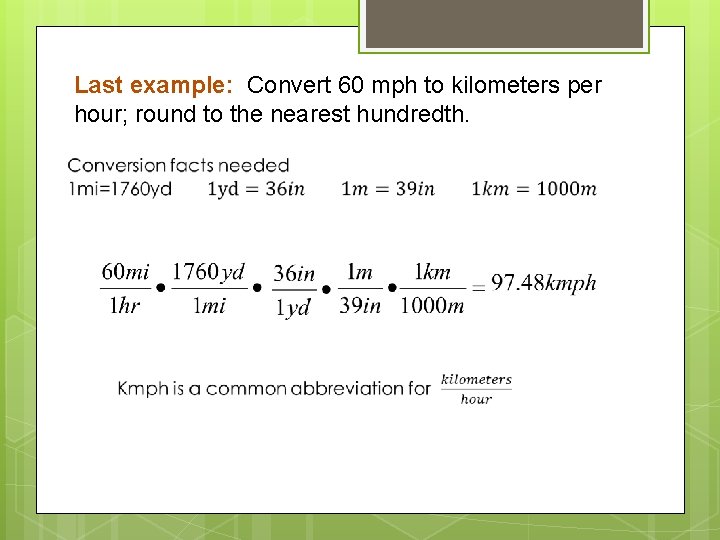
Last example: Convert 60 mph to kilometers per hour; round to the nearest hundredth.
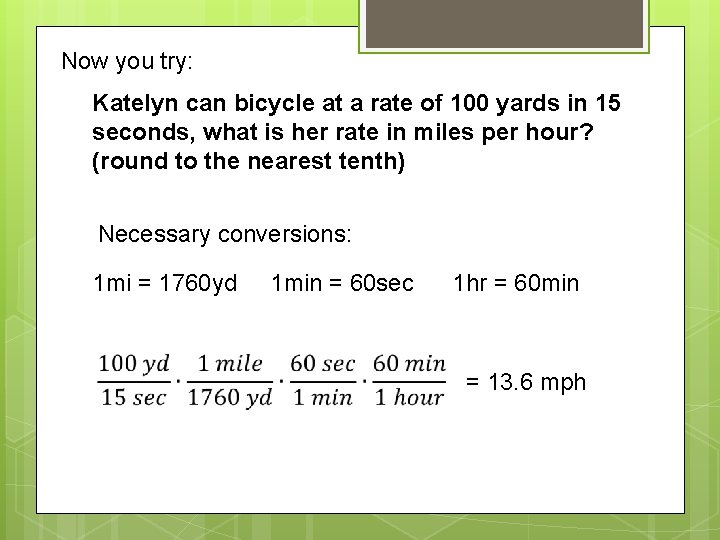
Now you try: Katelyn can bicycle at a rate of 100 yards in 15 seconds, what is her rate in miles per hour? (round to the nearest tenth) Necessary conversions: 1 mi = 1760 yd 1 min = 60 sec 1 hr = 60 min = 13. 6 mph