
Unit 9 Solutions 1 Solubility Terminology When a

Unit 9 Solutions 1

Solubility Terminology • When a solution can have solute added and dissolved, the solution is unsaturated. – Example: Lemonade with no or little sugar • When a solution cannot have solute added and dissolved, the solution is saturated – Example: Lemonade with perfect amount of sugar • Super saturated solution is when a solution that contains more of the dissolved material than could be dissolved by the solvent under normal circumstances. – Can have some of the solute fall out of the solution and form crystals – Examples: Lemonade with solid sugar left at the bottom of the picture.
Types of solutions • Concentration of a solution is a measure of the amount of solute that is dissolved in a given quantity of solvent. – Solute substance being dissolved – Solvent substance doing the dissolving – Lemonade solution, solute is lemon juice and sugar, solvent is water. • Dilute solution is on that contains a small amount of solute • Concentrated solution contains a large amount of solute – 1 g Na. Cl per 100 g H 2 O would be dilute when compared to 30 g Na. Cl per 100 g H 2 O (a concentrated solution) 3
Factors that affect rate of dissolving • Three factors affect the rate that a solid substance will dissolve in a liquid solvent • Agitation, temperature and particle size – Agitation or stirring a solution will make the crystals dissolve more quickly – increasing the temperature will increase the rate at which the substance will dissolve. – Smaller particles (more surface area) dissolve much quicker. – Remember: crush it, heat it, stir it
Factors that affect rate of dissolving • Three factors affect the rate that a Gas substance will dissolve in a liquid solvent • Agitation, pressure and temperature – gasses dissolved in a liquid decreasing the temperature will allow an increase in the amount of gasses that can be dissolved – Also increasing the pressure will increase the amount of gas that can dissolve in a liquid. – NOT agitating (no stirring or shaking) will increase the amount of gas a liquid can hold.
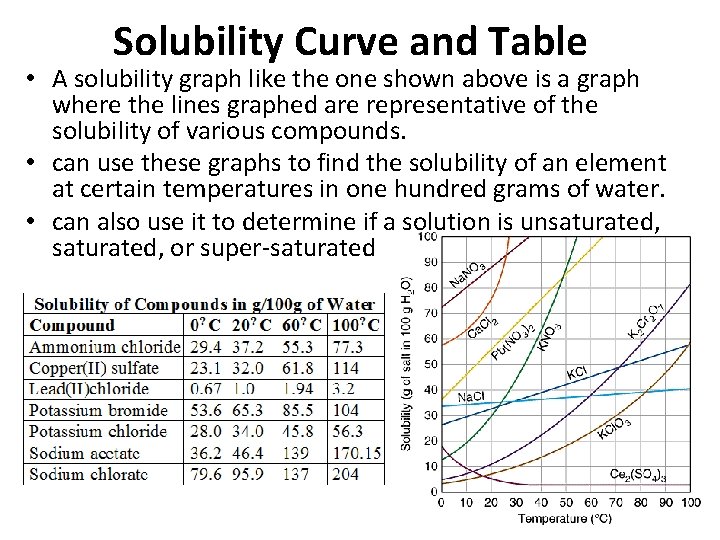
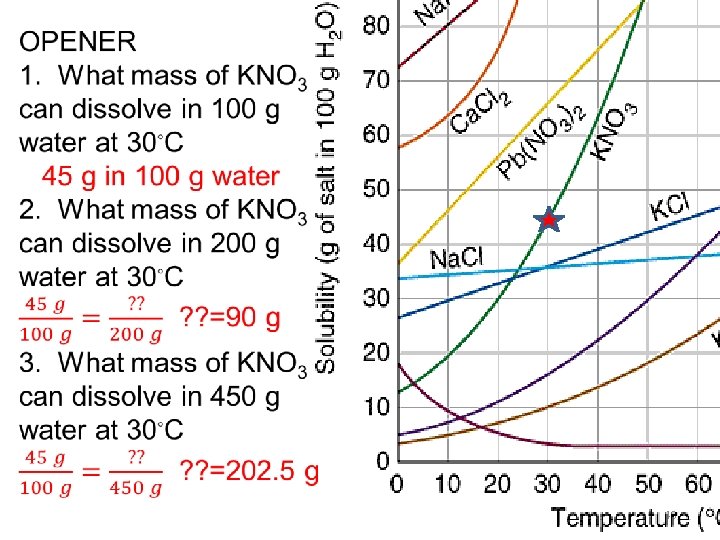
Solubility Curve and Table • A solubility graph like the one shown above is a graph where the lines graphed are representative of the solubility of various compounds. • can use these graphs to find the solubility of an element at certain temperatures in one hundred grams of water. • can also use it to determine if a solution is unsaturated, or super-saturated
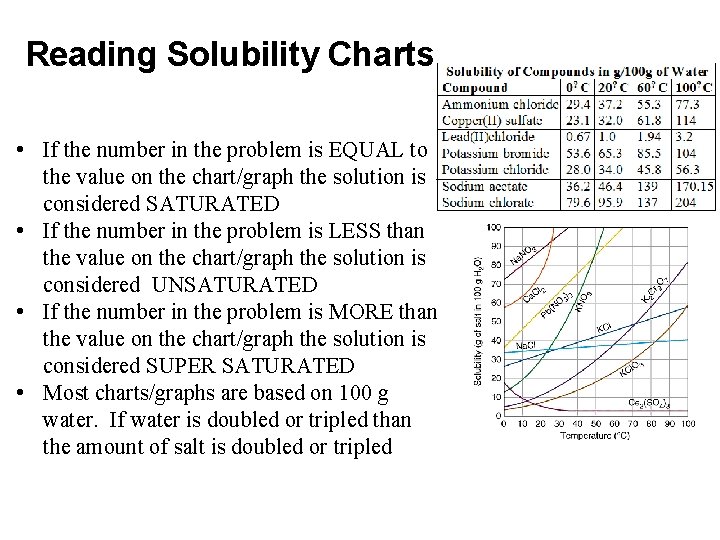
Reading Solubility Charts • If the number in the problem is EQUAL to the value on the chart/graph the solution is considered SATURATED • If the number in the problem is LESS than the value on the chart/graph the solution is considered UNSATURATED • If the number in the problem is MORE than the value on the chart/graph the solution is considered SUPER SATURATED • Most charts/graphs are based on 100 g water. If water is doubled or tripled than the amount of salt is doubled or tripled
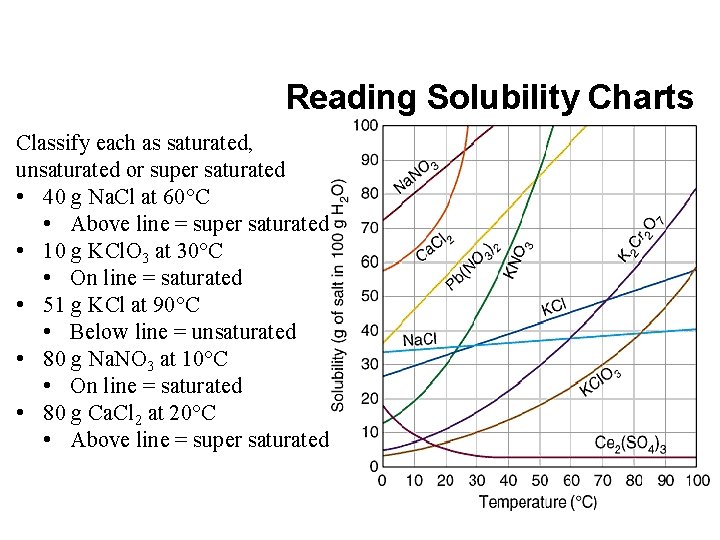
Reading Solubility Charts Classify each as saturated, unsaturated or super saturated • 40 g Na. Cl at 60°C • Above line = super saturated • 10 g KCl. O 3 at 30°C • On line = saturated • 51 g KCl at 90°C • Below line = unsaturated • 80 g Na. NO 3 at 10°C • On line = saturated • 80 g Ca. Cl 2 at 20°C • Above line = super saturated
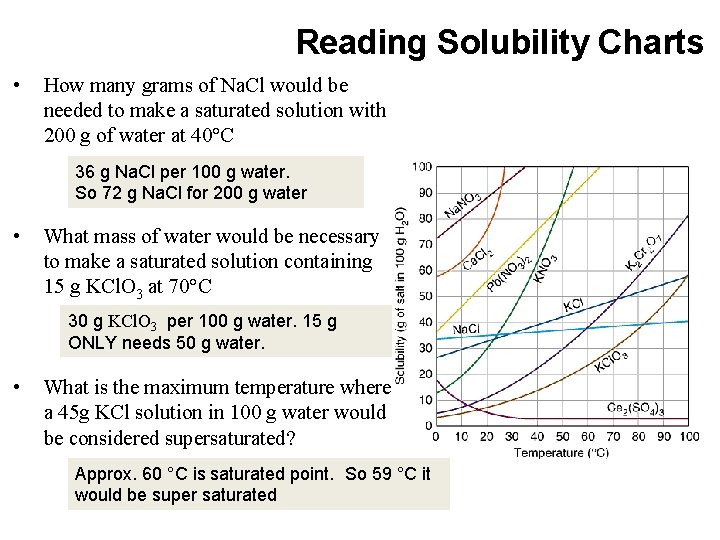
Reading Solubility Charts • How many grams of Na. Cl would be needed to make a saturated solution with 200 g of water at 40°C 36 g Na. Cl per 100 g water. So 72 g Na. Cl for 200 g water • What mass of water would be necessary to make a saturated solution containing 15 g KCl. O 3 at 70°C 30 g KCl. O 3 per 100 g water. 15 g ONLY needs 50 g water. • What is the maximum temperature where a 45 g KCl solution in 100 g water would be considered supersaturated? Approx. 60 °C is saturated point. So 59 °C it would be super saturated
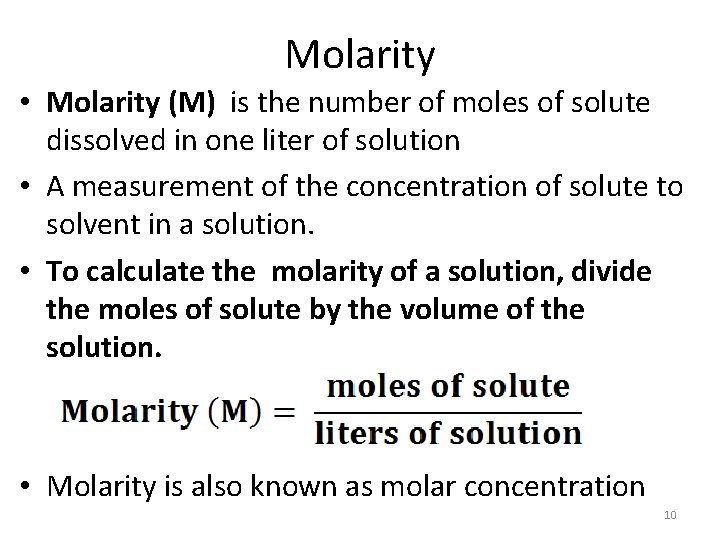
Molarity • Molarity (M) is the number of moles of solute dissolved in one liter of solution • A measurement of the concentration of solute to solvent in a solution. • To calculate the molarity of a solution, divide the moles of solute by the volume of the solution. • Molarity is also known as molar concentration 10
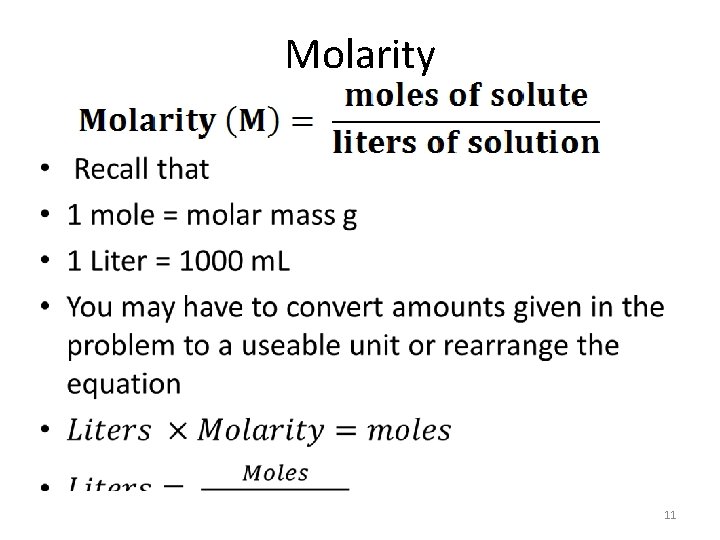
• Molarity 11
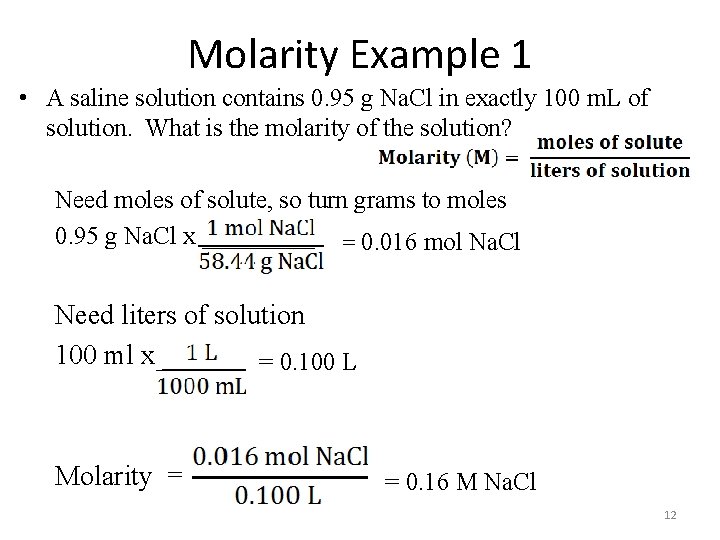
Molarity Example 1 • A saline solution contains 0. 95 g Na. Cl in exactly 100 m. L of solution. What is the molarity of the solution? Need moles of solute, so turn grams to moles 0. 95 g Na. Cl x _____ = 0. 016 mol Na. Cl Need liters of solution 100 ml x ______ = 0. 100 L Molarity = = 0. 16 M Na. Cl 12
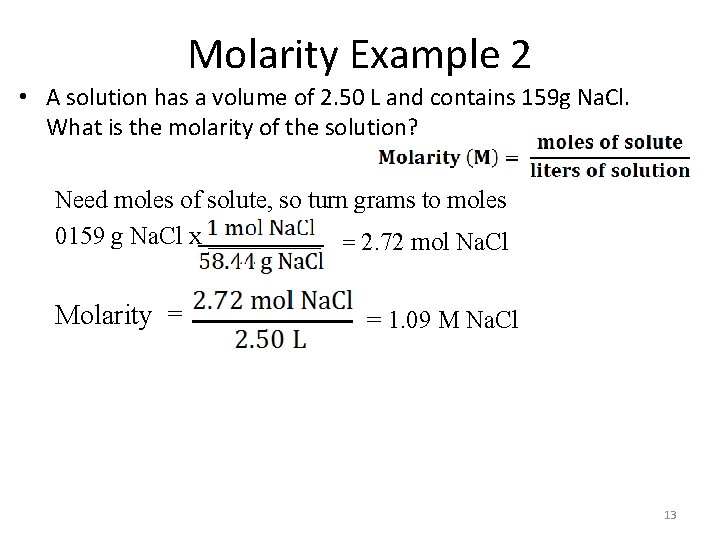
Molarity Example 2 • A solution has a volume of 2. 50 L and contains 159 g Na. Cl. What is the molarity of the solution? Need moles of solute, so turn grams to moles 0159 g Na. Cl x _____ = 2. 72 mol Na. Cl Molarity = = 1. 09 M Na. Cl 13
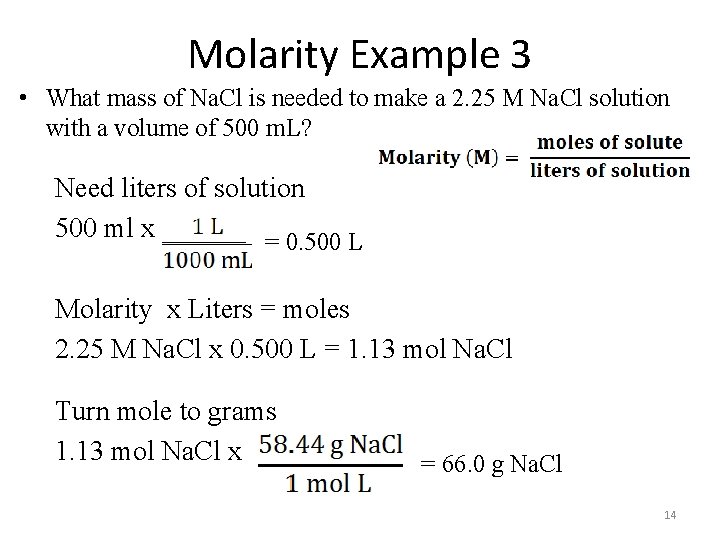
Molarity Example 3 • What mass of Na. Cl is needed to make a 2. 25 M Na. Cl solution with a volume of 500 m. L? Need liters of solution 500 ml x ______ = 0. 500 L Molarity x Liters = moles 2. 25 M Na. Cl x 0. 500 L = 1. 13 mol Na. Cl Turn mole to grams 1. 13 mol Na. Cl x = 66. 0 g Na. Cl 14
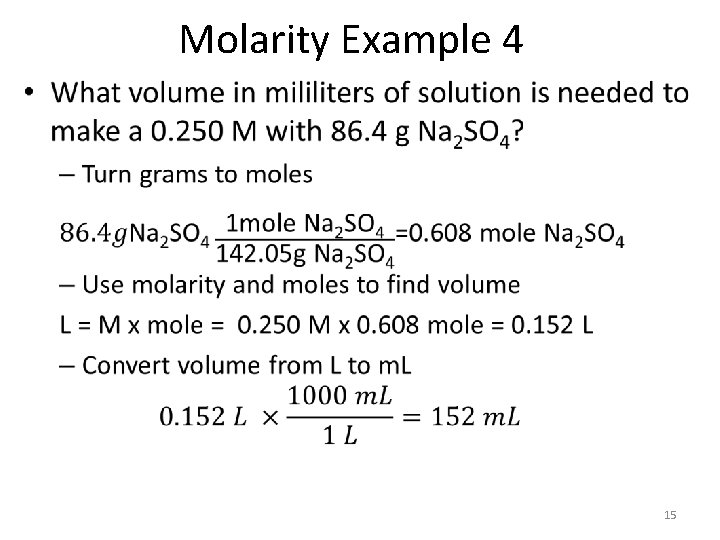
Molarity Example 4 • 15
Unit 10 Acids, Bases, and Salts Chapter 19 16
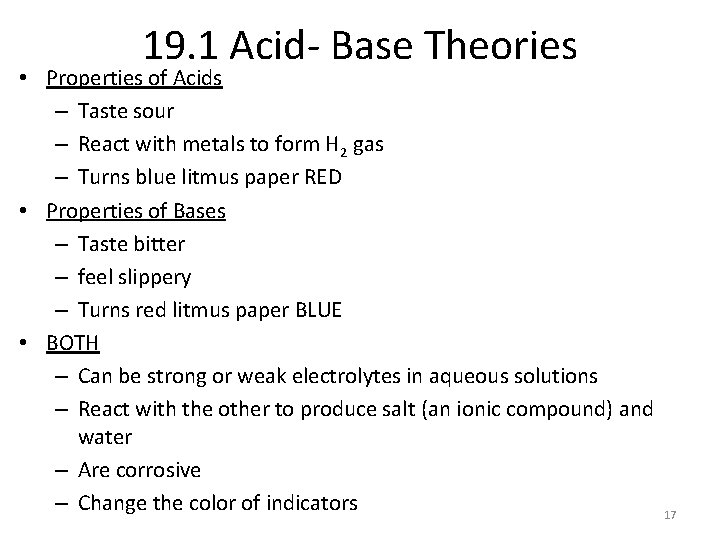
19. 1 Acid- Base Theories • Properties of Acids – Taste sour – React with metals to form H 2 gas – Turns blue litmus paper RED • Properties of Bases – Taste bitter – feel slippery – Turns red litmus paper BLUE • BOTH – Can be strong or weak electrolytes in aqueous solutions – React with the other to produce salt (an ionic compound) and water – Are corrosive – Change the color of indicators 17
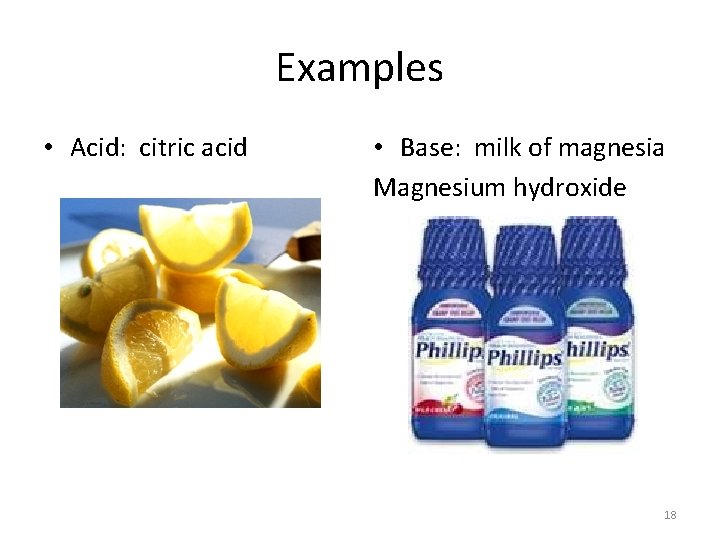
Examples • Acid: citric acid • Base: milk of magnesia Magnesium hydroxide 18
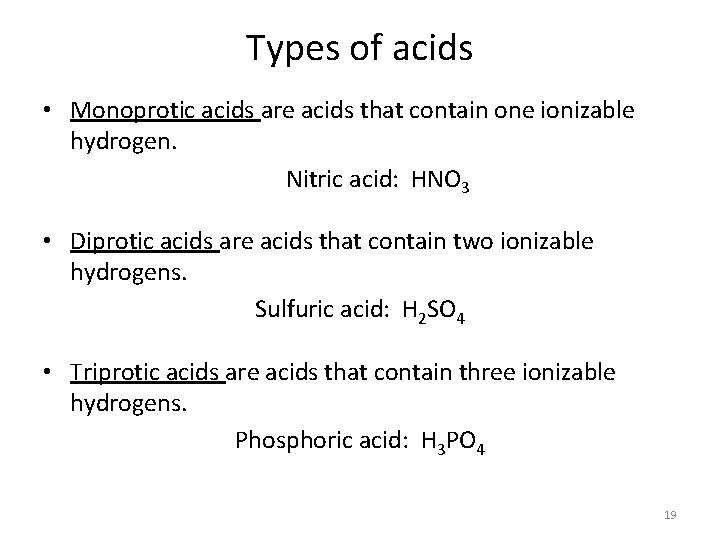
Types of acids • Monoprotic acids are acids that contain one ionizable hydrogen. Nitric acid: HNO 3 • Diprotic acids are acids that contain two ionizable hydrogens. Sulfuric acid: H 2 SO 4 • Triprotic acids are acids that contain three ionizable hydrogens. Phosphoric acid: H 3 PO 4 19
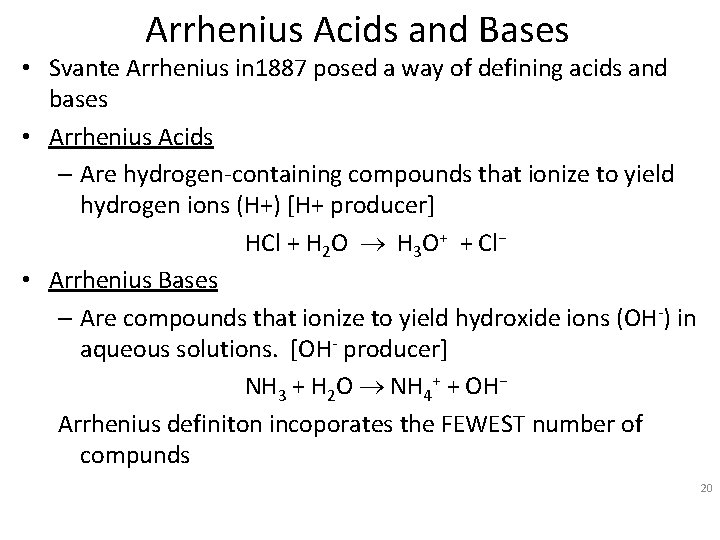
Arrhenius Acids and Bases • Svante Arrhenius in 1887 posed a way of defining acids and bases • Arrhenius Acids – Are hydrogen-containing compounds that ionize to yield hydrogen ions (H+) [H+ producer] HCl + H 2 O H 3 O+ + Cl− • Arrhenius Bases – Are compounds that ionize to yield hydroxide ions (OH-) in aqueous solutions. [OH- producer] NH 3 + H 2 O NH 4+ + OH− Arrhenius definiton incoporates the FEWEST number of compunds 20
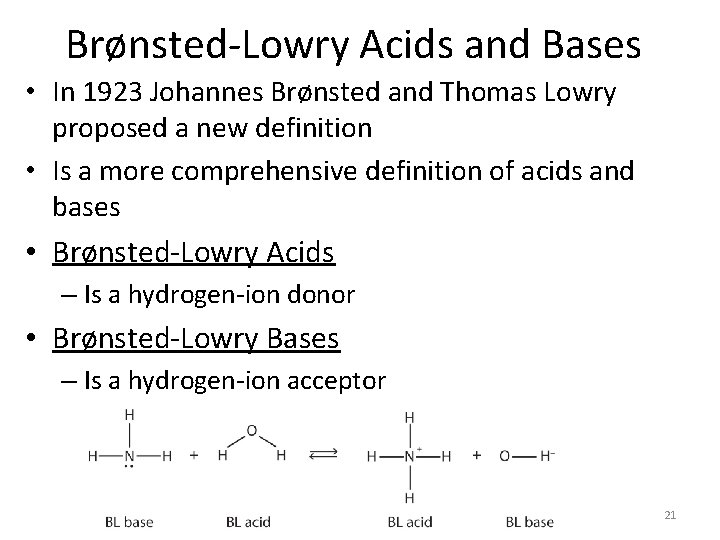
Brønsted-Lowry Acids and Bases • In 1923 Johannes Brønsted and Thomas Lowry proposed a new definition • Is a more comprehensive definition of acids and bases • Brønsted-Lowry Acids – Is a hydrogen-ion donor • Brønsted-Lowry Bases – Is a hydrogen-ion acceptor 21
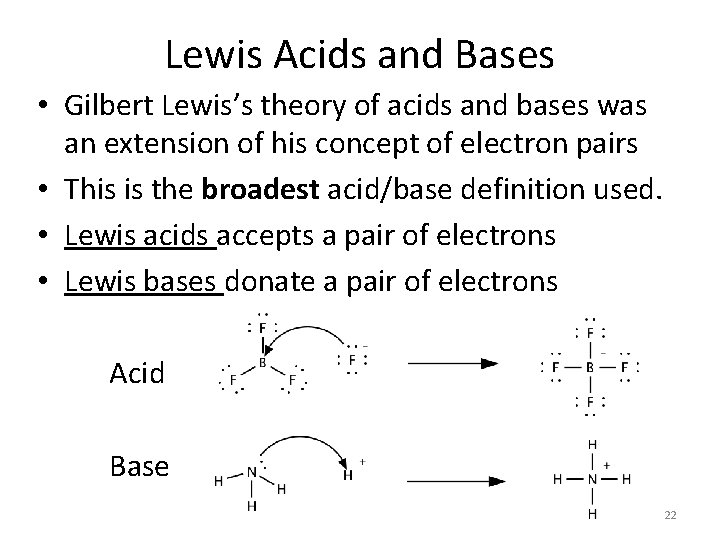
Lewis Acids and Bases • Gilbert Lewis’s theory of acids and bases was an extension of his concept of electron pairs • This is the broadest acid/base definition used. • Lewis acids accepts a pair of electrons • Lewis bases donate a pair of electrons Acid Base 22
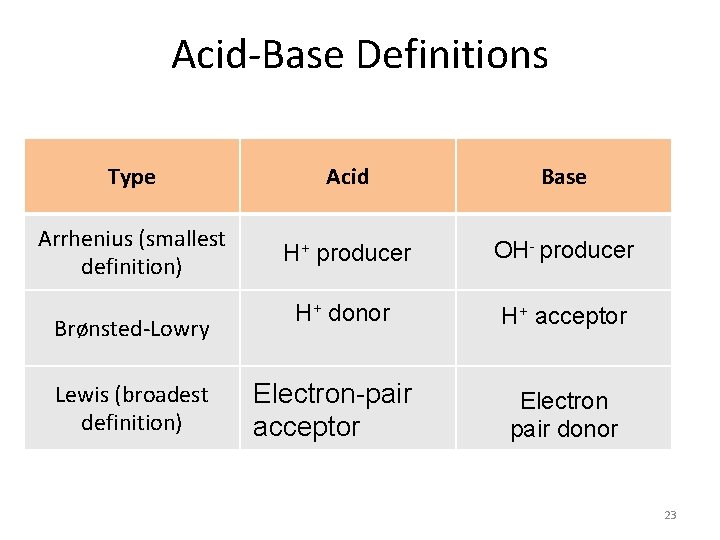
Acid-Base Definitions Type Acid Base Arrhenius (smallest definition) H+ producer OH- producer Brønsted-Lowry H+ donor H+ acceptor Lewis (broadest definition) Electron-pair acceptor Electron pair donor 23
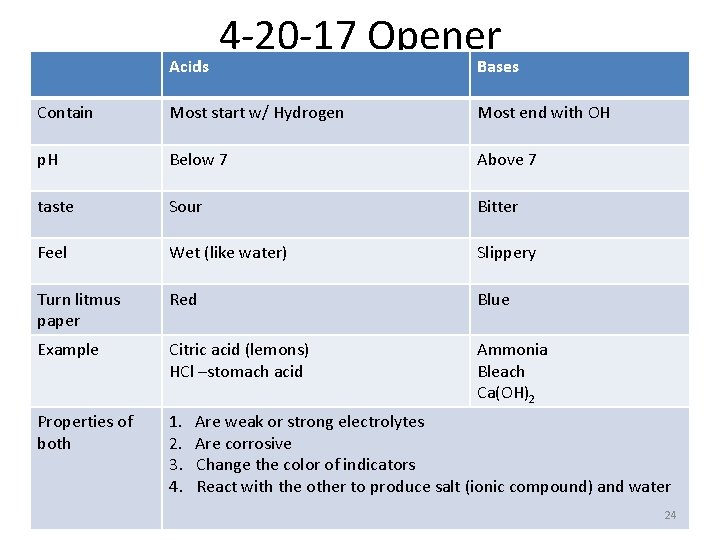
Acids 4 -20 -17 Opener Bases Contain Most start w/ Hydrogen Most end with OH p. H Below 7 Above 7 taste Sour Bitter Feel Wet (like water) Slippery Turn litmus paper Red Blue Example Citric acid (lemons) HCl –stomach acid Ammonia Bleach Ca(OH)2 Properties of both 1. Are weak or strong electrolytes 2. Are corrosive 3. Change the color of indicators 4. React with the other to produce salt (ionic compound) and water 24
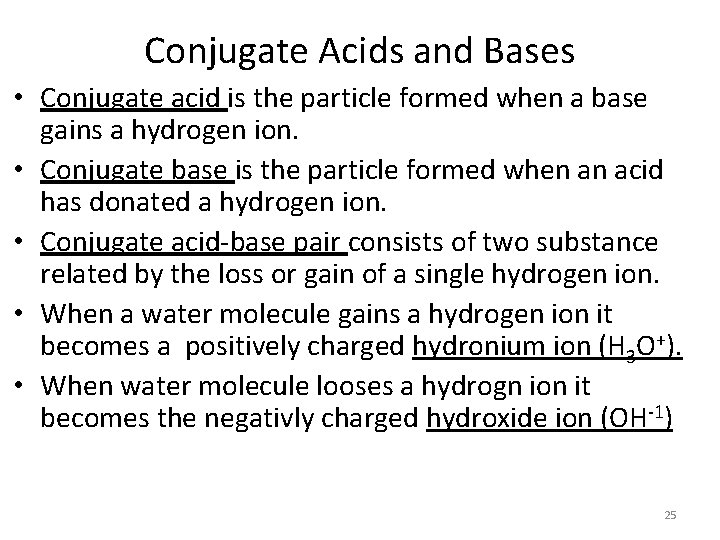
Conjugate Acids and Bases • Conjugate acid is the particle formed when a base gains a hydrogen ion. • Conjugate base is the particle formed when an acid has donated a hydrogen ion. • Conjugate acid-base pair consists of two substance related by the loss or gain of a single hydrogen ion. • When a water molecule gains a hydrogen ion it becomes a positively charged hydronium ion (H 3 O+). • When water molecule looses a hydrogn ion it becomes the negativly charged hydroxide ion (OH-1) 25
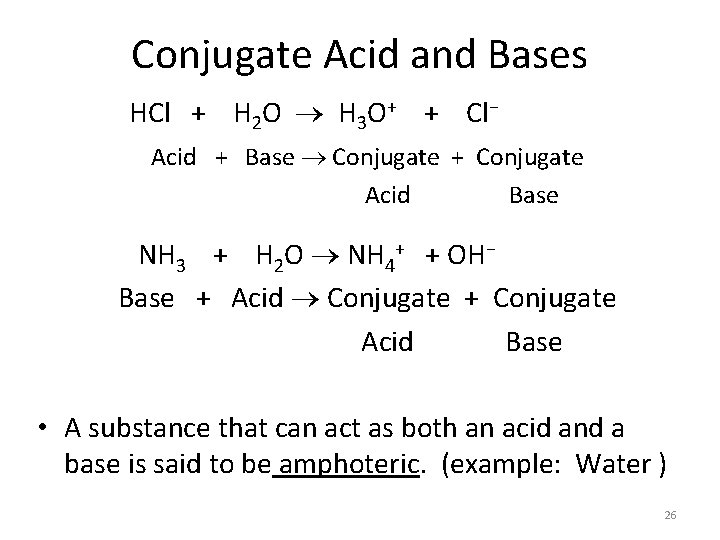
Conjugate Acid and Bases HCl + H 2 O H 3 O+ + Cl− Acid + Base Conjugate + Conjugate Acid Base NH 3 + H 2 O NH 4+ + OH− Base + Acid Conjugate + Conjugate Acid Base • A substance that can act as both an acid and a base is said to be amphoteric. (example: Water ) 26
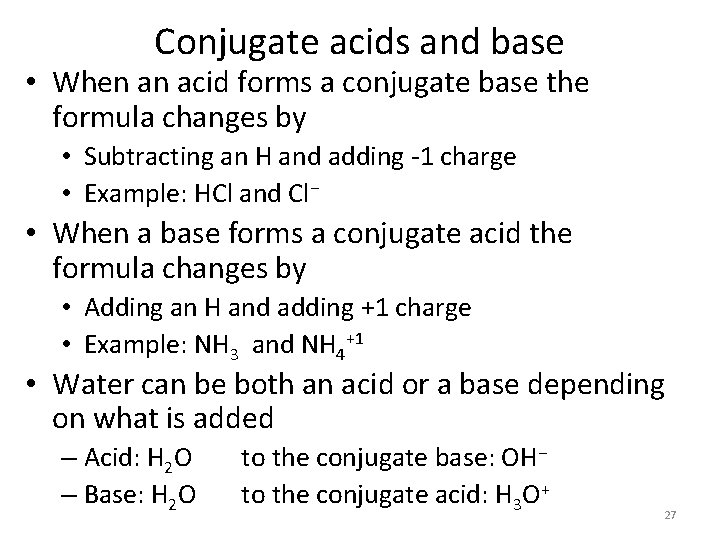
Conjugate acids and base • When an acid forms a conjugate base the formula changes by • Subtracting an H and adding -1 charge • Example: HCl and Cl− • When a base forms a conjugate acid the formula changes by • Adding an H and adding +1 charge • Example: NH 3 and NH 4+1 • Water can be both an acid or a base depending on what is added – Acid: H 2 O – Base: H 2 O to the conjugate base: OH− to the conjugate acid: H 3 O+ 27
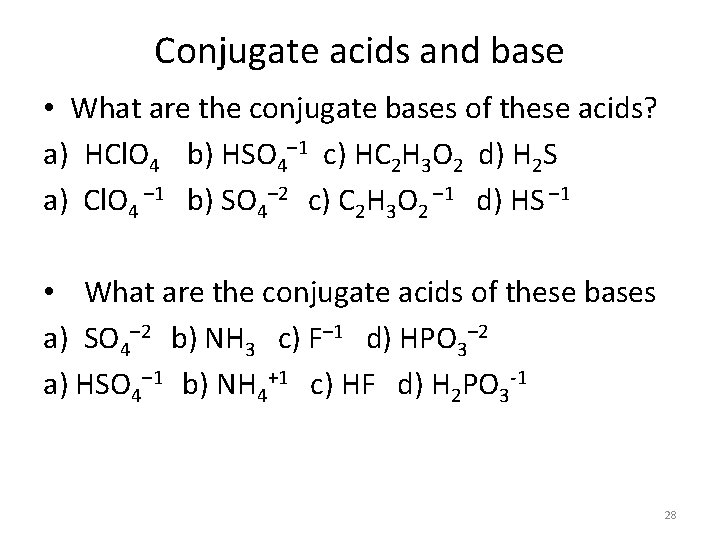
Conjugate acids and base • What are the conjugate bases of these acids? a) HCl. O 4 b) HSO 4– 1 c) HC 2 H 3 O 2 d) H 2 S a) Cl. O 4 – 1 b) SO 4– 2 c) C 2 H 3 O 2 – 1 d) HS – 1 • What are the conjugate acids of these bases a) SO 4– 2 b) NH 3 c) F– 1 d) HPO 3– 2 a) HSO 4– 1 b) NH 4+1 c) HF d) H 2 PO 3 -1 28
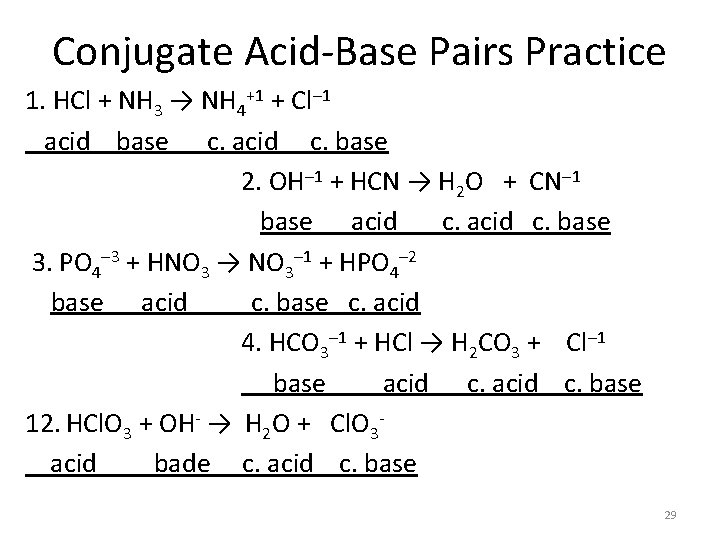
Conjugate Acid-Base Pairs Practice 1. HCl + NH 3 → NH 4+1 + Cl– 1 acid base c. acid c. base 2. OH– 1 + HCN → H 2 O + CN– 1 base acid c. base 3. PO 4– 3 + HNO 3 → NO 3– 1 + HPO 4– 2 base acid c. base c. acid 4. HCO 3– 1 + HCl → H 2 CO 3 + Cl– 1 base acid c. acid c. base 12. HCl. O 3 + OH- → H 2 O + Cl. O 3 acid bade c. acid c. base 29
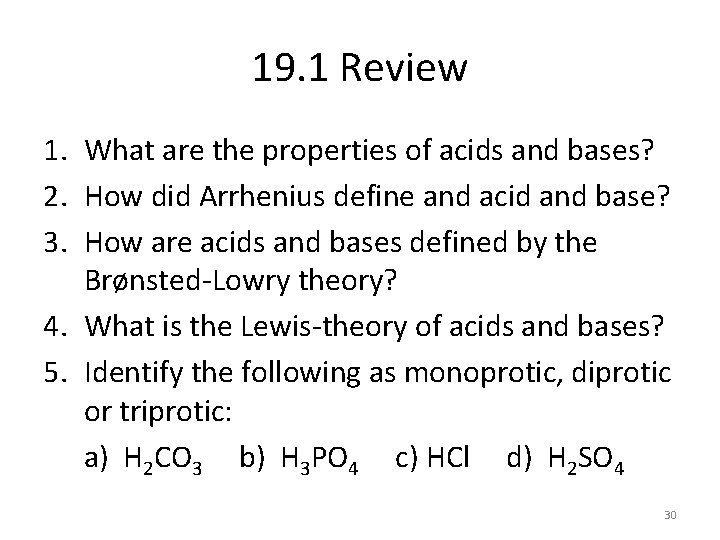
19. 1 Review 1. What are the properties of acids and bases? 2. How did Arrhenius define and acid and base? 3. How are acids and bases defined by the Brønsted-Lowry theory? 4. What is the Lewis-theory of acids and bases? 5. Identify the following as monoprotic, diprotic or triprotic: a) H 2 CO 3 b) H 3 PO 4 c) HCl d) H 2 SO 4 30
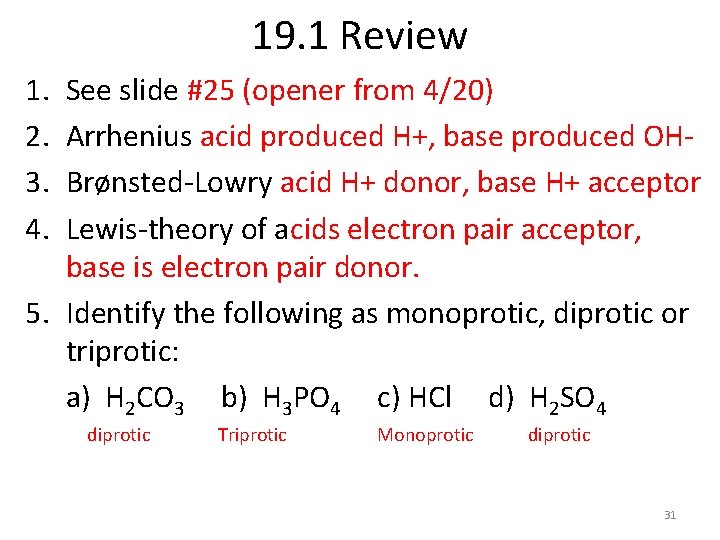
19. 1 Review 1. 2. 3. 4. See slide #25 (opener from 4/20) Arrhenius acid produced H+, base produced OHBrønsted-Lowry acid H+ donor, base H+ acceptor Lewis-theory of acids electron pair acceptor, base is electron pair donor. 5. Identify the following as monoprotic, diprotic or triprotic: a) H 2 CO 3 b) H 3 PO 4 c) HCl d) H 2 SO 4 diprotic Triprotic Monoprotic diprotic 31
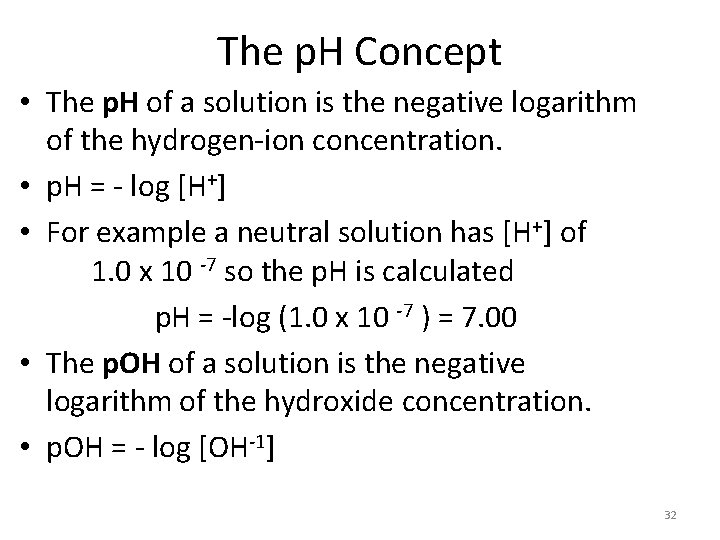
The p. H Concept • The p. H of a solution is the negative logarithm of the hydrogen-ion concentration. • p. H = - log [H+] • For example a neutral solution has [H+] of 1. 0 x 10 -7 so the p. H is calculated p. H = -log (1. 0 x 10 -7 ) = 7. 00 • The p. OH of a solution is the negative logarithm of the hydroxide concentration. • p. OH = - log [OH-1] 32
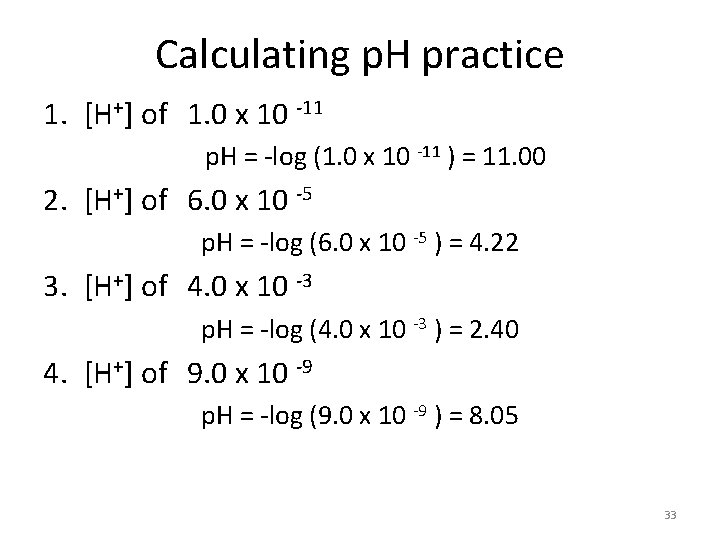
Calculating p. H practice 1. [H+] of 1. 0 x 10 -11 p. H = -log (1. 0 x 10 -11 ) = 11. 00 2. [H+] of 6. 0 x 10 -5 p. H = -log (6. 0 x 10 -5 ) = 4. 22 3. [H+] of 4. 0 x 10 -3 p. H = -log (4. 0 x 10 -3 ) = 2. 40 4. [H+] of 9. 0 x 10 -9 p. H = -log (9. 0 x 10 -9 ) = 8. 05 33
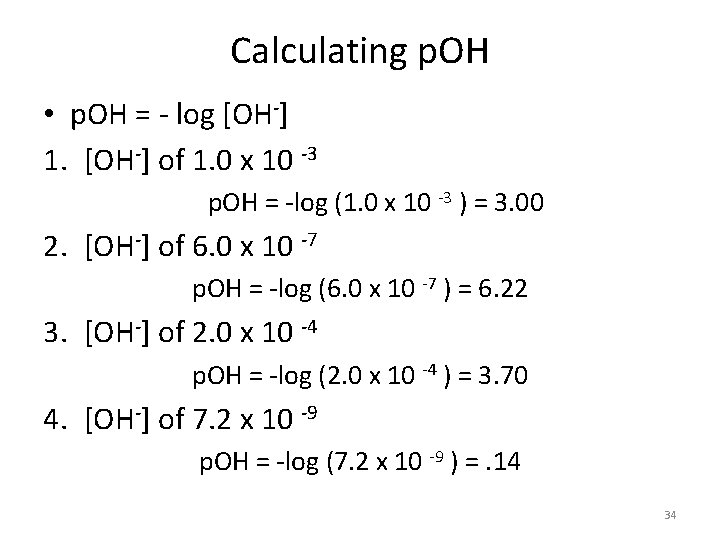
Calculating p. OH • p. OH = - log [OH-] 1. [OH-] of 1. 0 x 10 -3 p. OH = -log (1. 0 x 10 -3 ) = 3. 00 2. [OH-] of 6. 0 x 10 -7 p. OH = -log (6. 0 x 10 -7 ) = 6. 22 3. [OH-] of 2. 0 x 10 -4 p. OH = -log (2. 0 x 10 -4 ) = 3. 70 4. [OH-] of 7. 2 x 10 -9 p. OH = -log (7. 2 x 10 -9 ) =. 14 34
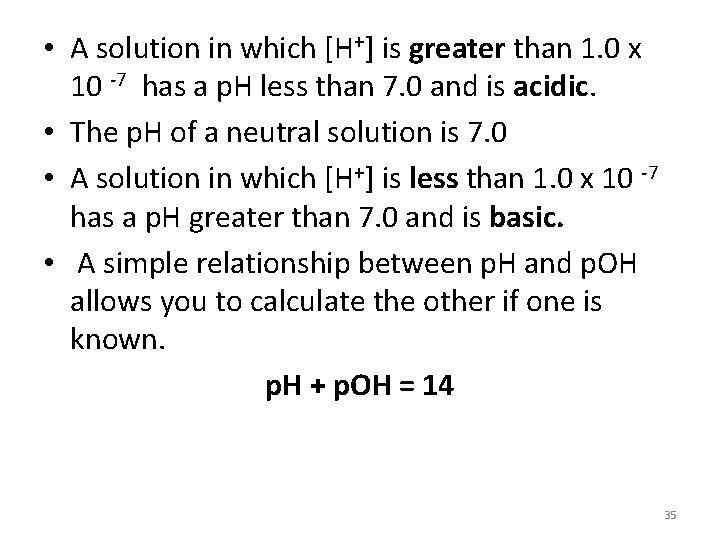
• A solution in which [H+] is greater than 1. 0 x 10 -7 has a p. H less than 7. 0 and is acidic. • The p. H of a neutral solution is 7. 0 • A solution in which [H+] is less than 1. 0 x 10 -7 has a p. H greater than 7. 0 and is basic. • A simple relationship between p. H and p. OH allows you to calculate the other if one is known. p. H + p. OH = 14 35
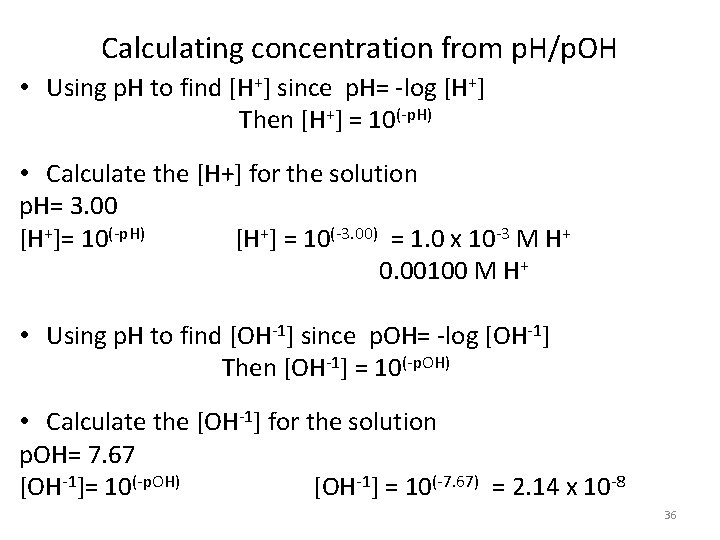
Calculating concentration from p. H/p. OH • Using p. H to find [H+] since p. H= -log [H+] Then [H+] = 10(-p. H) • Calculate the [H+] for the solution p. H= 3. 00 [H+]= 10(-p. H) [H+] = 10(-3. 00) = 1. 0 x 10 -3 M H+ 0. 00100 M H+ • Using p. H to find [OH-1] since p. OH= -log [OH-1] Then [OH-1] = 10(-p. OH) • Calculate the [OH-1] for the solution p. OH= 7. 67 [OH-1]= 10(-p. OH) [OH-1] = 10(-7. 67) = 2. 14 x 10 -8 36

p. H to p. OH • If [H+1] is 2. 5 x 10 -4 what is the p. OH p. H = -log [2. 5 x 10 -4 ] = 3. 60 p. OH = 14 – 3. 60 = 10. 40 • If the [OH-1] is 6. 8 x 10 -12 what is the p. H p. OH = -log [6. 8 x 10 -12 ] = 11. 17 p. H = 14 – 11. 17 = 2. 83 37
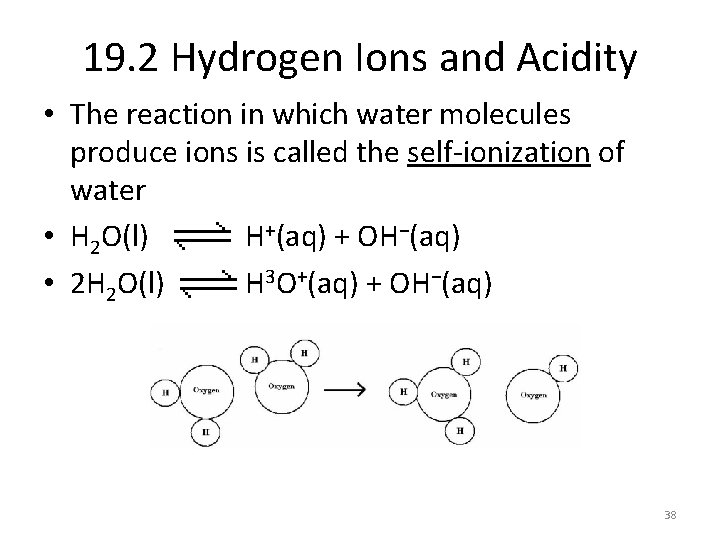
19. 2 Hydrogen Ions and Acidity • The reaction in which water molecules produce ions is called the self-ionization of water • H 2 O(l) H+(aq) + OH−(aq) • 2 H 2 O(l) H 3 O+(aq) + OH−(aq) 38
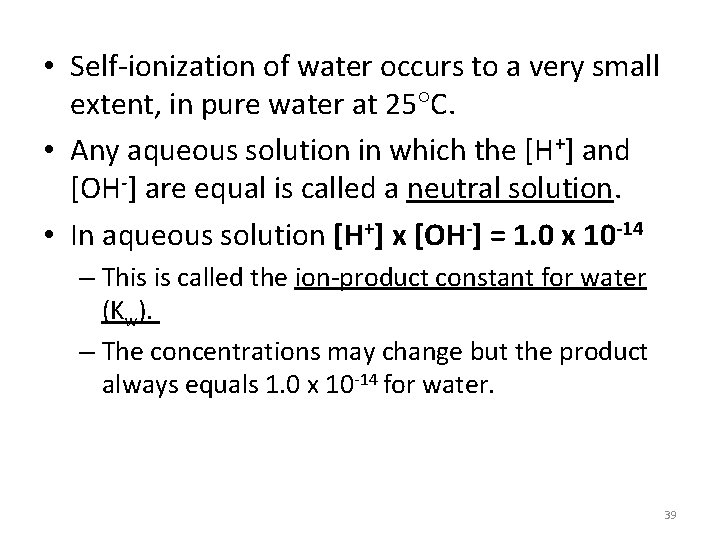
• Self-ionization of water occurs to a very small extent, in pure water at 25 C. • Any aqueous solution in which the [H+] and [OH-] are equal is called a neutral solution. • In aqueous solution [H+] x [OH-] = 1. 0 x 10 -14 – This is called the ion-product constant for water (Kw). – The concentrations may change but the product always equals 1. 0 x 10 -14 for water. 39
40
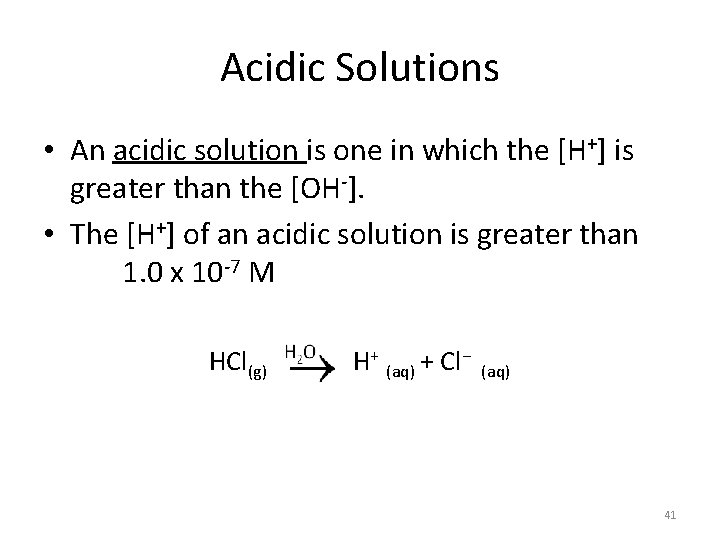
Acidic Solutions • An acidic solution is one in which the [H+] is greater than the [OH-]. • The [H+] of an acidic solution is greater than 1. 0 x 10 -7 M HCl(g) H+ (aq) + Cl− (aq) 41
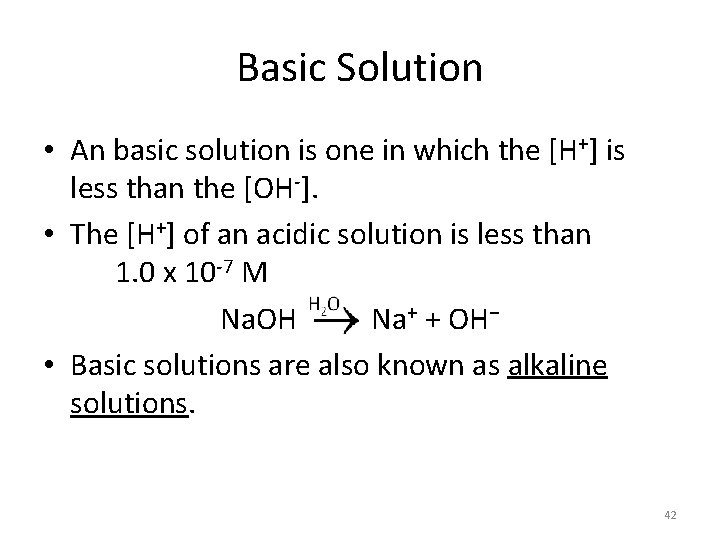
Basic Solution • An basic solution is one in which the [H+] is less than the [OH-]. • The [H+] of an acidic solution is less than 1. 0 x 10 -7 M Na. OH Na+ + OH− • Basic solutions are also known as alkaline solutions. 42
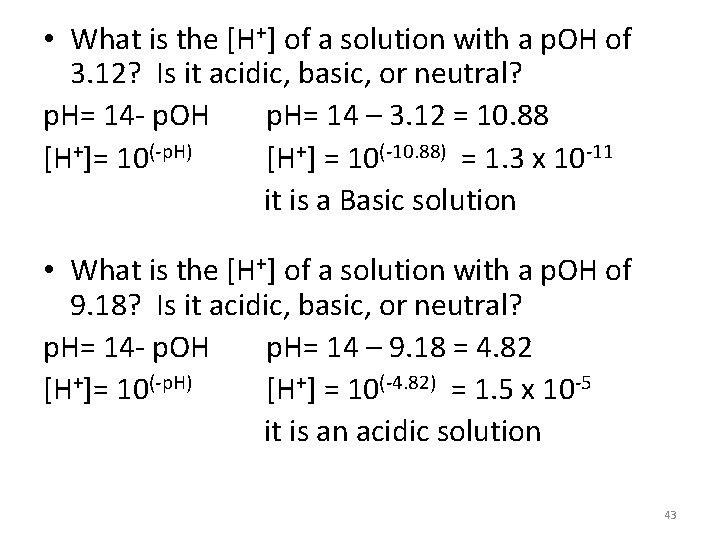
• What is the [H+] of a solution with a p. OH of 3. 12? Is it acidic, basic, or neutral? p. H= 14 - p. OH p. H= 14 – 3. 12 = 10. 88 [H+]= 10(-p. H) [H+] = 10(-10. 88) = 1. 3 x 10 -11 it is a Basic solution • What is the [H+] of a solution with a p. OH of 9. 18? Is it acidic, basic, or neutral? p. H= 14 - p. OH p. H= 14 – 9. 18 = 4. 82 [H+]= 10(-p. H) [H+] = 10(-4. 82) = 1. 5 x 10 -5 it is an acidic solution 43
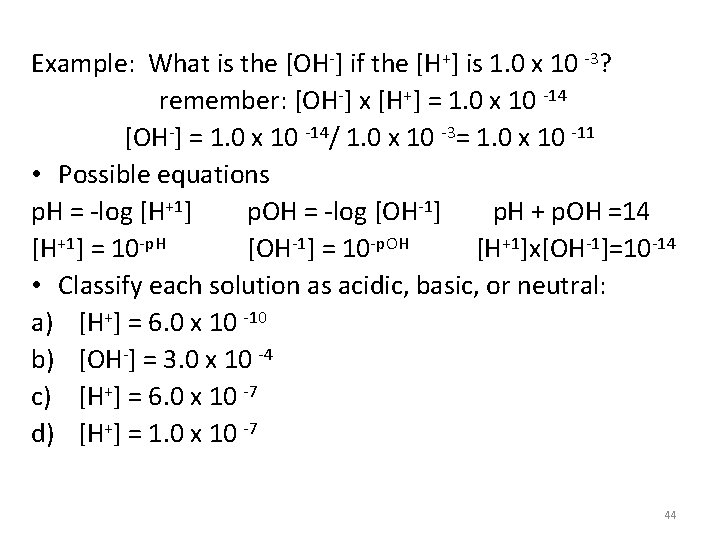
Example: What is the [OH-] if the [H+] is 1. 0 x 10 -3? remember: [OH-] x [H+] = 1. 0 x 10 -14 [OH-] = 1. 0 x 10 -14/ 1. 0 x 10 -3= 1. 0 x 10 -11 • Possible equations p. H = -log [H+1] p. OH = -log [OH-1] p. H + p. OH =14 [H+1] = 10 -p. H [OH-1] = 10 -p. OH [H+1]x[OH-1]=10 -14 • Classify each solution as acidic, basic, or neutral: a) [H+] = 6. 0 x 10 -10 b) [OH-] = 3. 0 x 10 -4 c) [H+] = 6. 0 x 10 -7 d) [H+] = 1. 0 x 10 -7 44
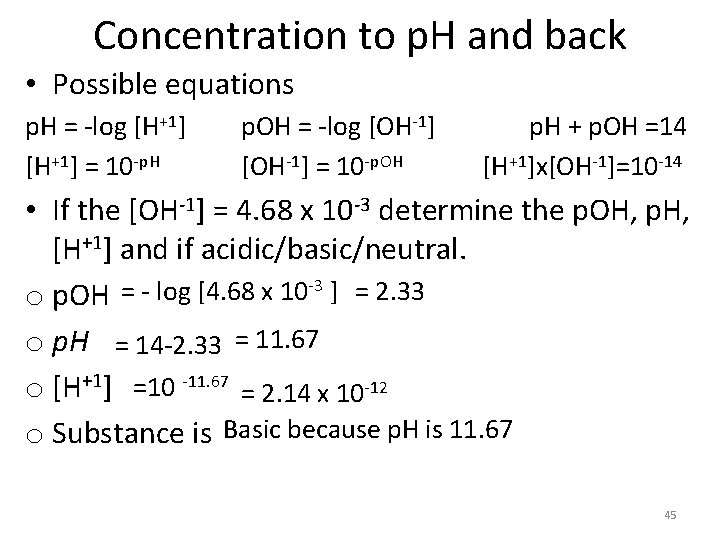
Concentration to p. H and back • Possible equations p. H = -log [H+1] = 10 -p. H p. OH = -log [OH-1] p. H + p. OH =14 [OH-1] = 10 -p. OH [H+1]x[OH-1]=10 -14 • If the [OH-1] = 4. 68 x 10 -3 determine the p. OH, p. H, [H+1] and if acidic/basic/neutral. -3 ] = 2. 33 = - log [4. 68 x 10 o p. OH o p. H = 14 -2. 33 = 11. 67 o [H+1] =10 -11. 67 = 2. 14 x 10 -12 o Substance is Basic because p. H is 11. 67 45
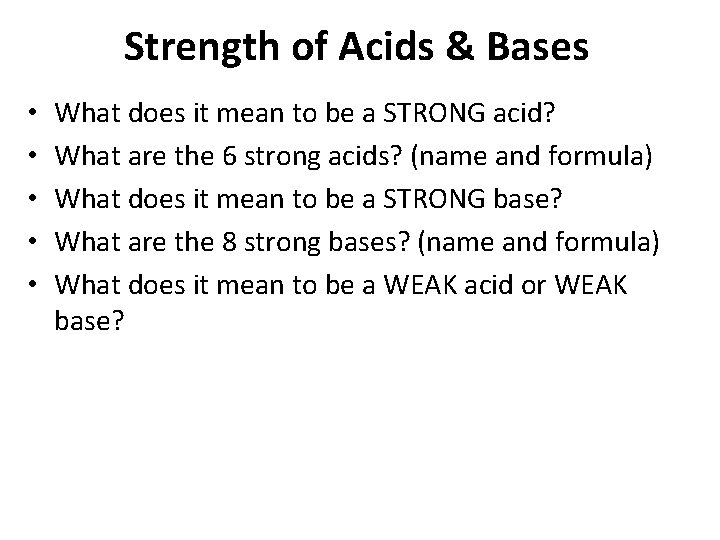
Strength of Acids & Bases • • • What does it mean to be a STRONG acid? What are the 6 strong acids? (name and formula) What does it mean to be a STRONG base? What are the 8 strong bases? (name and formula) What does it mean to be a WEAK acid or WEAK base?
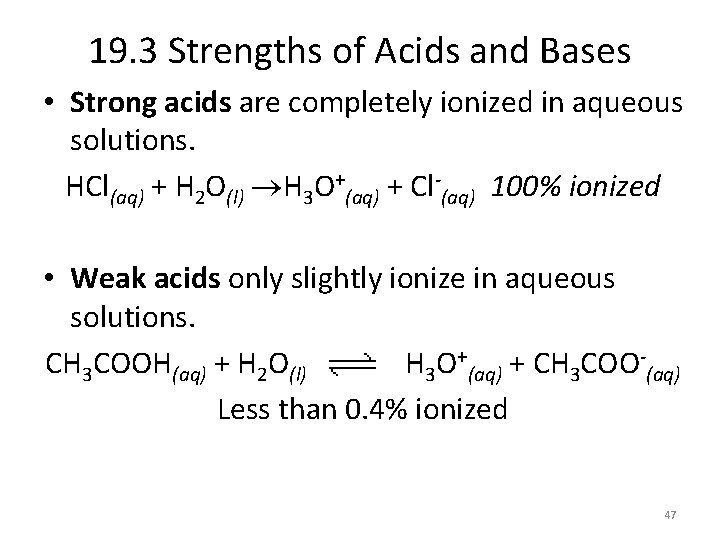
19. 3 Strengths of Acids and Bases • Strong acids are completely ionized in aqueous solutions. HCl(aq) + H 2 O(l) H 3 O+(aq) + Cl-(aq) 100% ionized • Weak acids only slightly ionize in aqueous solutions. CH 3 COOH(aq) + H 2 O(l) H 3 O+(aq) + CH 3 COO-(aq) Less than 0. 4% ionized 47
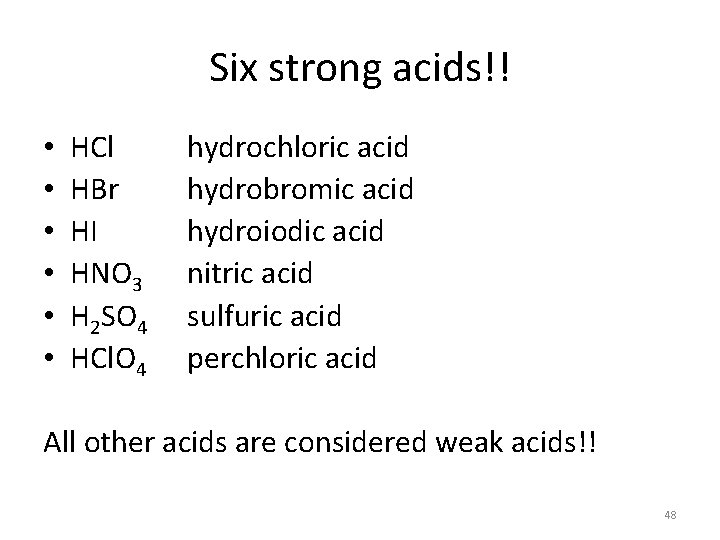
Six strong acids!! • • • HCl HBr HI HNO 3 H 2 SO 4 HCl. O 4 hydrochloric acid hydrobromic acid hydroiodic acid nitric acid sulfuric acid perchloric acid All other acids are considered weak acids!! 48
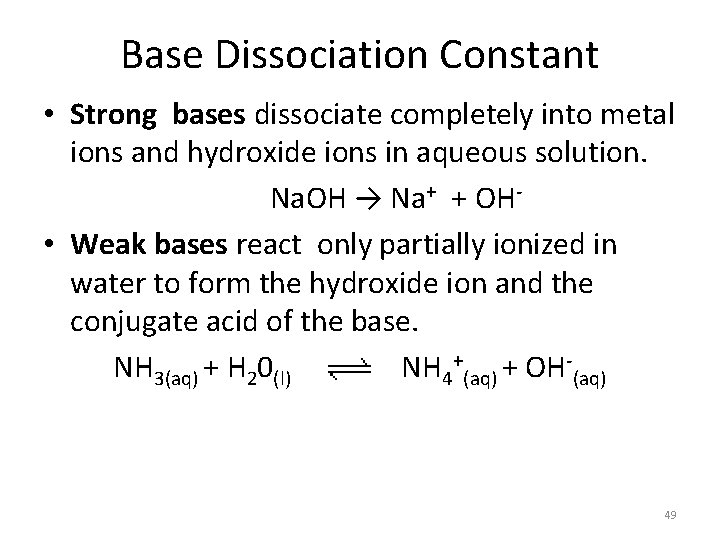
Base Dissociation Constant • Strong bases dissociate completely into metal ions and hydroxide ions in aqueous solution. Na. OH → Na+ + OH • Weak bases react only partially ionized in water to form the hydroxide ion and the conjugate acid of the base. NH 3(aq) + H 20(l) NH 4+(aq) + OH-(aq) 49
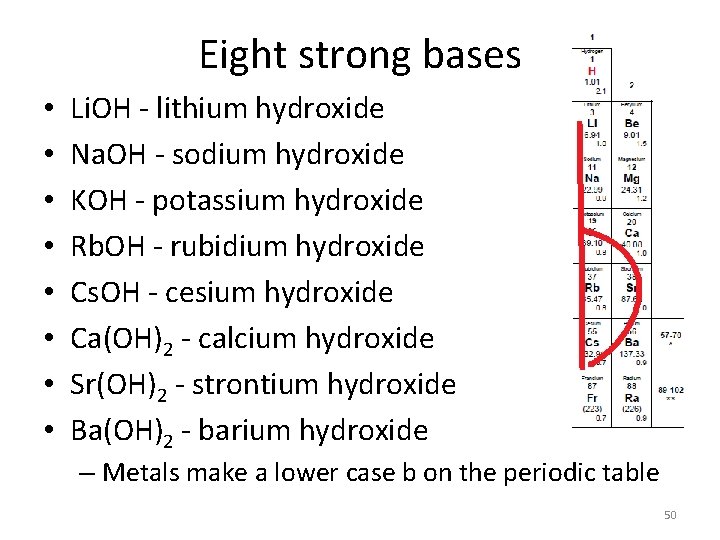
Eight strong bases • • Li. OH - lithium hydroxide Na. OH - sodium hydroxide KOH - potassium hydroxide Rb. OH - rubidium hydroxide Cs. OH - cesium hydroxide Ca(OH)2 - calcium hydroxide Sr(OH)2 - strontium hydroxide Ba(OH)2 - barium hydroxide – Metals make a lower case b on the periodic table 50
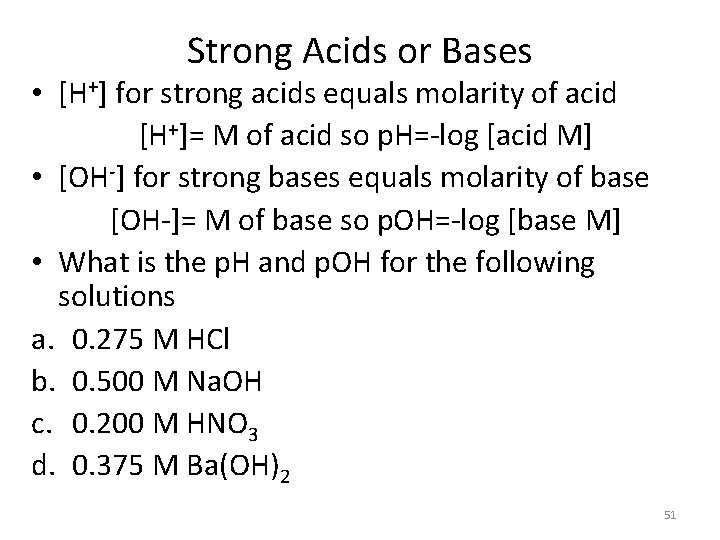
Strong Acids or Bases • [H+] for strong acids equals molarity of acid [H+]= M of acid so p. H=-log [acid M] • [OH-] for strong bases equals molarity of base [OH-]= M of base so p. OH=-log [base M] • What is the p. H and p. OH for the following solutions a. 0. 275 M HCl b. 0. 500 M Na. OH c. 0. 200 M HNO 3 d. 0. 375 M Ba(OH)2 51
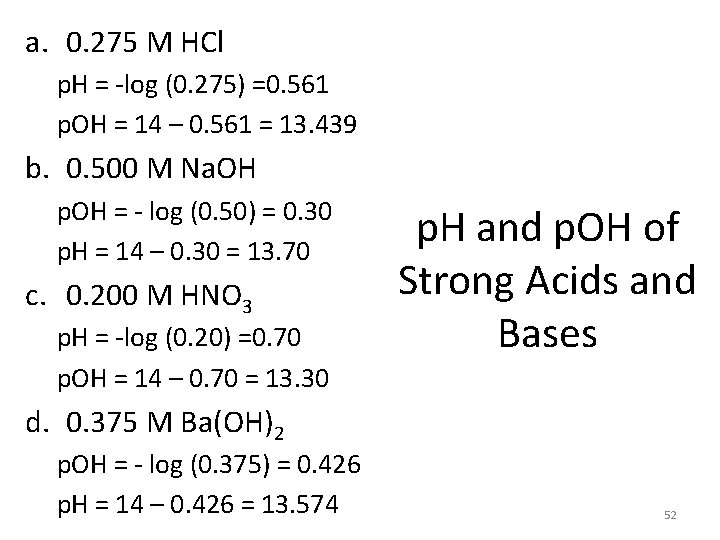
a. 0. 275 M HCl p. H = -log (0. 275) =0. 561 p. OH = 14 – 0. 561 = 13. 439 b. 0. 500 M Na. OH p. OH = - log (0. 50) = 0. 30 p. H = 14 – 0. 30 = 13. 70 c. 0. 200 M HNO 3 p. H = -log (0. 20) =0. 70 p. OH = 14 – 0. 70 = 13. 30 p. H and p. OH of Strong Acids and Bases d. 0. 375 M Ba(OH)2 p. OH = - log (0. 375) = 0. 426 p. H = 14 – 0. 426 = 13. 574 52
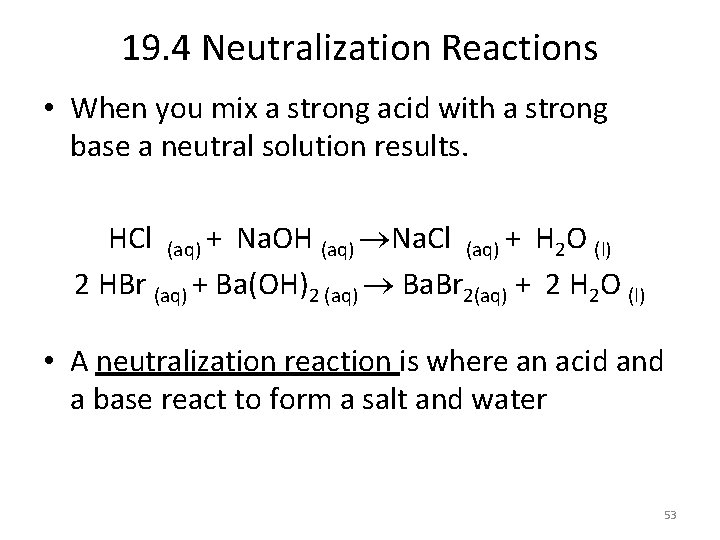
19. 4 Neutralization Reactions • When you mix a strong acid with a strong base a neutral solution results. HCl (aq) + Na. OH (aq) Na. Cl (aq) + H 2 O (l) 2 HBr (aq) + Ba(OH)2 (aq) Ba. Br 2(aq) + 2 H 2 O (l) • A neutralization reaction is where an acid and a base react to form a salt and water 53
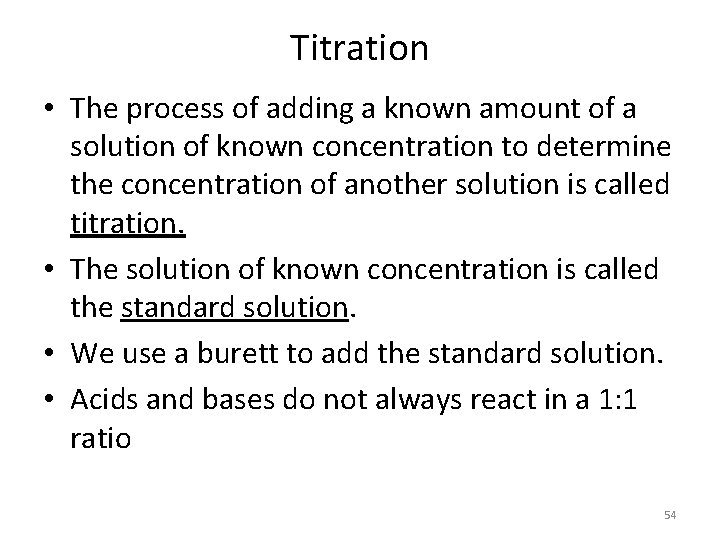
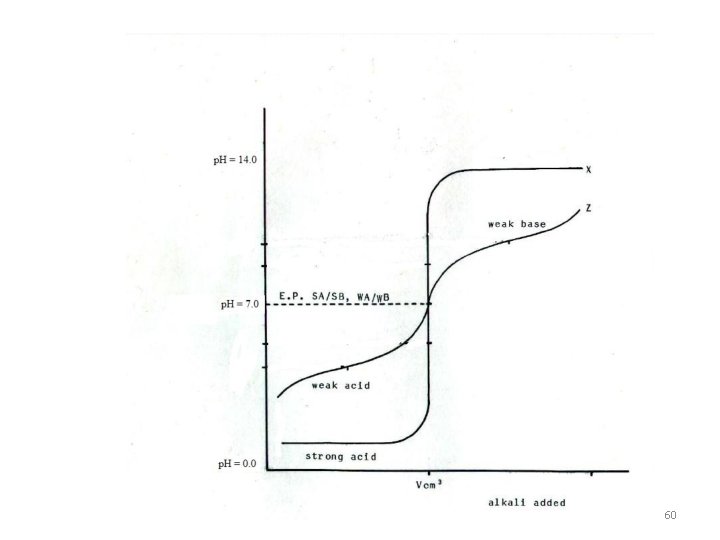
Titration • The process of adding a known amount of a solution of known concentration to determine the concentration of another solution is called titration. • The solution of known concentration is called the standard solution. • We use a burett to add the standard solution. • Acids and bases do not always react in a 1: 1 ratio 54
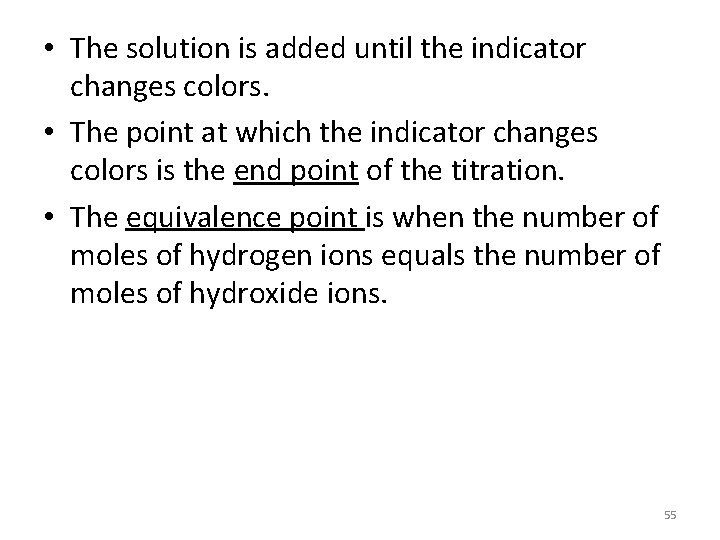
• The solution is added until the indicator changes colors. • The point at which the indicator changes colors is the end point of the titration. • The equivalence point is when the number of moles of hydrogen ions equals the number of moles of hydroxide ions. 55
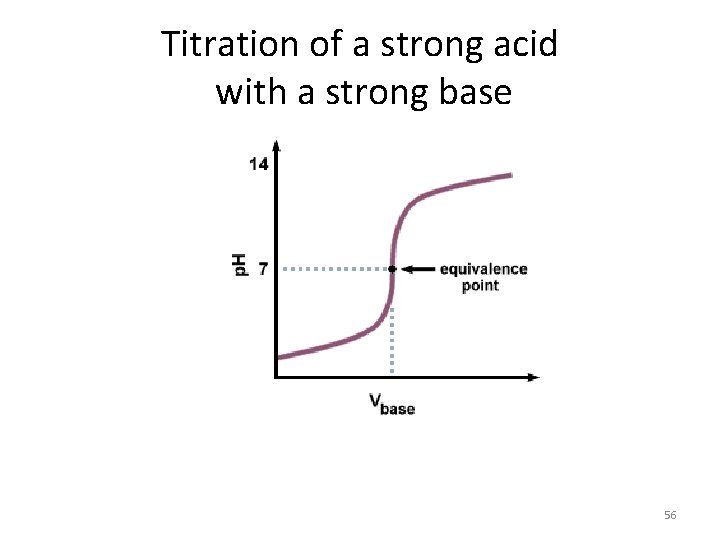
Titration of a strong acid with a strong base 56
19. 5 Salts in Solution • A salt consists of an anion from an acid and a cation from a base. It forms as the result of a neutralization reaction. • A buffer is a solution in which the p. H remains relatively constant when small amount of acid or base are added. • A buffer is a solution of a weak acid and one of its salts, or a solution of a weak base and one of its salts. • Buffers are able to resist drastic changes in p. H. 57
19. 5 • Salt hydrolysis the cations or anions of a dissociated salt remove hydrogen ions from or donate hydrogen ions to the water. • In general, salts that produce acidic solutions contain positive ions that release protons to water • Salts that produce basic solutions contain negative ions that attract protons from water. 58
• The buffering capacity is the amount of acid or base that can be added to a buffer solution before a significant change in p. H occurs. • Buffer systems are crucial in maintaining human blood p. H within a narrow range. 59
60
- Slides: 60