
Unit 9 Solids Lesson 9 1 Day 1
- Slides: 69
Unit 9 Solids
Lesson 9. 1 Day 1: Identifying Solids
Lesson 9. 1 Objectives l l l Define a polyhedron Identify properties of polyhedra Utilize Euler’s Theorem Identify a prism Identify a cylinder Calculate the surface area of prisms and cylinders (G 1. 8. 1)
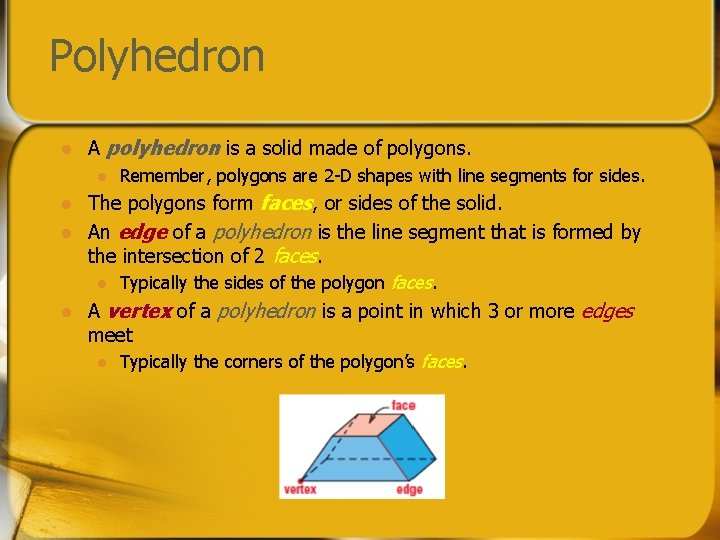
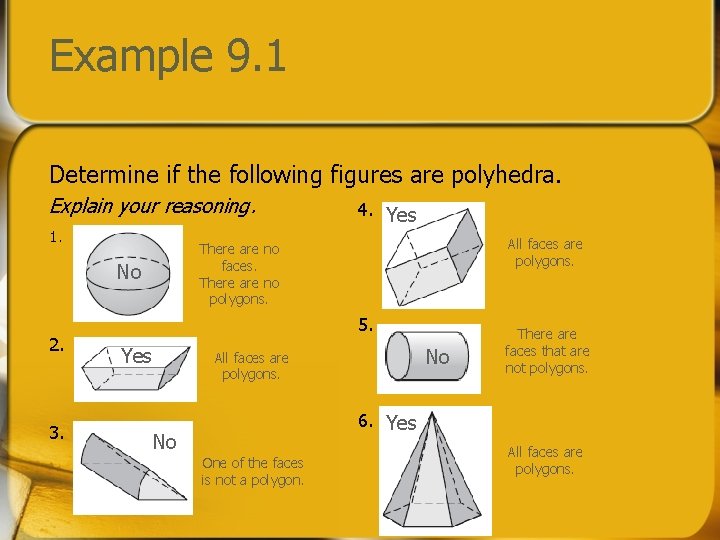
Polyhedron l A polyhedron is a solid made of polygons. l l Remember, polygons are 2 -D shapes with line segments for sides. The polygons form faces, or sides of the solid. An edge of a polyhedron is the line segment that is formed by the intersection of 2 faces. l Typically the sides of the polygon faces. A vertex of a polyhedron is a point in which 3 or more edges meet l Typically the corners of the polygon’s faces.
Example 9. 1 Determine if the following figures are polyhedra. Explain your reasoning. 1. 3. All faces are polygons. There are no faces. There are no polygons. No 2. 4. Yes 5. Yes No All faces are polygons. There are faces that are not polygons. 6. Yes No One of the faces is not a polygon. All faces are polygons.
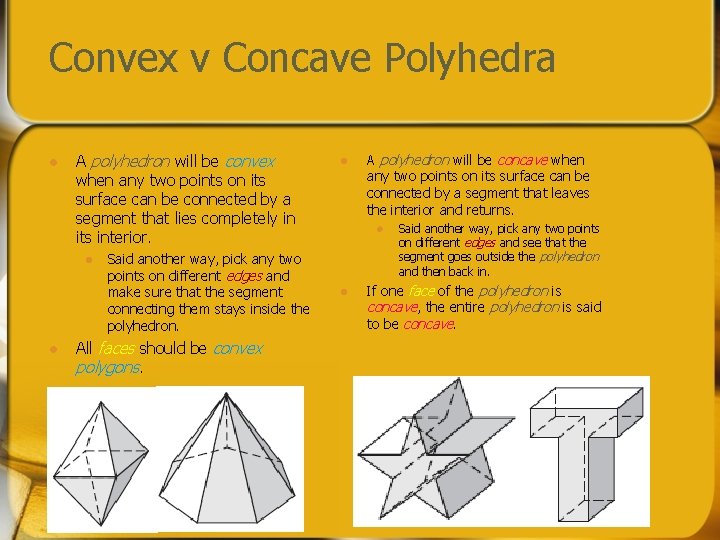
Convex v Concave Polyhedra l A polyhedron will be convex when any two points on its surface can be connected by a segment that lies completely in its interior. l l Said another way, pick any two points on different edges and make sure that the segment connecting them stays inside the polyhedron. All faces should be convex polygons. l A polyhedron will be concave when any two points on its surface can be connected by a segment that leaves the interior and returns. l l Said another way, pick any two points on different edges and see that the segment goes outside the polyhedron and then back in. If one face of the polyhedron is concave, the entire polyhedron is said to be concave.
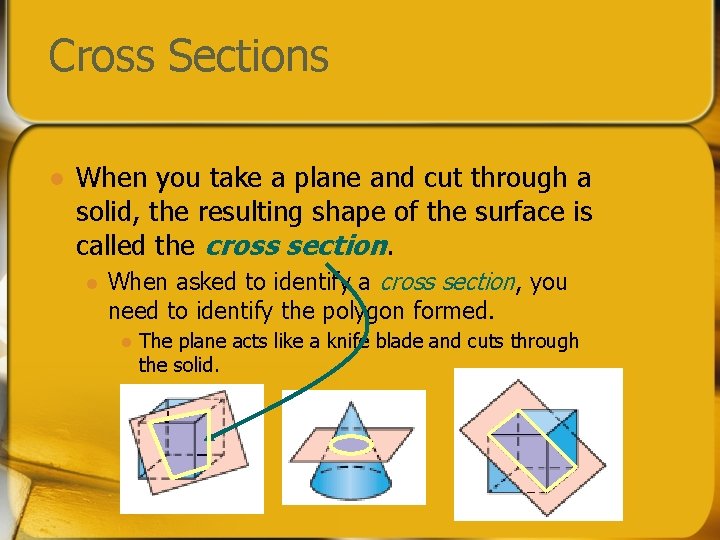
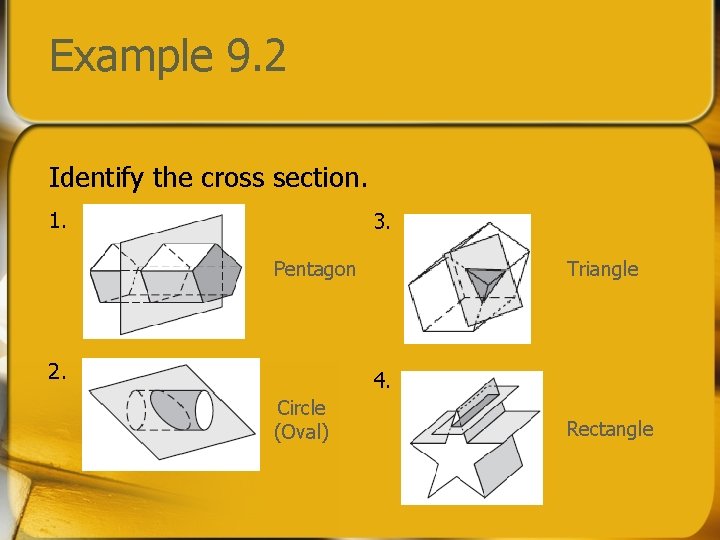
Cross Sections l When you take a plane and cut through a solid, the resulting shape of the surface is called the cross section. l When asked to identify a cross section, you need to identify the polygon formed. l The plane acts like a knife blade and cuts through the solid.
Example 9. 2 Identify the cross section. 1. 3. Pentagon 2. Triangle 4. Circle (Oval) Rectangle
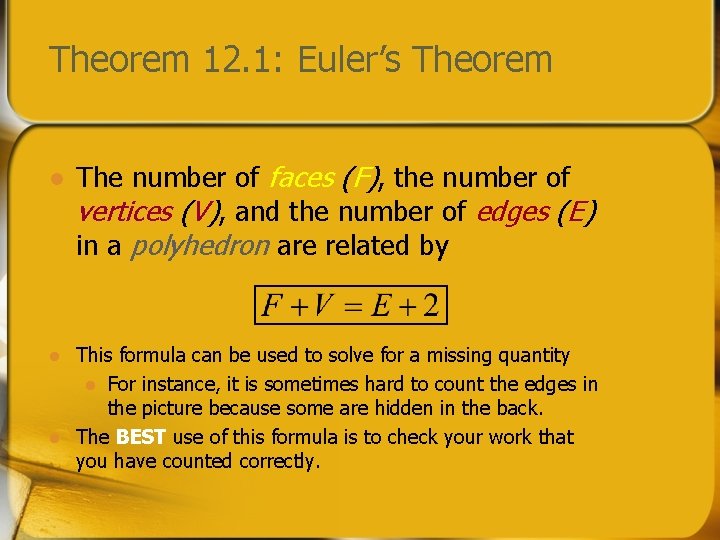
Theorem 12. 1: Euler’s Theorem l l l The number of faces (F), the number of vertices (V), and the number of edges (E) in a polyhedron are related by This formula can be used to solve for a missing quantity l For instance, it is sometimes hard to count the edges in the picture because some are hidden in the back. The BEST use of this formula is to check your work that you have counted correctly.
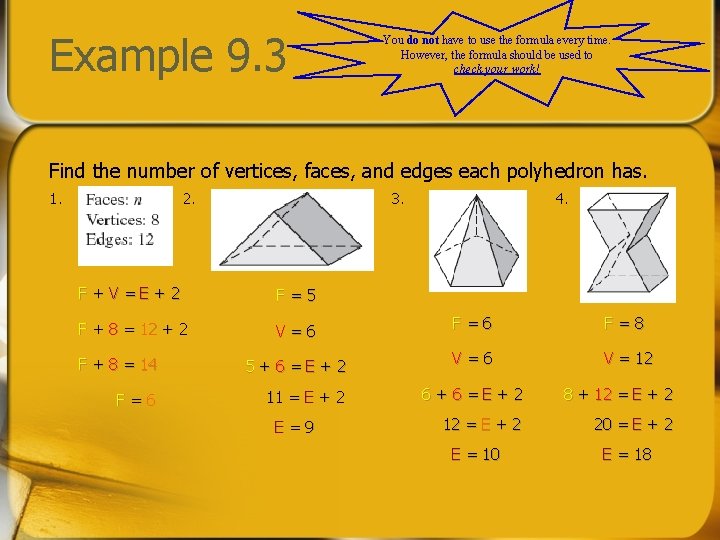
Example 9. 3 You do not have to use the formula every time. However, the formula should be used to check your work! Find the number of vertices, faces, and edges each polyhedron has. 1. 2. 3. 4. F+V=E+2 F=5 F + 8 = 12 + 2 V=6 F=8 F + 8 = 14 5+6=E+2 V=6 V = 12 F=6 11 = E + 2 E=9 6+6=E+2 8 + 12 = E + 2 20 = E + 2 E = 10 E = 18
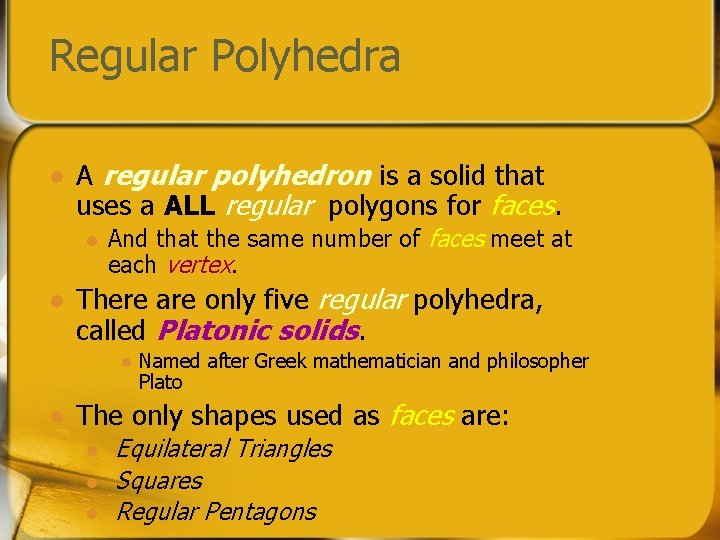
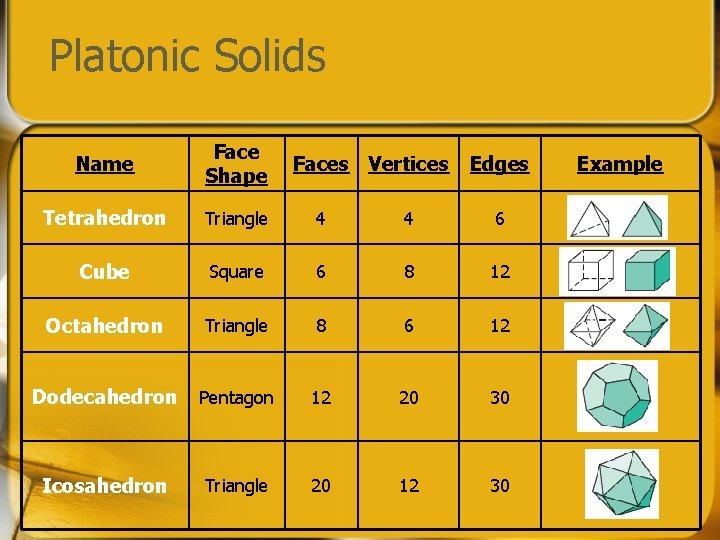
Regular Polyhedra l A regular polyhedron is a solid that uses a ALL regular polygons for faces. l l And that the same number of faces meet at each vertex. There are only five regular polyhedra, called Platonic solids. l l Named after Greek mathematician and philosopher Plato The only shapes used as faces are: l l l Equilateral Triangles Squares Regular Pentagons
Platonic Solids Name Face Shape Tetrahedron Triangle 4 4 6 Cube Square 6 8 12 Octahedron Triangle 8 6 12 Dodecahedron Pentagon 12 20 30 Icosahedron Triangle 20 12 30 Faces Vertices Edges Example
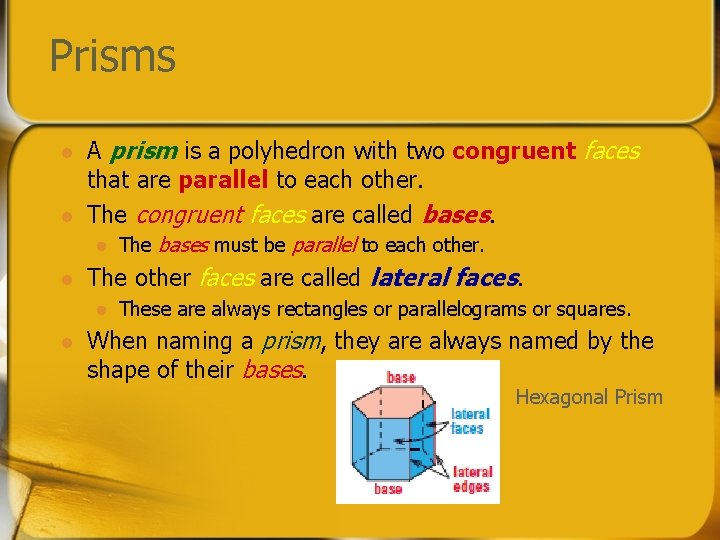
Prisms l l A prism is a polyhedron with two congruent faces that are parallel to each other. The congruent faces are called bases. l l The other faces are called lateral faces. l l The bases must be parallel to each other. These are always rectangles or parallelograms or squares. When naming a prism, they are always named by the shape of their bases. Hexagonal Prism
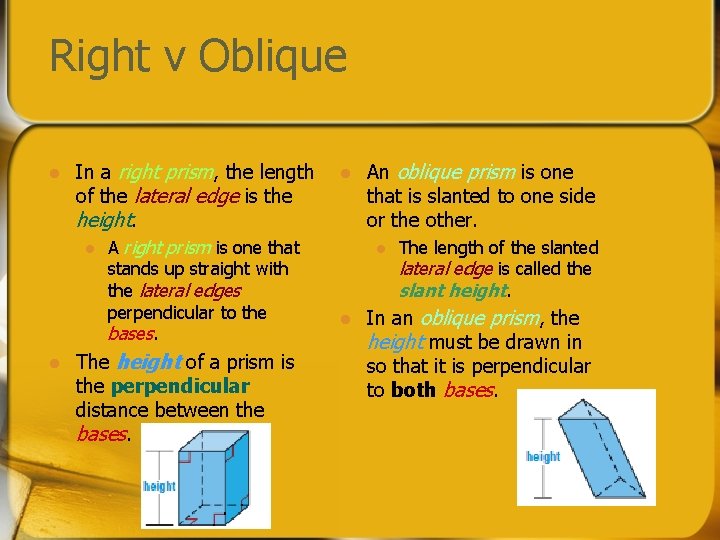
Right v Oblique l In a right prism, the length of the lateral edge is the height. l A right prism is one that stands up straight with the lateral edges perpendicular to the bases. l The height of a prism is the perpendicular distance between the bases. l An oblique prism is one that is slanted to one side or the other. l l The length of the slanted lateral edge is called the slant height. In an oblique prism, the height must be drawn in so that it is perpendicular to both bases.
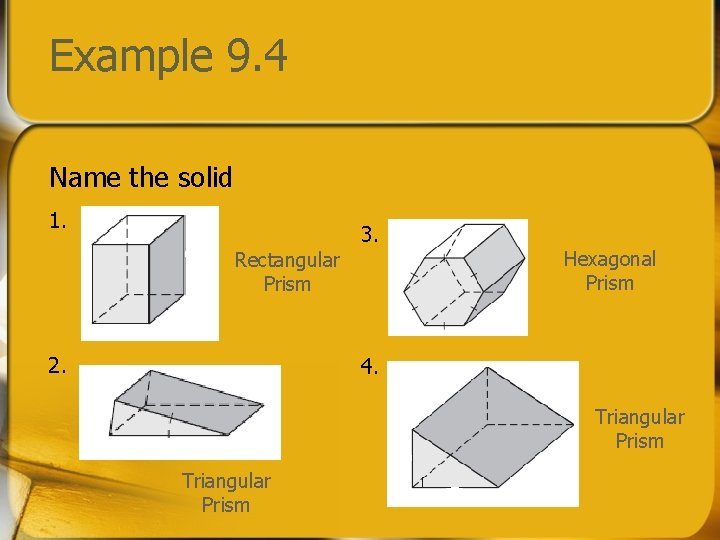
Example 9. 4 Name the solid 1. 3. Rectangular Prism 2. Hexagonal Prism 4. Triangular Prism
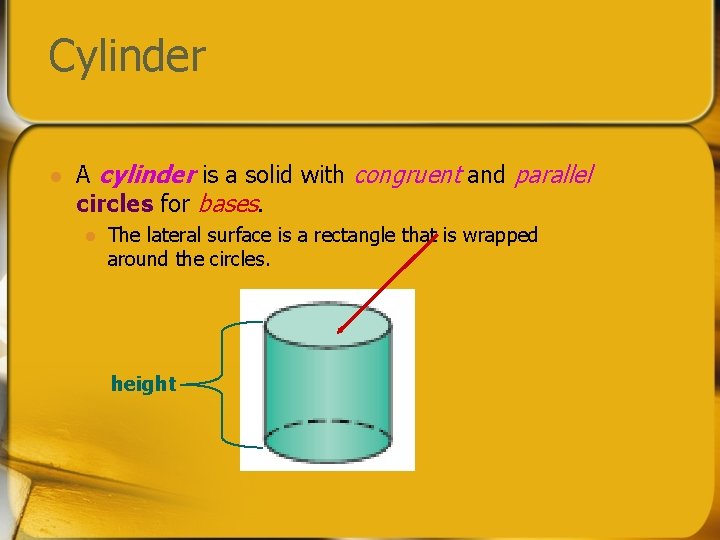
Cylinder l A cylinder is a solid with congruent and parallel circles for bases. l The lateral surface is a rectangle that is wrapped around the circles. height
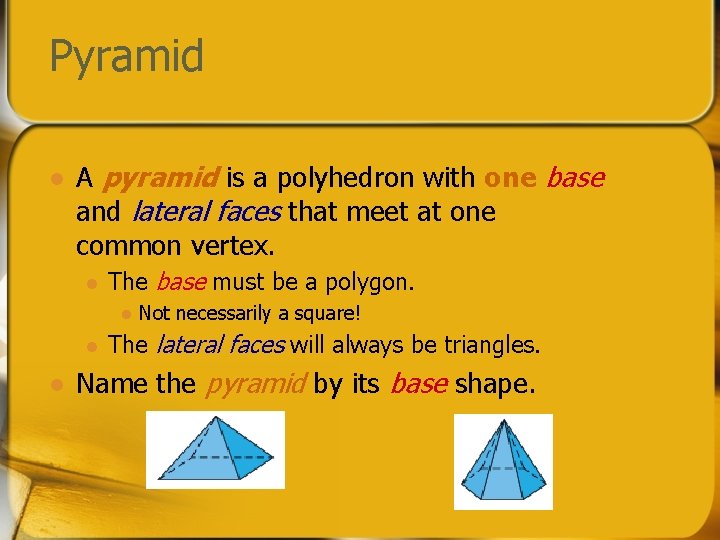
Pyramid l A pyramid is a polyhedron with one base and lateral faces that meet at one common vertex. l The base must be a polygon. l l l Not necessarily a square! The lateral faces will always be triangles. Name the pyramid by its base shape.
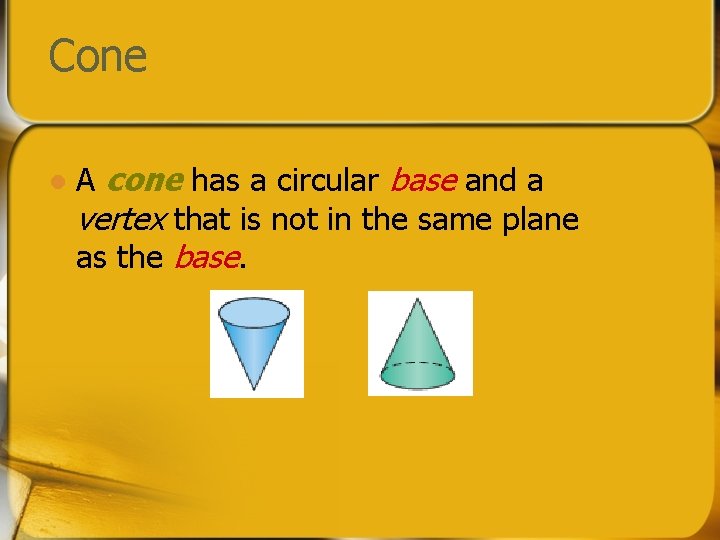
Cone l A cone has a circular base and a vertex that is not in the same plane as the base.
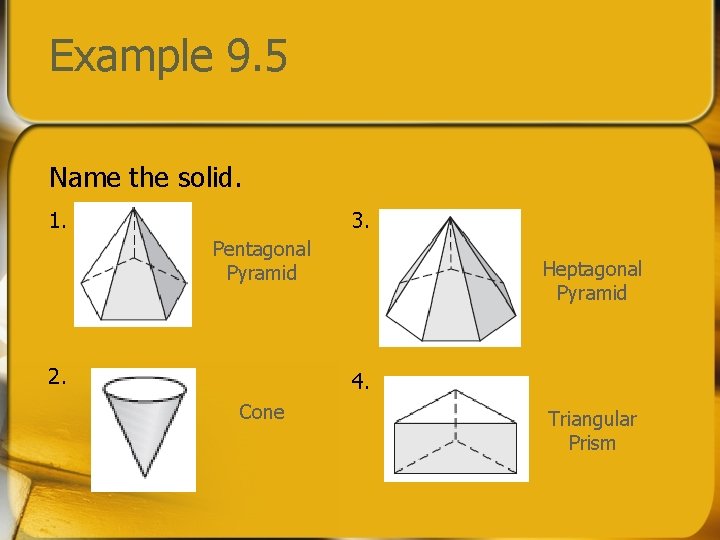
Example 9. 5 Name the solid. 1. 3. Pentagonal Pyramid 2. Heptagonal Pyramid 4. Cone Triangular Prism
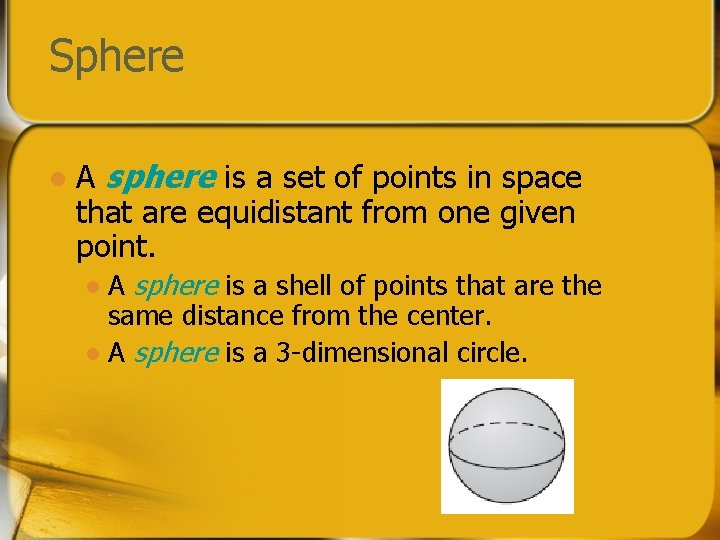
Sphere l A sphere is a set of points in space that are equidistant from one given point. A sphere is a shell of points that are the same distance from the center. l A sphere is a 3 -dimensional circle. l
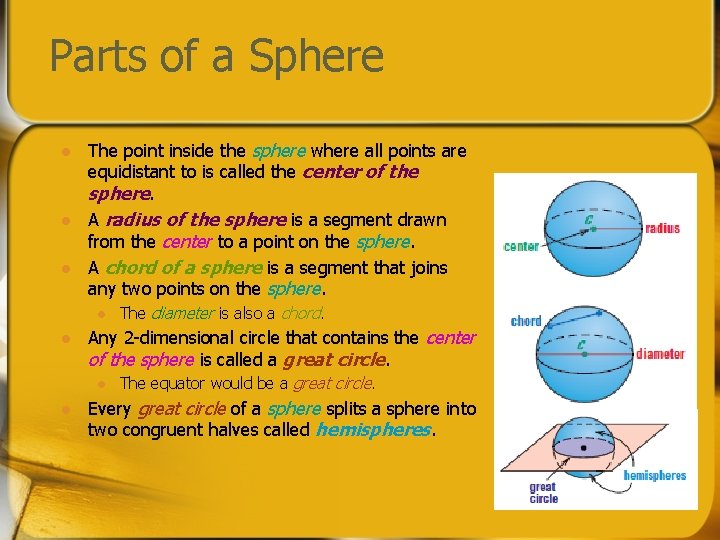
Parts of a Sphere l l l The point inside the sphere where all points are equidistant to is called the center of the sphere. A radius of the sphere is a segment drawn from the center to a point on the sphere. A chord of a sphere is a segment that joins any two points on the sphere. l l Any 2 -dimensional circle that contains the center of the sphere is called a great circle. l l The diameter is also a chord. The equator would be a great circle. Every great circle of a sphere splits a sphere into two congruent halves called hemispheres.
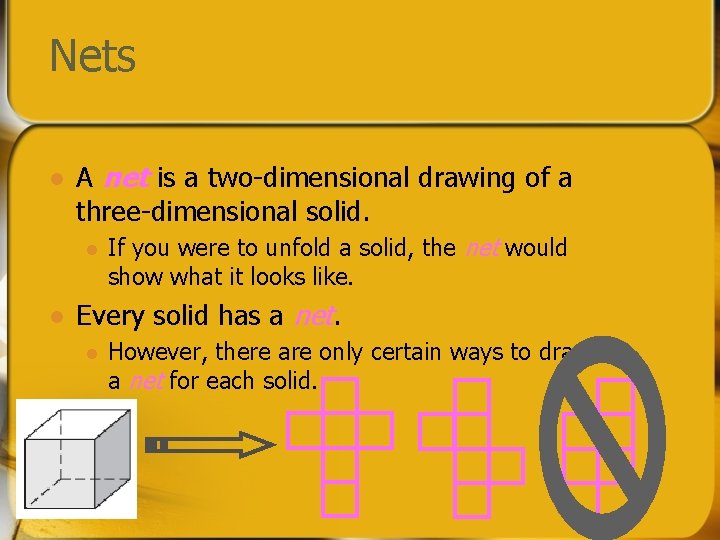
Nets l A net is a two-dimensional drawing of a three-dimensional solid. l l If you were to unfold a solid, the net would show what it looks like. Every solid has a net. l However, there are only certain ways to draw a net for each solid.
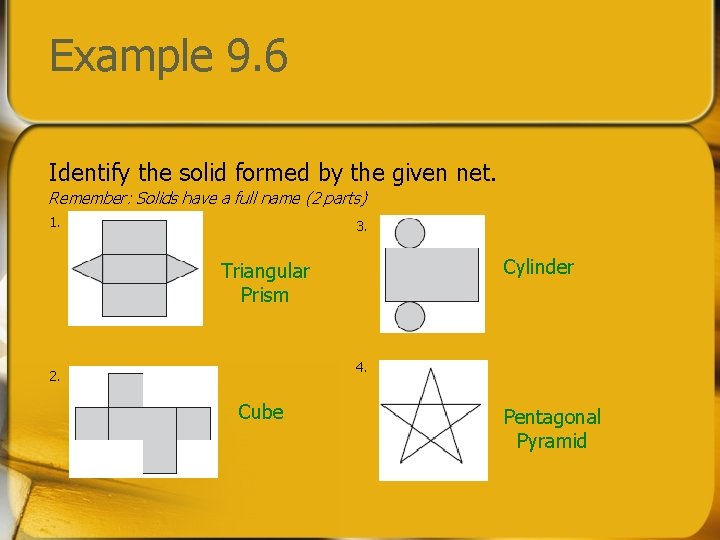
Example 9. 6 Identify the solid formed by the given net. Remember: Solids have a full name (2 parts) 1. 3. Cylinder Triangular Prism 4. 2. Cube Pentagonal Pyramid
Lesson 9. 1 Day 2: Surface Area of Prisms and Cylinders
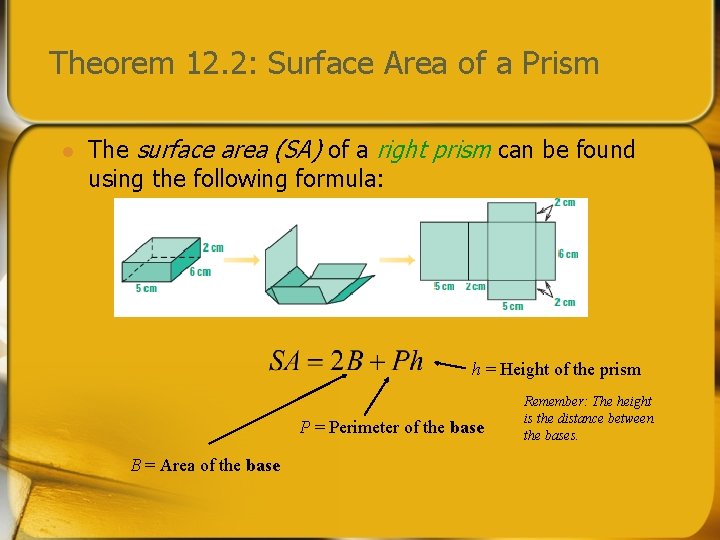
Theorem 12. 2: Surface Area of a Prism l The surface area (SA) of a right prism can be found using the following formula: h = Height of the prism P = Perimeter of the base B = Area of the base Remember: The height is the distance between the bases.
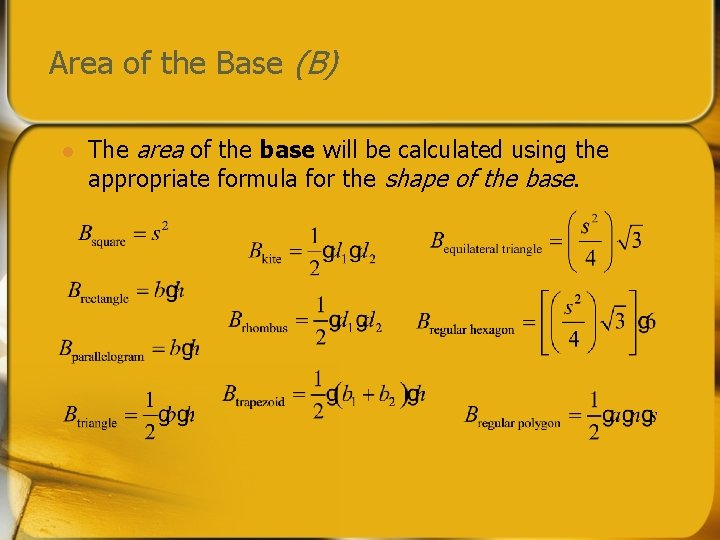
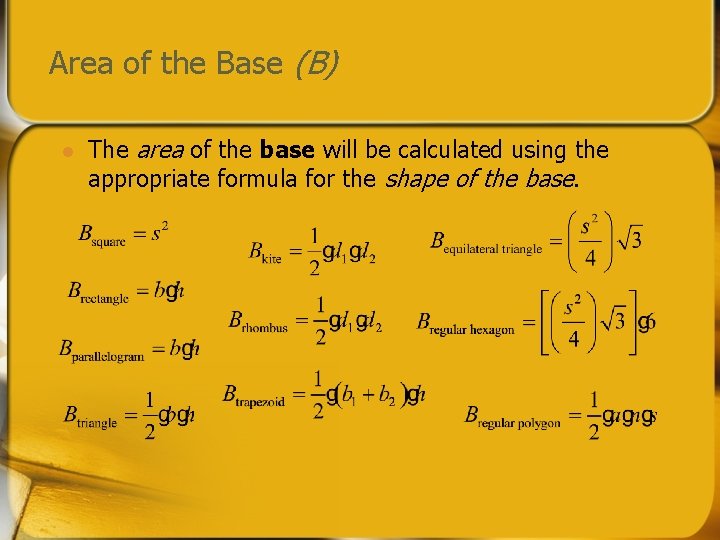
Area of the Base (B) l The area of the base will be calculated using the appropriate formula for the shape of the base.
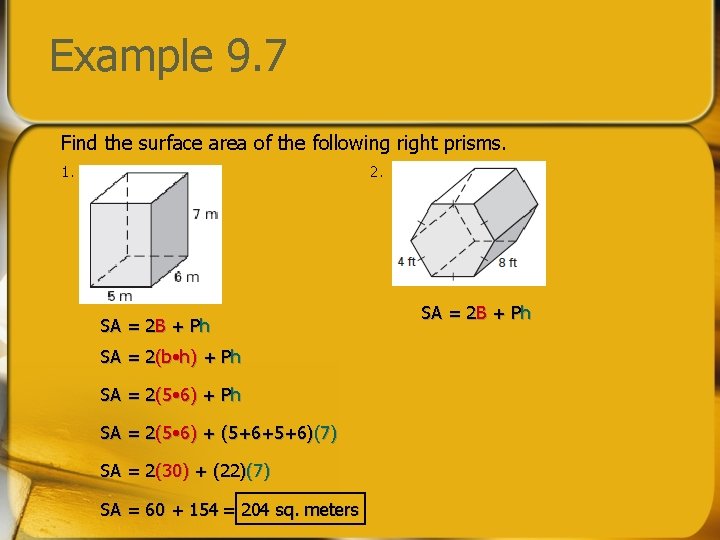
Example 9. 7 Find the surface area of the following right prisms. 1. 2. SA = 2 B + Ph SA = 2(b • h) + Ph SA = 2(5 • 6) + (5+6+5+6)(7) SA = 2(30) + (22)(7) SA = 60 + 154 = 204 sq. meters SA = 2 B + Ph
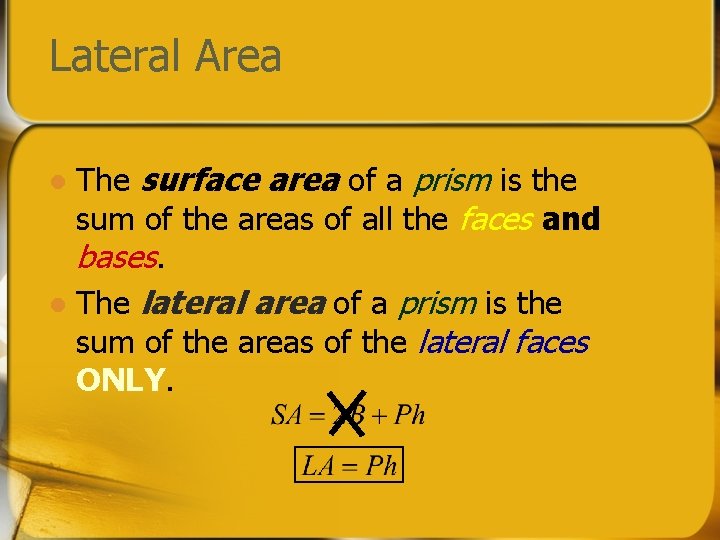
Lateral Area The surface area of a prism is the sum of the areas of all the faces and bases. l The lateral area of a prism is the sum of the areas of the lateral faces ONLY. l
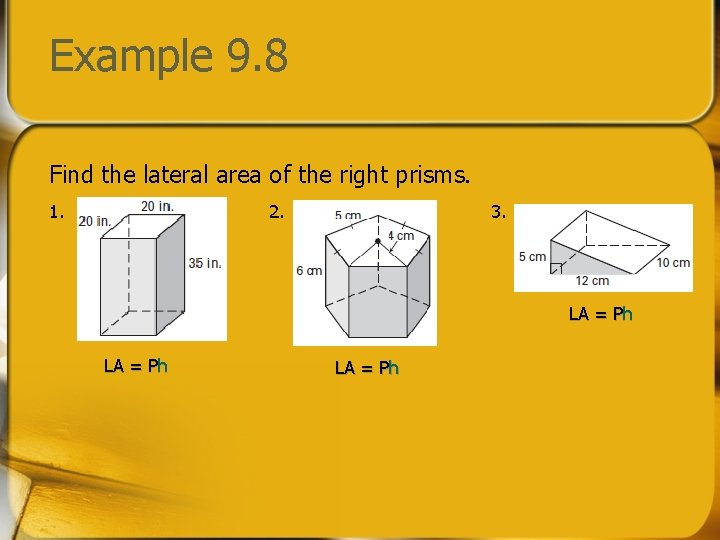
Example 9. 8 Find the lateral area of the right prisms. 1. 2. 3. LA = Ph
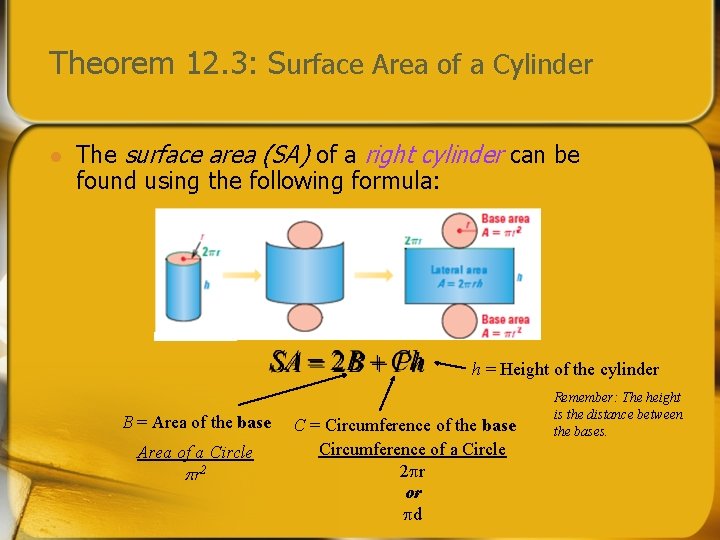
Theorem 12. 3: Surface Area of a Cylinder l The surface area (SA) of a right cylinder can be found using the following formula: h = Height of the cylinder B = Area of the base Area of a Circle r 2 C = Circumference of the base Circumference of a Circle 2 r or d Remember: The height is the distance between the bases.
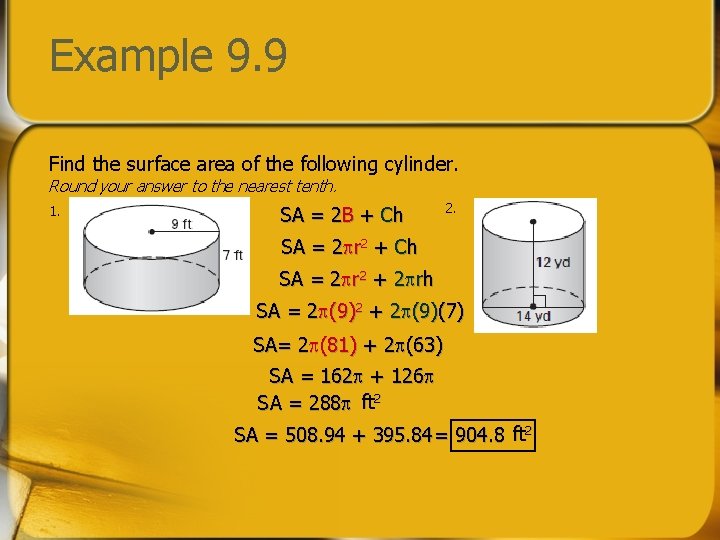
Example 9. 9 Find the surface area of the following cylinder. Round your answer to the nearest tenth. 1. SA = 2 B + Ch 2. SA = 2 r 2 + Ch SA = 2 r 2 + 2 rh SA = 2 (9)2 + 2 (9)(7) SA= 2 (81) + 2 (63) SA = 162 + 126 SA = 288 ft 2 SA = 508. 94 + 395. 84 = 904. 8 ft 2
Lesson 9. 2 Surface Area of Pyramids and Cones
Lesson 9. 2 Objectives l l Identify a pyramid Calculate slant height Identify a cone Calculate the surface area of a pyramid and cone. (G 1. 8. 1)
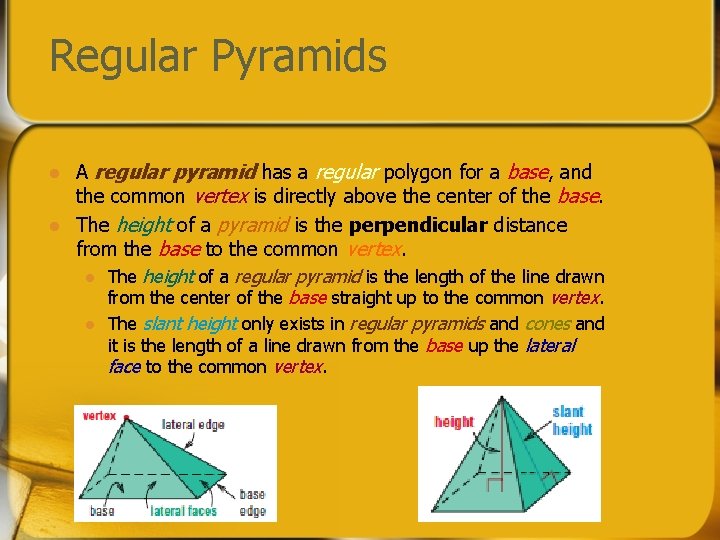
Regular Pyramids l l A regular pyramid has a regular polygon for a base, and the common vertex is directly above the center of the base. The height of a pyramid is the perpendicular distance from the base to the common vertex. l The height of a regular pyramid is the length of the line drawn from the center of the base straight up to the common vertex. l The slant height only exists in regular pyramids and cones and it is the length of a line drawn from the base up the lateral face to the common vertex.
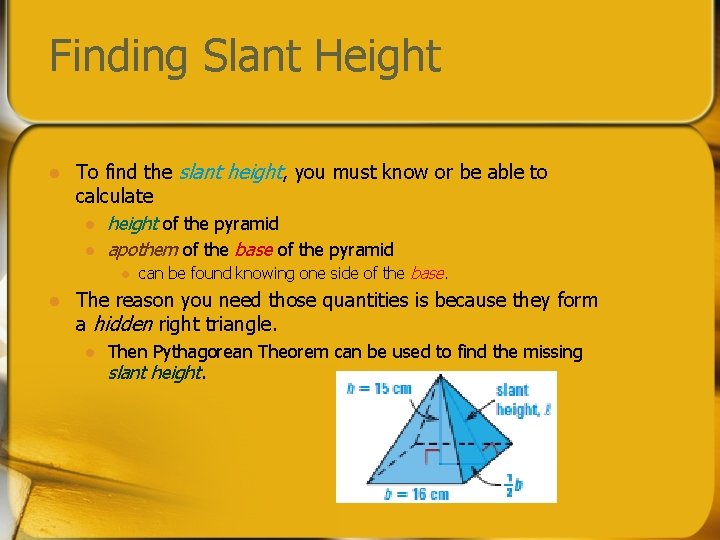
Finding Slant Height l To find the slant height, you must know or be able to calculate l height of the pyramid l apothem of the base of the pyramid l l can be found knowing one side of the base. The reason you need those quantities is because they form a hidden right triangle. l Then Pythagorean Theorem can be used to find the missing slant height.
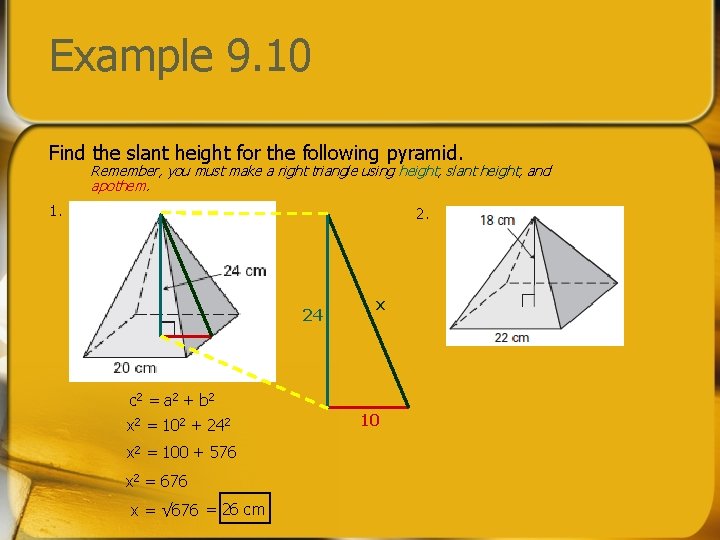
Example 9. 10 Find the slant height for the following pyramid. Remember, you must make a right triangle using height, slant height, and apothem. 1. 24 x c 2 = a 2 + b 2 x 2 = 102 + 242 x 2 = 100 + 576 x 2 = 676 x = √ 676 = 26 cm 10
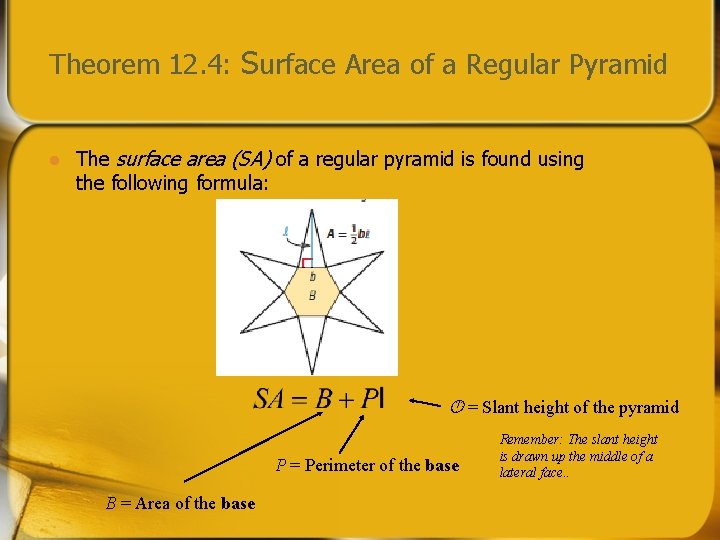
Theorem 12. 4: Surface Area of a Regular Pyramid l The surface area (SA) of a regular pyramid is found using the following formula: = Slant height of the pyramid P = Perimeter of the base B = Area of the base Remember: The slant height is drawn up the middle of a lateral face. .
Area of the Base (B) l The area of the base will be calculated using the appropriate formula for the shape of the base.
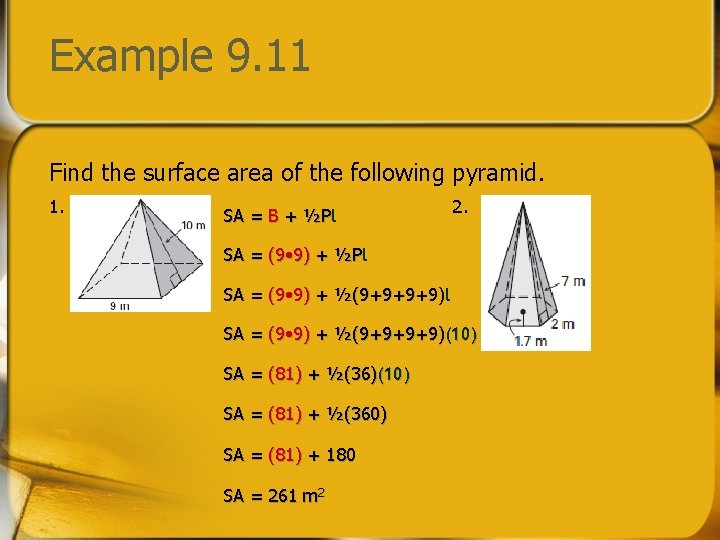
Example 9. 11 Find the surface area of the following pyramid. 1. SA = B + ½Pl ½P 2. SA = (9 • 9) + ½Pl ½P SA = (9 • 9) + ½(9+9+9+9)l ½(9+9+9+9) SA = (9 • 9) + ½(9+9+9+9)(10) SA = (81) + ½(360) SA = (81) + 180 SA = 261 m 2
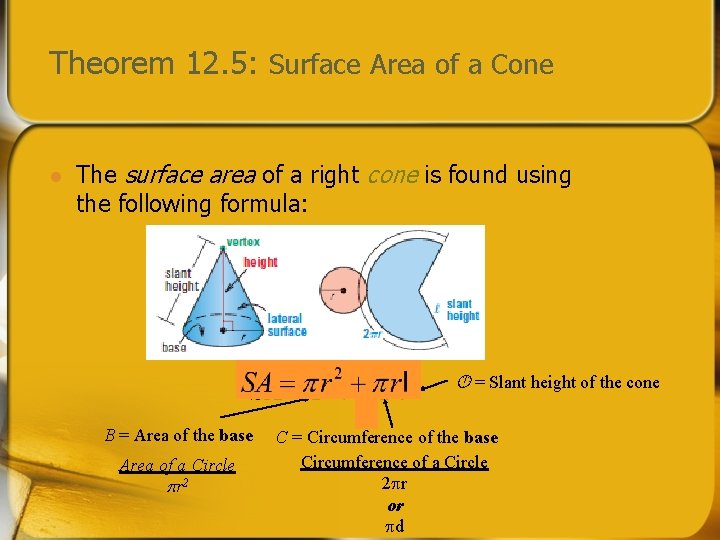
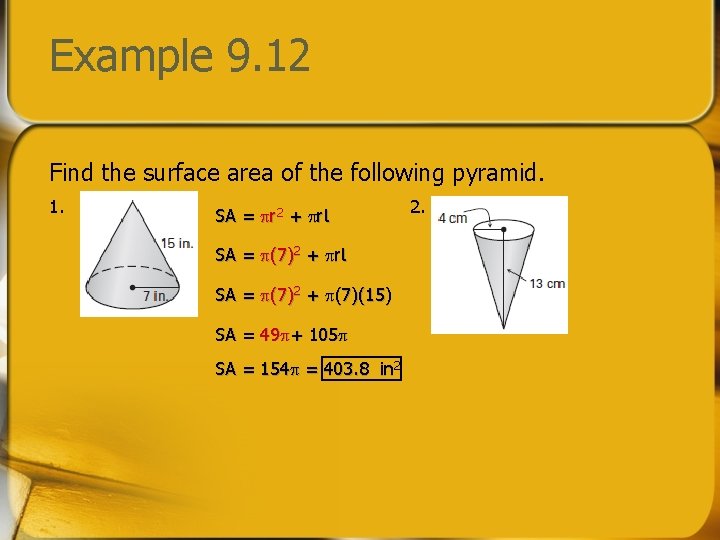
Theorem 12. 5: Surface Area of a Cone l The surface area of a right cone is found using the following formula: = Slant height of the cone B = Area of the base Area of a Circle r 2 C = Circumference of the base Circumference of a Circle 2 r or d
Example 9. 12 Find the surface area of the following pyramid. 1. SA = r 2 + rl SA = (7)2 + (7)(15) SA = 49 + 105 SA = 154 = 403. 8 in 2 2.
Lesson 9. 3 Volume of Special Solids
Lesson 9. 3 Objectives l l l Calculate the volume of a prism (G 1. 8. 1) Calculate the volume of a cylinder (G 1. 8. 1) Calculate the volume of a pyramid (G 1. 8. 1) Calculate the volume of a cone (G 1. 8. 1) Apply Cavalieri’s Principle Utilize the Volume Postulates
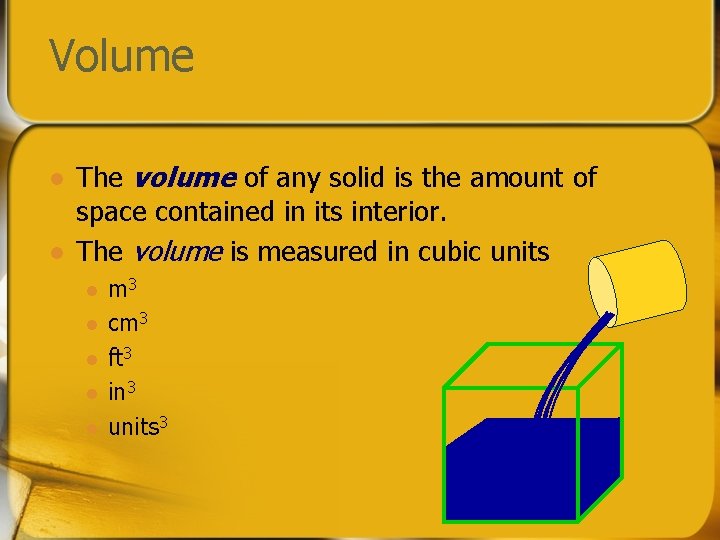
Volume l l The volume of any solid is the amount of space contained in its interior. The volume is measured in cubic units l l l m 3 cm 3 ft 3 in 3 units 3
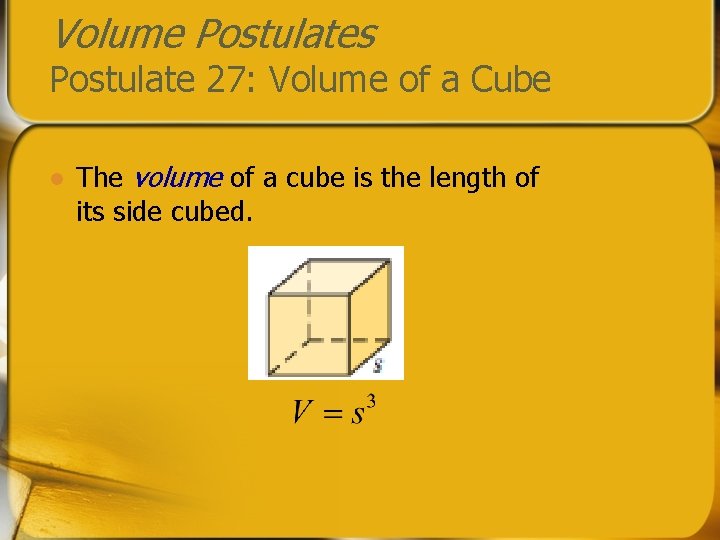
Volume Postulates Postulate 27: Volume of a Cube l The volume of a cube is the length of its side cubed.
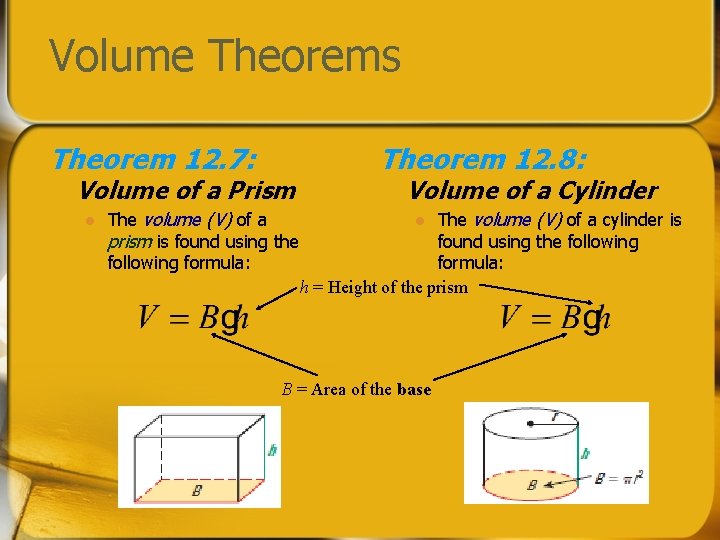
Volume Theorems Theorem 12. 7: Volume of a Prism l The volume (V) of a prism is found using the following formula: Theorem 12. 8: Volume of a Cylinder The volume (V) of a cylinder is found using the following formula: h = Height of the prism l B = Area of the base
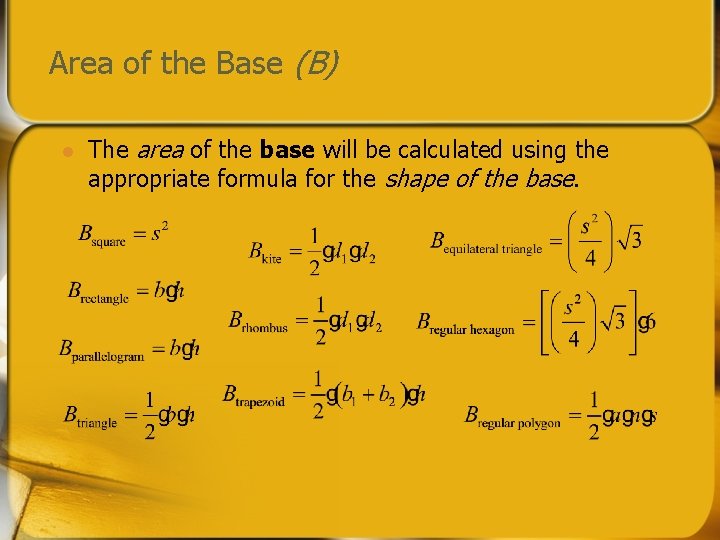
Area of the Base (B) l The area of the base will be calculated using the appropriate formula for the shape of the base.
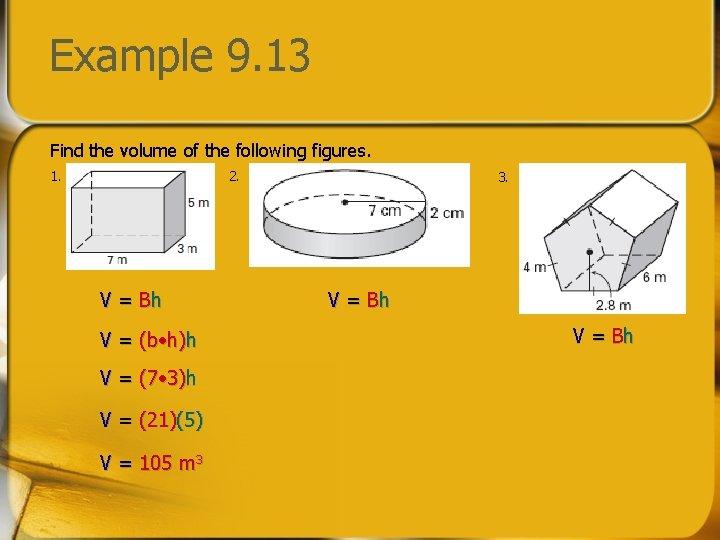
Example 9. 13 Find the volume of the following figures. 1. 2. V = Bh V = (b • h)h V = (7 • 3)h V = (21)(5) V = 105 m 3 3. V = Bh
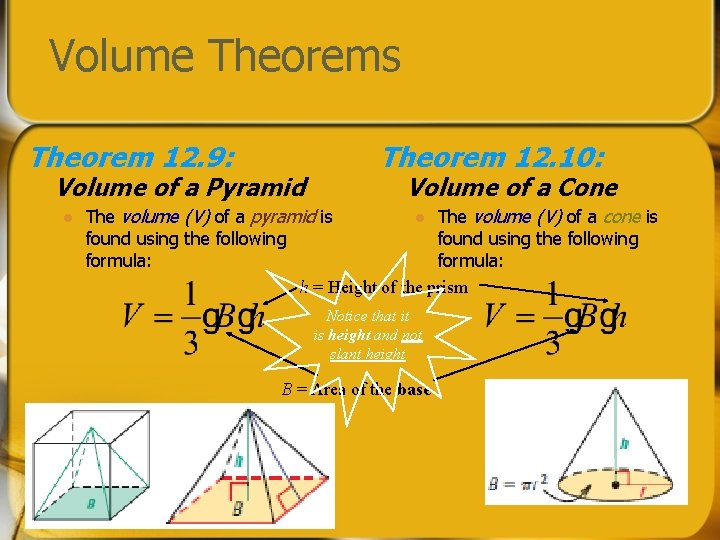
Volume Theorems Theorem 12. 9: Volume of a Pyramid l Theorem 12. 10: Volume of a Cone The volume (V) of a pyramid is l The volume (V) of a cone is found using the following formula: h = Height of the prism Notice that it is height and not slant height B = Area of the base
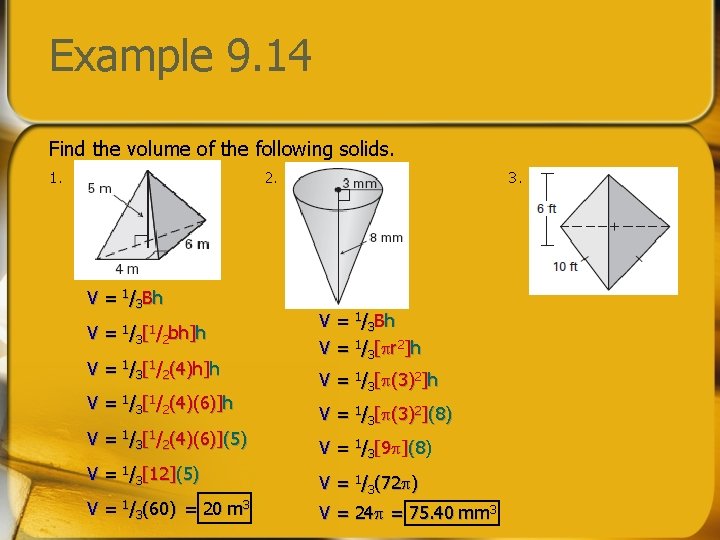
Example 9. 14 Find the volume of the following solids. 1. 2. V = 1 /3 Bh V= 1/ [1/ bh]h 3 2 V = 1/3[1/2(4)h]h V = 1/3[1/2(4)(6)](5) V = 1/3[12](5) V = 1/3(60) = 20 m 3 3. V = 1 /3 Bh V = 1 /3 [ r 2 ] h V = 1/3[ (3)2](8) V = 1/3[9 ](8) V = 1/3(72 ) V = 24 = 75. 40 mm 3
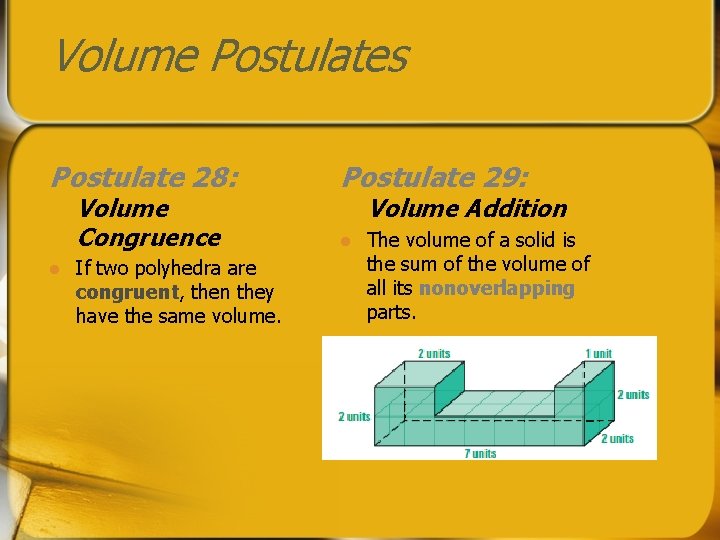
Volume Postulates Postulate 28: Volume Congruence l If two polyhedra are congruent, then they have the same volume. Postulate 29: Volume Addition l The volume of a solid is the sum of the volume of all its nonoverlapping parts.
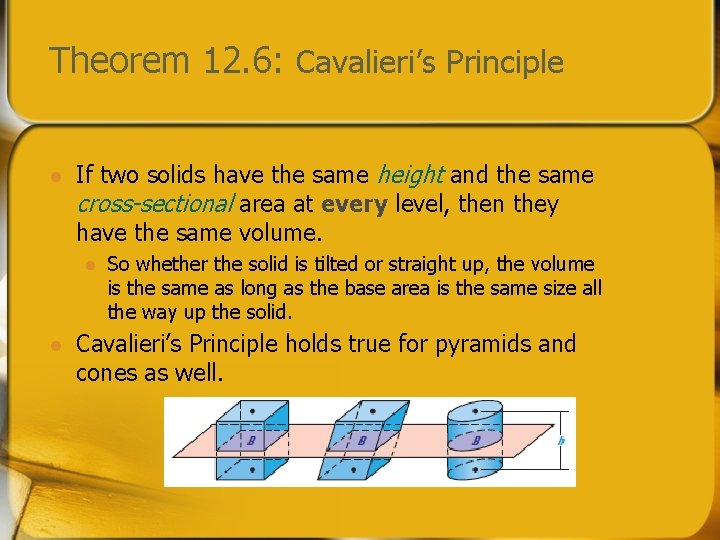
Theorem 12. 6: Cavalieri’s Principle l If two solids have the same height and the same cross-sectional area at every level, then they have the same volume. l l So whether the solid is tilted or straight up, the volume is the same as long as the base area is the same size all the way up the solid. Cavalieri’s Principle holds true for pyramids and cones as well.
Lesson 9. 4 Spheres
Lesson 9. 4 Objectives l l Define a sphere Calculate the surface area of a sphere (G 1. 8. 1) l l Calculate the volume of a sphere (G 1. 8. 1) Verify the effects of a dimensional change on surface area and volume. (G 2. 3. 5)
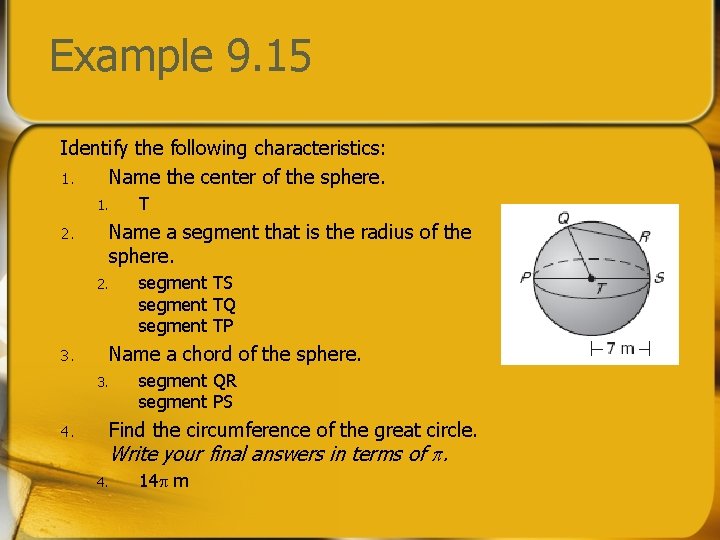
Example 9. 15 Identify the following characteristics: 1. Name the center of the sphere. 1. T Name a segment that is the radius of the sphere. 2. 2. segment TS segment TQ segment TP Name a chord of the sphere. 3. 3. segment QR segment PS Find the circumference of the great circle. 4. Write your final answers in terms of . 4. 14 m
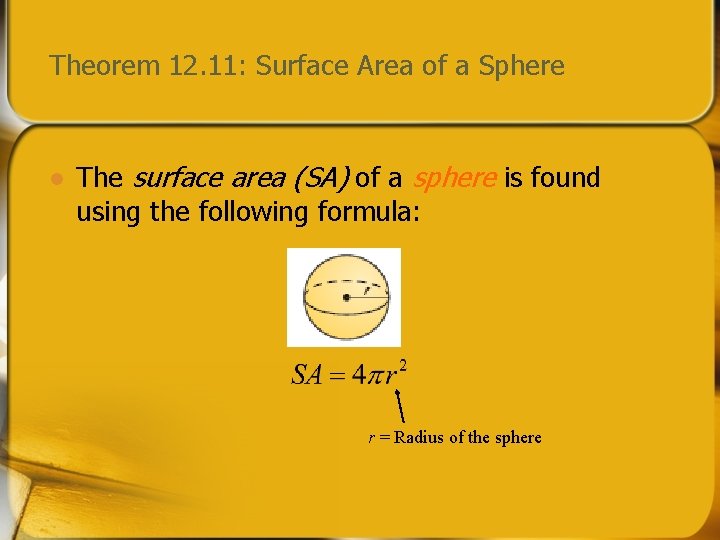
Theorem 12. 11: Surface Area of a Sphere l The surface area (SA) of a sphere is found using the following formula: r = Radius of the sphere
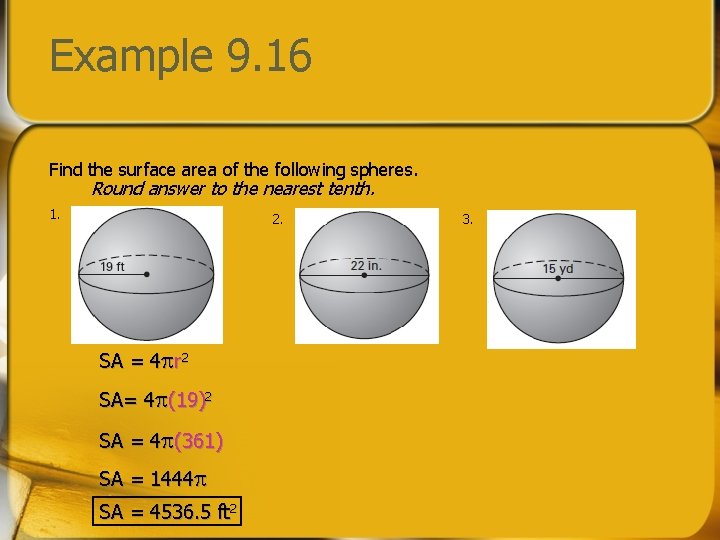
Example 9. 16 Find the surface area of the following spheres. Round answer to the nearest tenth. 1. 2. SA = 4 r 2 SA= 4 (19)2 SA = 4 (361) SA = 1444 SA = 4536. 5 ft 2 3.
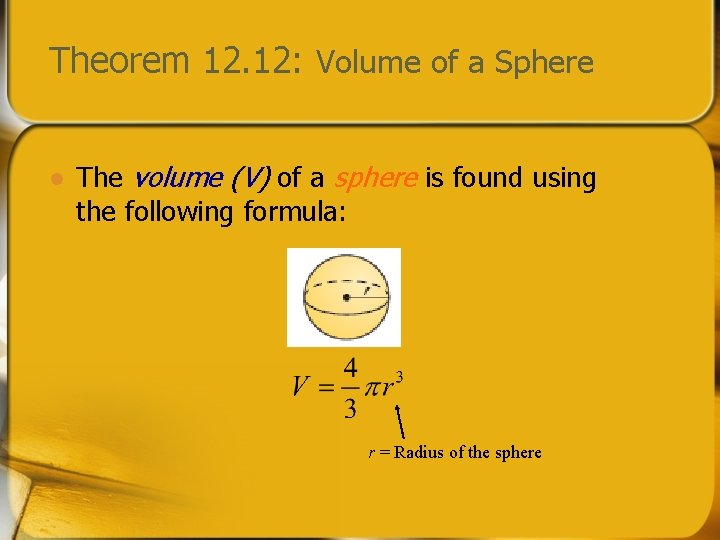
Theorem 12. 12: Volume of a Sphere l The volume (V) of a sphere is found using the following formula: r = Radius of the sphere
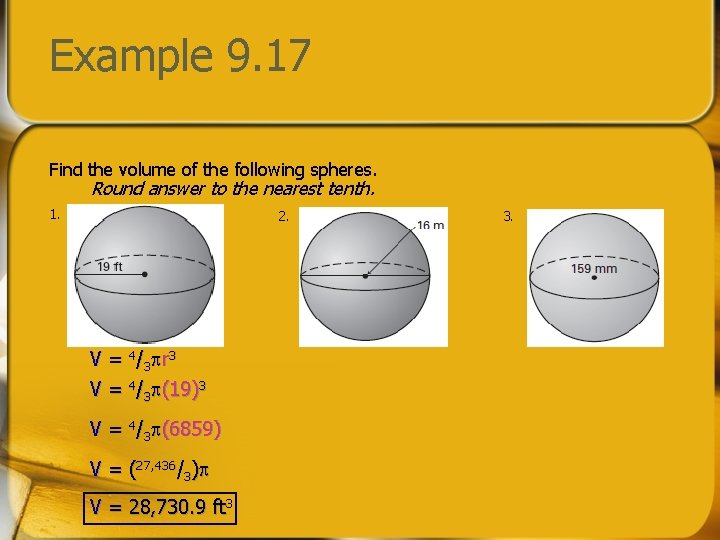
Example 9. 17 Find the volume of the following spheres. Round answer to the nearest tenth. 1. 2. V = 4 /3 r 3 V = 4/3 (19)3 V = 4/3 (6859) V = (27, 436/3) V = 28, 730. 9 ft 3 3.
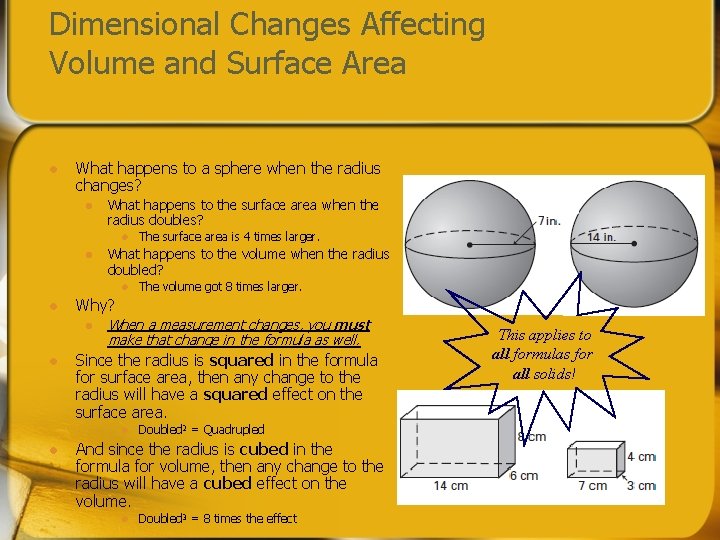
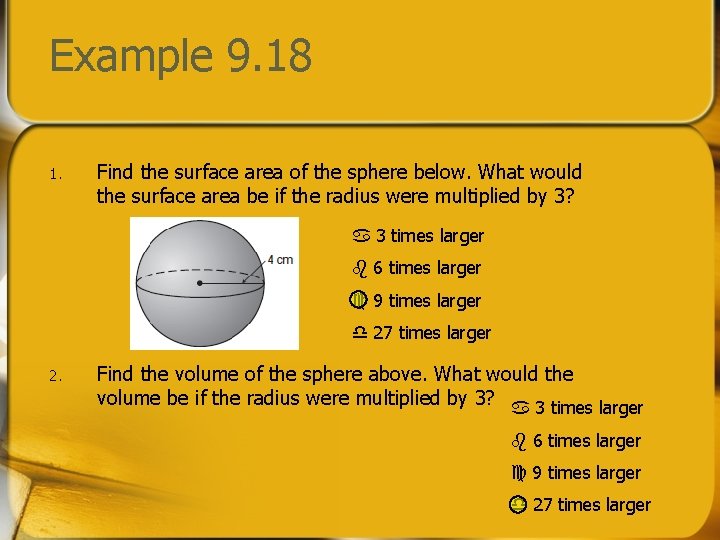
Dimensional Changes Affecting Volume and Surface Area l What happens to a sphere when the radius changes? l What happens to the surface area when the radius doubles? l l What happens to the volume when the radius doubled? l l When a measurement changes, you must make that change in the formula as well. Since the radius is squared in the formula for surface area, then any change to the radius will have a squared effect on the surface area. l l The volume got 8 times larger. Why? l l The surface area is 4 times larger. Doubled 2 = Quadrupled And since the radius is cubed in the formula for volume, then any change to the radius will have a cubed effect on the volume. l Doubled 3 = 8 times the effect This applies to all formulas for all solids!
Example 9. 18 1. Find the surface area of the sphere below. What would the surface area be if the radius were multiplied by 3? a 3 times larger b 6 times larger c 9 times larger d 27 times larger 2. Find the volume of the sphere above. What would the volume be if the radius were multiplied by 3? a 3 times larger b 6 times larger c 9 times larger d 27 times larger
Lesson 9. 5 Converting Units
Lesson 9. 5 Objectives l l Convert one-dimensional measurements (L 3. 1. 1) Convert various dimensional measurements
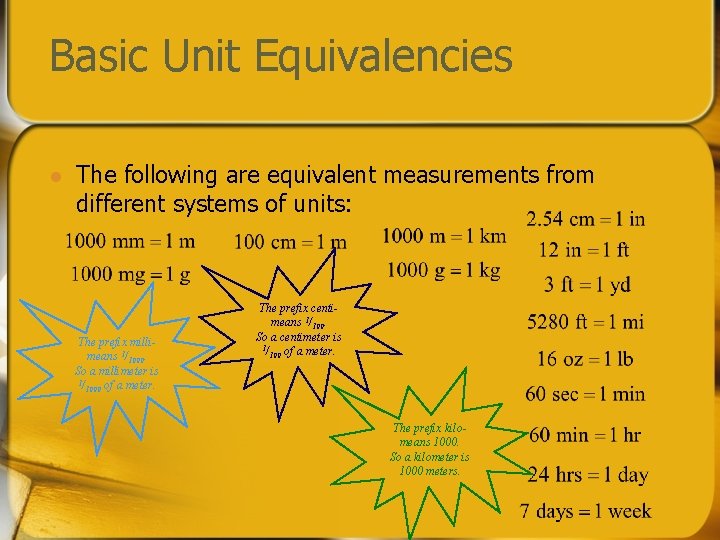
Basic Unit Equivalencies l The following are equivalent measurements from different systems of units: The prefix millimeans 1/1000. So a millimeter is 1/ 1000 of a meter. The prefix centimeans 1/100. So a centimeter is 1/ 100 of a meter. The prefix kilomeans 1000. So a kilometer is 1000 meters.
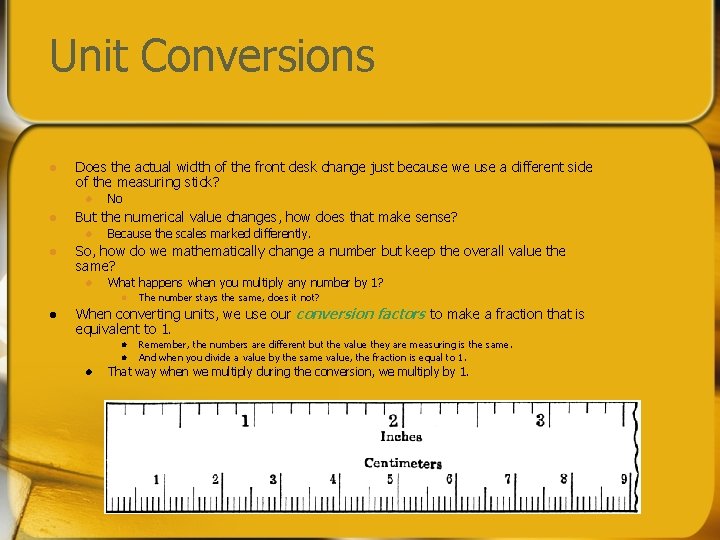
Unit Conversions l Does the actual width of the front desk change just because we use a different side of the measuring stick? l l But the numerical value changes, how does that make sense? l l No Because the scales marked differently. So, how do we mathematically change a number but keep the overall value the same? l What happens when you multiply any number by 1? l l The number stays the same, does it not? When converting units, we use our conversion factors to make a fraction that is equivalent to 1. l l l Remember, the numbers are different but the value they are measuring is the same. And when you divide a value by the same value, the fraction is equal to 1. That way when we multiply during the conversion, we multiply by 1.
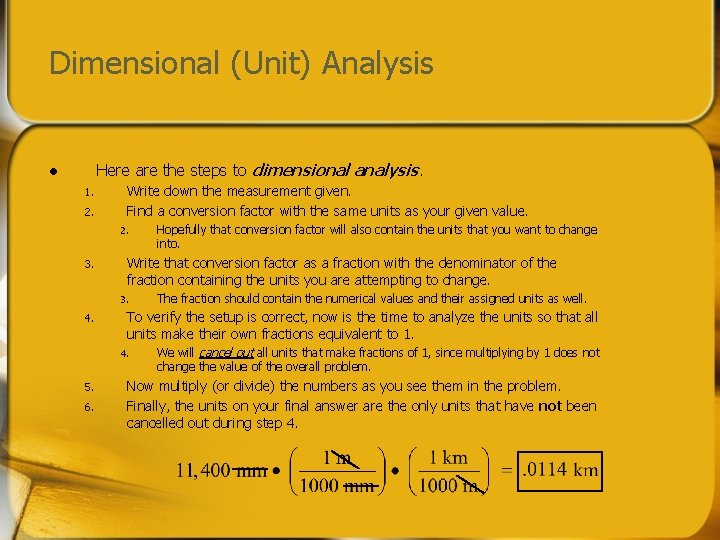
Dimensional (Unit) Analysis Here are the steps to dimensional analysis. l 1. 2. Write down the measurement given. Find a conversion factor with the same units as your given value. 2. 3. Write that conversion factor as a fraction with the denominator of the fraction containing the units you are attempting to change. 3. 4. 6. The fraction should contain the numerical values and their assigned units as well. To verify the setup is correct, now is the time to analyze the units so that all units make their own fractions equivalent to 1. 4. 5. Hopefully that conversion factor will also contain the units that you want to change into. We will cancel out all units that make fractions of 1, since multiplying by 1 does not change the value of the overall problem. Now multiply (or divide) the numbers as you see them in the problem. Finally, the units on your final answer are the only units that have not been cancelled out during step 4.
Example 9. 19 Convert the following 1. 432 cm m 2. 3. 5 hrs sec 3. 2. 1 km mm 4. 1 weeks min
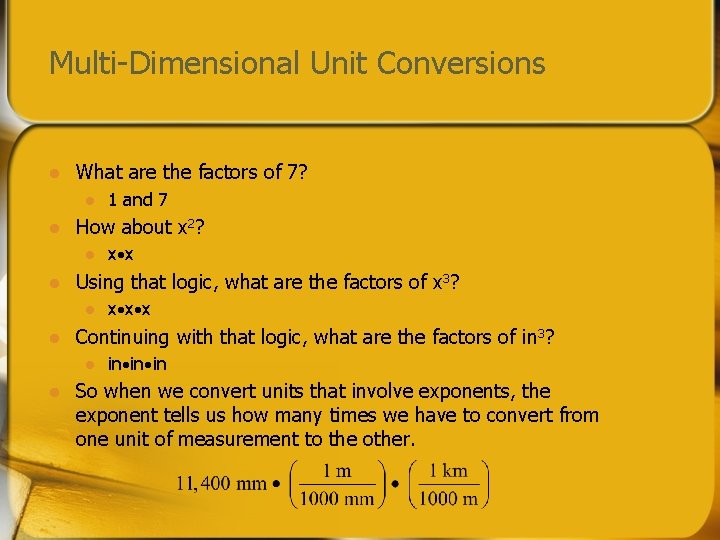
Multi-Dimensional Unit Conversions l What are the factors of 7? l l How about x 2? l l x x x Continuing with that logic, what are the factors of in 3? l l x x Using that logic, what are the factors of x 3? l l 1 and 7 in in in So when we convert units that involve exponents, the exponent tells us how many times we have to convert from one unit of measurement to the other.
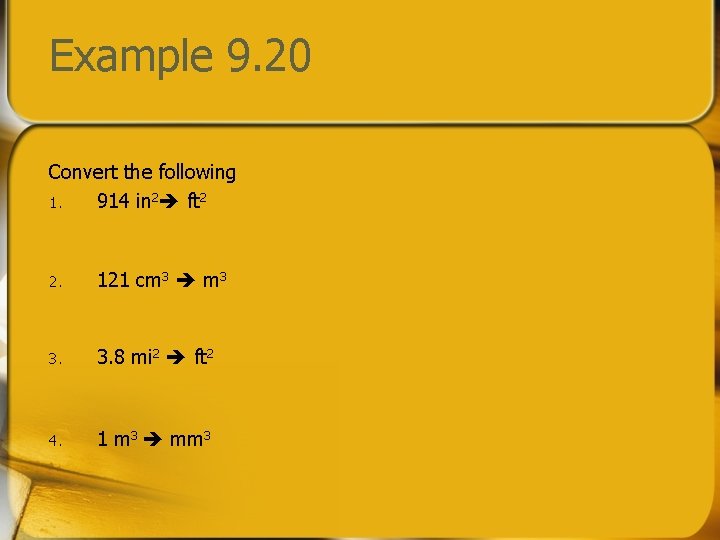
Example 9. 20 Convert the following 1. 914 in 2 ft 2 2. 121 cm 3 3. 8 mi 2 ft 2 4. 1 m 3 mm 3