
Unit 9 Section 2 Notes Types of Waves
- Slides: 20
Unit 9 Section 2 Notes Types of Waves
What is a Wave? Wave: A disturbance that carries energy through matter or space. Examples of Waves: Sound you hear from your headphones Earthquakes Ripples in a pond
Mediums A wave is not made of matter, but involves the movement of matter. Most waves travel through a medium. Medium: the matter through which a wave travels. Examples: Sound you hear from your headphones: Air Earthquakes: Earth Ripples in a pond: Water
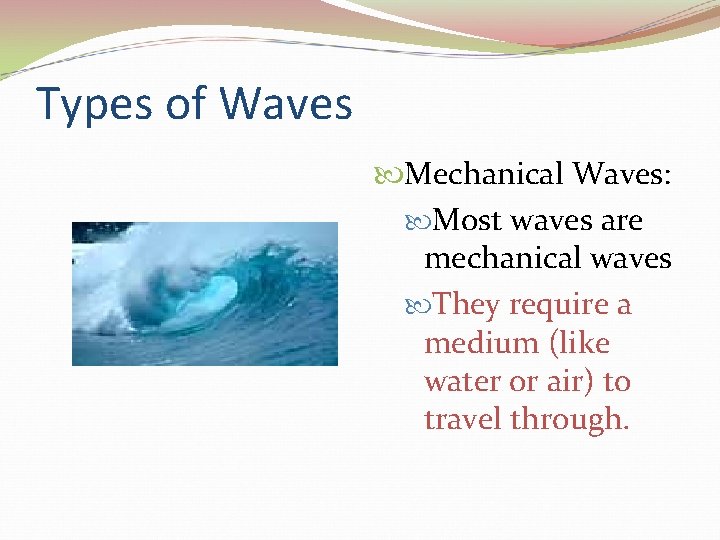
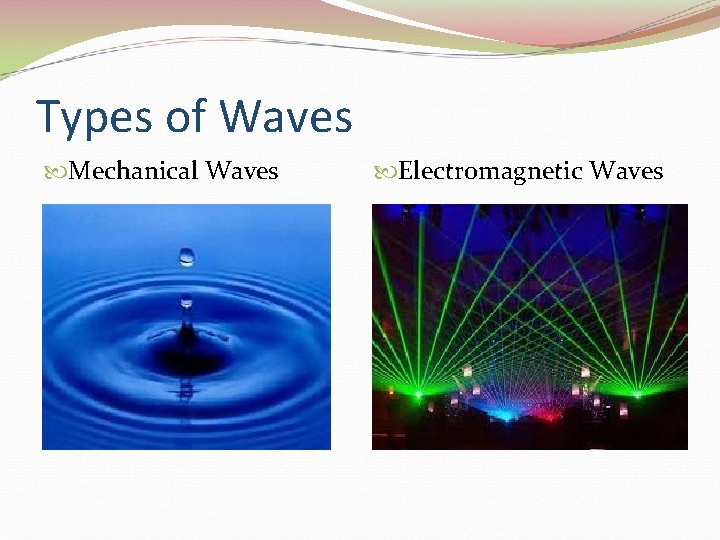
Types of Waves Mechanical Waves: Most waves are mechanical waves They require a medium (like water or air) to travel through.
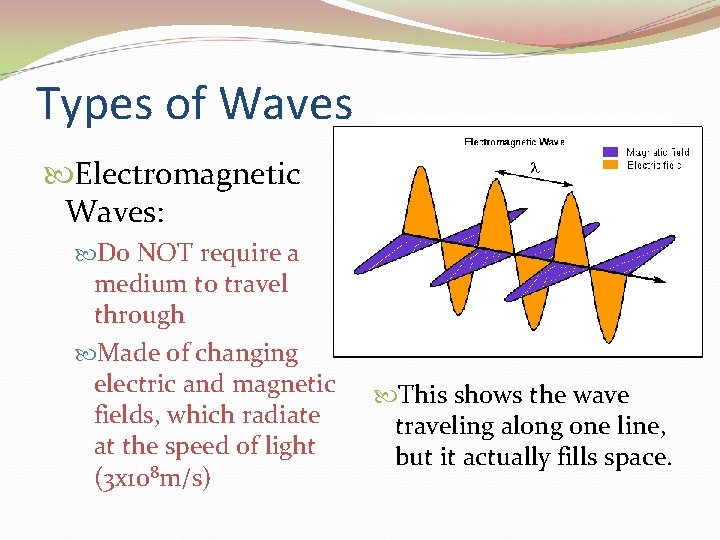
Types of Waves Electromagnetic Waves: Do NOT require a medium to travel through Made of changing electric and magnetic fields, which radiate at the speed of light (3 x 10⁸ m/s) This shows the wave traveling along one line, but it actually fills space.
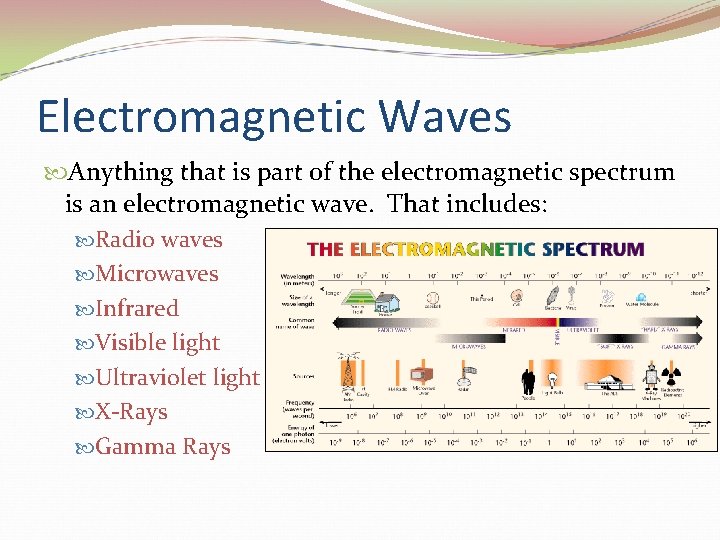
Electromagnetic Waves Anything that is part of the electromagnetic spectrum is an electromagnetic wave. That includes: Radio waves Microwaves Infrared Visible light Ultraviolet light X-Rays Gamma Rays
Types of Waves Mechanical Waves Electromagnetic Waves
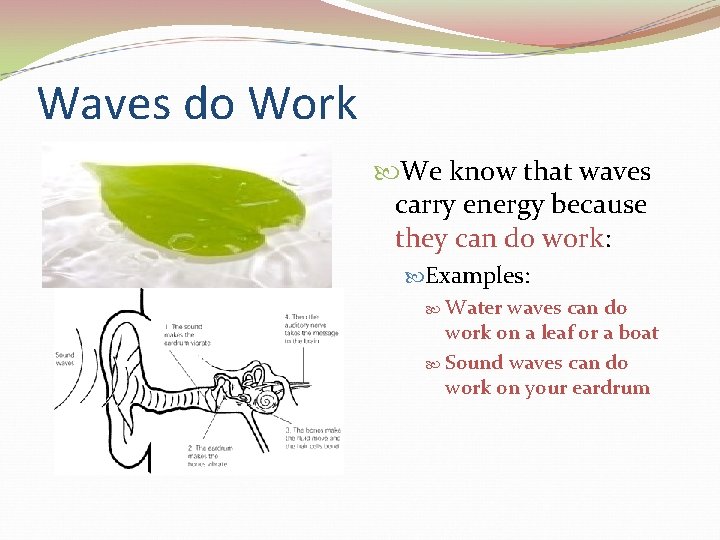
Waves do Work We know that waves carry energy because they can do work: Examples: Water waves can do work on a leaf or a boat Sound waves can do work on your eardrum
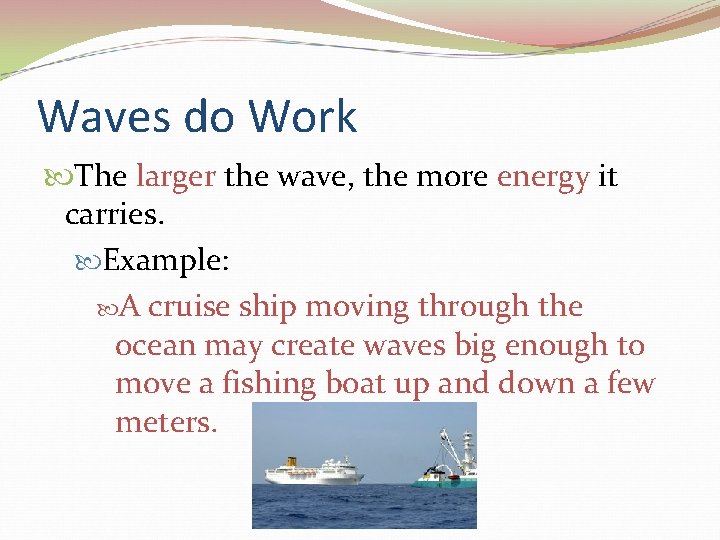
Waves do Work The larger the wave, the more energy it carries. Example: A cruise ship moving through the ocean may create waves big enough to move a fishing boat up and down a few meters.
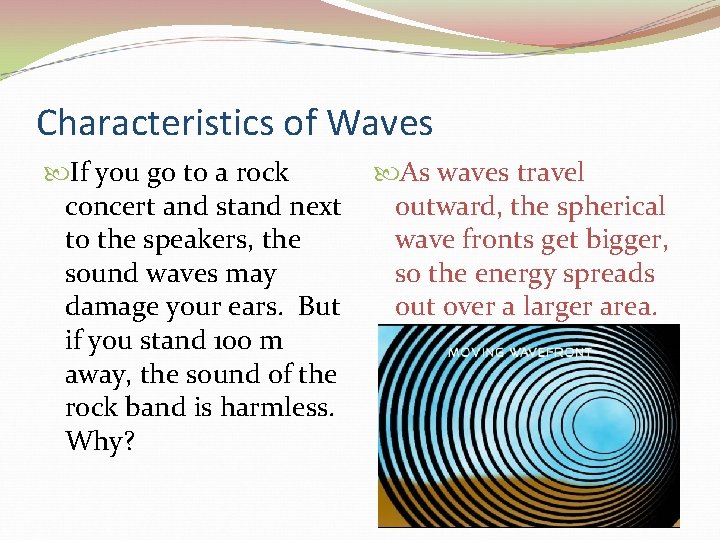
Characteristics of Waves If you go to a rock concert and stand next to the speakers, the sound waves may damage your ears. But if you stand 100 m away, the sound of the rock band is harmless. Why? As waves travel outward, the spherical wave fronts get bigger, so the energy spreads out over a larger area.
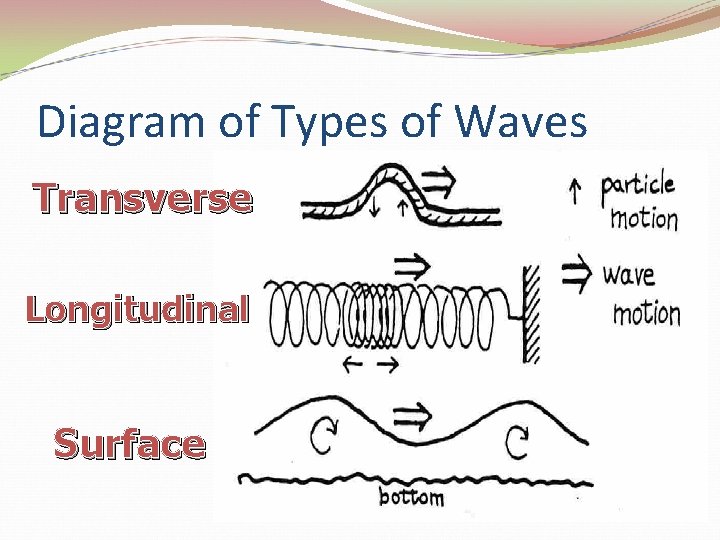
Transverse and Longitudinal Waves are classified according to the direction in which particles in the medium move as a wave passes by; they can either move up and down or back and forth. They are classified as either transverse or longitudinal.
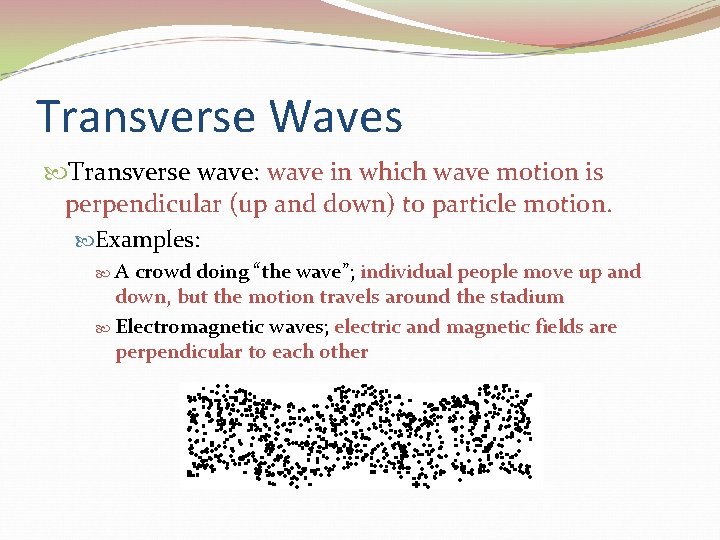
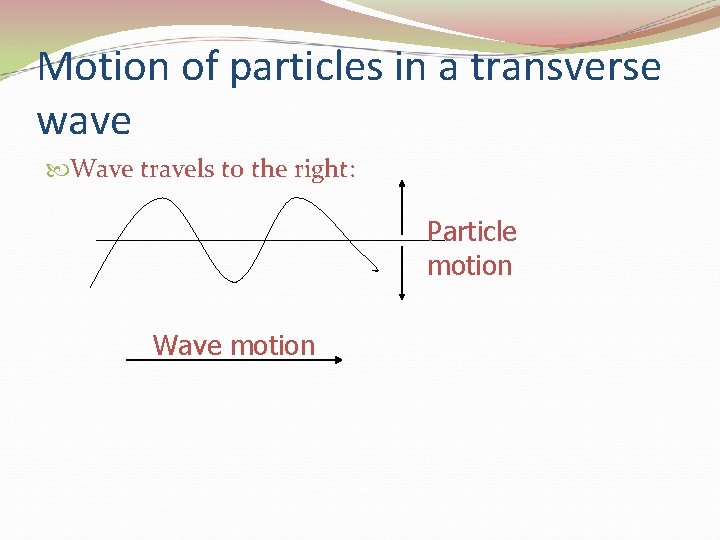
Transverse Waves Transverse wave: wave in which wave motion is perpendicular (up and down) to particle motion. Examples: A crowd doing “the wave”; individual people move up and down, but the motion travels around the stadium Electromagnetic waves; electric and magnetic fields are perpendicular to each other
Motion of particles in a transverse wave Wave travels to the right: Particle motion Wave motion
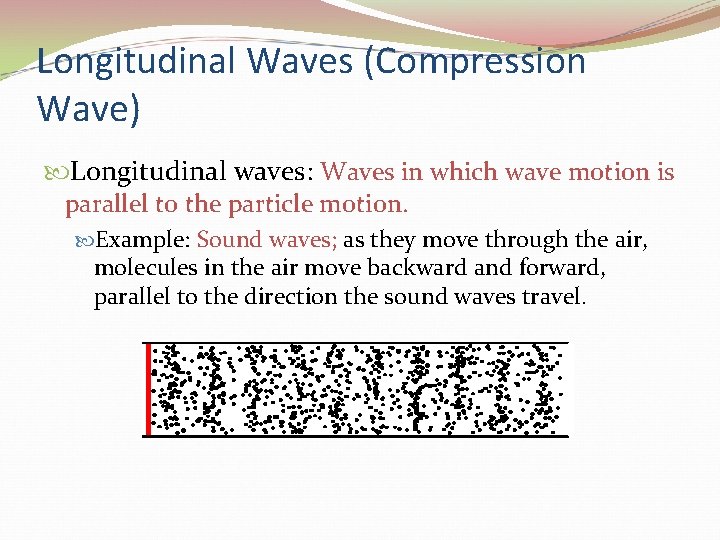
Longitudinal Waves (Compression Wave) Longitudinal waves: Waves in which wave motion is parallel to the particle motion. Example: Sound waves; as they move through the air, molecules in the air move backward and forward, parallel to the direction the sound waves travel.
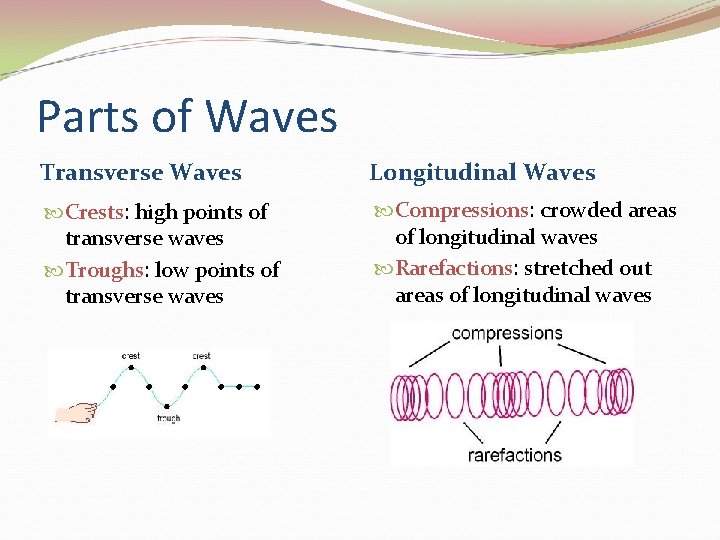
Parts of Waves Transverse Waves Longitudinal Waves Crests: high points of transverse waves Troughs: low points of transverse waves Compressions: crowded areas of longitudinal waves Rarefactions: stretched out areas of longitudinal waves
Surface Waves Some waves are not simply transverse or longitudinal: Surface Waves: Waves that move both perpendicular and parallel to the direction of wave motion. Example: Waves on the ocean or swimming pool This type of wave also occurs at the boundary between 2 different mediums, like water and air.
Surface Waves http: //www. acs. psu. edu/drussell/Demos/wave motion. html http: //www. teachersdomain. org/asset/lsps 07_int_wa ves/
Diagram of Types of Waves Transverse Longitudinal Surface
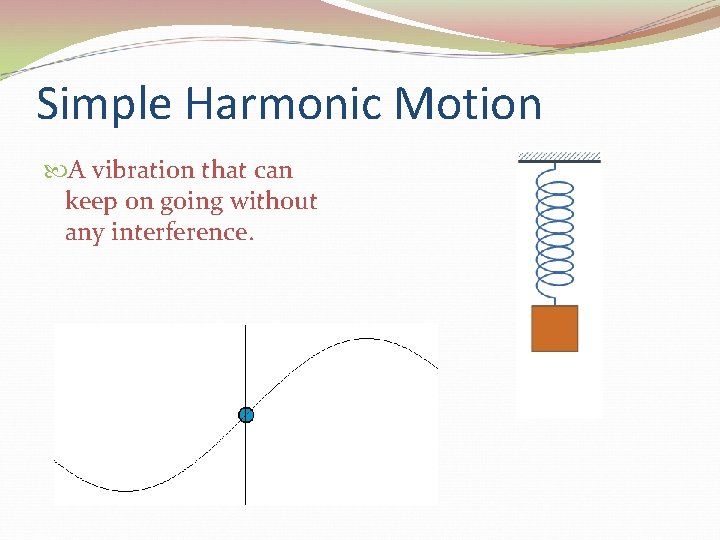
Simple Harmonic Motion A vibration that can keep on going without any interference.
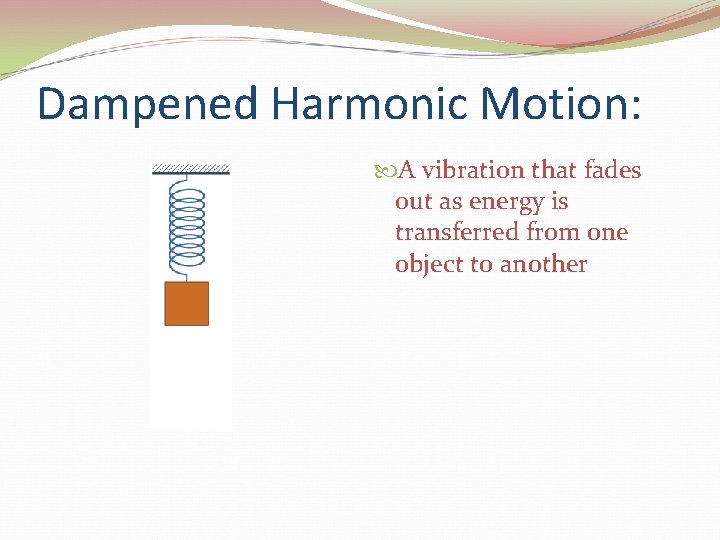
Dampened Harmonic Motion: A vibration that fades out as energy is transferred from one object to another