
Unit 9 Motivation and Emotion Motivation What are

- Slides: 43
Unit 9: Motivation and Emotion
Motivation What are some things you are “motivated” to do? ?
What is motivation? • Fueled by a motive, which is: – A specific need or desire that prompts goal-directed behavior • Primary: Hunger, Thirst, Sex • Secondary: – Stimulus (Contact, Comfort, Exploration) – Social (Aggression, Achievement, Motivation)
Where do “motives” come from? 1. Instincts – Inborn, goal-directed behavior that is characteristic of an entire species and unlearned – Human behavior is not easily explained by instincts because much what we do is learned and flexible (we aren’t JUST governed by instincts) – Human behavior is directed by both physiological needs (instincts: to eat) by psychological wants (that ice cream looks delicious but I’m not hungry)
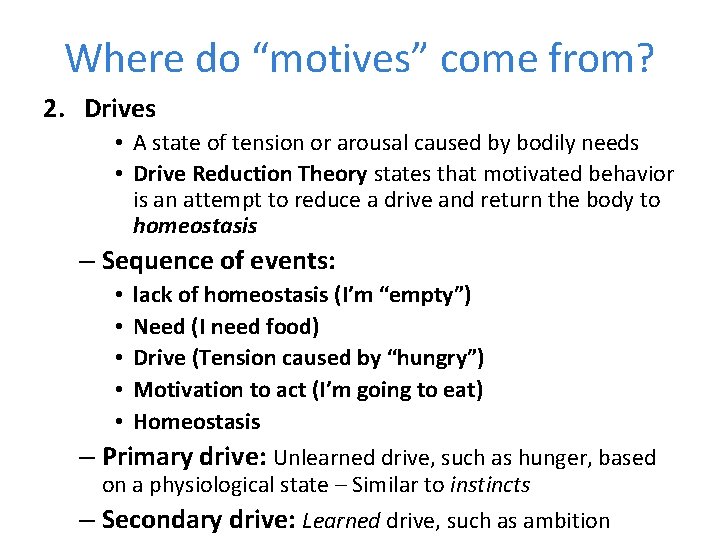
Where do “motives” come from? 2. Drives • A state of tension or arousal caused by bodily needs • Drive Reduction Theory states that motivated behavior is an attempt to reduce a drive and return the body to homeostasis – Sequence of events: • • • lack of homeostasis (I’m “empty”) Need (I need food) Drive (Tension caused by “hungry”) Motivation to act (I’m going to eat) Homeostasis – Primary drive: Unlearned drive, such as hunger, based on a physiological state – Similar to instincts – Secondary drive: Learned drive, such as ambition
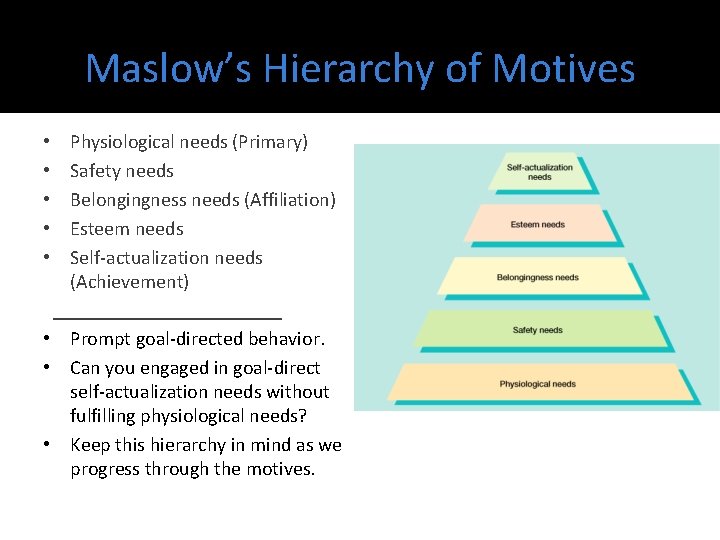
Maslow’s Hierarchy of Motives Physiological needs (Primary) Safety needs Belongingness needs (Affiliation) Esteem needs Self-actualization needs (Achievement) ____________ • Prompt goal-directed behavior. • Can you engaged in goal-direct self-actualization needs without fulfilling physiological needs? • Keep this hierarchy in mind as we progress through the motives. • • •
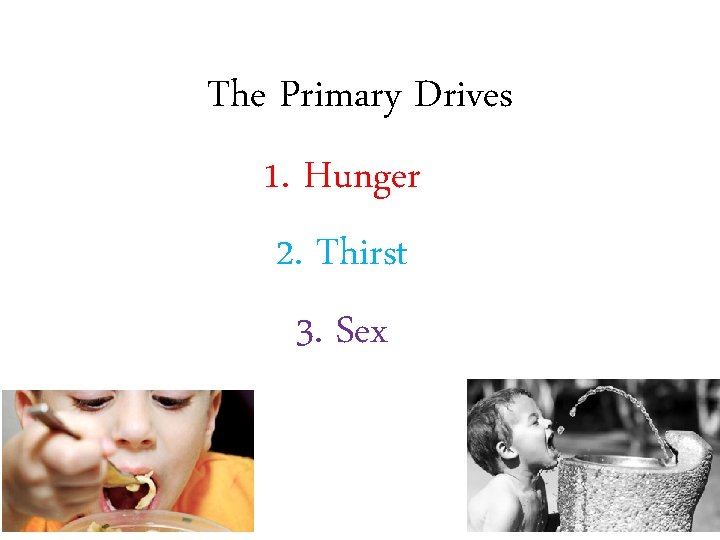
The Primary Drives 1. Hunger 2. Thirst 3. Sex
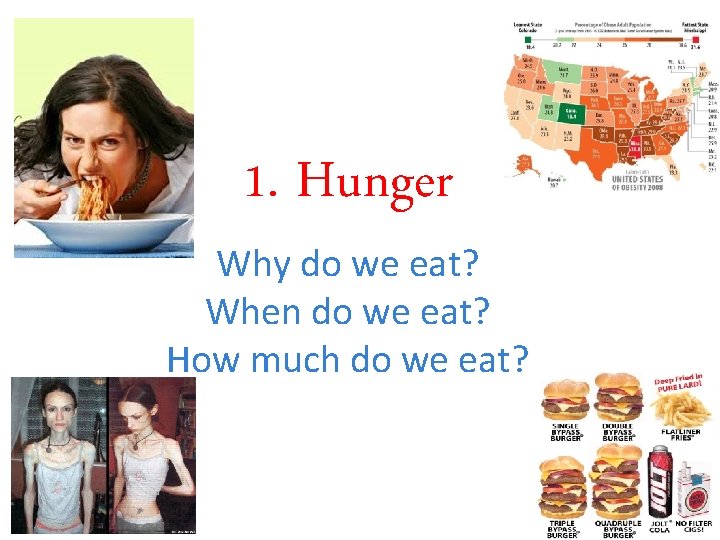
1. Hunger Why do we eat? When do we eat? How much do we eat?
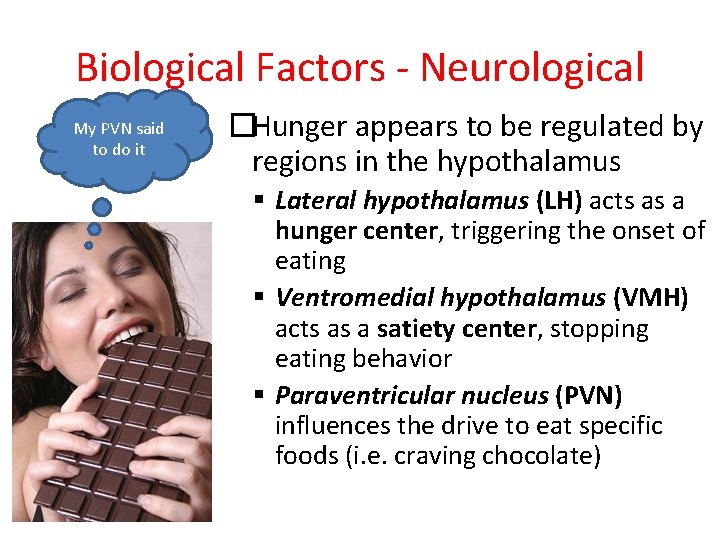
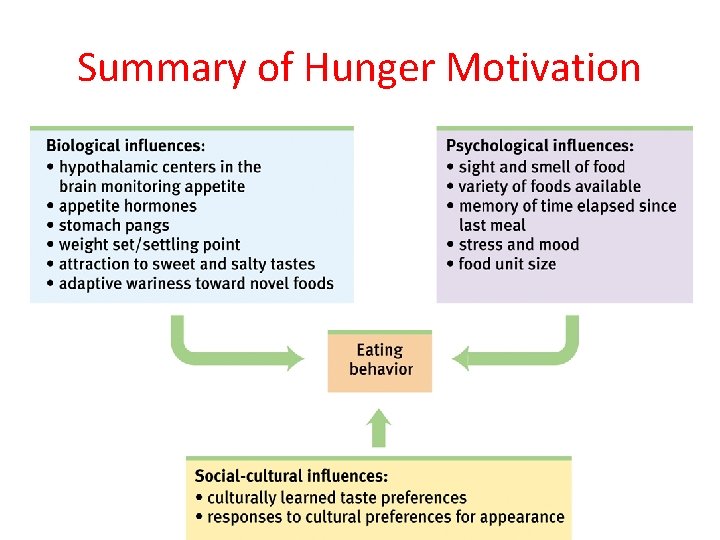
Biological Factors - Neurological My PVN said to do it �Hunger appears to be regulated by regions in the hypothalamus Lateral hypothalamus (LH) acts as a hunger center, triggering the onset of eating Ventromedial hypothalamus (VMH) acts as a satiety center, stopping eating behavior Paraventricular nucleus (PVN) influences the drive to eat specific foods (i. e. craving chocolate)
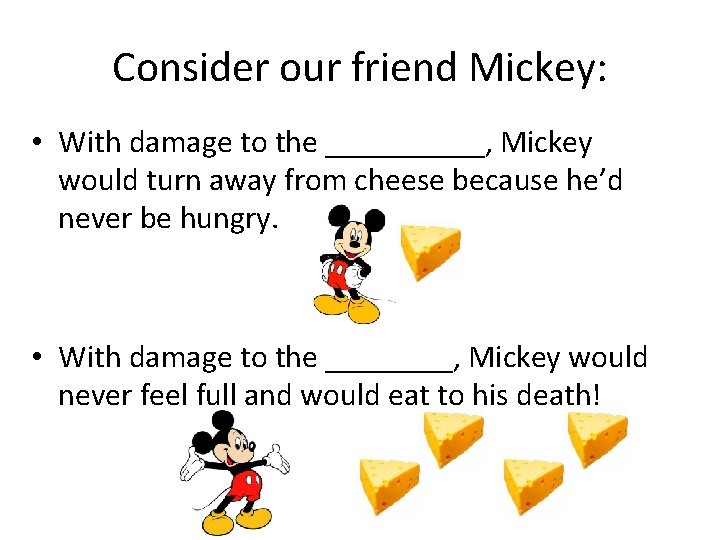
Consider our friend Mickey: • With damage to the _____, Mickey would turn away from cheese because he’d never be hungry. • With damage to the ____, Mickey would never feel full and would eat to his death!
Biological Factors – Chemical • Changes in blood glucose level, fats, carbohydrates, and insulin signal need for food – Partly regulated by what you eat – Protein- longer satiety; Sugar spikes (candy) results in drops that can later increase “hunger” • Hormones – Ghrelin turns on hunger; Leptin turns it off – Triggered by food intake; Natural levels affect sensitivity to impact of eating – Cholecystokinin (released by intestine) signals brain about satiety • takes 20 -30 minutes! EAT SLOWLY!
Biological Factors - Genetics • OB-1/Chromosome 15 – 15 th chromosome may carry a gene that predisposes some people to obesity • Basal Metabolic Rate (BMR) – How quickly you burn calories may be genetically influenced • Set Point Theory – Body has a “set” weight it wants to be. – Body has a set number of fat cells which shrink with weight loss and enlarge with weight gain, but the number does not change. – Efforts to go below this are seen by body as a threat, and body will compensate by slowing metabolic rate
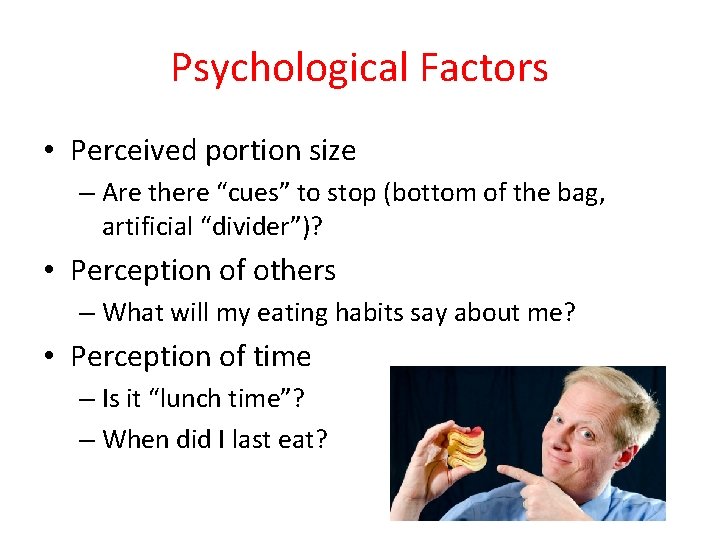
Psychological Factors • Perceived portion size – Are there “cues” to stop (bottom of the bag, artificial “divider”)? • Perception of others – What will my eating habits say about me? • Perception of time – Is it “lunch time”? – When did I last eat?
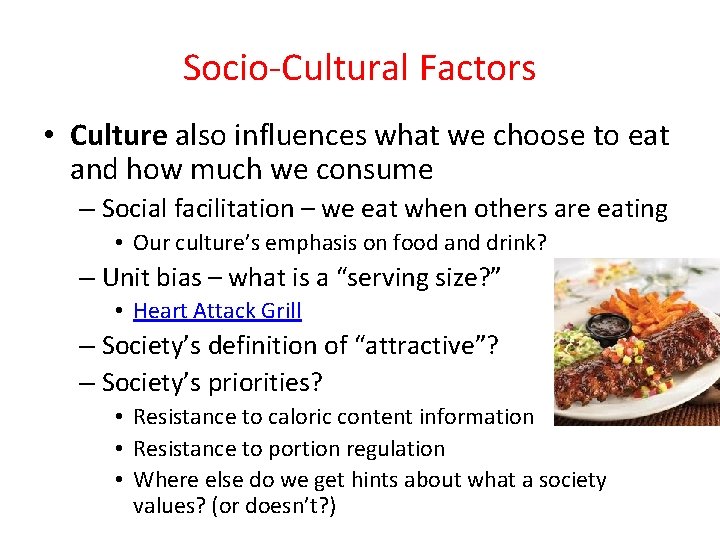
Socio-Cultural Factors • Culture also influences what we choose to eat and how much we consume – Social facilitation – we eat when others are eating • Our culture’s emphasis on food and drink? – Unit bias – what is a “serving size? ” • Heart Attack Grill – Society’s definition of “attractive”? – Society’s priorities? • Resistance to caloric content information • Resistance to portion regulation • Where else do we get hints about what a society values? (or doesn’t? )
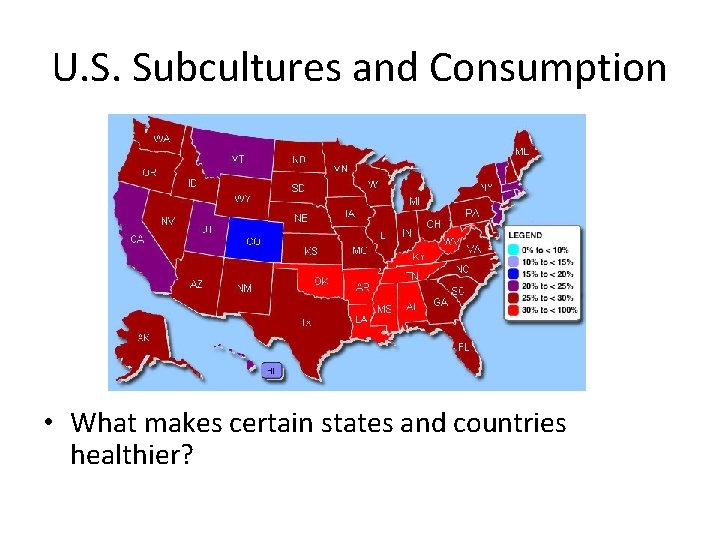
U. S. Subcultures and Consumption • What makes certain states and countries healthier?
Obesity • Considered by U. S. Surgeon General to be the most pressing health problem today • An estimated 36% of Americans are obese – 15 -25% of children and adolescents – 2/3 people are overweight • Obesity can lead to increased risk for – – Hypertension Cardiovascular disease Diabetes Sleep apnea • Tendency may be inherited (OB-1)
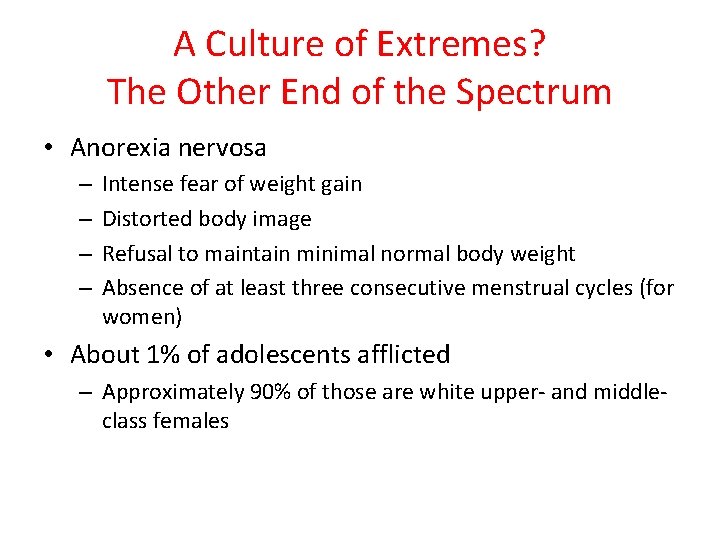
A Culture of Extremes? The Other End of the Spectrum • Anorexia nervosa – – Intense fear of weight gain Distorted body image Refusal to maintain minimal normal body weight Absence of at least three consecutive menstrual cycles (for women) • About 1% of adolescents afflicted – Approximately 90% of those are white upper- and middleclass females
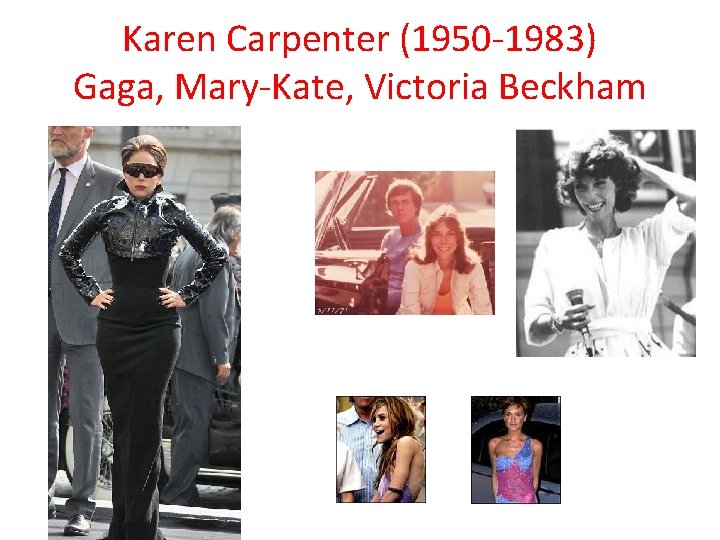
Karen Carpenter (1950 -1983) Gaga, Mary-Kate, Victoria Beckham
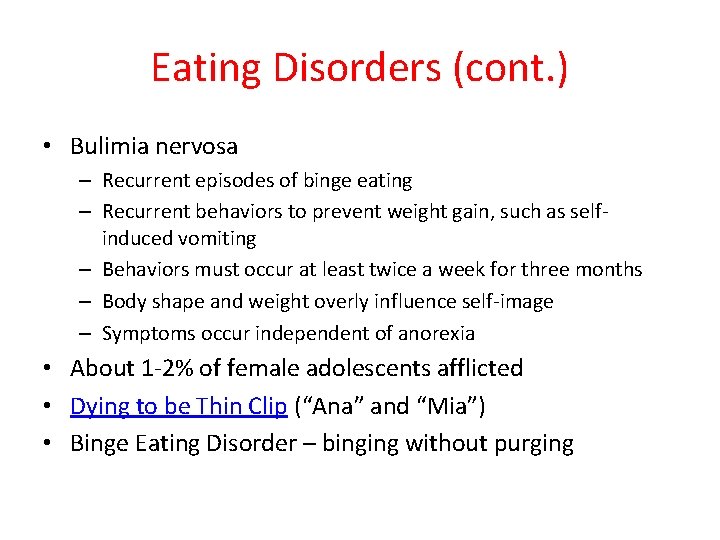
Eating Disorders (cont. ) • Bulimia nervosa – Recurrent episodes of binge eating – Recurrent behaviors to prevent weight gain, such as selfinduced vomiting – Behaviors must occur at least twice a week for three months – Body shape and weight overly influence self-image – Symptoms occur independent of anorexia • About 1 -2% of female adolescents afflicted • Dying to be Thin Clip (“Ana” and “Mia”) • Binge Eating Disorder – binging without purging
Summary of Hunger Motivation
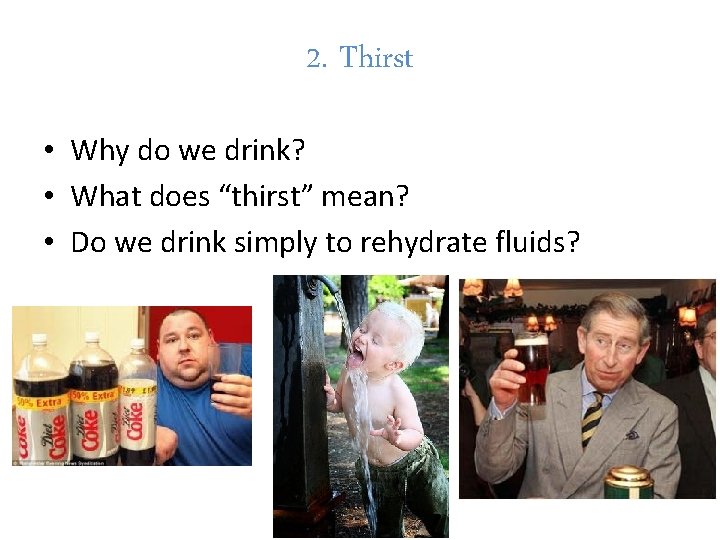
2. Thirst • Why do we drink? • What does “thirst” mean? • Do we drink simply to rehydrate fluids?
Thirst in a Nutshell • Both internal and external cues can trigger the thirst drive – Internal cues include level of fluids inside body cells and amount of fluids outside body cells • If you are “thirsty”, you are already dehydrated – External cues can include advertisements and weather conditions – Perception of liquid as less caloric than food? • Snacking: Drinking vs. eating
3. Sexual Motivation • What biological factors govern sexual behavior? • Is there a difference between males and females? • What determines sexual orientation?
Biological Factors • Hypothalamus controls the release of luteinizing hormone from the pituitary gland, which in turn controls the release of androgens and estrogens. • Testosterone – Important in both men and women in early development – Men and women seem to need some to be interested in sex, but as long as it is there its role in regulating sexual activity is minimal • Estrogens – Female hormones that peak during ovulation – Interestingly, when charting sexual activity, women are more receptive to sex during ovulation
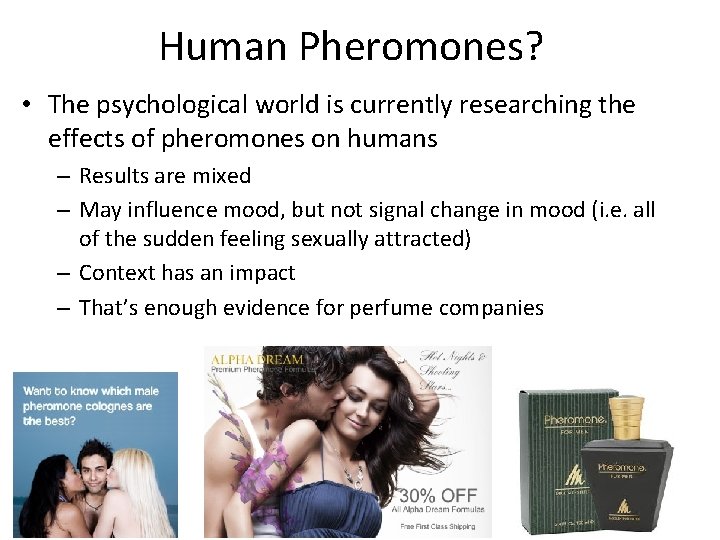
Human Pheromones? • The psychological world is currently researching the effects of pheromones on humans – Results are mixed – May influence mood, but not signal change in mood (i. e. all of the sudden feeling sexually attracted) – Context has an impact – That’s enough evidence for perfume companies
We are Not Just Animals: The Psychology of Sex • Human sexual motivation is much more dependent on experience and learning than on biology • There are many reasons why people have sex • External Stimuli – Both men and women tend to become aroused when exposed to sexually explicit material – Repeated exposure to the same stimuli lessens arousal over time (cheating? ? ) • Imagined Stimuli – Sexual arousal while dreaming in both sexes – Sexual fantasies are prevalent, but may not be indicative of desires in real life – Ugly Thoughts’ Defense Fails as Officer Is Convicted in Cannibal Plot
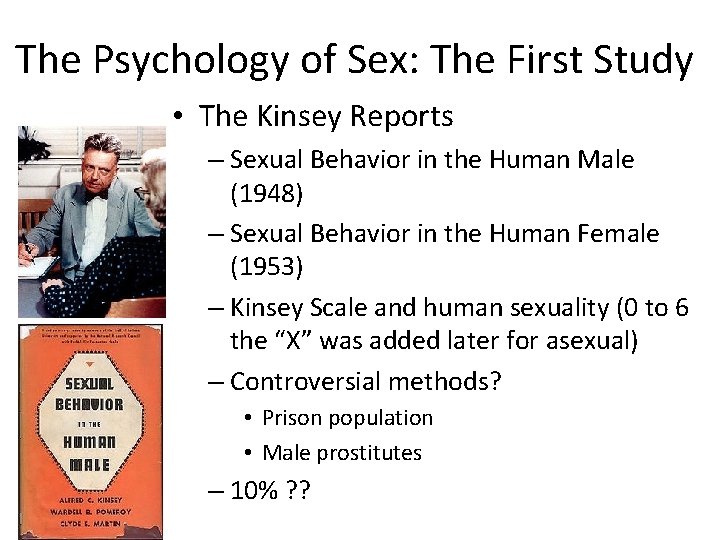
The Psychology of Sex: The First Study • The Kinsey Reports – Sexual Behavior in the Human Male (1948) – Sexual Behavior in the Human Female (1953) – Kinsey Scale and human sexuality (0 to 6 the “X” was added later for asexual) – Controversial methods? • Prison population • Male prostitutes – 10% ? ?
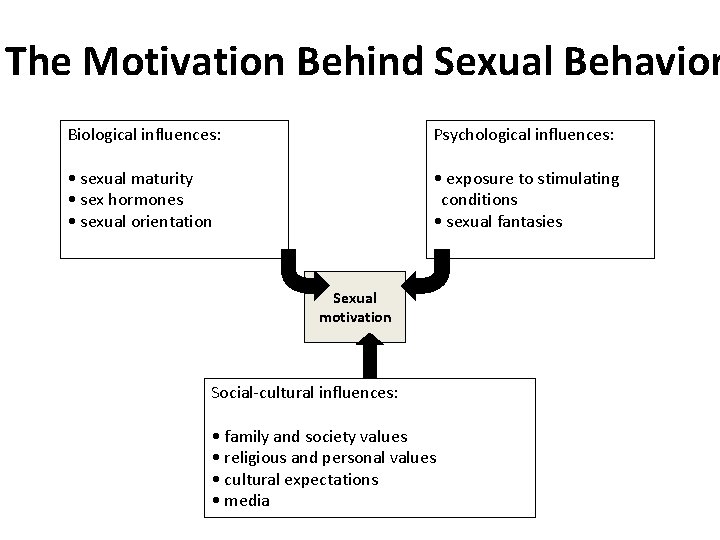
The Motivation Behind Sexual Behavior Biological influences: Psychological influences: • sexual maturity • sex hormones • sexual orientation • exposure to stimulating conditions • sexual fantasies Sexual motivation Social-cultural influences: • family and society values • religious and personal values • cultural expectations • media
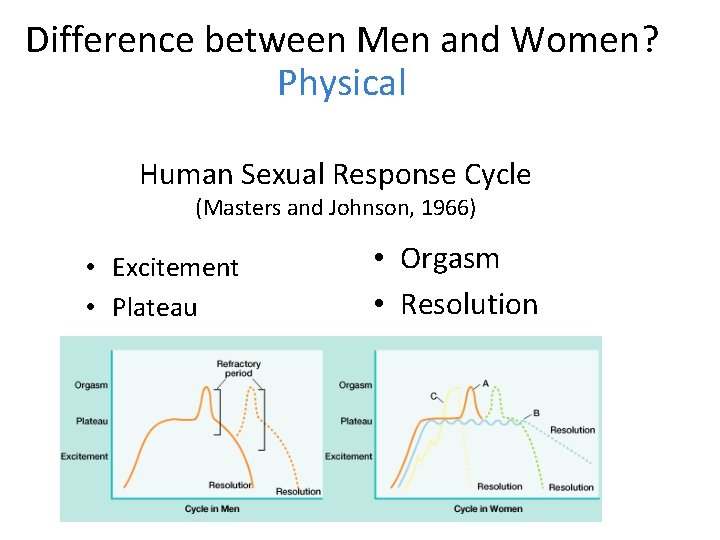
Difference between Men and Women? Physical Human Sexual Response Cycle (Masters and Johnson, 1966) • Excitement • Plateau • Orgasm • Resolution
Difference between Men and Women? Psychological • We already know that men and women have different response cycles (Masters and Johnson) • How do men and women differ in sexual activity? • Article: Does Sexuality Differ for Men and Women? • Age and sex – Dr. Oz on the Health Benefits
Adolescent Sexuality • Teen Pregnancy – US has a relatively high rate of teen pregnancy and abortion – Some explanations include a lack of knowledge about sex and birth control, substance use, and lack of media reinforcement of protected sex • Sexually Transmitted Infections/STDs – For reasons listed above, STIs are also prevalent amongst young people (2/3 of all new infections occur in population under 25) – Many people do not know the risks of certain sexual practices and do not think about the number of partners their partner has had • Why? – Alcohol and sex? – Frontal Lobe Dev’t?
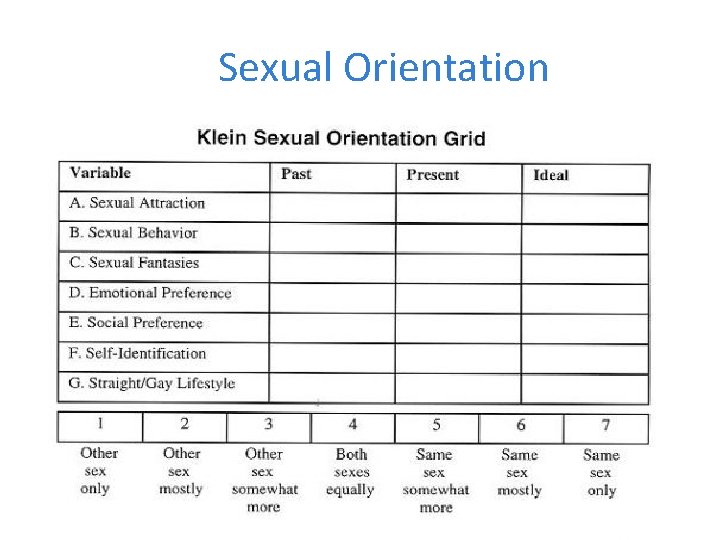
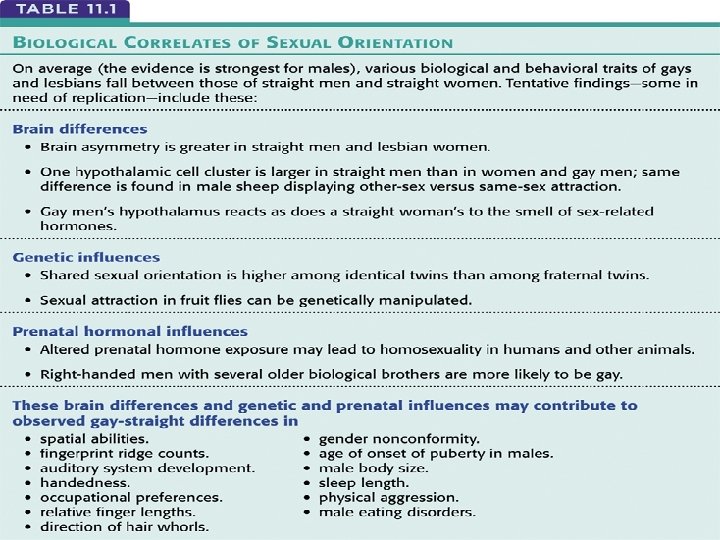
Sexual Orientation • Refers to the direction of an individual’s sexual interest – Heterosexual • Sexual attraction to opposite sex – Homosexual • Sexual attraction to same sex – Bisexual • Sexual attraction to both sexes • Approximately 3 -4% of men and 1 -2% of women are gay/lesbian. • Sexuality is enduring over time and cannot be “changed” • Women’s sexuality seems to be more “fluid” than men’s (“erotic plasticity”) • Nature and nurture explain human sexuality
Sexual Orientation
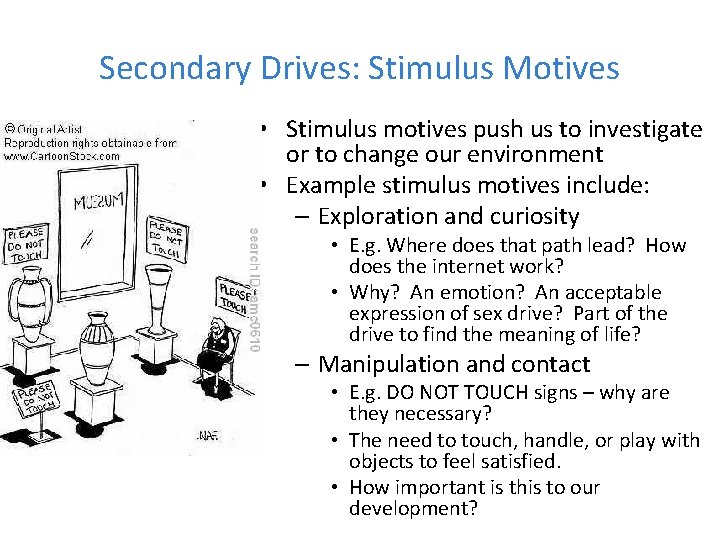
Secondary Drives: Stimulus Motives • Stimulus motives push us to investigate or to change our environment • Example stimulus motives include: – Exploration and curiosity • E. g. Where does that path lead? How does the internet work? • Why? An emotion? An acceptable expression of sex drive? Part of the drive to find the meaning of life? – Manipulation and contact • E. g. DO NOT TOUCH signs – why are they necessary? • The need to touch, handle, or play with objects to feel satisfied. • How important is this to our development?
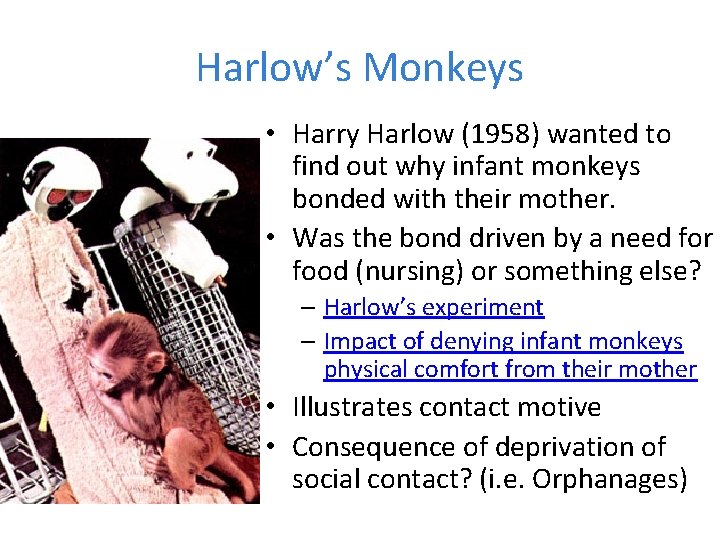
Harlow’s Monkeys • Harry Harlow (1958) wanted to find out why infant monkeys bonded with their mother. • Was the bond driven by a need for food (nursing) or something else? – Harlow’s experiment – Impact of denying infant monkeys physical comfort from their mother • Illustrates contact motive • Consequence of deprivation of social contact? (i. e. Orphanages)
Other Motives: Social Motives • Social motives are those which involve how we are driven to relate to others. They include the following: – Aggression – Achievement – Affiliation
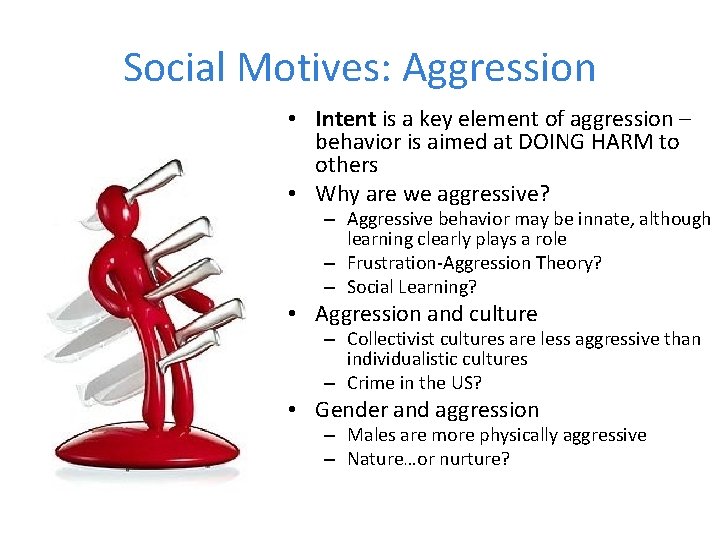
Social Motives: Aggression • Intent is a key element of aggression – behavior is aimed at DOING HARM to others • Why are we aggressive? – Aggressive behavior may be innate, although learning clearly plays a role – Frustration-Aggression Theory? – Social Learning? • Aggression and culture – Collectivist cultures are less aggressive than individualistic cultures – Crime in the US? • Gender and aggression – Males are more physically aggressive – Nature…or nurture?
Writing Prompt • Think of an example of something that you are intrinsically motivated to do, then think of an example of a behavior that you are extrinsically motivated to do.
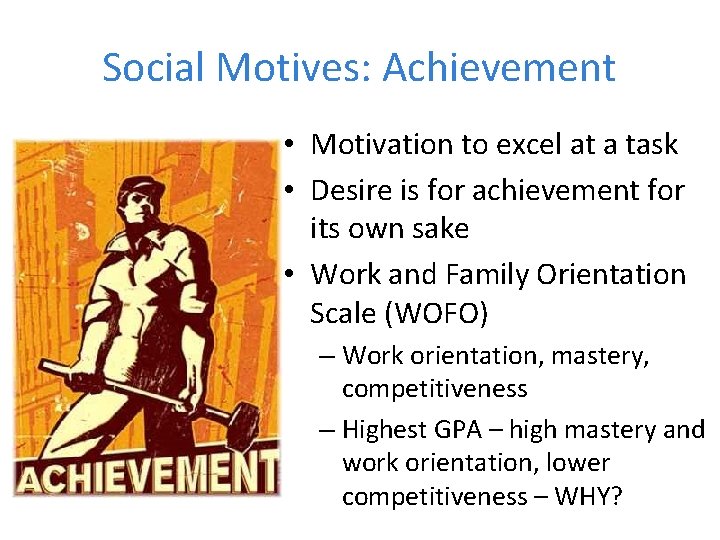
Social Motives: Achievement • Motivation to excel at a task • Desire is for achievement for its own sake • Work and Family Orientation Scale (WOFO) – Work orientation, mastery, competitiveness – Highest GPA – high mastery and work orientation, lower competitiveness – WHY?
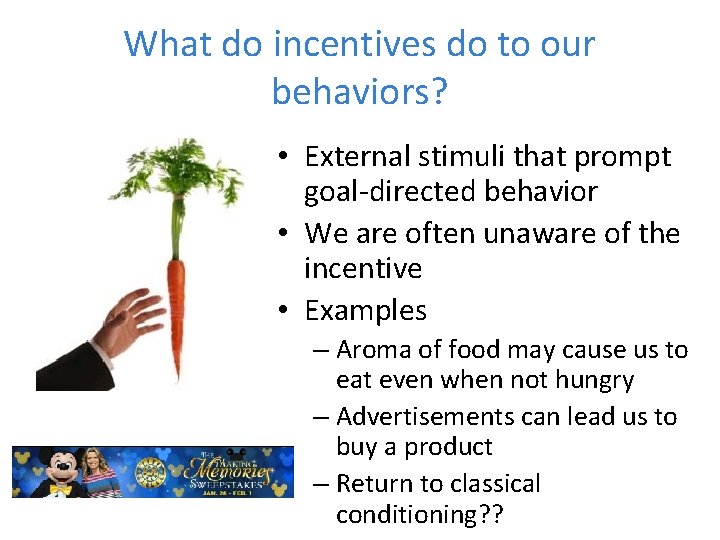
What do incentives do to our behaviors? • External stimuli that prompt goal-directed behavior • We are often unaware of the incentive • Examples – Aroma of food may cause us to eat even when not hungry – Advertisements can lead us to buy a product – Return to classical conditioning? ?
Intrinsic and Extrinsic Motivation • Intrinsic motivation – Motivation for a behavior is the behavior itself – Children playing is an example • Extrinsic motivation – Behavior is performed in order to obtain a reward (incentive) or to avoid punishment – A bonus program is an example – Dangers of providing extrinsic motivation for intrinsically motivated activities? – Overjustification • Dan Pink on Motivation (Ted Talks)
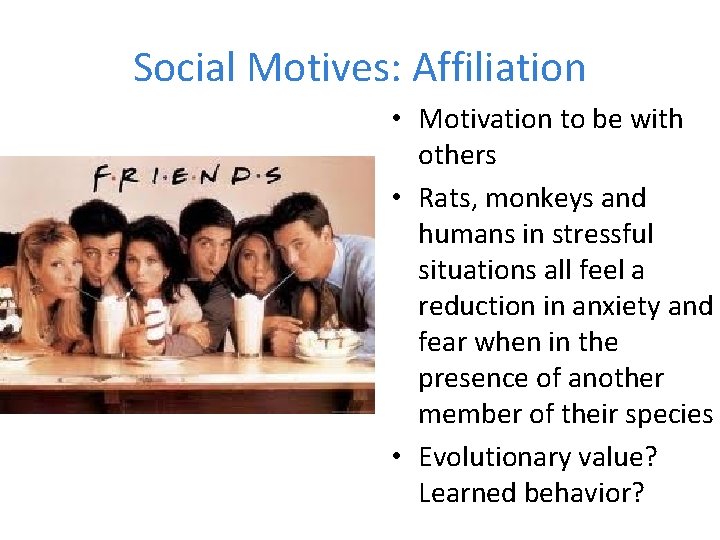
Social Motives: Affiliation • Motivation to be with others • Rats, monkeys and humans in stressful situations all feel a reduction in anxiety and fear when in the presence of another member of their species • Evolutionary value? Learned behavior?