
Unit 9 Introspective techniques What types of ELT

- Slides: 8
Unit 9. Introspective techniques • What types of ELT exercises would ask for the use of introspection? • In which context is introspection more justified/more important? – E. g. a speaking exercise? – E. g. doing MCQ questions? • What seems to be the real value of introspection? � 2015 Dávid & Ryan 1
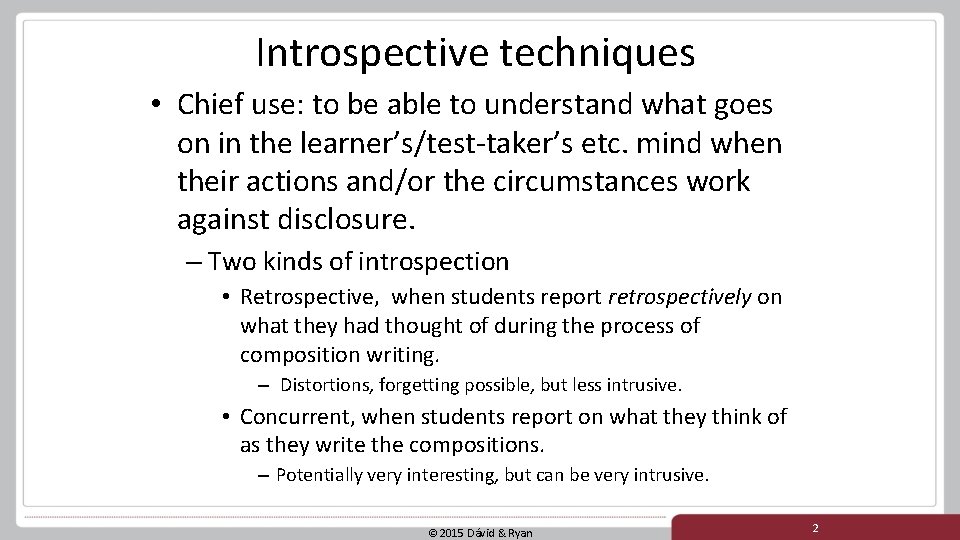
Introspective techniques • Chief use: to be able to understand what goes on in the learner’s/test-taker’s etc. mind when their actions and/or the circumstances work against disclosure. – Two kinds of introspection • Retrospective, when students report retrospectively on what they had thought of during the process of composition writing. – Distortions, forgetting possible, but less intrusive. • Concurrent, when students report on what they think of as they write the compositions. – Potentially very interesting, but can be very intrusive. © 2015 Dávid & Ryan 2
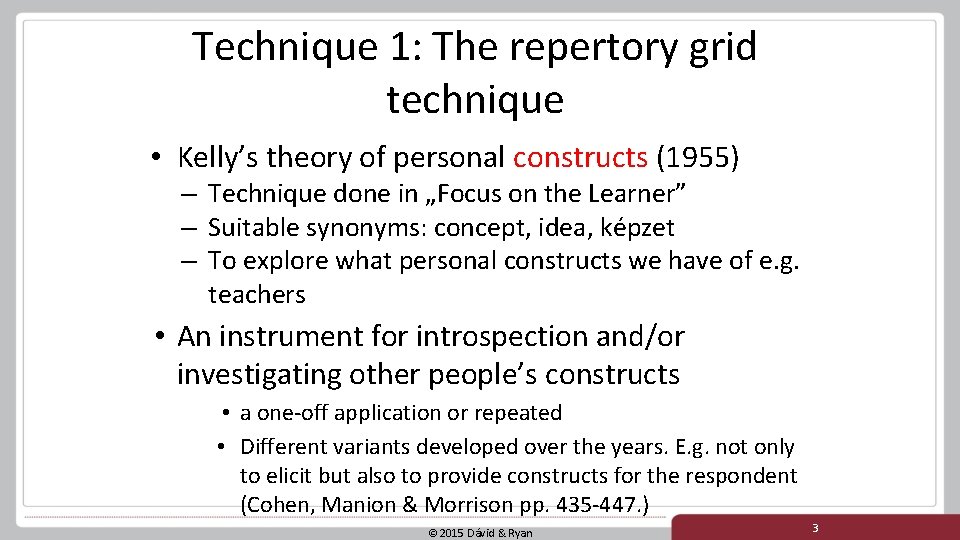
Technique 1: The repertory grid technique • Kelly’s theory of personal constructs (1955) – Technique done in „Focus on the Learner” – Suitable synonyms: concept, idea, képzet – To explore what personal constructs we have of e. g. teachers • An instrument for introspection and/or investigating other people’s constructs • a one-off application or repeated • Different variants developed over the years. E. g. not only to elicit but also to provide constructs for the respondent (Cohen, Manion & Morrison pp. 435 -447. ) © 2015 Dávid & Ryan 3
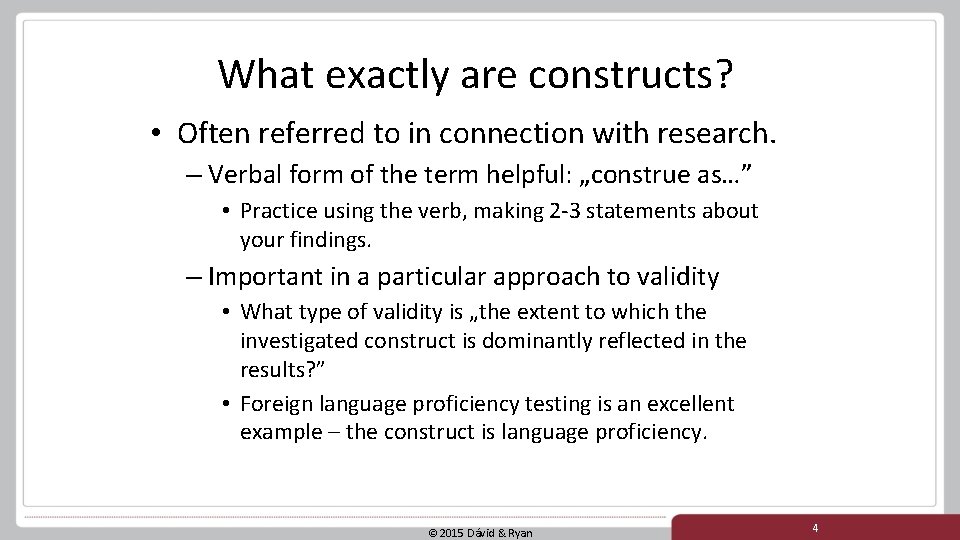
What exactly are constructs? • Often referred to in connection with research. – Verbal form of the term helpful: „construe as…” • Practice using the verb, making 2 -3 statements about your findings. – Important in a particular approach to validity • What type of validity is „the extent to which the investigated construct is dominantly reflected in the results? ” • Foreign language proficiency testing is an excellent example – the construct is language proficiency. © 2015 Dávid & Ryan 4
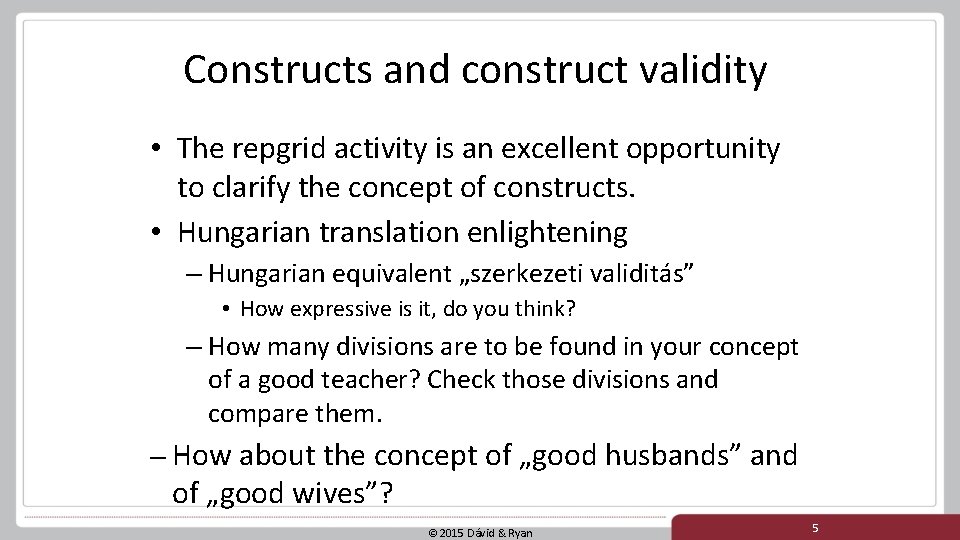
Constructs and construct validity • The repgrid activity is an excellent opportunity to clarify the concept of constructs. • Hungarian translation enlightening – Hungarian equivalent „szerkezeti validitás” • How expressive is it, do you think? – How many divisions are to be found in your concept of a good teacher? Check those divisions and compare them. – How about the concept of „good husbands” and of „good wives”? © 2015 Dávid & Ryan 5
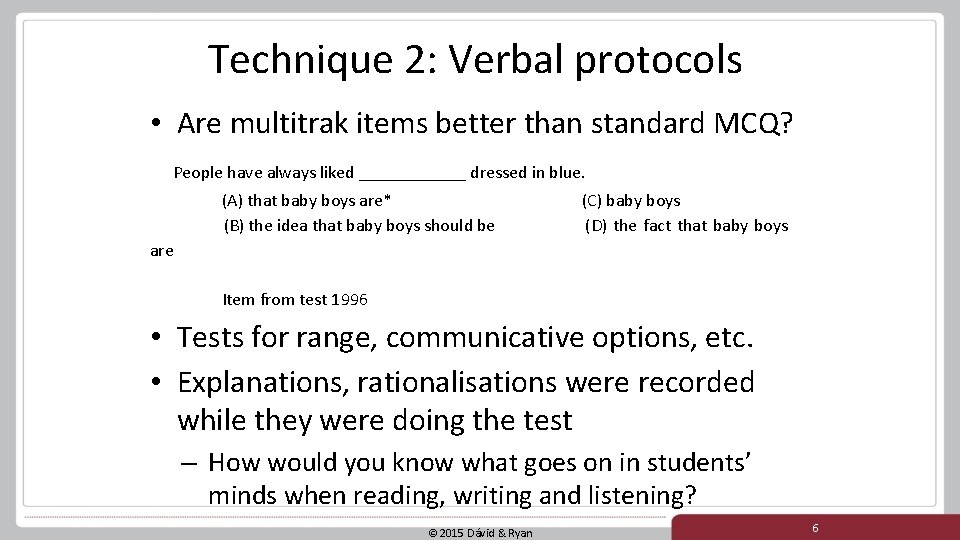
Technique 2: Verbal protocols • Are multitrak items better than standard MCQ? People have always liked ______ dressed in blue. (A) that baby boys are* (B) the idea that baby boys should be are (C) baby boys (D) the fact that baby boys Item from test 1996 • Tests for range, communicative options, etc. • Explanations, rationalisations were recorded while they were doing the test – How would you know what goes on in students’ minds when reading, writing and listening? © 2015 Dávid & Ryan 6
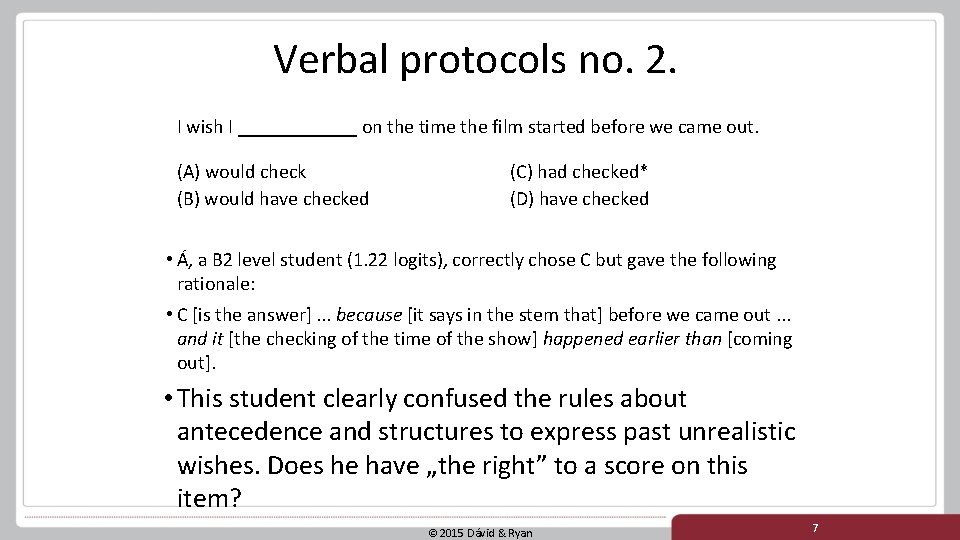
Verbal protocols no. 2. I wish I ______ on the time the film started before we came out. (A) would check (C) had checked* (B) would have checked (D) have checked • Á, a B 2 level student (1. 22 logits), correctly chose C but gave the following rationale: • C [is the answer]. . . because [it says in the stem that] before we came out. . . and it [the checking of the time of the show] happened earlier than [coming out]. • This student clearly confused the rules about antecedence and structures to express past unrealistic wishes. Does he have „the right” to a score on this item? © 2015 Dávid & Ryan 7
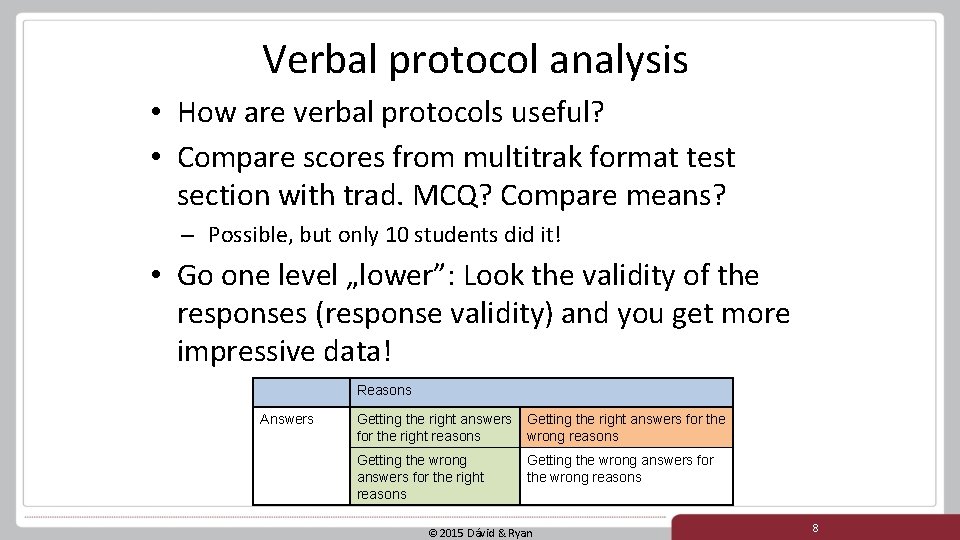
Verbal protocol analysis • How are verbal protocols useful? • Compare scores from multitrak format test section with trad. MCQ? Compare means? – Possible, but only 10 students did it! • Go one level „lower”: Look the validity of the responses (response validity) and you get more impressive data! Reasons Answers Getting the right answers for the right reasons Getting the right answers for the wrong reasons Getting the wrong answers for the right reasons Getting the wrong answers for the wrong reasons © 2015 Dávid & Ryan 8