
UNIT 9 CH 25 USING MODIFIERS 7 th
- Slides: 12
UNIT 9: CH. 25 USING MODIFIERS 7 th English
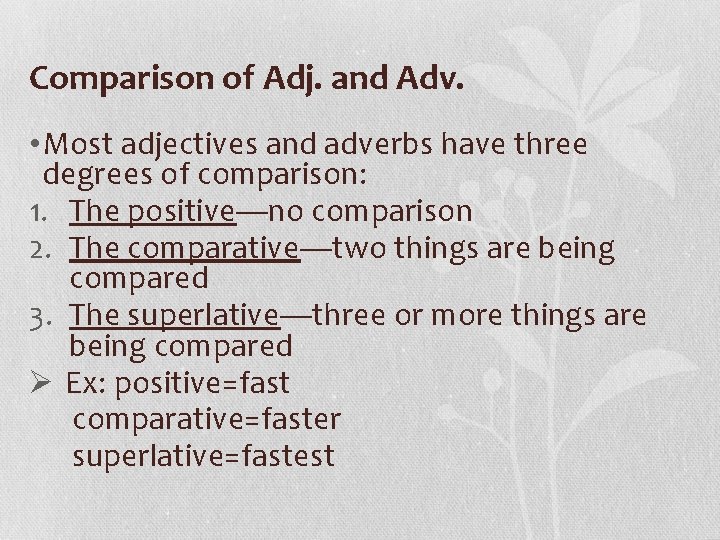
Comparison of Adj. and Adv. • Most adjectives and adverbs have three degrees of comparison: 1. The positive—no comparison 2. The comparative—two things are being compared 3. The superlative—three or more things are being compared Ø Ex: positive=fast comparative=faster superlative=fastest
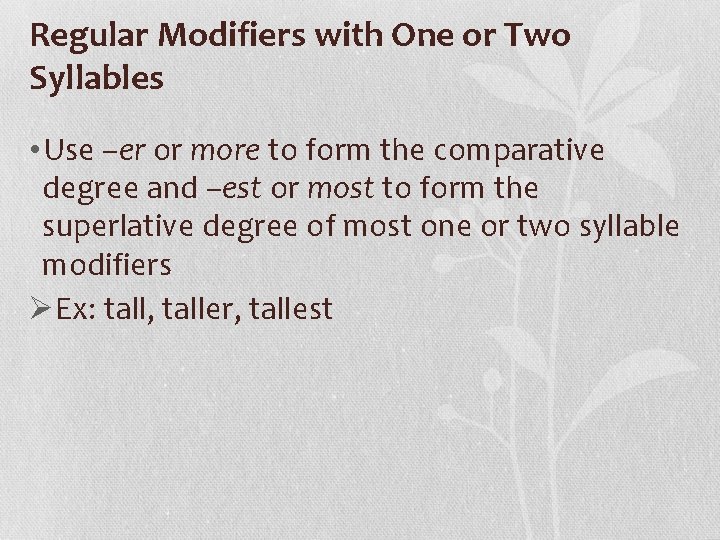
Regular Modifiers with One or Two Syllables • Use –er or more to form the comparative degree and –est or most to form the superlative degree of most one or two syllable modifiers ØEx: tall, taller, tallest
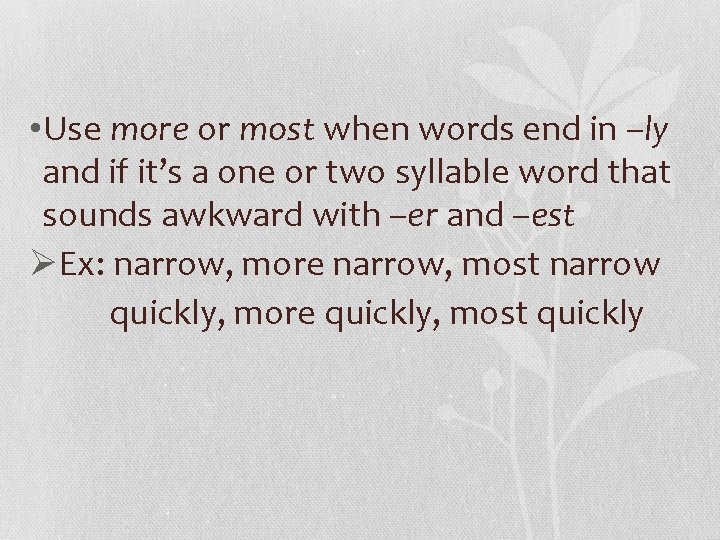
• Use more or most when words end in –ly and if it’s a one or two syllable word that sounds awkward with –er and –est ØEx: narrow, more narrow, most narrow quickly, more quickly, most quickly
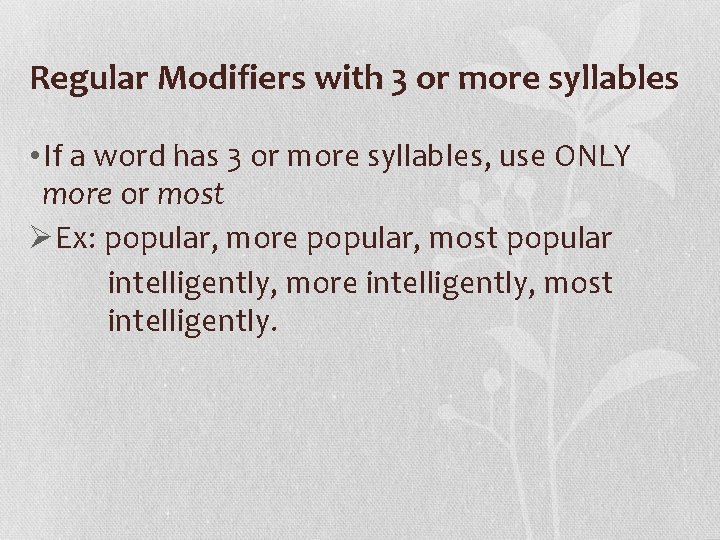
Regular Modifiers with 3 or more syllables • If a word has 3 or more syllables, use ONLY more or most ØEx: popular, more popular, most popular intelligently, more intelligently, most intelligently.
Irregular Adj. and Adv. • You will need to memorize the irregular comparative and superlative forms of certain adjectives and adverbs. ØSee handout in notes or pg. 413
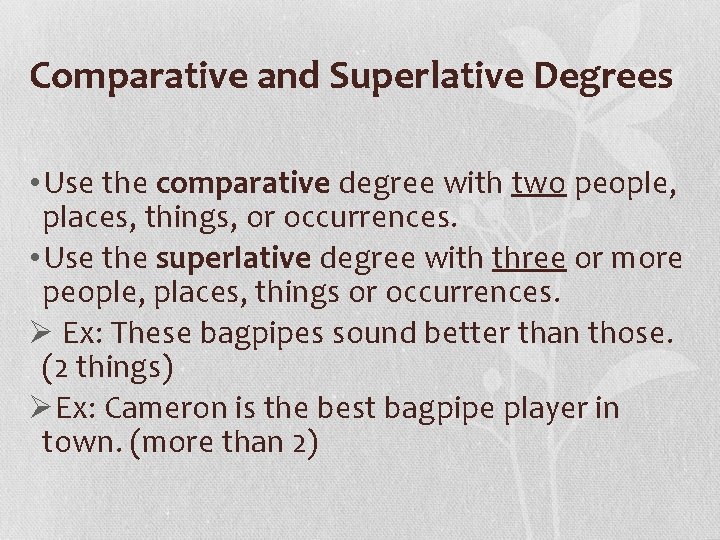
Comparative and Superlative Degrees • Use the comparative degree with two people, places, things, or occurrences. • Use the superlative degree with three or more people, places, things or occurrences. Ø Ex: These bagpipes sound better than those. (2 things) ØEx: Cameron is the best bagpipe player in town. (more than 2)
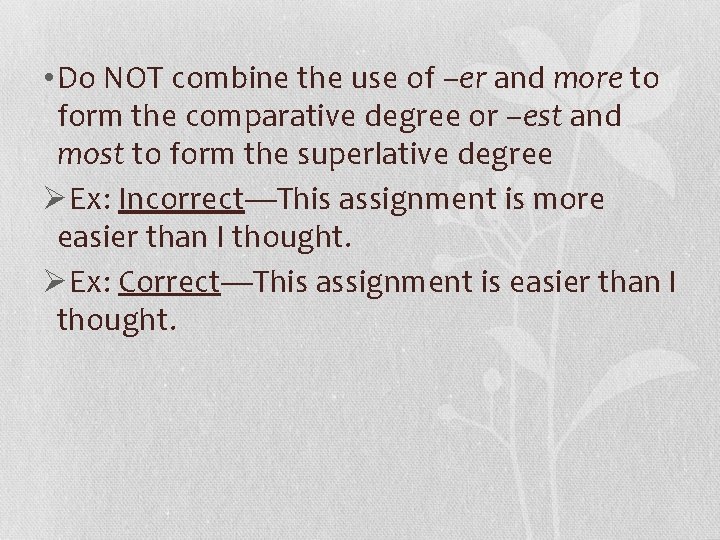
• Do NOT combine the use of –er and more to form the comparative degree or –est and most to form the superlative degree ØEx: Incorrect—This assignment is more easier than I thought. ØEx: Correct—This assignment is easier than I thought.
Troublesome Adj. and Adv. • Bad + Badly—”bad” is an adjective! Use after linking verbs such as are, appear, feel, look, and sound. “Badly” is an adverb—use after action verbs such as act, behave, do, and perform. Ø Ex: Incorrect—Jan looked badly after the trip. Ø Ex: Correct—Jan looked bad after the trip.
• Fewer + Less—use the adjective fewer to answer the question “How many? ” Use the adjective less to answer the question “How much? ” ØEx: How many? Fewer calories, fewer chores ØEx: How much? Less food, less work
• Good + Well—“Good” is an adjective. “Well” can be either an adjective or an adverb, depending on its meaning. Do NOT use “good” after an action verb, use “well” ØEx: Incorrect—The children have behaved good all day. ØEx: Correct—The children have behaved well all day.
• Just—When used as an adverb, “just” often means “no more than. ” When just has this meaning, place it directly before the word it is describing • Only—The position of “only” in a sentence sometimes affects the sentence’s entire meaning. Do NOT place “only” where it makes the sentence unclear. ØEx: Incorrect—Only take advice from me. ØEx: Correct—Take advice only from me.