
Unit 9 1 Global 10 Regents Review Which

Unit 9. 1 Global 10: Regents Review
Which was true of food-gathering societies in prehistoric times? 1. 2. 3. 4. Society was highly industrialized. The population tended to be small. The concept of private property was important. There was a system of mass production.
Which was true of food-gathering societies in prehistoric times? 1. 2. 3. 4. Society was highly industrialized. The population tended to be small. The concept of private property was important. There was a system of mass production.
In the Middle East during Neolithic times, the development of farming brought about 1. 2. 3. 4. the establishment of permanent settlements a return to a nomadic lifestyle the rise of hunting as an important occupation increased dependence on the exportation of oil
In the Middle East during Neolithic times, the development of farming brought about 1. 2. 3. 4. the establishment of permanent settlements a return to a nomadic lifestyle the rise of hunting as an important occupation increased dependence on the exportation of oil

The basic characteristic of subsistence agriculture is that farmers 1. 2. 3. 4. produce mostly staple crops to sell large portions of their crops at the market price produce crops mainly for their own immediate use produce crops according to government orders

The basic characteristic of subsistence agriculture is that farmers 1. 2. 3. 4. produce mostly staple crops to sell large portions of their crops at the market price produce crops mainly for their own immediate use produce crops according to government orders

In which order did the occupations listed below most likely develop in human history? (A) farmers (B) traders (C) nomadic herders (D) hunters and gatherers 1. 2. 3. 4. A, B, C, D B, D, A, C C, A, B, D D, C, A, B

In which order did the occupations listed below most likely develop in human history? (A) farmers (B) traders (C) nomadic herders (D) hunters and gatherers 1. 2. 3. 4. A, B, C, D B, D, A, C C, A, B, D D, C, A, B
One result of the Neolithic Revolution was 1. 2. 3. 4. an increase in the number of nomadic tribes a reliance on hunting and gathering for food the establishment of villages and the rise of governments a decrease in trade between cultural groups
One result of the Neolithic Revolution was 1. 2. 3. 4. an increase in the number of nomadic tribes a reliance on hunting and gathering for food the establishment of villages and the rise of governments a decrease in trade between cultural groups

Hunting and gathering, subsistence agriculture, and the barter system are characteristics of a 1. 2. 3. 4. market economy command economy traditional economy mixed economy

Hunting and gathering, subsistence agriculture, and the barter system are characteristics of a 1. 2. 3. 4. market economy command economy traditional economy mixed economy

The term "subsistence farmers" refers to people who grow 1. 2. 3. 4. enough food to feed an entire village food to sell in village markets just enough food to meet the needs of the immediate family a single cash crop

The term "subsistence farmers" refers to people who grow 1. 2. 3. 4. enough food to feed an entire village food to sell in village markets just enough food to meet the needs of the immediate family a single cash crop

What was an important result of the Neolithic Revolution? 1. 2. 3. 4. Food supplies became more reliable. New sources of energy became available. People became more nomadic. Populations declined.

What was an important result of the Neolithic Revolution? 1. 2. 3. 4. Food supplies became more reliable. New sources of energy became available. People became more nomadic. Populations declined.
During which period did the domestication of animals and growing of crops first occur? 1. 2. 3. 4. Iron Age Old Stone Age Neolithic Revolution Scientific Revolution
During which period did the domestication of animals and growing of crops first occur? 1. 2. 3. 4. Iron Age Old Stone Age Neolithic Revolution Scientific Revolution

Base your answer to the question on the quotation and on your knowledge of social studies. “…The daily tasks of the women are to milk the cattle in the morning and evening, and to fetch water as required. By using their donkeys it is possible for them to bring back enough water to last two or three days. When the settlement moves, on average about once every five weeks, each woman is responsible for moving her hut and rebuilding it. All the necessary movables, including hides, wooden containers and important struts in the framework of the hut, can normally be carried by two donkeys. Older women rely on their daughters, their younger co-wives, and their sons’ wives for help in all these tasks…. ” – Source: Paul Spencer, The Samburu, University of California Press, 1965 • Based on this passage, the Samburu people would be classified as 1. commercial farmers 2. urban dwellers 3. nomads 4. serfs

Base your answer to the question on the quotation and on your knowledge of social studies. “…The daily tasks of the women are to milk the cattle in the morning and evening, and to fetch water as required. By using their donkeys it is possible for them to bring back enough water to last two or three days. When the settlement moves, on average about once every five weeks, each woman is responsible for moving her hut and rebuilding it. All the necessary movables, including hides, wooden containers and important struts in the framework of the hut, can normally be carried by two donkeys. Older women rely on their daughters, their younger co-wives, and their sons’ wives for help in all these tasks…. ” – Source: Paul Spencer, The Samburu, University of California Press, 1965 • Based on this passage, the Samburu people would be classified as 1. commercial farmers 2. urban dwellers 3. nomads 4. serfs
How did the introduction of agriculture affect early peoples? 1. 2. 3. 4. Societies became nomadic. Food production declined. Civilizations developed. Birth rates decreased rapidly.
How did the introduction of agriculture affect early peoples? 1. 2. 3. 4. Societies became nomadic. Food production declined. Civilizations developed. Birth rates decreased rapidly.
Early civilizations developed mainly in 1. 2. 3. 4. areas with abundant mineral resources valleys near rivers areas with climatic diversity mountainous areas
Early civilizations developed mainly in 1. 2. 3. 4. areas with abundant mineral resources valleys near rivers areas with climatic diversity mountainous areas
The development of ancient civilizations in Egypt, Mesopotamia, India, and China indicates the importance of 1. 2. 3. 4. heavy forestation mountain passes rugged coastlines river valleys
The development of ancient civilizations in Egypt, Mesopotamia, India, and China indicates the importance of 1. 2. 3. 4. heavy forestation mountain passes rugged coastlines river valleys
The early civilizations of the Nile River Valley, Mesopotamia, and the Yellow River Valley were similar because they were 1. 2. 3. 4. industrialized societies monotheistic dependent on fertile land dependent on each other for trade
The early civilizations of the Nile River Valley, Mesopotamia, and the Yellow River Valley were similar because they were 1. 2. 3. 4. industrialized societies monotheistic dependent on fertile land dependent on each other for trade
The river valleys of the Tigris-Euphrates, the Nile, and the Indus were centers of civilization because they 1. 2. 3. 4. had rich deposits of iron ore and coal were isolated from other cultural influences were easy to defend from invasion provided a means of transportation and irrigation
The river valleys of the Tigris-Euphrates, the Nile, and the Indus were centers of civilization because they 1. 2. 3. 4. had rich deposits of iron ore and coal were isolated from other cultural influences were easy to defend from invasion provided a means of transportation and irrigation
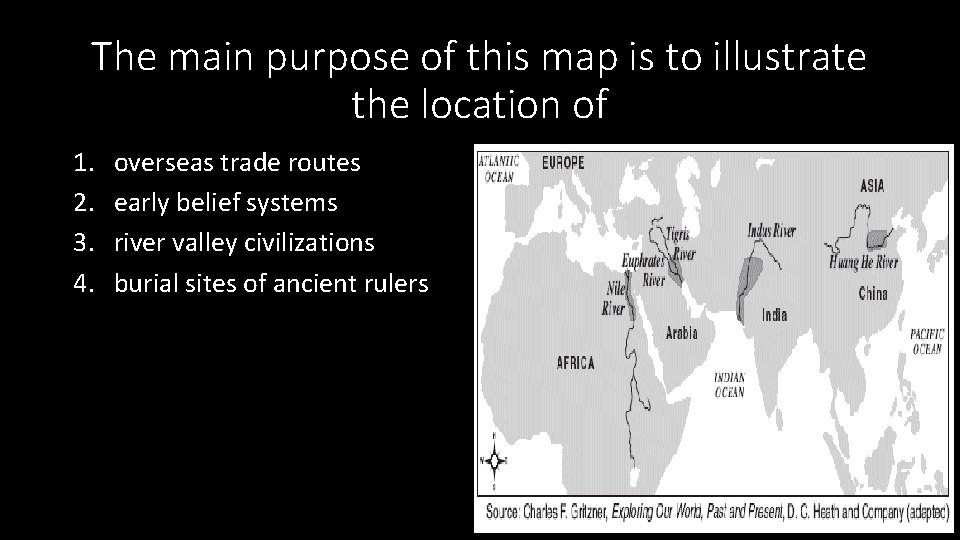
The main purpose of this map is to illustrate the location of 1. 2. 3. 4. overseas trade routes early belief systems river valley civilizations burial sites of ancient rulers
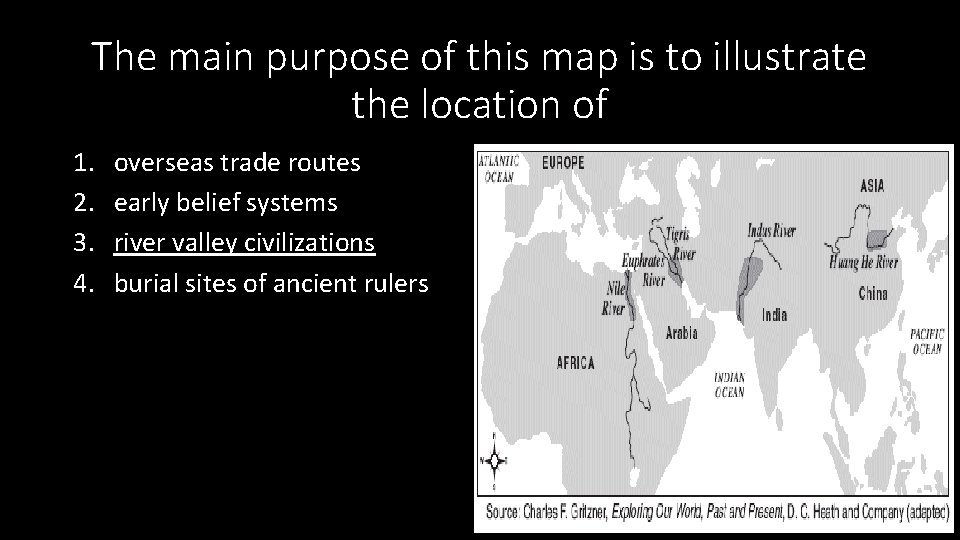
The main purpose of this map is to illustrate the location of 1. 2. 3. 4. overseas trade routes early belief systems river valley civilizations burial sites of ancient rulers
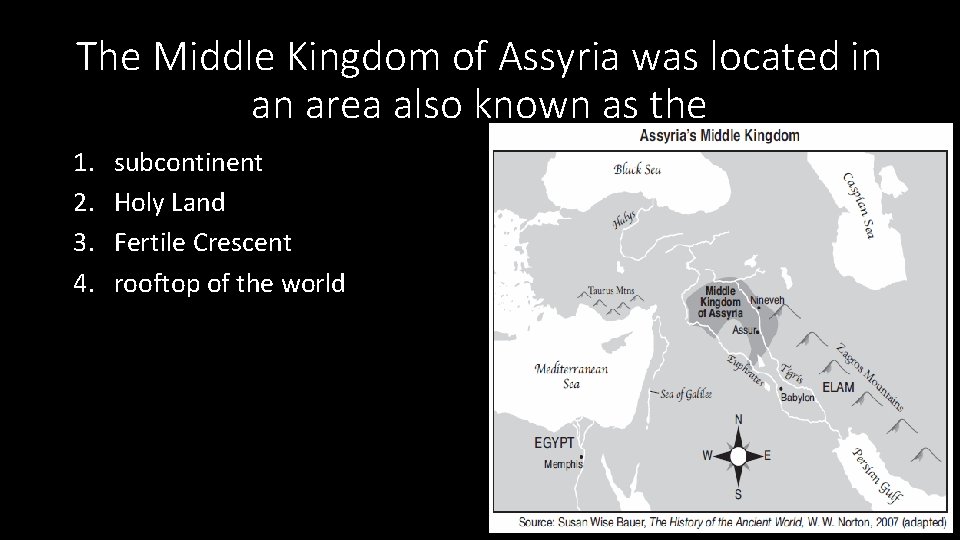
The Middle Kingdom of Assyria was located in an area also known as the 1. 2. 3. 4. subcontinent Holy Land Fertile Crescent rooftop of the world
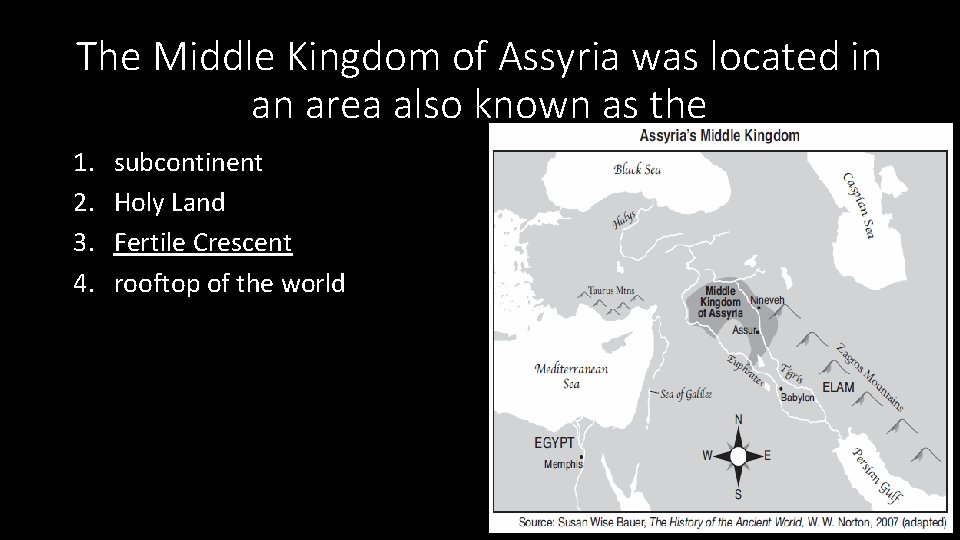
The Middle Kingdom of Assyria was located in an area also known as the 1. 2. 3. 4. subcontinent Holy Land Fertile Crescent rooftop of the world
The ancient Sumerians modified their environment to increase food production by 1. 2. 3. 4. building terraces removing rain forests digging irrigation canals developing chinampas
The ancient Sumerians modified their environment to increase food production by 1. 2. 3. 4. building terraces removing rain forests digging irrigation canals developing chinampas
Which best defines the term culture? 1. the interaction of peoples 2. the total learned heritage of a people 3. the acceptance by one ethnic group of another ethnic group’s values and customs 4. the adaptation by a less advanced people of the customs and values of a more advanced group
Which best defines the term culture? 1. the interaction of peoples 2. the total learned heritage of a people 3. the acceptance by one ethnic group of another ethnic group’s values and customs 4. the adaptation by a less advanced people of the customs and values of a more advanced group
Which characteristic was common to ancient civilizations in Egypt, Sumer, China, and Mexico? 1. 2. 3. 4. monotheistic religion written forms of communication influence of European cultures nomadic lifestyle
Which characteristic was common to ancient civilizations in Egypt, Sumer, China, and Mexico? 1. 2. 3. 4. monotheistic religion written forms of communication influence of European cultures nomadic lifestyle
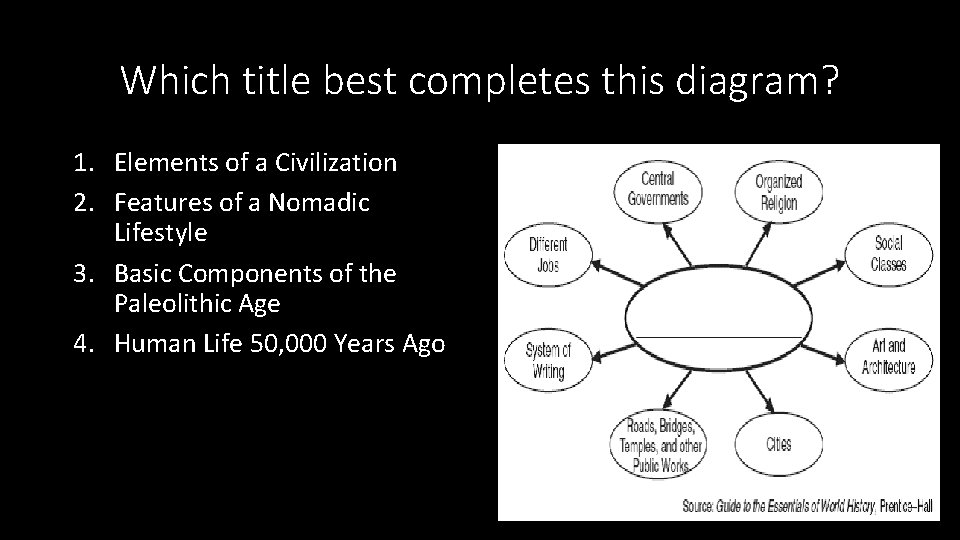
Which title best completes this diagram? 1. Elements of a Civilization 2. Features of a Nomadic Lifestyle 3. Basic Components of the Paleolithic Age 4. Human Life 50, 000 Years Ago
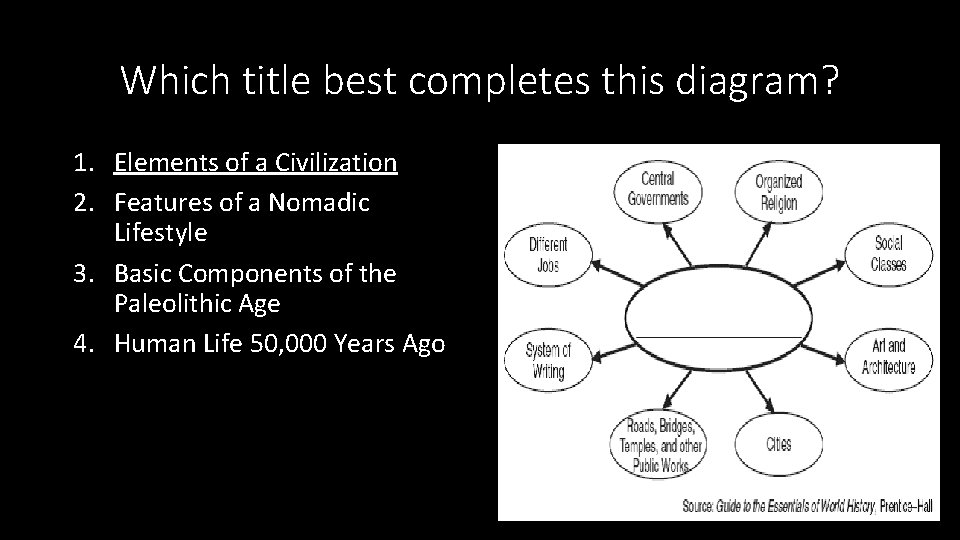
Which title best completes this diagram? 1. Elements of a Civilization 2. Features of a Nomadic Lifestyle 3. Basic Components of the Paleolithic Age 4. Human Life 50, 000 Years Ago
Cultural diffusion occurs most rapidly in societies that 1. 2. 3. 4. adhere to traditional social values have extended families come into frequent contact with other groups have a strong oral history

Cultural diffusion occurs most rapidly in societies that 1. 2. 3. 4. adhere to traditional social values have extended families come into frequent contact with other groups have a strong oral history
Which idea of Babylonian society does this portion of the Hammurabi code of law reflect? 1. All men were equal under the law. 2. Fines were preferable to corporal punishment. 3. Divisions existed between social classes. 4. Violence was always punished with violence. • “If a seignior (noble) has knocked out the tooth of a seignior of his own rank, they shall knock out his tooth. But if he has knocked out a commoner's tooth, he shall pay one-third mina of silver. ” – Code of Hammurabi
Which idea of Babylonian society does this portion of the Hammurabi code of law reflect? 1. All men were equal under the law. 2. Fines were preferable to corporal punishment. 3. Divisions existed between social classes. 4. Violence was always punished with violence. • “If a seignior (noble) has knocked out the tooth of a seignior of his own rank, they shall knock out his tooth. But if he has knocked out a commoner's tooth, he shall pay one-third mina of silver. ” – Code of Hammurabi
The Code of Hammurabi was designed to 1. 2. 3. 4. create a stable society promote peaceful relations with other cultures provide a framework for the development of democracy emphasize the importance of life after death
The Code of Hammurabi was designed to 1. 2. 3. 4. create a stable society promote peaceful relations with other cultures provide a framework for the development of democracy emphasize the importance of life after death
The Code of Hammurabi was a major contribution to the development of civilization because it 1. 2. 3. 4. treated citizens and slaves equally ended all physical punishment recorded existing laws for all to see rejected the principle of filial piety
The Code of Hammurabi was a major contribution to the development of civilization because it 1. 2. 3. 4. treated citizens and slaves equally ended all physical punishment recorded existing laws for all to see rejected the principle of filial piety
- Slides: 51