
Unit 8 The Periodic Table Chapters 4 11
Unit 8 ~ The Periodic Table (Chapters 4, 11) And YOU!!!!
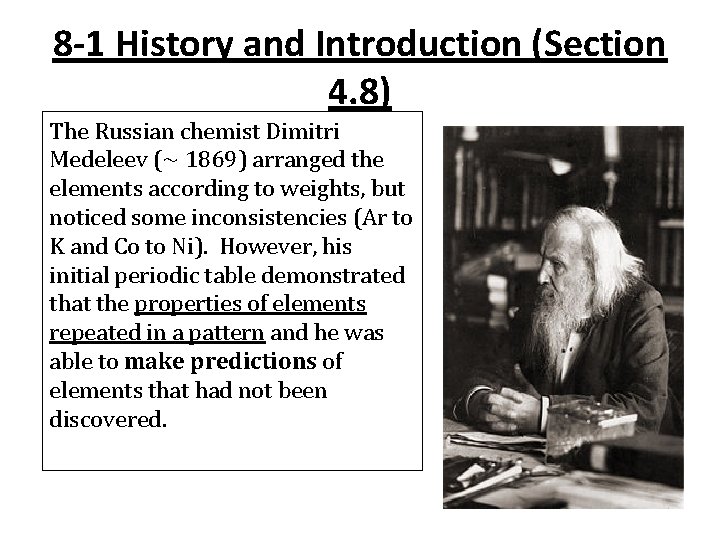
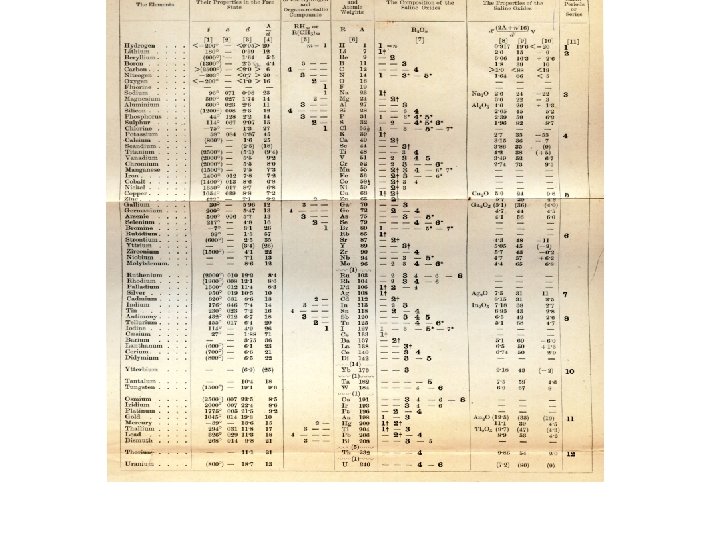
8 -1 History and Introduction (Section 4. 8) The Russian chemist Dimitri Medeleev (~ 1869) arranged the elements according to weights, but noticed some inconsistencies (Ar to K and Co to Ni). However, his initial periodic table demonstrated that the properties of elements repeated in a pattern and he was able to make predictions of elements that had not been discovered.

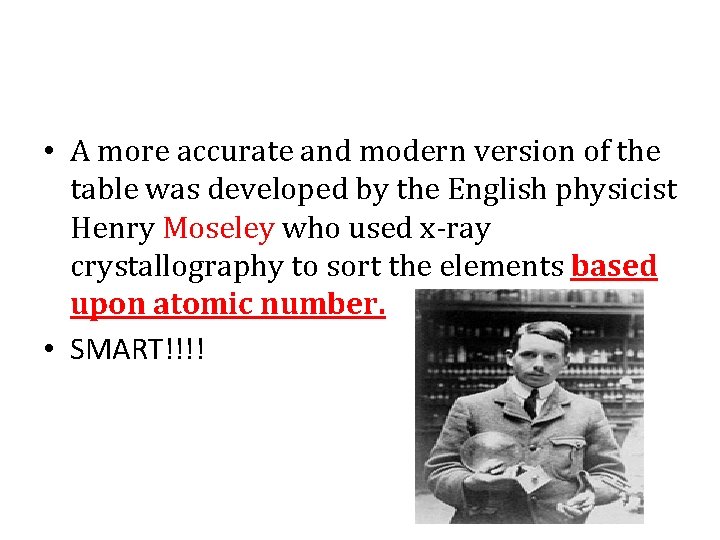
• A more accurate and modern version of the table was developed by the English physicist Henry Moseley who used x-ray crystallography to sort the elements based upon atomic number. • SMART!!!!
The Periodic Law: • the physical and chemical properties of the elements repeat in a systematic manner with increasing atomic number.
8 -2 The Chart (Section 4. 8) • Vertical columns are called “groups” or “families” and the elements in the group display similar chemical properties since they all have the same # of valence electrons. Four groups have distinct names that are commonly used: • Group 1 a: the Alkali Metals • Group 2 a: the Alkaline Earth metals • Group 7 a: the Halogens • Group 8 a: the Noble Gases
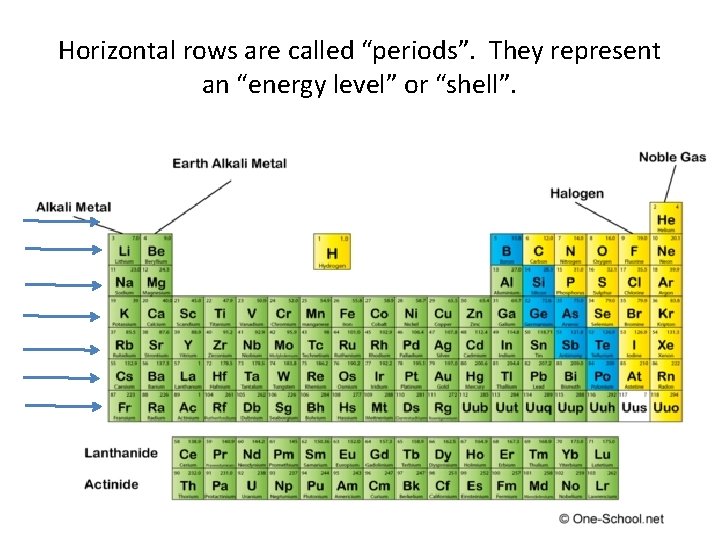
Horizontal rows are called “periods”. They represent an “energy level” or “shell”.
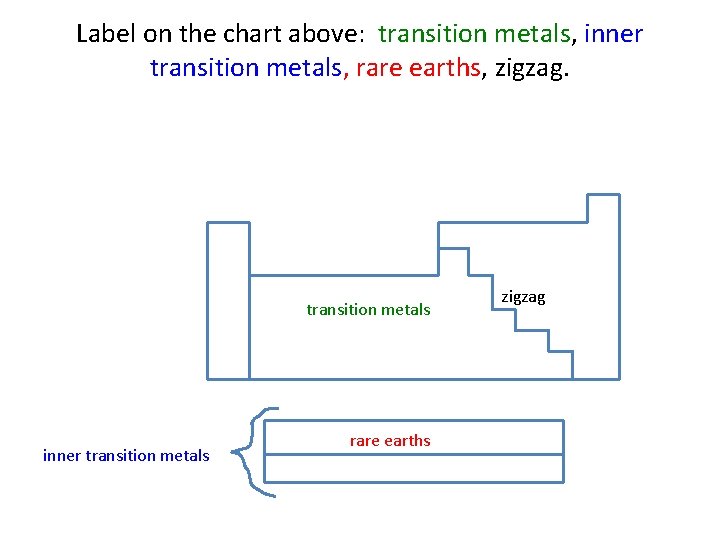
Label on the chart above: transition metals, inner transition metals, rare earths, zigzag. transition metals inner transition metals rare earths zigzag
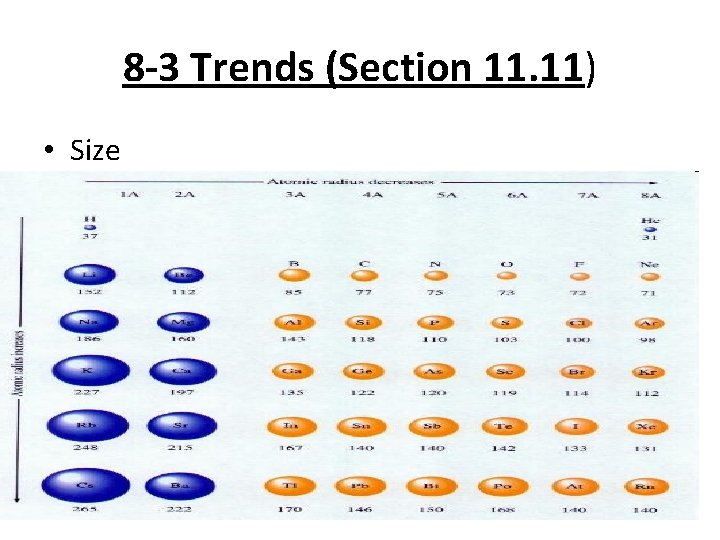
8 -3 Trends (Section 11. 11) • Size
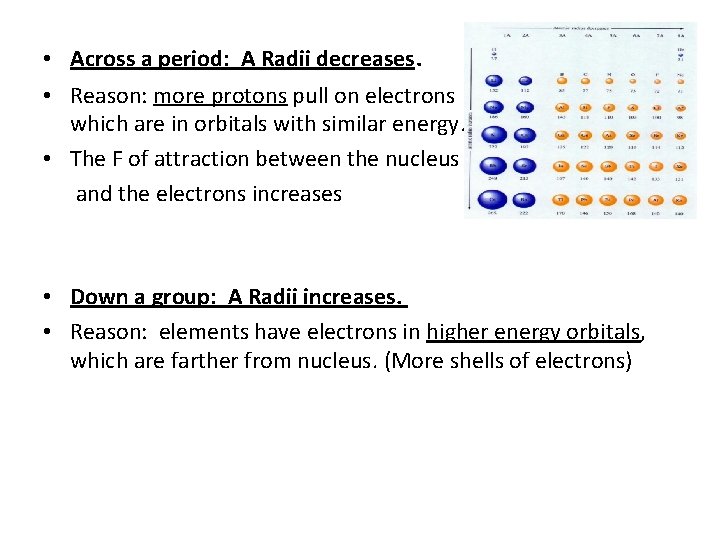
• Across a period: A Radii decreases. • Reason: more protons pull on electrons which are in orbitals with similar energy. • The F of attraction between the nucleus and the electrons increases • Down a group: A Radii increases. • Reason: elements have electrons in higher energy orbitals, which are farther from nucleus. (More shells of electrons)
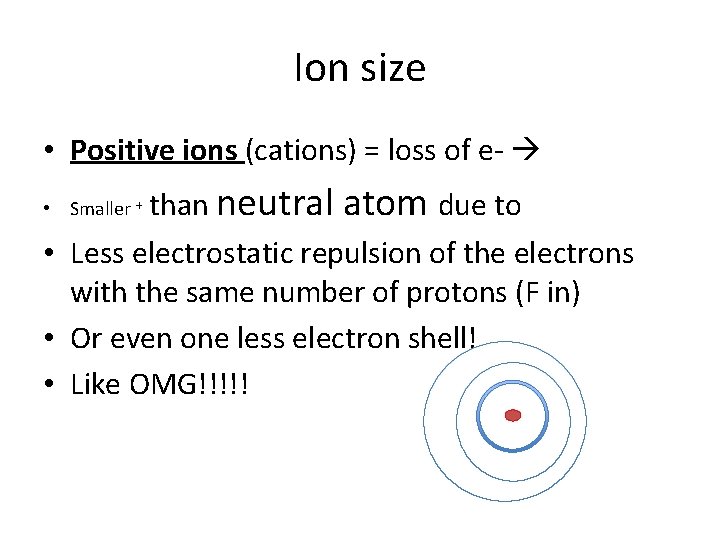
Ion size • Positive ions (cations) = loss of e- • Smaller + than neutral atom due to • Less electrostatic repulsion of the electrons with the same number of protons (F in) • Or even one less electron shell! • Like OMG!!!!!
Ion size continued • Negative ions (anions) = gain of e- • Increased size - relative to neutral atom • Increased F repulsion (F out) with same number of protons (same F in) • Also electron shielding of outer e- by inner e • Like “get away from me!!!”
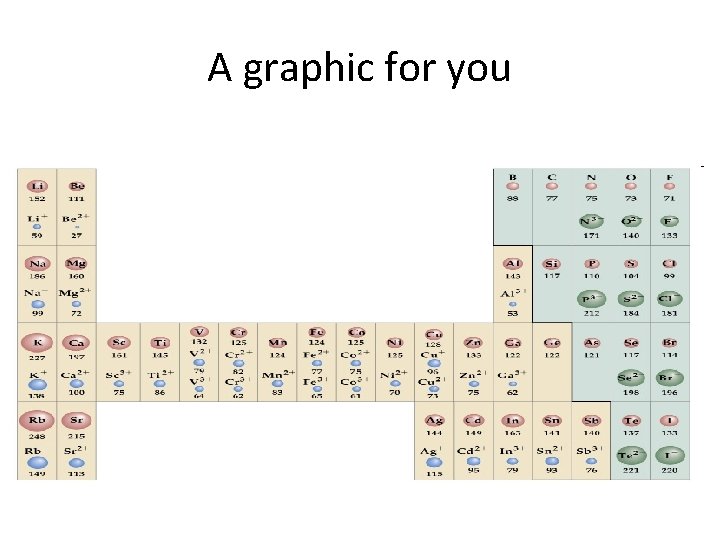
A graphic for you
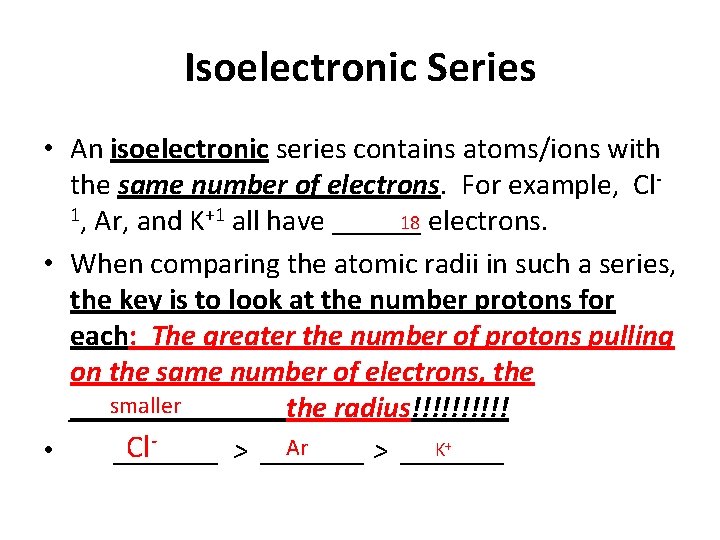
Isoelectronic Series • An isoelectronic series contains atoms/ions with the same number of electrons. For example, Cl 1, Ar, and K+1 all have ______ electrons. 18 • When comparing the atomic radii in such a series, the key is to look at the number protons for each: The greater the number of protons pulling on the same number of electrons, the smaller _______ the radius!!!!! Ar K+ Cl • _______ > _______
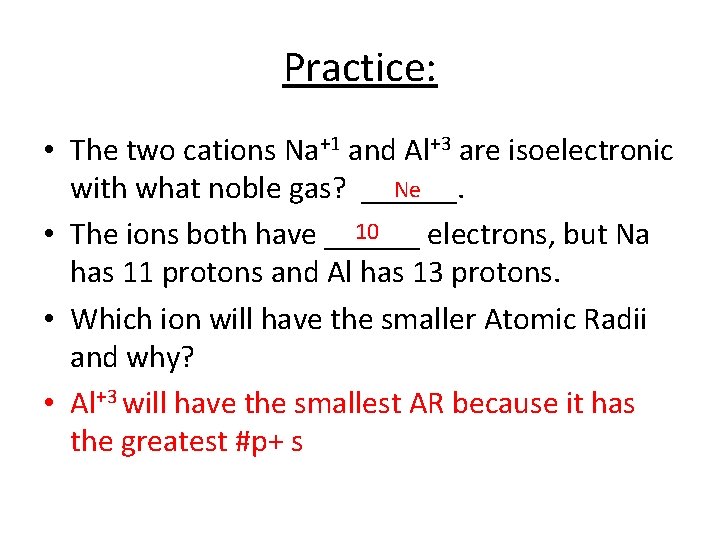
Practice: • The two cations Na+1 and Al+3 are isoelectronic Ne with what noble gas? ______. 10 • The ions both have ______ electrons, but Na has 11 protons and Al has 13 protons. • Which ion will have the smaller Atomic Radii and why? • Al+3 will have the smallest AR because it has the greatest #p+ s
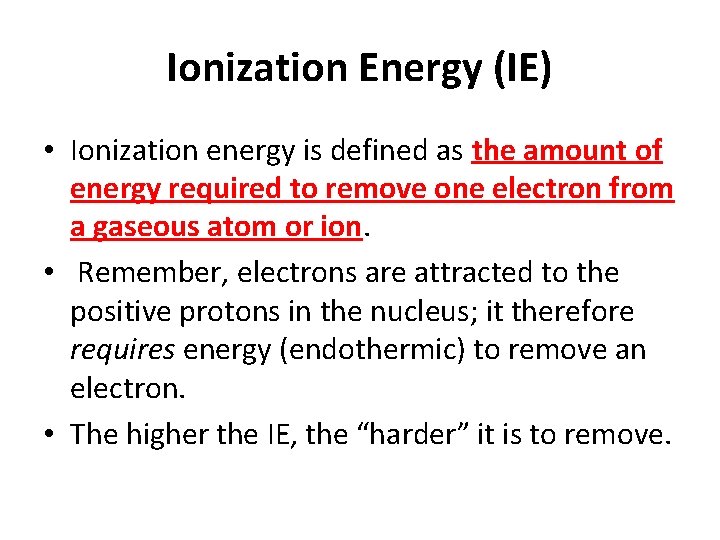
Ionization Energy (IE) • Ionization energy is defined as the amount of energy required to remove one electron from a gaseous atom or ion. • Remember, electrons are attracted to the positive protons in the nucleus; it therefore requires energy (endothermic) to remove an electron. • The higher the IE, the “harder” it is to remove.
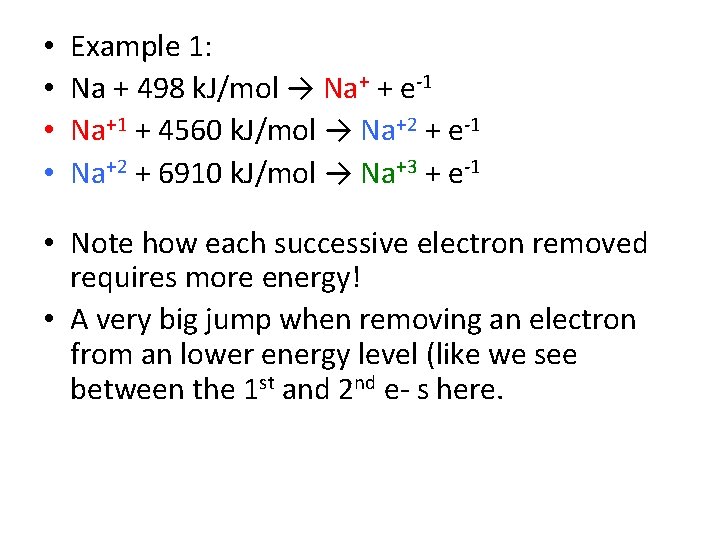
• • Example 1: Na + 498 k. J/mol → Na+ + e-1 Na+1 + 4560 k. J/mol → Na+2 + e-1 Na+2 + 6910 k. J/mol → Na+3 + e-1 • Note how each successive electron removed requires more energy! • A very big jump when removing an electron from an lower energy level (like we see between the 1 st and 2 nd e- s here.

• Example 2: • Na (at #11) 1 s 2 2 p 6 3 s 1 • 1 st electron removed would be 3 s 1 • • Ti (at # 22) 1 s 2 2 p 6 3 s 23 p 6 4 s 2 3 d 2 4 s electrons go before the 3 d electrons Please see the orbital filling chart to see why Strange but true!
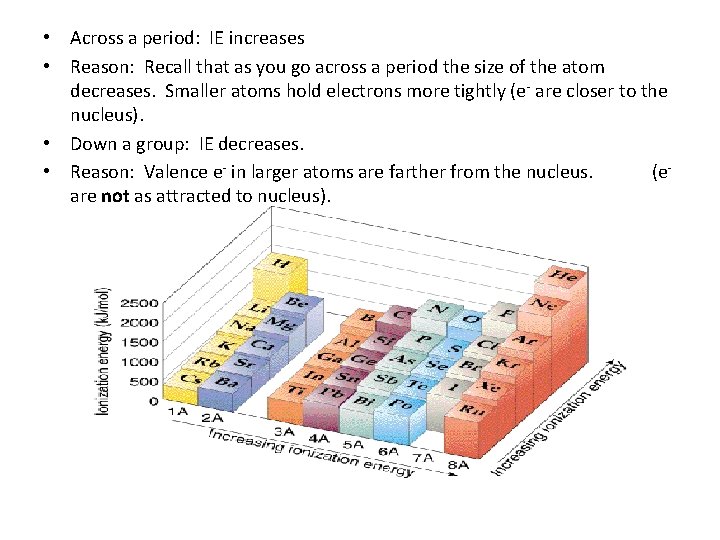
• Across a period: IE increases • Reason: Recall that as you go across a period the size of the atom decreases. Smaller atoms hold electrons more tightly (e- are closer to the nucleus). • Down a group: IE decreases. • Reason: Valence e- in larger atoms are farther from the nucleus. (e- are not as attracted to nucleus).
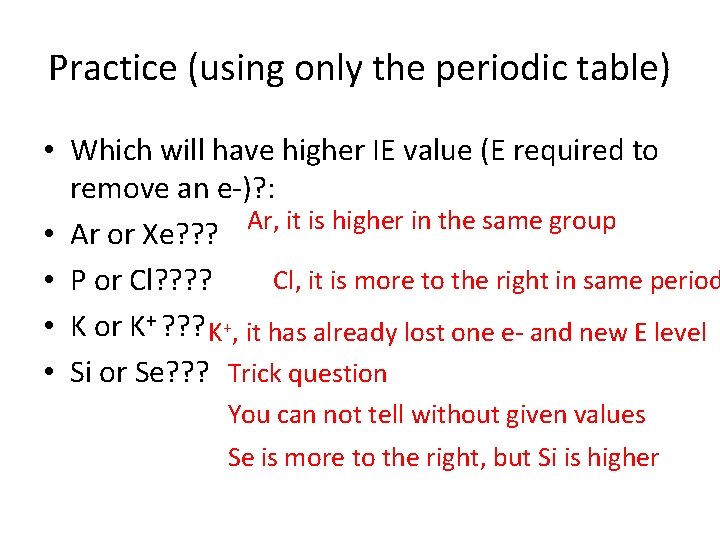
Practice (using only the periodic table) • Which will have higher IE value (E required to remove an e-)? : Ar, it is higher in the same group • Ar or Xe? ? ? Cl, it is more to the right in same period • P or Cl? ? • K or K+ ? ? ? K+, it has already lost one e- and new E level • Si or Se? ? ? Trick question You can not tell without given values Se is more to the right, but Si is higher
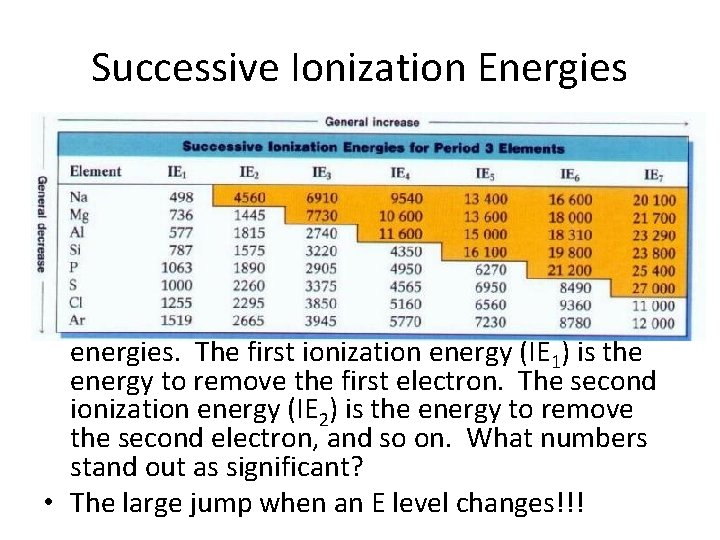
Successive Ionization Energies • The above chart displays multiple ionization energies. The first ionization energy (IE 1) is the energy to remove the first electron. The second ionization energy (IE 2) is the energy to remove the second electron, and so on. What numbers stand out as significant? • The large jump when an E level changes!!!
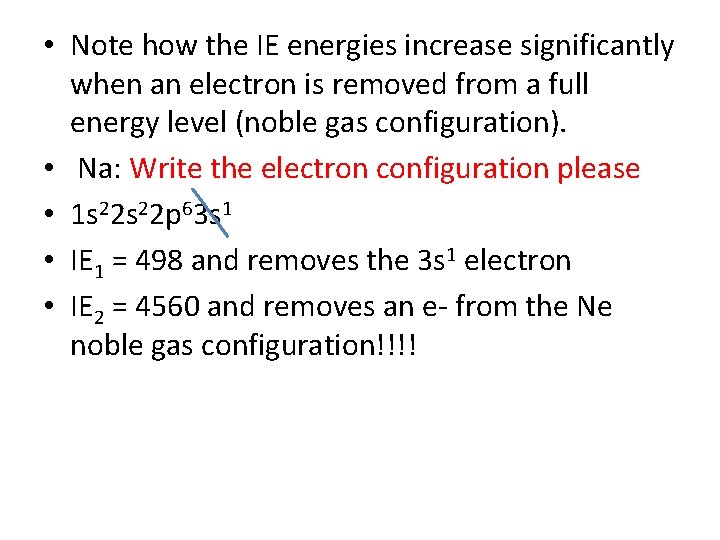
• Note how the IE energies increase significantly when an electron is removed from a full energy level (noble gas configuration). • Na: Write the electron configuration please • 1 s 22 p 63 s 1 • IE 1 = 498 and removes the 3 s 1 electron • IE 2 = 4560 and removes an e- from the Ne noble gas configuration!!!!
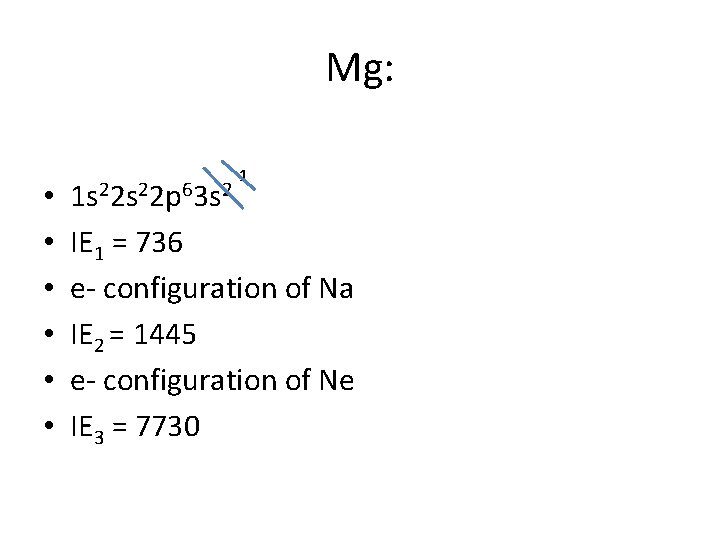
Mg: • • • 1 1 s 22 p 63 s 2 IE 1 = 736 e- configuration of Na IE 2 = 1445 e- configuration of Ne IE 3 = 7730
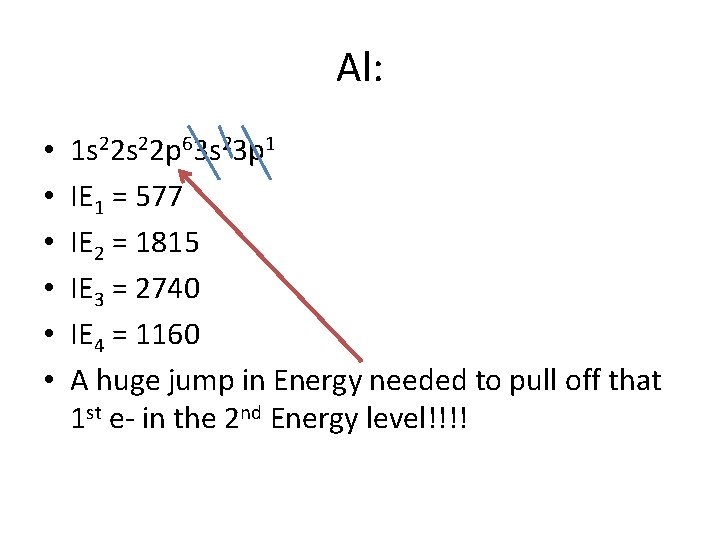
Al: • • • 1 s 22 p 63 s 23 p 1 IE 1 = 577 IE 2 = 1815 IE 3 = 2740 IE 4 = 1160 A huge jump in Energy needed to pull off that 1 st e- in the 2 nd Energy level!!!!
Electron Affinity (EA) • Electron affinity is defined as the energy change associated with adding an electron to an atom in the gas phase to produce an anion: X(g) + e- → X-1(g) • Recall that IE was the E required to remove an electron. . . (see previous notes) – many students get these terms confused – You may want to make certain you do not.
• EA values are typically negative, because energy is usually released (exothermic). • If the resulting anion is stable, the EA will be negative; the more stable the anion is, the larger the negative number. • If the resulting anion is unstable, the value for the electron affinity will be positive (requires E to force the e- on!!!). • so remember that high e- affinity = large negative value. • Recall that IE always required E!!!
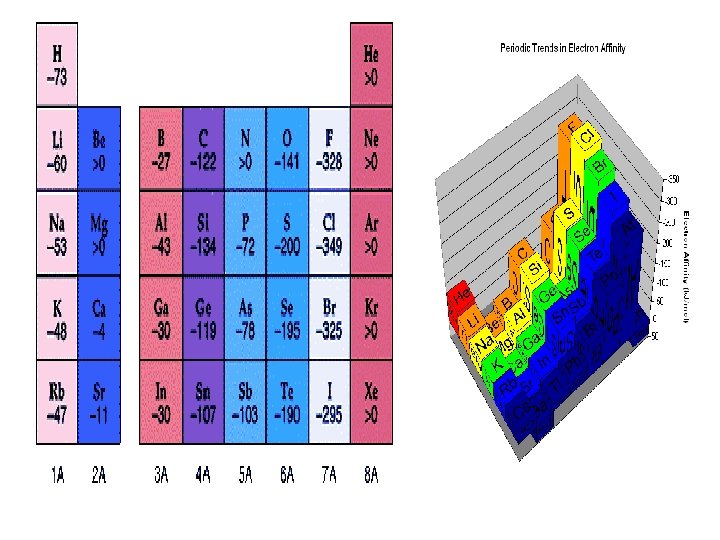
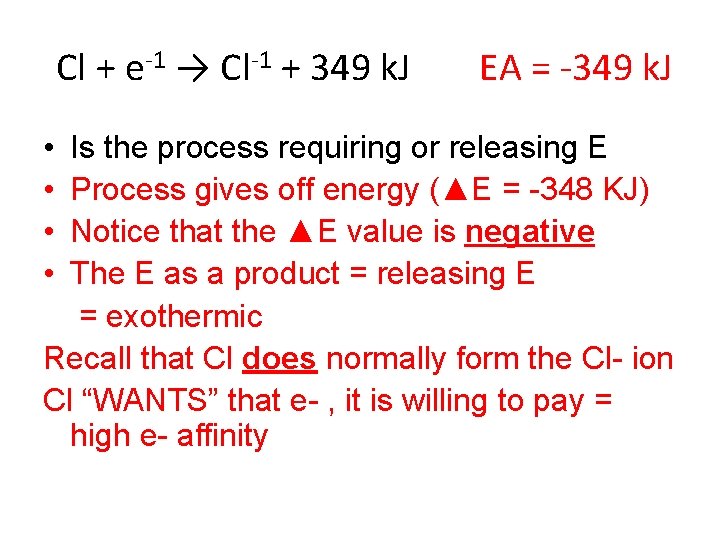
• Electron affinity generally increases from bottom to top within a group (that is, it goes from smaller to larger negative numbers), and increases from left to right within a period. • The halogens all have large negative electron affinities, since accepting one electron generates a stable halide ion (with a noble gas configuration). • Noble gases already have a full energy level; therefore, adding an electron will cost or require energy, giving a +EA value.
Cl + e-1 → Cl-1 + 349 k. J EA = -349 k. J • • Is the process requiring or releasing E Process gives off energy (▲E = -348 KJ) Notice that the ▲E value is negative The E as a product = releasing E = exothermic Recall that Cl does normally form the Cl- ion Cl “WANTS” that e- , it is willing to pay = high e- affinity
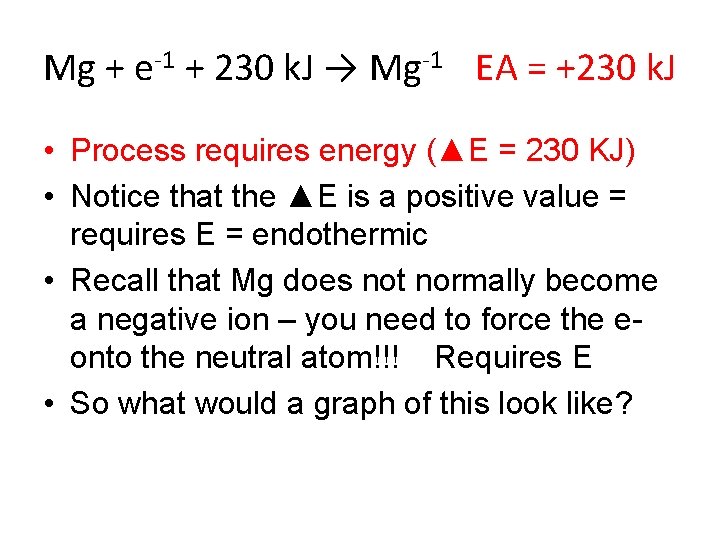
Mg + e-1 + 230 k. J → Mg-1 EA = +230 k. J • Process requires energy (▲E = 230 KJ) • Notice that the ▲E is a positive value = requires E = endothermic • Recall that Mg does not normally become a negative ion – you need to force the eonto the neutral atom!!! Requires E • So what would a graph of this look like?
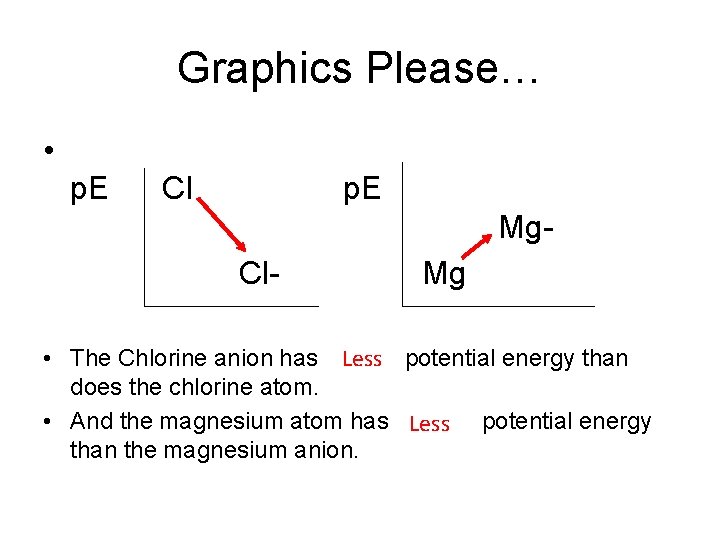
Graphics Please… • p. E Cl p. E Mg. Cl- Mg • The Chlorine anion has Less potential energy than does the chlorine atom. • And the magnesium atom has Less potential energy than the magnesium anion.
Say What? ? ? • I like to think about the dynamite parallel – If you give dynamite some activation energy, it gives off a great deal of potential energy that was stored in the bonds of the molecules. The product (what is left after the explosion) is not reactive, has less potential energy, and is more stable.
- Slides: 33