
Unit 8 THE MOMENTUM TRANSFER MODEL MTM IMPULSE





- Slides: 79
Unit 8 THE MOMENTUM TRANSFER MODEL (MTM) IMPULSE AND MOMENTUM
Outcomes
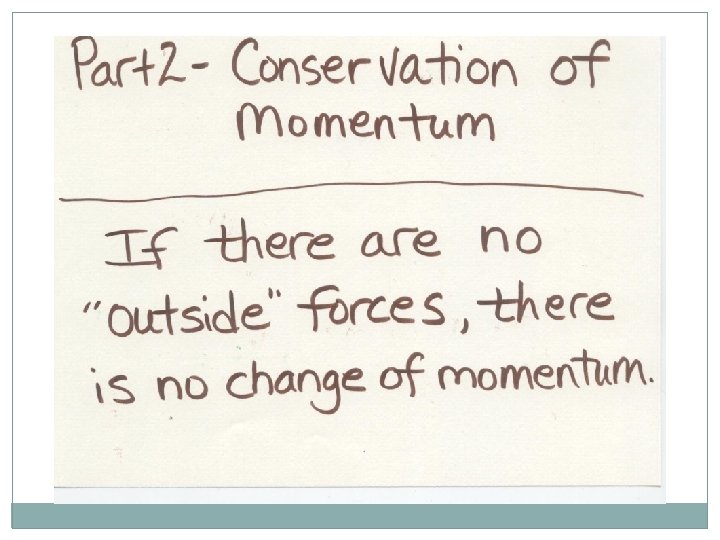
Unit 8 - MTM PART 1 – FORCES CHANGE MOMENTUM PART 2 – MOMENTUM IS CONSERVED
What does the word momentum mean to you? The home team has momentum with a five-game winning streak. “The presidential candidate” really started to gain momentum after the Iowa Caucuses in 2016.
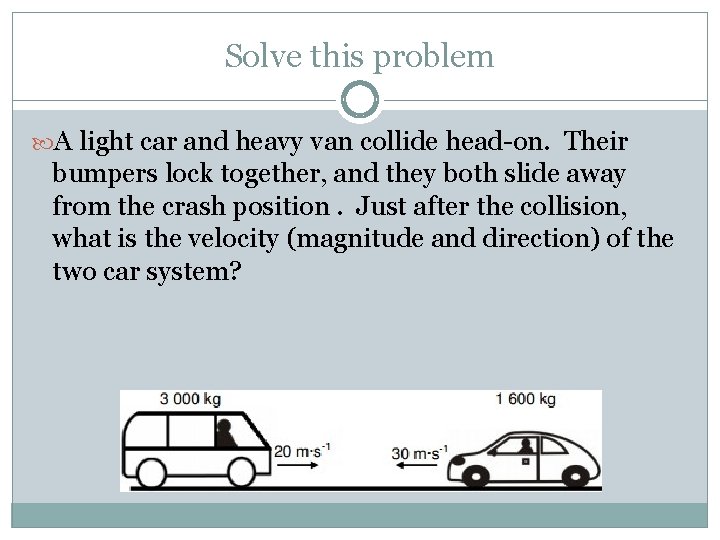
Solve this problem A light car and heavy van collide head-on. Their bumpers lock together, and they both slide away from the crash position. Just after the collision, what is the velocity (magnitude and direction) of the two car system?
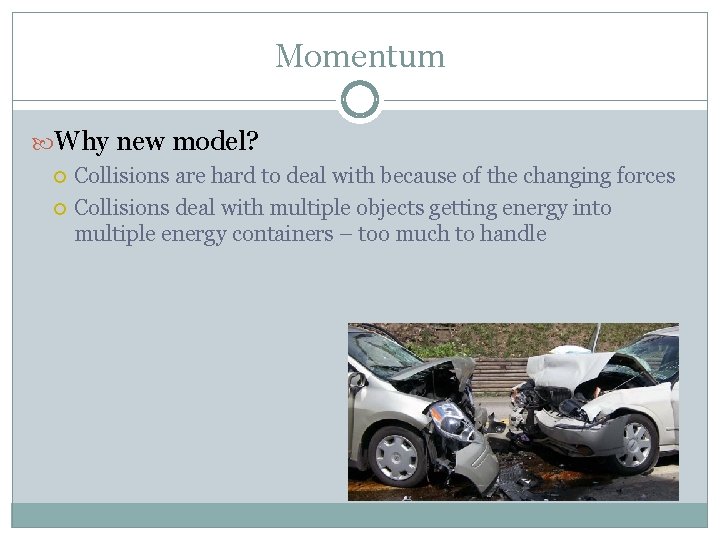
Momentum Why new model? Collisions are hard to deal with because of the changing forces Collisions deal with multiple objects getting energy into multiple energy containers – too much to handle
Review During Newton’s Laws, we were able to calculate changes in position and velocity due to constant acceleration. When forces are not constant, it becomes much more difficult. We introduced energy to make solving problems easier – primarily, we used it to neglect certain paths (taking kinetic out of g-potential to spring system – you would have had to include the entire path using kinematics)
We want to develop another conservation law, just like energy. These are very powerful tools, because, no matter how complicated the system is, we can always set the value of a conserved quantity equal to itself. Energy, as a model, usually breaks down during collisions because energy has a very hard time dealing with thermal energy (unless a constant force like friction), sound energy, mass loss, and the overall chaotic system that is a collision.
Would you rather… Get tackled by an NFL lineman or a 7 th grader if they were both going the same speed? Get hit in the face by a bowling ball or a ping pong ball if they were both going the same speed? Get hit in the face by a bowling ball traveling 0. 000001 m/s or a ping pong ball traveling 1000 m/s?
Momentum “mass in motion” All objects have mass; so if an object is moving, then it has momentum- it has mass in motion. The amount of momentum an object has depends on two things How much stuff is moving (mass) How fast the stuff is moving (velocity)
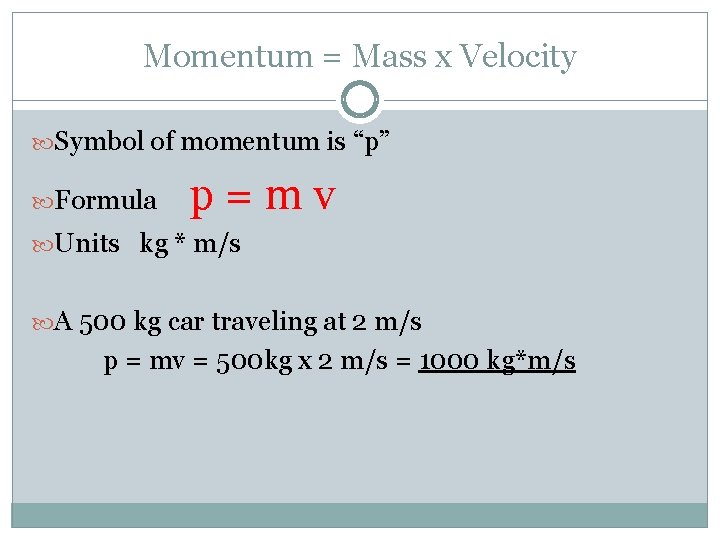
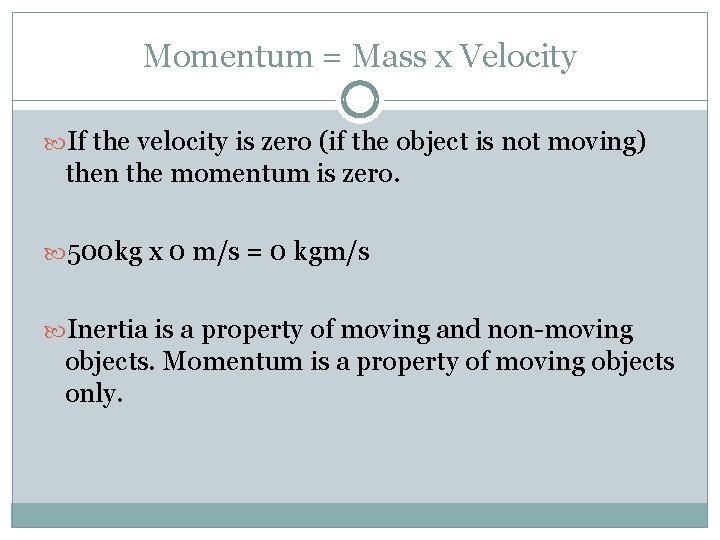
Momentum = Mass x Velocity Symbol of momentum is “p” Formula p=mv Units kg * m/s A 500 kg car traveling at 2 m/s p = mv = 500 kg x 2 m/s = 1000 kg*m/s
Momentum = Mass x Velocity If the velocity is zero (if the object is not moving) then the momentum is zero. 500 kg x 0 m/s = 0 kgm/s Inertia is a property of moving and non-moving objects. Momentum is a property of moving objects only.
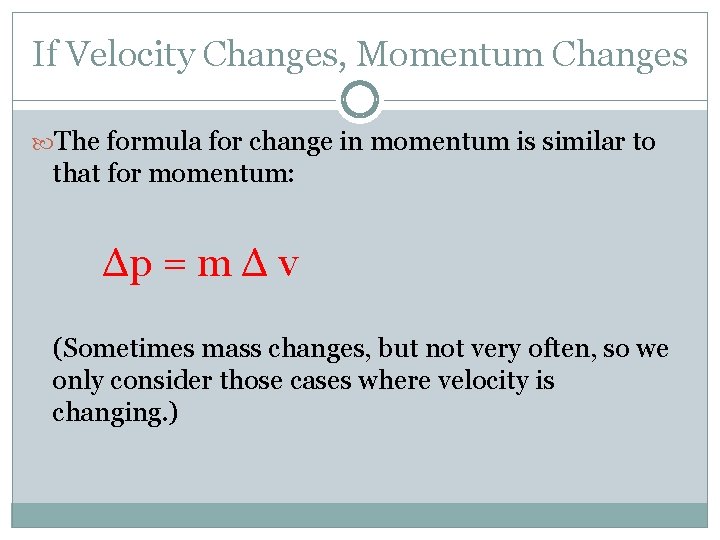
If Velocity Changes, Momentum Changes The formula for change in momentum is similar to that for momentum: Δp = m Δ v (Sometimes mass changes, but not very often, so we only consider those cases where velocity is changing. )
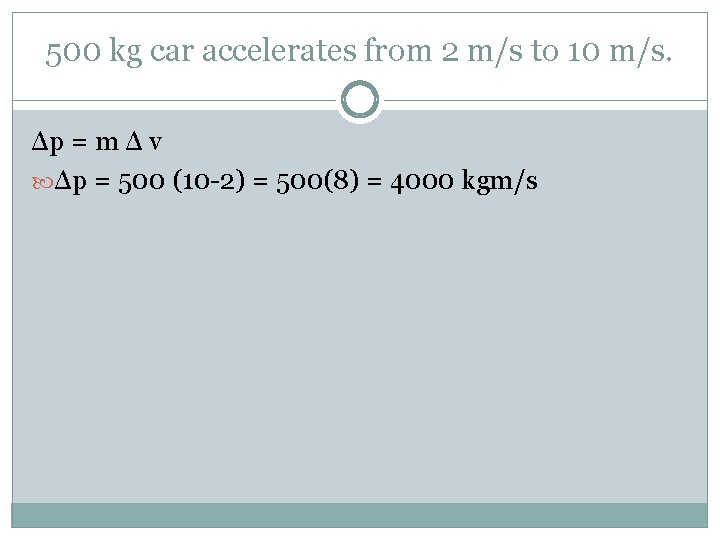
500 kg car accelerates from 2 m/s to 10 m/s. Δp = m Δ v Δp = 500 (10 -2) = 500(8) = 4000 kgm/s
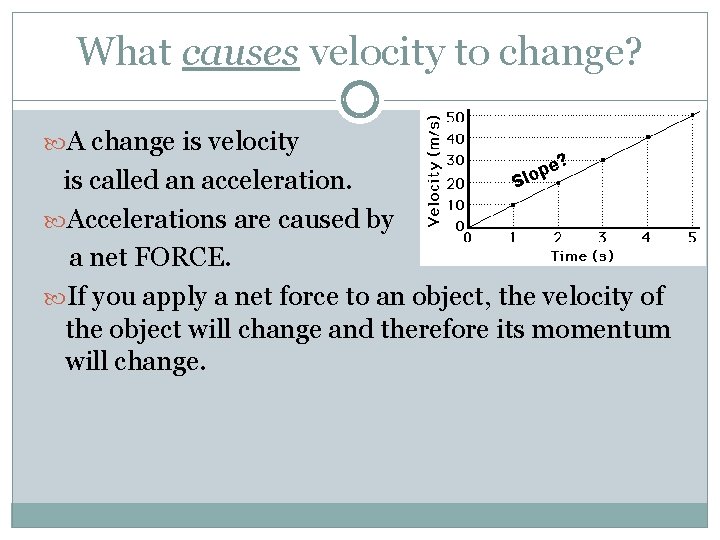
What causes velocity to change? A change is velocity e? p Slo is called an acceleration. Accelerations are caused by a net FORCE. If you apply a net force to an object, the velocity of the object will change and therefore its momentum will change.
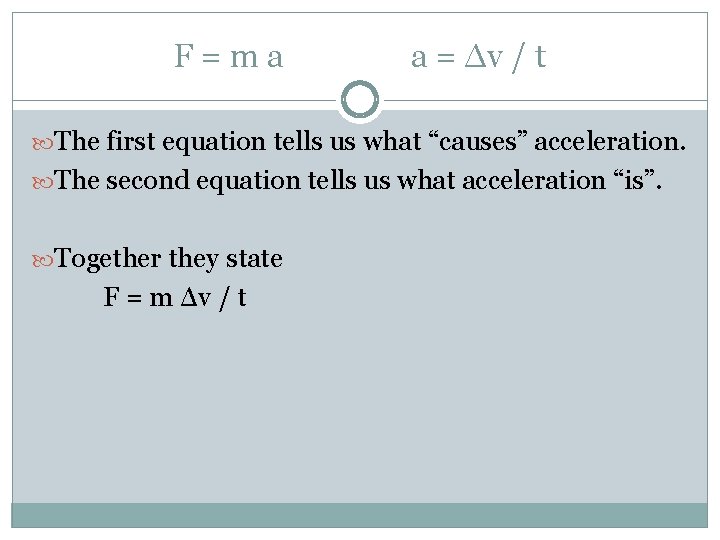
F=ma a = Δv / t The first equation tells us what “causes” acceleration. The second equation tells us what acceleration “is”. Together they state F = m Δv / t
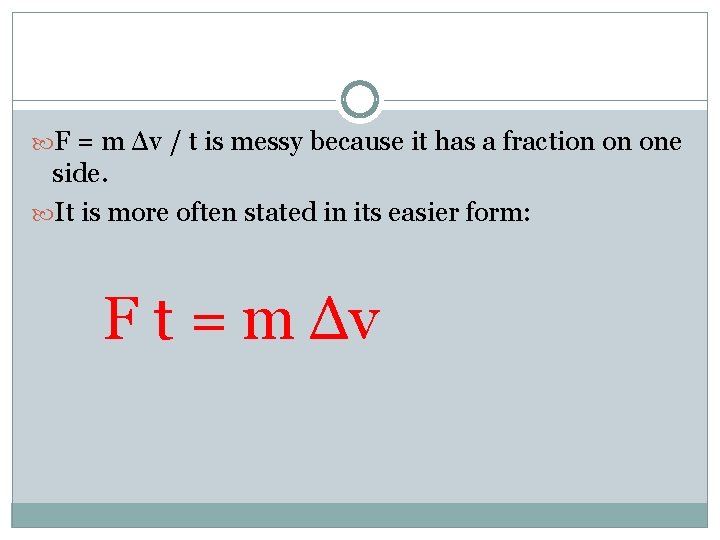
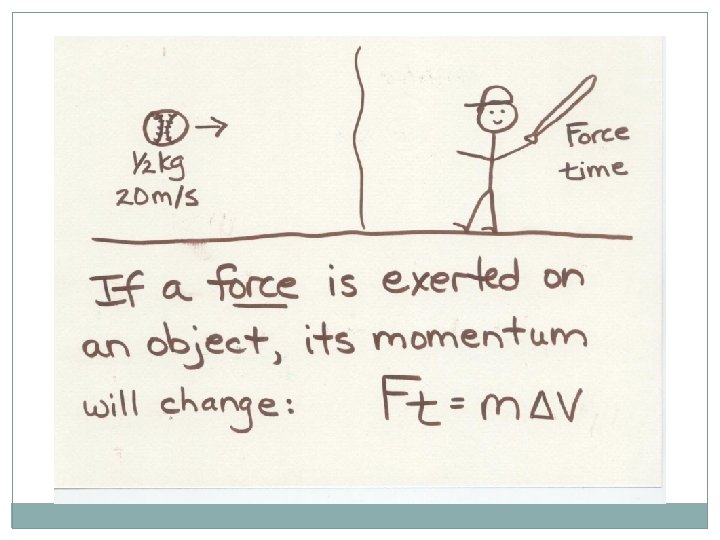
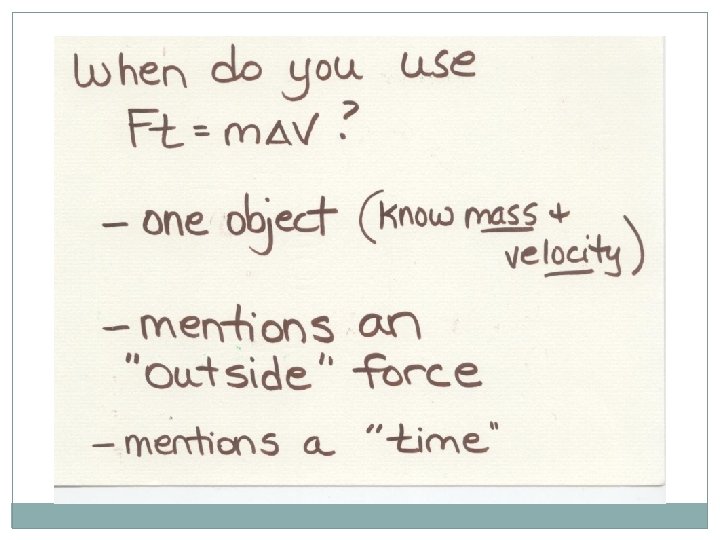
F = m Δv / t is messy because it has a fraction on one side. It is more often stated in its easier form: F t = m Δv
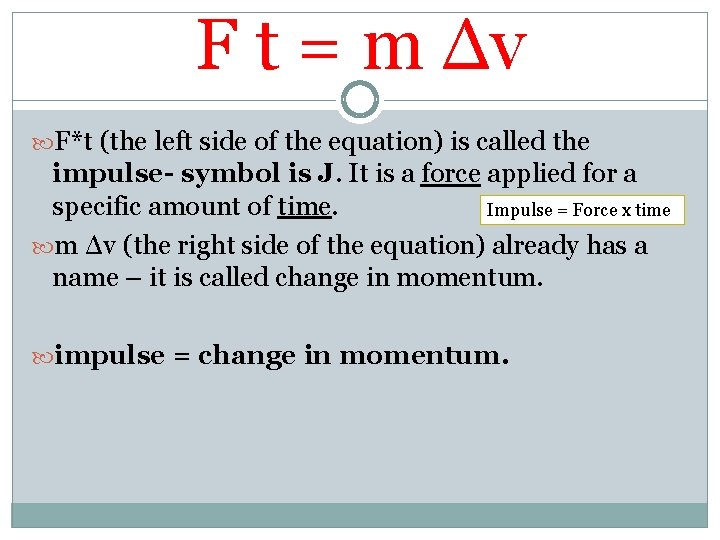
F t = m Δv F*t (the left side of the equation) is called the impulse- symbol is J. It is a force applied for a specific amount of time. Impulse = Force x time m Δv (the right side of the equation) already has a name – it is called change in momentum. impulse = change in momentum.
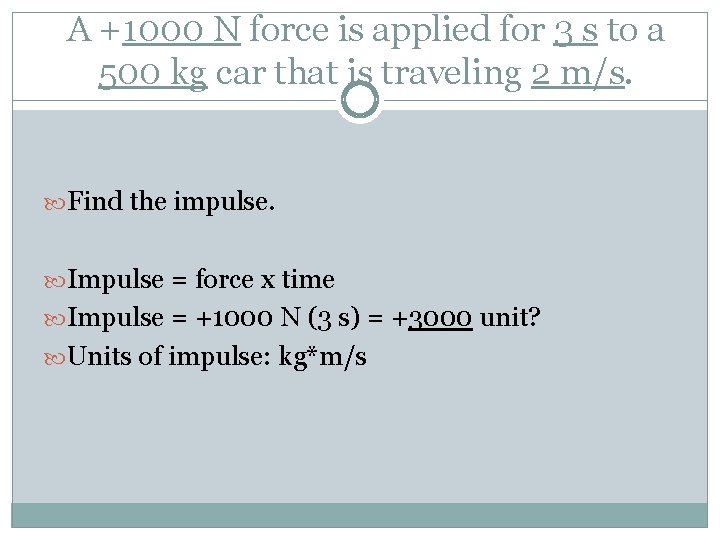
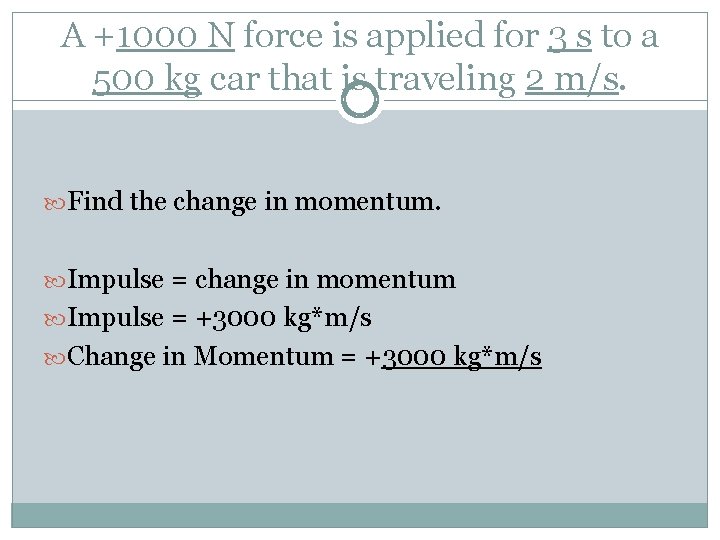
A +1000 N force is applied for 3 s to a 500 kg car that is traveling 2 m/s. Find the impulse. Impulse = force x time Impulse = +1000 N (3 s) = +3000 unit? Units of impulse: kg*m/s
A +1000 N force is applied for 3 s to a 500 kg car that is traveling 2 m/s. Find the change in momentum. Impulse = change in momentum Impulse = +3000 kg*m/s Change in Momentum = +3000 kg*m/s
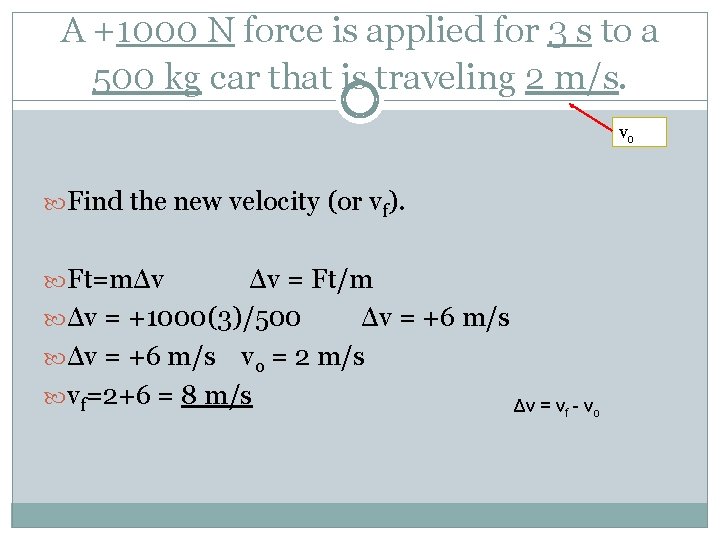
A +1000 N force is applied for 3 s to a 500 kg car that is traveling 2 m/s. vo Find the new velocity (or vf). Ft=mΔv Δv = Ft/m Δv = +1000(3)/500 Δv = +6 m/s vo = 2 m/s vf=2+6 = 8 m/s Δv = vf - vo
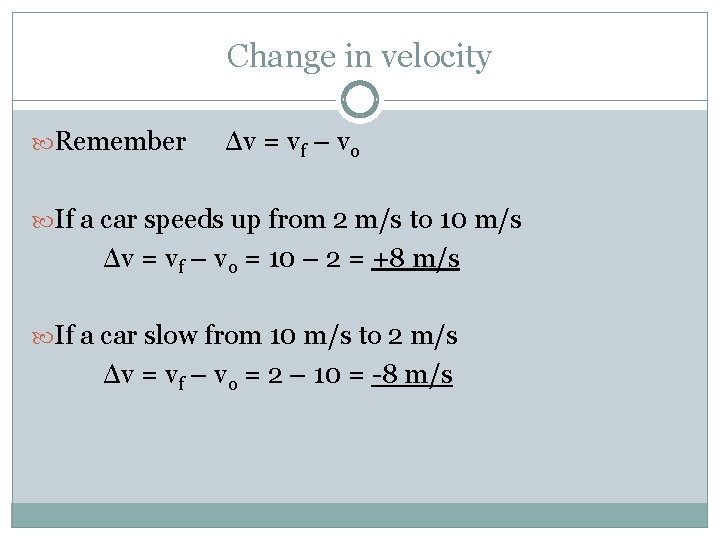
Change in velocity Remember Δv = vf – vo If a car speeds up from 2 m/s to 10 m/s Δv = vf – vo = 10 – 2 = +8 m/s If a car slow from 10 m/s to 2 m/s Δv = vf – vo = 2 – 10 = -8 m/s
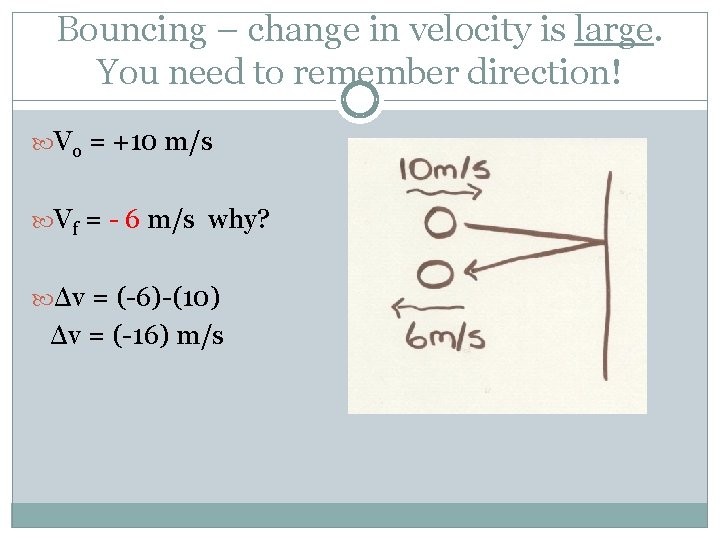
Bouncing – change in velocity is large. You need to remember direction! Vo = +10 m/s Vf = - 6 m/s why? Δv = (-6)-(10) Δv = (-16) m/s
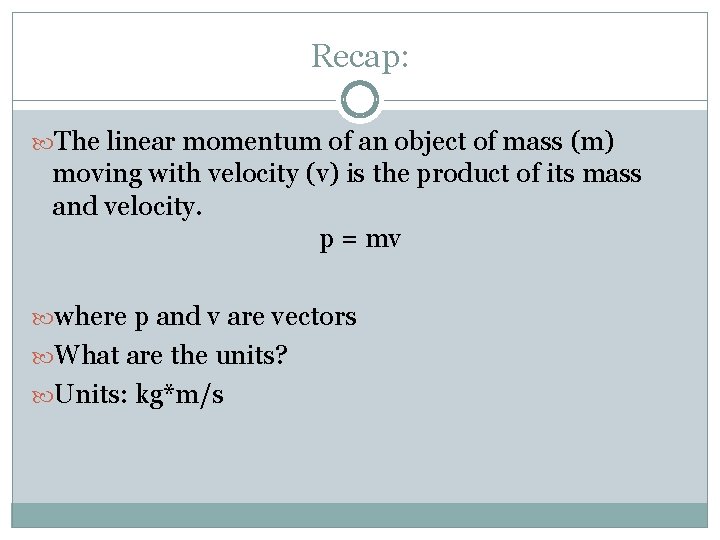
Recap: The linear momentum of an object of mass (m) moving with velocity (v) is the product of its mass and velocity. p = mv where p and v are vectors What are the units? Units: kg*m/s
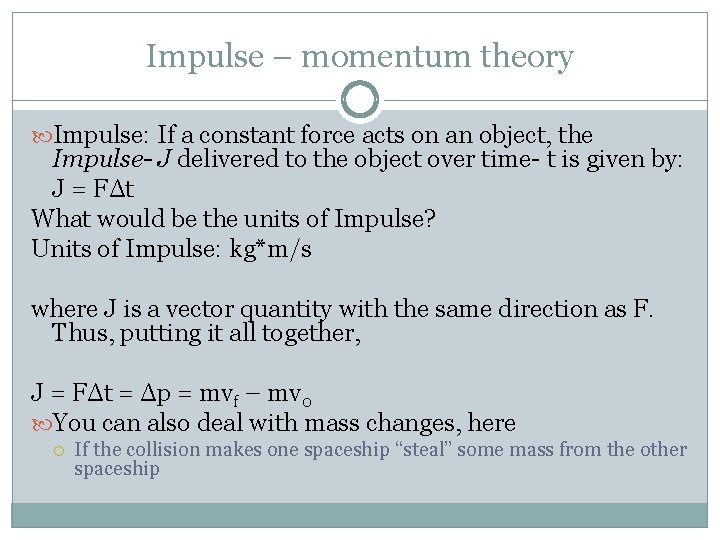
Impulse – momentum theory Impulse: If a constant force acts on an object, the Impulse- J delivered to the object over time- t is given by: J = FΔt What would be the units of Impulse? Units of Impulse: kg*m/s where J is a vector quantity with the same direction as F. Thus, putting it all together, J = FΔt = Δp = mvf – mv 0 You can also deal with mass changes, here If the collision makes one spaceship “steal” some mass from the other spaceship
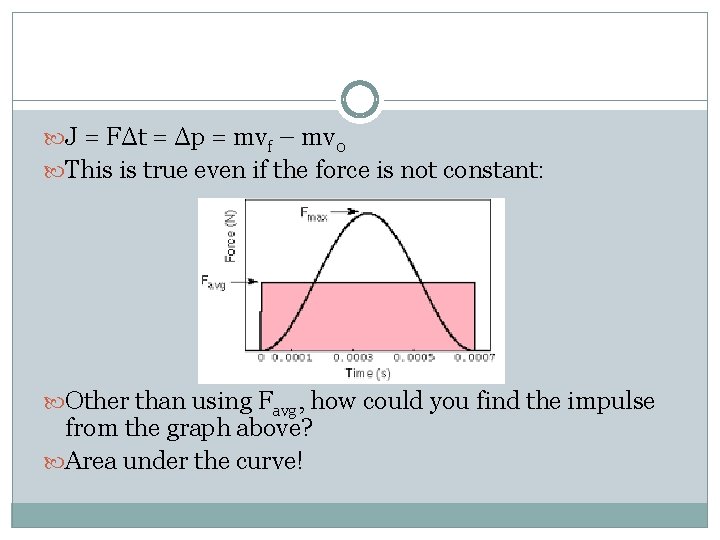
J = FΔt = Δp = mvf – mv 0 This is true even if the force is not constant: Other than using Favg, how could you find the impulse from the graph above? Area under the curve!
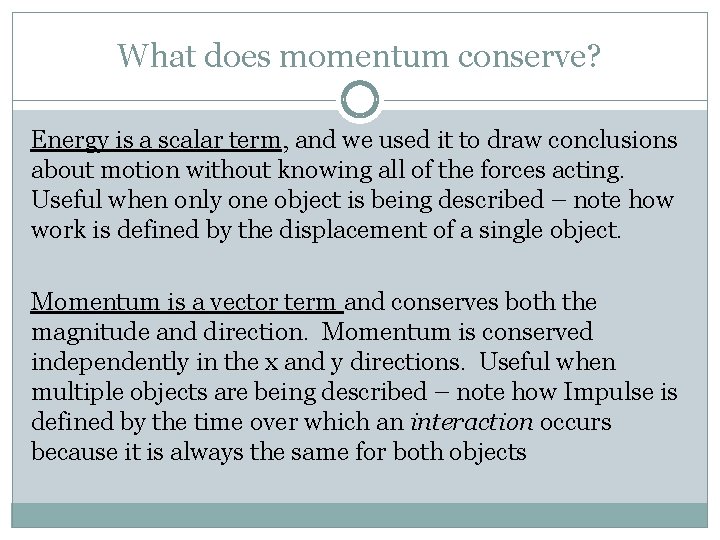
What does momentum conserve? Energy is a scalar term, and we used it to draw conclusions about motion without knowing all of the forces acting. Useful when only one object is being described – note how work is defined by the displacement of a single object. Momentum is a vector term and conserves both the magnitude and direction. Momentum is conserved independently in the x and y directions. Useful when multiple objects are being described – note how Impulse is defined by the time over which an interaction occurs because it is always the same for both objects
Work is a energy transfer due to a force acting over a distance. Usually only works for describing the motion of a single object. Impulse is a momentum transfer due to a force acting over a time. Useful when more than one object is involved.
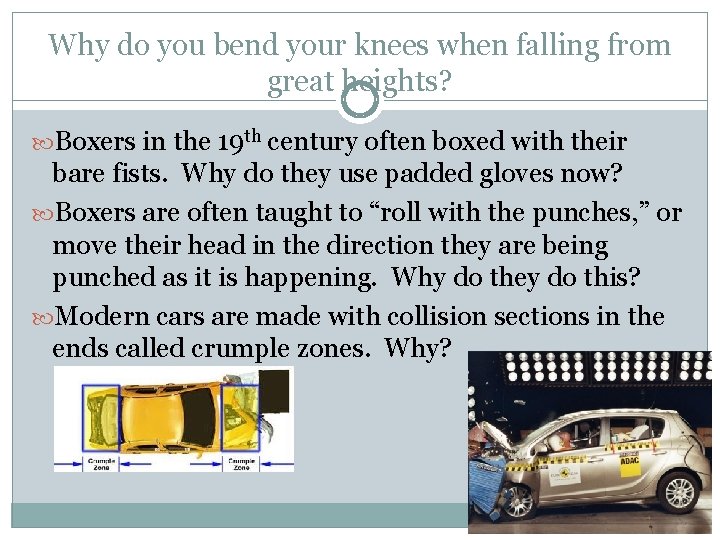
Why do you bend your knees when falling from great heights? Boxers in the 19 th century often boxed with their bare fists. Why do they use padded gloves now? Boxers are often taught to “roll with the punches, ” or move their head in the direction they are being punched as it is happening. Why do they do this? Modern cars are made with collision sections in the ends called crumple zones. Why?
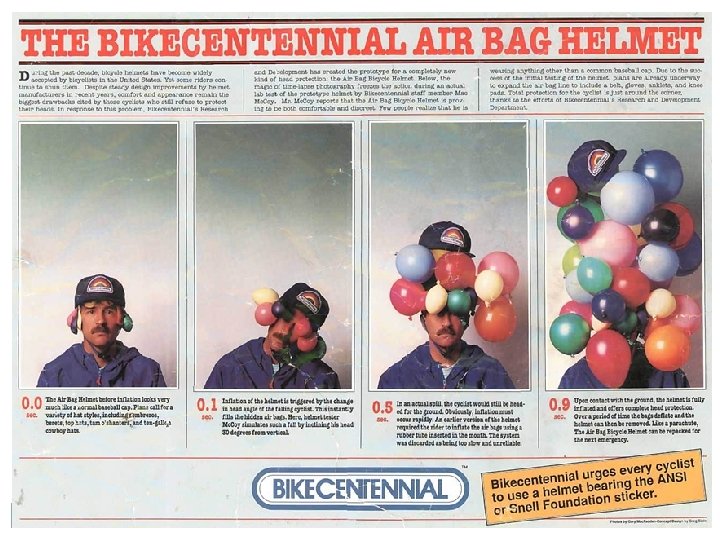
Egg Drop and Air Bags
F t = m Δv Try this at home: play catch a with a raw egg or a water balloon. How can you minimize your chances of the object breaking on you? Try catching by moving your hands backward as you catch it.
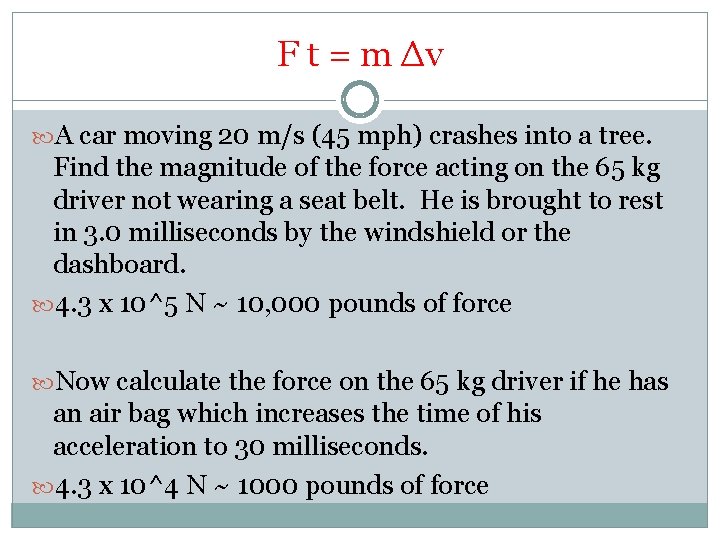
F t = m Δv A car moving 20 m/s (45 mph) crashes into a tree. Find the magnitude of the force acting on the 65 kg driver not wearing a seat belt. He is brought to rest in 3. 0 milliseconds by the windshield or the dashboard. 4. 3 x 10^5 N ~ 10, 000 pounds of force Now calculate the force on the 65 kg driver if he has an air bag which increases the time of his acceleration to 30 milliseconds. 4. 3 x 10^4 N ~ 1000 pounds of force
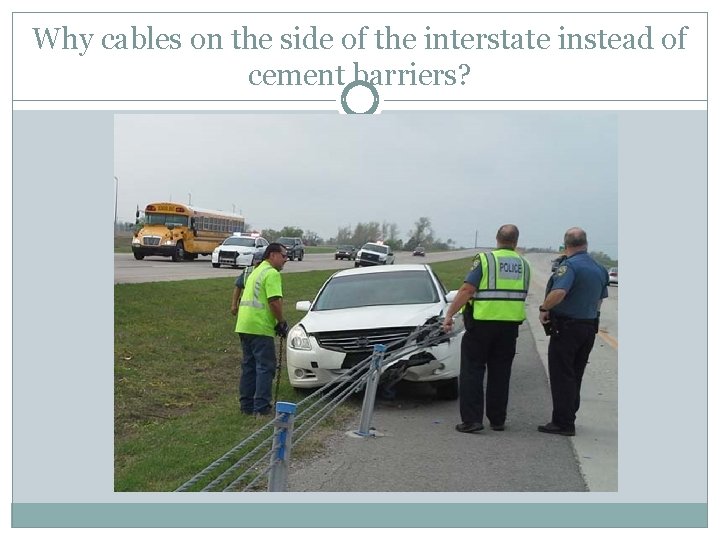
Why cables on the side of the interstate instead of cement barriers?
The Day Gwen Stacy Died https: //www. youtube. com/watch ? v=k. Ea 1 g. Fr 1 a. EA
The Day Gwen Stacy Died Using your knowledge of impulse, momentum, force, time, mass, and change in velocity, how did she die? No, she does not hit the ground. Use diagrams if needed, but be sure to explain your reasoning.
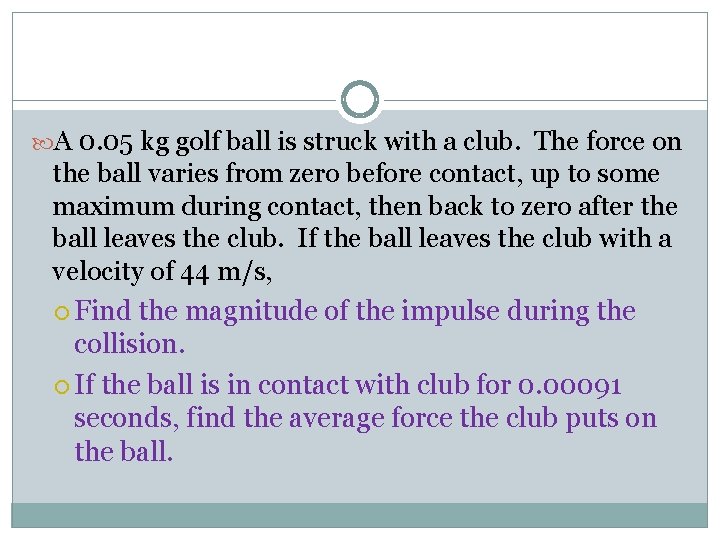
A 0. 05 kg golf ball is struck with a club. The force on the ball varies from zero before contact, up to some maximum during contact, then back to zero after the ball leaves the club. If the ball leaves the club with a velocity of 44 m/s, Find the magnitude of the impulse during the collision. If the ball is in contact with club for 0. 00091 seconds, find the average force the club puts on the ball.
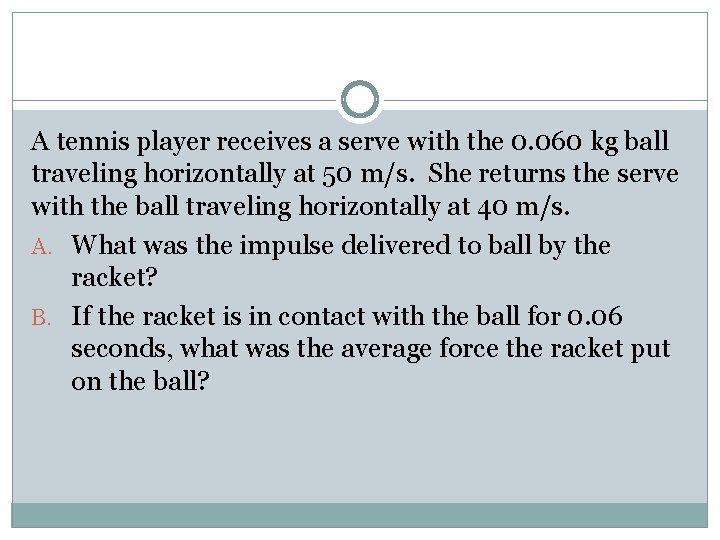
A tennis player receives a serve with the 0. 060 kg ball traveling horizontally at 50 m/s. She returns the serve with the ball traveling horizontally at 40 m/s. A. What was the impulse delivered to ball by the racket? B. If the racket is in contact with the ball for 0. 06 seconds, what was the average force the racket put on the ball?
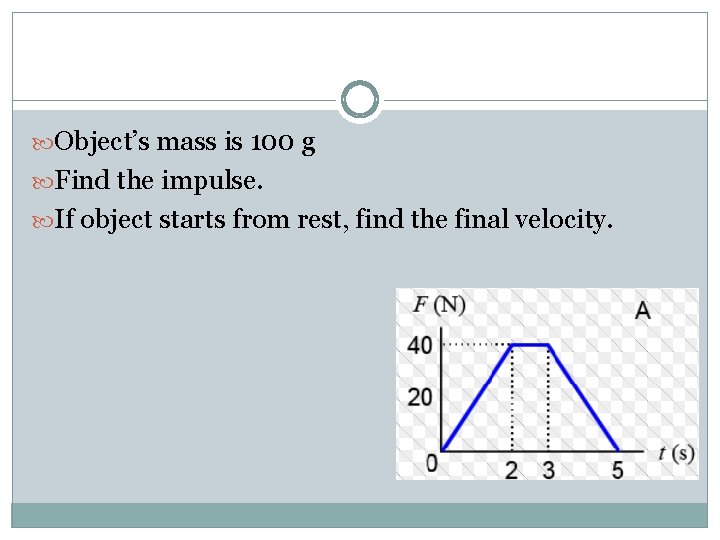
Object’s mass is 100 g Find the impulse. If object starts from rest, find the final velocity.
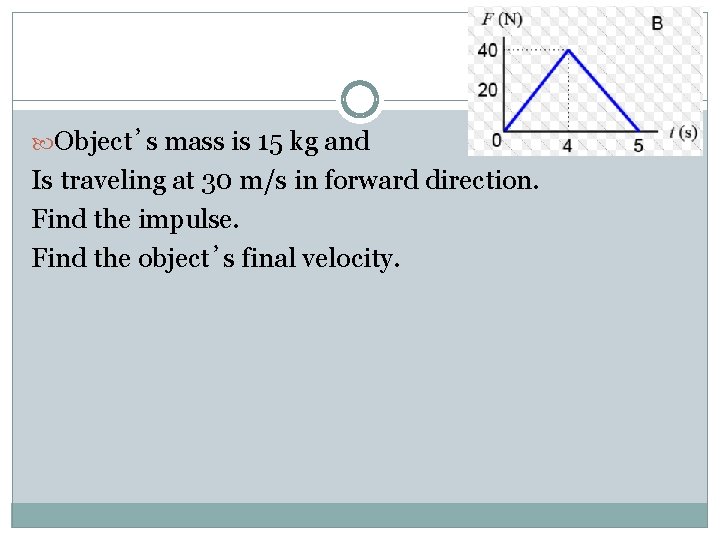
Object’s mass is 15 kg and Is traveling at 30 m/s in forward direction. Find the impulse. Find the object’s final velocity.
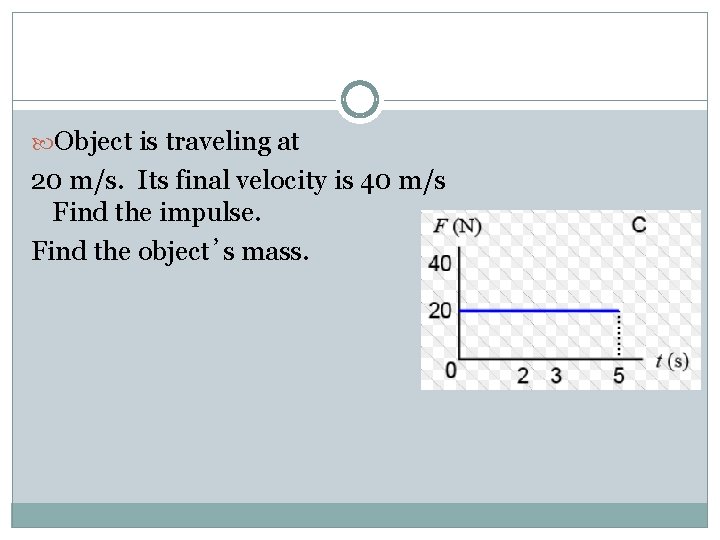
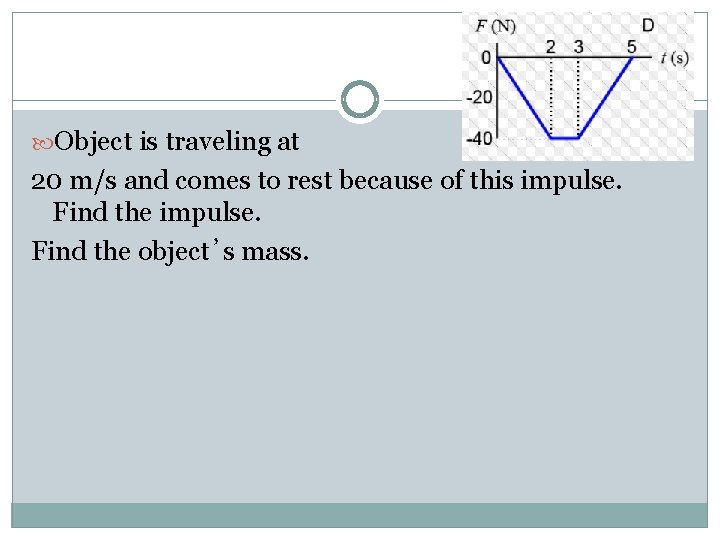
Object is traveling at 20 m/s. Its final velocity is 40 m/s Find the impulse. Find the object’s mass.
Object is traveling at 20 m/s and comes to rest because of this impulse. Find the object’s mass.
A 60 g tennis ball is flying forward at 30 m/s and hits a wall. It bounces off the wall at 20 m/s. Find the impulse the wall puts on the tennis ball. If the collision occurs over a 0. 1 second time interval, find the force the wall put on the ball.
Conservation of Momentum COLLISIONS AND EXPLOSIONS
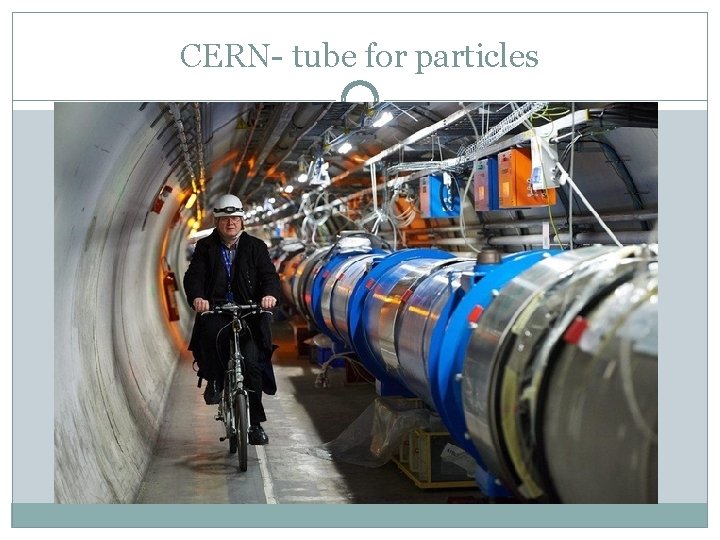
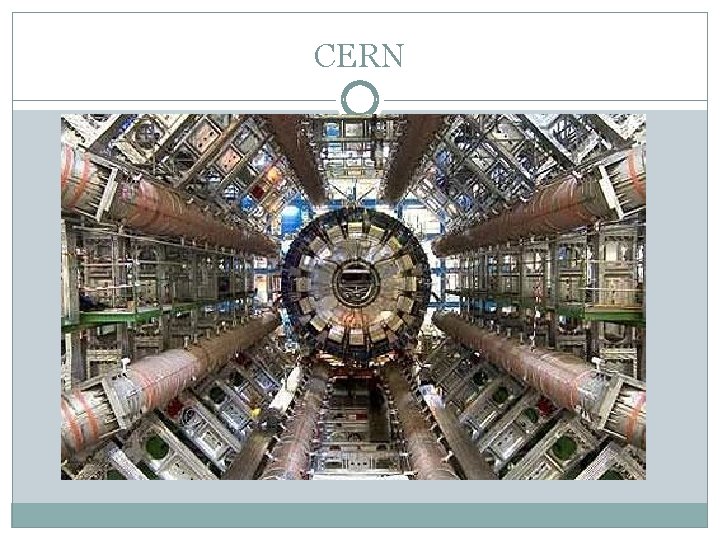
CERN- tube for particles
CERN
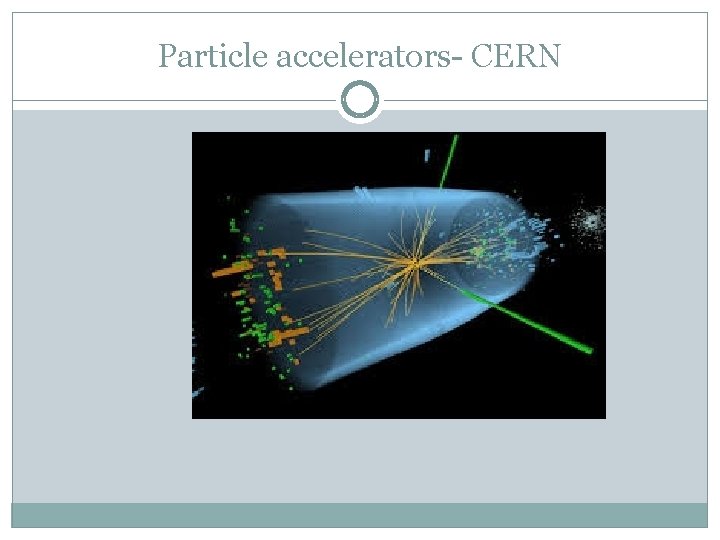
Particle accelerators- CERN
Review of Newton’s 3 rd Law While driving down the road, a firefly strikes the windshield of a bus and makes a quite obvious mess in front of the face of the driver. This is a clear case of Newton's third law of motion. The firefly hit the bus and the bus hits the firefly. Which of the two forces is greater: the force on the firefly or the force on the bus?
Review of Part 1 FT=MΔV
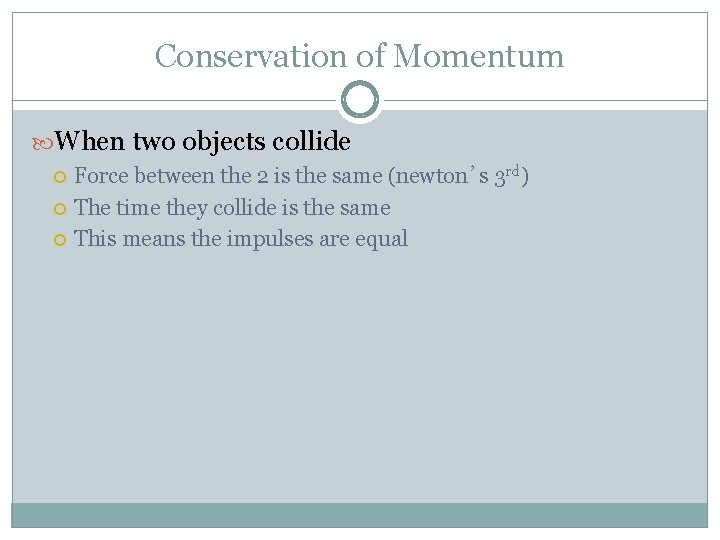
Conservation of Momentum When two objects collide Force between the 2 is the same (newton’s 3 rd) The time they collide is the same This means the impulses are equal
Conservation of Momentum When two objects collide Force between the 2 is the same (newton’s 3 rd) The time they collide is the same This means the impulses are equal
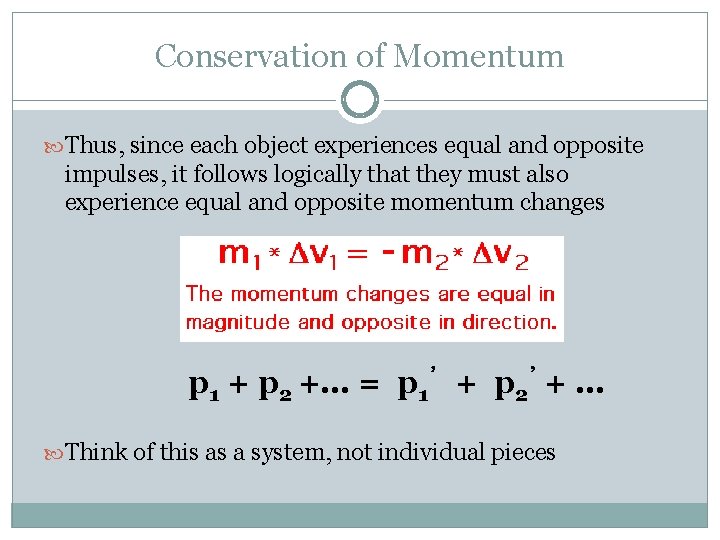
Conservation of Momentum Thus, since each object experiences equal and opposite impulses, it follows logically that they must also experience equal and opposite momentum changes p 1 + p 2 +… = p 1’ + p 2’ + … Think of this as a system, not individual pieces
Check Your Understanding When fighting fires, a firefighter must use great caution to hold a hose that emits large amounts of water at high speeds. Why would such a task be difficult?
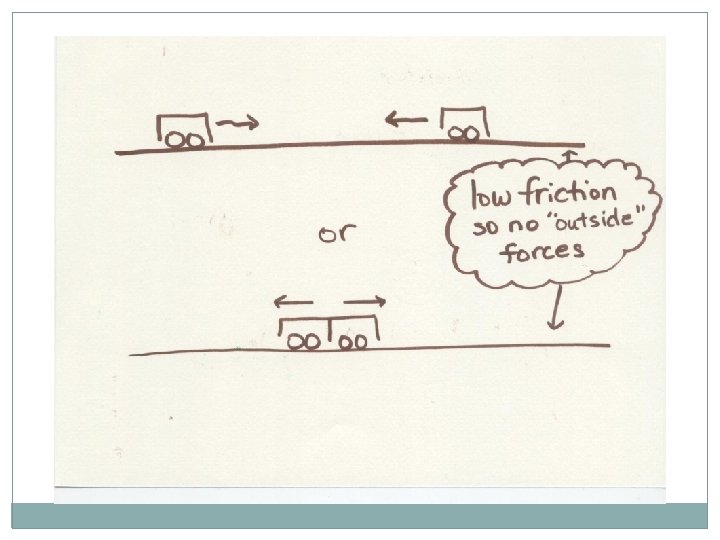
When is momentum conserved? Always in collisions Collisions in the air or on low friction surfaces like ice or lab tracks Explosions where one object flies apart in pieces.
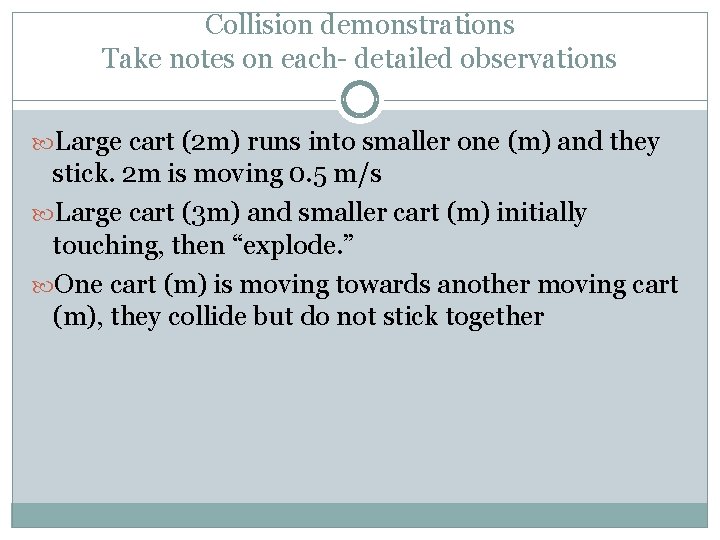
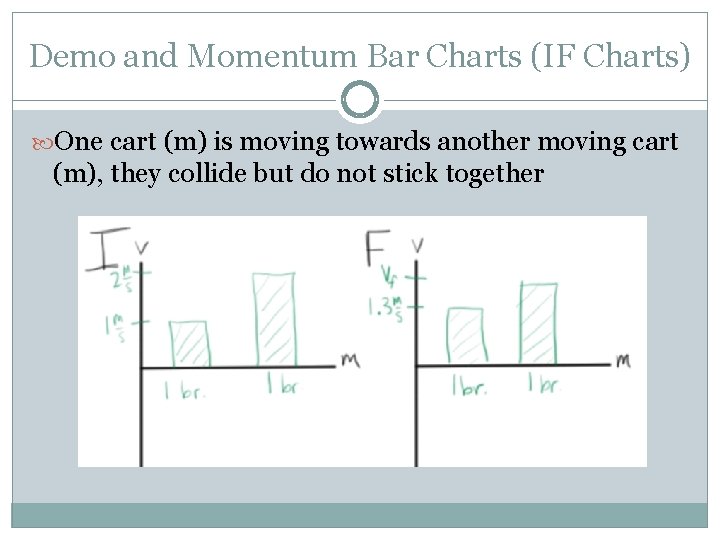
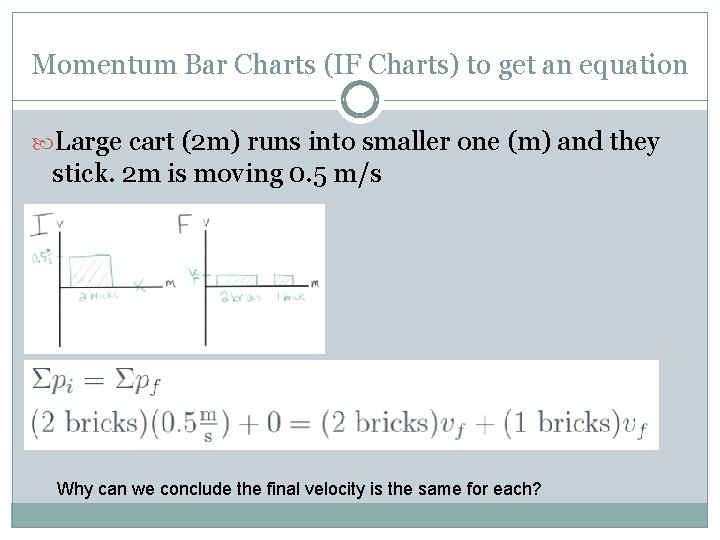
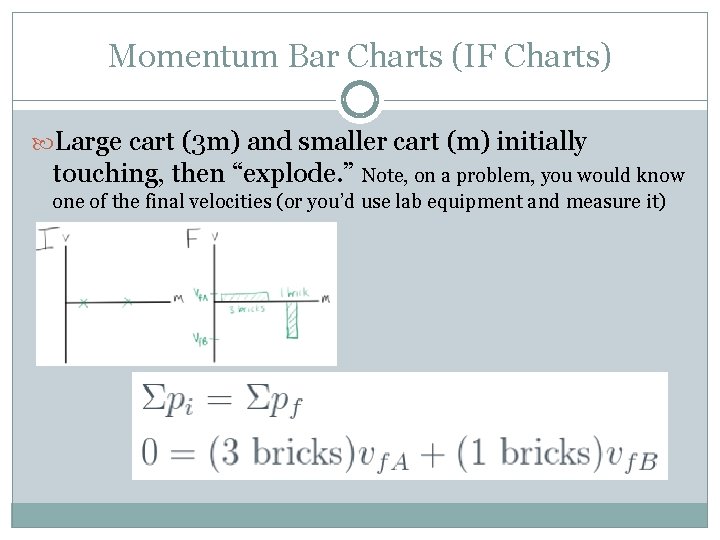
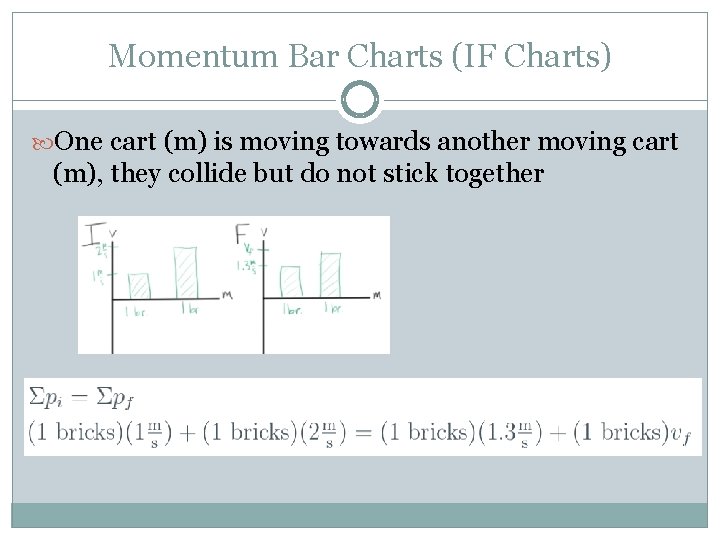
Collision demonstrations Take notes on each- detailed observations Large cart (2 m) runs into smaller one (m) and they stick. 2 m is moving 0. 5 m/s Large cart (3 m) and smaller cart (m) initially touching, then “explode. ” One cart (m) is moving towards another moving cart (m), they collide but do not stick together
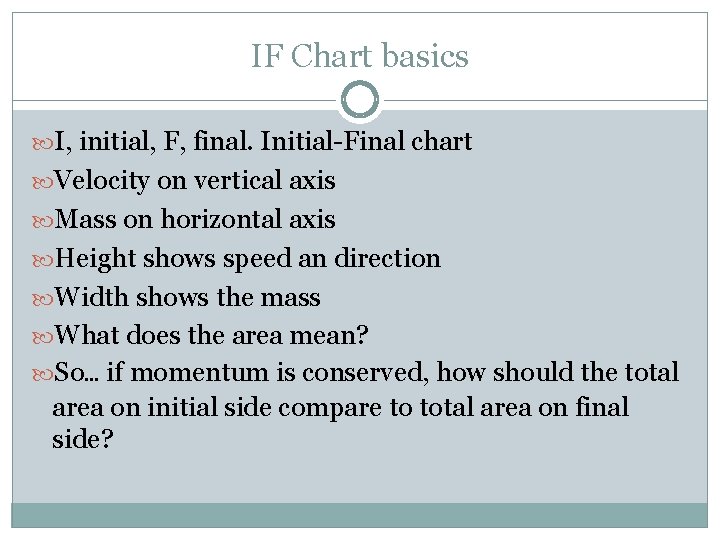
IF Chart basics I, initial, F, final. Initial-Final chart Velocity on vertical axis Mass on horizontal axis Height shows speed an direction Width shows the mass What does the area mean? So… if momentum is conserved, how should the total area on initial side compare to total area on final side?
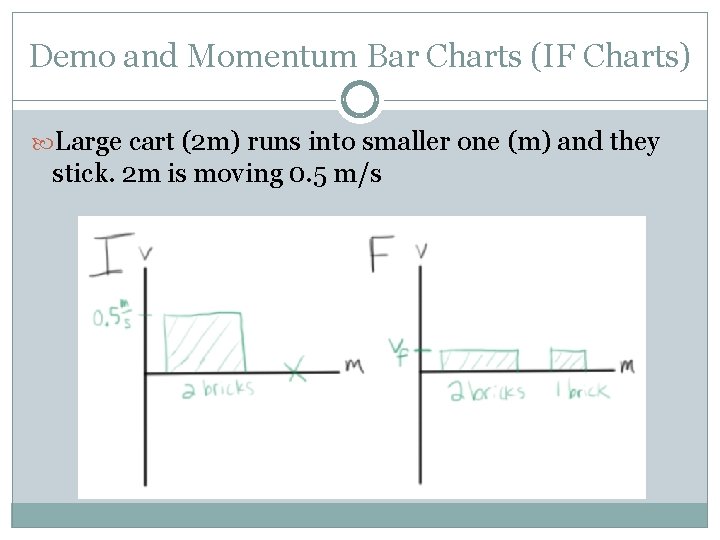
Demo and Momentum Bar Charts (IF Charts) Large cart (2 m) runs into smaller one (m) and they stick. 2 m is moving 0. 5 m/s
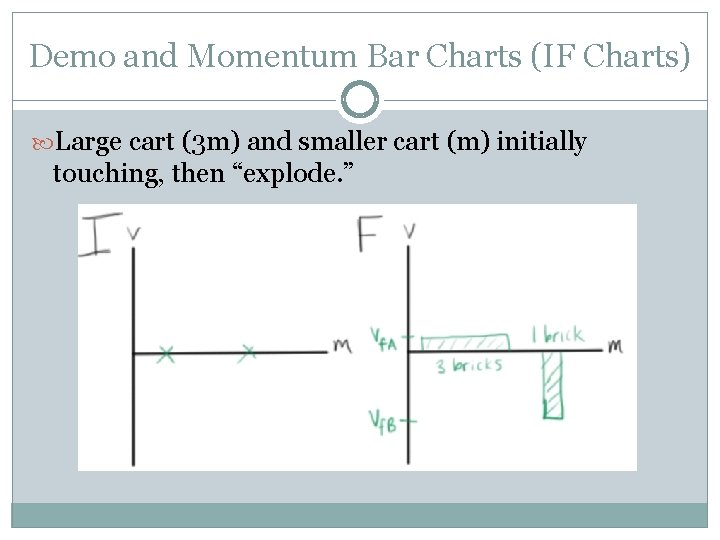
Demo and Momentum Bar Charts (IF Charts) Large cart (3 m) and smaller cart (m) initially touching, then “explode. ”
Demo and Momentum Bar Charts (IF Charts) One cart (m) is moving towards another moving cart (m), they collide but do not stick together
Momentum Bar Charts (IF Charts) to get an equation Large cart (2 m) runs into smaller one (m) and they stick. 2 m is moving 0. 5 m/s Why can we conclude the final velocity is the same for each?
Momentum Bar Charts (IF Charts) Large cart (3 m) and smaller cart (m) initially touching, then “explode. ” Note, on a problem, you would know one of the final velocities (or you’d use lab equipment and measure it)
Momentum Bar Charts (IF Charts) One cart (m) is moving towards another moving cart (m), they collide but do not stick together
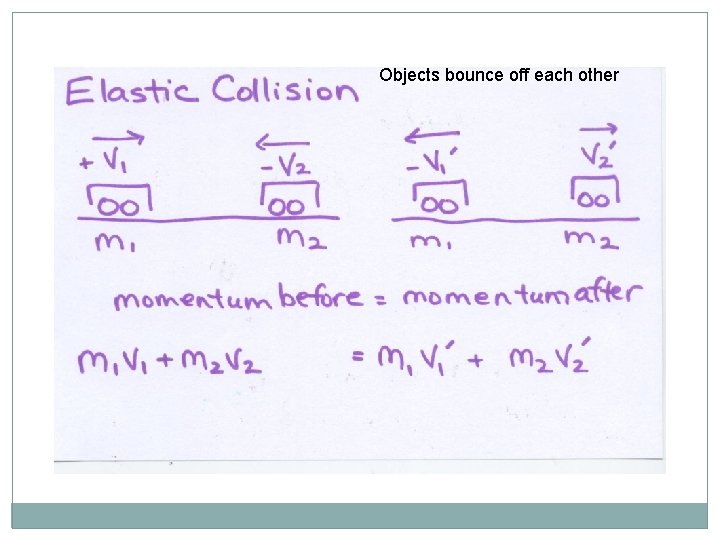
Objects bounce off each other
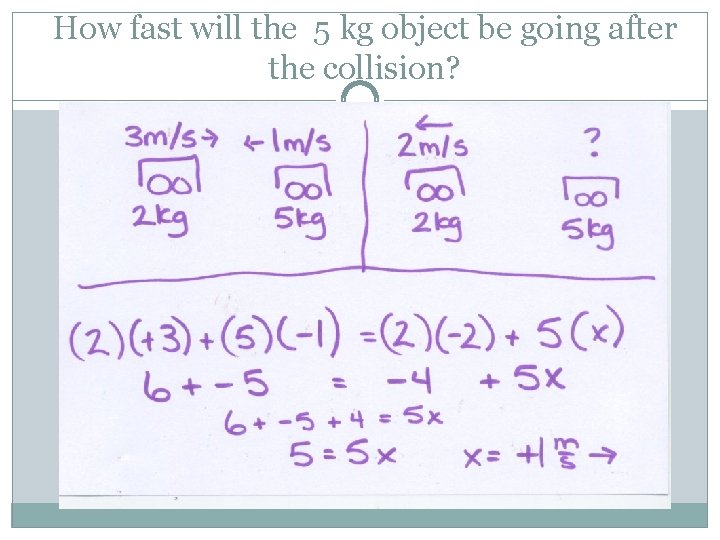
How fast will the 5 kg object be going after the collision?
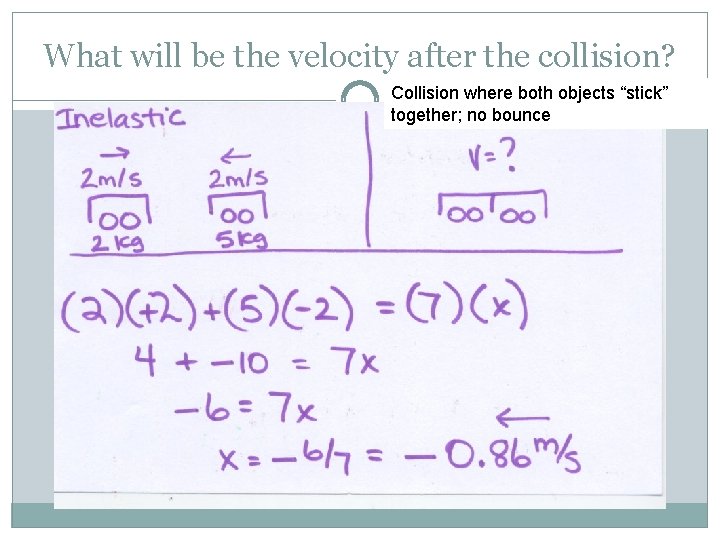
What will be the velocity after the collision? Collision where both objects “stick” together; no bounce
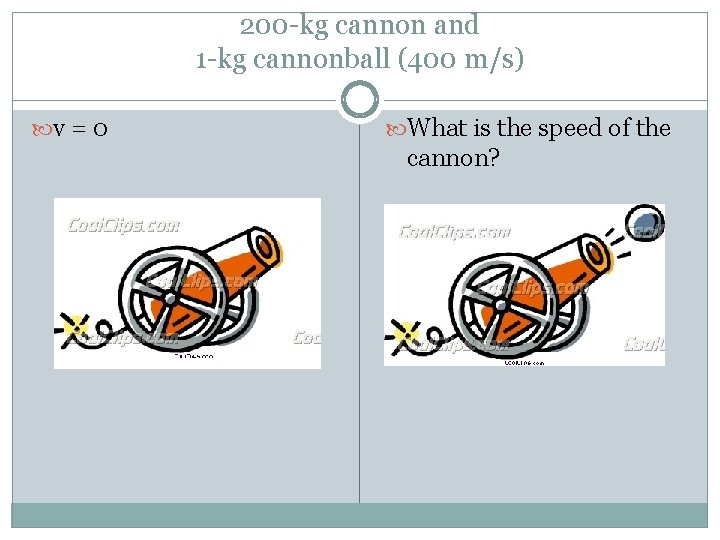
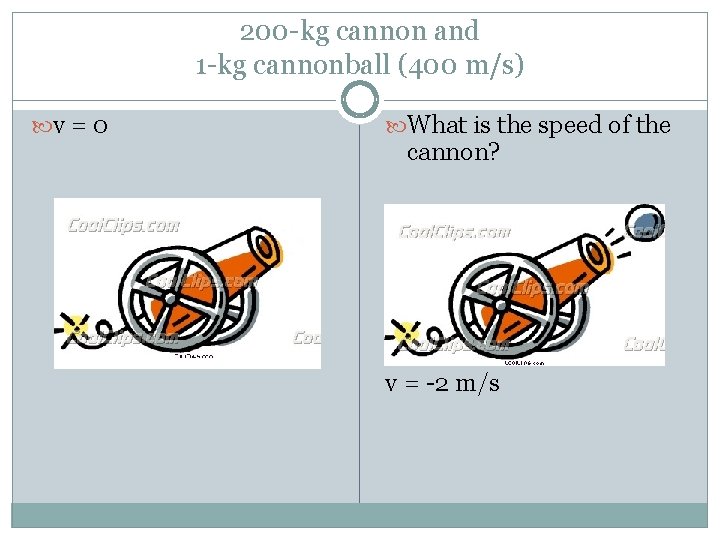
200 -kg cannon and 1 -kg cannonball (400 m/s) v = 0 What is the speed of the cannon?
200 -kg cannon and 1 -kg cannonball (400 m/s) v = 0 What is the speed of the cannon? 0= (200)v + (1)(400) v = -2 m/s
Check Your Understanding A large truck and a Volkswagen have a head-on collision. a. Which vehicle experiences the greatest force of impact? b. Which vehicle experiences the greatest impulse? c. Which vehicle experiences the greatest momentum change? d. Which vehicle experiences the greatest acceleration?