
Unit 8 Law of Diplomatic and Consular Relations
- Slides: 9
Unit 8 Law of Diplomatic and Consular Relations • The Vienna Convention on Diplomatic Relations (1961) • The Vienna Convention on Consular Relations (1963) • Mexico v. United States of America (2004)
Request by Mexico(para. 1 -4): • US’s violation of its international obligation • notification of consular rights; consular access • clemency proceedings; “procedural default” doctrine • restitutio in integrum
US Objections to Jurisdiction • the Court’s admissibility would be an abuse of its • • • jurisdiction (why) Art. 36 creates no obligation constraining the rights of the US to arrest a foreign national The result of restitution in integrum would intrude into the independence of its courts The Court lacks jurisdiction to determine whether or not consular notification is a ‘human rights’, or to declare fundamental requirement of substantive or procedural due process
The Court’s reasoning on the objection of the US to admissibility (para. 36 -48) • The Court’s function as a court of criminal appeal • The rule of exhaustion of local remedies • The dual nationality • Mexico’s delay in response to US’s breach • Principle of reciprocity
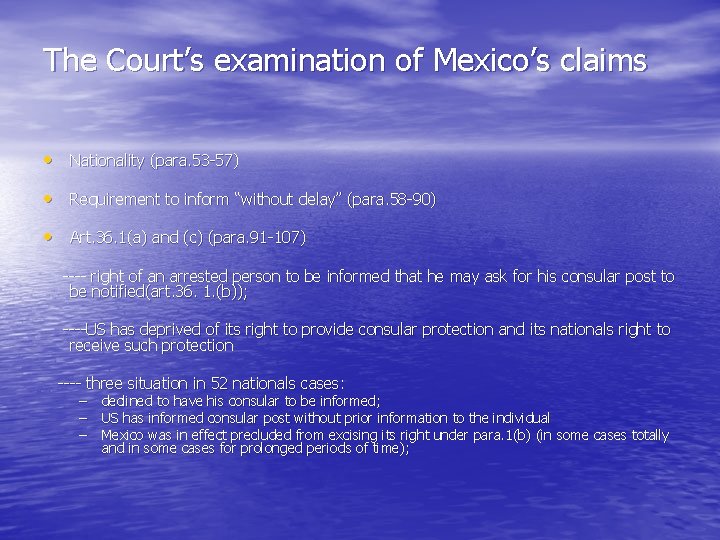
The Court’s examination of Mexico’s claims • Nationality (para. 53 -57) • Requirement to inform “without delay” (para. 58 -90) • Art. 36. 1(a) and (c) (para. 91 -107) ---- right of an arrested person to be informed that he may ask for his consular post to be notified(art. 36. 1. (b)); ----US has deprived of its right to provide consular protection and its nationals right to receive such protection ---- three situation in 52 nationals cases: – declined to have his consular to be informed; – US has informed consular post without prior information to the individual – Mexico was in effect precluded from excising its right under para. 1(b) (in some cases totally and in some cases for prolonged periods of time);
The Court’s interpretation upon Art. 36 para 2 (107 -114) • Mexico’s request • US’s arguments • The Court’s observations and Conclution
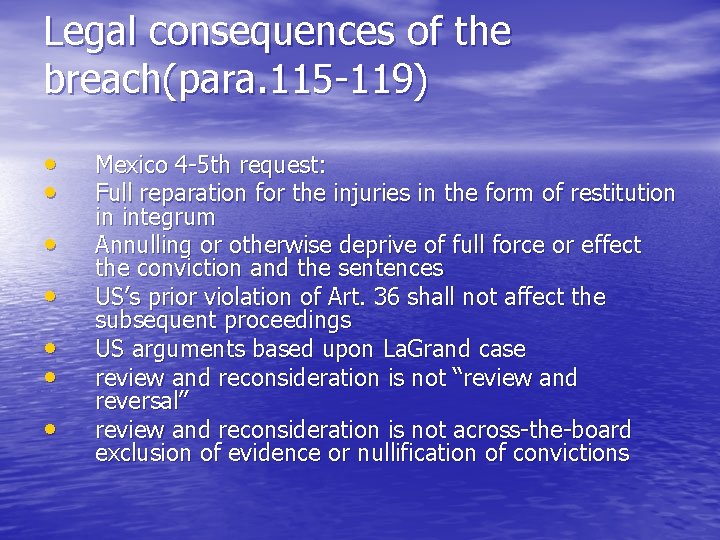
Legal consequences of the breach(para. 115 -119) • • Mexico 4 -5 th request: Full reparation for the injuries in the form of restitution in integrum Annulling or otherwise deprive of full force or effect the conviction and the sentences US’s prior violation of Art. 36 shall not affect the subsequent proceedings US arguments based upon La. Grand case review and reconsideration is not “review and reversal” review and reconsideration is not across-the-board exclusion of evidence or nullification of convictions
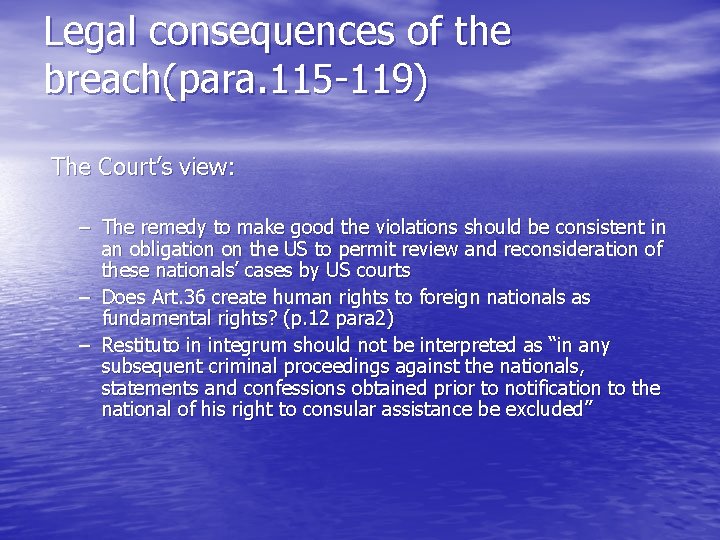
Legal consequences of the breach(para. 115 -119) The Court’s view: – The remedy to make good the violations should be consistent in an obligation on the US to permit review and reconsideration of these nationals’ cases by US courts – Does Art. 36 create human rights to foreign nationals as fundamental rights? (p. 12 para 2) – Restituto in integrum should not be interpreted as “in any subsequent criminal proceedings against the nationals, statements and confessions obtained prior to notification to the national of his right to consular assistance be excluded”
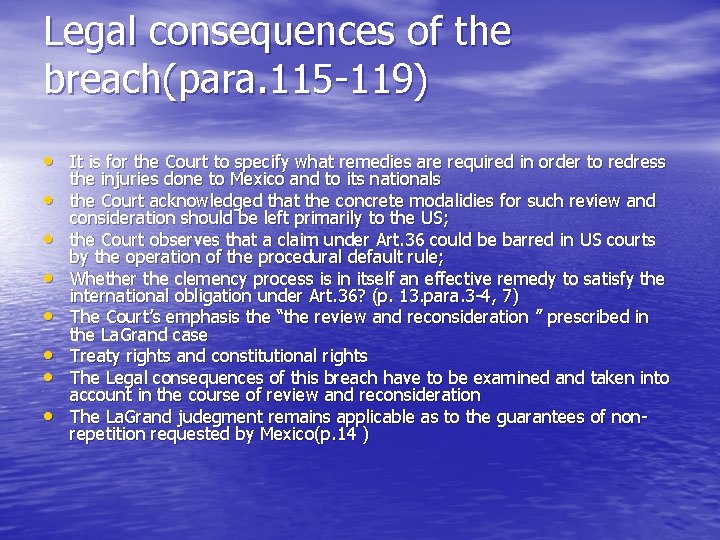
Legal consequences of the breach(para. 115 -119) • It is for the Court to specify what remedies are required in order to redress • • the injuries done to Mexico and to its nationals the Court acknowledged that the concrete modalidies for such review and consideration should be left primarily to the US; the Court observes that a claim under Art. 36 could be barred in US courts by the operation of the procedural default rule; Whether the clemency process is in itself an effective remedy to satisfy the international obligation under Art. 36? (p. 13. para. 3 -4, 7) The Court’s emphasis the “the review and reconsideration ” prescribed in the La. Grand case Treaty rights and constitutional rights The Legal consequences of this breach have to be examined and taken into account in the course of review and reconsideration The La. Grand judegment remains applicable as to the guarantees of nonrepetition requested by Mexico(p. 14 )