
Unit 8 Evolution Classification of Organisms Bottlenose West
*Unit 8* Evolution
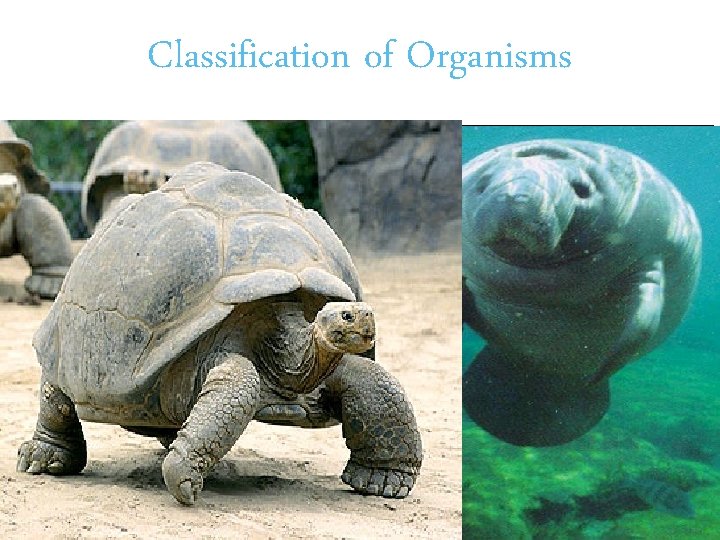
Classification of Organisms Bottlenose West Indian Dolphin Manatee Galapagos Tortoise Kingdom Animalia Phylum Chordata Class Mammalia Sauropsida Order Cetacea Sirenia Testudines Family Delphinidae Trichechidae Testudinidae Genus Tursiops Trichechus Geochelone Species truncatus manatus nigra

Species Genus Family Order Class Phylum Ursus americanus (American black bear) Ursus Ursidae Carnivora Mammalia Chordata Animalia Eukarya Kingdom Domain
B-5. 1 Summarize the process of natural selection • You should be able to: – Infer the fate of a particular species given a scenario of environmental change – Compare microevolution and macroevolution – Explain how changes in the environment may result in the appearance or disappearance of particular traits
Biological Evolution • Describes all changes that have transformed life on Earth – From the earliest beginnings to the diversity of organisms in the world today

Microevolution • Branch of biological evolution • Small scale • Affects single population
Macroevolution • Branch of biological evolution • Large scale • Affects changes in species across populations
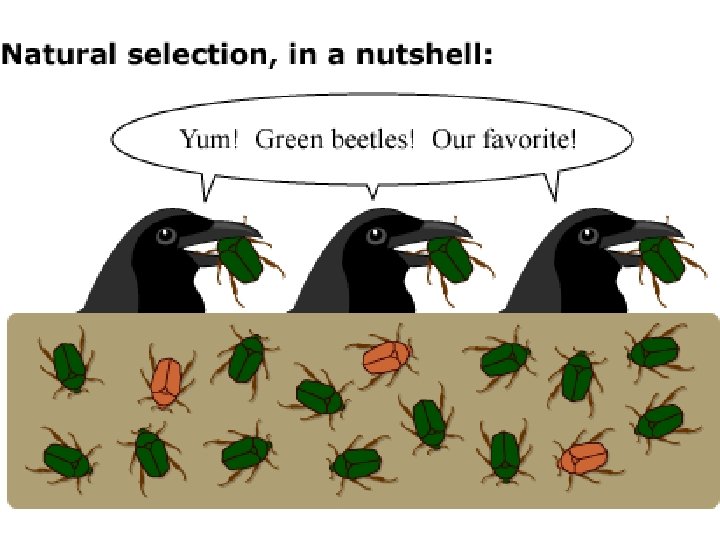
Natural Selection • Explanation of how evolution occurs • Individual members of a population have different traits – These traits allow them to interact with their environment more or less effectively than other members of population
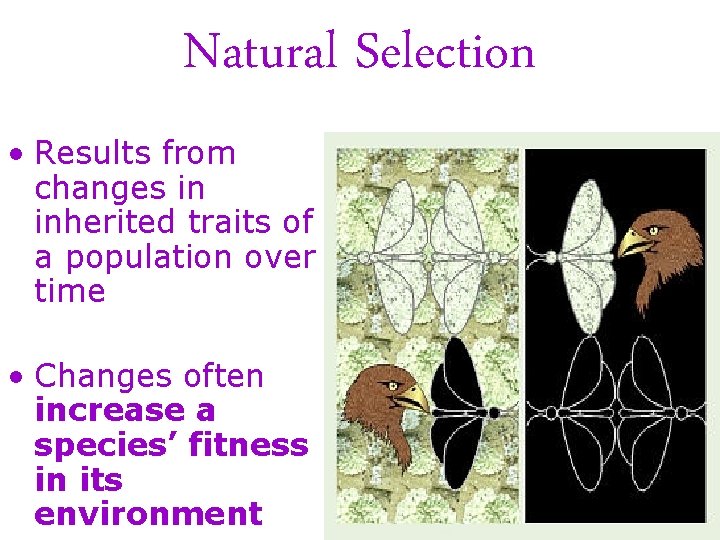
Natural Selection • Results from changes in inherited traits of a population over time • Changes often increase a species’ fitness in its environment
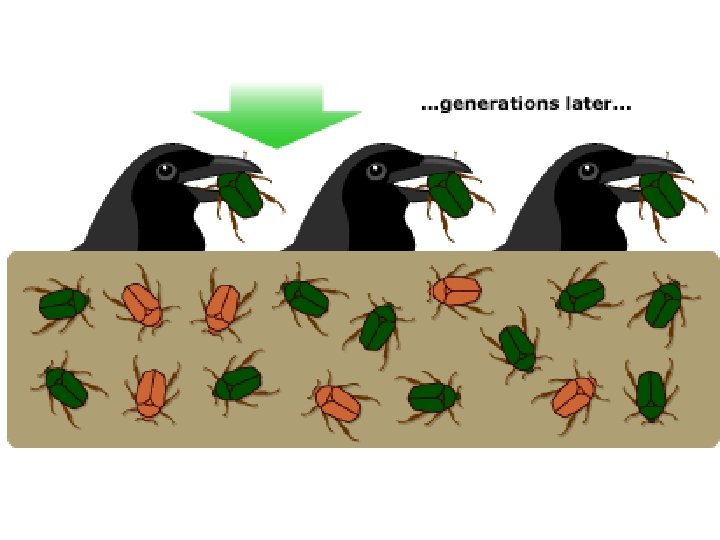
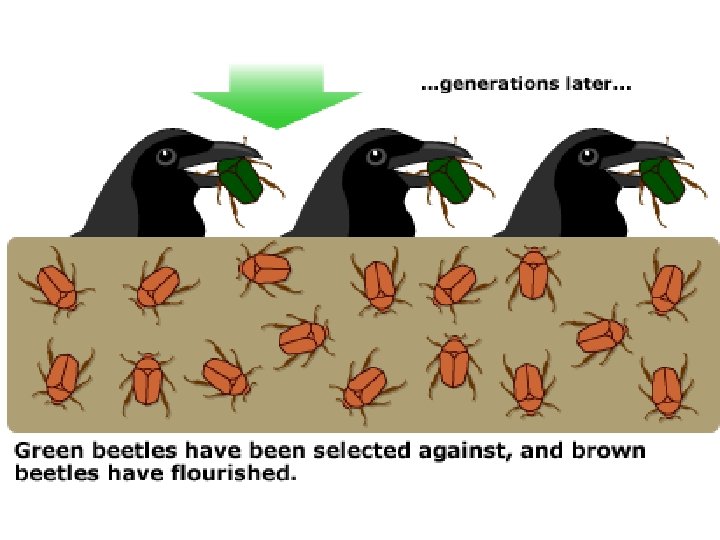
4 Main Principles of Natural Selection • Overproduction of offspring • Variation • Adaptation • Descent with modification
Overproduction of Offspring • The ability of a population to have many offspring raises the chance that some will survive • It also increases competition for resources
Variation (we all look different!!) • Exists within every population – We all inherit different combinations of traits • Exists in phenotypes of individuals – The way they look (physical appearance): • body structures & characteristics
Variation • The way you look influences your ability to find, obtain, or utilize resources – Ex. food, water, shelter, & oxygen • Variation influences an organism’s ability to reproduce
How does Variation occur? • It is controlled by both: – genotype – environment • Individuals with phenotypes that do NOT interact well with environment are more likely to die/produce fewer offspring – Compared to those who interact well with environment
Adaptation • Leads to the increase in frequency of: – A particular structure – Physiological process – Behavior in a population of organisms that makes organism better able to survive & reproduce
Adaptation • In every generation: – Organisms with specific beneficial inherited traits become more prevalent • This is due to genetic variation
Adaptation • As a generation progresses (grows up): – Organisms that carry genes that hinder their ability to meet day to day needs become less & less prevalent in population • Organisms having a hard time finding, obtaining or utilizing food, water, shelter, or oxygen will be less healthy & more likely to die before reproducing – Or produce less viable or fewer offspring
Adaptation • The gene pool of a population changes over time to favor the traits that are beneficial • Fitness: measures how a particular trait contributes to reproductive success in a given environment – Results from adaptations
Adaptation • Sometimes even known as: Survival of the fittest
Descent with Modification • Refers to changes that occur in species due to natural selection over successive generations • As environment changes, entire process of natural selection can yield populations with new phenotypes adapted to new conditions
Descent with Modification • Results in population with: – different structures – live in different niches/habitats from ancestors • Each successive living species will have descended with adaptations (or modifications) from previous generations
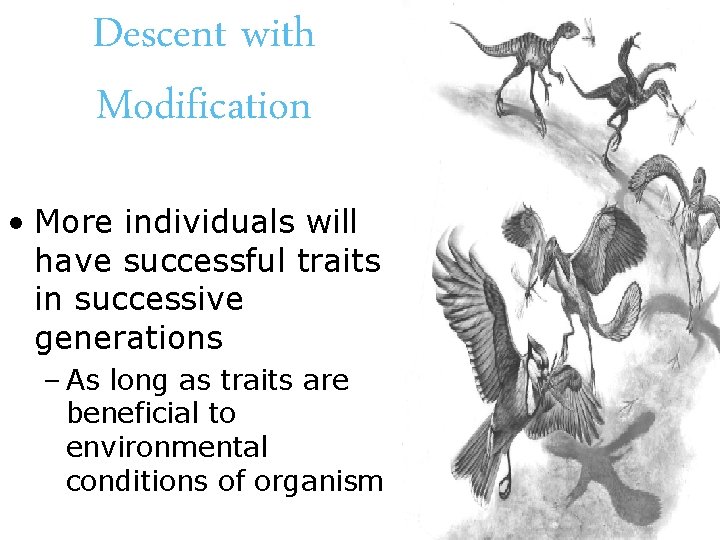
Descent with Modification • More individuals will have successful traits in successive generations – As long as traits are beneficial to environmental conditions of organism
B-5. 2 Explain how genetic processes result in the continuity of life-forms over time. • You should be able to: – Recall the similarities between organisms that live today with those that lived in the past – Exemplify how genetic variability results in the continuity of life-forms – Compare the results of sexual and asexual reproduction – Summarize how sexual and asexual reproduction ensure that genetic material is passed to offspring allowing for the continuity of life-forms
Continuity of life-forms • All life that has ever existed on Earth share at least the same 2 structures: 1. Nucleic acids – DNA or RNA – carry the code for the synthesis of organism’s proteins 2. Proteins – composed of same 20 amino acids in all life forms on Earth
Continuity of life-forms • Process by which nucleic acids code for proteins is the same in all lifeforms on Earth – Transcription & translation
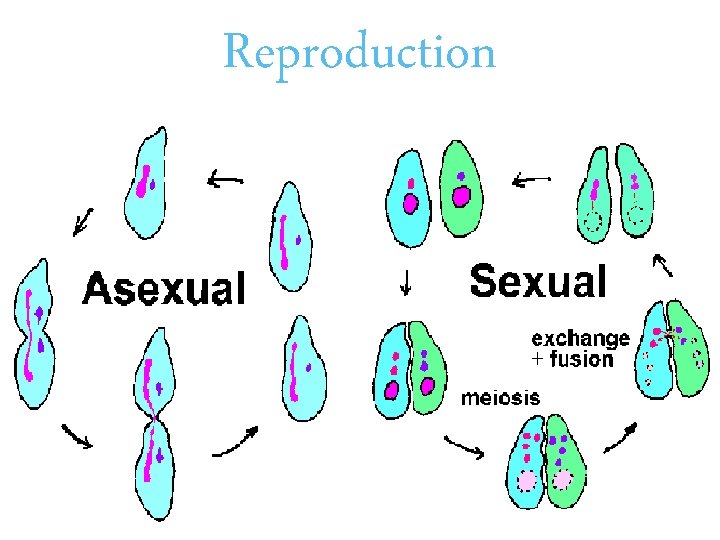
Reproduction • Reliable means of passing genetic information to offspring in all organisms • Result in offspring receiving same genetic information as parent(s) – Some genetic variability • 2 types: – Sexual – Asexual
Sexual Reproduction • Uses process of meiosis to create gametes • Fertilization: embryo receives alleles from each parent for each trait • New individual expresses a combination of traits – Allows for variation within offspring
Sexual Reproduction • Genetic variability due to: – Gene shuffling – Crossing-over – Recombination of DNA – Mutations • When gametes are produced, each parent’s alleles may be arranged in new ways in the offspring
Asexual Reproduction • Involves only 1 parent • Offspring (for the most part) are genetically identical to the parent
Asexual Reproduction • Genetic variability only occurs through mutations in DNA – Passed from parent to offspring – Also a way organisms achieve variations as populations continue over time
Asexual Reproduction • Advantages: – Much faster than sexual reproduction – Many offspring produced • Well fit to continue life in current environment
Asexual Reproduction • Disadvantages: – In changing conditions • Genetically identical offspring respond to environment in the same way – If population lacks traits that enable them to survive & reproduce, entire population could die off
Summary • Transfer of genetic material through reproduction is essential for survival of population • Continuity of a species is contingent upon the genetic processes • If organism can reproduce sexually AND asexually, they have an adaptive advantage for survival
B-5. 3 Explain how diversity within a species increases the chances of survival • You should be able to: – Summarize the ways that diversity affects a species chances of survival – Exemplify favorable traits that ensure reproductive success or species survival – Infer the fate of a particular species in the face of a specific environmental change based on the degree of diversity of its members – Compare the chances of 2 species to survive in the face of a specific environmental change
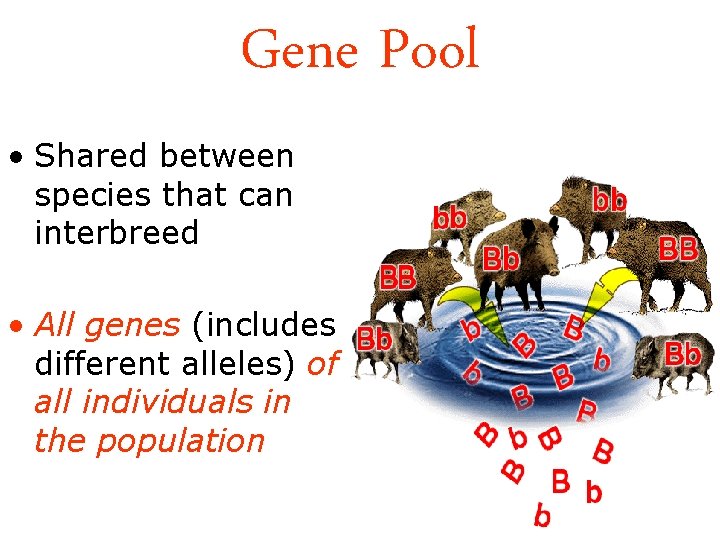
Gene Pool • Shared between species that can interbreed • All genes (includes different alleles) of all individuals in the population
Gene Pool • Genetic change in 1 individual can spread through population –How? ? : • Individual mating with others in population –Producing offspring with similar change • Affected offspring reproducing
Gene Pool • If the change increases fitness: – Change will be beneficial (it’s good!) – Eventually found in many individuals in population
Diversity • Same gene pool – different genotypes (letters) – different phenotypes (looks) • diversity, chances for species to survive during environmental changes
Environmental Changes • Well-suited individuals: –Survive –Reproduce At higher rates (than those with less favorable phenotypes)
Favorable Traits • Favorable phenotypes: –Increase in frequency –Become more common –Increase the chances of survival of species
Favorable Traits • Enhance reproductive success • Examples: – Coloration – Odors – Competitive strength – Courting behaviors
B-5. 4 Explain how genetic variability & environmental factors lead to biological evolution. • You should be able to: – Summarize the factors influencing genetic variability in a population – Summarize the Hardy-Weinberg principle – Explain the process of speciation – Summarize the patterns of macroevolution – Compare gradual & mass extinction
Factors Influencing Genetic Variability • Genetic drift • Gene flow • Non-random mating • Mutations • Natural selection
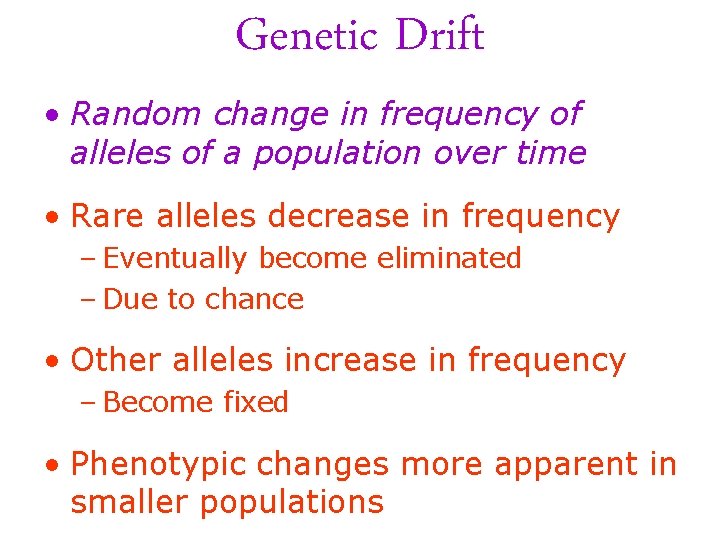
Genetic Drift • Random change in frequency of alleles of a population over time • Rare alleles decrease in frequency – Eventually become eliminated – Due to chance • Other alleles increase in frequency – Become fixed • Phenotypic changes more apparent in smaller populations
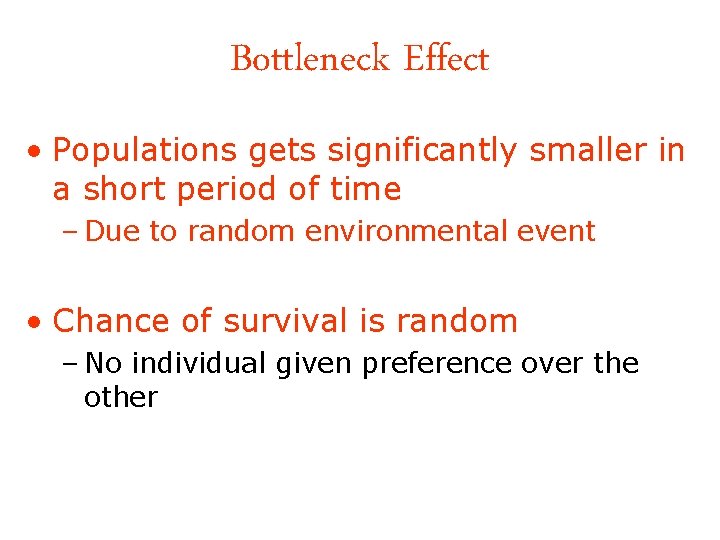
Bottleneck Effect • Populations gets significantly smaller in a short period of time – Due to random environmental event • Chance of survival is random – No individual given preference over the other
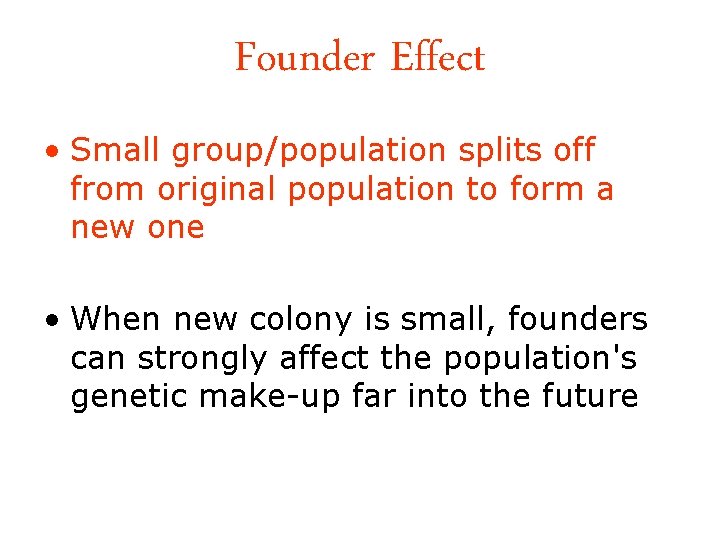
Founder Effect • Small group/population splits off from original population to form a new one • When new colony is small, founders can strongly affect the population's genetic make-up far into the future
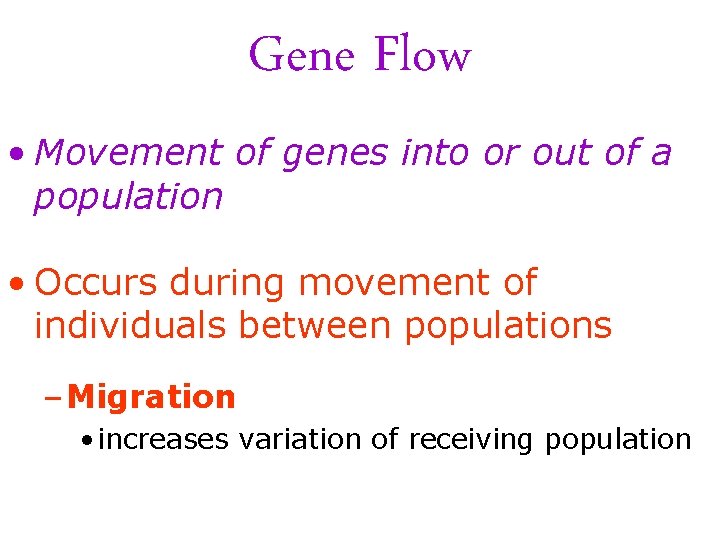
Gene Flow • Movement of genes into or out of a population • Occurs during movement of individuals between populations – Migration • increases variation of receiving population
Non-random mating • Selecting your mate; being “choosey” • Limits frequency of expression of certain alleles • RANDOM mating ensures that each individual has an equal chance of passing alleles to offspring
Mutations • Increase the frequencies & types of allele changes within the population • If genes mutate, new alleles may be introduced into the population – Allele frequencies change
Natural Selection • Allows for the most favorable phenotypes to survive – Survival of the fittest • Traits passed on to future generations
Genetic Equilibrium • When there is NO CHANGE in allele frequencies within a species • Hardy-Weinberg principle
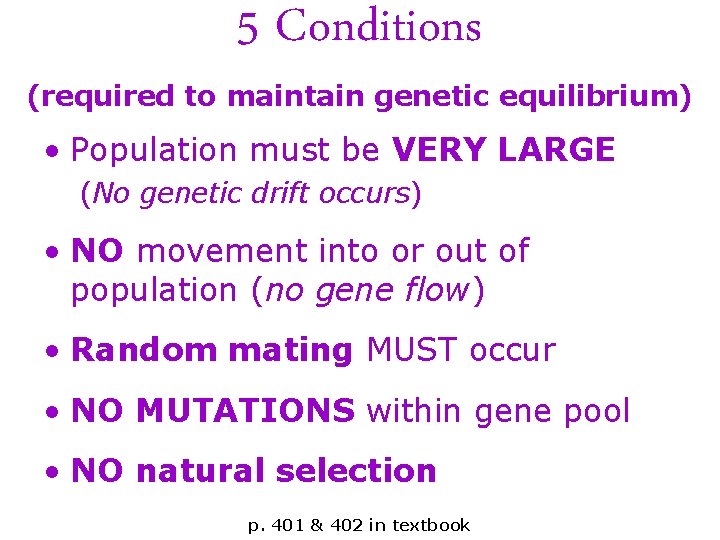
5 Conditions (required to maintain genetic equilibrium) • Population must be VERY LARGE (No genetic drift occurs) • NO movement into or out of population (no gene flow) • Random mating MUST occur • NO MUTATIONS within gene pool • NO natural selection p. 401 & 402 in textbook
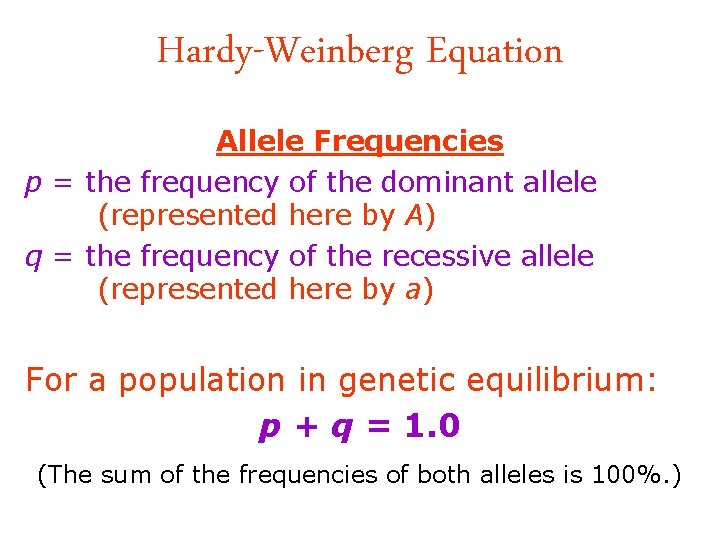
Hardy-Weinberg Equation Allele Frequencies p = the frequency of the dominant allele (represented here by A) q = the frequency of the recessive allele (represented here by a) For a population in genetic equilibrium: p + q = 1. 0 (The sum of the frequencies of both alleles is 100%. )
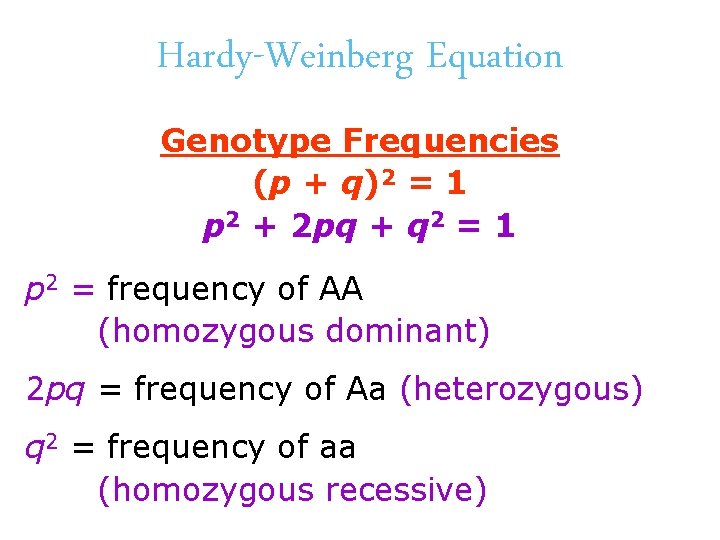
Hardy-Weinberg Equation Genotype Frequencies (p + q)2 = 1 p 2 + 2 pq + q 2 = 1 p 2 = frequency of AA (homozygous dominant) 2 pq = frequency of Aa (heterozygous) q 2 = frequency of aa (homozygous recessive)
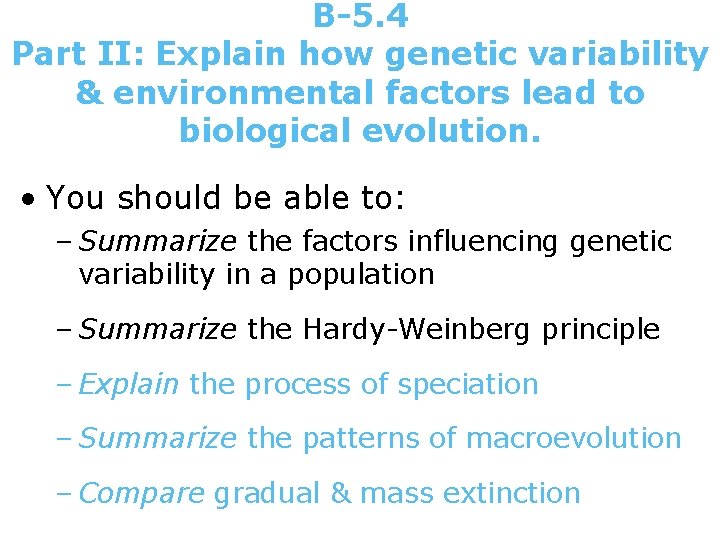
B-5. 4 Part II: Explain how genetic variability & environmental factors lead to biological evolution. • You should be able to: – Summarize the factors influencing genetic variability in a population – Summarize the Hardy-Weinberg principle – Explain the process of speciation – Summarize the patterns of macroevolution – Compare gradual & mass extinction
Patterns of Evolution: • Gradualism • Punctuated equilibrium • Adaptive radiation/divergent evolution • Convergent evolution • Coevolution • Extinction
Gradualism • Gradual changes of a species • Over long periods of time • Example: –Gradual trend toward larger or smaller body size
Punctuated Equilibrium • Periods of abrupt changes in a species • After long periods of little change within species • Example: – Sudden change in species size or shape • Due to environmental factors
Adaptive Radiation/ Divergent Evolution • Different species diverge (split-off) from a common ancestor • Results in homologous structures • Over many generations • Organisms (whose ancestors were all of the evolve variety of characteristics same species) – Allow them to survive in different niches
Convergent Evolution • Different groups of organisms living in similar environments • Produces species similar in appearance & behavior • Analogous structures: – Structures similar in appearance & function – Different evolutionary origins
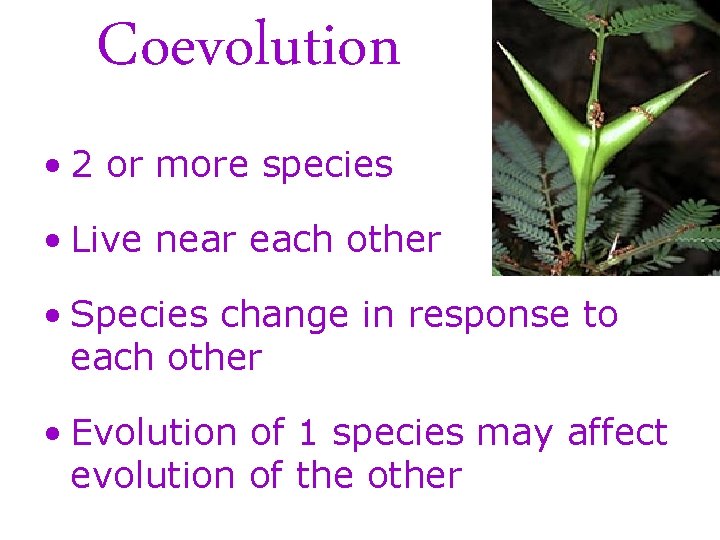
Coevolution • 2 or more species • Live near each other • Species change in response to each other • Evolution of 1 species may affect evolution of the other
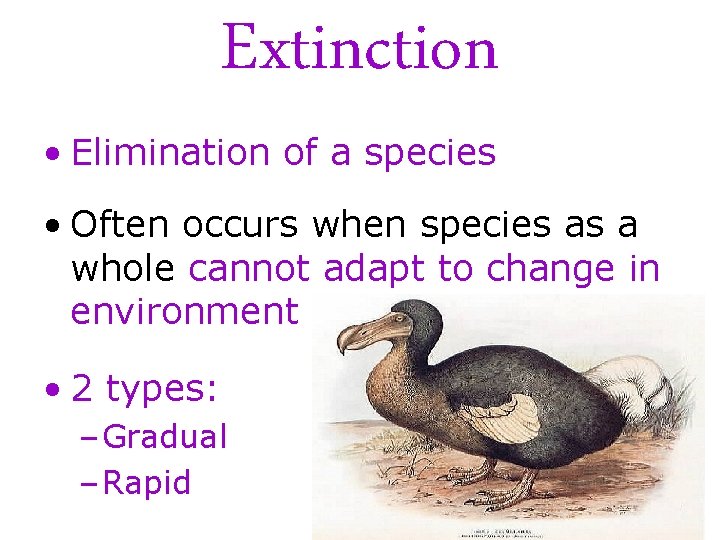
Extinction • Elimination of a species • Often occurs when species as a whole cannot adapt to change in environment • 2 types: – Gradual – Rapid
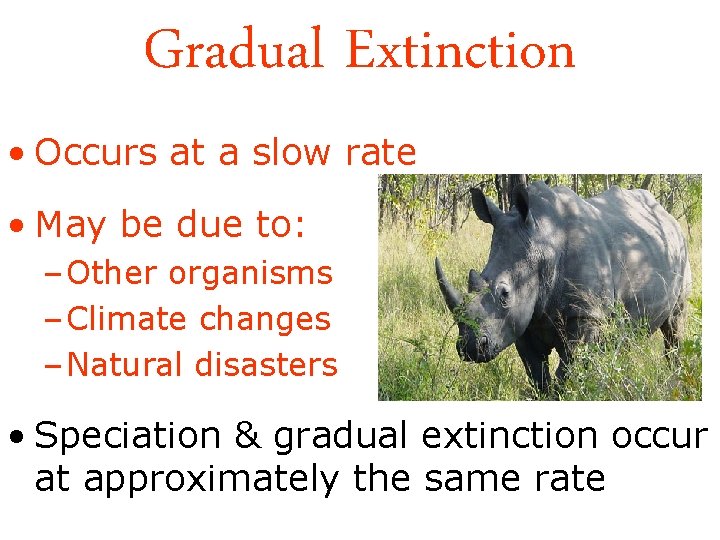
Gradual Extinction • Occurs at a slow rate • May be due to: – Other organisms – Climate changes – Natural disasters • Speciation & gradual extinction occur at approximately the same rate
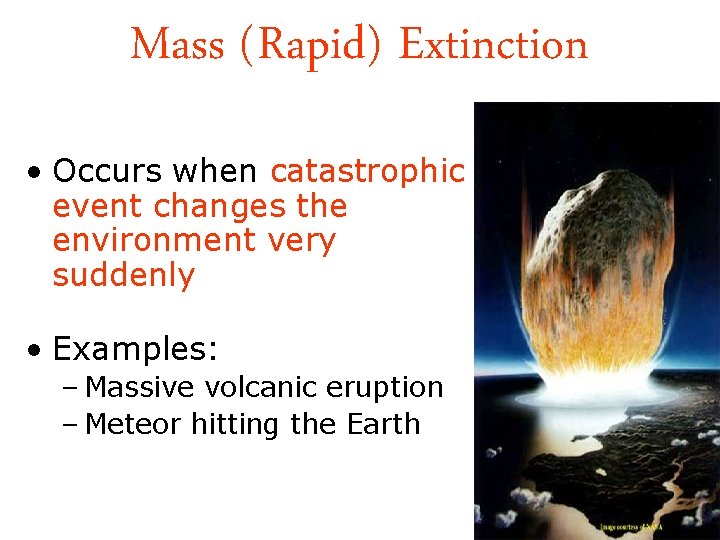
Mass (Rapid) Extinction • Occurs when catastrophic event changes the environment very suddenly • Examples: – Massive volcanic eruption – Meteor hitting the Earth
B-5. 5 Exemplify scientific evidence in the fields of anatomy, embryology, biochemistry, and paleontology that underlies theory of biological evolution. • You should be able to: – Identify fields of science that provide evidence for biological evolution – Illustrate evidence for biological evolution using pictures, diagrams or words – Infer relationships among organisms based on evidence from each field of science listed – Summarize the ways that each field of science listed provides evidence for evolutionary relationships
Evidences of Evolution • Anatomy-homologous structures & vestigial organs • Embryology-study embryonic development • Biochemistry-study genes & proteins • Paleontology-study fossils (prehistoric life)
Field of Anatomy • Study of structures of organisms • Homologous structures: – possible relationship between evolutionary paths of 2 species – Explained by divergent evolution – Same internal structure, shared common ancestor, different function • Vestigial Organs: - structures with little or no function - remnants from common ancestors
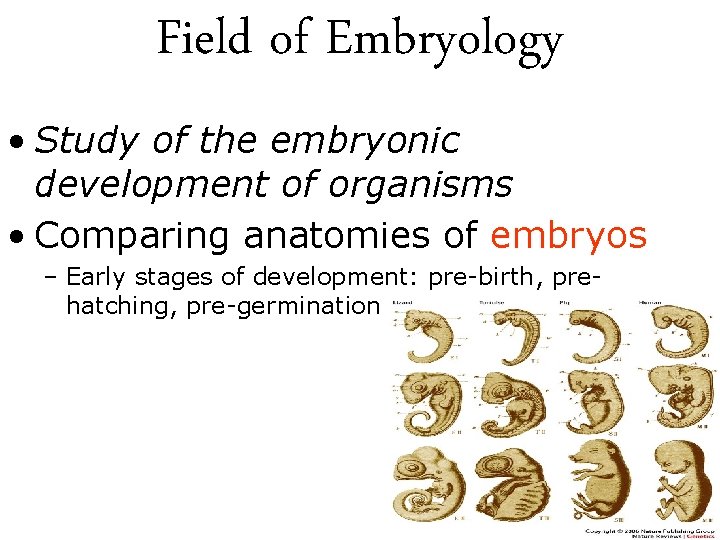
Field of Embryology • Study of the embryonic development of organisms • Comparing anatomies of embryos – Early stages of development: pre-birth, prehatching, pre-germination
Field of Biochemistry • Study of chemical processes in organisms • Studies genes & proteins to provide support for biological evolution
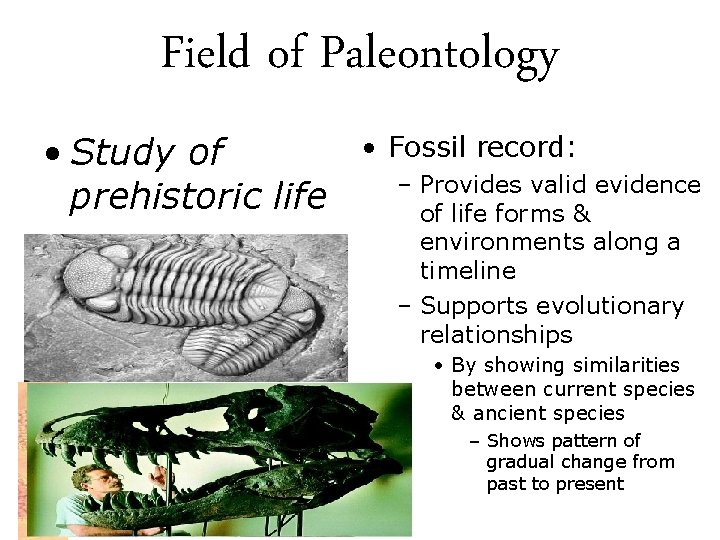
Field of Paleontology • Study of prehistoric life • Fossil record: – Provides valid evidence of life forms & environments along a timeline – Supports evolutionary relationships • By showing similarities between current species & ancient species – Shows pattern of gradual change from past to present
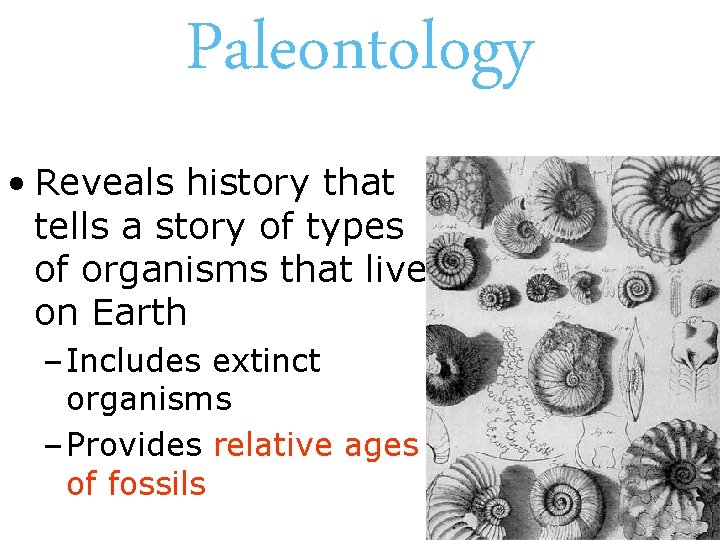
Paleontology • Reveals history that tells a story of types of organisms that lived on Earth – Includes extinct organisms – Provides relative ages of fossils
Paleontology • Fossil record – INCOMPLETE • WHY? ? – Most organisms do not form fossils – Have not found all fossils • Under the ocean! – Many gaps have been filled in as more fossils have been discovered • Older fossils, less resemblance to modern species
B-5. 6 Summarize ways that scientists use data from a variety of sources to investigate & critically analyze aspects of evolutionary theory. • You should be able to: – Compare the evidence within the fields that scientists use to critically analyze evolutionary ancestry – Recall the evidence that analogous & homologous structures provide for evolutionary relationships – Infer how the fossil record has challenged scientists in paleontology – Explain how biochemists use DNA evidence to show evolutionary relationships
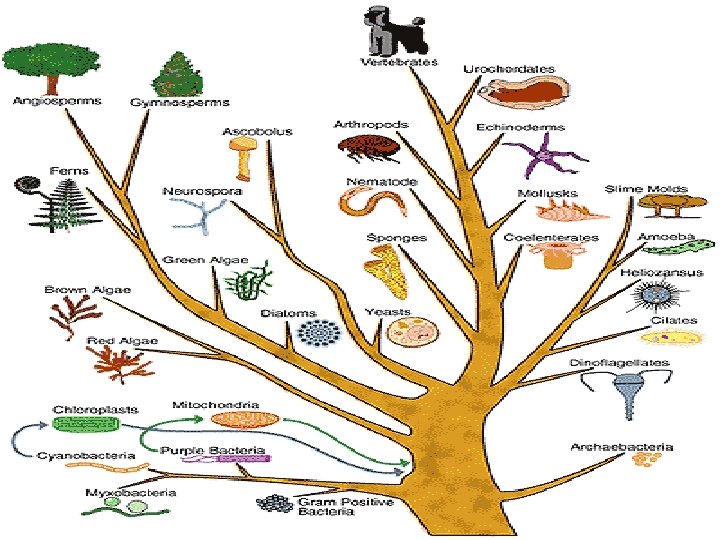
Phylogeny • Evolutionary history • Study of data to trace history of species or group or related species • Theory developed: – All forms of life on Earth are related • Ancestry of organisms can be traced back to common origin • Evidence found in living & fossil organisms – Physical features, structure of proteins, sequences in DNA/RNA
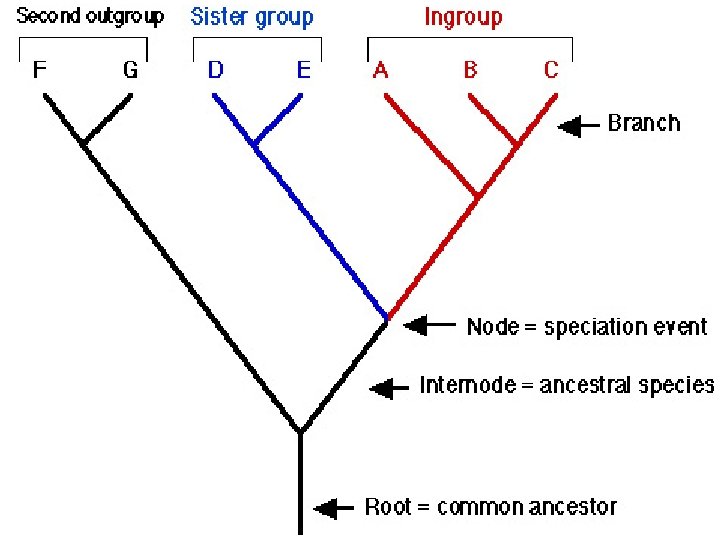
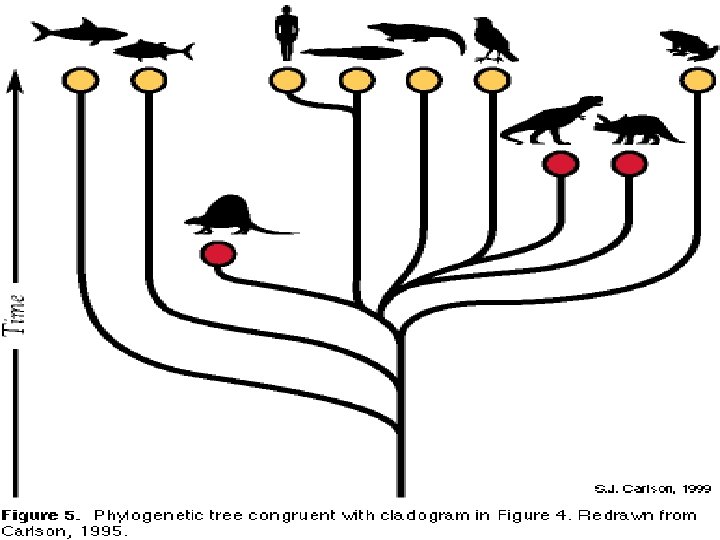
Phylogenetic Trees • Tree showing evolutionary relationships among species sharing a common ancestor • Each node with descendants most recent common ancestor • Lengths correspond to time estimates
Cladograms • Classifies organisms into hierarchical groups • Shows: –Relatively recent common ancestors –Shows sharing of homologous features
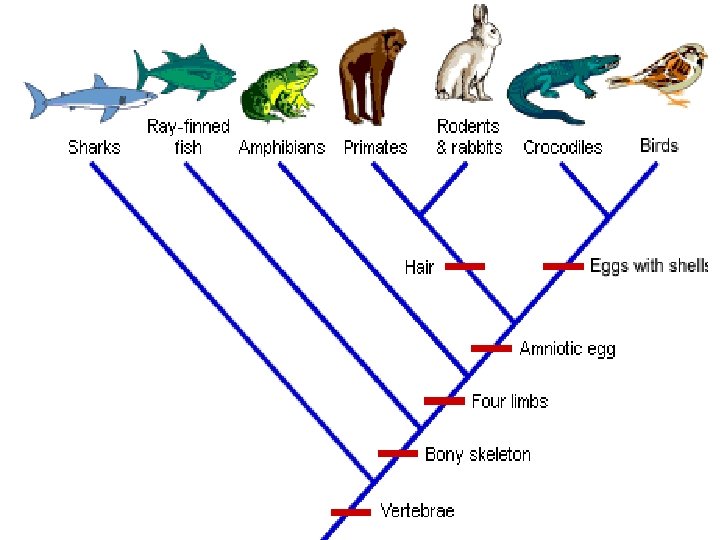
1. What structure do all organisms in this cladogram share? Vertebrae 2. What do the four most recent organisms share? Amniotic egg 3. Which shared a more recent common ancestor? Amphibians & Primates OR Primates & Rodents/Rabbits 4. List the characteristics that amphibians and primates share. Vertebrae, Bony Skeleton, Four Limbs
- Slides: 83