
Unit 8 Behavior of Gases Table of Contents
Unit 8: Behavior of Gases
Table of Contents � Slides 3 -8 � Slides 10 -16 � Slides 18 -24 ◦ Part One: Kinetic Molecular Theory and Introduction to Gas Laws ◦ Part Two: Boyle’s Law, Charles’ Law, and Combined Gas Law ◦ Part Three: Ideal Gas Law, Avogadro’s Principle, and Dalton’s Law of Partial Pressure
Kinetic Molecular Theory and Introduction to Gas Laws C. 4. C-Compare solids, liquids, and gases in terms of compressibility, structure, shape, and volume. C. 9. C-Describe the postulates of Kinetic Molecular Theory
Kinetic Molecular Theory � Gases are… ◦ Small spherical particles ◦ Compressible �Compressibility-A measure of how much the volume of matter decreases under pressure. � No attractive or repulsive forces exist between the particles, as a result gases are free to move inside their container.
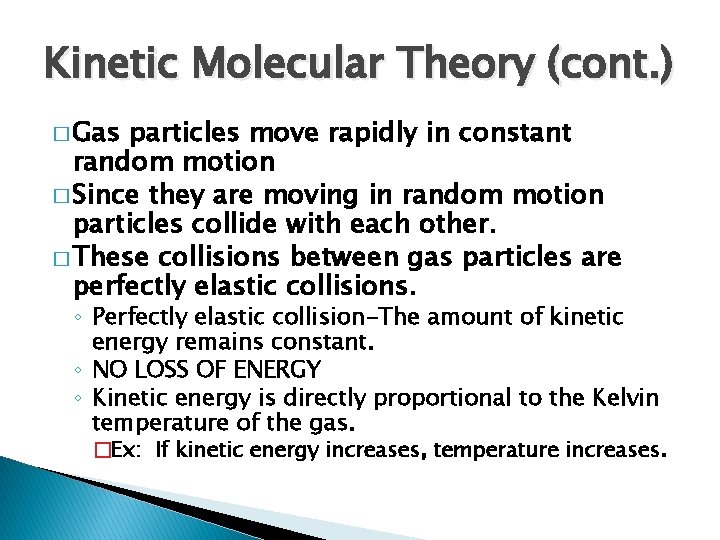
Kinetic Molecular Theory (cont. ) � Gas particles move rapidly in constant random motion � Since they are moving in random motion particles collide with each other. � These collisions between gas particles are perfectly elastic collisions. ◦ Perfectly elastic collision-The amount of kinetic energy remains constant. ◦ NO LOSS OF ENERGY ◦ Kinetic energy is directly proportional to the Kelvin temperature of the gas. �Ex: If kinetic energy increases, temperature increases.
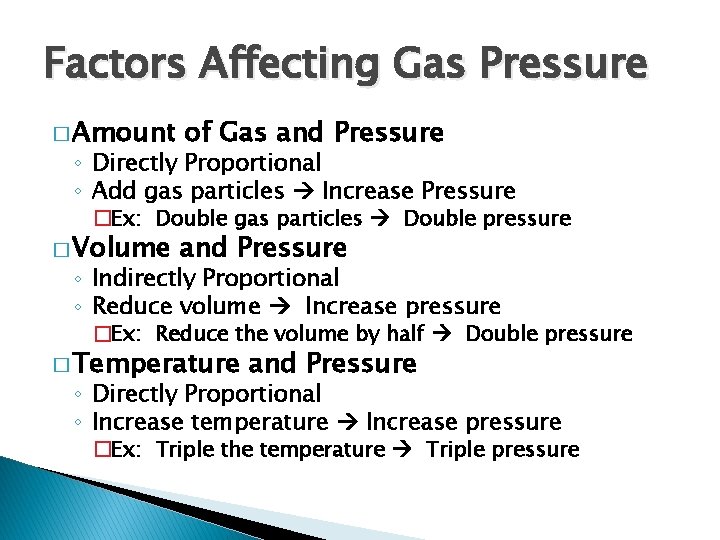
Factors Affecting Gas Pressure � Amount of Gas and Pressure ◦ Directly Proportional ◦ Add gas particles Increase Pressure �Ex: Double gas particles Double pressure � Volume and Pressure ◦ Indirectly Proportional ◦ Reduce volume Increase pressure �Ex: Reduce the volume by half Double pressure � Temperature and Pressure ◦ Directly Proportional ◦ Increase temperature Increase pressure �Ex: Triple the temperature Triple pressure

Variables � P=Pressure ◦ Units for Pressure �atm-atmospheres �k. Pa-kilopascals �mm. Hg-millimeters of mercury � V=Volume � T=Temperature ◦ Must be in Kelvin �TK=T°C + 273 � n=Number of Moles � R=Ideal Gas Constant
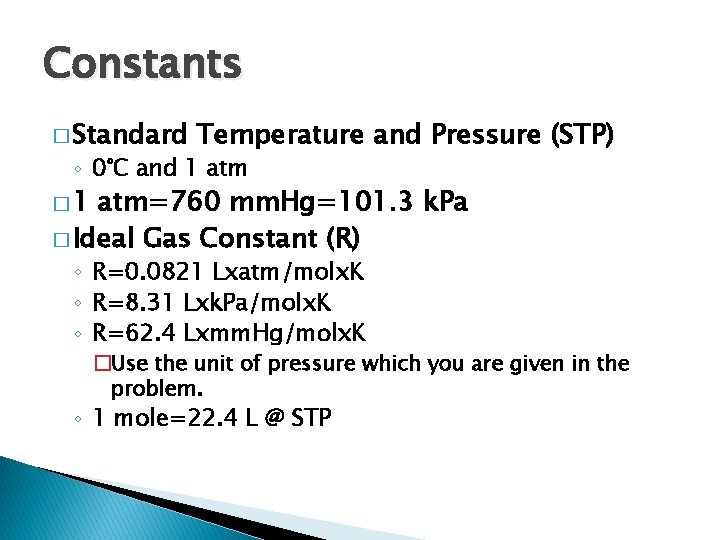
Constants � Standard Temperature and Pressure (STP) ◦ 0°C and 1 atm � 1 atm=760 mm. Hg=101. 3 k. Pa � Ideal Gas Constant (R) ◦ R=0. 0821 Lxatm/molx. K ◦ R=8. 31 Lxk. Pa/molx. K ◦ R=62. 4 Lxmm. Hg/molx. K �Use the unit of pressure which you are given in the problem. ◦ 1 mole=22. 4 L @ STP

Stop at this Slide
*Boyle’s Law *Charles’ Law *Combined Gas Law C. 9. A-Describe and calculate the relations between volume, pressure, number of moles, and temperature for an ideal gas as described by Boyle’s Law, Charles’ Law, Avogadro’s Law, Dalton’s Law of Partial Pressure, and the Ideal Gas Law.
Boyle’s Law � � � At constant temperature, volume of a fixed amount of gas varies inversely with the pressure. P 1 V 1=P 2 V 2 Ex: A diver blows a 1. 25 L air bubble under water. As it rises to the surface, the pressure goes from 3. 00 atm to 1. 04 atm. What will be the volume of air the bubble at the surface? � V 1=1. 25 L � P 1=3. 00 atm � P 2=1. 04 atm � V 2=? � (3. 00 atm)(1. 25 L)=(1. 04 atm) V 2 � V 2=3. 61 L
Boyle’s Law Practice Problems � 1. The pressure of 250. 0 m. L of a gas is 79. 0 k. Pa. If the volume is increased to 400. 0 m. L, what is the new pressure? � Answer: 49. 4 k. Pa � 2. The pressure of a sample of gas in a 2. 00 -L container is 1. 25 atm. What will the pressure be if the sample is placed in a 4. 00 -L container? � Answer: 0. 63 atm
Charles’ Law � � � At constant pressure, the volume of a give amount of gas is directly proportional to its Kelvin temperature. V 1/T 1=V 2/T 2 Ex: A balloon occupies a volume of 4. 52 L @ 39. 0°C. If the temperature rises to 85. 0°C, what is the new volume of the balloon, assuming the pressure remains constant? � � � Change temperature to Kelvin V 1=4. 52 L T 1=39. 0 + 273= 312. 0 K T 2=85. 0 + 273= 358. 0 K V 2=? (4. 52 L)/(312 K)=V 2 /(358 K) � V 2=5. 19 L
Charles’ Law Practice Problems � 1. A gas at 80°C occupies a volume of 1. 45 L. What will the temperature be if the volume increases to 2. 24 L? � Answer: 545 K � 2. The temperature of a 5. 00 -L sample of gas is lowered from 95. 0°C to 30. 0°C. What will be the new volume of the gas? � Answer: 4. 12 L
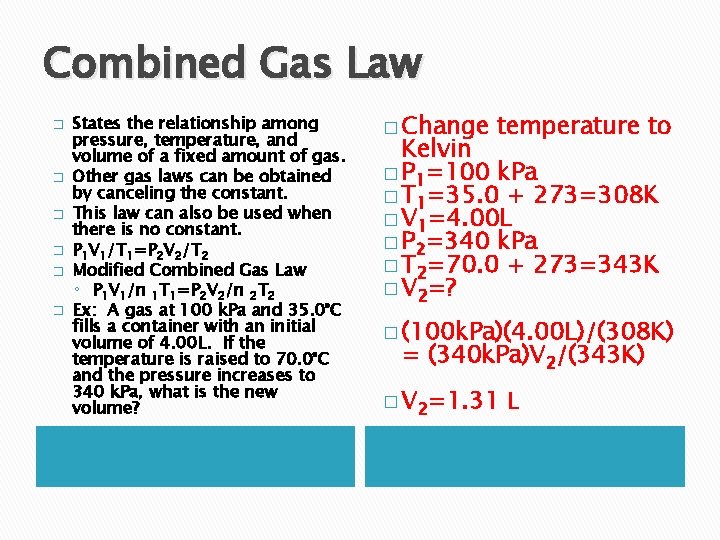
Combined Gas Law � � � States the relationship among pressure, temperature, and volume of a fixed amount of gas. Other gas laws can be obtained by canceling the constant. This law can also be used when there is no constant. P 1 V 1/T 1=P 2 V 2/T 2 Modified Combined Gas Law ◦ P 1 V 1/n 1 T 1=P 2 V 2/n 2 T 2 Ex: A gas at 100 k. Pa and 35. 0°C fills a container with an initial volume of 4. 00 L. If the temperature is raised to 70. 0°C and the pressure increases to 340 k. Pa, what is the new volume? � Change temperature to Kelvin � P 1=100 k. Pa � T 1=35. 0 + 273=308 K � V 1=4. 00 L � P 2=340 k. Pa � T 2=70. 0 + 273=343 K � V 2=? � (100 k. Pa)(4. 00 L)/(308 K) = (340 k. Pa)V 2/(343 K) � V 2=1. 31 L
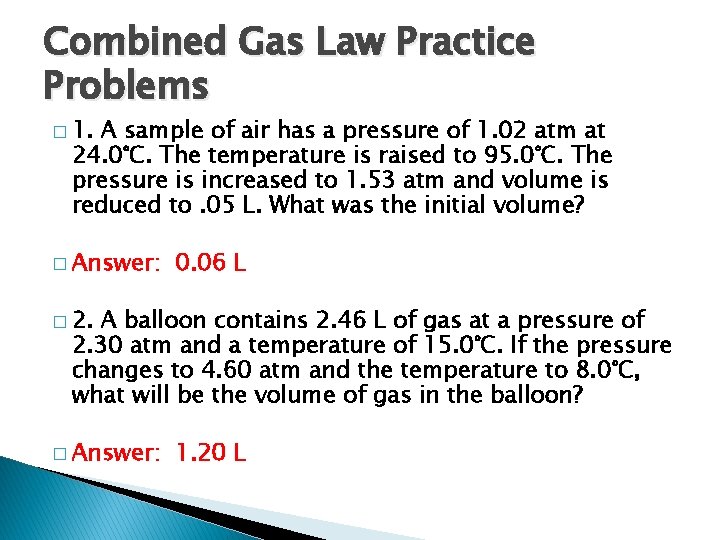
Combined Gas Law Practice Problems � 1. A sample of air has a pressure of 1. 02 atm at 24. 0°C. The temperature is raised to 95. 0°C. The pressure is increased to 1. 53 atm and volume is reduced to. 05 L. What was the initial volume? � Answer: 0. 06 L � 2. A balloon contains 2. 46 L of gas at a pressure of 2. 30 atm and a temperature of 15. 0°C. If the pressure changes to 4. 60 atm and the temperature to 8. 0°C, what will be the volume of gas in the balloon? � Answer: 1. 20 L

Stop at this slide
*Ideal Gas Law *Avogadro’s Principle *Dalton’s Law of Partial Pressure C. 9. A-Describe and calculate the relations between volume, pressure, number of moles, and temperature for an ideal gas as described by Boyle’s Law, Charles’ Law, Avogadro’s Law, Dalton’s Law of Partial Pressure, and the Ideal Gas Law. C. 9. B-Perform stoichiometric calculations, including determination of mass and volume relationships between reactants and products for reactions involving gases.
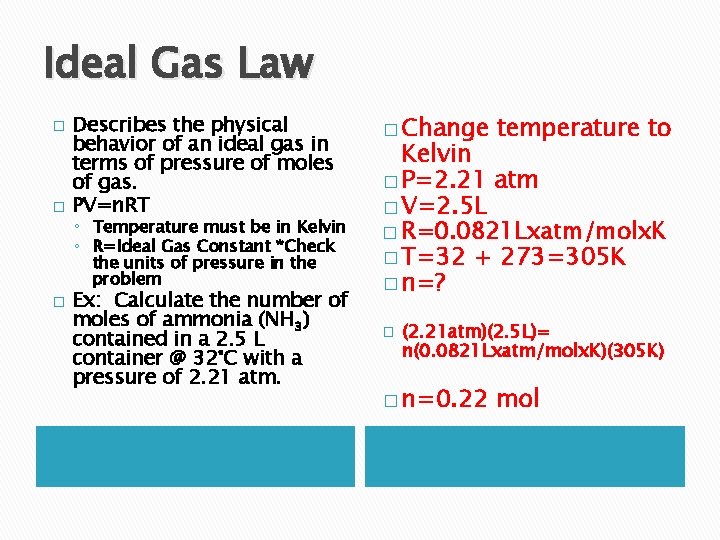
Ideal Gas Law � � � Describes the physical behavior of an ideal gas in terms of pressure of moles of gas. PV=n. RT ◦ Temperature must be in Kelvin ◦ R=Ideal Gas Constant *Check the units of pressure in the problem Ex: Calculate the number of moles of ammonia (NH 3) contained in a 2. 5 L container @ 32°C with a pressure of 2. 21 atm. � Change temperature to Kelvin � P=2. 21 atm � V=2. 5 L � R=0. 0821 Lxatm/molx. K � T=32 + 273=305 K � n=? � (2. 21 atm)(2. 5 L)= n(0. 0821 Lxatm/molx. K)(305 K) � n=0. 22 mol
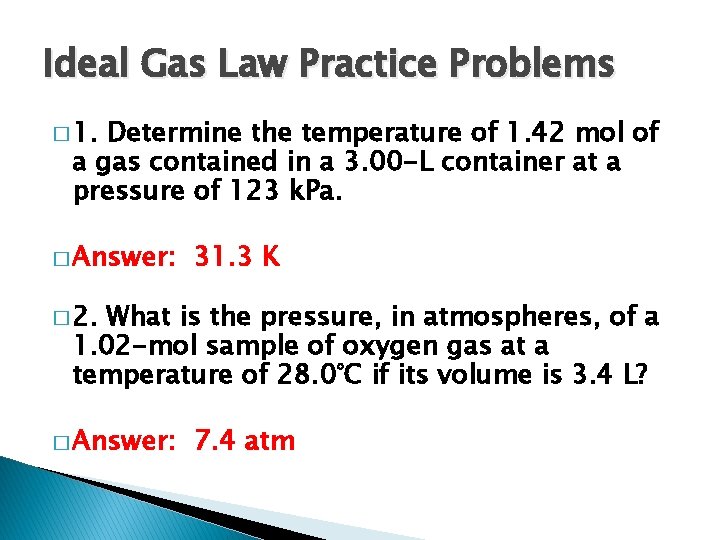
Ideal Gas Law Practice Problems � 1. Determine the temperature of 1. 42 mol of a gas contained in a 3. 00 -L container at a pressure of 123 k. Pa. � Answer: 31. 3 K � 2. What is the pressure, in atmospheres, of a 1. 02 -mol sample of oxygen gas at a temperature of 28. 0°C if its volume is 3. 4 L? � Answer: 7. 4 atm
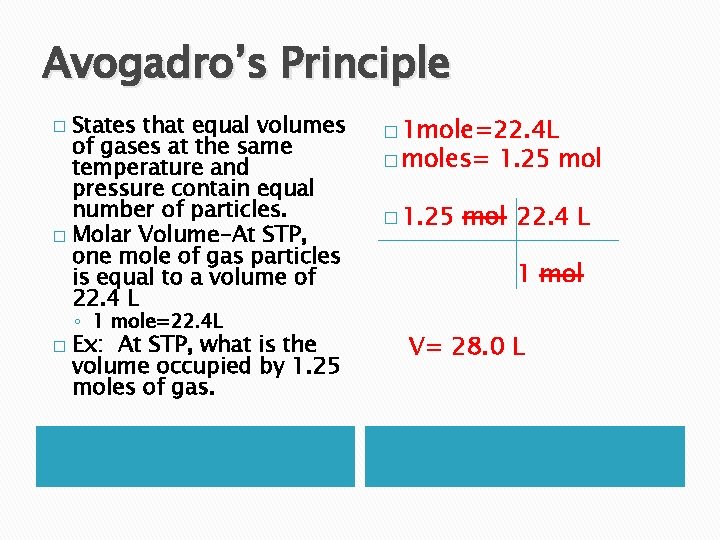
Avogadro’s Principle States that equal volumes of gases at the same temperature and pressure contain equal number of particles. � Molar Volume-At STP, one mole of gas particles is equal to a volume of 22. 4 L � ◦ 1 mole=22. 4 L � Ex: At STP, what is the volume occupied by 1. 25 moles of gas. � 1 mole=22. 4 L � moles= � 1. 25 mol 22. 4 L 1 mol V= 28. 0 L
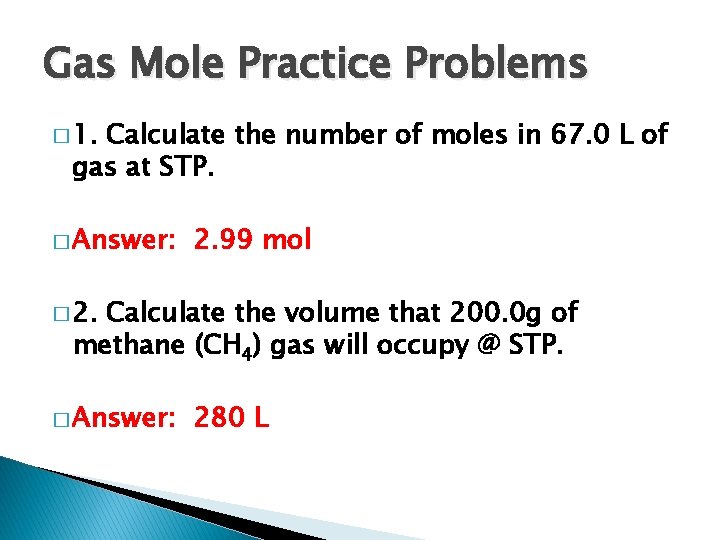
Gas Mole Practice Problems � 1. Calculate the number of moles in 67. 0 L of gas at STP. � Answer: 2. 99 mol � 2. Calculate the volume that 200. 0 g of methane (CH 4) gas will occupy @ STP. � Answer: 280 L
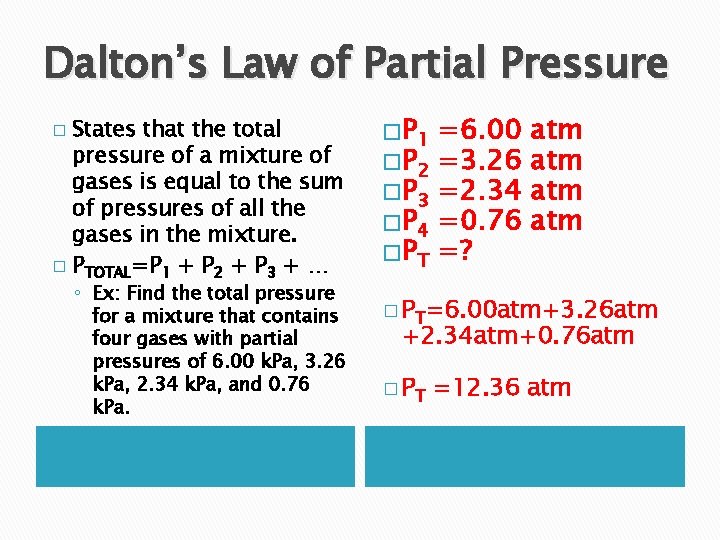
Dalton’s Law of Partial Pressure States that the total pressure of a mixture of gases is equal to the sum of pressures of all the gases in the mixture. � PTOTAL=P 1 + P 2 + P 3 + … � ◦ Ex: Find the total pressure for a mixture that contains four gases with partial pressures of 6. 00 k. Pa, 3. 26 k. Pa, 2. 34 k. Pa, and 0. 76 k. Pa. � P 1 � P 2 � P 3 � P 4 � PT =6. 00 =3. 26 =2. 34 =0. 76 =? atm atm � PT=6. 00 atm+3. 26 atm +2. 34 atm+0. 76 atm � PT =12. 36 atm
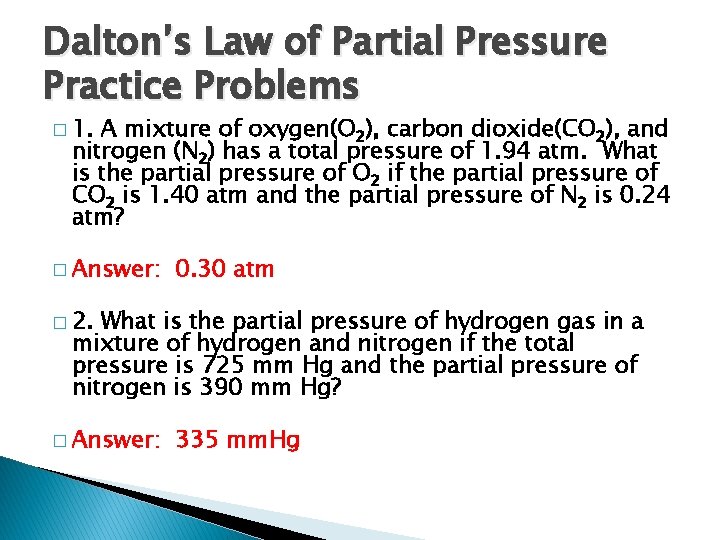
Dalton’s Law of Partial Pressure Practice Problems � 1. A mixture of oxygen(O 2), carbon dioxide(CO 2), and nitrogen (N 2) has a total pressure of 1. 94 atm. What is the partial pressure of O 2 if the partial pressure of CO 2 is 1. 40 atm and the partial pressure of N 2 is 0. 24 atm? � Answer: 0. 30 atm � 2. What is the partial pressure of hydrogen gas in a mixture of hydrogen and nitrogen if the total pressure is 725 mm Hg and the partial pressure of nitrogen is 390 mm Hg? � Answer: 335 mm. Hg
- Slides: 24