
UNIT 8 A GENERIC DIGITAL SWITCHING SYSTEM MODEL
- Slides: 17
UNIT 8 A GENERIC DIGITAL SWITCHING SYSTEM MODEL 1/17/2022
• Scope • This chapter creates a generic digital switching system and its hardware and software architectures. Typical calls through the switch are traced to reveal the functionalities of an operational digital switching system. 1/17/2022
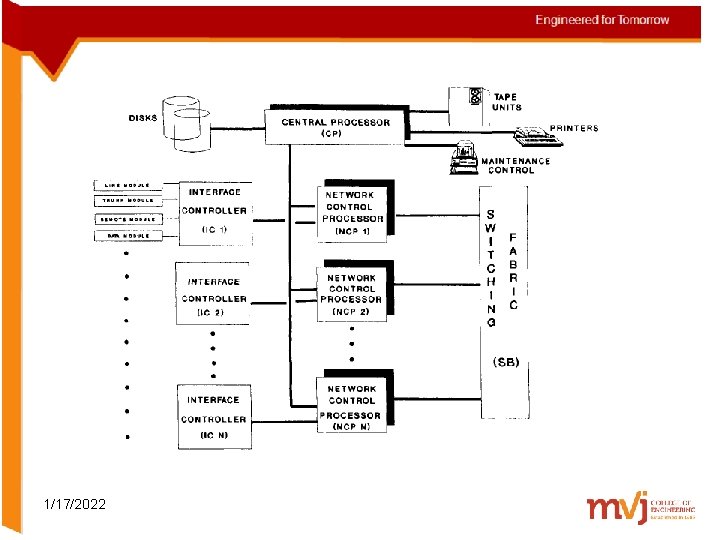
Hardware Architecture • This hypothetical digital switching system is based on a quasi-distributed control architecture. • It can be covered only in a technical specification of a product, and not in a textbook of this type. 1/17/2022
1/17/2022
• Central Processor • A typical digital switching system usually employs a central processor (CP) as the primary processor, and it is always duplicated. • Network Control Processors • The network control processors are the secondary processors. Usually, their purpose is to provide call processing functions and assist in setting up a path through the switching fabric. 1/17/2022
• Interface Controllers • Most digital switching systems employ a processorbased controller that acts as a concentrator of all incoming lines or trunks. These controllers use time multiplexed output to the NCPs and provide timeswitching (T switch) functions. • Interface Modules • Different types of modules are employed in a digital switching system. Most common are the line modules (LMs) and the trunk modules (TMs). Depending on the design objectives of a digital switching system, a line module may terminate a single line or scores of lines. 1/17/2022
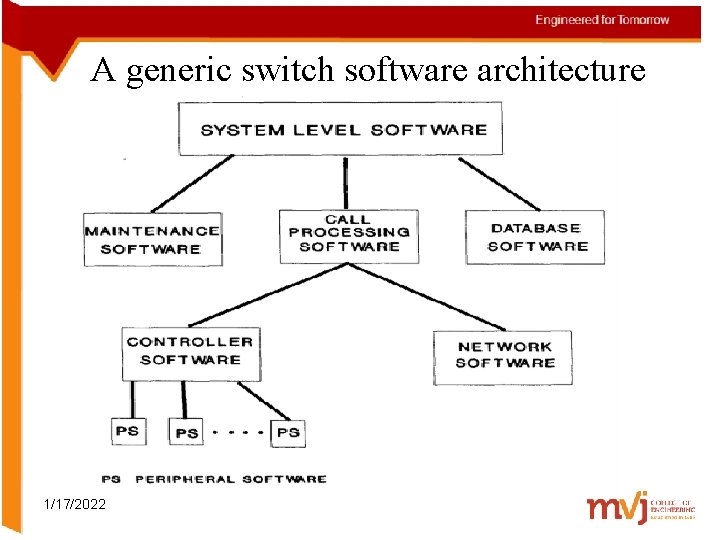
• System-Level Software • Most digital switching systems employ some system-level software. Software at this level is normally a multitasking operating system (OS) and is based on a duplex mainframe computer. The function of the OS is to control each application system (AS) deployed by the digital switching system. Basic software systems for a digital switch can be classified as • - Maintenance software • - Call processing software - Database software 1/17/2022
Call Processing Software • Based on the architecture of the digital switching system, the call processing program can be divided into three levels: • - High level includes call processing functions that require support from a central processing unit or a central database. • - Medium-level functions usually reside in the network processing units. Software supports routine call processing functions such as ' establishing a path through the switching fabric. 1/17/2022
A generic switch software architecture 1/17/2022
• Database Software • The contents of the database software can vary greatly between digital switching systems, and within a switching system product, a switch may be engineered to provide different functions. • Recovery Strategy • The following is a possible recovery strategy for the hypothetical digital switching system developed for this book. An effective recovery strategy for this digital switch could be based on a three-level scheme. 1/17/2022
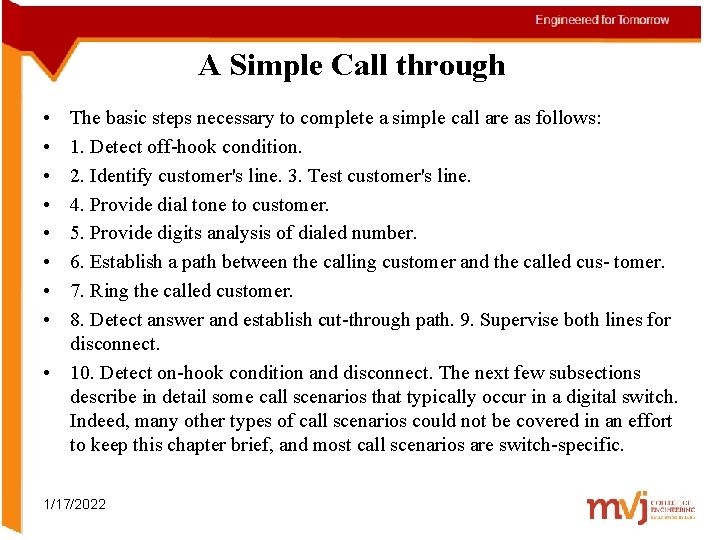
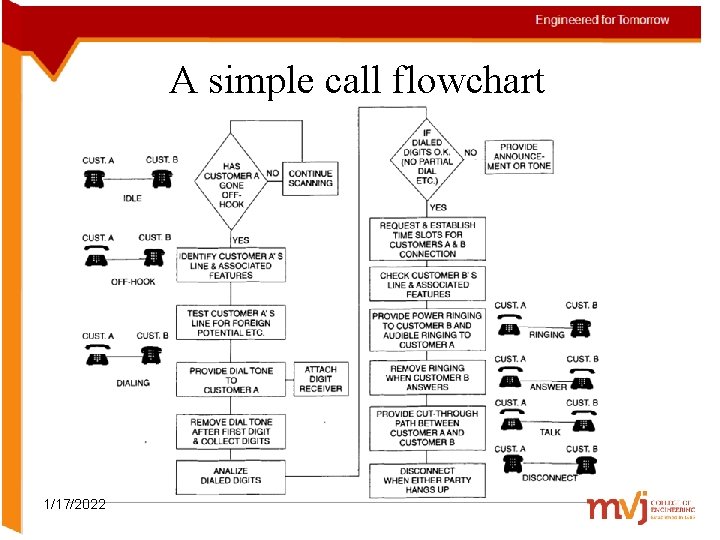
A Simple Call through • • The basic steps necessary to complete a simple call are as follows: 1. Detect off-hook condition. 2. Identify customer's line. 3. Test customer's line. 4. Provide dial tone to customer. 5. Provide digits analysis of dialed number. 6. Establish a path between the calling customer and the called cus- tomer. 7. Ring the called customer. 8. Detect answer and establish cut-through path. 9. Supervise both lines for disconnect. • 10. Detect on-hook condition and disconnect. The next few subsections describe in detail some call scenarios that typically occur in a digital switch. Indeed, many other types of call scenarios could not be covered in an effort to keep this chapter brief, and most call scenarios are switch-specific. 1/17/2022
A simple call flowchart 1/17/2022
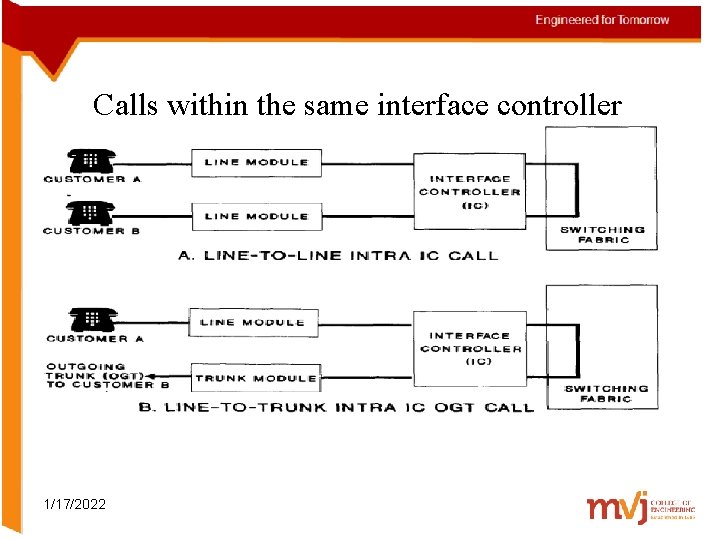
Calls within the same interface controller 1/17/2022
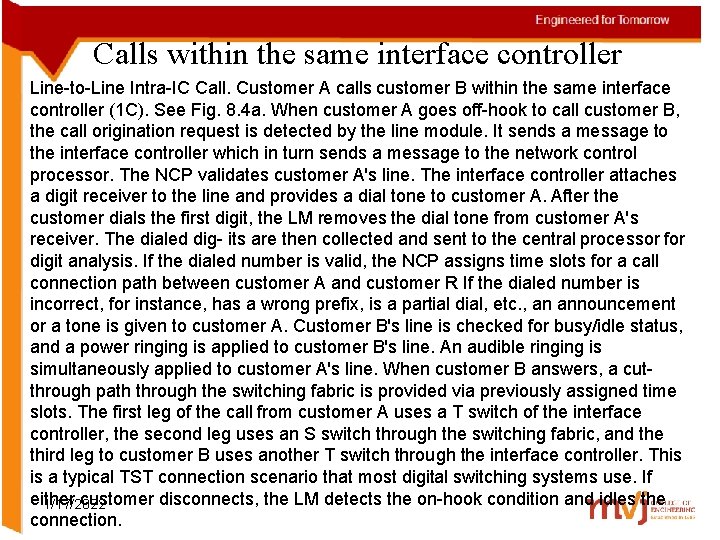
Calls within the same interface controller Line-to-Line Intra-IC Call. Customer A calls customer B within the same interface controller (1 C). See Fig. 8. 4 a. When customer A goes off-hook to call customer B, the call origination request is detected by the line module. It sends a message to the interface controller which in turn sends a message to the network control processor. The NCP validates customer A's line. The interface controller attaches a digit receiver to the line and provides a dial tone to customer A. After the customer dials the first digit, the LM removes the dial tone from customer A's receiver. The dialed dig- its are then collected and sent to the central processor for digit analysis. If the dialed number is valid, the NCP assigns time slots for a call connection path between customer A and customer R If the dialed number is incorrect, for instance, has a wrong prefix, is a partial dial, etc. , an announcement or a tone is given to customer A. Customer B's line is checked for busy/idle status, and a power ringing is applied to customer B's line. An audible ringing is simultaneously applied to customer A's line. When customer B answers, a cutthrough path through the switching fabric is provided via previously assigned time slots. The first leg of the call from customer A uses a T switch of the interface controller, the second leg uses an S switch through the switching fabric, and the third leg to customer B uses another T switch through the interface controller. This is a typical TST connection scenario that most digital switching systems use. If either customer disconnects, the LM detects the on-hook condition and idles the 1/17/2022 connection.
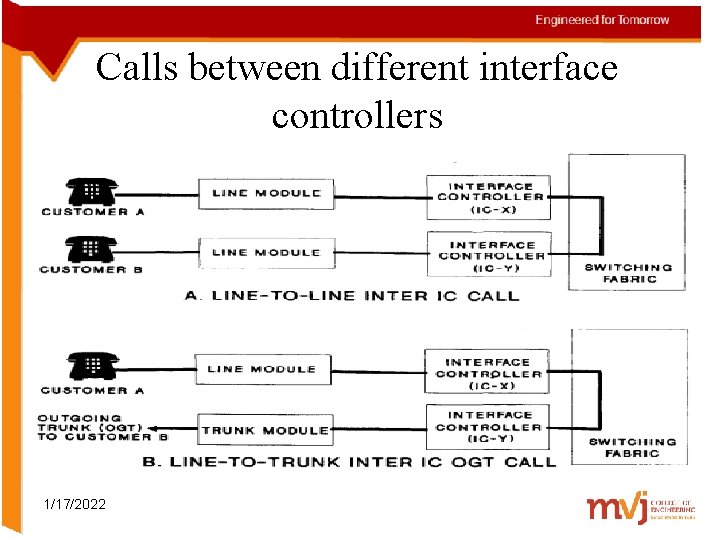
Calls between different interface controllers 1/17/2022
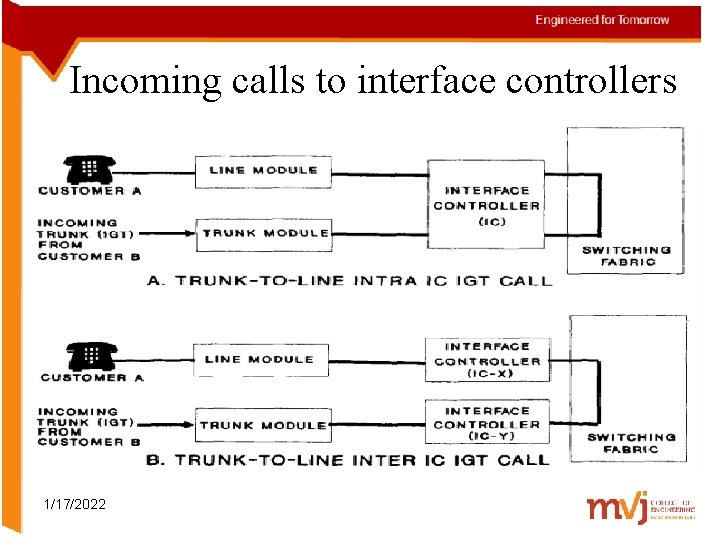
Incoming calls to interface controllers 1/17/2022
Incoming calls to interface controllers The CO for customer B homes into customer A's CO directly or through a tandem office. It connects to customer A's CO via an incoming trunk (IGT). If the trunk and customer A's line are in the same interface controller, a path is established through the switching fabric to the line module of customer A. The associated NCP performs all time-slot assignments for the IGT and customer A's line. Line A is validated, and its idle/busy status is checked. A power ringing to customer A's line is applied by the 1 C, and an audible ringing is simultaneously transmitted to customer B's line via the IGT When customer A answers, a cut through path through the switching fabric is provided via previously assigned time slots. As in line-to-line calls, each CO uses a TST connection. If either customer disconnects, the LM of either CO detects the on-hook condition and idles the connection. 1/17/2022