
UNIT 7 THE BODY I The human body
UNIT 7 THE BODY
I. The human body plan • Body Tissue – Collection of cells that work together to perform a particular function – 4 Main Types 1. Muscle 2. Nervous 3. Epithelial 4. Connective
1. Muscle Tissue • Cells that can contract – 3 types 1. Skeletal: moves bone *voluntary* 2. Smooth: uncontrolled movements *invol* • Ex: movement of food 3. Cardiac: heart muscle *invol*
2. Nervous Tissue • Cells receive and transmit messages • Makes up the brain, spinal cord, and nerves • Also in some sensory organs
3. Epithelial Tissue • Layer of cells that line or cover all internal and external body surface • Various thicknesses • Skin: layer of dead cells
4. Connective Tissue • Binds, supports, and protects structures in the body • Most abundant and diverse – Ex: bone, cartil. , tendons, fat, blood, lymph • Matrix: intercellular substance; solid, semisolid, liquid
II. Organs and Organ Systems • Body Cavities – Protect delicate internal organs from injury – 4 Main body Cavities 1. 2. 3. 4. Cranial: encases brain Spinal: surrounds spinal cord Thoracic: heart, esophagus, and respiratory organs Abdominal: digestive, reproduct, excretory organs • Diaphragm: muscle that separates thoracic and abdom
I. Skeletal System • About 206 bones • Axial Skeleton: skull, ribs, spine, sternum • Appendicular skeleton: arms, legs, scapula, clavicle, pelvis • Function 1. Rigid frame work 2. Store minerals for metabolic process 3. Produce RBC and some WBC
II. Bone Structure (206) • Makes up less than 20% of body mass • Moist living tissue 1. Periosteum: tough membrane, covers bones surface; contains vessels and nerves 2. Compact bone: hard material, thicker layer • Osteocytes: living bone cells – – Osteoblasts: bone forming Osteoclasts: bone destroying (Allow to Grow)
3. Spongy Bone: hard and strong • Bone marrow: – Red: produce RBC – Yellow: fat cells (nrg reserve); can be converted to RBC • Fracture: if circul is maintained and periosteum survives healing will occur
III. Joints • Where 2 bones meet • 3 types of joints 1. Fixed 2. Semimovable 3. Moveable (most)
1. Fixed • Prevents movement – In the skull
2. Semimovable • Limited movement – Vertebrae, ribs
3. Movable (most) • Hinge joint – Move forward and backward. Ex: elbow, knee • Ball-and-Socket – Move up, down, forward, backward, rotate in circle. Ex: shoulder • Pivot joint – Side to side, “yes, no” Ex: top 2 vert • Saddle Joint – Rotate and grasp Ex: ankle
III. Joints - continued • Joint Structure – Ligaments: holds bone to bone (LBB) – Synovial fluid: lubric substance helps protect the ends of the bones from damage by function – Arthritis: painful, swollen joints 1. Rheumatoid arthritis: immune syst attacks body 2. Osteoarthritis: degen joint disease
Bone Test • • • Phalanges Carpal Metacarpal Sternum Xiphoid process Costal Cartilage Calcaneus Talus Femur Tibia Fibula • • Radius Ulna Tarsals Patella Scapula Clavicle Humerus Metatarsal
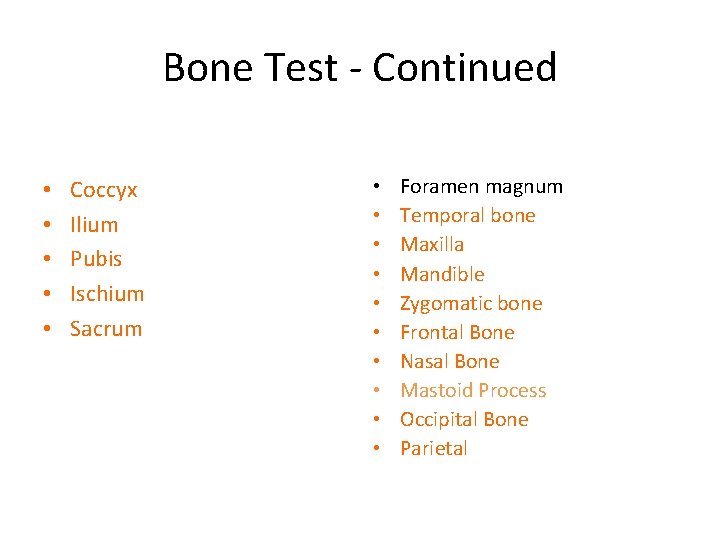
Bone Test - Continued • • • Coccyx Ilium Pubis Ischium Sacrum • • • Foramen magnum Temporal bone Maxilla Mandible Zygomatic bone Frontal Bone Nasal Bone Mastoid Process Occipital Bone Parietal
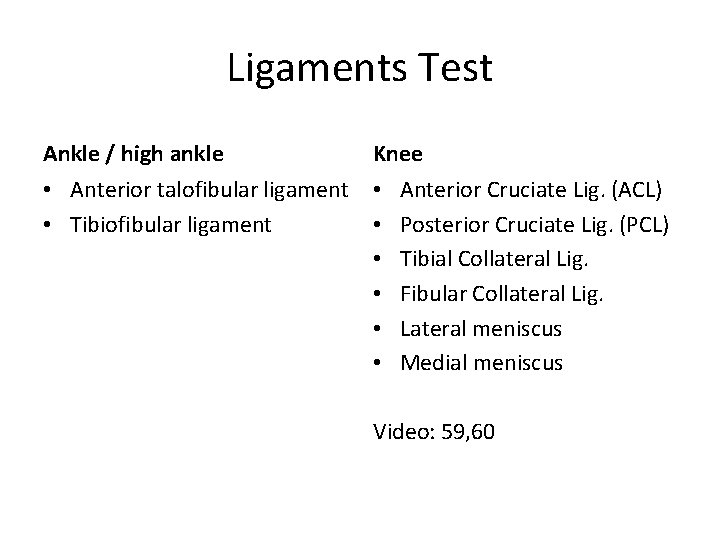
Ligaments Test Ankle / high ankle Knee • Anterior talofibular ligament • Anterior Cruciate Lig. (ACL) • Tibiofibular ligament • Posterior Cruciate Lig. (PCL) • Tibial Collateral Lig. • Fibular Collateral Lig. • Lateral meniscus • Medial meniscus Video: 59, 60
I. Muscular System • 1/3 of weight (33%)
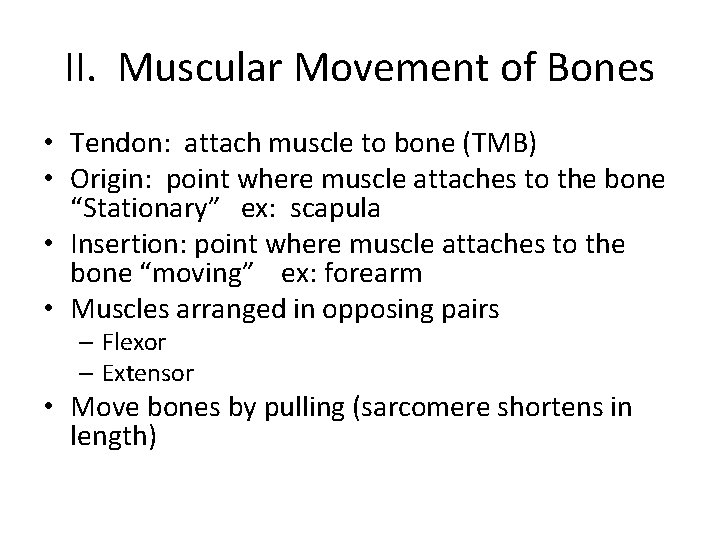
II. Muscular Movement of Bones • Tendon: attach muscle to bone (TMB) • Origin: point where muscle attaches to the bone “Stationary” ex: scapula • Insertion: point where muscle attaches to the bone “moving” ex: forearm • Muscles arranged in opposing pairs – Flexor – Extensor • Move bones by pulling (sarcomere shortens in length)
III. Muscular Fatigue • Physiological inability of a muscle to contract • Nrg – Glucose, glycogen, fat • Fatigue 1. Glycogen is converted into lactic acid 2. As the acid accumulates p. H lowers 3. Muscle loses ability to contract
Muscle TEST • • • Trapezius Gastrocnemius Gluteus Maximus Latissimus dorsi Deltoid Biceps brachii Triceps brachii Pectoralis major Rhomboid Iliacus Internal Intercostals • • • Rectus abdominis External oblique Diaphragm Sternocleidomastoid Sartorius Biceps femoris Soleus Rectus femoris Masseter
I. Integumentary System • Skin, hair, nails 1. Retain body fluids 2. Protect against disease 3. Eliminate waste 4. Regulate body temp
A. Skin • One of the largest organs • 2 layers 1. Epidermis 2. Dermis
1. Epidermis • Outer layer of skin • Mostly dead cells • Keratin: protein, gives skin rough, leathery, waterproof quality • Melanin: brown pigment – Absorbs harmful UV radiation – Amounts depend on 2 factors (heredity, UV exposure) – Increase is a response to injury by UV – UV can damage DNA and lead to skin cancer
2. Dermis • Inner layer of skin • Living cells and specialized structures 1. Sensory neurons 2. Blood vessels 3. Muscle fibers - - “Goose bumps” • • Hair rise to look bigger Increase amount of air between hairs to increase body temp
4. Glands • Sweat: cool body • Oil: soften skin, water proofing 5. Fat (right below dermis) • Nrg reserve • Protective layer • insulation
3. Nails and Hair • Nails – Composed mostly of keratin – 1 mm / wk – Shape, structure, and appearance may be an indicator of disease or poisoning – http: //www. mayoclinic. org/healthy-lifestyle/adult -health/multimedia/nails/sls-20076131? s=1 – http: //mentalfloss. com/article/23174/5 -classicpoisons-and-people-who-used-them
• Hair – Protect and insulates body – Produced by Hair follicles – Dead keratin filled cells – Oil is secreted to keep hair from drying out – Hair color: melanin “hereditary”
4. Glands • Sweat: cooling system by evapor • Oil: – Sebum: prevents water loss, moistens skin and hair, mildly toxic to bacteria
- Slides: 30