
Unit 7 Soil Factor and Biogeochemical Cycle Topic
Unit 7: Soil Factor and Biogeochemical Cycle Topic: Major Vegetation of Pakistan B. Ed (Hons) Secondary Semester: III Subject: Biology III Minor Course Title: Plant Physiology and Ecology Represented By: Ms Sidra Younis Department of Education (Planning and Development) Lahore College For Women University, Lahore
VEGETATION • It refers to the ground cover provided by plants. 1. Natural vegetation: • Refers to a plant community which has grown naturally without human aid. 2 - Local vegetation: • Assemblages of plant species and the ground cover they provide
TROPICAL VEGETATION: • Tropical vegetation is any vegetation in tropical latitudes. • Plant life that occurs in climates that are warm year-round is in general more biologically diverse that in other latitudes. • Some tropical areas may receive abundant rain the whole year round, but others have long dry seasons • These seasonal droughts have great impact on the vegetation.
DRY TROPICAL FOREST VEGETATION: Climate • Temperatures are high 2 Soils: • Soils are essentially like those of tropical rain forests, with the same processes. 3 Vegetation: • The deciduousness of most tree species. • Tree canopy is lower (10 -30 m). • The trees less dense where drought is more extreme. • The trees have thicker, more ridged, bark; deeper roots. 1 -

4 - Plant Adaptations: • Trees have thicker bark (antifire adaptation), • Thicker and smaller leaves (antidesiccation adaptation), • Thorns (antiherbivore adaptation), • Longer roots (to reach deeper water table), Dry tropical forest:

TROPICAL DRY DECIDUOUS FORESTS: • Forests of low or moderate height consisting almost entirely of deciduous species. • Their canopy is typically light though it may appear fairly dense and complete during the short rainy season • Not occur extensively in Pakistan but there are limited areas in the Rawalpindi foothills carrying this vegetation type.
TROPICAL THORN FORESTS: • A thorny forest is a dense, scrub-like vegetation characteristic of dry subtropical and warm temperate areas with a seasonal rainfall averaging 250 to 500 mm. • This vegetation covers a large part of: • Southwestern North America • and southwestern Africa • And smaller areas in Africa, South America, and Australia.
VEGETATION IN THORN FOREST: • The major tree species are: • Prosopis cineraria (Jhand), • Capparis decidua (Karir, Karil), • Zizyphus mauritiana (Ber), • Tamarix aphylla (Farash) and Salvadora oleoides (Pilu, wan) • A characteristic pioneer vegetation is developed on inland sand dunes and the semi-deserts of the areas of least rainfall.
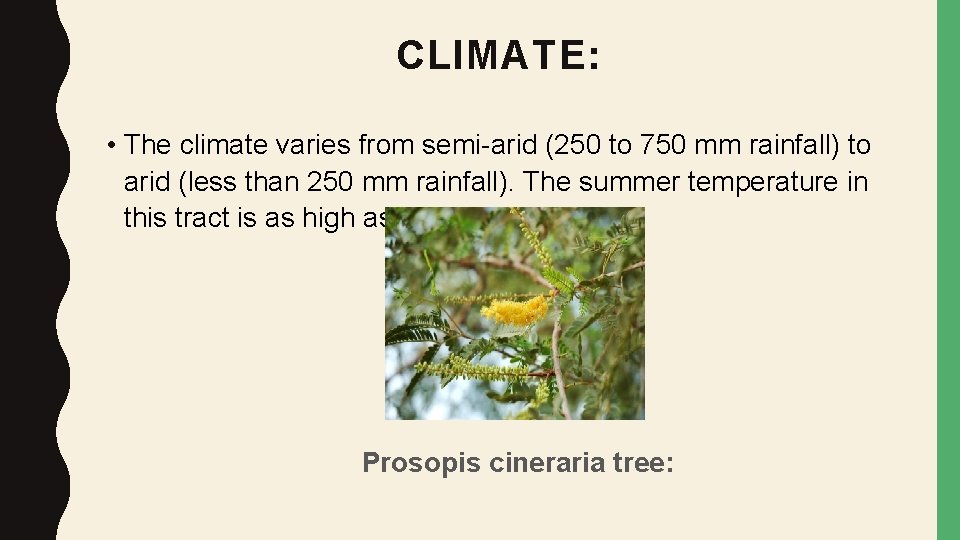
CLIMATE: • The climate varies from semi-arid (250 to 750 mm rainfall) to arid (less than 250 mm rainfall). The summer temperature in this tract is as high as 50°C. Prosopis cineraria tree:
MOIST TEMPERATE FORESTS Ø Distinct sub-type of forests. North American coniferous ØAlso called temperate rain forests. ØTemperature, humidity and often moist conditions encourage the development of mossy, moisture loving plants layer under the giant trees of coast redwood, western red cedar.
HIMALAYAN MOIST TEMPERATE FORESTS : ØDevelop in the areas of lesser rain fall, up to 45 meters tall. ØDominant element of vegetation are oak and conifers, under growth is shrubby. ØEver green forests of conifers fall in this category, under growth is rarely dense consist of both ever green and deciduous species. ØThese forest occur between 1500 m and 3000 m elevation in the western himalayas except where the rainfall below 1000 mm. ØDivided in 2 zones upper zone and lower zone in which definite species of oak and conifers dominate
HIMALAYAN DRY TEMPERATE FORESTS: ØPredominantly coniferous forest shrubs. with xerophytic ØThese forest found in dry ranges of Himalayas where precipitation is below 100 cm. ØThese forests found at the altitude of 4000 m in the western Himalayas. 3000 m to ØCommonly found species belong to indigofera, cannabis, several epiphytic mosses, lichens etc.
SUB-ALPINE VEGETATION: ØSubalpine zone is the biotic zone below the tree line. ØSpecies in this zone depend on the location of the zone on earth. Meadows are present. ØConditions favorable for subalpine vegetation are heavy snow, high humidity of soil and air, summer precipitation and good surface drainage. ØIt depends on the geographical location of the mountains. ØThe destruction of forest artificially lowers the boundary of subalpine vegetation and changes its composition.
SUB-TROPICAL VEGETATION: ØNatural vegetation ØSubtropical areas are mainly evergreen trees, bushes, and shrubs ØHardy evergreen trees like pine and spruce ØThese evergreens are more delicate ØPlants here are evergreens is because of the long months of warmth and regular rain
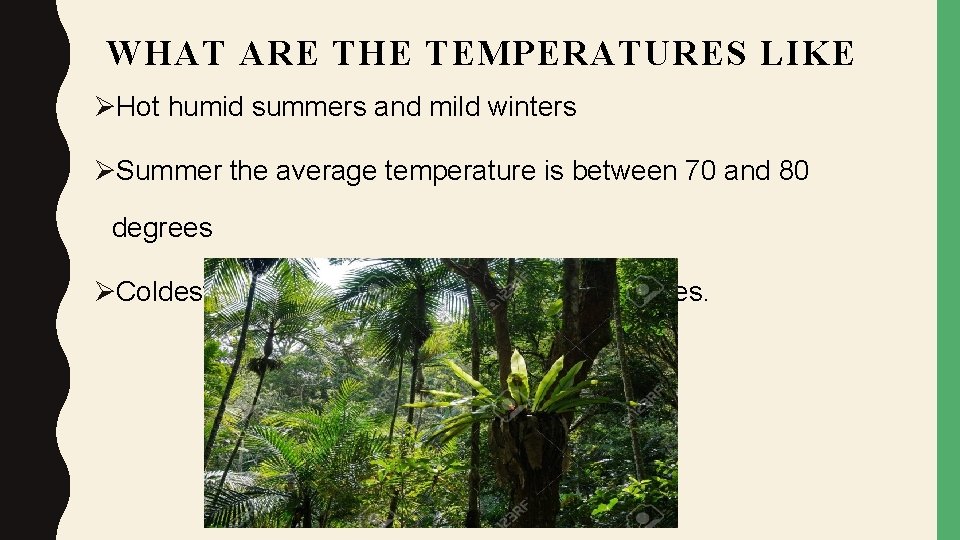
WHAT ARE THE TEMPERATURES LIKE ØHot humid summers and mild winters ØSummer the average temperature is between 70 and 80 degrees ØColdest month usually averages 45 -50 degrees.
DRY SUB-TROPICAL SUB-MOUNTAINOUS VEGETATION ØVegetation includes trees and shrubs ØTrees may show solid growth and shrubs are sharp ØAverage rain fall in this region is 10 – 36 inches ØHumidity is low annual mean humidity is 50% ØTemperature rises to 40°C in summer ØArea includes Siwalik Hills and Baluchistan Plateau
SUB-TROPICAL BROAD LEAVED EVERGREEN FOREST ØBroad-leaved evergreen forest ØBroad-leaved forests occur in the formation types Ø(a)Broad-leaved evergreen Ø(b)Broad-leaved deciduous ØThis forest type requires plentiful, well-distributed rainfall
SUB-TROPICAL PINE FOREST ØTropical pine forests are confined to Nepal, Bhutan, states of Jammu and Kashmir ØPine forests are mainly classified into types ØLower Siwalik Chir Pine Forest and Upper (Himalayan) Chir pine forest ØThe variety of life forms i. e. Flora and fauna
TEMPERATURE-VEGETATION ØTemperature is one of the three major influences on global patterns of plant growth ØWith available sunlight and water ØTemperature determines wheather ØWhere vegetation is dense, the land surface temperature never rises above 35 degrees Celsius
DRY TEMPERATE FORESTS ØUnfavorable climate ØHave less number of plants ØThis area has bare soil ØPlants are mostly Xerophytic ØRegion includes Suleiman Range, Karakoram Range ØThis region has long cold winter, Temperature becomes lower than zero ØSome of these areas are covered by snow
- Slides: 20