
UNIT 7 REAL WORLD STOICHIOMETRY SCENARIO RUBRIC In
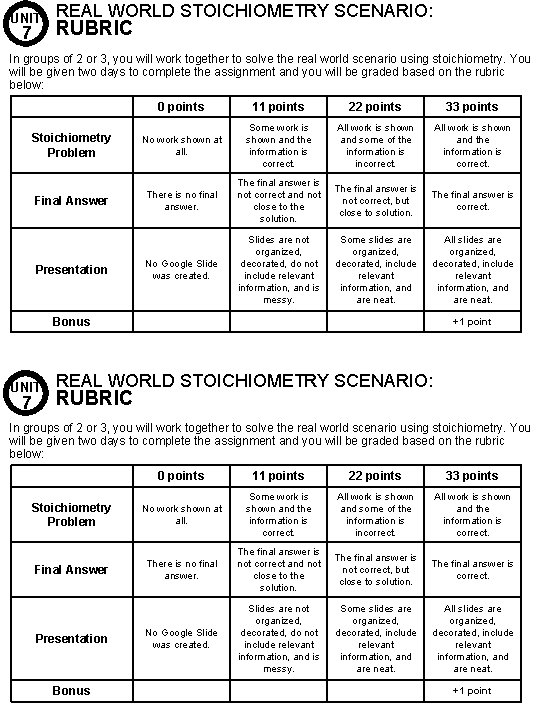
UNIT 7 REAL WORLD STOICHIOMETRY SCENARIO: RUBRIC In groups of 2 or 3, you will work together to solve the real world scenario using stoichiometry. You will be given two days to complete the assignment and you will be graded based on the rubric below: 0 points 11 points 22 points 33 points Stoichiometry Problem No work shown at all. Some work is shown and the information is correct. All work is shown and some of the information is incorrect. All work is shown and the information is correct. Final Answer There is no final answer. The final answer is not correct and not close to the solution. The final answer is not correct, but close to solution. The final answer is correct. No Google Slide was created. Slides are not organized, decorated, do not include relevant information, and is messy. Some slides are organized, decorated, include relevant information, and are neat. All slides are organized, decorated, include relevant information, and are neat. Presentation Bonus UNIT 7 +1 point REAL WORLD STOICHIOMETRY SCENARIO: RUBRIC In groups of 2 or 3, you will work together to solve the real world scenario using stoichiometry. You will be given two days to complete the assignment and you will be graded based on the rubric below: 0 points 11 points 22 points 33 points Stoichiometry Problem No work shown at all. Some work is shown and the information is correct. All work is shown and some of the information is incorrect. All work is shown and the information is correct. Final Answer There is no final answer. The final answer is not correct and not close to the solution. The final answer is not correct, but close to solution. The final answer is correct. No Google Slide was created. Slides are not organized, decorated, do not include relevant information, and is messy. Some slides are organized, decorated, include relevant information, and are neat. All slides are organized, decorated, include relevant information, and are neat. Presentation Bonus +1 point
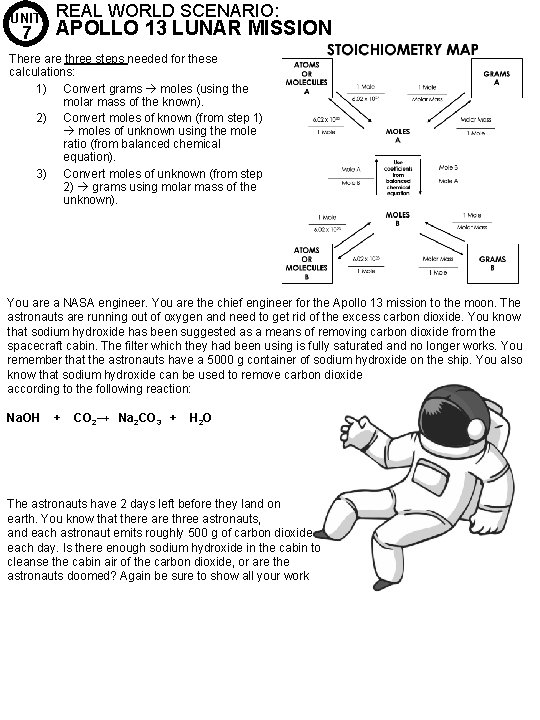
UNIT 7 REAL WORLD SCENARIO: APOLLO 13 LUNAR MISSION There are three steps needed for these calculations: 1) Convert grams moles (using the molar mass of the known). 2) Convert moles of known (from step 1) moles of unknown using the mole ratio (from balanced chemical equation). 3) Convert moles of unknown (from step 2) grams using molar mass of the unknown). You are a NASA engineer. You are the chief engineer for the Apollo 13 mission to the moon. The astronauts are running out of oxygen and need to get rid of the excess carbon dioxide. You know that sodium hydroxide has been suggested as a means of removing carbon dioxide from the spacecraft cabin. The filter which they had been using is fully saturated and no longer works. You remember that the astronauts have a 5000 g container of sodium hydroxide on the ship. You also know that sodium hydroxide can be used to remove carbon dioxide according to the following reaction: Na. OH + CO 2→ Na 2 CO 3 + H 2 O The astronauts have 2 days left before they land on earth. You know that there are three astronauts, and each astronaut emits roughly 500 g of carbon dioxide each day. Is there enough sodium hydroxide in the cabin to cleanse the cabin air of the carbon dioxide, or are the astronauts doomed? Again be sure to show all your work
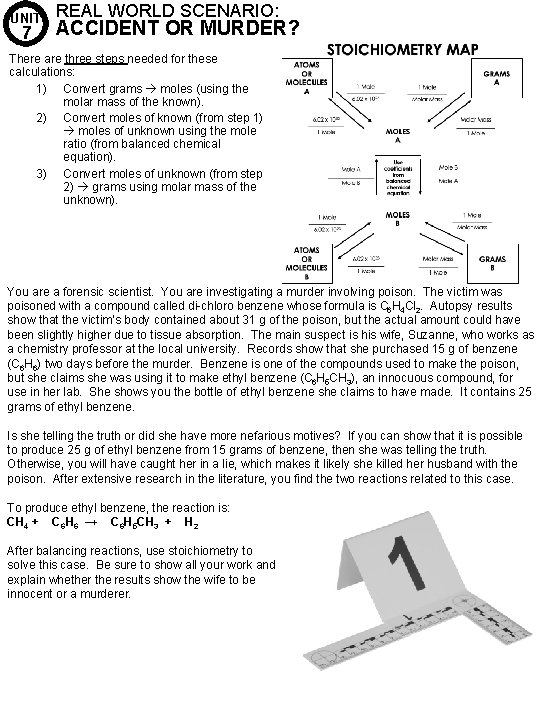
UNIT 7 REAL WORLD SCENARIO: ACCIDENT OR MURDER? There are three steps needed for these calculations: 1) Convert grams moles (using the molar mass of the known). 2) Convert moles of known (from step 1) moles of unknown using the mole ratio (from balanced chemical equation). 3) Convert moles of unknown (from step 2) grams using molar mass of the unknown). You are a forensic scientist. You are investigating a murder involving poison. The victim was poisoned with a compound called di-chloro benzene whose formula is C 6 H 4 Cl 2. Autopsy results show that the victim’s body contained about 31 g of the poison, but the actual amount could have been slightly higher due to tissue absorption. The main suspect is his wife, Suzanne, who works as a chemistry professor at the local university. Records show that she purchased 15 g of benzene (C 6 H 6) two days before the murder. Benzene is one of the compounds used to make the poison, but she claims she was using it to make ethyl benzene (C 6 H 5 CH 3), an innocuous compound, for use in her lab. She shows you the bottle of ethyl benzene she claims to have made. It contains 25 grams of ethyl benzene. Is she telling the truth or did she have more nefarious motives? If you can show that it is possible to produce 25 g of ethyl benzene from 15 grams of benzene, then she was telling the truth. Otherwise, you will have caught her in a lie, which makes it likely she killed her husband with the poison. After extensive research in the literature, you find the two reactions related to this case. To produce ethyl benzene, the reaction is: CH 4 + C 6 H 6 → C 6 H 5 CH 3 + H 2 After balancing reactions, use stoichiometry to solve this case. Be sure to show all your work and explain whether the results show the wife to be innocent or a murderer.
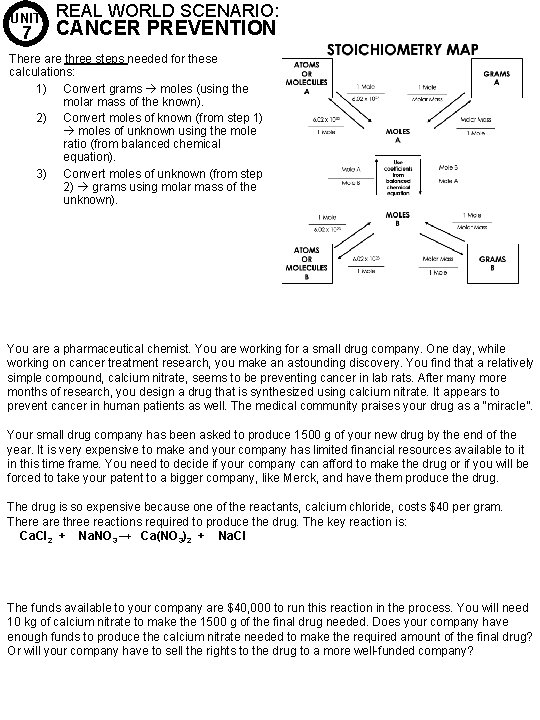
UNIT 7 REAL WORLD SCENARIO: CANCER PREVENTION There are three steps needed for these calculations: 1) Convert grams moles (using the molar mass of the known). 2) Convert moles of known (from step 1) moles of unknown using the mole ratio (from balanced chemical equation). 3) Convert moles of unknown (from step 2) grams using molar mass of the unknown). You are a pharmaceutical chemist. You are working for a small drug company. One day, while working on cancer treatment research, you make an astounding discovery. You find that a relatively simple compound, calcium nitrate, seems to be preventing cancer in lab rats. After many more months of research, you design a drug that is synthesized using calcium nitrate. It appears to prevent cancer in human patients as well. The medical community praises your drug as a “miracle”. Your small drug company has been asked to produce 1500 g of your new drug by the end of the year. It is very expensive to make and your company has limited financial resources available to it in this time frame. You need to decide if your company can afford to make the drug or if you will be forced to take your patent to a bigger company, like Merck, and have them produce the drug. The drug is so expensive because one of the reactants, calcium chloride, costs $40 per gram. There are three reactions required to produce the drug. The key reaction is: Ca. Cl 2 + Na. NO 3 → Ca(NO 3)2 + Na. Cl The funds available to your company are $40, 000 to run this reaction in the process. You will need 10 kg of calcium nitrate to make the 1500 g of the final drug needed. Does your company have enough funds to produce the calcium nitrate needed to make the required amount of the final drug? Or will your company have to sell the rights to the drug to a more well-funded company?
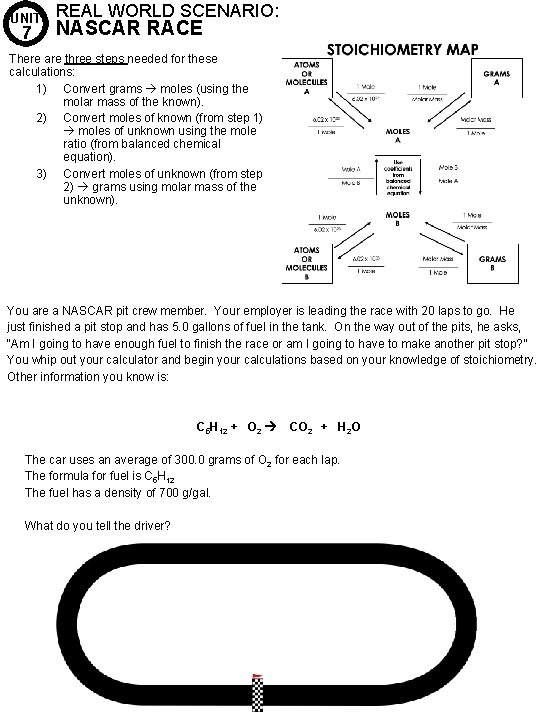
UNIT 7 REAL WORLD SCENARIO: NASCAR RACE There are three steps needed for these calculations: 1) Convert grams moles (using the molar mass of the known). 2) Convert moles of known (from step 1) moles of unknown using the mole ratio (from balanced chemical equation). 3) Convert moles of unknown (from step 2) grams using molar mass of the unknown). You are a NASCAR pit crew member. Your employer is leading the race with 20 laps to go. He just finished a pit stop and has 5. 0 gallons of fuel in the tank. On the way out of the pits, he asks, “Am I going to have enough fuel to finish the race or am I going to have to make another pit stop? ” You whip out your calculator and begin your calculations based on your knowledge of stoichiometry. Other information you know is: C 5 H 12 + O 2 CO 2 + H 2 O The car uses an average of 300. 0 grams of O 2 for each lap. The formula for fuel is C 5 H 12 The fuel has a density of 700 g/gal. What do you tell the driver?
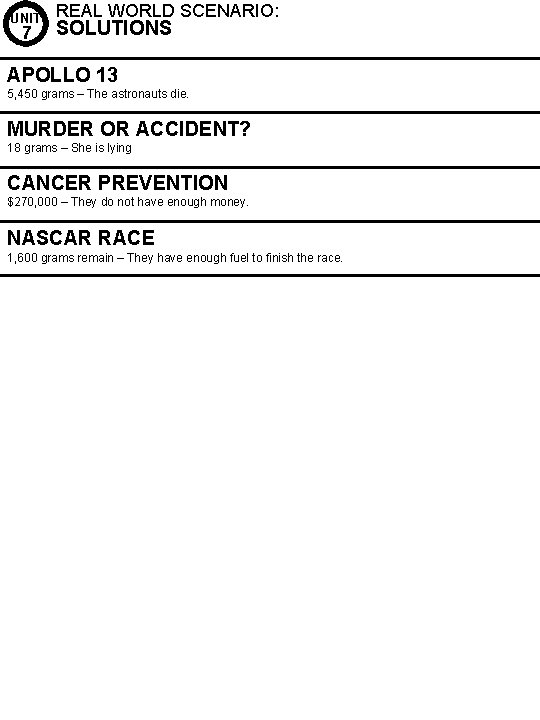
UNIT 7 REAL WORLD SCENARIO: SOLUTIONS APOLLO 13 5, 450 grams – The astronauts die. MURDER OR ACCIDENT? 18 grams – She is lying CANCER PREVENTION $270, 000 – They do not have enough money. NASCAR RACE 1, 600 grams remain – They have enough fuel to finish the race.
- Slides: 6