
UNIT 7 Reactions and Stoichiometry Symbols relative atomic
UNIT 7 Reactions and Stoichiometry
Symbols, relative atomic mass and the periodic table • Each element has a symbol, an atomic number and an atomic mass number listed on the periodic table. • Some elements have a symbol made up of one letter, others have two. • It is important when writing the two letter symbols to ensure that you use a lower case letter for the second letter. • This may sound trivial but is very important, for example Co (Cobalt), a metal element, is not the same as CO (Carbon monoxide), a gaseous compound made from Carbon (C) and Oxygen (O).
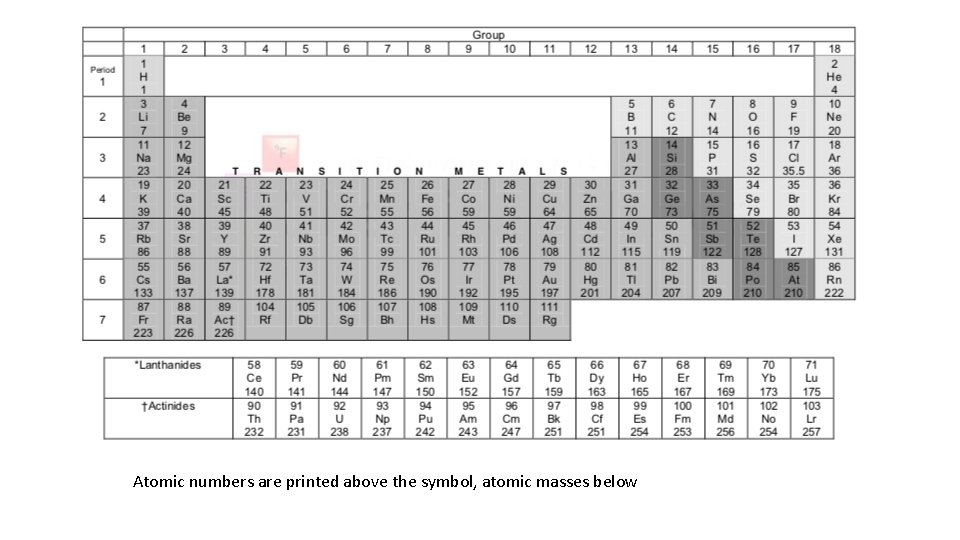
Atomic numbers are printed above the symbol, atomic masses below

Formula of compounds • The chemical formula of a compound shows the exact ratio of the different elements that are present. • The numbers of each element are recorded using a subscript to the right of the elements symbol. • When only one atom is present, the subscript one is assumed (understood), and not written.
Percentage composition in chemical formula • To determine the % composition of an individual element within a compound, simply express the mass of each element as a % of the mass of the compound.

Empirical formula • The empirical formula is the simplest whole number ratio of the atoms of each element in that compound and can be calculated from mass data. • There is a simple method to follow 1. Take the percentage of each element present, assume a sample of 100 g, and divide that mass by the appropriate mass number. (This gives the number of moles - see later). 2. Find the smallest number calculated in�� and divide all the results of the calculations in 1 by that number. (This gives the molar ratio). N. B. Avoid rounding up or down too much at this stage and be lenient with significant figures. 3. The results from 2 should be in a convenient ratio and give the empirical formula. N. B. It may be that the ratio includes a decimal (fraction) such as. 500, . 250 or. 333 etc. If so then multiply all numbers by 2, 4 or 3 as appropriate to remove the decimal
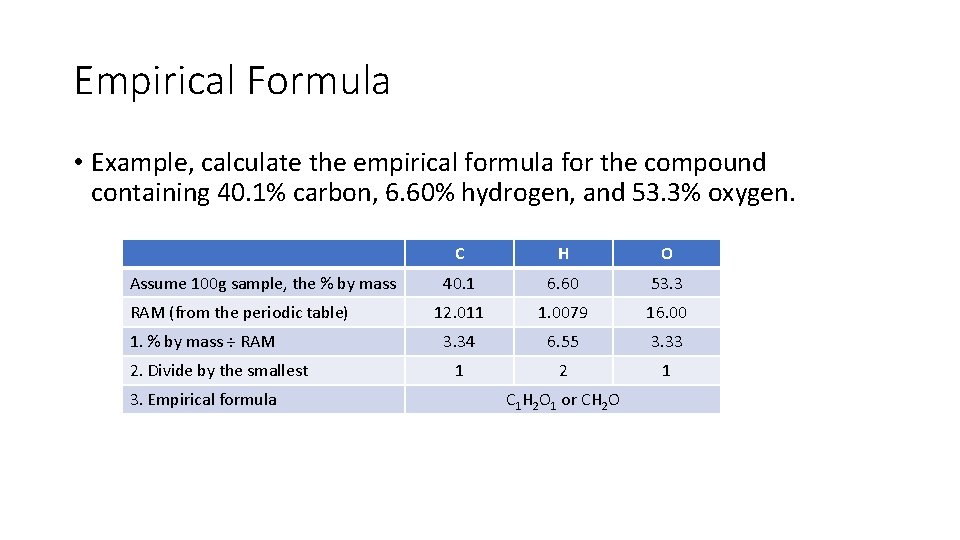
Empirical Formula • Example, calculate the empirical formula for the compound containing 40. 1% carbon, 6. 60% hydrogen, and 53. 3% oxygen. Assume 100 g sample, the % by mass RAM (from the periodic table) 1. % by mass ÷ RAM 2. Divide by the smallest 3. Empirical formula C H O 40. 1 6. 60 53. 3 12. 011 1. 0079 16. 00 3. 34 6. 55 3. 33 1 2 1 C 1 H 2 O 1 or CH 2 O
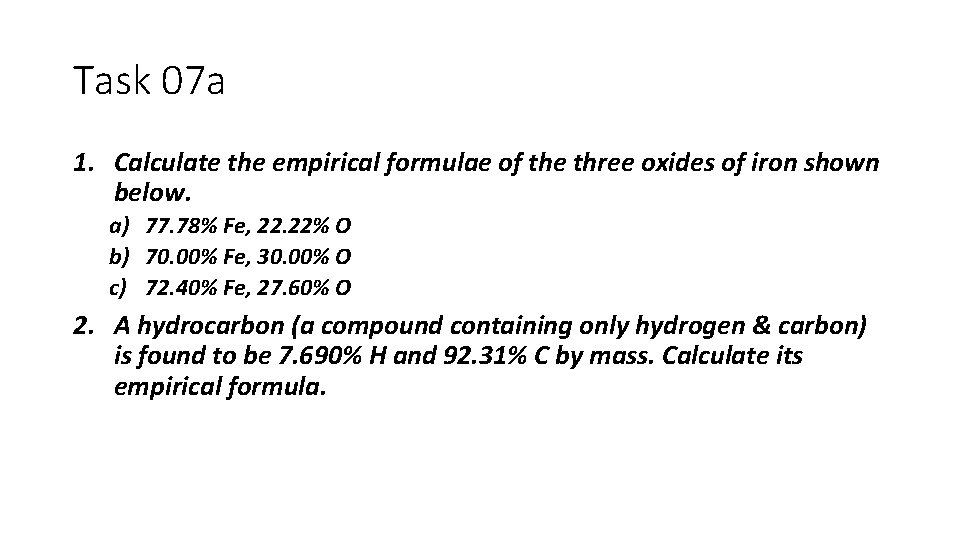
Task 07 a 1. Calculate the empirical formulae of the three oxides of iron shown below. a) 77. 78% Fe, 22. 22% O b) 70. 00% Fe, 30. 00% O c) 72. 40% Fe, 27. 60% O 2. A hydrocarbon (a compound containing only hydrogen & carbon) is found to be 7. 690% H and 92. 31% C by mass. Calculate its empirical formula.
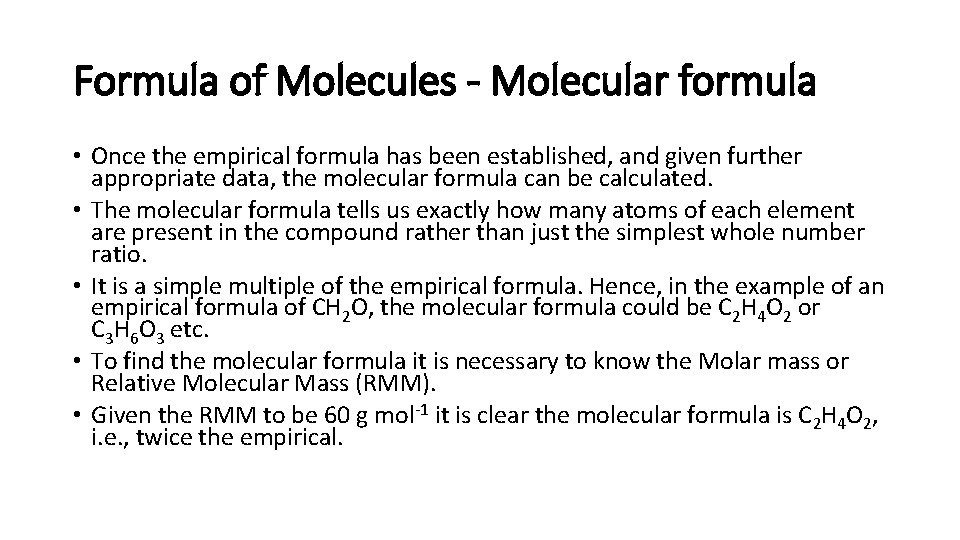
Formula of Molecules - Molecular formula • Once the empirical formula has been established, and given further appropriate data, the molecular formula can be calculated. • The molecular formula tells us exactly how many atoms of each element are present in the compound rather than just the simplest whole number ratio. • It is a simple multiple of the empirical formula. Hence, in the example of an empirical formula of CH 2 O, the molecular formula could be C 2 H 4 O 2 or C 3 H 6 O 3 etc. • To find the molecular formula it is necessary to know the Molar mass or Relative Molecular Mass (RMM). • Given the RMM to be 60 g mol-1 it is clear the molecular formula is C 2 H 4 O 2, i. e. , twice the empirical.
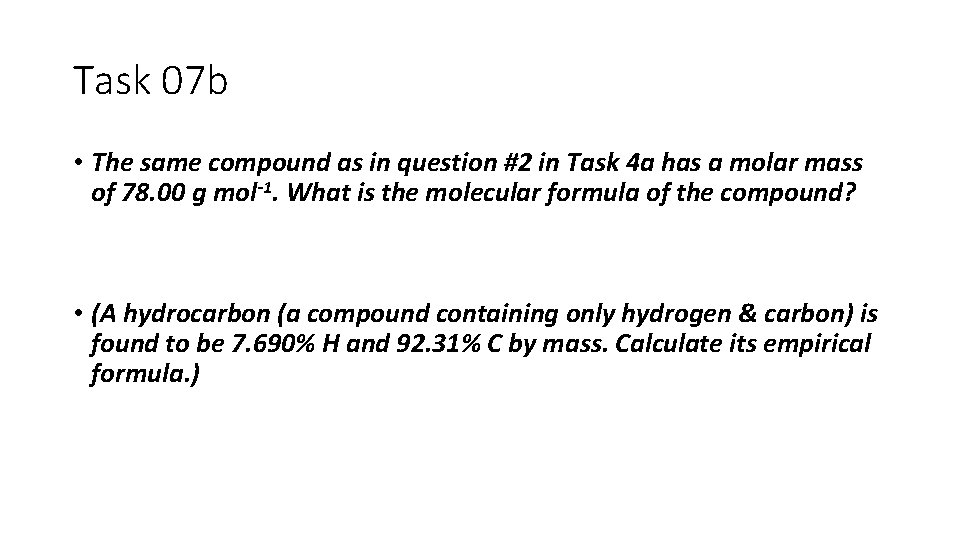
Task 07 b • The same compound as in question #2 in Task 4 a has a molar mass of 78. 00 g mol-1. What is the molecular formula of the compound? • (A hydrocarbon (a compound containing only hydrogen & carbon) is found to be 7. 690% H and 92. 31% C by mass. Calculate its empirical formula. )
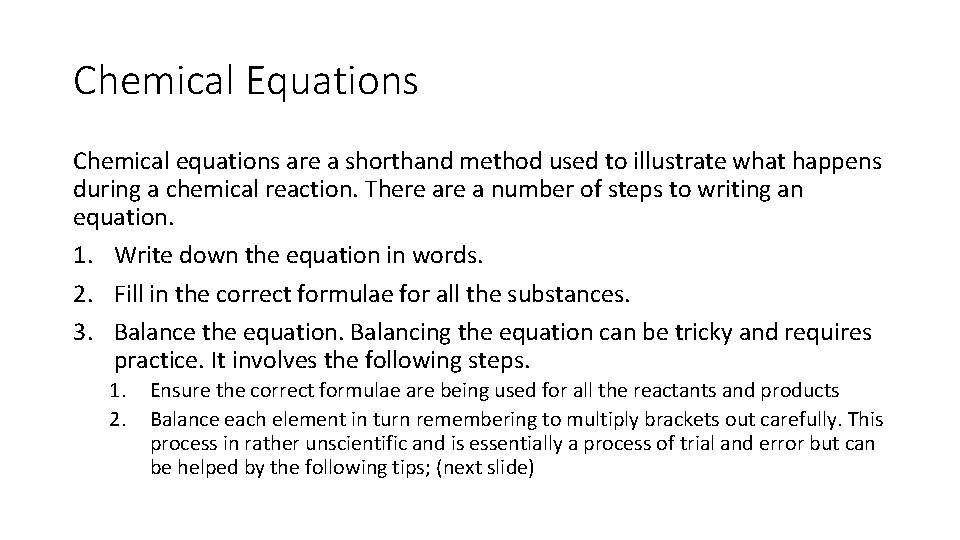
Chemical Equations Chemical equations are a shorthand method used to illustrate what happens during a chemical reaction. There a number of steps to writing an equation. 1. Write down the equation in words. 2. Fill in the correct formulae for all the substances. 3. Balance the equation. Balancing the equation can be tricky and requires practice. It involves the following steps. 1. 2. Ensure the correct formulae are being used for all the reactants and products Balance each element in turn remembering to multiply brackets out carefully. This process in rather unscientific and is essentially a process of trial and error but can be helped by the following tips; (next slide)

Chemical Equations First, If an element appears in only one compound on each side of the equation, try balancing that first. Second if one of the reactants or products appears as the free element, try balancing that last. 3. When balancing, only place numbers in front of whole formulae. Do not change the (correct) formulae of any of the reactants or products, or add any extra formulae. The numbers that appear in front of each formula are called the stoichiometric coefficients. They have an extremely important role to play in calculations since they give the reacting ratio (i. e. the number of moles of one substance that react with, or are produced from, others). 4. Add state symbols, (s) for solid, (l) for liquid, (g) for gas, and (aq) for aqueous (meaning in solution with water)

Task 07 c 1. Write balanced equations for the following reactions. a) Hydrogen + copper (II) oxide → copper + water b) Carbon + oxygen → carbon monoxide c) Magnesium + sulfuric acid → hydrogen + magnesium sulfate
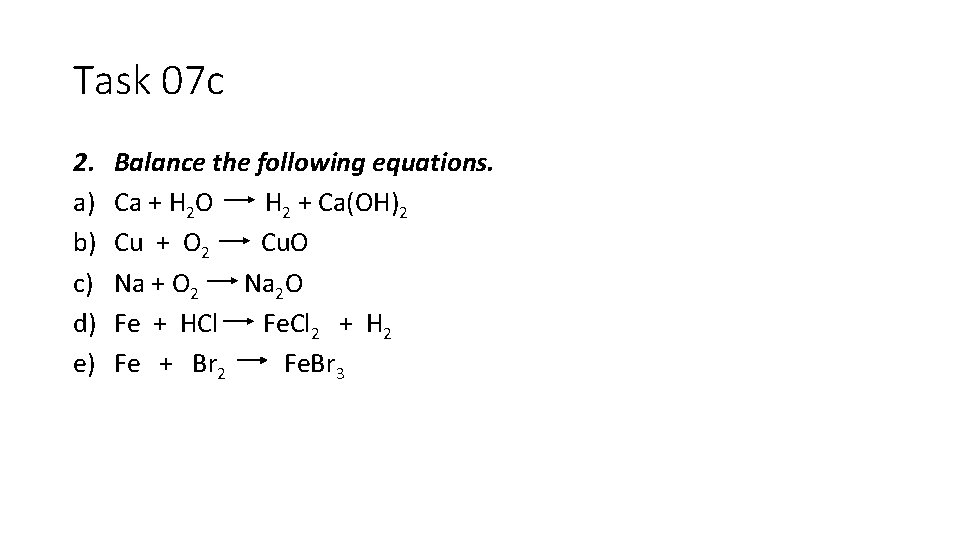
Task 07 c 2. a) b) c) d) e) Balance the following equations. Ca + H 2 O H 2 + Ca(OH)2 Cu + O 2 Cu. O Na + O 2 Na 2 O Fe + HCl Fe. Cl 2 + H 2 Fe + Br 2 Fe. Br 3
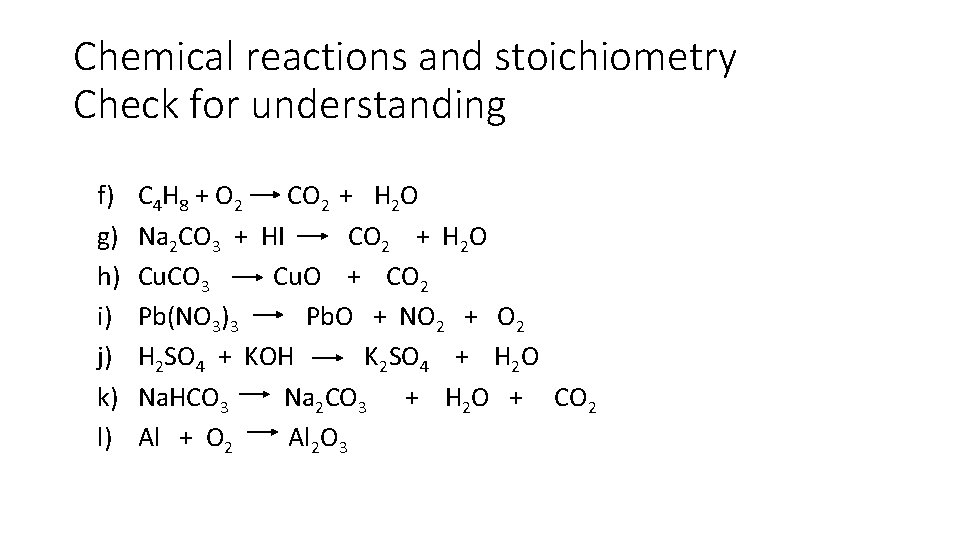
Chemical reactions and stoichiometry Check for understanding f) g) h) i) j) k) l) C 4 H 8 + O 2 CO 2 + H 2 O Na 2 CO 3 + HI CO 2 + H 2 O Cu. CO 3 Cu. O + CO 2 Pb(NO 3)3 Pb. O + NO 2 + O 2 H 2 SO 4 + KOH K 2 SO 4 + H 2 O Na. HCO 3 Na 2 CO 3 + H 2 O + CO 2 Al + O 2 Al 2 O 3
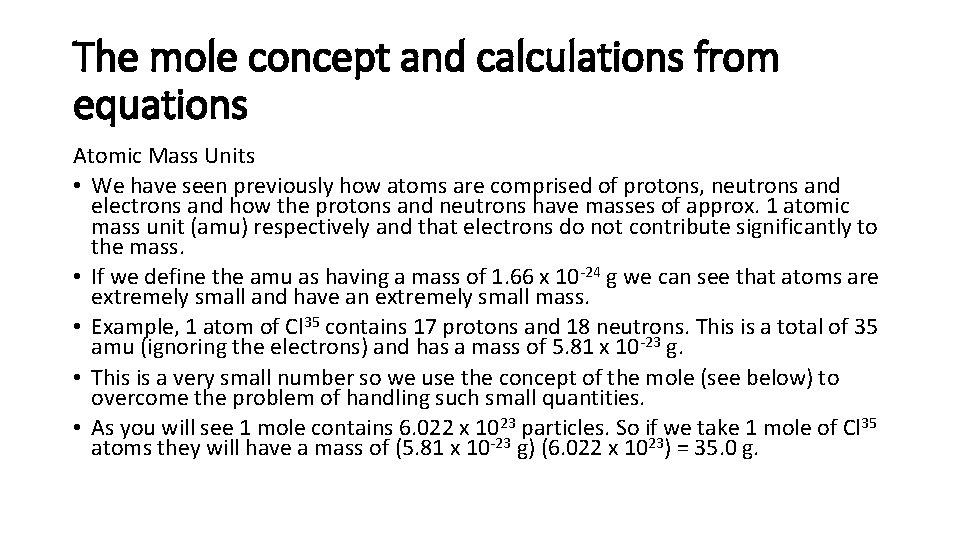
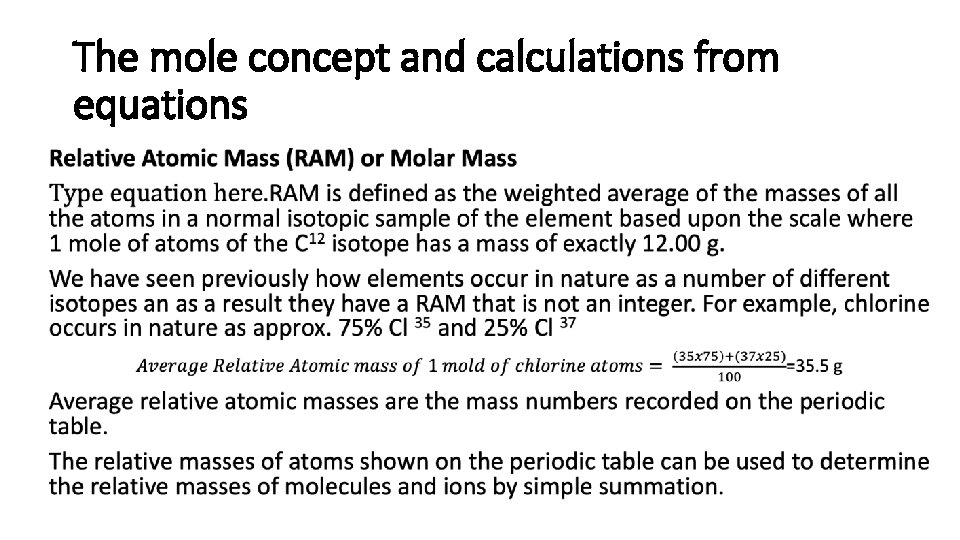
The mole concept and calculations from equations Atomic Mass Units • We have seen previously how atoms are comprised of protons, neutrons and electrons and how the protons and neutrons have masses of approx. 1 atomic mass unit (amu) respectively and that electrons do not contribute significantly to the mass. • If we define the amu as having a mass of 1. 66 x 10 -24 g we can see that atoms are extremely small and have an extremely small mass. • Example, 1 atom of Cl 35 contains 17 protons and 18 neutrons. This is a total of 35 amu (ignoring the electrons) and has a mass of 5. 81 x 10 -23 g. • This is a very small number so we use the concept of the mole (see below) to overcome the problem of handling such small quantities. • As you will see 1 mole contains 6. 022 x 1023 particles. So if we take 1 mole of Cl 35 atoms they will have a mass of (5. 81 x 10 -23 g) (6. 022 x 1023) = 35. 0 g.
The mole concept and calculations from equations •
The mole concept and calculations from equations • Relative Molecular Mass (RMM) or Molar Mass Found by adding all of the individual RAM’s together in one molecule of a compound. • Relative Formula Mass (RFM) or Molar Mass Found by adding all of the individual RAM’s together in one formula unit of an ionic compound.
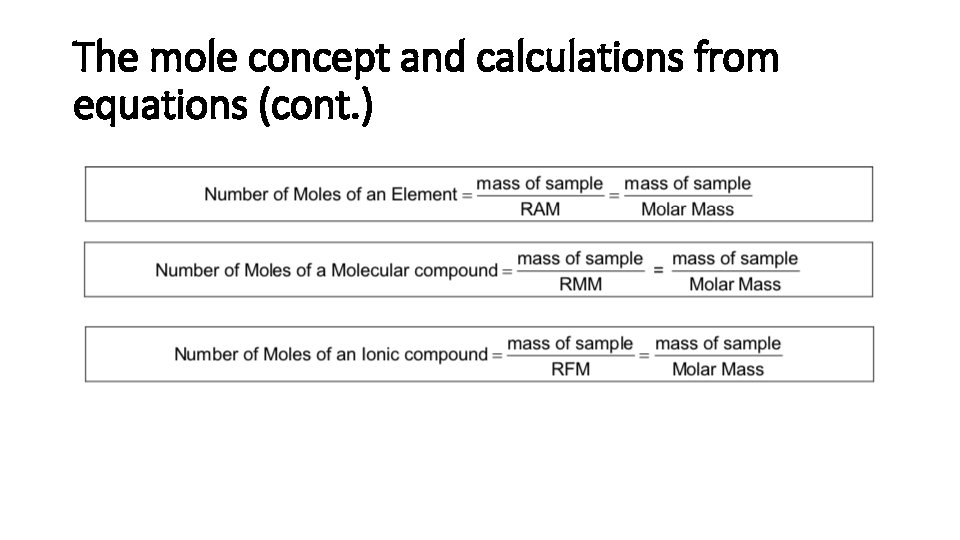
The mole concept and calculations from equations Avogadro’s number and the mole concept In chemistry, amounts of substances are measured in moles (mols). The mole is a standard number of particles (atoms, ions or molecules) and can be defined as, the amount of any substance that contains the same number of particles, as there are C 12 atoms in 12. 00 g of the C 12 isotope. The actual number of particles in a mole, known as the Avogadro constant or number is found to be 6. 022 x 1023 particles per mole and has the unit, mol-1. For example, one mole of atoms = 6. 02 x 1023 atoms. The average Relative Atomic Mass (RAM) of each element is given on the periodic table. The figure shows the average mass of one mole of atoms of that particular element. This leads to the relationships on the next slide
The mole concept and calculations from equations (cont. )
Task 07 d 1. What is the mass of one mole of sodium chloride, Na. CI 2. How many moles of Ca atoms are there in 140. g of calcium? 3. How many moles of Cu. Br 2 are there in 0. 522 g of copper(II) bromide? 4. How many moles of CO 2 molecules are there in 23. 0 g of carbon dioxide? 5. How many ‘particles’ are present in each of the chemicals in questions #1 -4 above?
The mole concept and calculations from equations If we know the number of moles of a substance that is present in a reaction and we know a balanced chemical equation, (i. e. we know the reacting ratio), it is possible to calculate the moles of another substance present in the equation. Use this method; 1. Write a correct and balanced equation. 2. Find the number of moles present by using a moles relationship for one substance. 3. Use the stoichiometric coefficients in the equation to find the reacting ratio of the moles. Use this relationship to find the number of moles of the unknown substance. 4. Re-apply a moles relationship for the unknown substance.
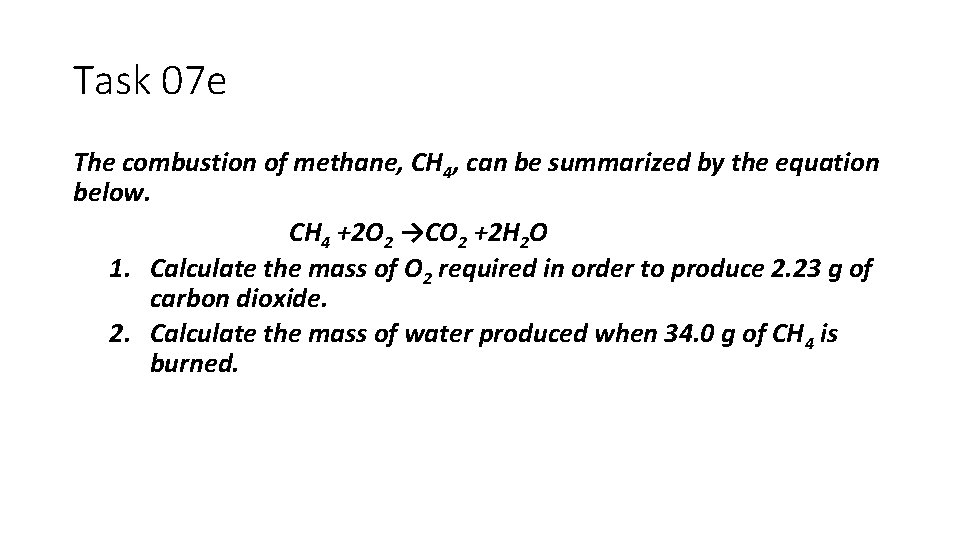
Task 07 e The combustion of methane, CH 4, can be summarized by the equation below. CH 4 +2 O 2 →CO 2 +2 H 2 O 1. Calculate the mass of O 2 required in order to produce 2. 23 g of carbon dioxide. 2. Calculate the mass of water produced when 34. 0 g of CH 4 is burned.
Volumetric analysis and moles • Chemical reactions are often carried out between substances that are in solution (dissolved in a solvent, usually water). • The concentration of a solution can be measured in terms of the number of grams of the solute (solid) that has been dissolved in a particular volume of the solution (where water is usually the solvent), or more usually, in terms of the number of moles of the solute in a particular volume of the solution. • Typical units are g dm-3 or g/dm 3 or mol dm-3 or mol/dm 3 or mol/L or mol L-1. • The method of expressing the concentration of a solution in mol L-1 is the most common (and most useful) and is referred to as Molarity (M). • So, for example, a solution that has a concentration of 0. 250 mol L-1 can be referred to as 0. 250 M solution, or a 0. 250 “molar” solution. When concentration is measured in mol L-1, or M, and volume in L, then, for solutions; Moles = (concentration)(volume)
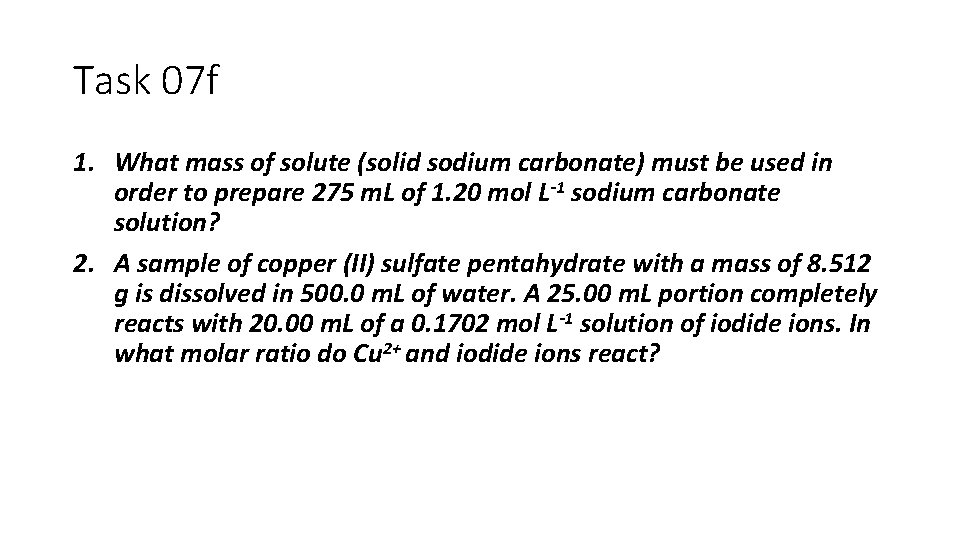
Task 07 f 1. What mass of solute (solid sodium carbonate) must be used in order to prepare 275 m. L of 1. 20 mol L-1 sodium carbonate solution? 2. A sample of copper (II) sulfate pentahydrate with a mass of 8. 512 g is dissolved in 500. 0 m. L of water. A 25. 00 m. L portion completely reacts with 20. 00 m. L of a 0. 1702 mol L-1 solution of iodide ions. In what molar ratio do Cu 2+ and iodide ions react?
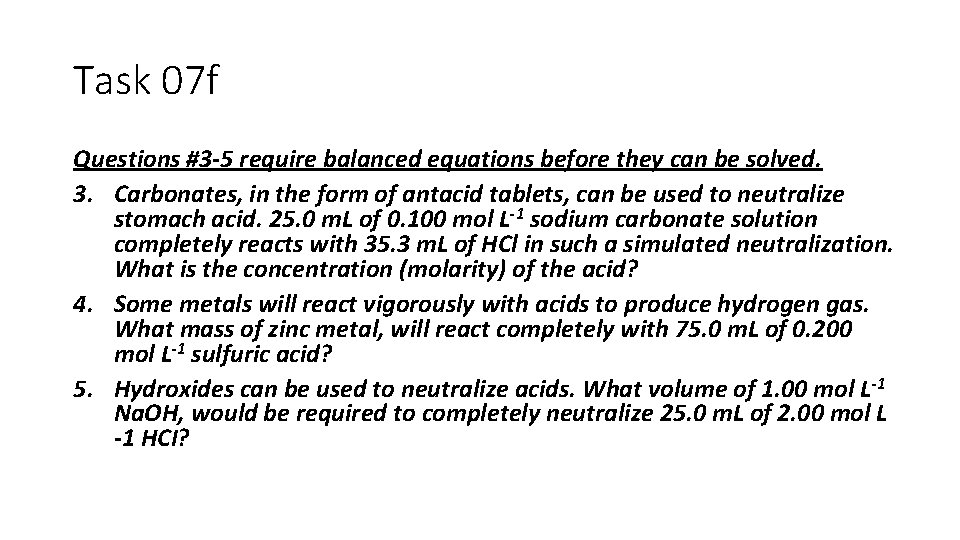
Task 07 f Questions #3 -5 require balanced equations before they can be solved. 3. Carbonates, in the form of antacid tablets, can be used to neutralize stomach acid. 25. 0 m. L of 0. 100 mol L-1 sodium carbonate solution completely reacts with 35. 3 m. L of HCl in such a simulated neutralization. What is the concentration (molarity) of the acid? 4. Some metals will react vigorously with acids to produce hydrogen gas. What mass of zinc metal, will react completely with 75. 0 m. L of 0. 200 mol L-1 sulfuric acid? 5. Hydroxides can be used to neutralize acids. What volume of 1. 00 mol L-1 Na. OH, would be required to completely neutralize 25. 0 m. L of 2. 00 mol L -1 HCI?
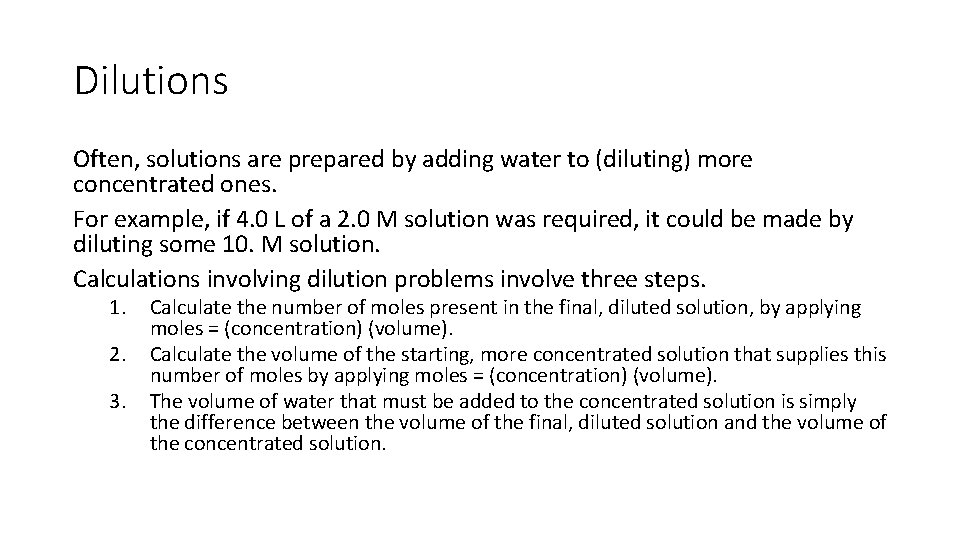
Dilutions Often, solutions are prepared by adding water to (diluting) more concentrated ones. For example, if 4. 0 L of a 2. 0 M solution was required, it could be made by diluting some 10. M solution. Calculations involving dilution problems involve three steps. 1. 2. 3. Calculate the number of moles present in the final, diluted solution, by applying moles = (concentration) (volume). Calculate the volume of the starting, more concentrated solution that supplies this number of moles by applying moles = (concentration) (volume). The volume of water that must be added to the concentrated solution is simply the difference between the volume of the final, diluted solution and the volume of the concentrated solution.
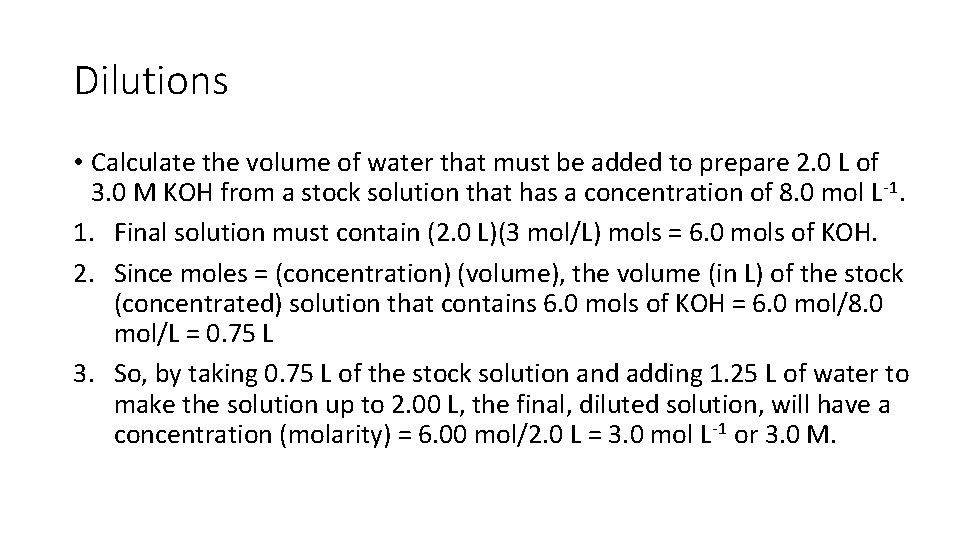
Dilutions • Calculate the volume of water that must be added to prepare 2. 0 L of 3. 0 M KOH from a stock solution that has a concentration of 8. 0 mol L-1. 1. Final solution must contain (2. 0 L)(3 mol/L) mols = 6. 0 mols of KOH. 2. Since moles = (concentration) (volume), the volume (in L) of the stock (concentrated) solution that contains 6. 0 mols of KOH = 6. 0 mol/8. 0 mol/L = 0. 75 L 3. So, by taking 0. 75 L of the stock solution and adding 1. 25 L of water to make the solution up to 2. 00 L, the final, diluted solution, will have a concentration (molarity) = 6. 00 mol/2. 0 L = 3. 0 mol L-1 or 3. 0 M.
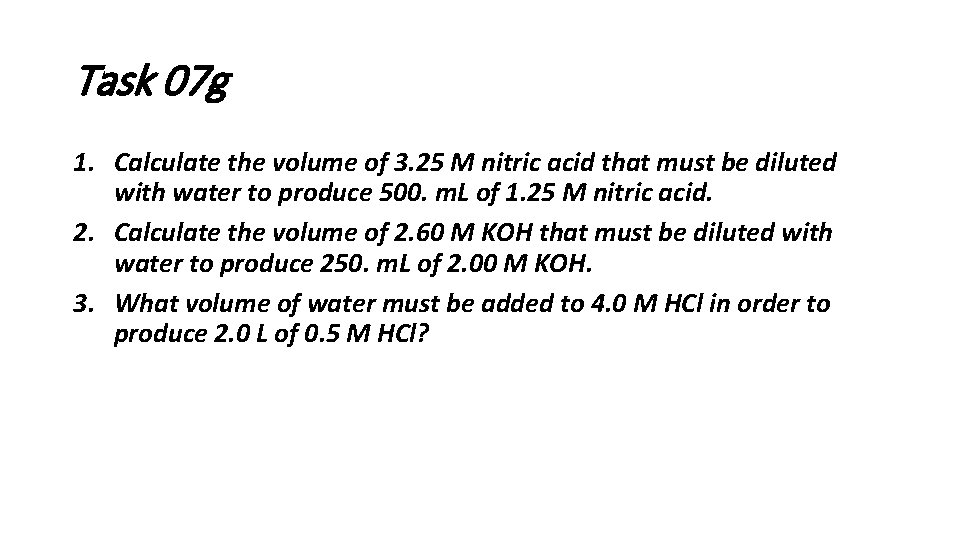
Task 07 g 1. Calculate the volume of 3. 25 M nitric acid that must be diluted with water to produce 500. m. L of 1. 25 M nitric acid. 2. Calculate the volume of 2. 60 M KOH that must be diluted with water to produce 250. m. L of 2. 00 M KOH. 3. What volume of water must be added to 4. 0 M HCl in order to produce 2. 0 L of 0. 5 M HCl?
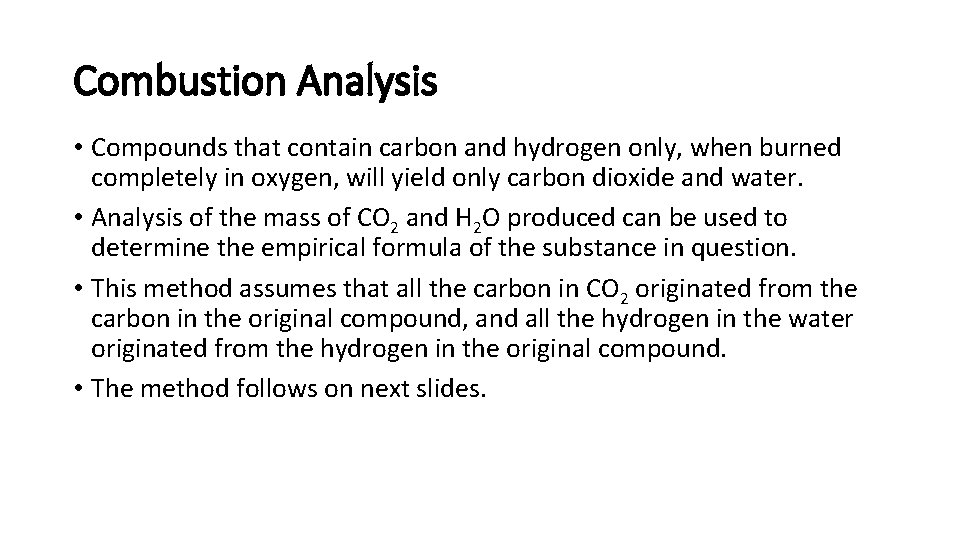
Combustion Analysis • Compounds that contain carbon and hydrogen only, when burned completely in oxygen, will yield only carbon dioxide and water. • Analysis of the mass of CO 2 and H 2 O produced can be used to determine the empirical formula of the substance in question. • This method assumes that all the carbon in CO 2 originated from the carbon in the original compound, and all the hydrogen in the water originated from the hydrogen in the original compound. • The method follows on next slides.
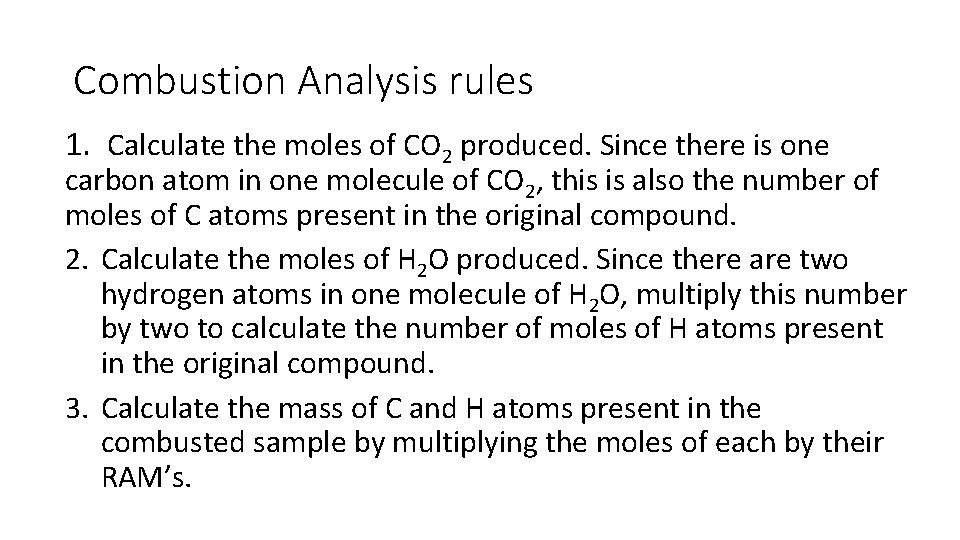
Combustion Analysis rules 1. Calculate the moles of CO 2 produced. Since there is one carbon atom in one molecule of CO 2, this is also the number of moles of C atoms present in the original compound. 2. Calculate the moles of H 2 O produced. Since there are two hydrogen atoms in one molecule of H 2 O, multiply this number by two to calculate the number of moles of H atoms present in the original compound. 3. Calculate the mass of C and H atoms present in the combusted sample by multiplying the moles of each by their RAM’s.
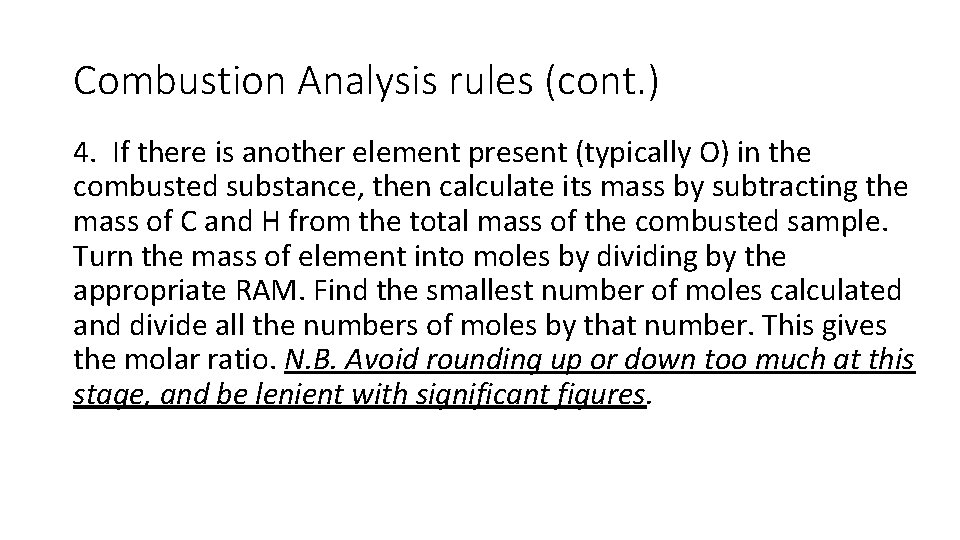
Combustion Analysis rules (cont. ) 4. If there is another element present (typically O) in the combusted substance, then calculate its mass by subtracting the mass of C and H from the total mass of the combusted sample. Turn the mass of element into moles by dividing by the appropriate RAM. Find the smallest number of moles calculated and divide all the numbers of moles by that number. This gives the molar ratio. N. B. Avoid rounding up or down too much at this stage, and be lenient with significant figures.
Combustion Analysis rules (cont. ) 5. The results from #4 should be in a convenient ratio, and give the empirical formula. N. B. It may be that the ratio includes a fraction such as. 500, . 250 or. 333 etc. If so, then multiply all numbers by 2, 4 or 3 as appropriate to remove the fraction. 6. If necessary, use the molar mass to turn the empirical formula into a molecular formula.
Task 07 h • When 4 -ketopentenoic acid is analyzed by combustion, it is found that a 0. 3000 g sample produces 0. 579 g of CO 2 and 0. 142 g of H 2 O. The acid contains only carbon, hydrogen, and oxygen. What is the empirical formula of the acid?
Analysis of hydrates • Hydrates are formula units with water associated with them. The water molecules are incorporated into the solid structure. For example, Cu. SO 4 *5 H 2 O, copper(II) sulfate pentahydrate. Strong heating can evaporate the water. When water is removed the salts are called anhydrous (without water).
Task 07 i • A sample of the hydrated salt Co. Cl 2 * x. H 2 O, with a mass of 11. 73 g is weighed, heated to drive off the water of crystallization, cooled and reweighed until constant mass (6. 410 g) is achieved. Calculate the value of x. • What is meant by the term, “constant mass” in question #1?
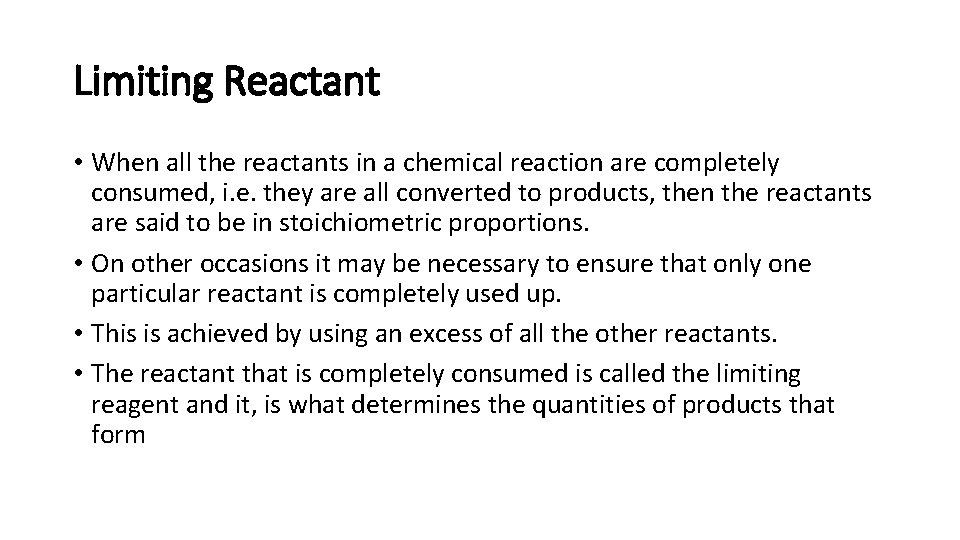
Limiting Reactant • When all the reactants in a chemical reaction are completely consumed, i. e. they are all converted to products, then the reactants are said to be in stoichiometric proportions. • On other occasions it may be necessary to ensure that only one particular reactant is completely used up. • This is achieved by using an excess of all the other reactants. • The reactant that is completely consumed is called the limiting reagent and it, is what determines the quantities of products that form
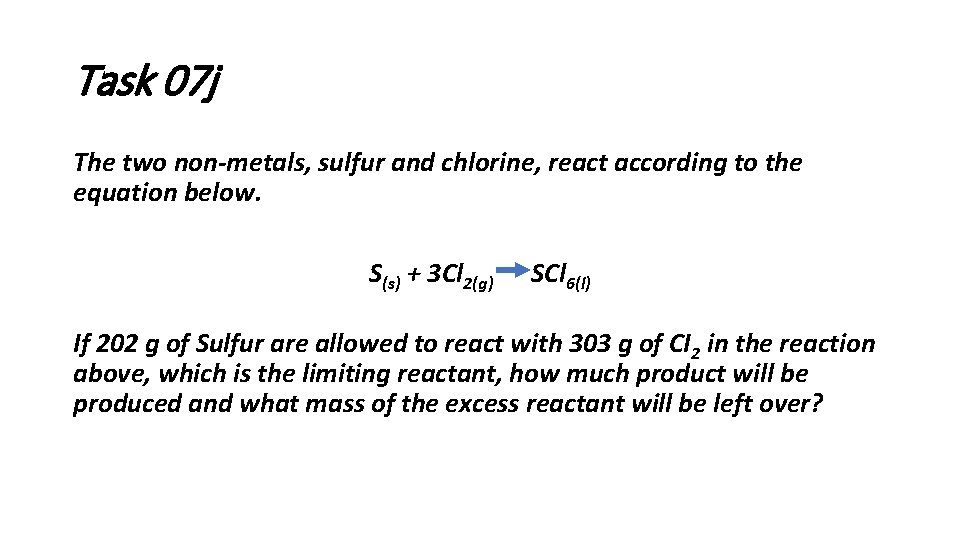
Task 07 j The two non-metals, sulfur and chlorine, react according to the equation below. S(s) + 3 Cl 2(g) SCl 6(l) If 202 g of Sulfur are allowed to react with 303 g of CI 2 in the reaction above, which is the limiting reactant, how much product will be produced and what mass of the excess reactant will be left over?
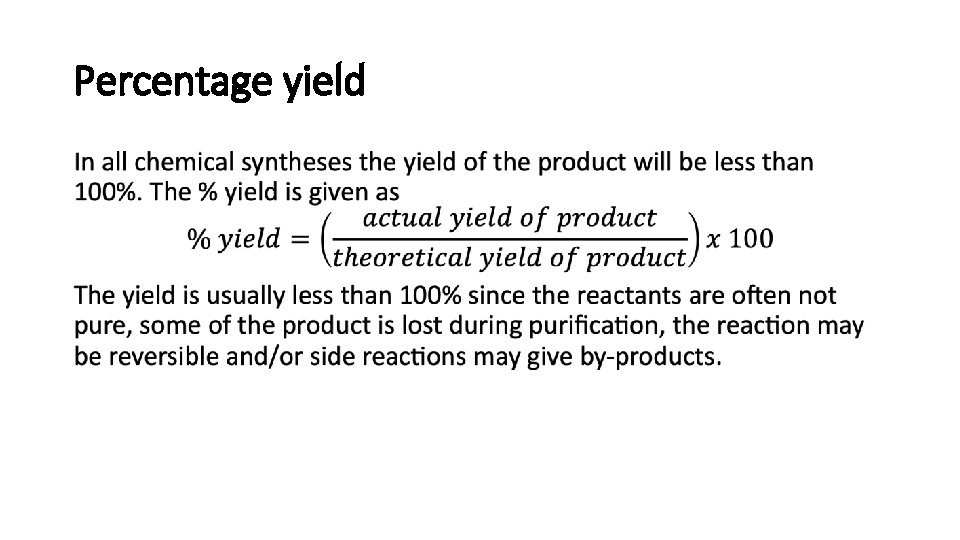
Percentage yield •
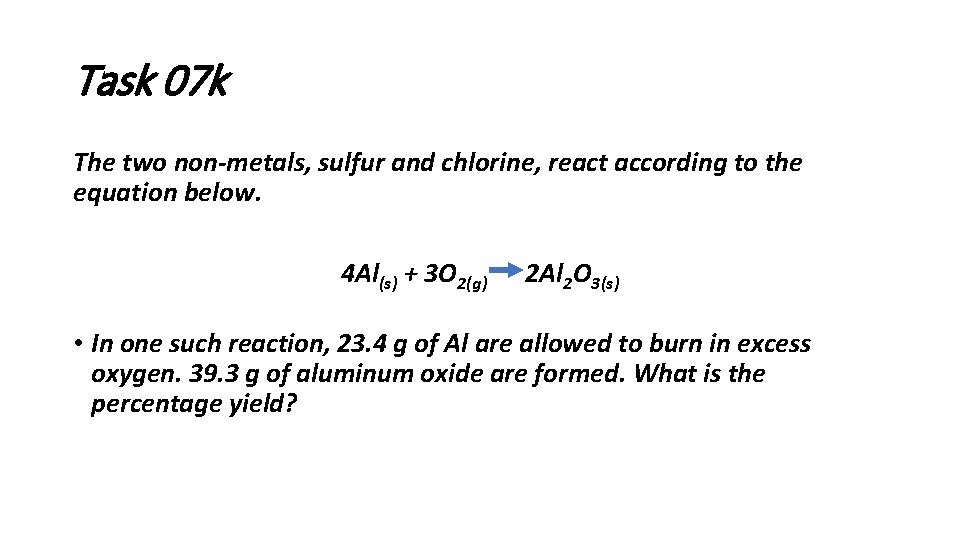
Task 07 k The two non-metals, sulfur and chlorine, react according to the equation below. 4 Al(s) + 3 O 2(g) 2 Al 2 O 3(s) • In one such reaction, 23. 4 g of Al are allowed to burn in excess oxygen. 39. 3 g of aluminum oxide are formed. What is the percentage yield?
- Slides: 40