
Unit 7 Microbes Diseases 8 L 1 1
Unit 7: Microbes & Diseases 8. L 1. 1 Summarize the basic characteristics of viruses, bacteria, fungi, and parasites relating to the spread, treatment, and prevention of disease. 1 of 31 20 © Boardworks Ltd 2005 2004
Contents 8 C Microbes and Disease What are microbes? Uses of microbes How microbes cause disease Fighting disease Summary activities 1 20 2 of 31 © Boardworks Ltd 2005 2004
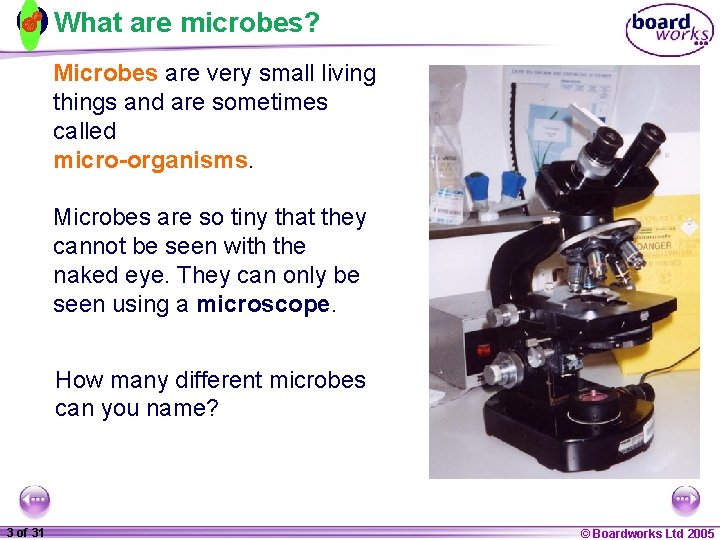
What are microbes? Microbes are very small living things and are sometimes called micro-organisms. Microbes are so tiny that they cannot be seen with the naked eye. They can only be seen using a microscope. How many different microbes can you name? 1 20 3 of 31 © Boardworks Ltd 2005 2004
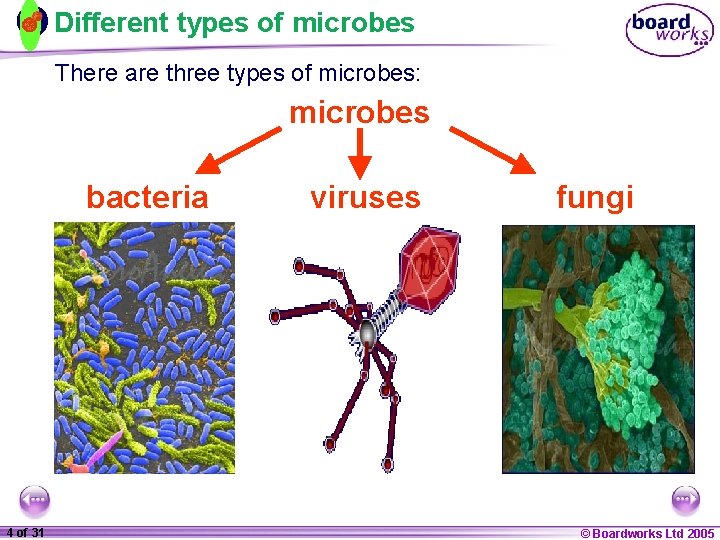
Different types of microbes There are three types of microbes: microbes bacteria 1 20 4 of 31 viruses fungi © Boardworks Ltd 2005 2004

Bacteria fact file Bacteria Found everywhere, in the air, soil, water, inside your body and on your skin. e. g. Salmonella and Streptococcus size: 1/1000 mm very small shape: Bacteria can be spherical, rodshaped or spiral or corkscrew. Usually classified by its shape. structure: Bacteria are single-celled organisms, which do not completely have a nucleus. Some cause disease, but many are useful. reproduction: Bacteria reproduce very quickly. They tend to multiply very rapidly under favourable conditions, forming colonies of millions or even billions of organisms within a space as small as a drop of water. 1 20 5 of 31 © Boardworks Ltd 2005 2004
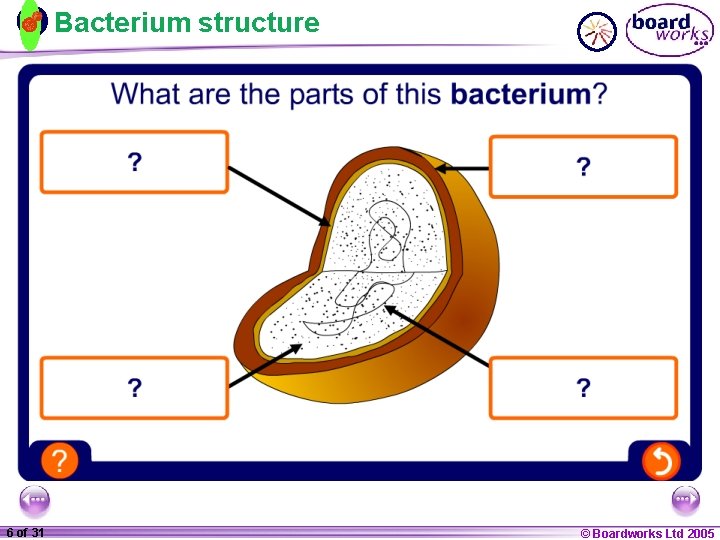
Bacterium structure 1 20 6 of 31 © Boardworks Ltd 2005 2004
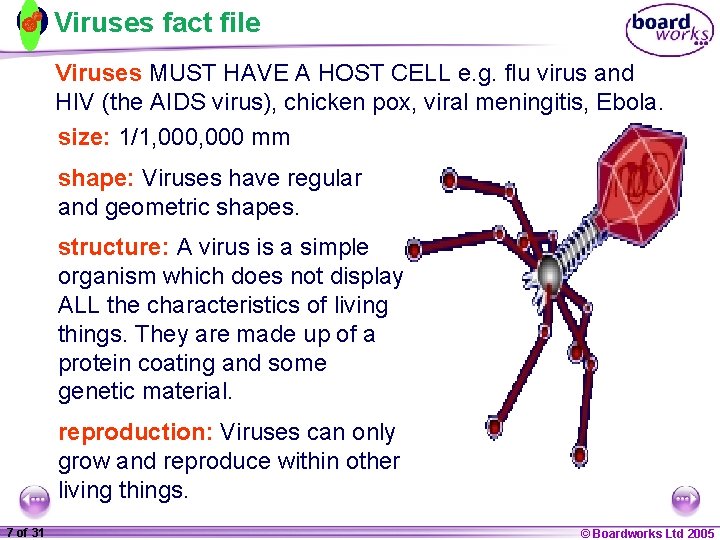
Viruses fact file Viruses MUST HAVE A HOST CELL e. g. flu virus and HIV (the AIDS virus), chicken pox, viral meningitis, Ebola. size: 1/1, 000 mm shape: Viruses have regular and geometric shapes. structure: A virus is a simple organism which does not display ALL the characteristics of living things. They are made up of a protein coating and some genetic material. reproduction: Viruses can only grow and reproduce within other living things. 1 20 7 of 31 © Boardworks Ltd 2005 2004
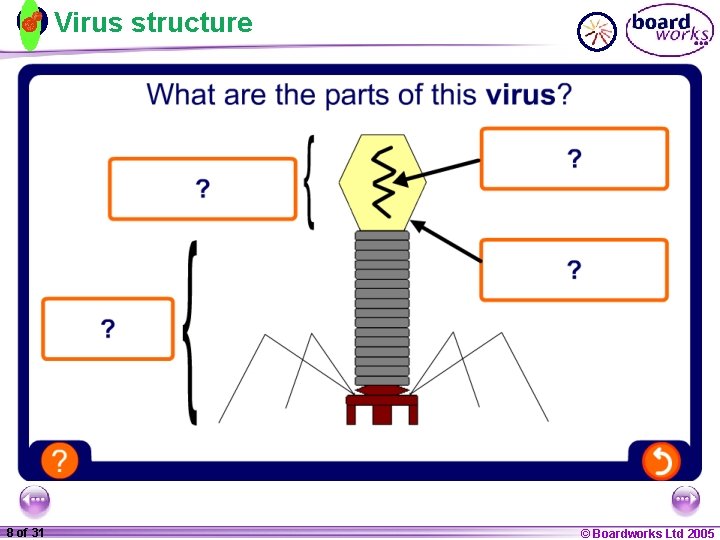
Virus structure 1 20 8 of 31 © Boardworks Ltd 2005 2004
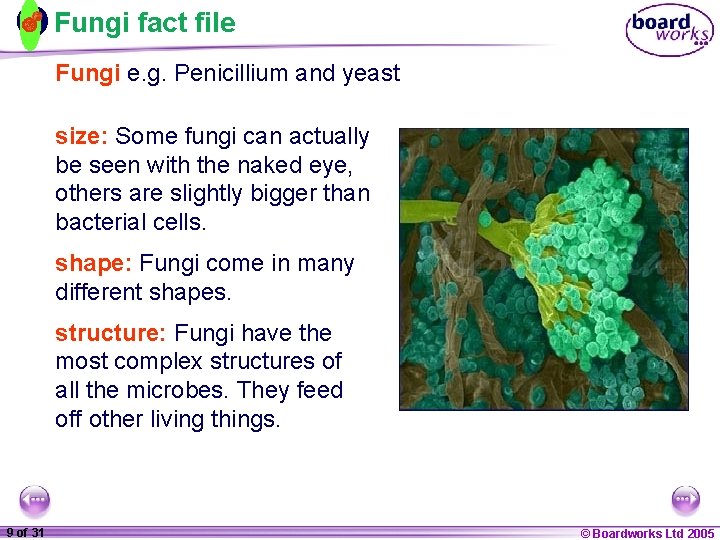
Fungi fact file Fungi e. g. Penicillium and yeast size: Some fungi can actually be seen with the naked eye, others are slightly bigger than bacterial cells. shape: Fungi come in many different shapes. structure: Fungi have the most complex structures of all the microbes. They feed off other living things. 1 20 9 of 31 © Boardworks Ltd 2005 2004
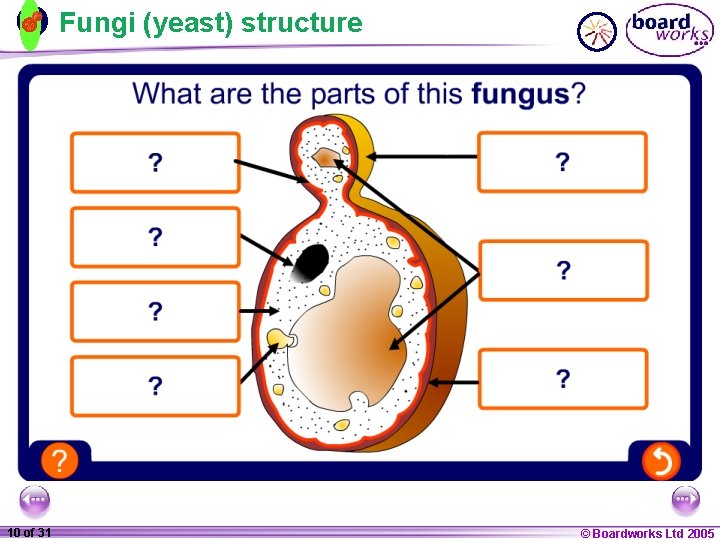
Fungi (yeast) structure 1 10 ofof 20 31 © Boardworks Ltd 2005 2004
Contents 8 C Microbes and Disease What are microbes? Uses of microbes How microbes cause disease Fighting disease Summary activities 1 11 ofof 20 31 © Boardworks Ltd 2005 2004
Contents 8 C Microbes and Disease What are microbes? Uses of microbes How microbes cause disease Fighting disease Summary activities 1 12 ofof 20 31 © Boardworks Ltd 2005 2004
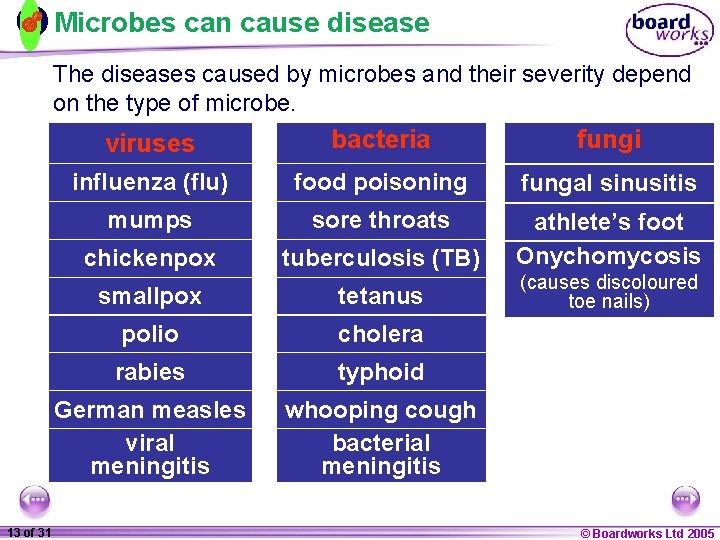
Microbes can cause disease The diseases caused by microbes and their severity depend on the type of microbe. 1 13 ofof 20 31 viruses bacteria fungi influenza (flu) food poisoning fungal sinusitis mumps sore throats chickenpox tuberculosis (TB) athlete’s foot Onychomycosis smallpox tetanus polio cholera rabies typhoid German measles viral meningitis whooping cough bacterial meningitis (causes discoloured toe nails) © Boardworks Ltd 2005 2004
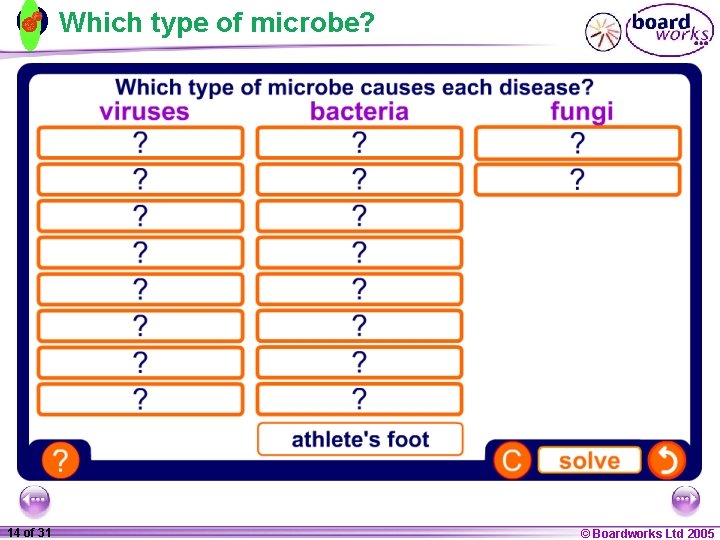
Which type of microbe? 1 14 ofof 20 31 © Boardworks Ltd 2005 2004
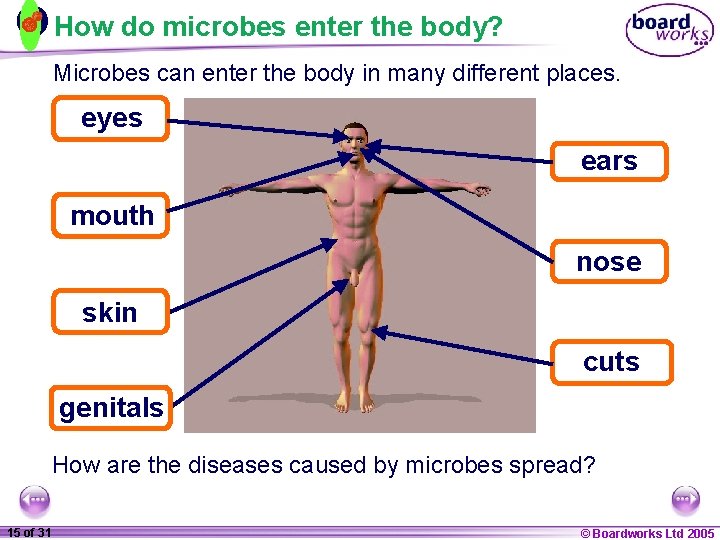
How do microbes enter the body? Microbes can enter the body in many different places. eyes ears mouth nose skin cuts genitals How are the diseases caused by microbes spread? 1 15 ofof 20 31 © Boardworks Ltd 2005 2004
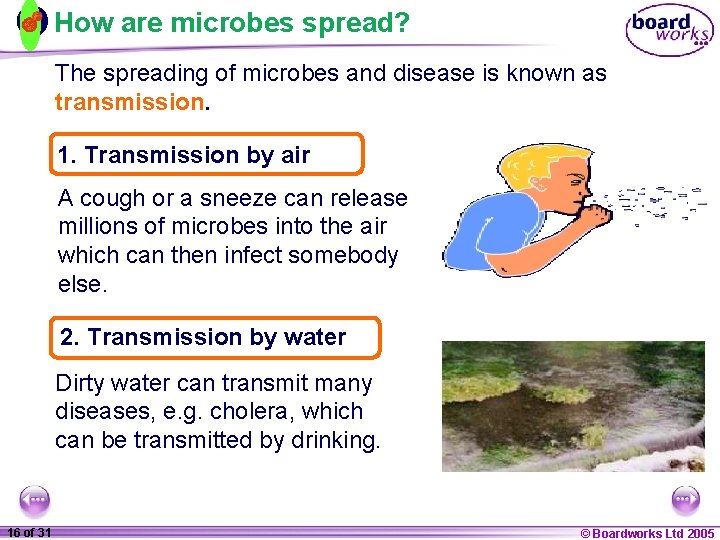
How are microbes spread? The spreading of microbes and disease is known as transmission. 1. Transmission by air A cough or a sneeze can release millions of microbes into the air which can then infect somebody else. 2. Transmission by water Dirty water can transmit many diseases, e. g. cholera, which can be transmitted by drinking. 1 16 ofof 20 31 © Boardworks Ltd 2005 2004
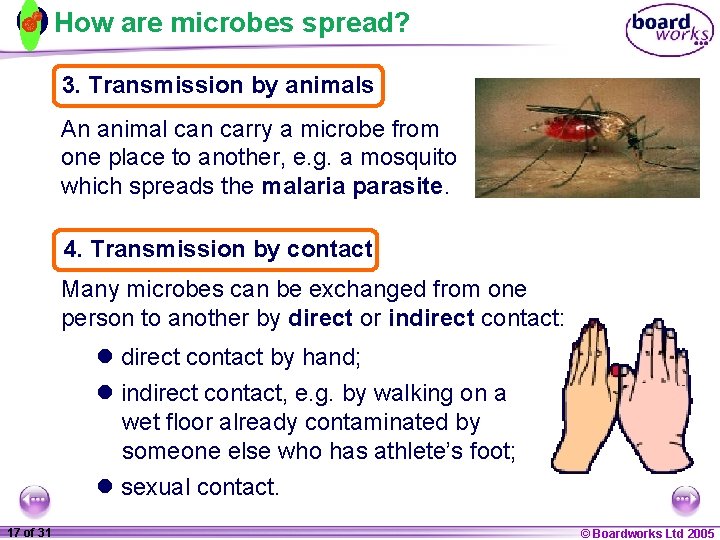
How are microbes spread? 3. Transmission by animals An animal can carry a microbe from one place to another, e. g. a mosquito which spreads the malaria parasite. 4. Transmission by contact Many microbes can be exchanged from one person to another by direct or indirect contact: l direct contact by hand; l indirect contact, e. g. by walking on a wet floor already contaminated by someone else who has athlete’s foot; l sexual contact. 1 17 ofof 20 31 © Boardworks Ltd 2005 2004
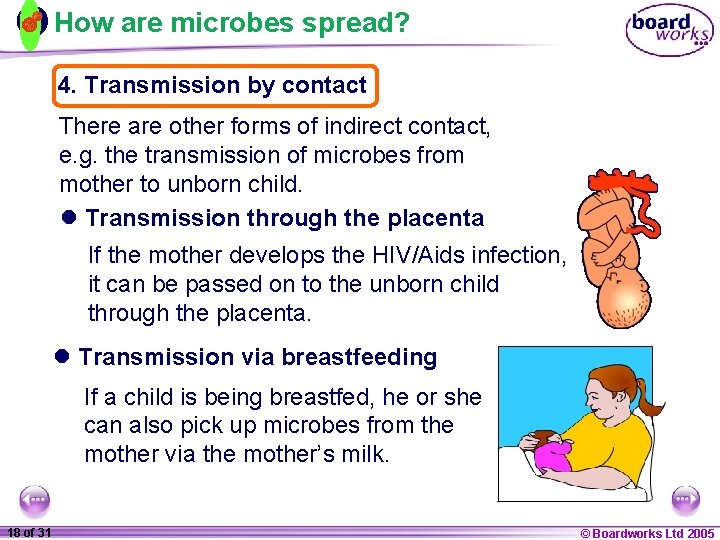
How are microbes spread? 4. Transmission by contact There are other forms of indirect contact, e. g. the transmission of microbes from mother to unborn child. l Transmission through the placenta If the mother develops the HIV/Aids infection, it can be passed on to the unborn child through the placenta. l Transmission via breastfeeding If a child is being breastfed, he or she can also pick up microbes from the mother via the mother’s milk. 1 18 ofof 20 31 © Boardworks Ltd 2005 2004
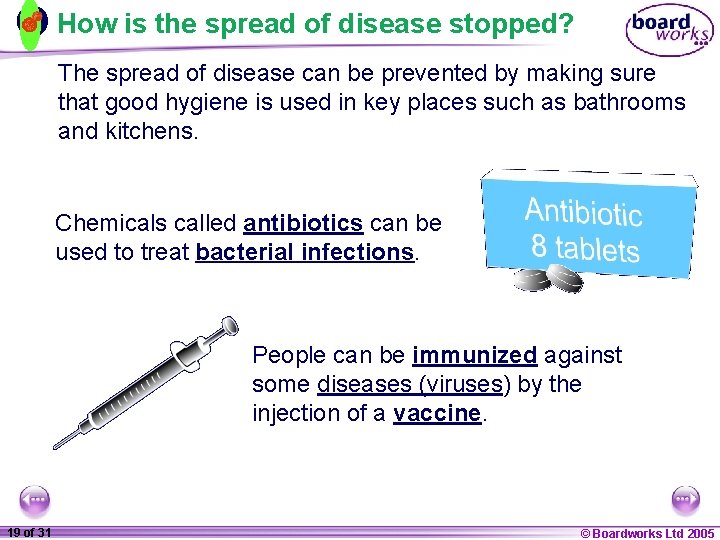
How is the spread of disease stopped? The spread of disease can be prevented by making sure that good hygiene is used in key places such as bathrooms and kitchens. Chemicals called antibiotics can be used to treat bacterial infections. People can be immunized against some diseases (viruses) by the injection of a vaccine. 1 19 ofof 20 31 © Boardworks Ltd 2005 2004
Contents 8 C Microbes and Disease What are microbes? Uses of microbes How microbes cause disease Fighting disease Summary activities 1 20 ofof 20 31 © Boardworks Ltd 2005 2004
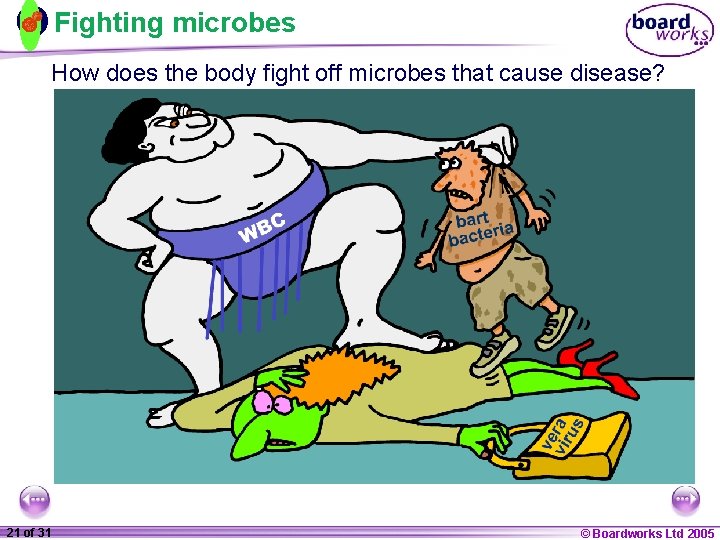
Fighting microbes How does the body fight off microbes that cause disease? 1 21 ofof 20 31 © Boardworks Ltd 2005 2004
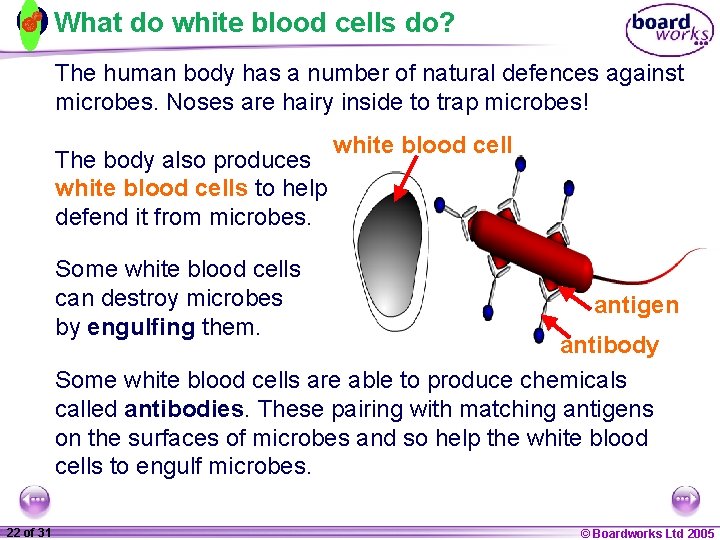
What do white blood cells do? The human body has a number of natural defences against microbes. Noses are hairy inside to trap microbes! The body also produces white blood cells to help defend it from microbes. Some white blood cells can destroy microbes by engulfing them. white blood cell antigen antibody Some white blood cells are able to produce chemicals called antibodies. These pairing with matching antigens on the surfaces of microbes and so help the white blood cells to engulf microbes. 1 22 ofof 20 31 © Boardworks Ltd 2005 2004
Contents 8 C Microbes and Disease What are microbes? Uses of microbes How microbes cause disease Fighting disease Summary activities 1 23 ofof 20 31 © Boardworks Ltd 2005 2004
Glossary l antibiotics – Chemicals prescribed as medicine to kill bacteria inside the body. l antibodies – Chemicals produced by white blood cells to fight microbes that cause disease. l bacteria – The type of microbes that are single-celled organisms. l fungi – The type of microbes that feed off other living things. l immune – Resistance to infection caused by a microbe. l microbe – A very small living thing. l transmission – The spread of a disease from person to person. l viruses – The type of microbes that can only grow and reproduce within other living things. 1 24 ofof 20 31 © Boardworks Ltd 2005 2004
- Slides: 24