
Unit 7 Lessons Based on Master ASL J

Unit 7 Lessons Based on Master ASL, J. Zinza © 2011 Natasha Escalada-Westland Unit 7
Unit 7 Objectives • To sign about daily routines and activities • To identify and understand noun-verb pairs in ASL • To describe clothing • To learn and use spatial organization • To apply turn-taking strategies in conversation • To understand the sign language continuum Based on Master ASL Level One by Jason Zinza Unit 7

What’s your routine? , p. 255 1. Narrative. Watch Kelly explain her daily routine. 2. Analysis. Identify the signs you already know in the video. 3. Daily Routine. Ask a partner what he or she does daily. Unit 7
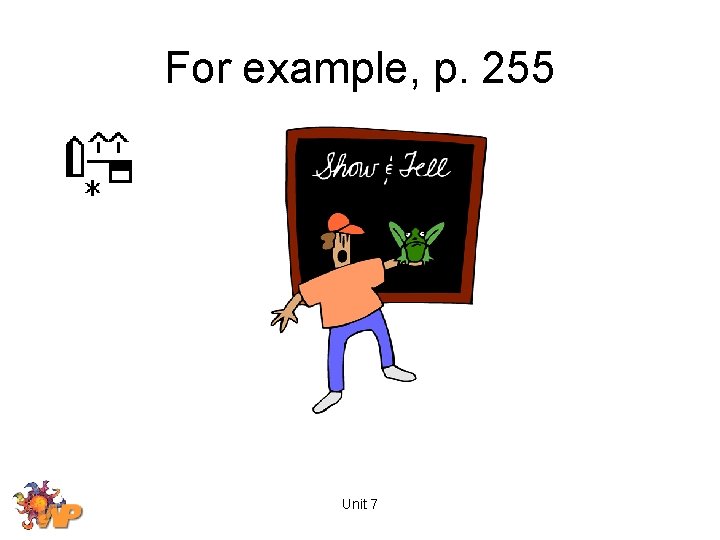
For example, p. 255 Unit 7
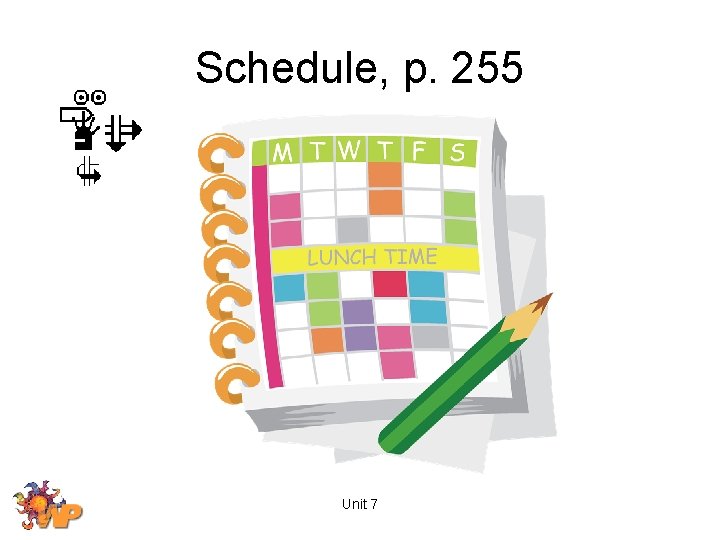
Schedule, p. 255 Unit 7
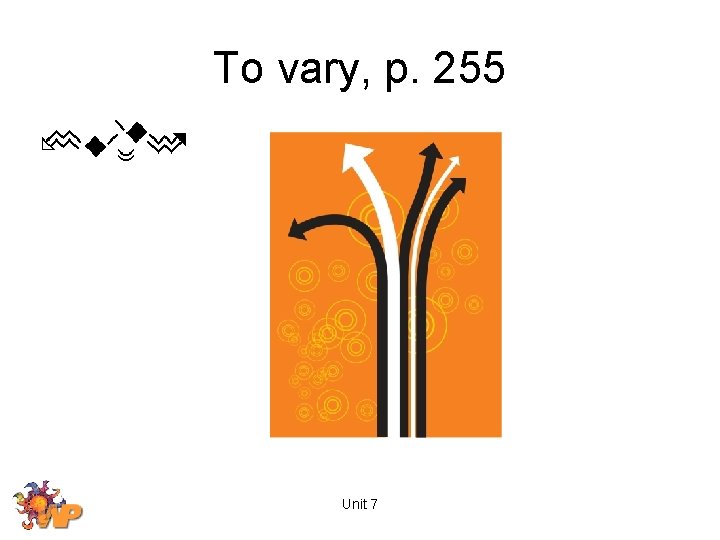
To vary, p. 255 Unit 7
What’s your routine? , p. 255 Hi, what’s up? What do you do every day? My schedule varies each week. For example, after school on Mondays and Wednesdays, I work, but on Tuesdays and Thursdays I have gymnastics from 3 until 5. When practice is over I take off and go home. I eat dinner, study, then go to bed at 11: 00. I’m always running around! Unit 7
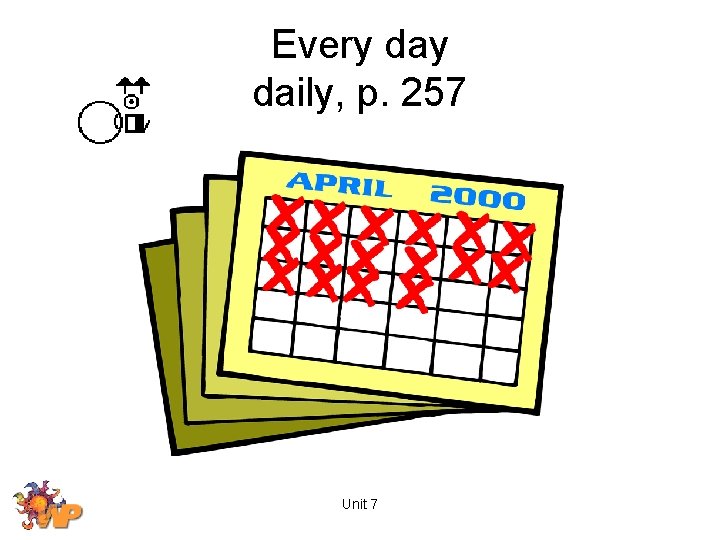
Every daily, p. 257 Unit 7
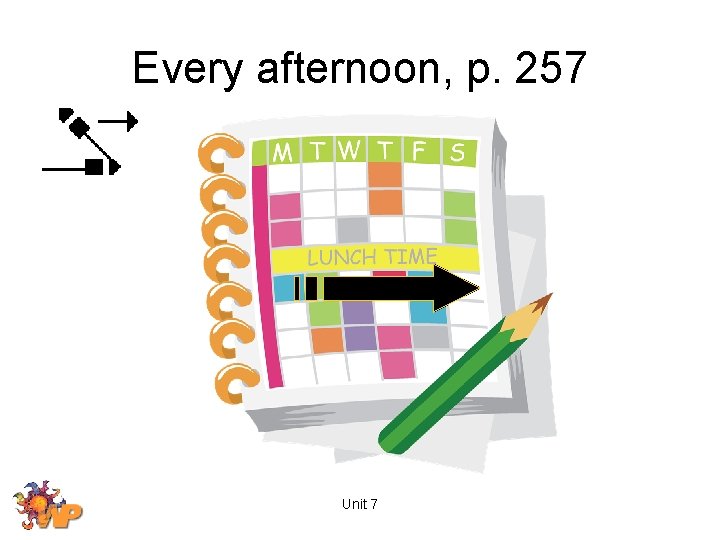
Every afternoon, p. 257 Unit 7
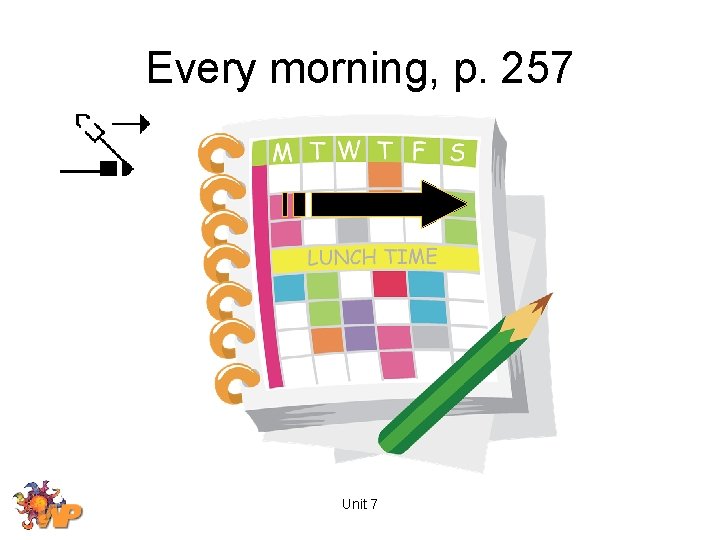
Every morning, p. 257 Unit 7
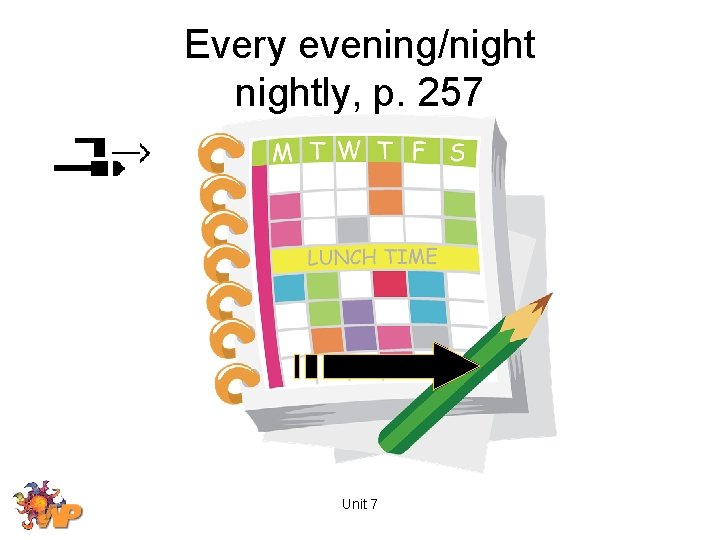
Every evening/nightly, p. 257 Unit 7
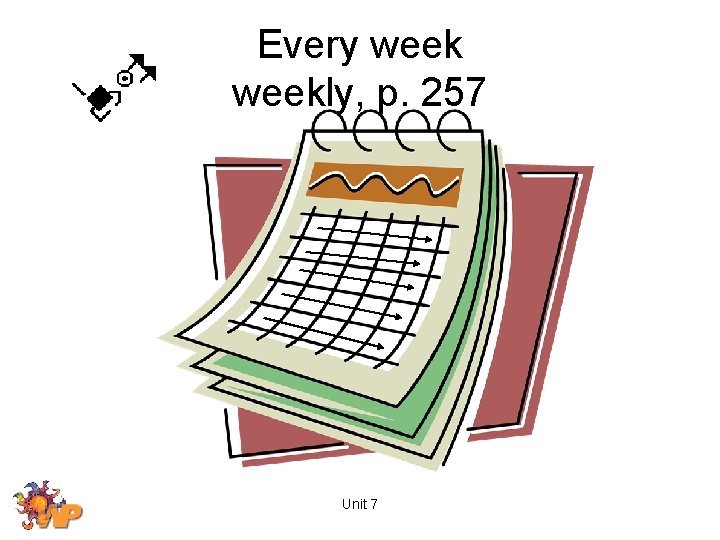
Every weekly, p. 257 Unit 7
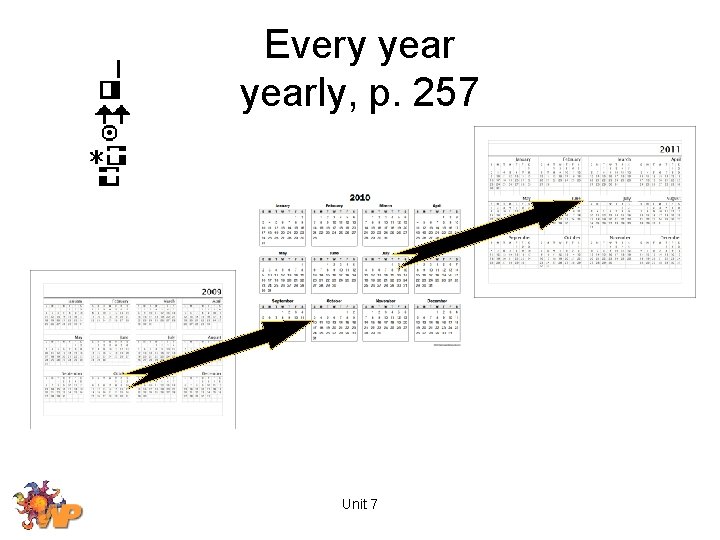
Every yearly, p. 257 Unit 7
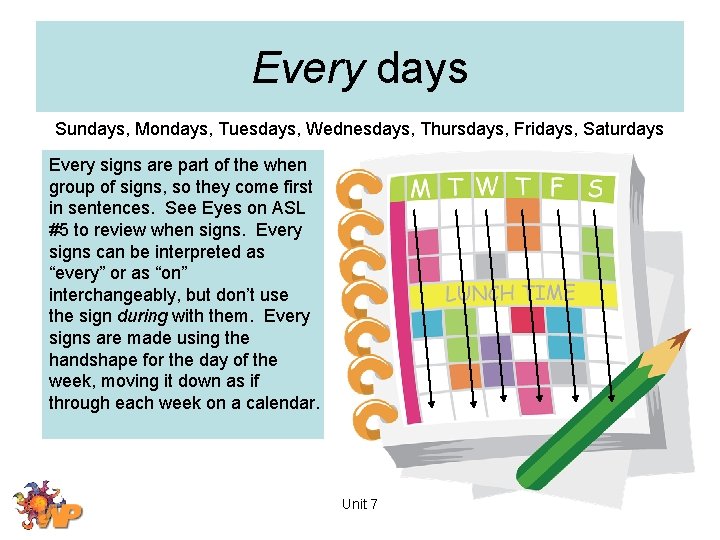
Every days Sundays, Mondays, Tuesdays, Wednesdays, Thursdays, Fridays, Saturdays Every signs are part of the when group of signs, so they come first in sentences. See Eyes on ASL #5 to review when signs. Every signs can be interpreted as “every” or as “on” interchangeably, but don’t use the sign during with them. Every signs are made using the handshape for the day of the week, moving it down as if through each week on a calendar. Unit 7
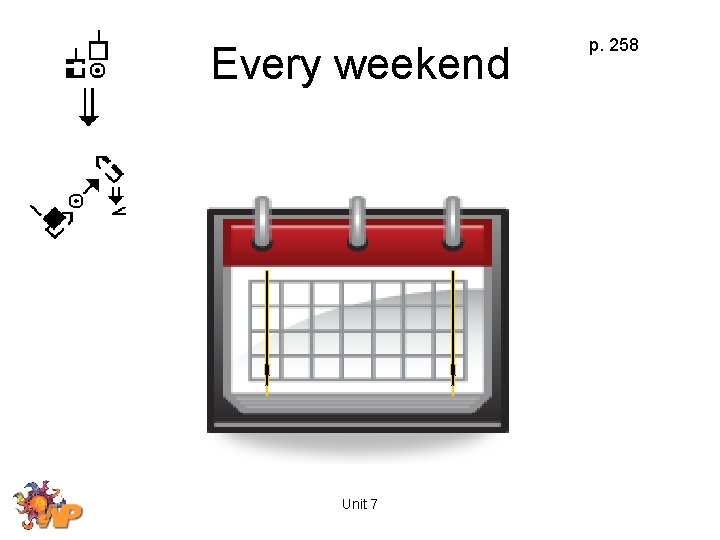
Every weekend Unit 7 p. 258
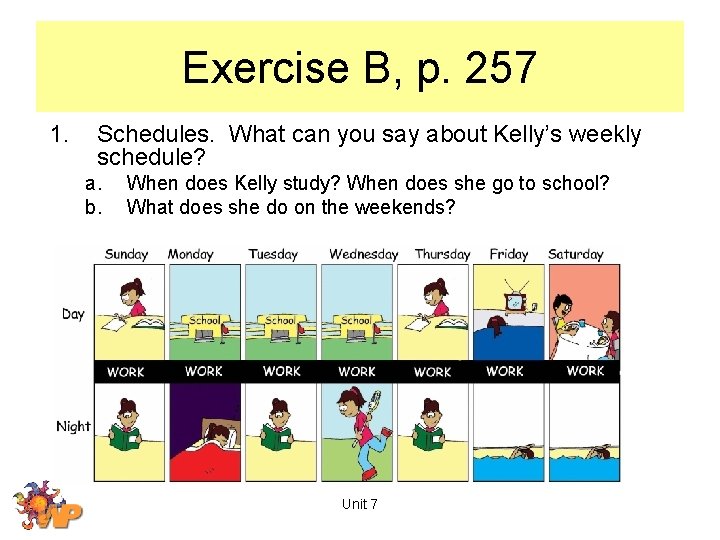
Exercise B, p. 257 1. Schedules. What can you say about Kelly’s weekly schedule? a. b. When does Kelly study? When does she go to school? What does she do on the weekends? Unit 7
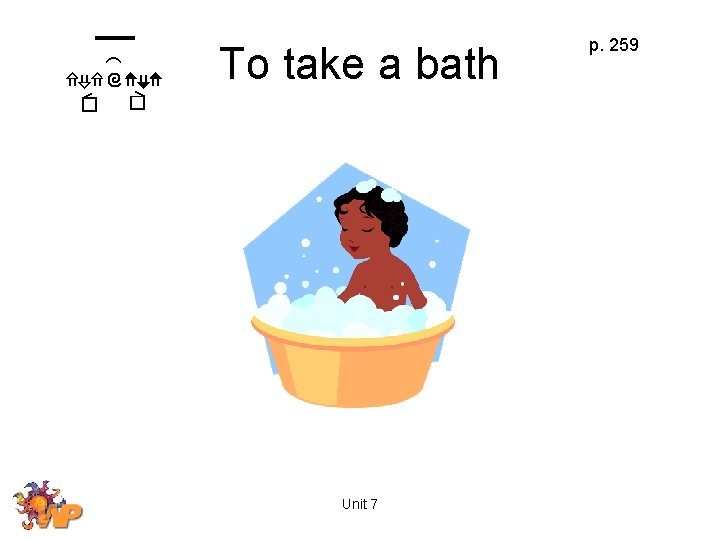
To take a bath Unit 7 p. 259
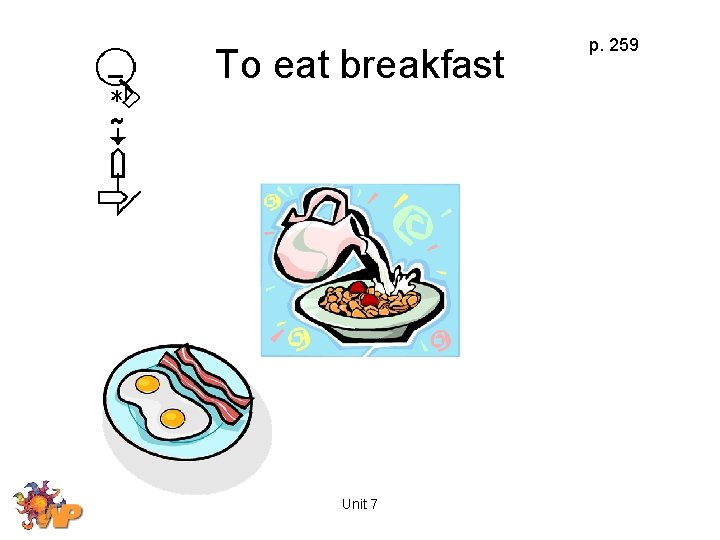
To eat breakfast Unit 7 p. 259
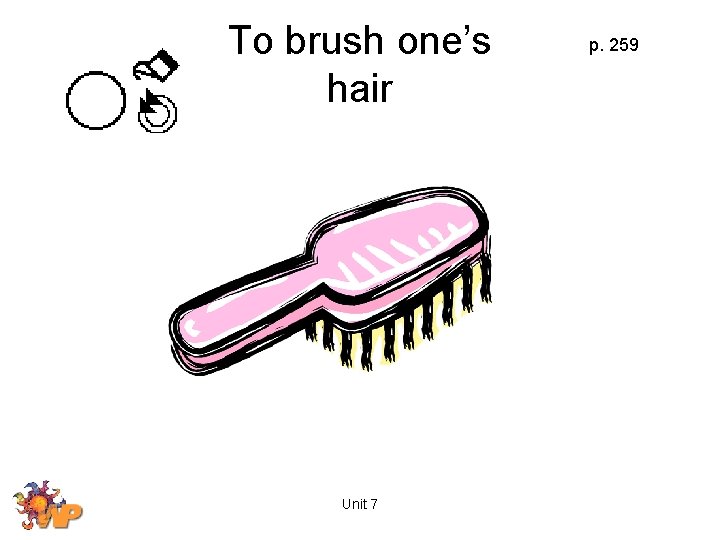
To brush one’s hair Unit 7 p. 259
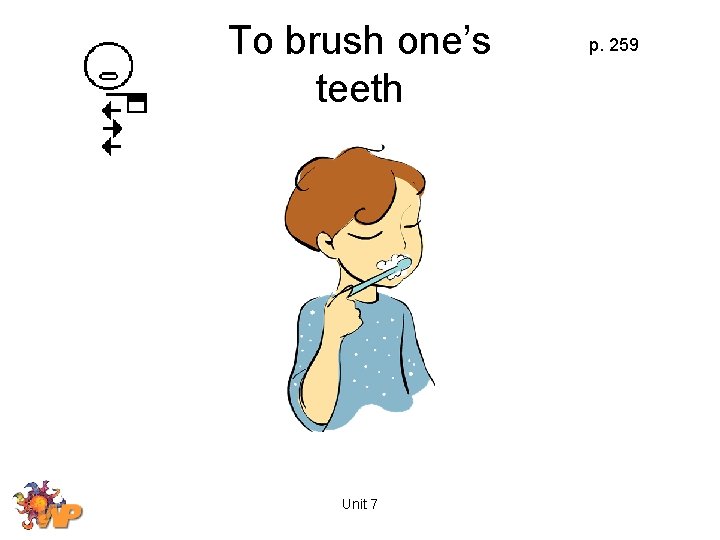
To brush one’s teeth Unit 7 p. 259
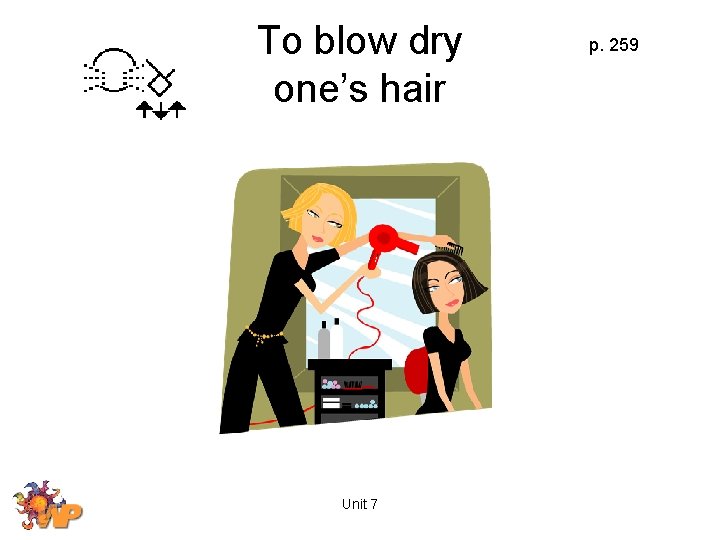
To blow dry one’s hair Unit 7 p. 259
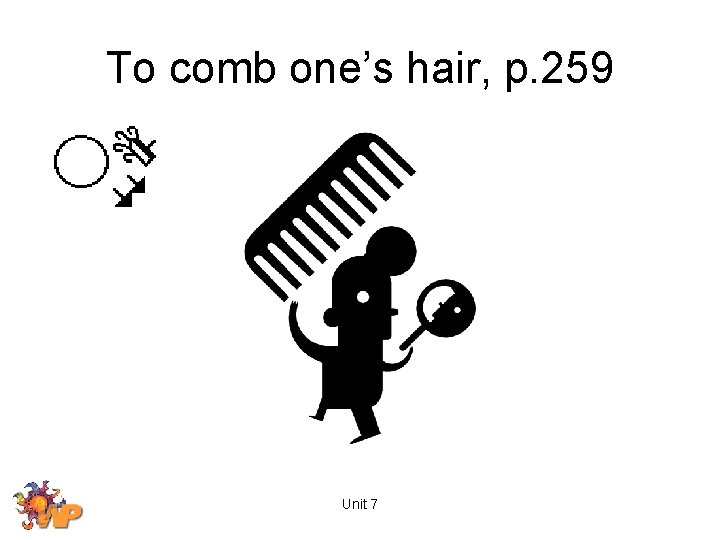
To comb one’s hair, p. 259 Unit 7
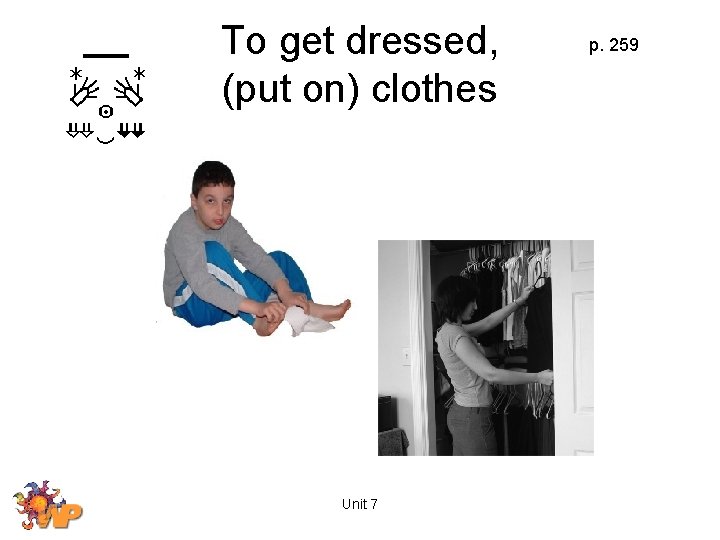
To get dressed, (put on) clothes Unit 7 p. 259
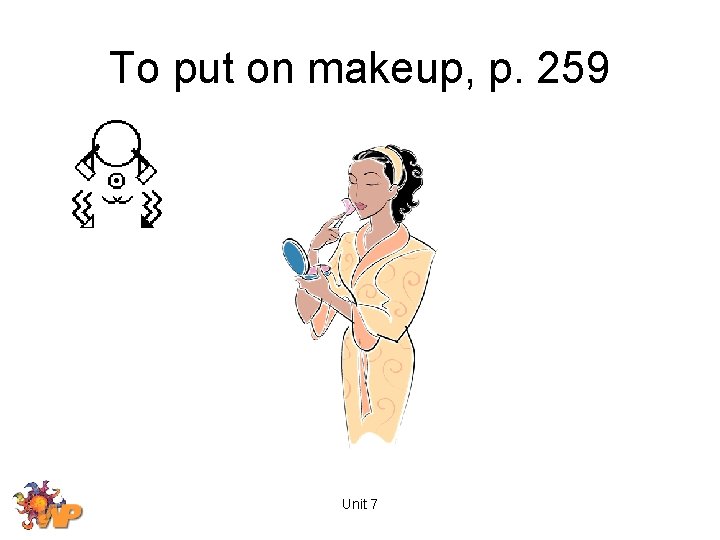
To put on makeup, p. 259 Unit 7
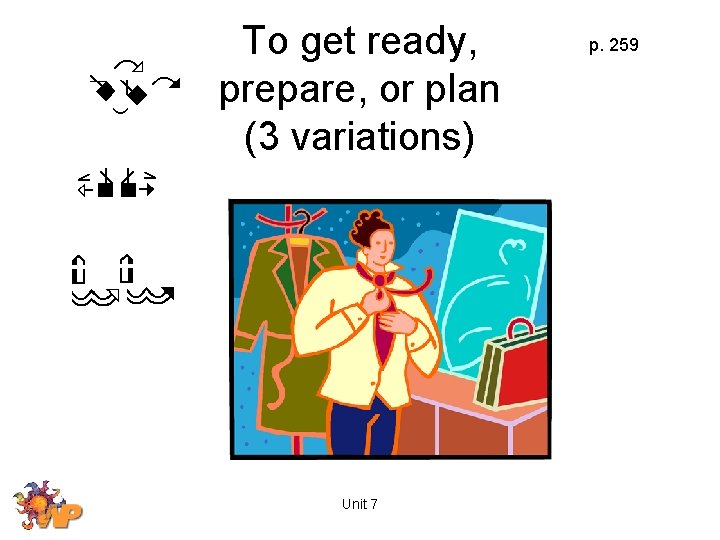
To get ready, prepare, or plan (3 variations) Unit 7 p. 259
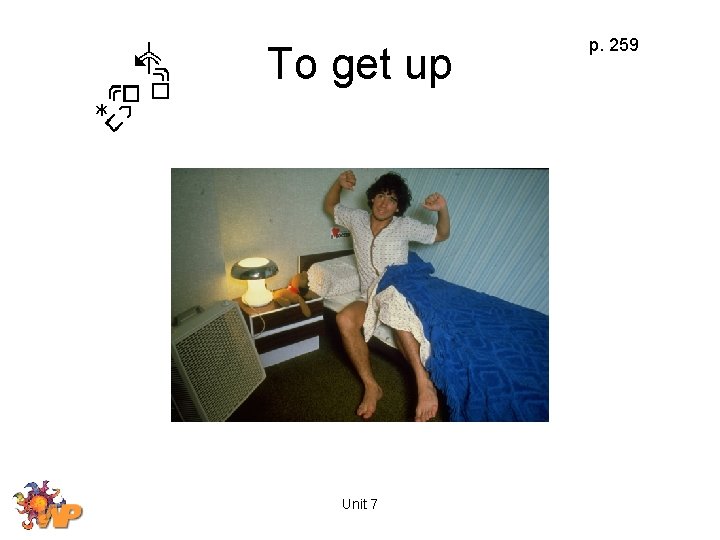
To get up Unit 7 p. 259
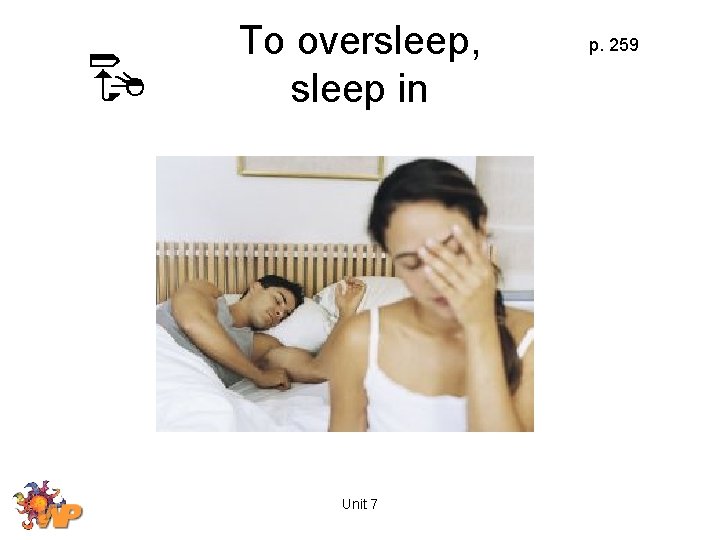
To oversleep, sleep in Unit 7 p. 259
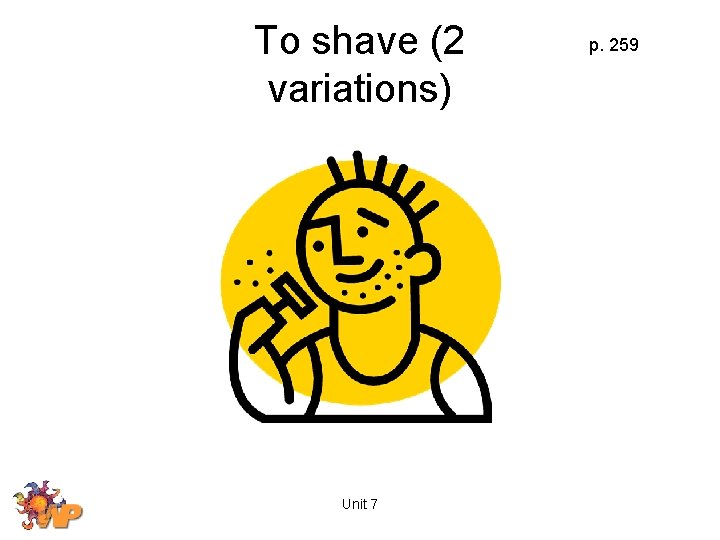
To shave (2 variations) Unit 7 p. 259
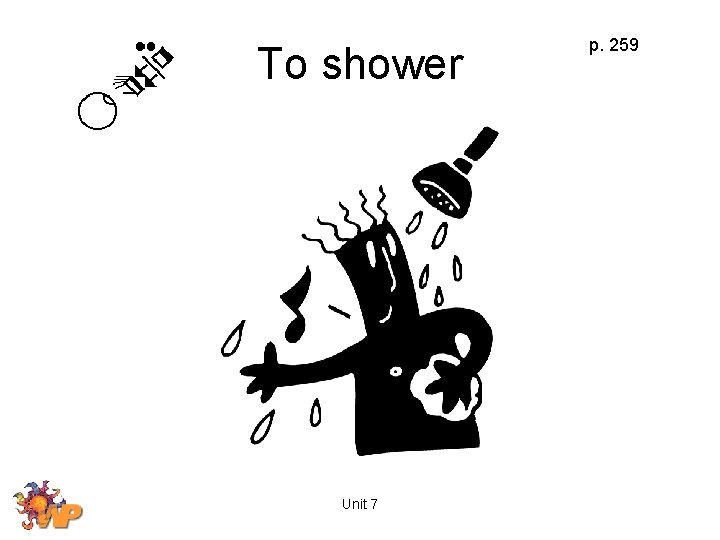
To shower Unit 7 p. 259
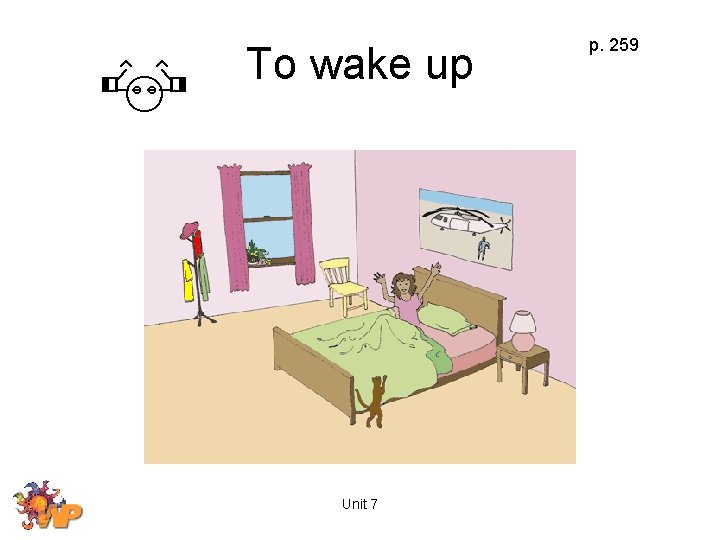
To wake up Unit 7 p. 259
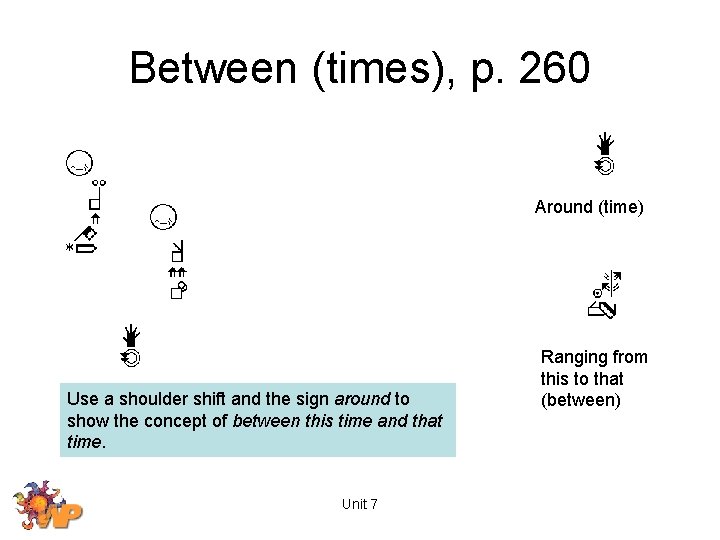
Between (times), p. 260 Around (time) Use a shoulder shift and the sign around to show the concept of between this time and that time. Unit 7 Ranging from this to that (between)
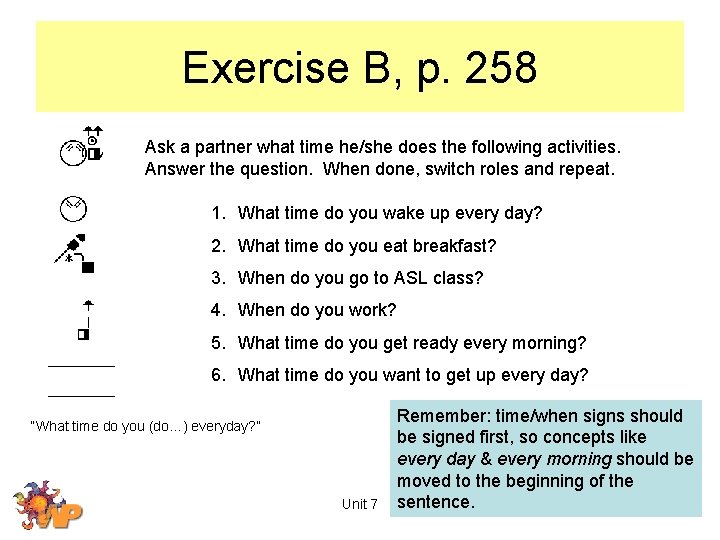
Exercise B, p. 258 Ask a partner what time he/she does the following activities. Answer the question. When done, switch roles and repeat. 1. What time do you wake up every day? 2. What time do you eat breakfast? 3. When do you go to ASL class? 4. When do you work? 5. What time do you get ready every morning? 6. What time do you want to get up every day? “What time do you (do…) everyday? ” Unit 7 Remember: time/when signs should be signed first, so concepts like every day & every morning should be moved to the beginning of the sentence.
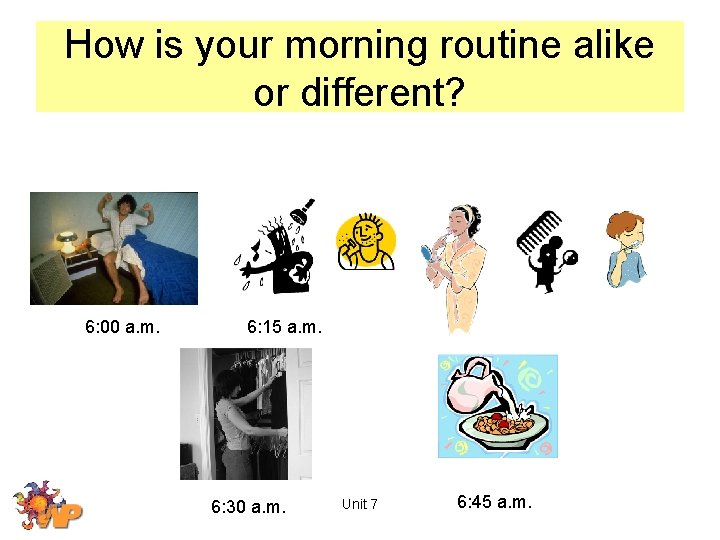
How is your morning routine alike or different? 6: 00 a. m. 6: 15 a. m. 6: 30 a. m. Unit 7 6: 45 a. m.
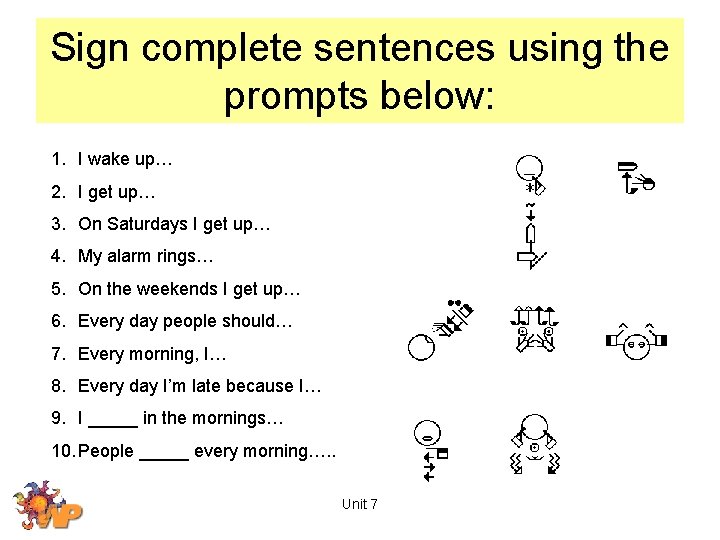
Sign complete sentences using the prompts below: 1. I wake up… 2. I get up… 3. On Saturdays I get up… 4. My alarm rings… 5. On the weekends I get up… 6. Every day people should… 7. Every morning, I… 8. Every day I’m late because I… 9. I _____ in the mornings… 10. People _____ every morning…. . Unit 7
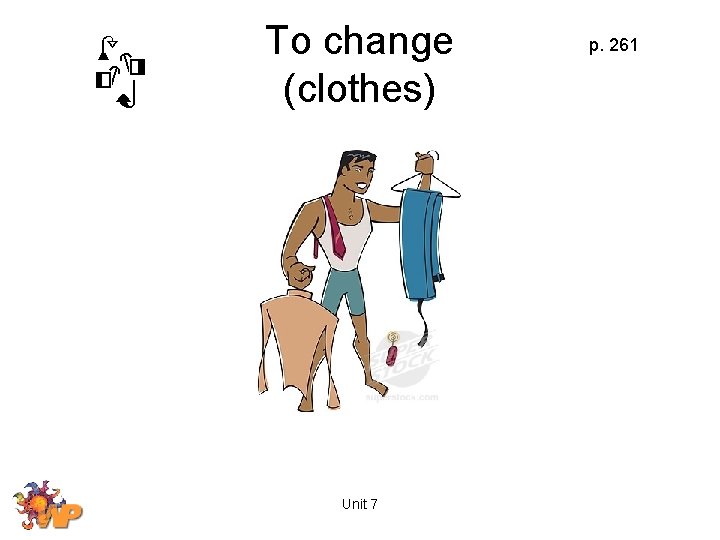
To change (clothes) Unit 7 p. 261
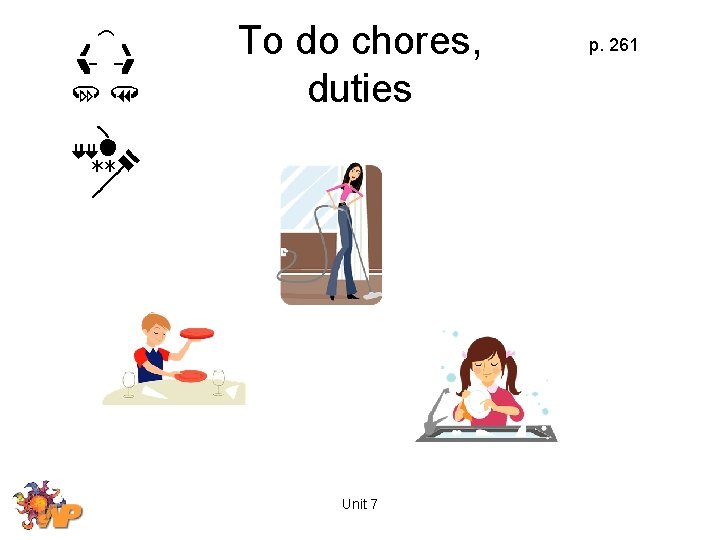
To do chores, duties Unit 7 p. 261
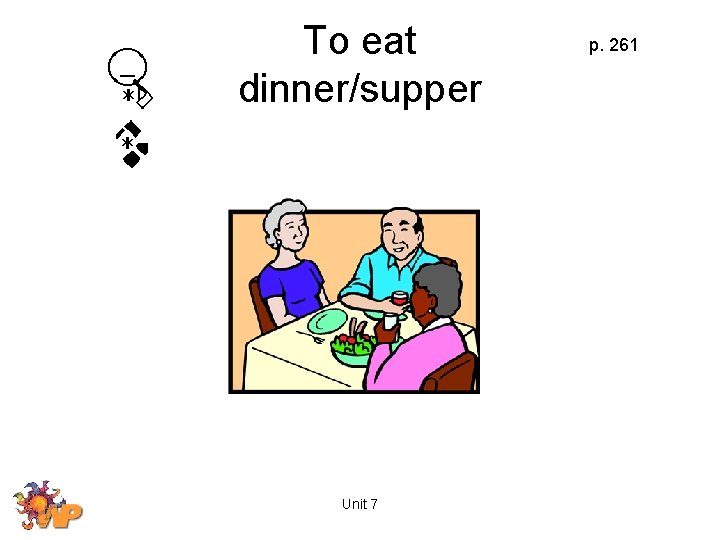
To eat dinner/supper Unit 7 p. 261
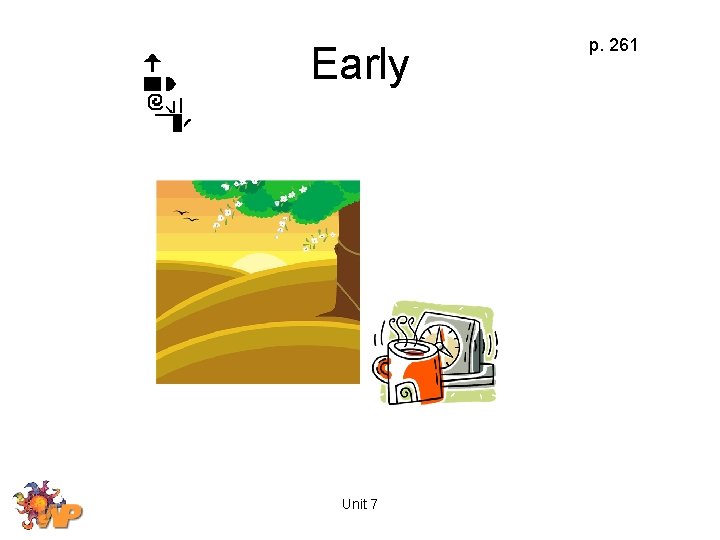
Early Unit 7 p. 261
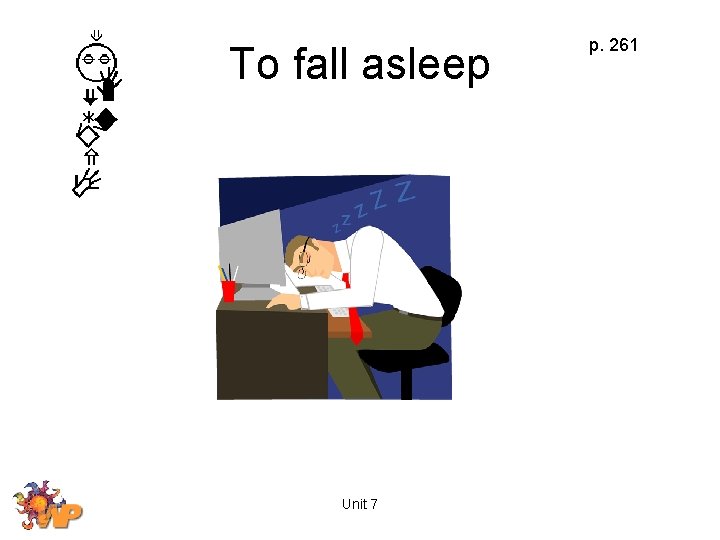
To fall asleep Unit 7 p. 261
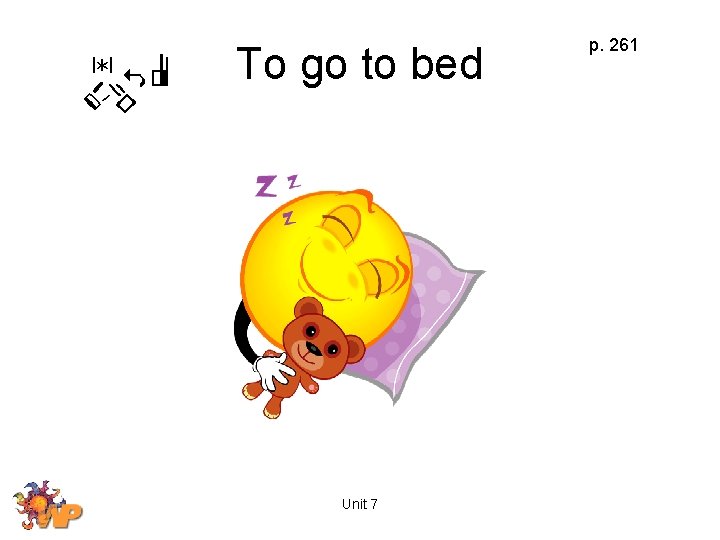
To go to bed Unit 7 p. 261
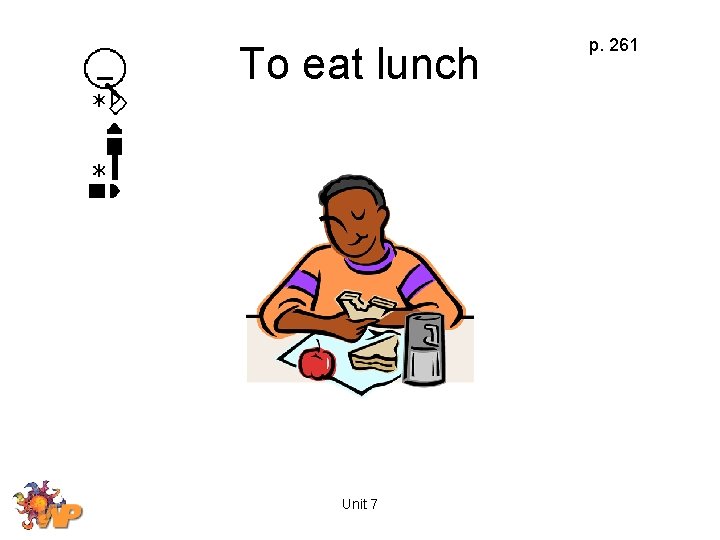
To eat lunch Unit 7 p. 261
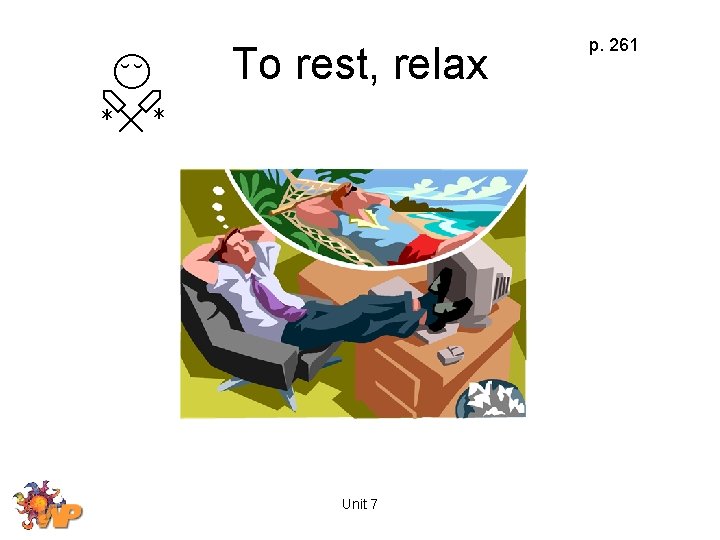
To rest, relax Unit 7 p. 261
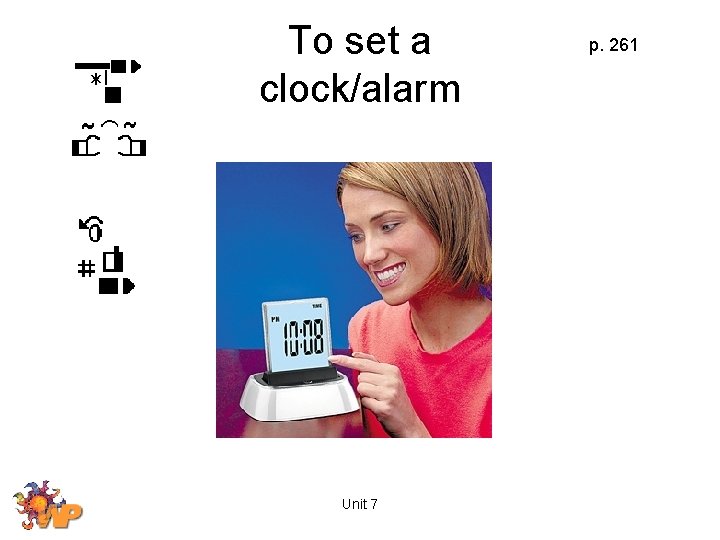
To set a clock/alarm Unit 7 p. 261
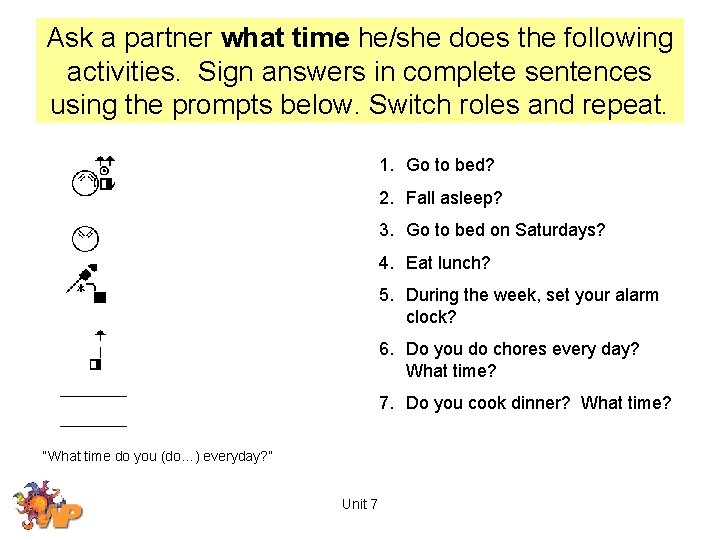
Ask a partner what time he/she does the following activities. Sign answers in complete sentences using the prompts below. Switch roles and repeat. 1. Go to bed? 2. Fall asleep? 3. Go to bed on Saturdays? 4. Eat lunch? 5. During the week, set your alarm clock? 6. Do you do chores every day? What time? 7. Do you cook dinner? What time? “What time do you (do…) everyday? ” Unit 7
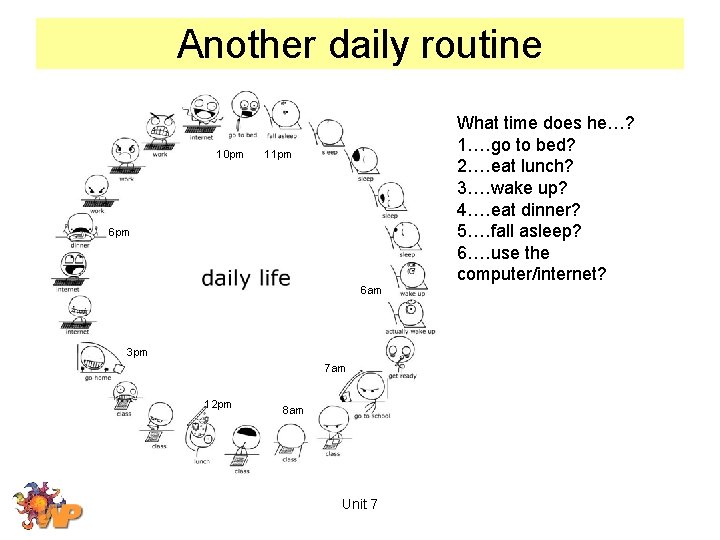
Another daily routine 10 pm 11 pm 6 am 3 pm 7 am 12 pm 8 am Unit 7 What time does he…? 1. …go to bed? 2. …eat lunch? 3. …wake up? 4. …eat dinner? 5. …fall asleep? 6. …use the computer/internet?
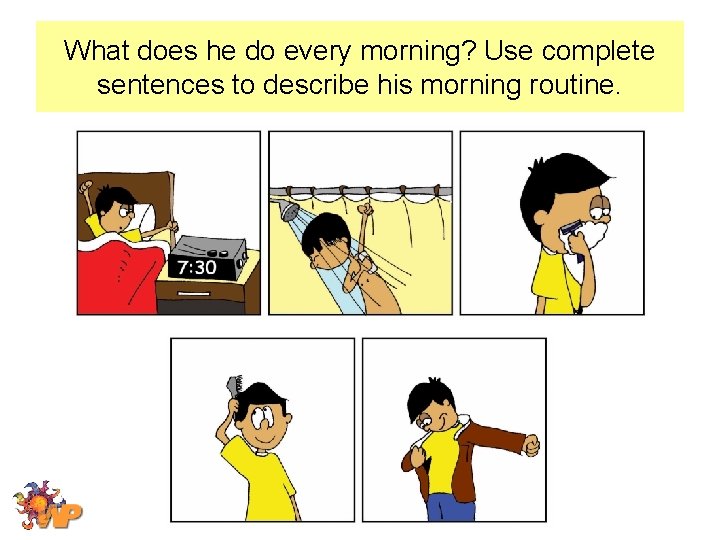
What does he do every morning? Use complete sentences to describe his morning routine.
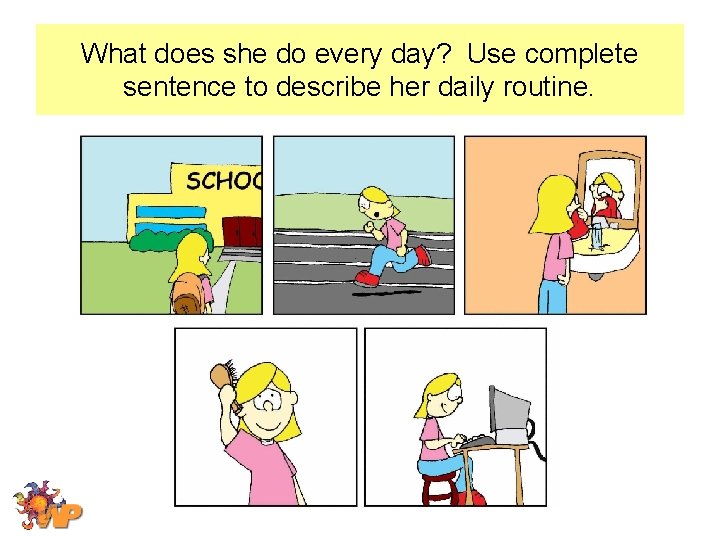
What does she do every day? Use complete sentence to describe her daily routine.
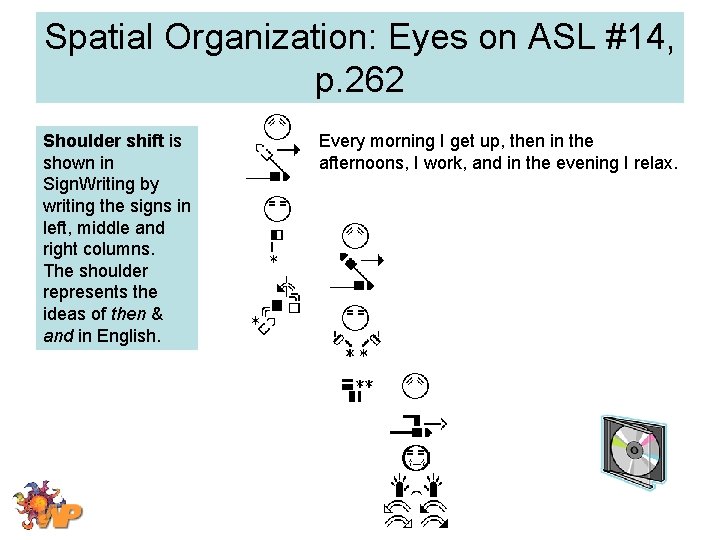
Spatial Organization: Eyes on ASL #14, p. 262 Shoulder shift is shown in Sign. Writing by writing the signs in left, middle and right columns. The shoulder represents the ideas of then & and in English. Every morning I get up, then in the afternoons, I work, and in the evening I relax.
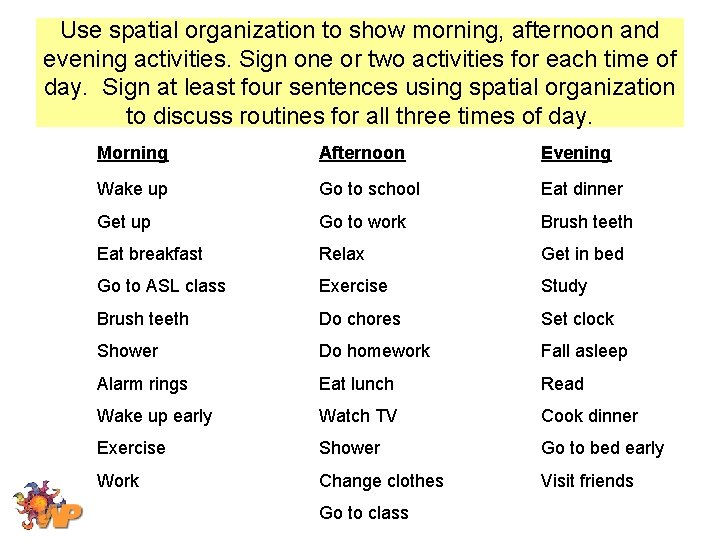
Use spatial organization to show morning, afternoon and evening activities. Sign one or two activities for each time of day. Sign at least four sentences using spatial organization to discuss routines for all three times of day. Morning Afternoon Evening Wake up Go to school Eat dinner Get up Go to work Brush teeth Eat breakfast Relax Get in bed Go to ASL class Exercise Study Brush teeth Do chores Set clock Shower Do homework Fall asleep Alarm rings Eat lunch Read Wake up early Watch TV Cook dinner Exercise Shower Go to bed early Work Change clothes Visit friends Go to class
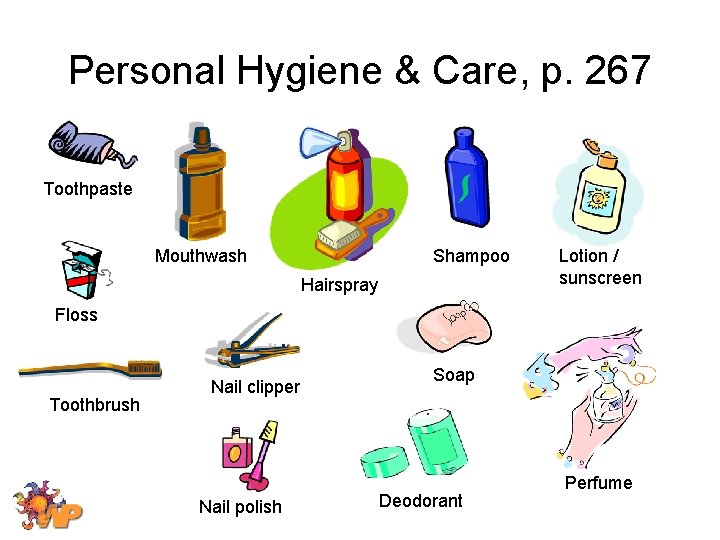
Personal Hygiene & Care, p. 267 Toothpaste Mouthwash Shampoo Hairspray Lotion / sunscreen Floss Toothbrush Nail clipper Nail polish Soap Deodorant Perfume
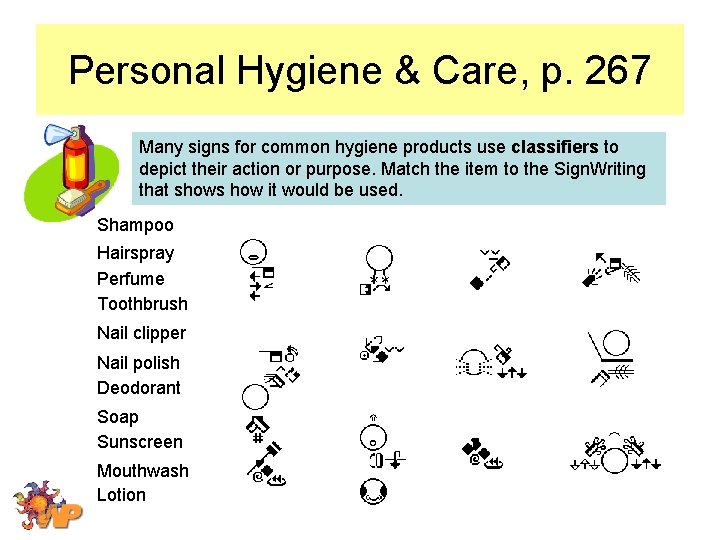
Personal Hygiene & Care, p. 267 Many signs for common hygiene products use classifiers to depict their action or purpose. Match the item to the Sign. Writing that shows how it would be used. Shampoo Hairspray Perfume Toothbrush Nail clipper Nail polish Deodorant Soap Sunscreen Mouthwash Lotion
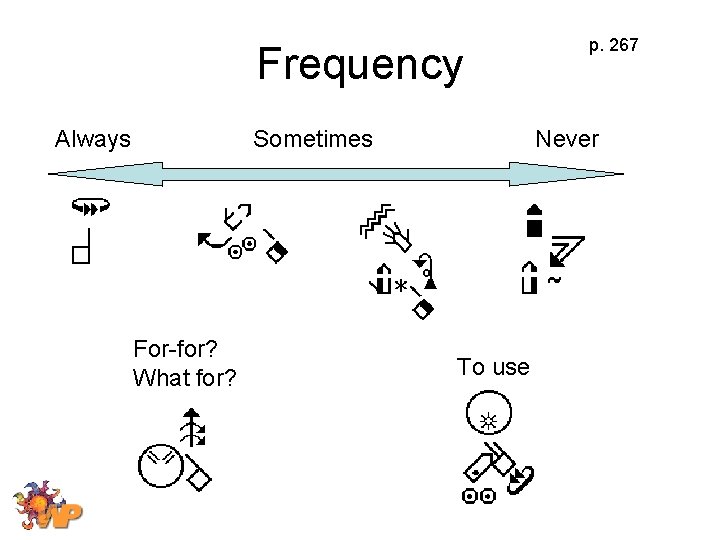
Frequency Always Sometimes For-for? What for? p. 267 Never To use
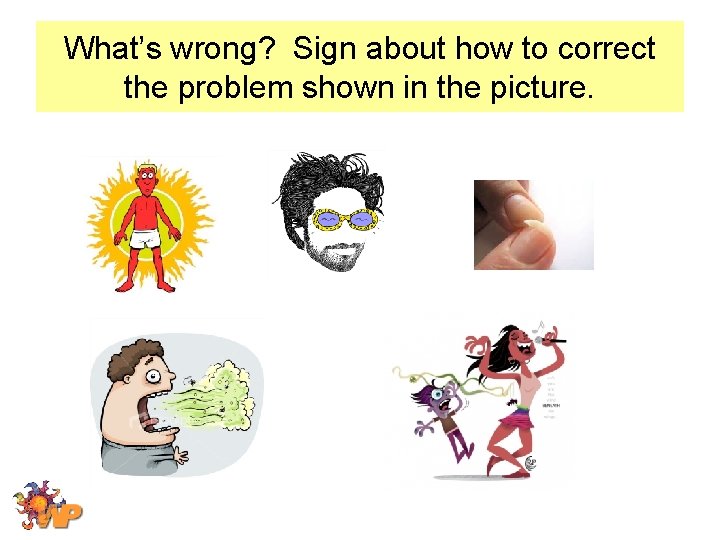
What’s wrong? Sign about how to correct the problem shown in the picture.
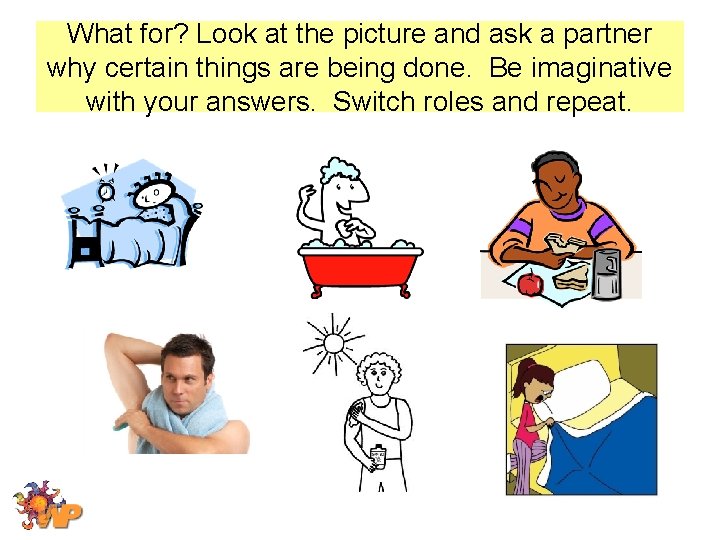
What for? Look at the picture and ask a partner why certain things are being done. Be imaginative with your answers. Switch roles and repeat.
Captioning, p. 269 Closed captioning means that the captions are programmed into the original material and must be turned on to work. Open captions are always present on the screen and cannot be turned off. The National Association of the Deaf (NAD) has lobbied Congress to have captioning offered on television, movie screens, and other locations accessible to the public (including on the internet). Since the Americans with Disabilities Act (ADA) passed in 1990, captioning is now common on most TV shows & commercials. This benefits Deaf, hard of hearing and hearing people. Did you know it is relatively easy to caption your own video using widely available computer video editing programs?

To clean p. 271
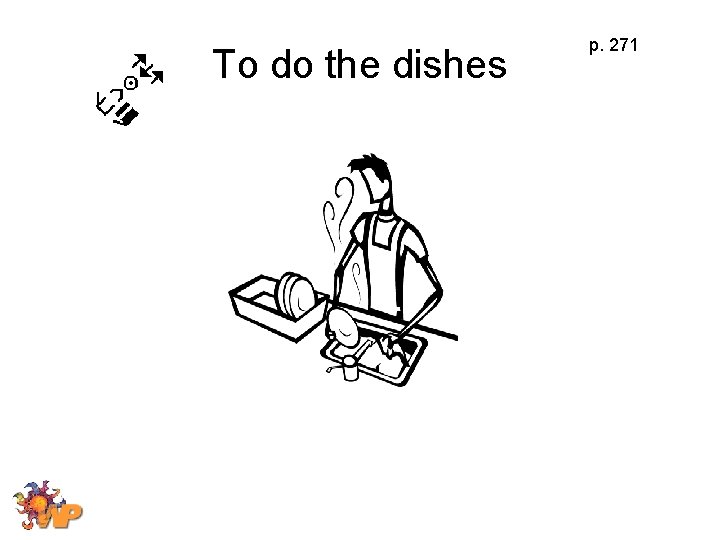
To do the dishes p. 271
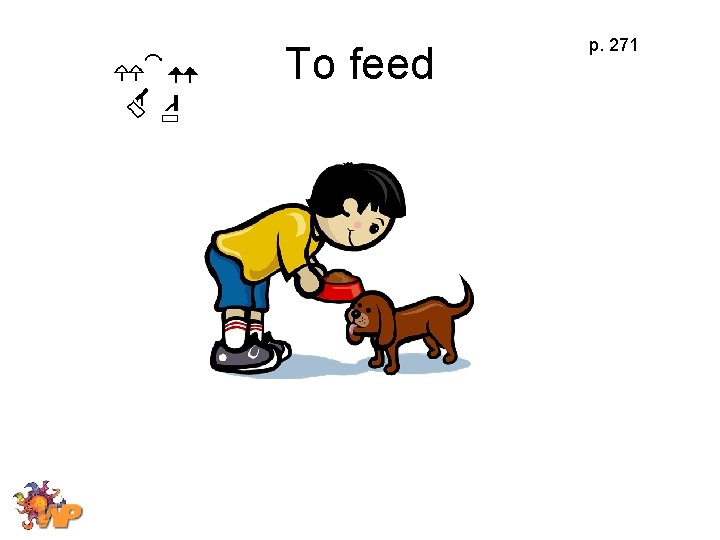
To feed p. 271
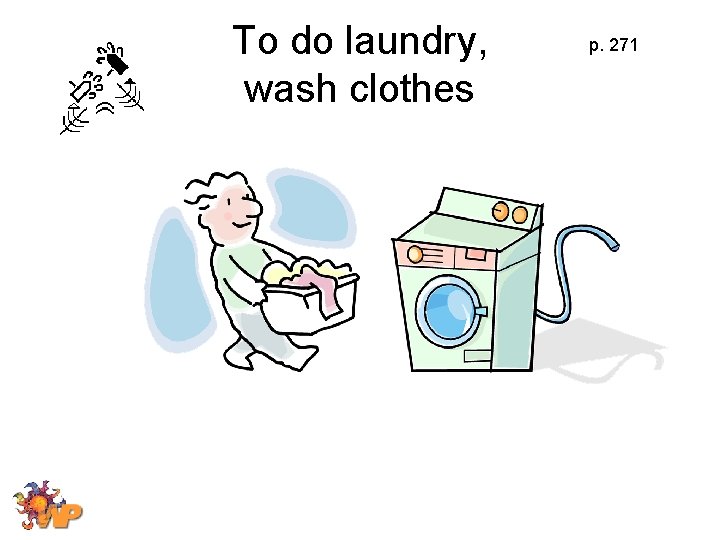
To do laundry, wash clothes p. 271
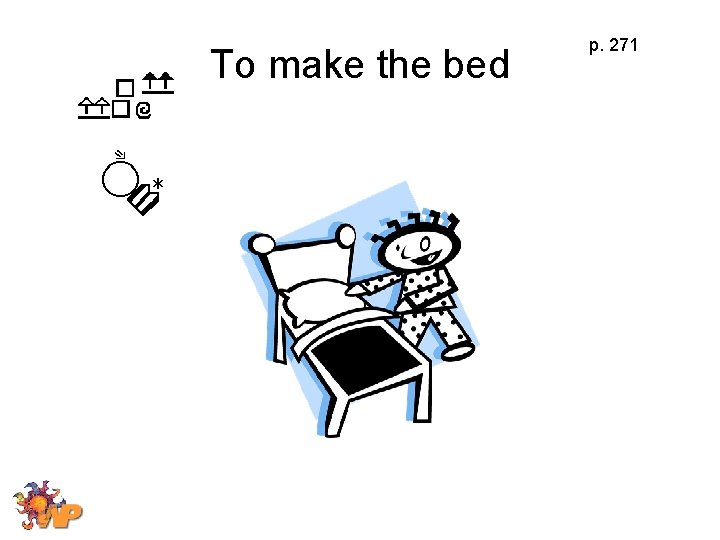
To make the bed p. 271
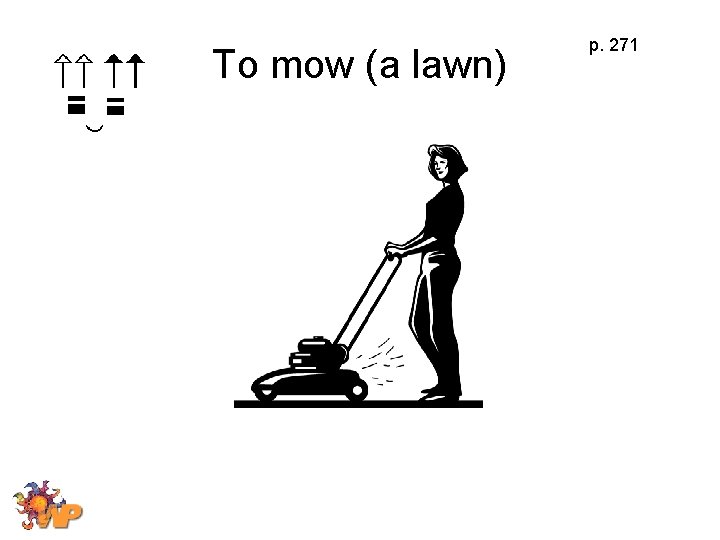
To mow (a lawn) p. 271
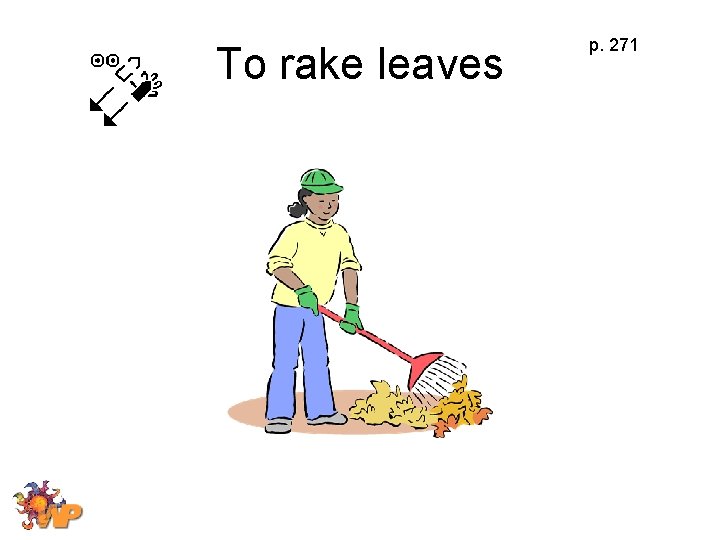
To rake leaves p. 271
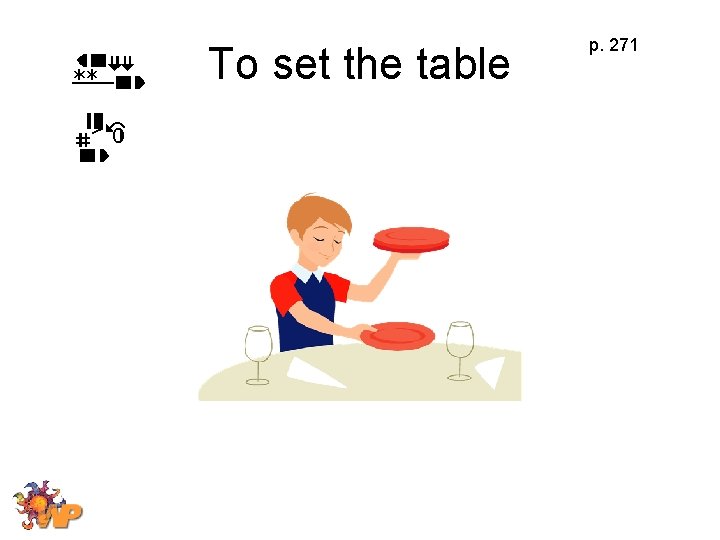
To set the table p. 271
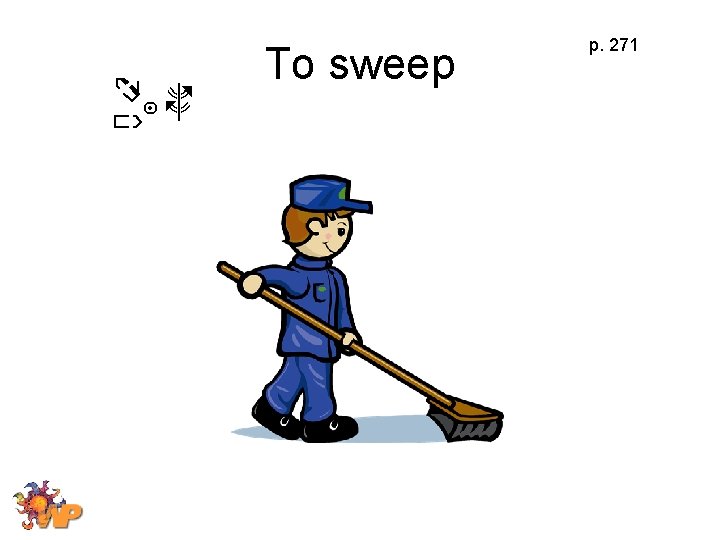
To sweep p. 271
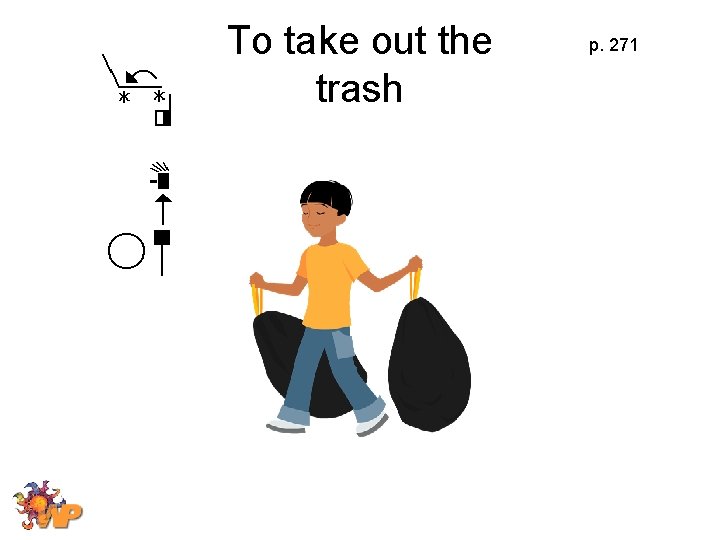
To take out the trash p. 271
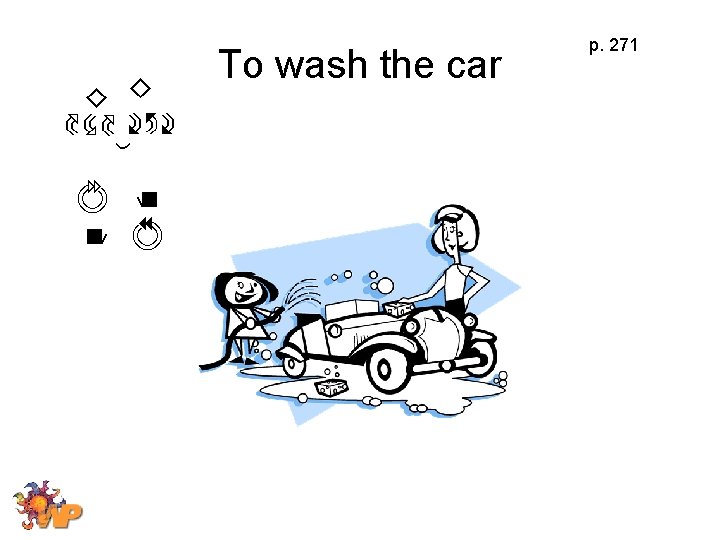
To wash the car p. 271
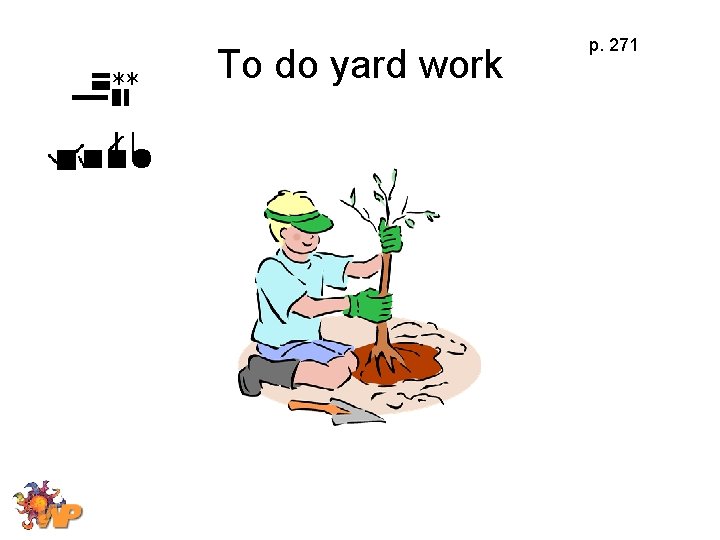
To do yard work p. 271
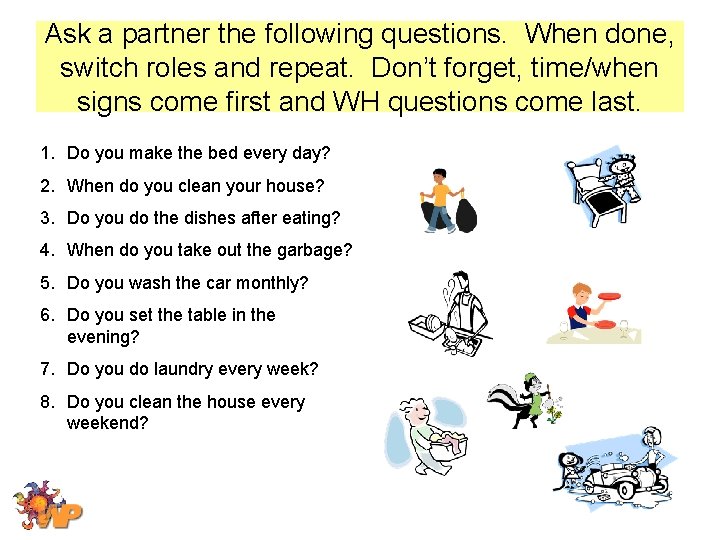
Ask a partner the following questions. When done, switch roles and repeat. Don’t forget, time/when signs come first and WH questions come last. 1. Do you make the bed every day? 2. When do you clean your house? 3. Do you do the dishes after eating? 4. When do you take out the garbage? 5. Do you wash the car monthly? 6. Do you set the table in the evening? 7. Do you do laundry every week? 8. Do you clean the house every weekend?
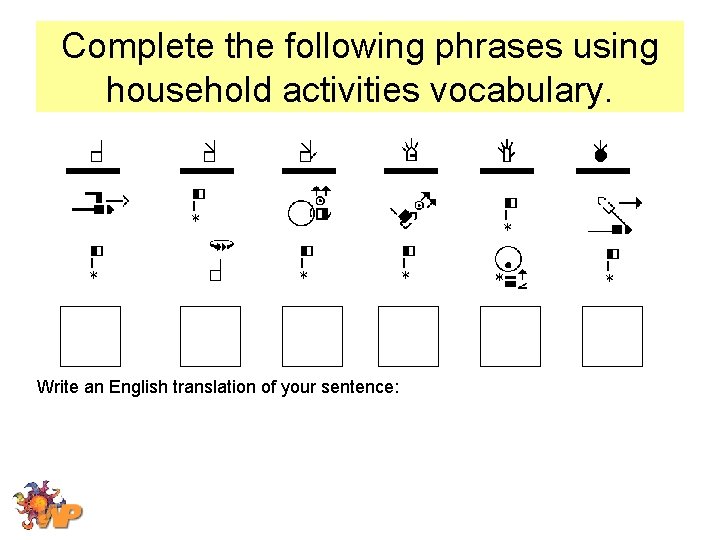
Complete the following phrases using household activities vocabulary. Write an English translation of your sentence:
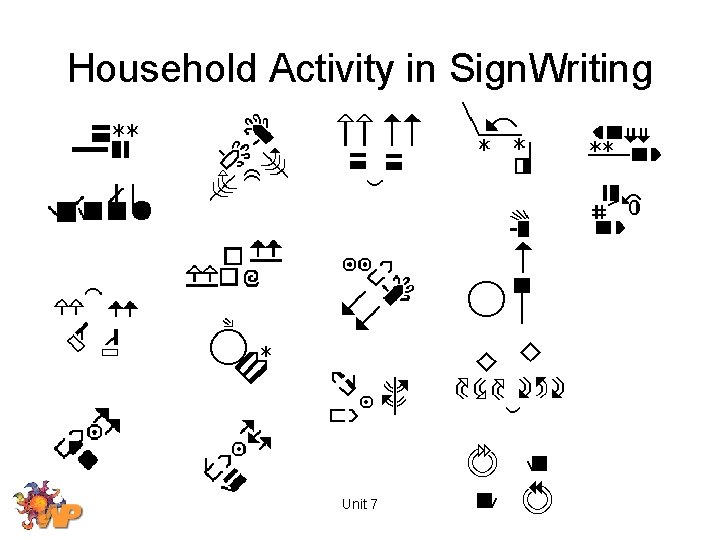
Household Activity in Sign. Writing Unit 7

Sign each sentence in ASL. Remember to place when signs in their correct location. 1. I don’t like raking leaves. 6. I do laundry on Wednesdays. 2. I wash the car every Saturday. 7. I feed my cat and dog every night. 3. I never make my bed in the morning. 8. Once in a while I clean my room. 4. I don’t mind mowing the lawn. 5. Every night I help cook, and then I do the dishes. 9. I take out the garbage after dinner. 10. I always set the table.
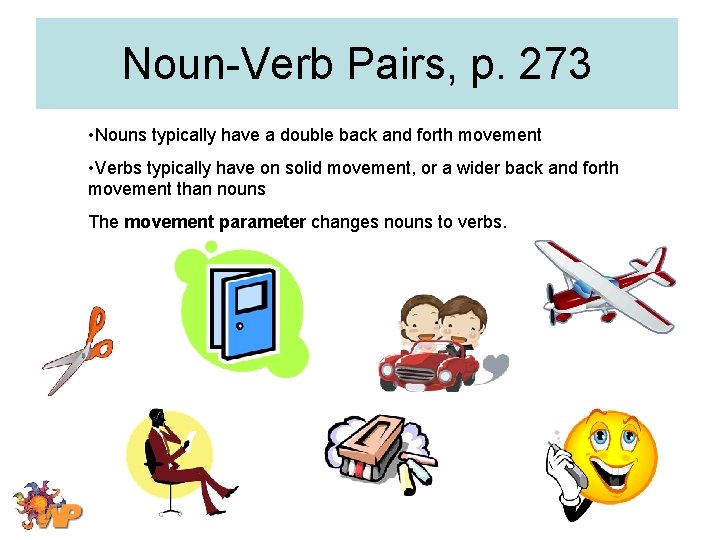
Noun-Verb Pairs, p. 273 • Nouns typically have a double back and forth movement • Verbs typically have on solid movement, or a wider back and forth movement than nouns The movement parameter changes nouns to verbs.
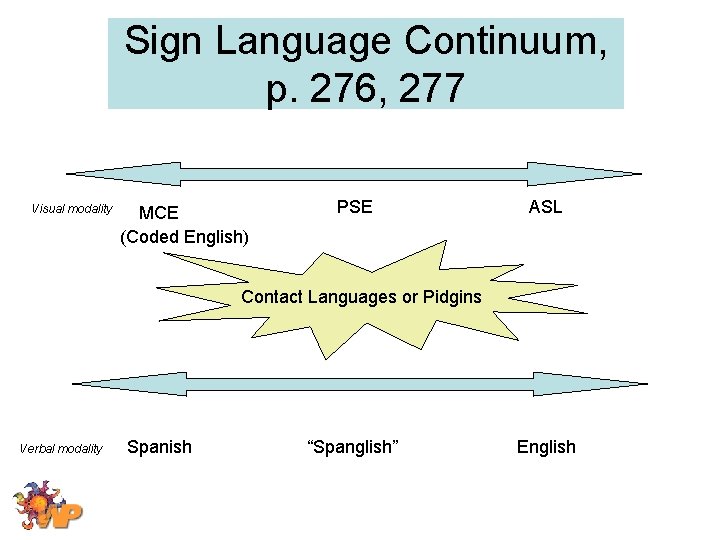
Sign Language Continuum, p. 276, 277 Visual modality MCE (Coded English) PSE ASL Contact Languages or Pidgins Verbal modality Spanish “Spanglish” English
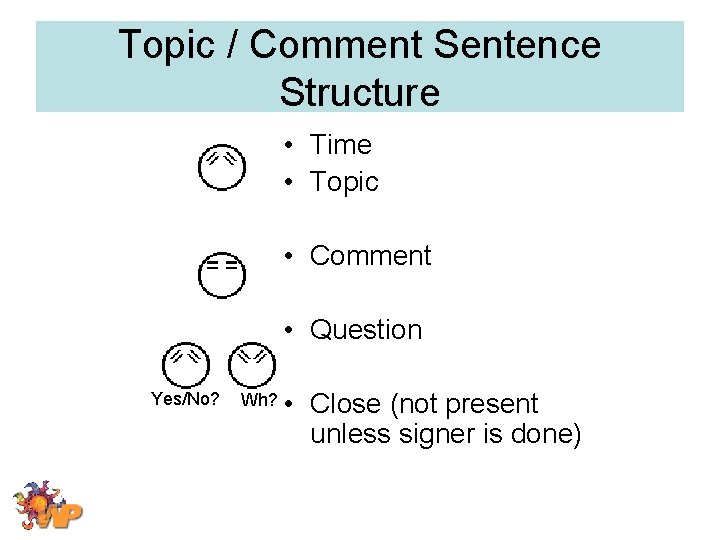
Topic / Comment Sentence Structure • Time • Topic • Comment • Question Yes/No? Wh? • Close (not present unless signer is done)
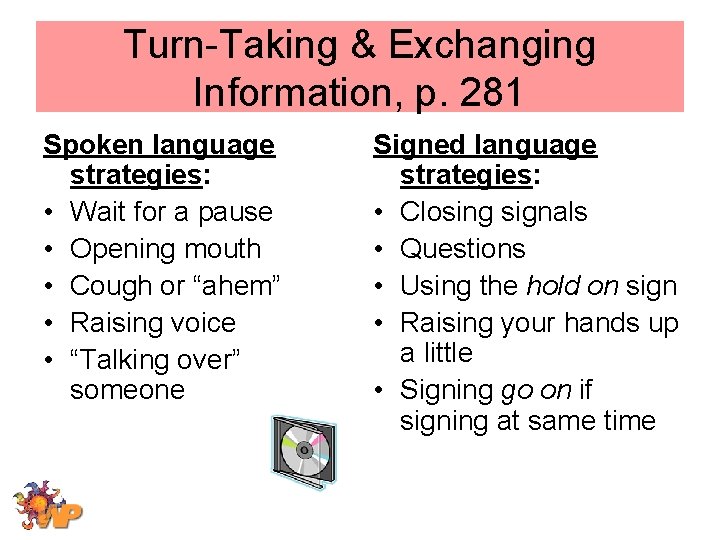
Turn-Taking & Exchanging Information, p. 281 Spoken language strategies: • Wait for a pause • Opening mouth • Cough or “ahem” • Raising voice • “Talking over” someone Signed language strategies: • Closing signals • Questions • Using the hold on sign • Raising your hands up a little • Signing go on if signing at same time
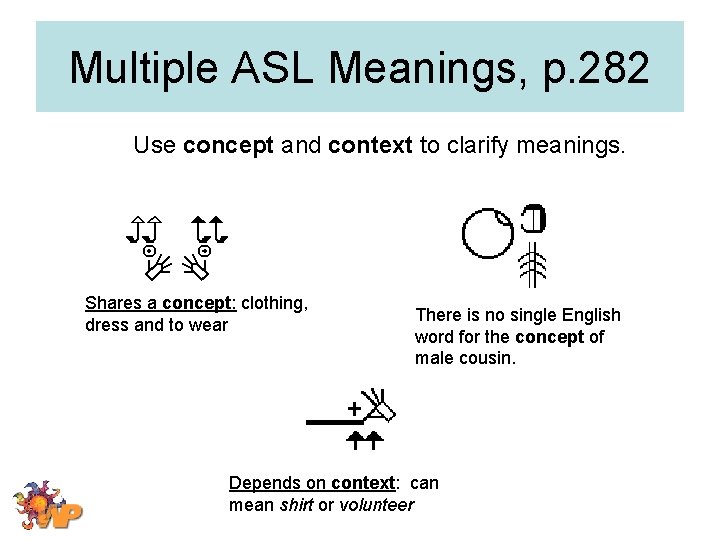
Multiple ASL Meanings, p. 282 Use concept and context to clarify meanings. Shares a concept: clothing, dress and to wear There is no single English word for the concept of male cousin. Depends on context: can mean shirt or volunteer
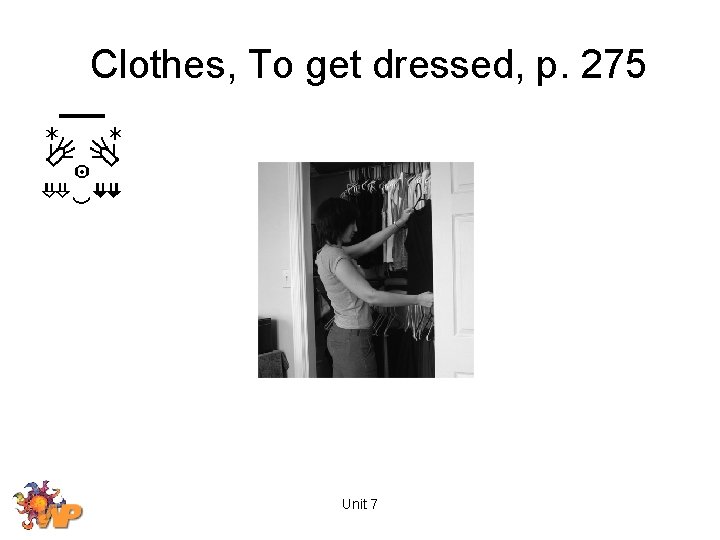
Clothes, To get dressed, p. 275 Unit 7
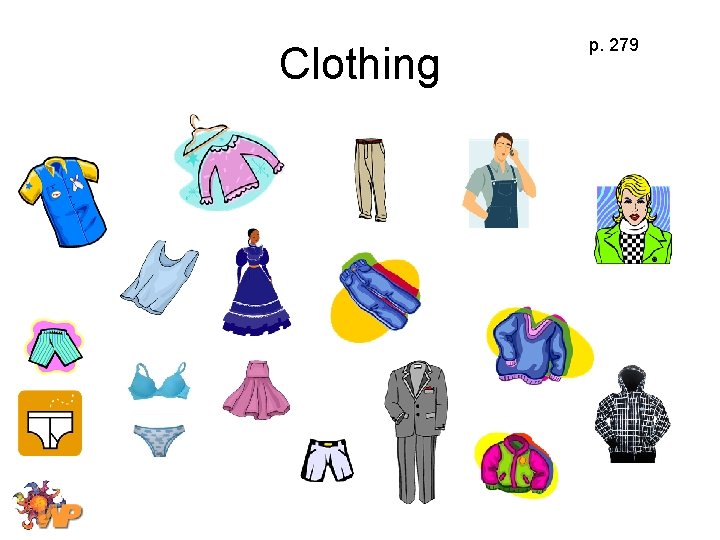
Clothing p. 279
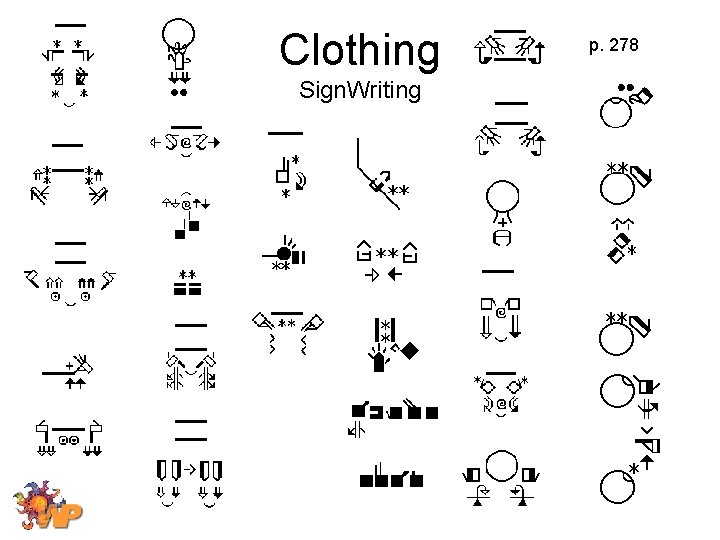
Clothing Sign. Writing p. 278
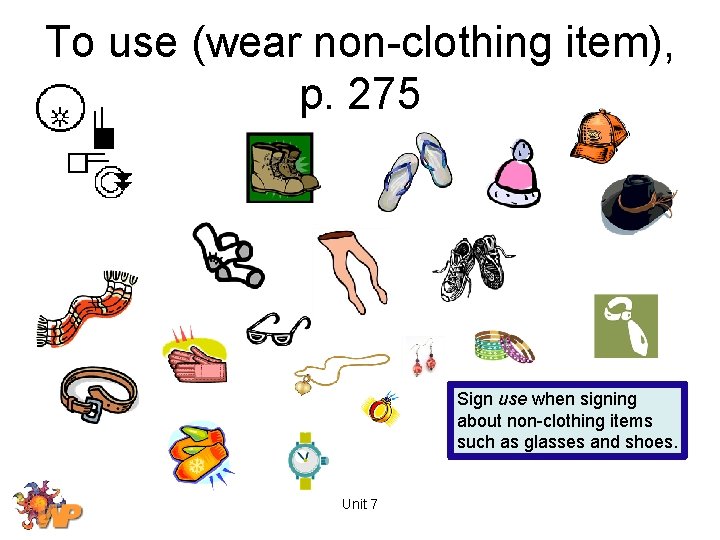
To use (wear non-clothing item), p. 275 Sign use when signing about non-clothing items such as glasses and shoes. Unit 7
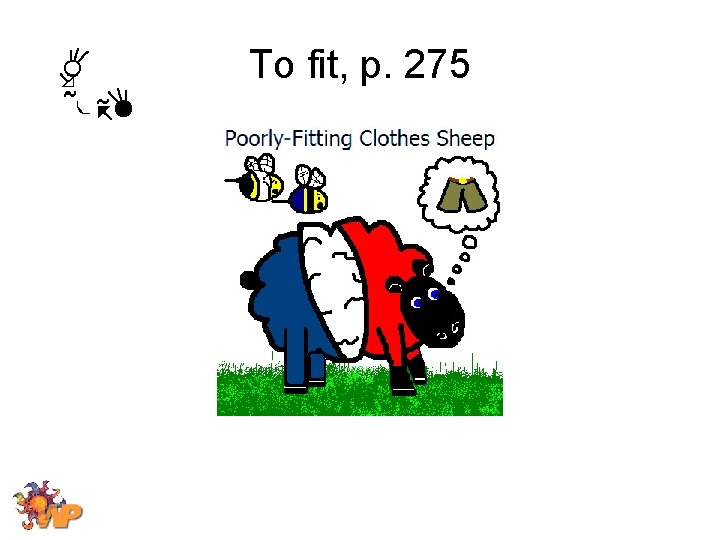
To fit, p. 275

To match, p. 275
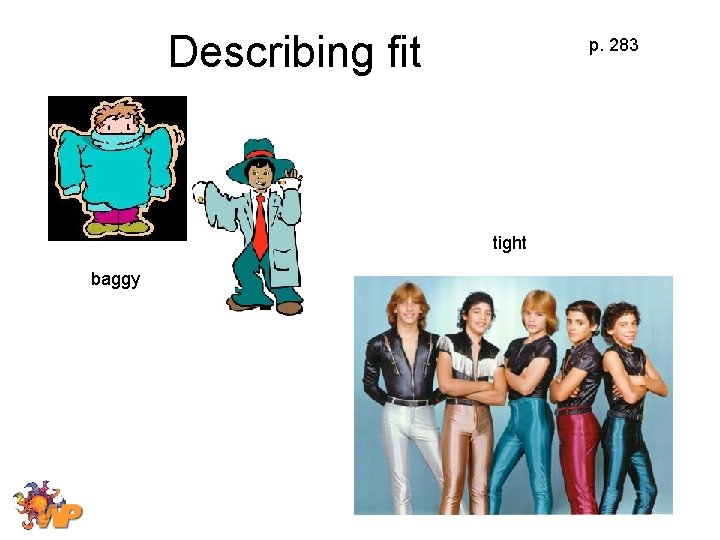
Describing fit p. 283 tight baggy
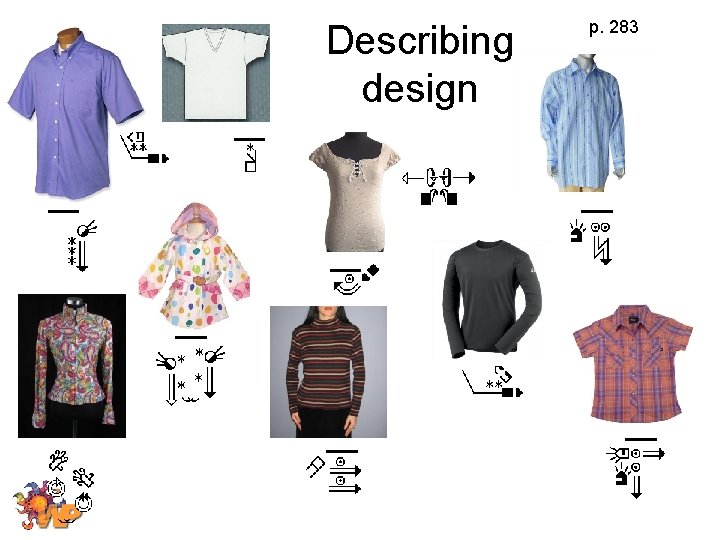
Describing design p. 283
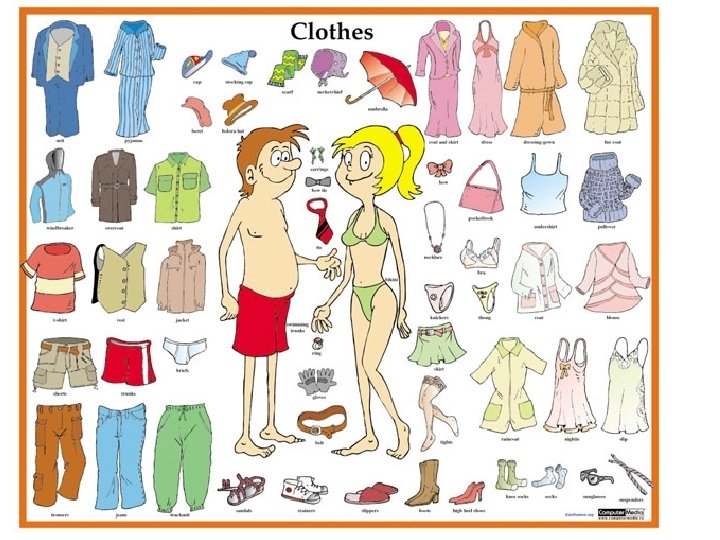
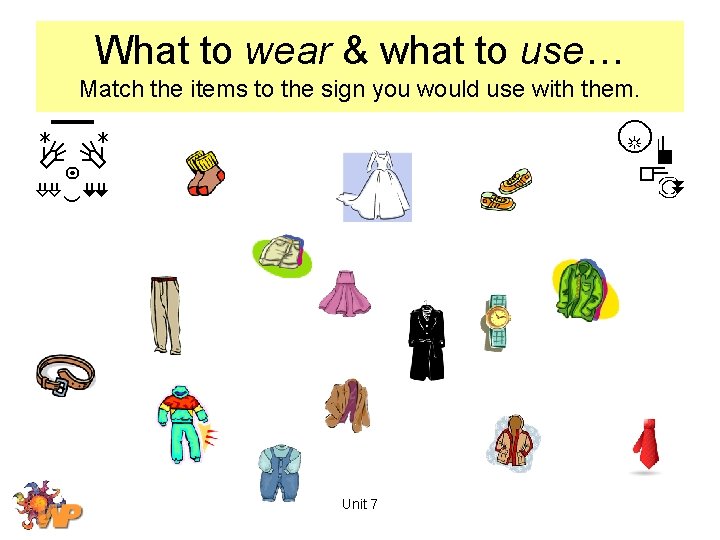
What to wear & what to use… Match the items to the sign you would use with them. Unit 7
1. Describe what at least 5 other people in the room are wearing. 2. Translate the following sentences: 1. I’m wearing sandals. 2. He has a sweatshirt on. 3. She’s wearing boots with jeans. 4. I like wearing flip-flops 5. She’s wearing a blue blouse and jacket. 6. He’s wearing brown shoes. 7. People wear shoes every day. 8. I’m wearing tennis shoes / sneakers today.
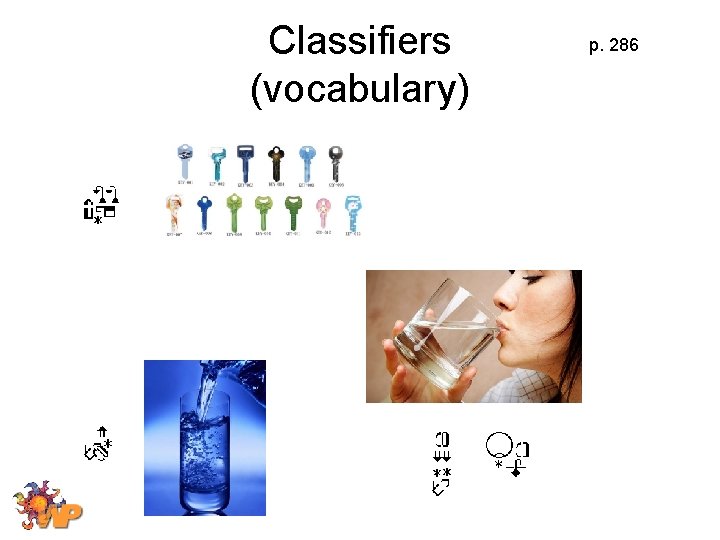
Classifiers (vocabulary) p. 286
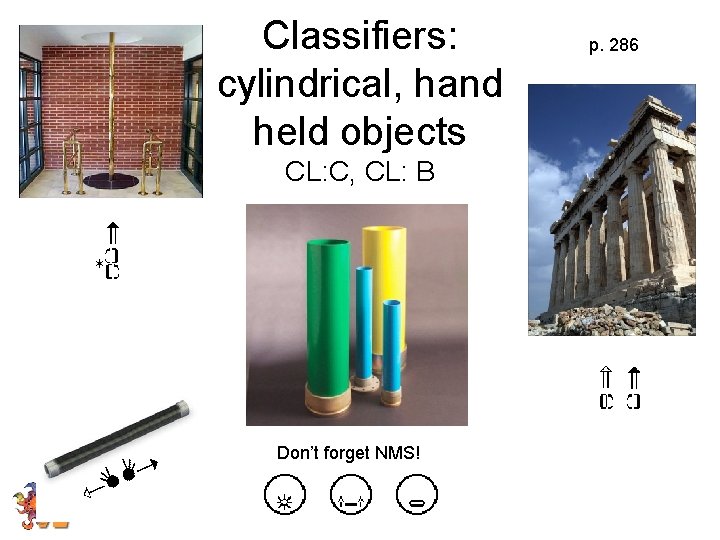
Classifiers: cylindrical, hand held objects CL: C, CL: B Don’t forget NMS! p. 286
- Slides: 89