
UNIT 7 HUMAN POPULATION GROWTH AND ITS IMPACTS
- Slides: 20
UNIT 7 HUMAN POPULATION GROWTH AND ITS IMPACTS APARAJITA MUKHERJEE THK JAIN COLLEGE
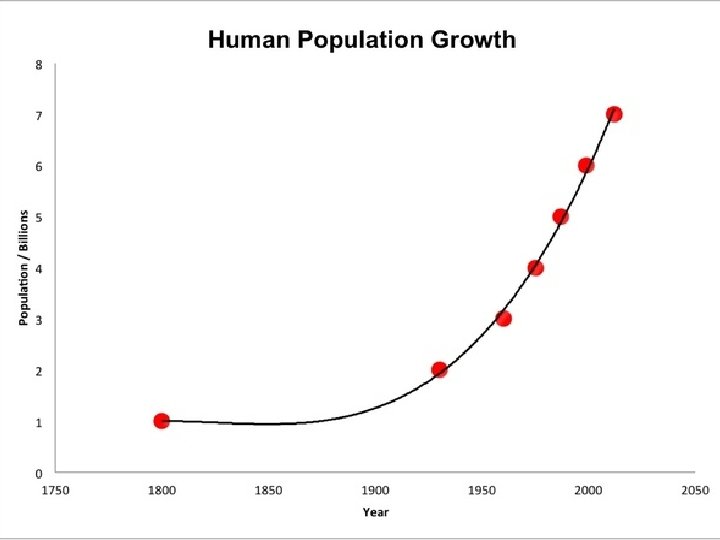
World Human Population • In biology, a population is the total number of organisms of the same group or species which live in a particular geographical area, and have the capability of interbreeding. • In demographics, the world population is the total number of humans currently living in the world. • It was estimated to have reached 7. 8 billion people as of March 2020. • It took over 200, 000 years of human history for the world's population to reach 1 billion, and only 200 years more to reach 7 billion.
Population Growth • Population growth is the increase in the number of individuals in a population. • Global human population growth amounts to around 83 million annually, or 1. 1% per year. • The global population has grown from 1 billion in 1800 to 7. 774 billion in 2020. • It is expected to keep growing, and estimates have put the total population at 8. 6 billion by mid-2030, 9. 8 billion by mid-2050 and 11. 2 billion by 2100. • The rapid increase in world's human population since the end of World War II, attributed to an accelerating birthrate, a decrease in infant mortality, and an increase in life expectancy • Many nations with rapid population growth have low standards of living, whereas many nations with low rates of population growth have high standards of living
Reasons of Population growth • Human overpopulation occurs if the number of people in a group exceeds the carrying capacity of the region occupied by that group. • The reasons of population explosion are: § Better health care leads to a decline in the death rate § The rise in the Birth Rate § Poverty § Lack of Education/ awareness § Cultural Influences against birth control § Lack of Family Planning § Immigration
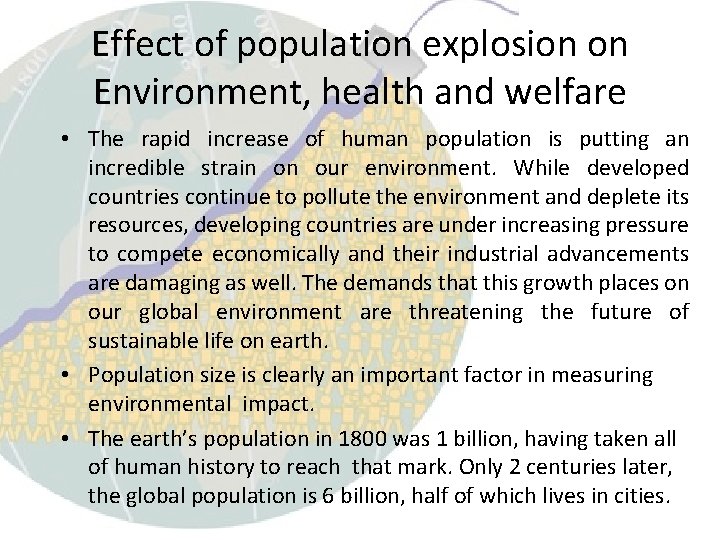
Effect of population explosion on Environment, health and welfare • The rapid increase of human population is putting an incredible strain on our environment. While developed countries continue to pollute the environment and deplete its resources, developing countries are under increasing pressure to compete economically and their industrial advancements are damaging as well. The demands that this growth places on our global environment are threatening the future of sustainable life on earth. • Population size is clearly an important factor in measuring environmental impact. • The earth’s population in 1800 was 1 billion, having taken all of human history to reach that mark. Only 2 centuries later, the global population is 6 billion, half of which lives in cities.
Impacts of Population Growth on the Physical Environment: Ø Physical environment means – non living environment or the land, air, water, soil and minerals. Ø The utilization, overuse and misuse of physical resources increased manifold due to the growth of human population. Ø More cultivable land has been made available by clearing forests and by reclaiming wet lands, ponds and green belts. Ø Advanced agriculture requires utilization of more water, more fertilizers and more pesticides. Application of fertilizers and pesticides makes the soil infertile. Ø Clearing of forests has its own serious impacts and the environment on the whole gets imbalanced. Ø More population means more space to construct houses and availability of more consumer goods. It also requires more means of transport, more consumption of fossil fuels and more pollution of air, land water. Ø Thus growth of population leads to pollution of air, land water. Different types of pollutions are causing a number of problems in the physical environment that are further affecting the biological environment seriously
Pollution • • • One of the major issues that have lately been bothering environmentalists all over the world is global warming. Like glass in a greenhouse, gases like carbon monoxide admit the sun's light but tend to reflect back downward the heat that is radiated from the ground below, trapping heat in the earth's atmosphere. This is called the greenhouse effect. Air pollution is not the only environmental damage being done by the increasing population. Nowadays water pollution is also one of the increasing problems due to the population explosion. Water is considered the essence of life. As in the case of air pollution, the increasing population calls for increasing numbers of factories. These factories lead to various kinds of pollution, including water pollution. Also, India being an agrarian country, the water pollution also comes from pesticides used for agriculture. As we can observe, the increased population size is leading to increased pollution, which in turn is leading to a more hostile environment for human beings themselves Increasing population is leading to increased crop production. To ensure that more chemical pesticides and fertilizers are being used leading to soil pollution. Increased population and people’s ill activity often cause noise pollution and vision pollution (city sky is almost getting covered with banners and hoardings)
Deforestation • Enhancing the quality of environment by influencing the ecological balance and life support system (checking soil erosion, maintaining soil fertility, conserving water, regulating water cycles and floods, balancing carbon dioxide and oxygen content in atmosphere etc. • India has a forest cover of 76. 52 million square kms. of recorded forest area, while only 63. 34 million square kms. can be classified as actual forest cover. In the year 1997, as compared to 1993, the total forest cover has decreased by 6710 Sq. Kms. • The states, which have shown significant decline in the forest covers, are Andhra Pradesh and Madhya Pradesh. Continuing deforestation, therefore, has brought us face to face with a major ecological and socio-economic crisis.
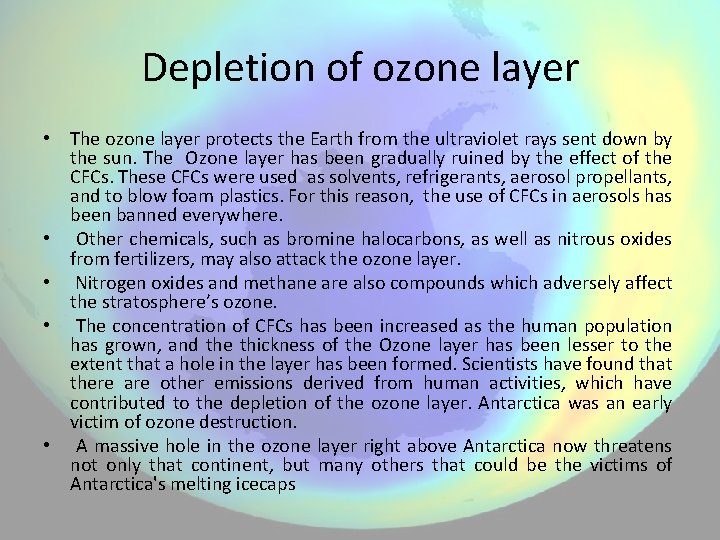
Depletion of ozone layer • The ozone layer protects the Earth from the ultraviolet rays sent down by the sun. The Ozone layer has been gradually ruined by the effect of the CFCs. These CFCs were used as solvents, refrigerants, aerosol propellants, and to blow foam plastics. For this reason, the use of CFCs in aerosols has been banned everywhere. • Other chemicals, such as bromine halocarbons, as well as nitrous oxides from fertilizers, may also attack the ozone layer. • Nitrogen oxides and methane are also compounds which adversely affect the stratosphere’s ozone. • The concentration of CFCs has been increased as the human population has grown, and the thickness of the Ozone layer has been lesser to the extent that a hole in the layer has been formed. Scientists have found that there are other emissions derived from human activities, which have contributed to the depletion of the ozone layer. Antarctica was an early victim of ozone destruction. • A massive hole in the ozone layer right above Antarctica now threatens not only that continent, but many others that could be the victims of Antarctica's melting icecaps
Extinction of species • Today, human activities are causing a massive extinction of species, the full implications of which are barely understood. • More than 1. 1 billion people live in areas that conservationists consider the richest in non-human species and the most threatened by human activities. While these areas comprise about 12 percent of the planet's land surface, they hold nearly 20 percent of its human population. • The population in these biodiversity hotspots is growing at a collective rate of 1. 8 percent annually, compared to the world's population's annual growth rate of 1. 3 percent. • Modern agricultural practices strip the Earth of its thin layer of topsoil through water and wind erosion, destroying this precious micro ecosystem that takes centuries to form and supports all life on land. • Many species are of immense value to humans as sources of food, medicines, fuel and building • materials. Between 10, 000 and 20, 000 plant species are used in medicines worldwide. • The diversity of nature helps meet the recreational, emotional, cultural, spiritual and aesthetic needs of people
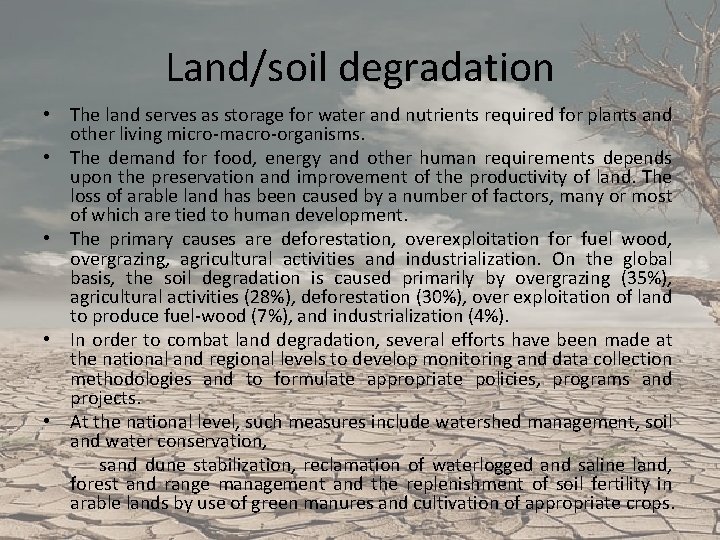
Land/soil degradation • The land serves as storage for water and nutrients required for plants and other living micro-macro-organisms. • The demand for food, energy and other human requirements depends upon the preservation and improvement of the productivity of land. The loss of arable land has been caused by a number of factors, many or most of which are tied to human development. • The primary causes are deforestation, overexploitation for fuel wood, overgrazing, agricultural activities and industrialization. On the global basis, the soil degradation is caused primarily by overgrazing (35%), agricultural activities (28%), deforestation (30%), over exploitation of land to produce fuel-wood (7%), and industrialization (4%). • In order to combat land degradation, several efforts have been made at the national and regional levels to develop monitoring and data collection methodologies and to formulate appropriate policies, programs and projects. • At the national level, such measures include watershed management, soil and water conservation, sand dune stabilization, reclamation of waterlogged and saline land, forest and range management and the replenishment of soil fertility in arable lands by use of green manures and cultivation of appropriate crops.
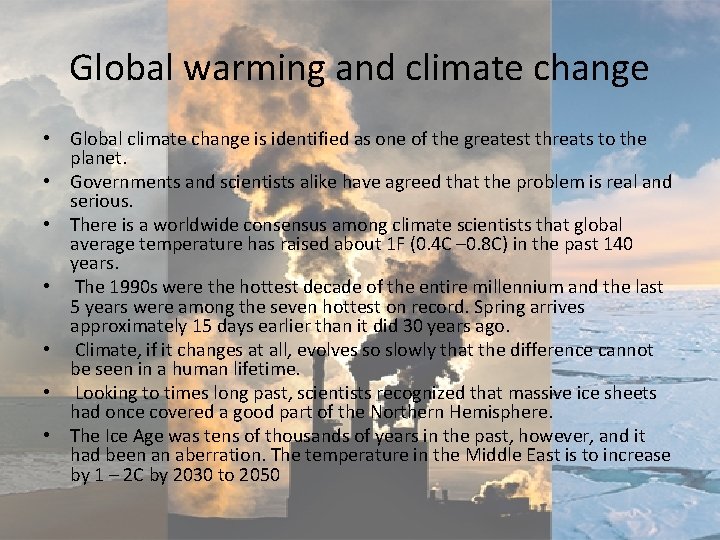
Global warming and climate change • Global climate change is identified as one of the greatest threats to the planet. • Governments and scientists alike have agreed that the problem is real and serious. • There is a worldwide consensus among climate scientists that global average temperature has raised about 1 F (0. 4 C – 0. 8 C) in the past 140 years. • The 1990 s were the hottest decade of the entire millennium and the last 5 years were among the seven hottest on record. Spring arrives approximately 15 days earlier than it did 30 years ago. • Climate, if it changes at all, evolves so slowly that the difference cannot be seen in a human lifetime. • Looking to times long past, scientists recognized that massive ice sheets had once covered a good part of the Northern Hemisphere. • The Ice Age was tens of thousands of years in the past, however, and it had been an aberration. The temperature in the Middle East is to increase by 1 – 2 C by 2030 to 2050
Impact of population explosion on human health • Human health is at risk as the denser the population.
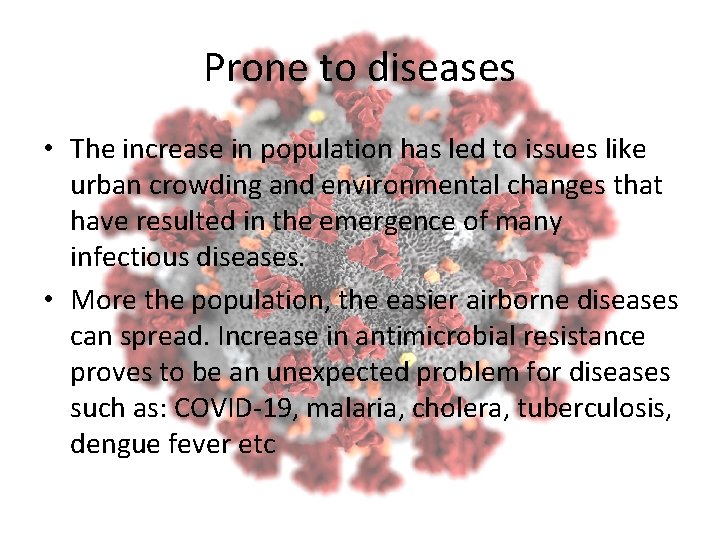
Prone to diseases • The increase in population has led to issues like urban crowding and environmental changes that have resulted in the emergence of many infectious diseases. • More the population, the easier airborne diseases can spread. Increase in antimicrobial resistance proves to be an unexpected problem for diseases such as: COVID-19, malaria, cholera, tuberculosis, dengue fever etc
Prone to diseases • Overpopulation results in polluted water supplies. People die each year because of contaminated water-related disease. The viruses spread faster in a denser population which enables deadly mutations to continue, making the water unsafe for utilization. • With the increasing number of people travelling by their vehicle, there is a growing concern about the health impacts caused due to the traffic on the road. The toxic content in the air impacts the kids more than the adults. Today, the decrease in the quality of air has resulted in the majority of people suffering from respiratory problems such as: Asthma, Lung cancer, Chest pain, Congestion, Throat inflammation, Cardiovascular disease, Respiratory diseases and many more.
Prone to diseases • Soon, sunscreens won’t be enough to protect us from the harmful sunrays. • Increased pollution has also led to a depletion of ozone layer. The ozone layer of the atmosphere no longer protects us from the harmful ultraviolet (UV) rays of the sun causing skin problems such as skin cancers and premature aging of the skin. UV rays also result in a host of eye-related problems such as cataract and blindness. • Most of all, it weakens the human immune system.
Other problems • The number of people migrating to the cities for jobs and prosperity increases daily. Concentrated energy use leads to greater air pollution with significant impact on human health, and automobile exhaust produces elevated lead levels in the urban air. • Large volumes of uncollected waste create multiple health hazards like cancer, neurological disease, congenital malformation etc. • Over population is the root of all other major problems. Population growth adds to the inability of governments to scale up health care systems and facilities. Hence, the need of the hour is to deal with the issue and come up with solutions to resolve the problem.
Conclusion • The Earth's environment is finite and can be destroyed if we do not start population control. Measures need to be taken now to correct the current situation which includes the increase of deforestation and desertification, the decrease of farmland, more water pollution, the deteriorating ozone layer, and the greenhouse effect. • It should be known that population control will not end all the problems mentioned above, but they would definitely allow more time for them to be fixed. • Also, population control helps alienate environment problems. The alternative, letting the population grow indefinitely could only hurt the environment. • Overpopulation is a negative solution for everyone; plants, animals, land, water, and humans.
THANK YOU