
UNIT 7 Energy changes the Earth FOSSILISATION Biology
UNIT 7 Energy changes the Earth FOSSILISATION Biology and Geology 3. Secondary Education
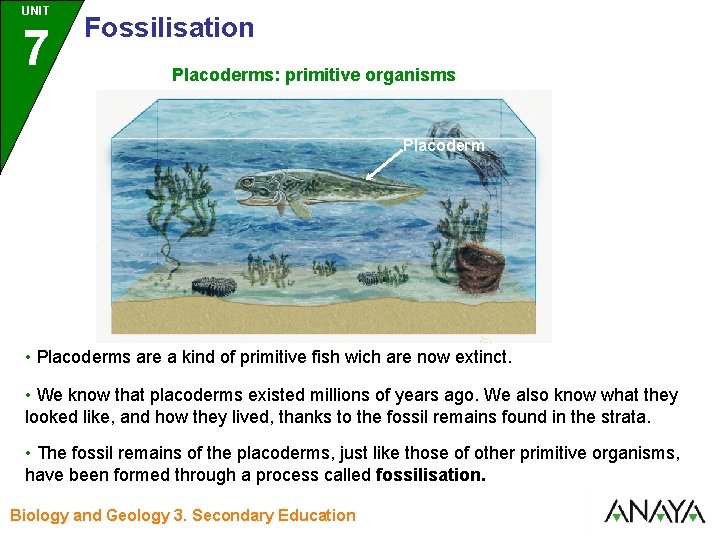
UNIT UNIDAD 7 3 Fossilisation Placoderms: primitive organisms Placoderm • Placoderms are a kind of primitive fish wich are now extinct. • We know that placoderms existed millions of years ago. We also know what they looked like, and how they lived, thanks to the fossil remains found in the strata. • The fossil remains of the placoderms, just like those of other primitive organisms, have been formed through a process called fossilisation. Biology and Geology 3. Secondary Education
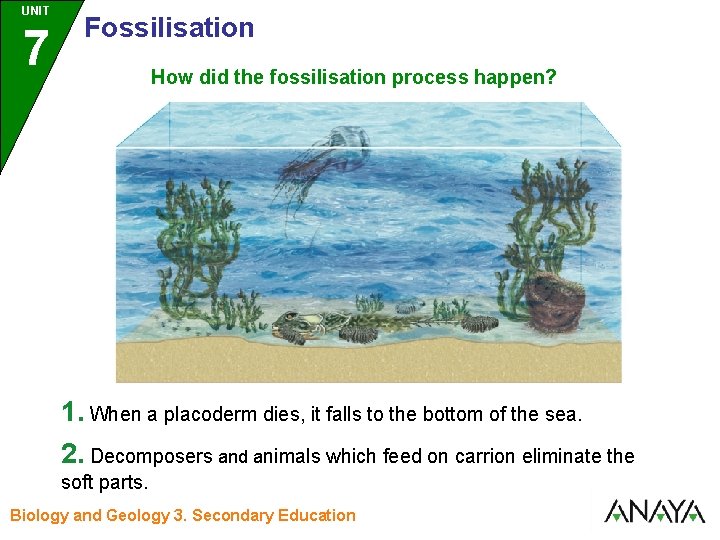
UNIT UNIDAD 7 3 Fossilisation How did the fossilisation process happen? 1. When a placoderm dies, it falls to the bottom of the sea. 2. Decomposers and animals which feed on carrion eliminate the soft parts. Biology and Geology 3. Secondary Education
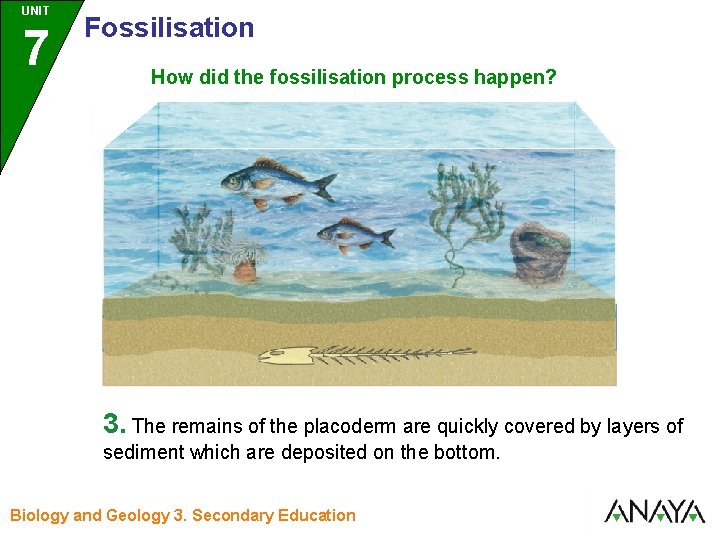
UNIT UNIDAD 7 3 Fossilisation How did the fossilisation process happen? 3. The remains of the placoderm are quickly covered by layers of sediment which are deposited on the bottom. Biology and Geology 3. Secondary Education
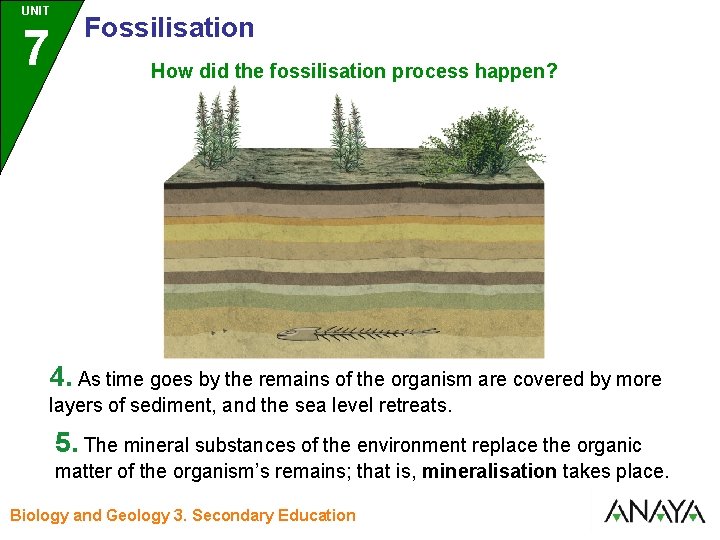
UNIT UNIDAD 7 3 Fossilisation How did the fossilisation process happen? 4. As time goes by the remains of the organism are covered by more layers of sediment, and the sea level retreats. 5. The mineral substances of the environment replace the organic matter of the organism’s remains; that is, mineralisation takes place. Biology and Geology 3. Secondary Education

UNIT UNIDAD 7 3 Fossilisation How did the fossilisation process happen? 6. Millions of years later, erosion leaves the fossil of the placoderm exposed. Biology and Geology 3. Secondary Education
- Slides: 6