
Unit 7 B Chapter 24 The Progressive Era
Unit #7 B Chapter 24 The Progressive Era (1901 – 1917)
SSUSH 13— The student will identify major efforts to reform American society and politics in the Progressive Era. a. Explain Upton Sinclair’s The Jungle and federal oversight of the meat packing industry. b. Identify Jane Addams and Hull House and describe the role of women in reform movements. c. Describe the significance of progressive reforms such as initiative, recall, and referendum; direct election of United States Senators; reform and labor laws; and efforts to improve living conditions for the poor in cities. d. Describe the passage of the Eighteenth Amendment, establishing Prohibition, and the Nineteenth Amendment, establishing women’s suffrage.
Chapter 24 The Progressive Era (1901 – 1917)
Chapter 24: The Progressive Era Overview In the first two decades of the 1900 s, United States citizens embraced the “Progressive” Movement and many of its reforms.
Section 1 – Expansion of Industry Main Idea: Social and economic changes during the late 19 th century (led by the Populist Movement) create a broad reform movement in American society known as Progressivism (1900 – 1920).
c. Describe the significance of progressive reforms such as initiative, recall, and referendum; direct election of United States Senators; reform and labor laws; and efforts to improve living conditions for the poor in cities. Reformers – § As the 20 th century began, middle-class reformers addressed the problems of the social upheavals of the 1890 s and continued themes addressed by the Populist Party. Progressive Movement – § Return control of federal and state governments to the people. § Restore economic opportunity. § Correct injustices in American life.
“The Progressive Era” (p. 1) 1. How were the 20 th century Progressives similar to the Populists of the 1890 s? Both Progressives of the early 1900 s and the Populists of the late 1890 s. . . § Pushed for reforms in society. § Formed a political party. § Ran candidates for office. § Affected the outcome of political races of the two major parties.
“The Progressive Era” (p. 1) 2. What areas did the Progressives think were in need of the greatest reform? Progressives believed that the greatest need of reform involved. . . § The government. § Urban poor. § Labor. § Education.

c. Describe the significance of progressive reforms such as initiative, recall, and referendum; direct election of United States Senators; reform and labor laws; and efforts to improve living conditions for the poor in cities. Social Gospel – § The movement which inspired many “progressives” to want to use the power of government to help the poor, workers, and immigrants. § Many ideals were rooted in religious beliefs tied to helping others.
“The Progressive Era” (p. 1) 3. Contrast the Social Gospel and its results with Social Darwinism. Unlike Social Darwinism, which applied to the principle of “survival of the fittest” to society, the Social Gospel Movement applied the Bible’s teachings on charity and justice to improve society.
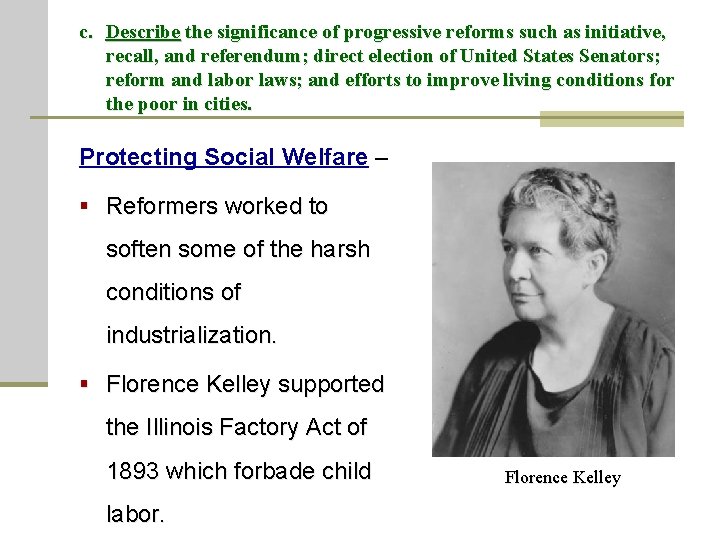
c. Describe the significance of progressive reforms such as initiative, recall, and referendum; direct election of United States Senators; reform and labor laws; and efforts to improve living conditions for the poor in cities. Protecting Social Welfare – § Reformers worked to soften some of the harsh conditions of industrialization. § Florence Kelley supported the Illinois Factory Act of 1893 which forbade child labor. Florence Kelley
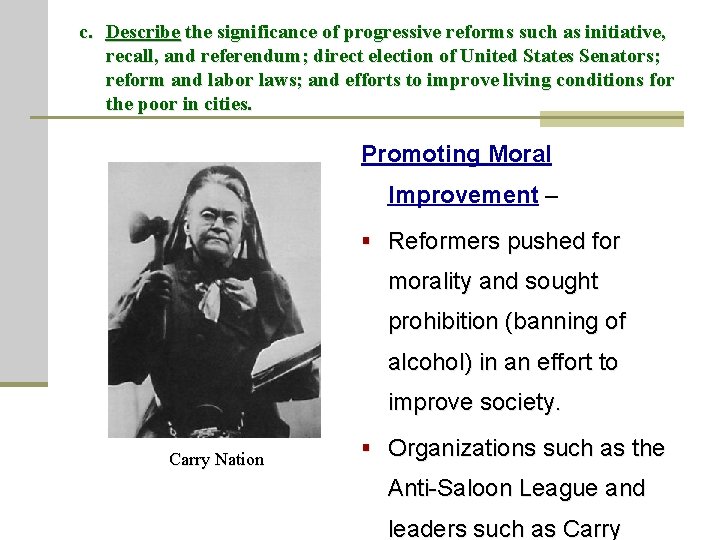
c. Describe the significance of progressive reforms such as initiative, recall, and referendum; direct election of United States Senators; reform and labor laws; and efforts to improve living conditions for the poor in cities. Promoting Moral Improvement – § Reformers pushed for morality and sought prohibition (banning of alcohol) in an effort to improve society. Carry Nation § Organizations such as the Anti-Saloon League and leaders such as Carry
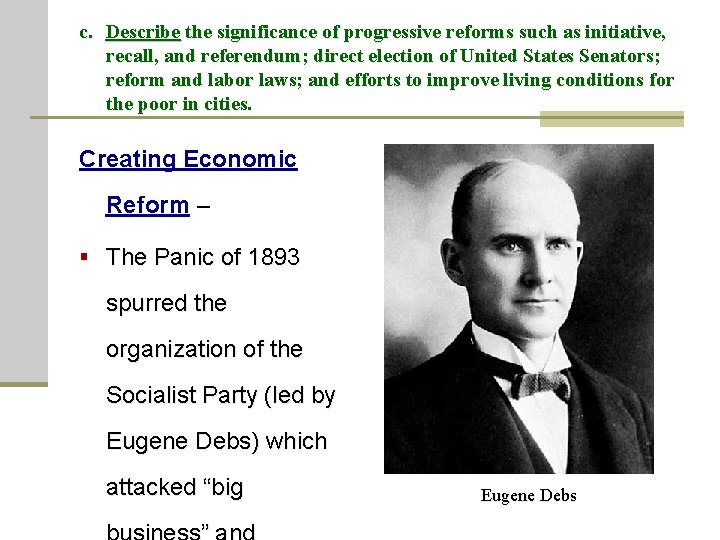
c. Describe the significance of progressive reforms such as initiative, recall, and referendum; direct election of United States Senators; reform and labor laws; and efforts to improve living conditions for the poor in cities. Creating Economic Reform – § The Panic of 1893 spurred the organization of the Socialist Party (led by Eugene Debs) which attacked “big Eugene Debs
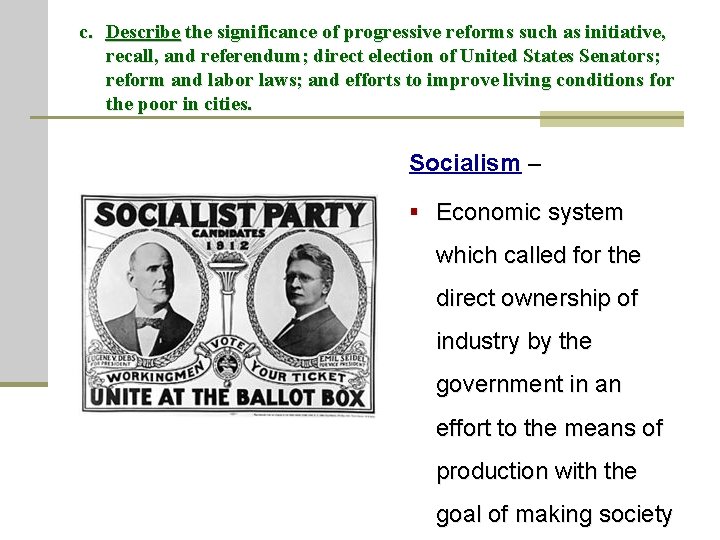
c. Describe the significance of progressive reforms such as initiative, recall, and referendum; direct election of United States Senators; reform and labor laws; and efforts to improve living conditions for the poor in cities. Socialism – § Economic system which called for the direct ownership of industry by the government in an effort to the means of production with the goal of making society
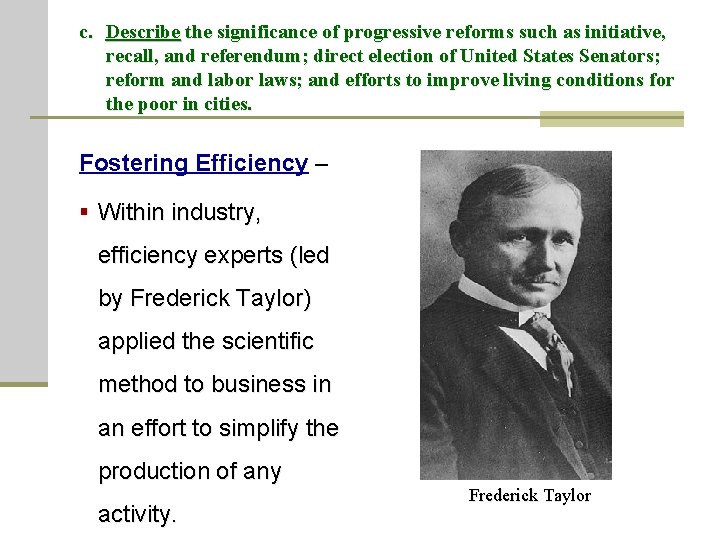
c. Describe the significance of progressive reforms such as initiative, recall, and referendum; direct election of United States Senators; reform and labor laws; and efforts to improve living conditions for the poor in cities. Fostering Efficiency – § Within industry, efficiency experts (led by Frederick Taylor) applied the scientific method to business in an effort to simplify the production of any activity. Frederick Taylor
c. Describe the significance of progressive reforms such as initiative, recall, and referendum; direct election of United States Senators; reform and labor laws; and efforts to improve living conditions for the poor in cities. Reforming City Government – § Creation of a city council or commission became a norm after 1900 for hundreds of cities. City Managers – § Were used to help run cities more efficiently replacing mayors (who tended to be political). Reform Mayors – § Progressive mayors lowered of taxes for the poor and dismissed corrupt government officials.
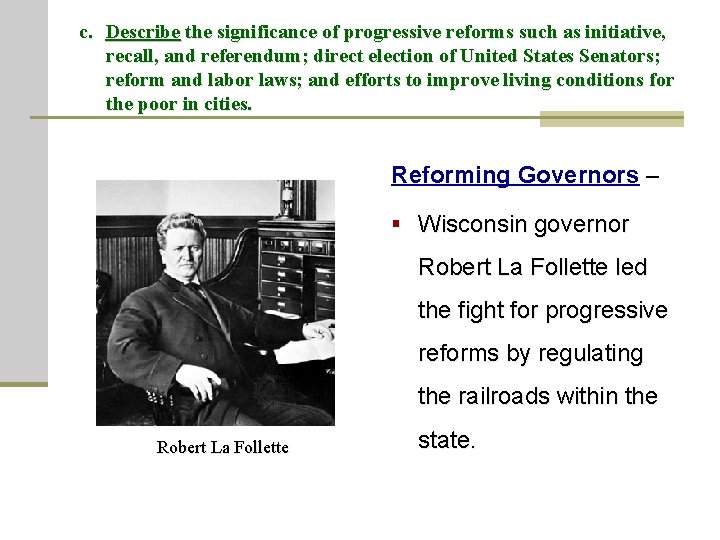
c. Describe the significance of progressive reforms such as initiative, recall, and referendum; direct election of United States Senators; reform and labor laws; and efforts to improve living conditions for the poor in cities. Reforming Governors – § Wisconsin governor Robert La Follette led the fight for progressive reforms by regulating the railroads within the Robert La Follette state.
c. Describe the significance of progressive reforms such as initiative, recall, and referendum; direct election of United States Senators; reform and labor laws; and efforts to improve living conditions for the poor in cities. Child Labor Laws – § By 1920, states began to pass laws regulating and later outlawing child labor. Reforming Laws to Protect Workers – § By 1920, the Supreme Court ruled in cases supporting laws to limit work hours for working women and compensation for on-the-job injuries and deaths.
c. Describe the significance of progressive reforms such as initiative, recall, and referendum; direct election of United States Senators; reform and labor laws; and efforts to improve living conditions for the poor in cities. Reforming Elections – § Government power to the ordinary citizen and the increase of “democracy” with the following: - recall – Enables voters to remove public officials. - initiative – A bill originated by the people rather then lawmakers. - referendum – A vote on the initiative.
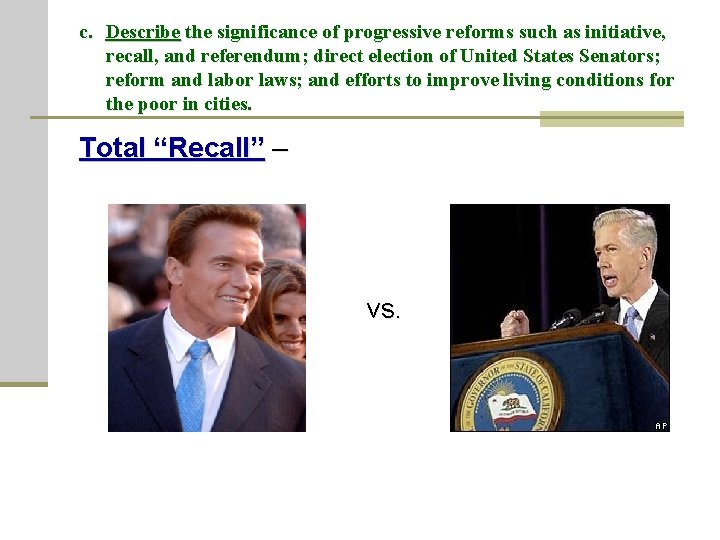
c. Describe the significance of progressive reforms such as initiative, recall, and referendum; direct election of United States Senators; reform and labor laws; and efforts to improve living conditions for the poor in cities. Total “Recall” – vs.
c. Describe the significance of progressive reforms such as initiative, recall, and referendum; direct election of United States Senators; reform and labor laws; and efforts to improve living conditions for the poor in cities. Seventeenth Amendment (Ratified, 1913) – § Before the amendment, state legislatures elected Senators to protect the rights of the states in a federal system. § Following the amendment, Senators began to be elected by the people of each state in an effort to extend democracy. § The result of the amendment is that no state in the
Section 2 – Women in Public Life Main Idea: As a result of social and economic change, many women entered public life as workers and reformers.
b. Identify Jane Addams and Hull House and describe the role of women in reform movements. Farm Women – § On farms in the South and Midwest, life for most women had not changed since the beginning of the previous century. Women in Industry – § New opportunities were found in growing cities and towns in offices, stores, and classrooms. Domestic Workers – § Women without skills worked as domestic workers.
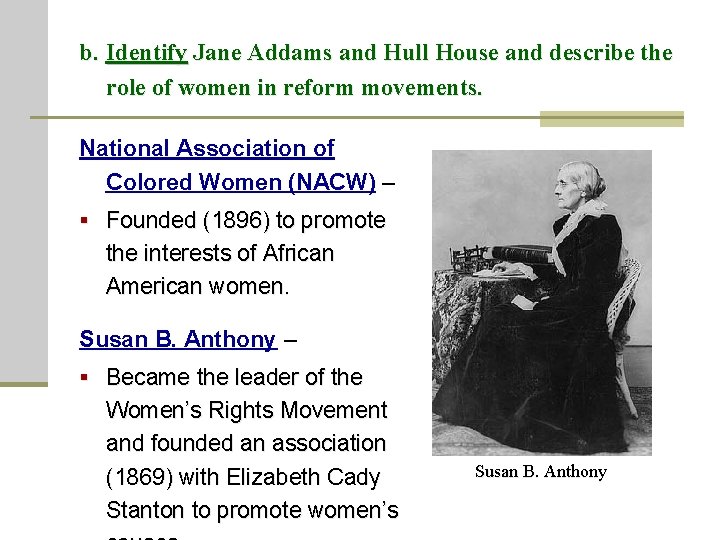
b. Identify Jane Addams and Hull House and describe the role of women in reform movements. National Association of Colored Women (NACW) – § Founded (1896) to promote the interests of African American women. Susan B. Anthony – § Became the leader of the Women’s Rights Movement and founded an association (1869) with Elizabeth Cady Stanton to promote women’s Susan B. Anthony
b. Identify Jane Addams and Hull House and describe the role of women in reform movements. National American Woman Suffrage Association (NAWSA)— § Organization formed (1890) as a proponent for women’s rights. Issues Facing Women’s Rights – § Obstacles included the following: - textile industry - liquor industry - men (in general)
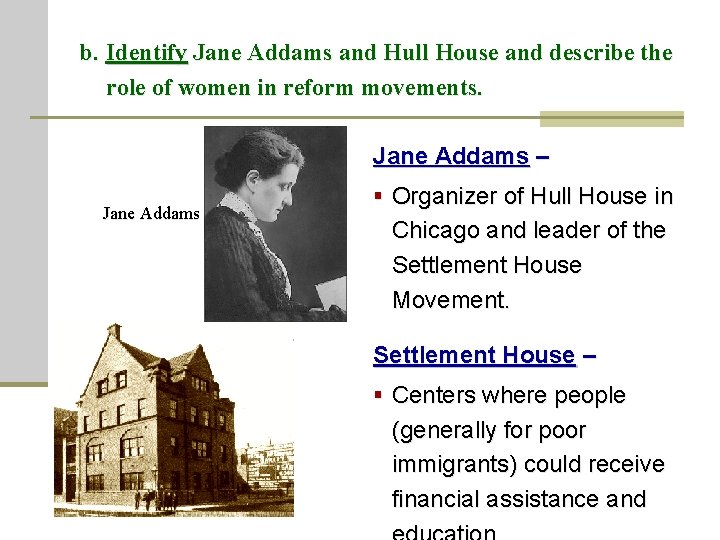
b. Identify Jane Addams and Hull House and describe the role of women in reform movements. Jane Addams – Jane Addams § Organizer of Hull House in Chicago and leader of the Settlement House Movement. Settlement House – § Centers where people (generally for poor immigrants) could receive financial assistance and
Section 3 – Teddy Roosevelt’s “Square Deal” Main Idea: As president, Theodore Roosevelt worked to give citizens a “Square Deal” through his progressive reforms.
c. Describe the significance of progressive reforms such as initiative, recall, and referendum; direct election of United States Senators; reform and labor laws; and efforts to improve living conditions for the poor in cities. Rise to Power – § Born in New York to a wealthy family and did the following: § Roosevelt was an outdoorsman, boxed, and wrestled; § Roosevelt was an NYC Assemblyman, NYC Police Commissioner, and Assistant Secretary of the Navy; § Joined the “Rough Riders” in the Spanish American War; § Won the governorship of New York State.
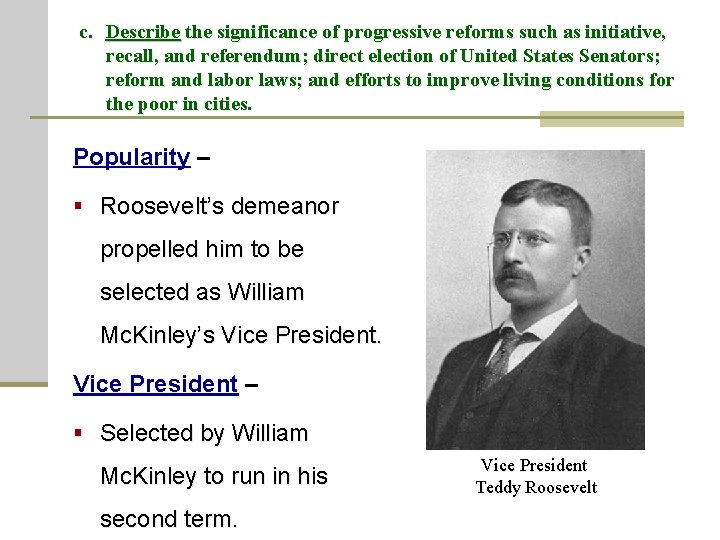
c. Describe the significance of progressive reforms such as initiative, recall, and referendum; direct election of United States Senators; reform and labor laws; and efforts to improve living conditions for the poor in cities. Popularity – § Roosevelt’s demeanor propelled him to be selected as William Mc. Kinley’s Vice President – § Selected by William Mc. Kinley to run in his second term. Vice President Teddy Roosevelt
c. Describe the significance of progressive reforms such as initiative, recall, and referendum; direct election of United States Senators; reform and labor laws; and efforts to improve living conditions for the poor in cities. Mc. Kinley’s Assassination – § Became president (October, 1901) at the age of 42. Modern Presidency – § Dominated the news during his presidency and helped create a “modern presidency” before his time. § He saw the presidency as a “bully pulpit” for him to make decisions and help shape legislation. “Square Deal” – § Term used to describe Roosevelt’s “progressive” legislation.
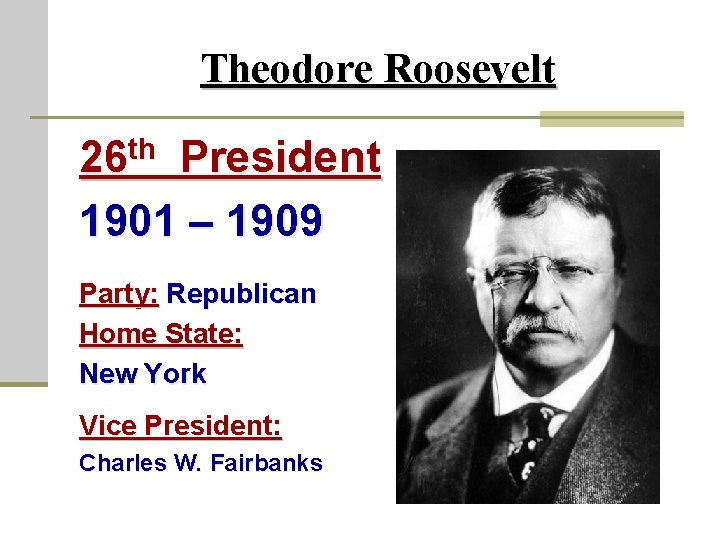
Theodore Roosevelt th 26 President 1901 – 1909 Party: Republican Home State: New York Vice President: Charles W. Fairbanks
Theodore Roosevelt Domestic § Became President following the assassination of William Mc. Kinley Foreign § Supported the use of “Big Stick § Known as a “Trustbuster” Diplomacy” as a § Initiated the building of the Panama foreign policy tool in Canal Latin America § Supported public land conservation § Roosevelt Corollary § Signed the Pure Food & Drug Act of 1906 § Signed the Meat Inspection Act of 1906 in Latin America
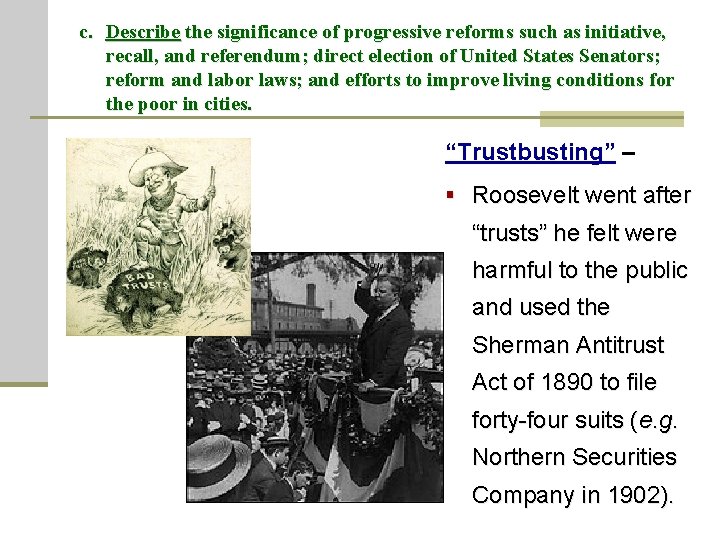
c. Describe the significance of progressive reforms such as initiative, recall, and referendum; direct election of United States Senators; reform and labor laws; and efforts to improve living conditions for the poor in cities. “Trustbusting” – § Roosevelt went after “trusts” he felt were harmful to the public and used the Sherman Antitrust Act of 1890 to file forty-four suits (e. g. Northern Securities Company in 1902).
c. Describe the significance of progressive reforms such as initiative, recall, and referendum; direct election of United States Senators; reform and labor laws; and efforts to improve living conditions for the poor in cities. Coal Strike – § Roosevelt brought the miners and the coal companies together (1902) and used “collective bargaining” to get both sides to compromise. § Roosevelt’s actions demonstrated the use of federal power to resolve issues with the public in mind. Railroad Regulation – § Roosevelt pushed for passage of the Hepburn Act of 1906 which enabled the ICC to regulate rail rates.
a. Explain Upton Sinclair’s The Jungle and federal oversight of the meat packing industry. “Muckrakers” – § Writers and reporters who exposed corruption in business and government; Phrase was coined by Roosevelt. Upton Sinclair – § Muckraking journalist who exposed the meat packing industry for exploiting the “human condition. ” “The Jungle” (1906) – § Novel which exposed the human condition of workers in Chicago’s meat packing industry. § Read by Roosevelt who immediately began investigations which led to laws protecting the public.
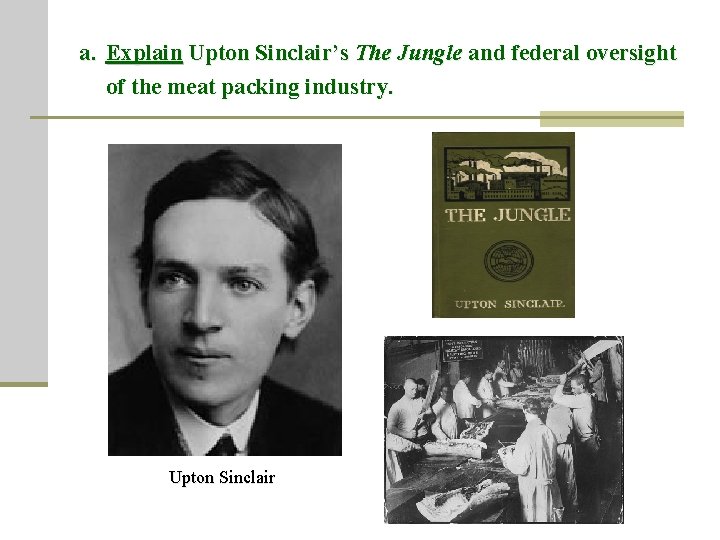
a. Explain Upton Sinclair’s The Jungle and federal oversight of the meat packing industry. Upton Sinclair
a. Explain Upton Sinclair’s The Jungle and federal oversight of the meat packing industry. “There would be meat that had tumbled out onto the floor, in the dirt and sawdust, where workers had tramped and spit uncounted billions of consumption [tuberculosis] germs. There would be meat stored in great piles in rooms. . . A man could run his hand over these piles of meat and sweep off handfuls of dried dung of rats. These rats were nuisances, and the packers would put poisoned bread out for them; they would die, and then rats, bread, and meat would go into the hoppers together. ”
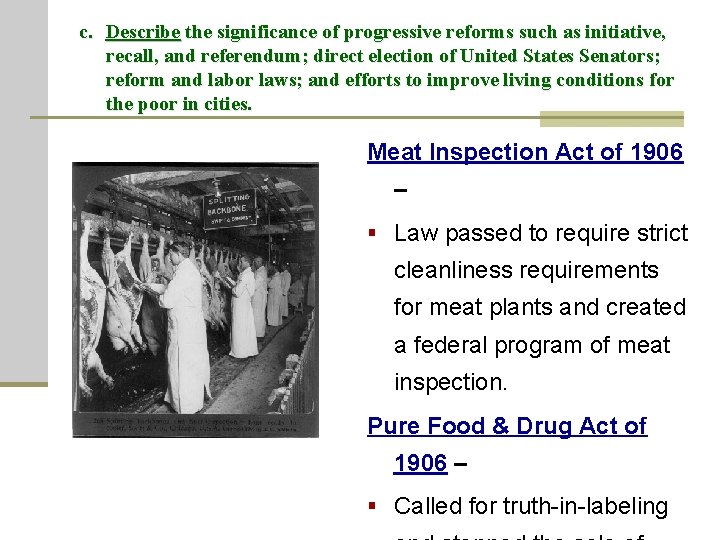
c. Describe the significance of progressive reforms such as initiative, recall, and referendum; direct election of United States Senators; reform and labor laws; and efforts to improve living conditions for the poor in cities. Meat Inspection Act of 1906 – § Law passed to require strict cleanliness requirements for meat plants and created a federal program of meat inspection. Pure Food & Drug Act of 1906 – § Called for truth-in-labeling
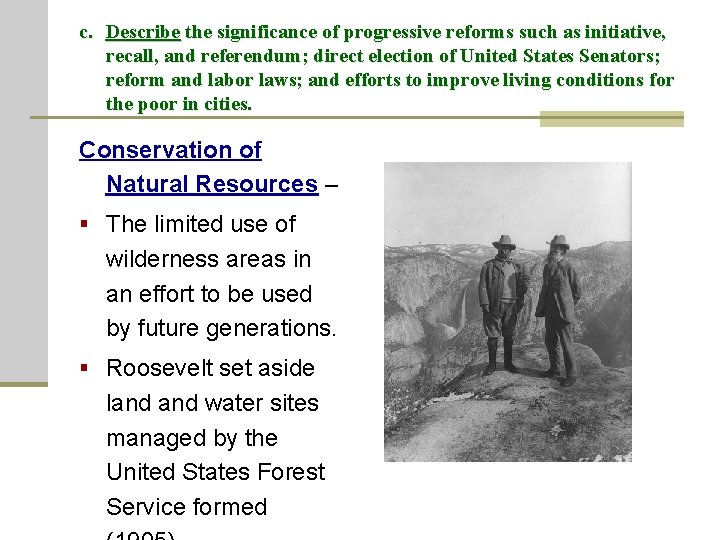
c. Describe the significance of progressive reforms such as initiative, recall, and referendum; direct election of United States Senators; reform and labor laws; and efforts to improve living conditions for the poor in cities. Conservation of Natural Resources – § The limited use of wilderness areas in an effort to be used by future generations. § Roosevelt set aside land water sites managed by the United States Forest Service formed
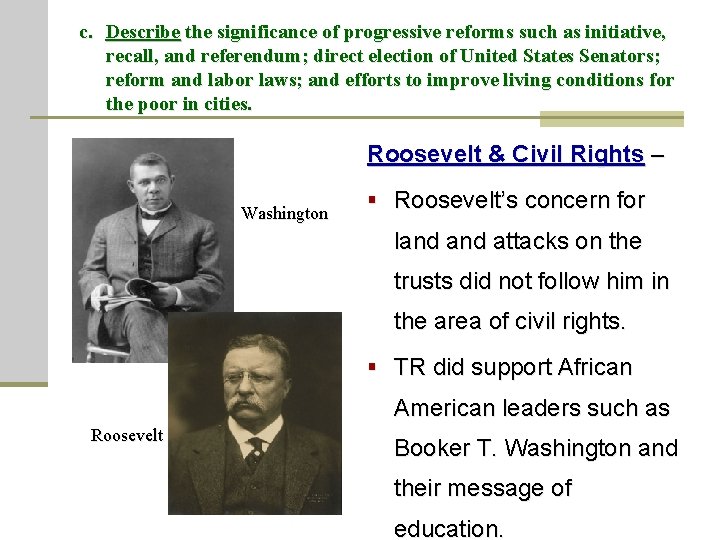
c. Describe the significance of progressive reforms such as initiative, recall, and referendum; direct election of United States Senators; reform and labor laws; and efforts to improve living conditions for the poor in cities. Roosevelt & Civil Rights – Washington § Roosevelt’s concern for land attacks on the trusts did not follow him in the area of civil rights. § TR did support African American leaders such as Roosevelt Booker T. Washington and their message of education.
c. Describe the significance of progressive reforms such as initiative, recall, and referendum; direct election of United States Senators; reform and labor laws; and efforts to improve living conditions for the poor in cities. National Association for the Advancement of Colored People (NAACP) – § Formed in New York (1909) by W. E. B. Du Bois and prominent white leaders in the progressive
“The Progressive Era” (p. 2) 5. What did Teddy Roosevelt believe government should do for citizens? President Teddy Roosevelt believed that the government’s role was to keep the powerful from taking advantage of smaller businesses and the poor so that everyone received a “square deal. ”
Section 4 – Progressivism Under Taft Main Idea: William H. Taft’s ambivalent approach to progressive reform led to a split in the Republican Party and the loss of the presidency to the Democrats.
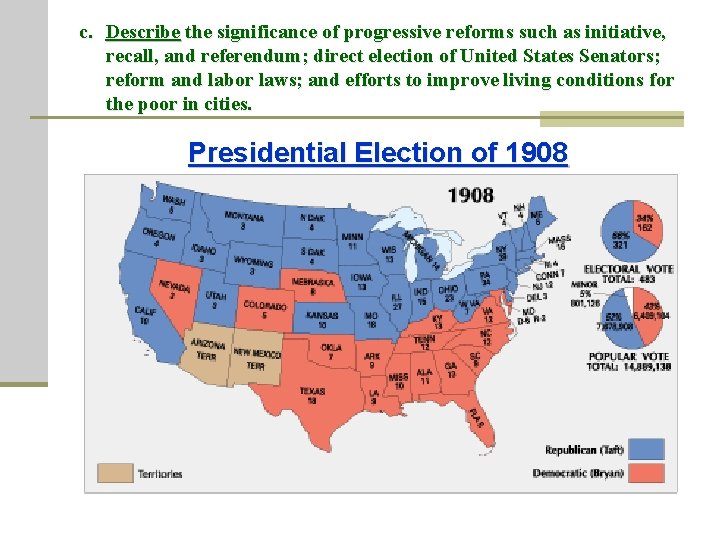
c. Describe the significance of progressive reforms such as initiative, recall, and referendum; direct election of United States Senators; reform and labor laws; and efforts to improve living conditions for the poor in cities. Presidential Election of 1908
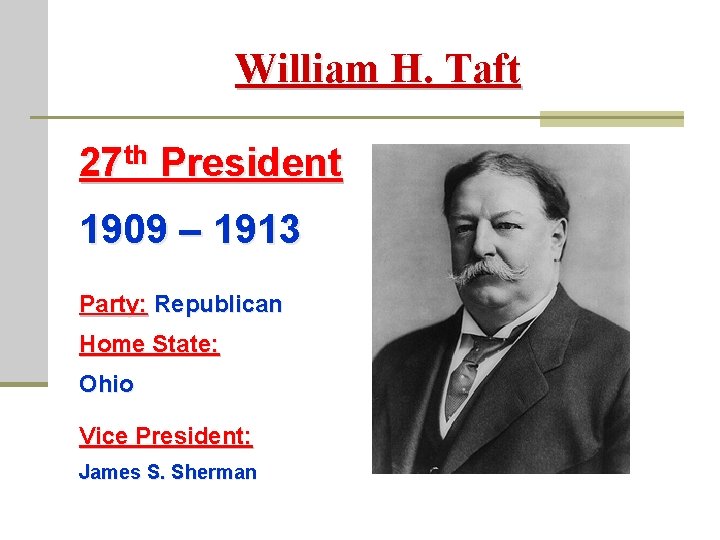
William H. Taft 27 th President 1909 – 1913 Party: Republican Home State: Ohio Vice President: James S. Sherman
William H. Taft Domestic § Largest president (300 lbs. ) § 16 th Amendment & 17 th Amendment passed during his presidency § Considered the least progressive of the three “Progressive” presidents Foreign § Supported the use of “Dollar Diplomacy” as a foreign policy tool in Latin America
c. Describe the significance of progressive reforms such as initiative, recall, and referendum; direct election of United States Senators; reform and labor laws; and efforts to improve living conditions for the poor in cities. William Howard Taft [1909 – 1913] – § Secretary of War under Roosevelt who won the Presidential Election of 1908 election over Democrat William Jennings Bryan. Taft Stumbles – § Despite winning 90 cases against businesses trusts, Taft was cautious in the area of tariffs and conservation.
c. Describe the significance of progressive reforms such as initiative, recall, and referendum; direct election of United States Senators; reform and labor laws; and efforts to improve living conditions for the poor in cities. Payne-Aldrich Tariff – § Signed by Taft (angering Progressive Republicans) and was a compromise of rate increases and decreases on foreign goods. Disputing Public Lands – § Taft’s appointment of Secretary of the Interior (Richard Ballinger) led to the removal of 1 million acres of public land angering conservationists.
“The Progressive Era” (p. 2) 6. Describe the differences between the presidencies of Roosevelt and Taft took a stronger stance against trusts, supported government control over some industries, encouraged Congress to propose a federal income tax, and did not lower tariffs as much as Roosevelt.
c. Describe the significance of progressive reforms such as initiative, recall, and referendum; direct election of United States Senators; reform and labor laws; and efforts to improve living conditions for the poor in cities. Republican Schism – § Taft’s cautious nature made it impossible for him to hold both wings of the Republican Party together: Progressives and Conservatives. Progressive “Bull Moose” Party – § Formed by Teddy Roosevelt in an effort to win back the Progressive wing of the Republican and Democratic parties.
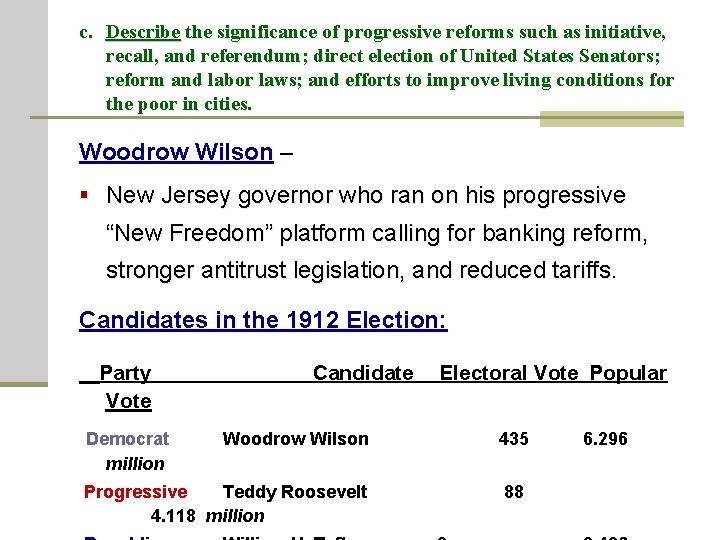
c. Describe the significance of progressive reforms such as initiative, recall, and referendum; direct election of United States Senators; reform and labor laws; and efforts to improve living conditions for the poor in cities. Woodrow Wilson – § New Jersey governor who ran on his progressive “New Freedom” platform calling for banking reform, stronger antitrust legislation, and reduced tariffs. Candidates in the 1912 Election: Party Vote Democrat million Candidate Electoral Vote Popular Woodrow Wilson 435 Progressive Teddy Roosevelt 4. 118 million 88 6. 296
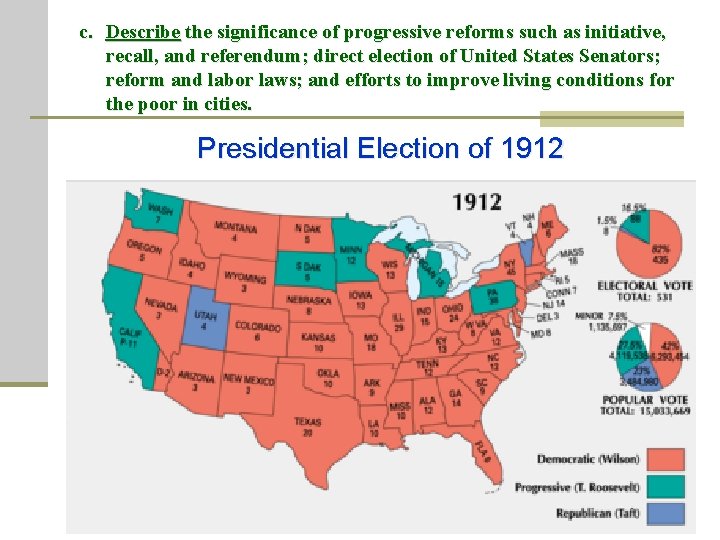
c. Describe the significance of progressive reforms such as initiative, recall, and referendum; direct election of United States Senators; reform and labor laws; and efforts to improve living conditions for the poor in cities. Presidential Election of 1912
“The Progressive Era” (p. 2) 7. Explain the significance of the Progressive Party in the Election of 1912. The Progressive Party caused a split among Republicans (Conservatives and Moderates voting for Taft, and Progressives voting for Roosevelt) and helped secure the Democratic candidate (Woodrow Wilson) the presidency.
Section 5 – Wilson’s New Freedom Main Idea: Woodrow Wilson established a strong reform agenda as a progressive leader.
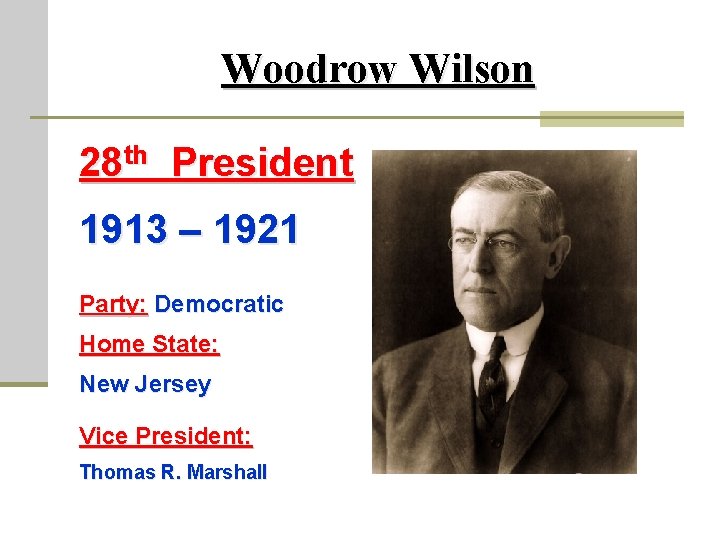
Woodrow Wilson 28 th President 1913 – 1921 Party: Democratic Home State: New Jersey Vice President: Thomas R. Marshall
Woodrow Wilson Domestic § Only president to earn a Doctorate Degree. § Progressive Democratic President § Signed Clayton Antitrust Act (1914). Foreign § Supported the use of “Moral Diplomacy” as a foreign policy tool in Latin America. § President during World War I. § 18 th and 19 th Amendments § Wrote the “Fourteen passed during his Points. ”
c. Describe the significance of progressive reforms such as initiative, recall, and referendum; direct election of United States Senators; reform and labor laws; and efforts to improve living conditions for the poor in cities. Woodrow Wilson [1913 – 1921] – § Democratic president who won two-terms and continued progressive reforms of Taft and Roosevelt. Rise to Power – § Wilson was born in the South in a strict Presbyterian family and did the following: - Lawyer by trade; - President of Princeton University; - Governor of New Jersey (1910 – 1913); - Supported progressive reforms, a direct primary, worker’s compensation, and regulation of public
c. Describe the significance of progressive reforms such as initiative, recall, and referendum; direct election of United States Senators; reform and labor laws; and efforts to improve living conditions for the poor in cities. Underwood Tariff Act of 1913 – § Congress passed the act to reduce tariffs for the first time since the end of the Civil War. Clayton Antitrust Act of 1914 – § Prohibited corporations from acquiring stock of another company (if it created a monopoly). § Legalized strikes and union boycotting. Federal Trade Commission (FTC) – § Gave the federal government the power to investigate possible violations of regulatory statutes (laws).
c. Describe the significance of progressive reforms such as initiative, recall, and referendum; direct election of United States Senators; reform and labor laws; and efforts to improve living conditions for the poor in cities. Sixteenth Amendment (Ratified, 1913) – § Established a progressive federal income tax (originally taxing 1 – 6% on incomes over $4, 000). § Most United States citizens did not pay he tax because their incomes were lower than the annual threshold. Federal Reserve System – § Divided the nation into 12 regional banks headed by the Federal Reserve Board which sets a prime rate to
d. Describe the passage of the Eighteenth Amendment, establishing Prohibition, and the Nineteenth Amendment, establishing women’s suffrage. Suffragists – § Carrie Chapman Catt led the NAWSA while Lucy Burns and Alice Paul all led the National Women’s Party eventually resulting in a picketing, arrests, and a hunger strike. Nineteenth Amendment (Ratified, 1920) – § Stated that one could not be denied the right to vote because of gender. Suffrage –
“The Progressive Era” (p. 2) 4. How did women of the Progressive Era make progress and win suffrage? Women during the Progressive Era. . . § Lobbied Congress to pass a constitutional amendment giving women the right to vote. § Used the referendum process to pass state suffrage laws. § Held protest marches and hunger strikes to bring awareness of their cause.
d. Describe the passage of the Eighteenth Amendment, establishing Prohibition, and the Nineteenth Amendment, establishing women’s suffrage. Eighteenth Amendment (Ratified, 1919) – § Stated that one could manufacture, sell, drink alcoholic beverages. § The Amendment was in effect until the passage of the Twenty-first Amendment which repealed it. § The only amendment to the Constitution which has been repealed.
c. Describe the significance of progressive reforms such as initiative, recall, and referendum; direct election of United States Senators; reform and labor laws; and efforts to improve living conditions for the poor in cities. Wilson & Civil Rights – § Wilson retreated on civil rights by not passing any legislation to promote the equal right of African Americans. The End of the Progressive Era – § Wilson’s first term (dealing with imperialism), and his second term (dealing with WWI) brought about an end to progressivism and the rise of conservatism in the 1920 s.
“The Progressive Era” (p. 2) 8. What steps did President Woodrow Wilson take to increase the role of government in the economy? President Woodrow Wilson. . . § Encouraged Congress to lower tariffs. § Reformed the banking industry. § Persuaded Congress to establish the Federal Trade Commission (FTC), and signed the
- Slides: 64