
Unit 7 Atomic Nuclear Particle Physics Part 1
- Slides: 64
Unit 7: Atomic, Nuclear, & Particle Physics Part 1 – Discrete Energy & Radioactivity
Table of Contents History of Spectroscopy & the Discrete Energy of Atomic Emission Nuclear Structure Radioactive Decay The Fundamental Forces
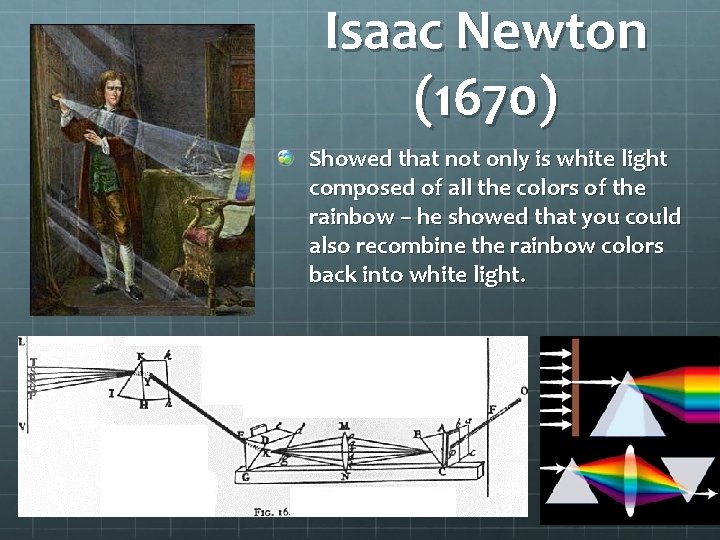
Isaac Newton (1670) Showed that not only is white light composed of all the colors of the rainbow – he showed that you could also recombine the rainbow colors back into white light.
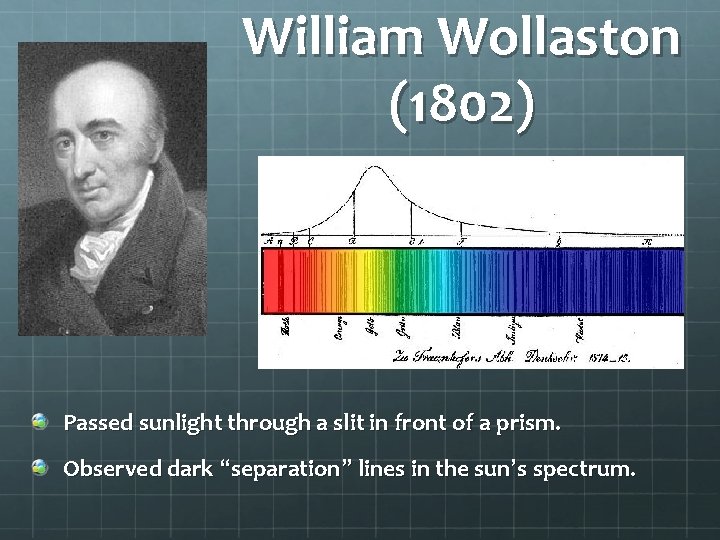
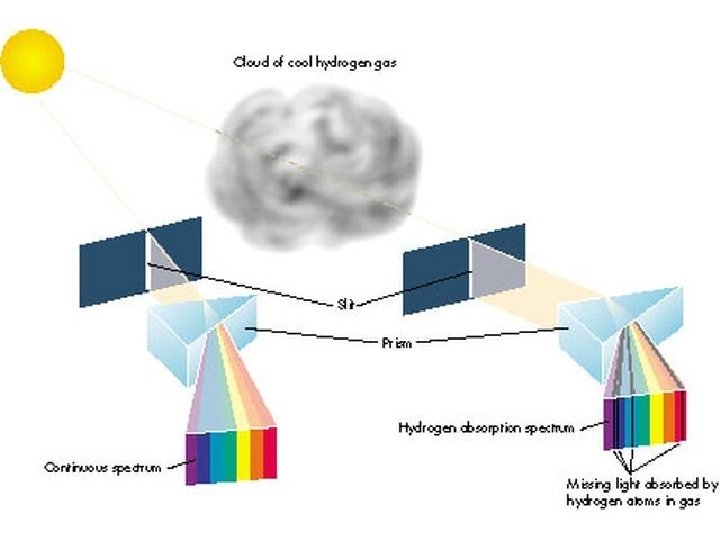
William Wollaston (1802) Passed sunlight through a slit in front of a prism. Observed dark “separation” lines in the sun’s spectrum.
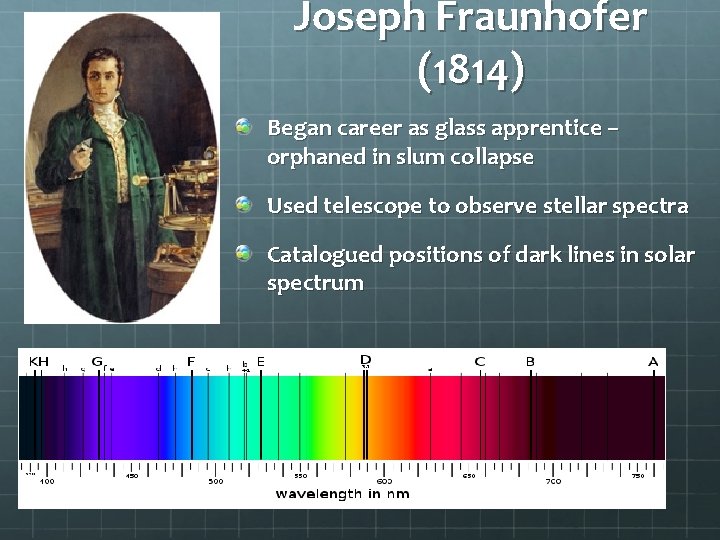
Joseph Fraunhofer (1814) Began career as glass apprentice – orphaned in slum collapse Used telescope to observe stellar spectra Catalogued positions of dark lines in solar spectrum
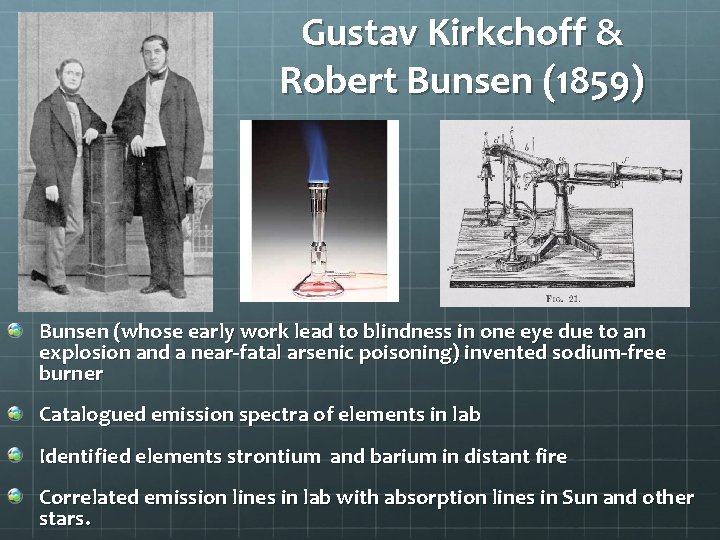
Gustav Kirkchoff & Robert Bunsen (1859) Bunsen (whose early work lead to blindness in one eye due to an explosion and a near-fatal arsenic poisoning) invented sodium-free burner Catalogued emission spectra of elements in lab Identified elements strontium and barium in distant fire Correlated emission lines in lab with absorption lines in Sun and other stars.
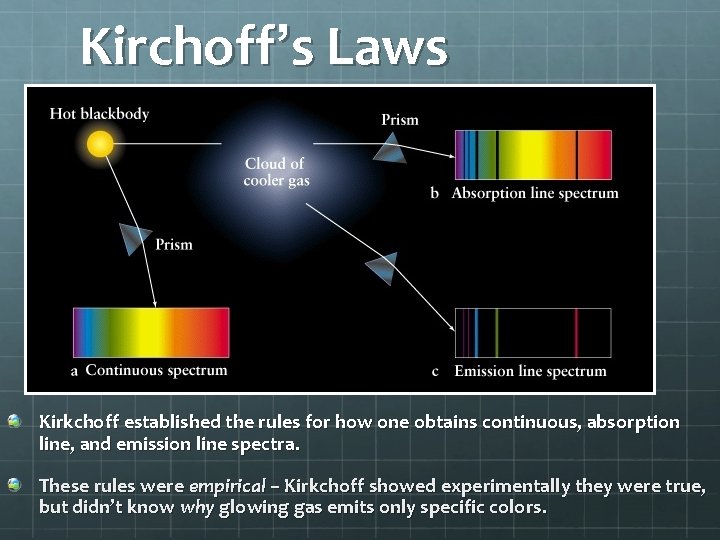
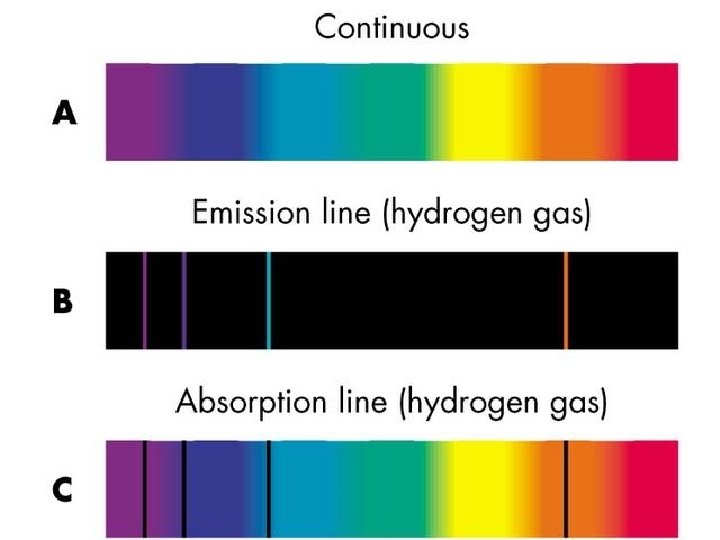
Kirchoff’s Laws Kirkchoff established the rules for how one obtains continuous, absorption line, and emission line spectra. These rules were empirical – Kirkchoff showed experimentally they were true, but didn’t know why glowing gas emits only specific colors.
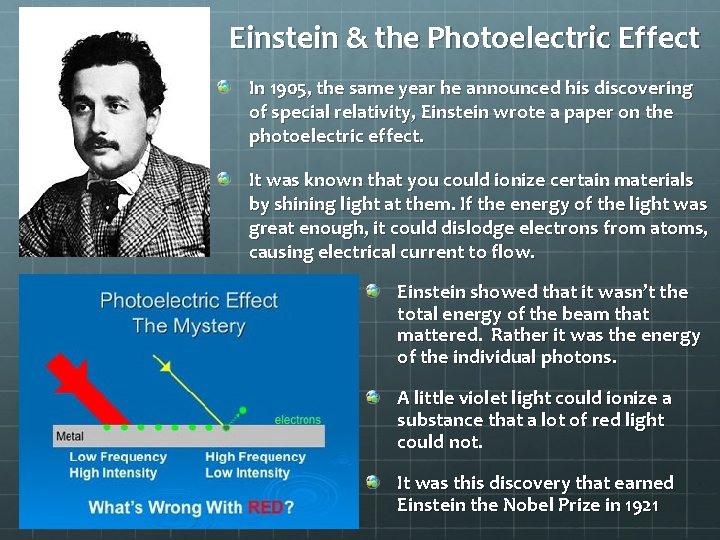
Einstein & the Photoelectric Effect In 1905, the same year he announced his discovering of special relativity, Einstein wrote a paper on the photoelectric effect. It was known that you could ionize certain materials by shining light at them. If the energy of the light was great enough, it could dislodge electrons from atoms, causing electrical current to flow. Einstein showed that it wasn’t the total energy of the beam that mattered. Rather it was the energy of the individual photons. A little violet light could ionize a substance that a lot of red light could not. It was this discovery that earned Einstein the Nobel Prize in 1921
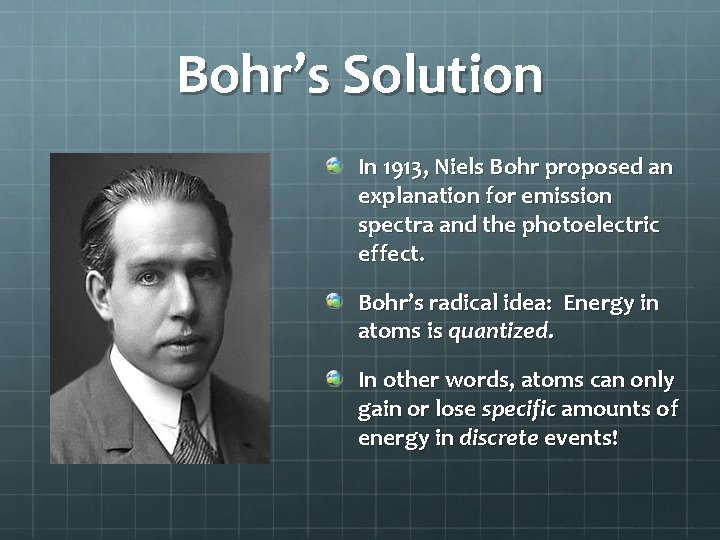
Bohr’s Solution In 1913, Niels Bohr proposed an explanation for emission spectra and the photoelectric effect. Bohr’s radical idea: Energy in atoms is quantized. In other words, atoms can only gain or lose specific amounts of energy in discrete events!
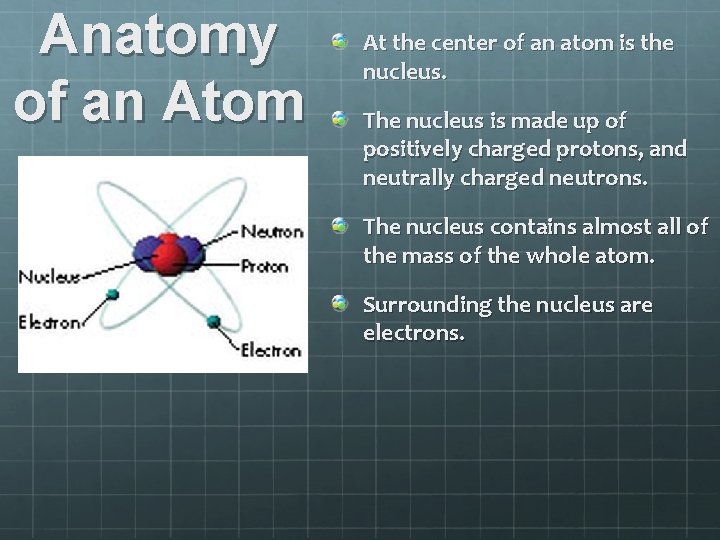
Anatomy of an Atom At the center of an atom is the nucleus. The nucleus is made up of positively charged protons, and neutrally charged neutrons. The nucleus contains almost all of the mass of the whole atom. Surrounding the nucleus are electrons.
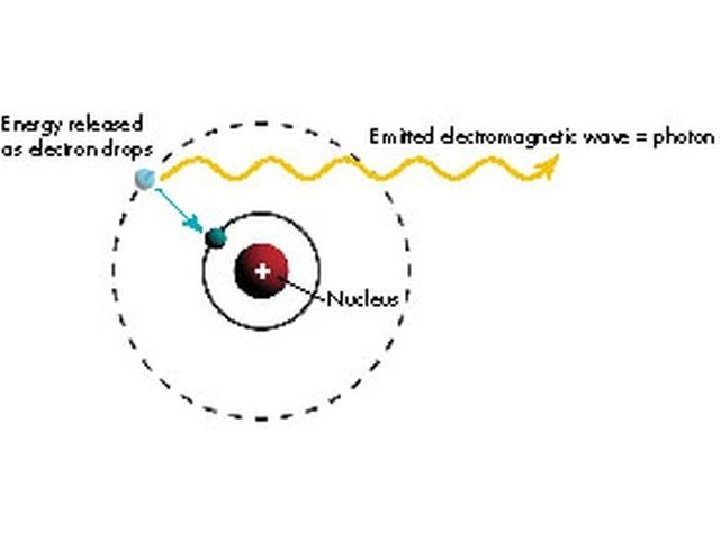
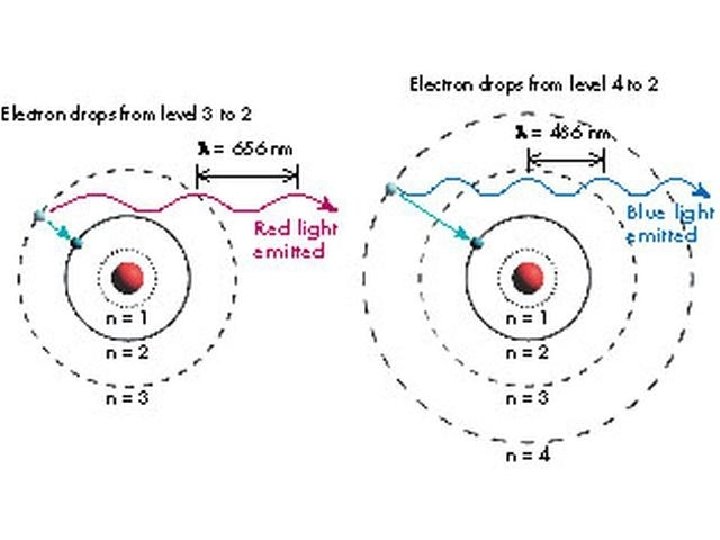
Some important facts about Electrons: Electrons “orbit” the nucleus. They are restricted to certain “energy levels” – an electron can’t orbit in just any old way about the nucleus. When an electron drops from a higher energy level to a lower one, it loses energy. The energy is released in the form of a photon.
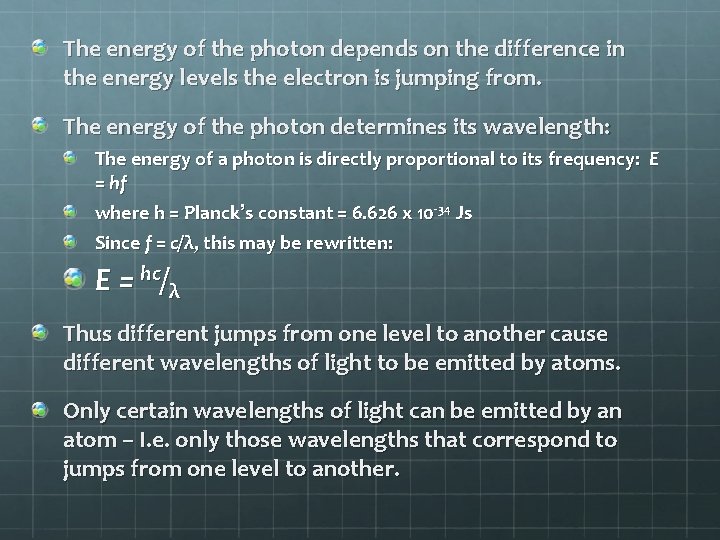
The energy of the photon depends on the difference in the energy levels the electron is jumping from. The energy of the photon determines its wavelength: The energy of a photon is directly proportional to its frequency: E = hf where h = Planck’s constant = 6. 626 x 10 -34 Js Since f = c/λ, this may be rewritten: E = hc/λ Thus different jumps from one level to another cause different wavelengths of light to be emitted by atoms. Only certain wavelengths of light can be emitted by an atom – I. e. only those wavelengths that correspond to jumps from one level to another.
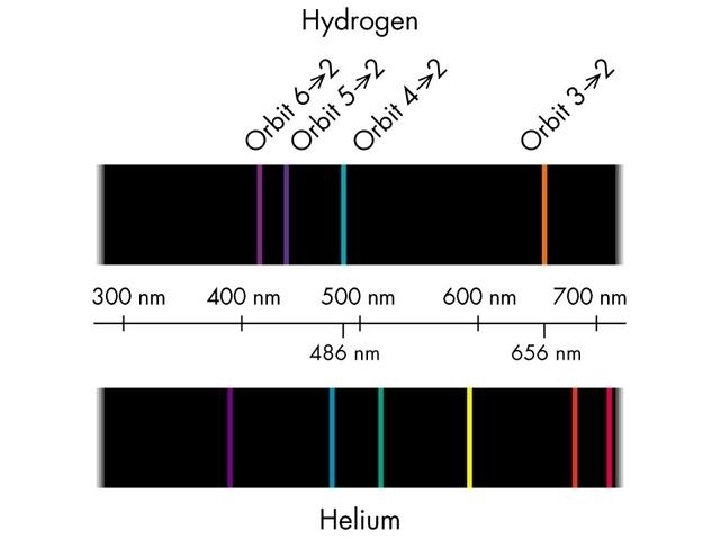
Key fact for astronomers: Different atoms have completely different configurations of energy levels. Why is this so useful to astronomers? Different atoms produce completely different spectra! By passing light emitted from a material through a prism, you can tell what the material is made of!
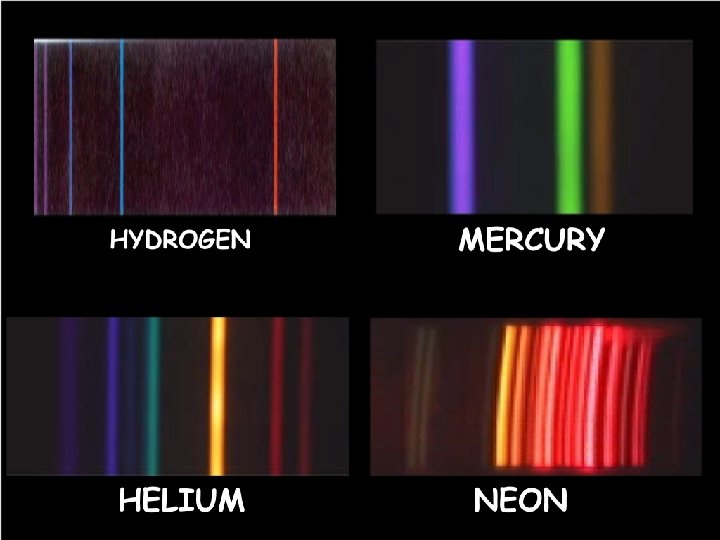
The hydrogen and helium spectra on the previous slide are examples of ‘emission spectra’ Emission spectra are obtained when you pass light from a diffuse (not dense) hot gas through a prism. What does it look like when you pass light-bulb light through a prism? A light-bulb filament is a hot, dense object. Such objects produce continuous spectra, i. e. full rainbows.
Let’s see if we can identify some unknown substances based on their emission spectra…
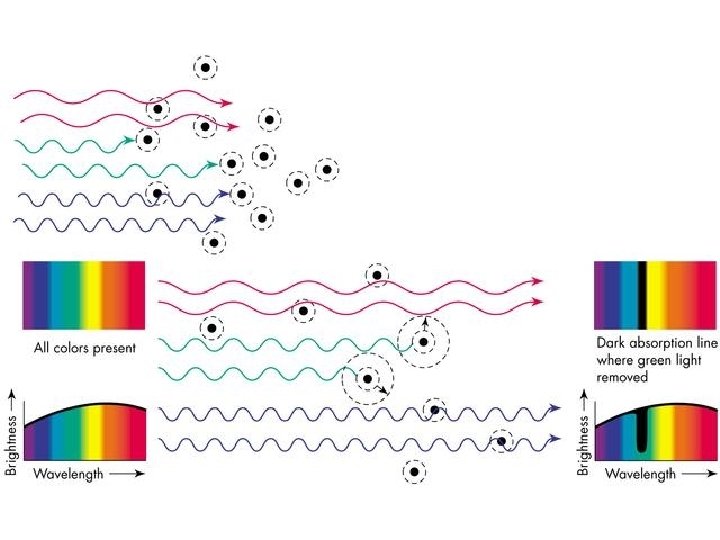
What happens when there is a diffuse gas between you and a hot dense glowing object? Answer: The gas absorbs certain wavelengths of light. These wavelengths correspond to the correct energy amounts that would allow electrons to be kicked from a low to a high energy level.
Even though stars are made of gas, that gas is not diffuse. So stars are hot, dense objects. Like planets, stars also have atmospheres, which are diffuse. What type of spectrum (continuous, emission, or absorption) do you think we see when we pass starlight through a prism?
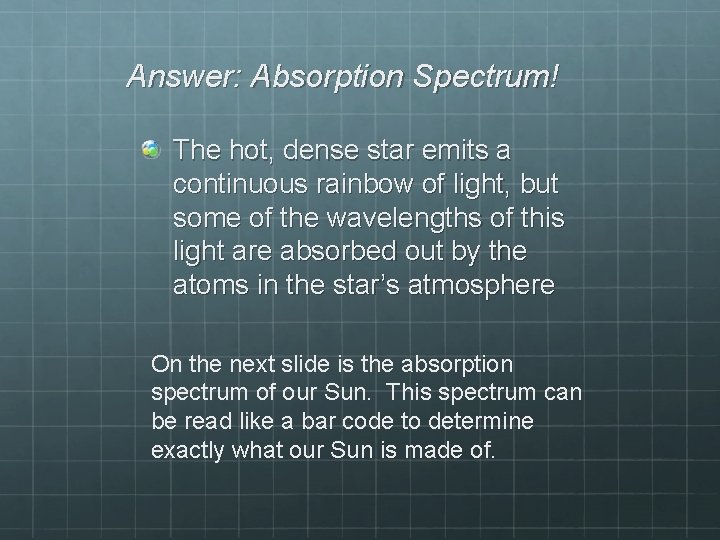
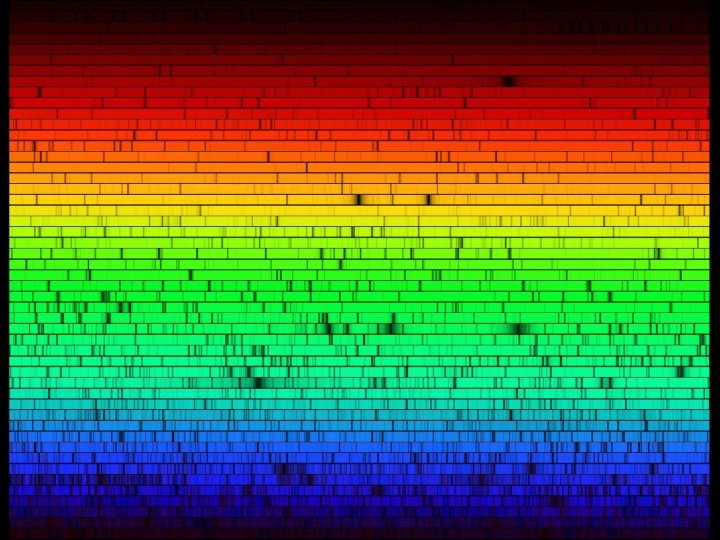
Answer: Absorption Spectrum! The hot, dense star emits a continuous rainbow of light, but some of the wavelengths of this light are absorbed out by the atoms in the star’s atmosphere On the next slide is the absorption spectrum of our Sun. This spectrum can be read like a bar code to determine exactly what our Sun is made of.
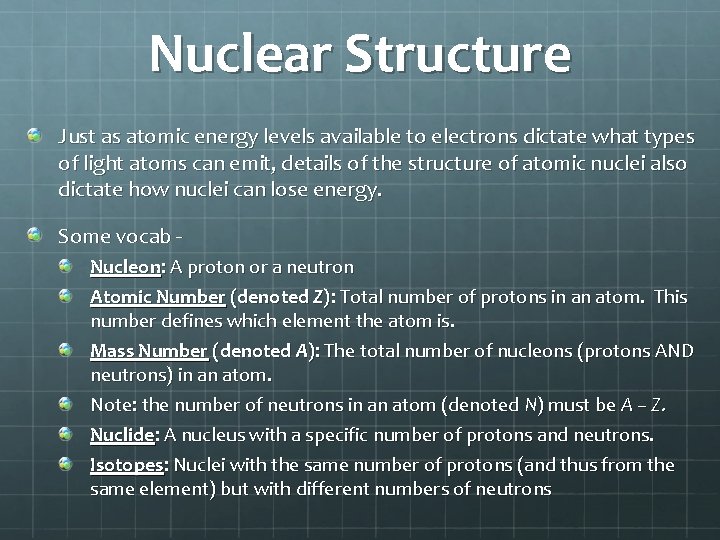
Nuclear Structure Just as atomic energy levels available to electrons dictate what types of light atoms can emit, details of the structure of atomic nuclei also dictate how nuclei can lose energy. Some vocab Nucleon: A proton or a neutron Atomic Number (denoted Z): Total number of protons in an atom. This number defines which element the atom is. Mass Number (denoted A): The total number of nucleons (protons AND neutrons) in an atom. Note: the number of neutrons in an atom (denoted N) must be A – Z. Nuclide: A nucleus with a specific number of protons and neutrons. Isotopes: Nuclei with the same number of protons (and thus from the same element) but with different numbers of neutrons
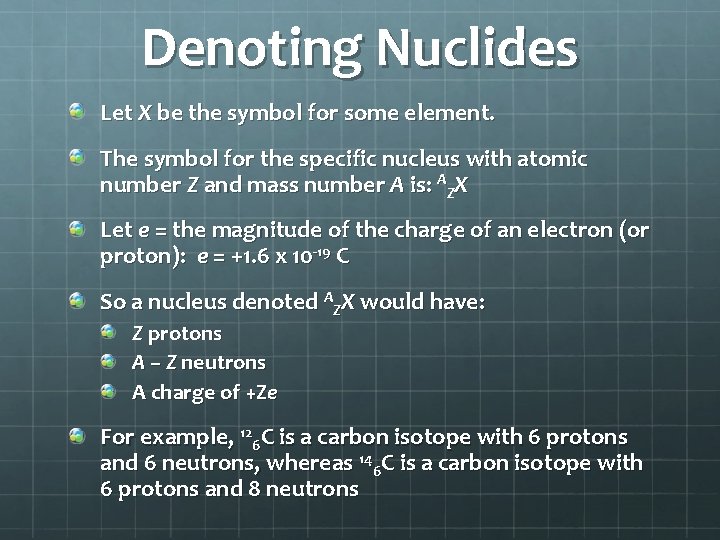
Denoting Nuclides Let X be the symbol for some element. The symbol for the specific nucleus with atomic number Z and mass number A is: AZX Let e = the magnitude of the charge of an electron (or proton): e = +1. 6 x 10 -19 C So a nucleus denoted AZX would have: Z protons A – Z neutrons A charge of +Ze For example, 126 C is a carbon isotope with 6 protons and 6 neutrons, whereas 146 C is a carbon isotope with 6 protons and 8 neutrons
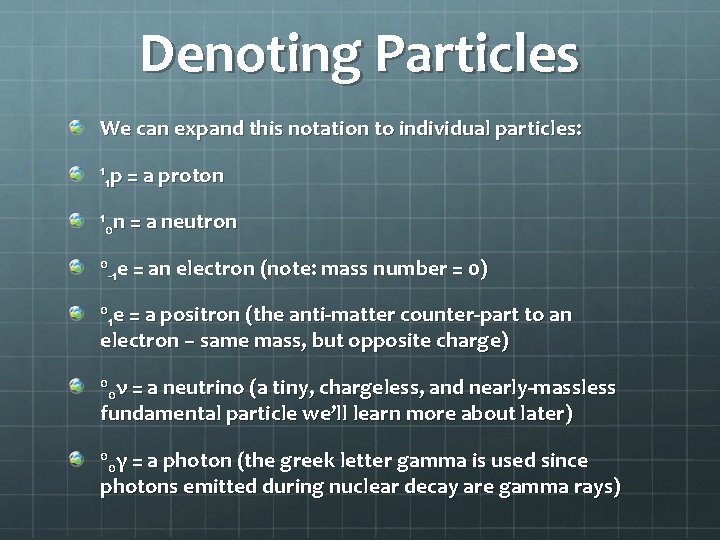
Denoting Particles We can expand this notation to individual particles: 1 p = a proton 1 1 n = a neutron 0 0 e = an electron (note: mass number = 0) -1 0 e = a positron (the anti-matter counter-part to an 1 electron – same mass, but opposite charge) 0 ν = a neutrino (a tiny, chargeless, and nearly-massless 0 fundamental particle we’ll learn more about later) 0 γ = a photon (the greek letter gamma is used since 0 photons emitted during nuclear decay are gamma rays)
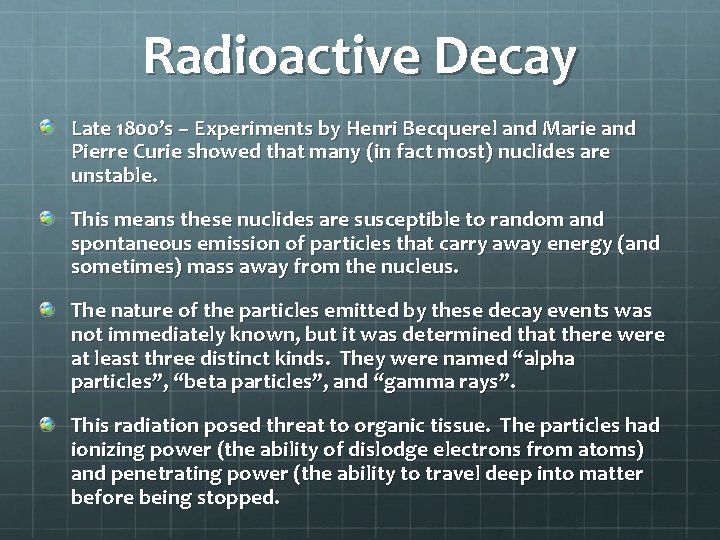
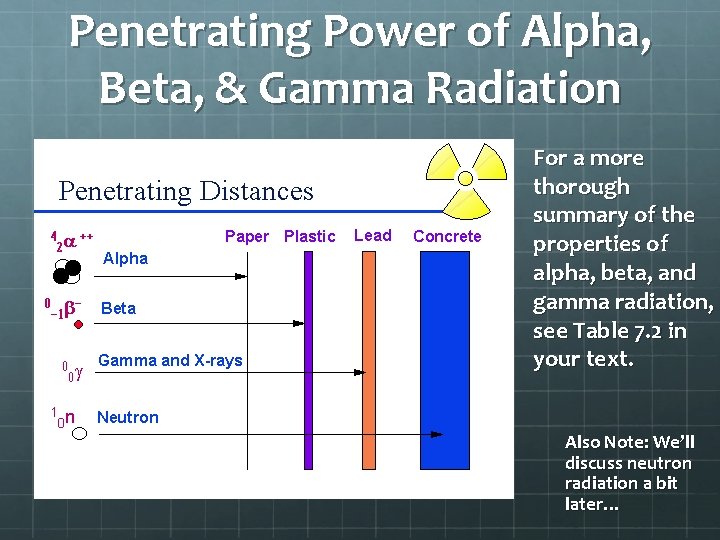
Radioactive Decay Late 1800’s – Experiments by Henri Becquerel and Marie and Pierre Curie showed that many (in fact most) nuclides are unstable. This means these nuclides are susceptible to random and spontaneous emission of particles that carry away energy (and sometimes) mass away from the nucleus. The nature of the particles emitted by these decay events was not immediately known, but it was determined that there were at least three distinct kinds. They were named “alpha particles”, “beta particles”, and “gamma rays”. This radiation posed threat to organic tissue. The particles had ionizing power (the ability of dislodge electrons from atoms) and penetrating power (the ability to travel deep into matter before being stopped.
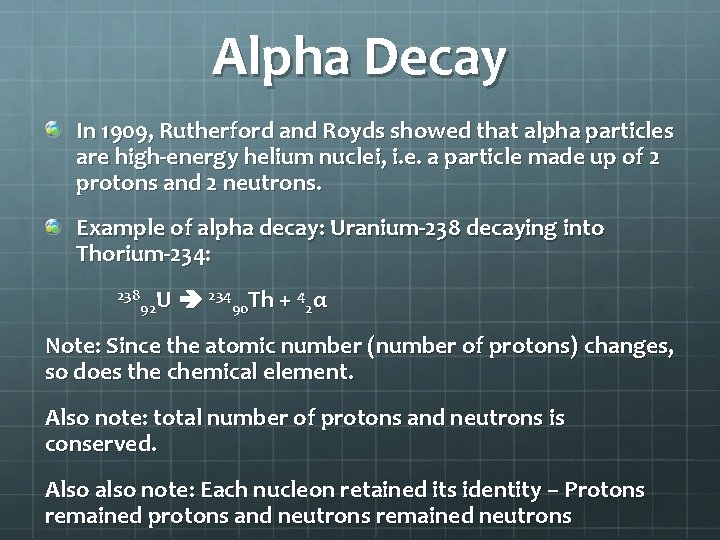
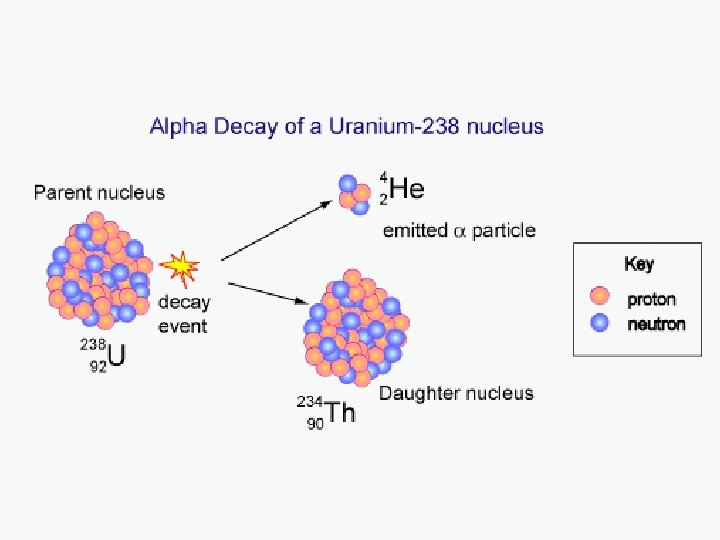
Alpha Decay In 1909, Rutherford and Royds showed that alpha particles are high-energy helium nuclei, i. e. a particle made up of 2 protons and 2 neutrons. Example of alpha decay: Uranium-238 decaying into Thorium-234: 238 U 234 Th + 4 α 92 90 2 Note: Since the atomic number (number of protons) changes, so does the chemical element. Also note: total number of protons and neutrons is conserved. Also also note: Each nucleon retained its identity – Protons remained protons and neutrons remained neutrons
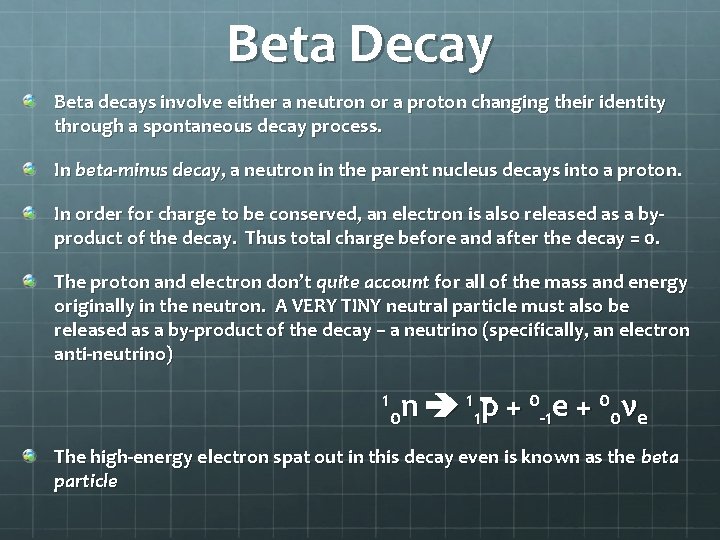
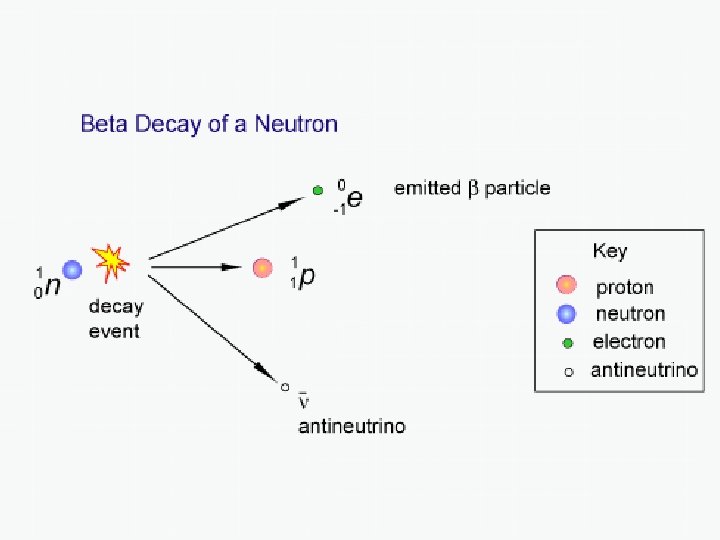
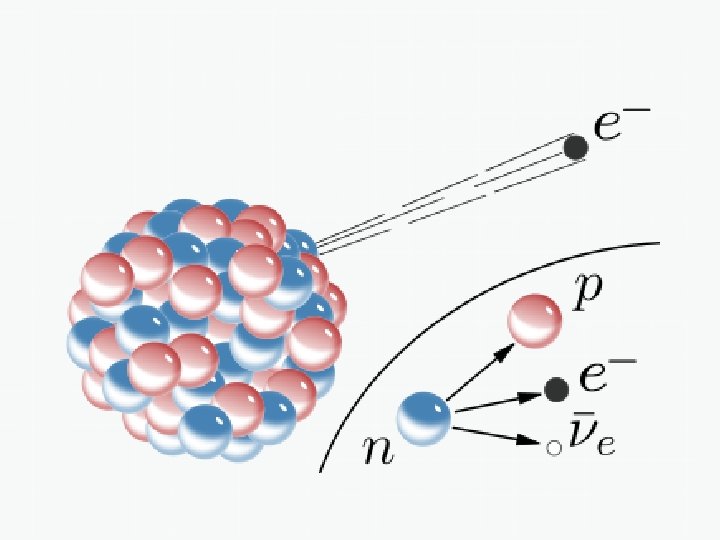
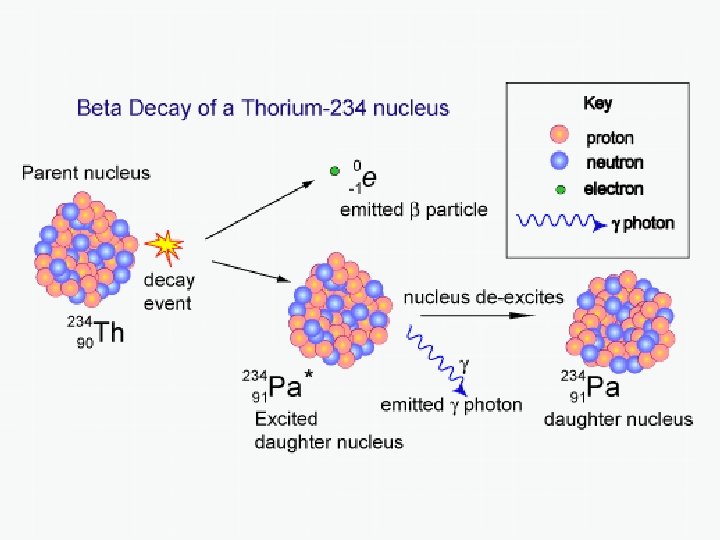
Beta Decay Beta decays involve either a neutron or a proton changing their identity through a spontaneous decay process. In beta-minus decay, a neutron in the parent nucleus decays into a proton. In order for charge to be conserved, an electron is also released as a byproduct of the decay. Thus total charge before and after the decay = 0. The proton and electron don’t quite account for all of the mass and energy originally in the neutron. A VERY TINY neutral particle must also be released as a by-product of the decay – a neutrino (specifically, an electron anti-neutrino) 1 n 1 p+0 e+0 ν 0 1 -1 0 e The high-energy electron spat out in this decay even is known as the beta particle
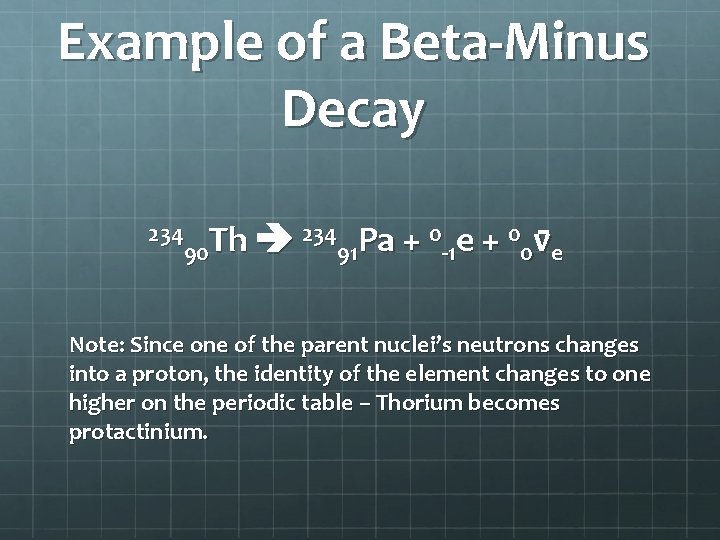
Example of a Beta-Minus Decay 234 Th 234 Pa + 0 e + 0 v 90 91 -1 0 e Note: Since one of the parent nuclei’s neutrons changes into a proton, the identity of the element changes to one higher on the periodic table – Thorium becomes protactinium.
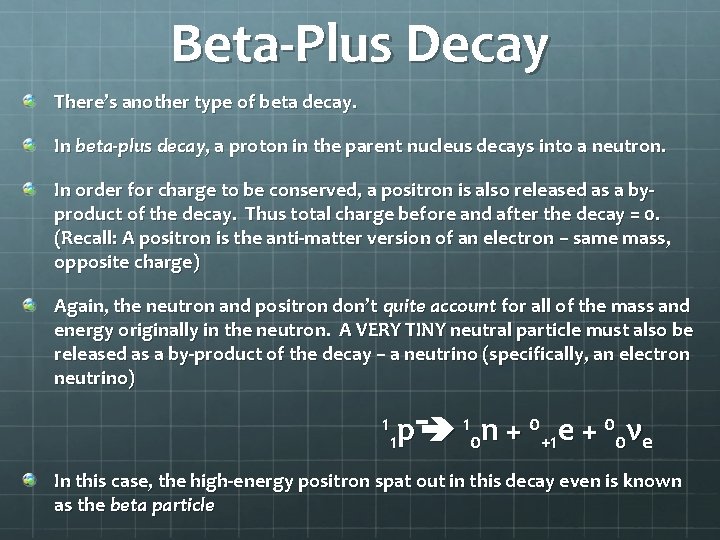
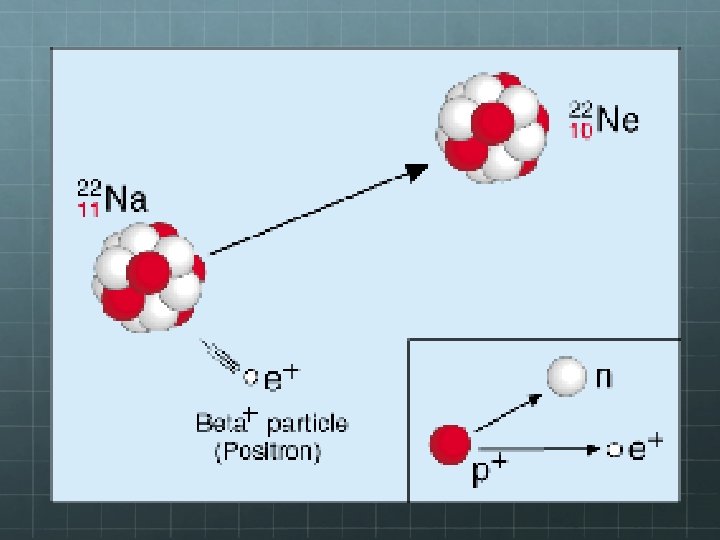
Beta-Plus Decay There’s another type of beta decay. In beta-plus decay, a proton in the parent nucleus decays into a neutron. In order for charge to be conserved, a positron is also released as a byproduct of the decay. Thus total charge before and after the decay = 0. (Recall: A positron is the anti-matter version of an electron – same mass, opposite charge) Again, the neutron and positron don’t quite account for all of the mass and energy originally in the neutron. A VERY TINY neutral particle must also be released as a by-product of the decay – a neutrino (specifically, an electron neutrino) 1 p 1 n+0 e+0 ν 1 0 +1 0 e In this case, the high-energy positron spat out in this decay even is known as the beta particle
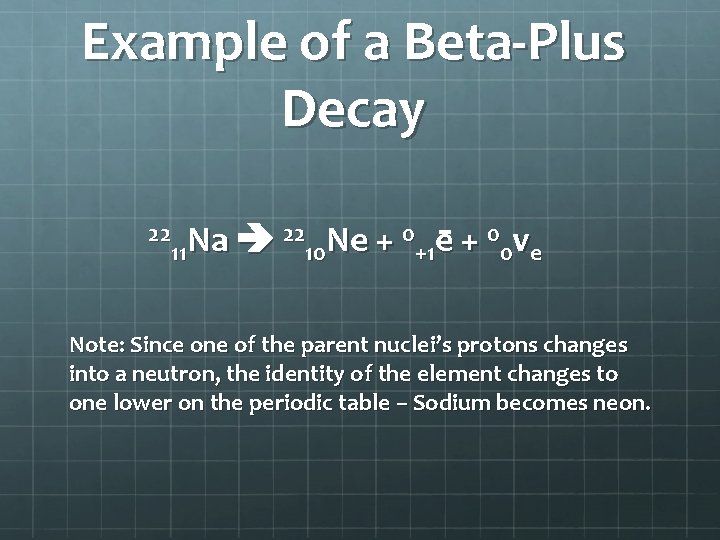
Example of a Beta-Plus Decay 22 Na 22 Ne + 0 v 11 10 +1 0 e Note: Since one of the parent nuclei’s protons changes into a neutron, the identity of the element changes to one lower on the periodic table – Sodium becomes neon.
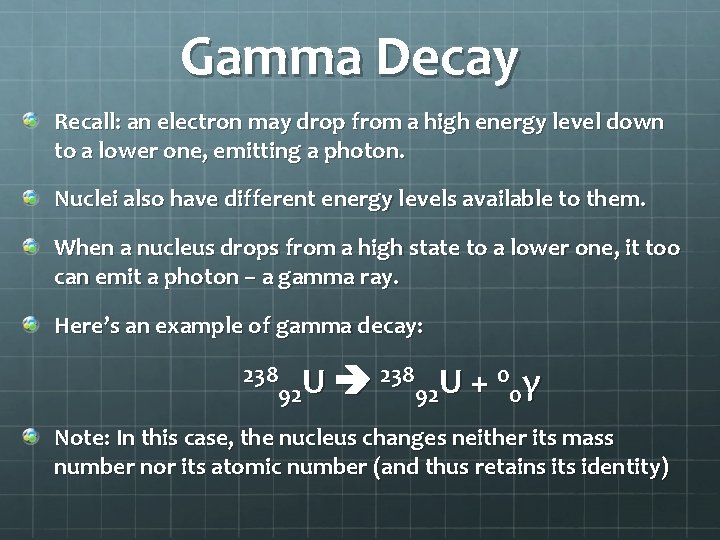
Gamma Decay Recall: an electron may drop from a high energy level down to a lower one, emitting a photon. Nuclei also have different energy levels available to them. When a nucleus drops from a high state to a lower one, it too can emit a photon – a gamma ray. Here’s an example of gamma decay: 238 U + 0 γ 92 92 0 Note: In this case, the nucleus changes neither its mass number nor its atomic number (and thus retains its identity)
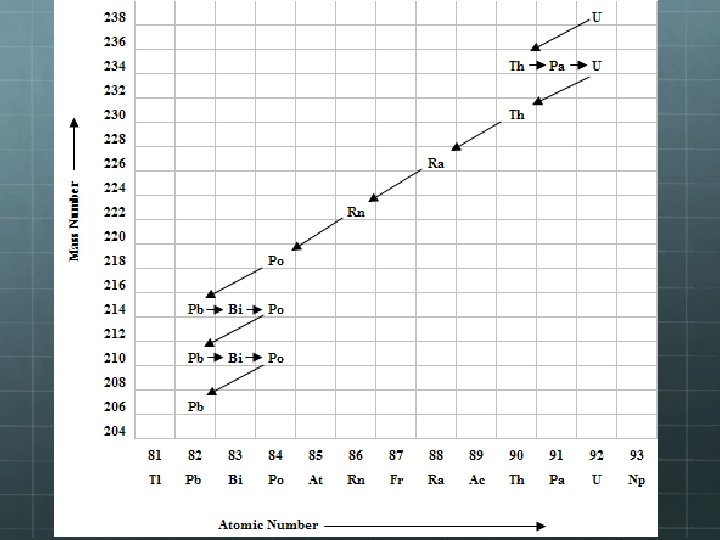
Decay Series As seen on the previous slide, sometimes a the decay of an unstable nucleus results in the creation of another unstable nucleus. Further decays will occur until a stable nucleus is the result. The set of decays a nucleus undergoes on its journey toward stability is called its “decay series” It may be represented visually as a graph of mass number vs. atomic number. On the next slide is the decay series for uranium-238.
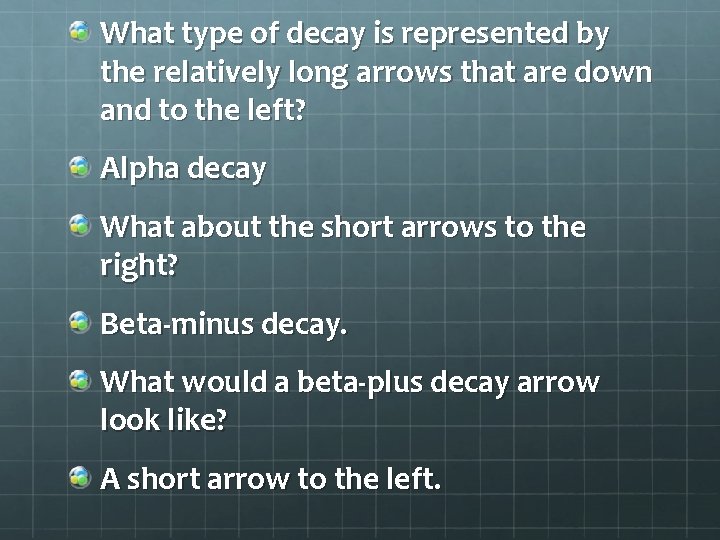
What type of decay is represented by the relatively long arrows that are down and to the left? Alpha decay What about the short arrows to the right? Beta-minus decay. What would a beta-plus decay arrow look like? A short arrow to the left.
Penetrating Power of Alpha, Beta, & Gamma Radiation For a more thorough summary of the properties of alpha, beta, and gamma radiation, see Table 7. 2 in your text. Also Note: We’ll discuss neutron radiation a bit later…
The Nature of Radioactive Decay It is random – We cannot predict which unstable nucleus in a sample will decay next, nor can we predict when the next decay event will occur. It is spontaneous – We cannot influence, by external circumstance, whether a decay event occurs or not.
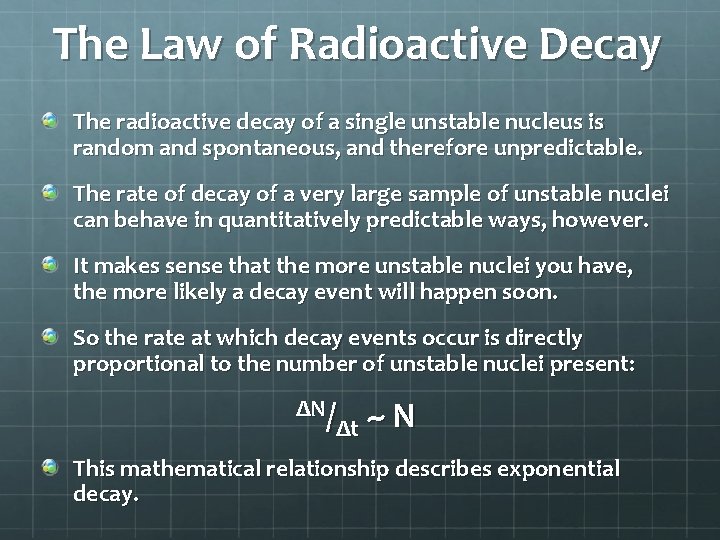
The Law of Radioactive Decay The radioactive decay of a single unstable nucleus is random and spontaneous, and therefore unpredictable. The rate of decay of a very large sample of unstable nuclei can behave in quantitatively predictable ways, however. It makes sense that the more unstable nuclei you have, the more likely a decay event will happen soon. So the rate at which decay events occur is directly proportional to the number of unstable nuclei present: ΔN/ ~ N Δt This mathematical relationship describes exponential decay.
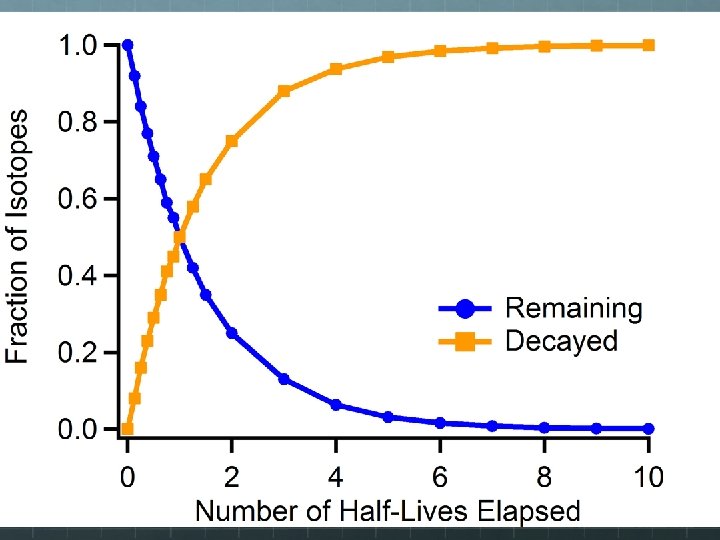
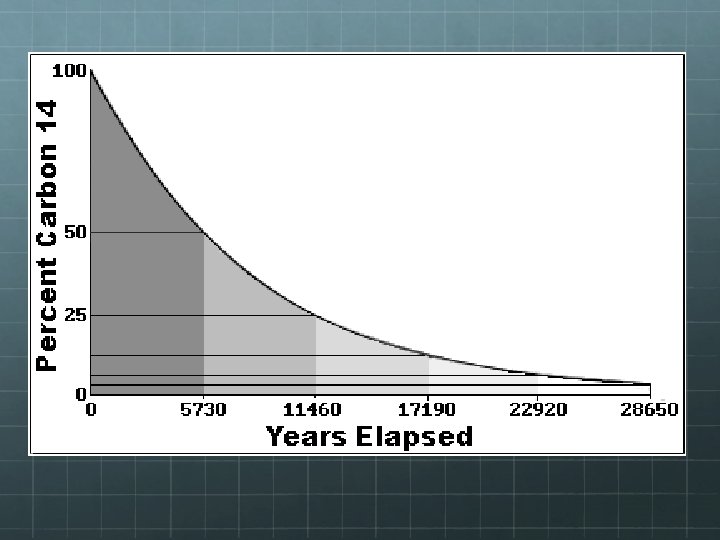
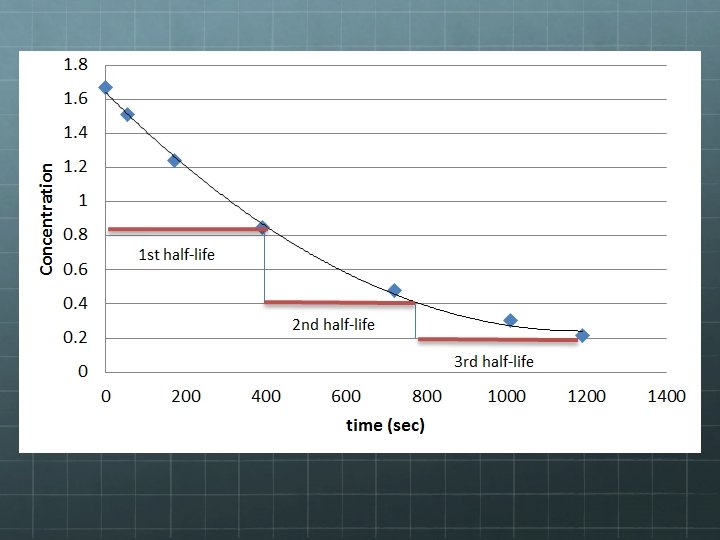
Half-Life Note, on the previous graph, time was plotted along the x-axis, but not in seconds, hours, or years, but in half lives. The half life of an unstable nucleus is a measure of its longevity and its likelihood of decaying during a specified time frame. The half life of an unstable nucleus is the amount of time it takes for half of the nuclei in a statisticallylarge sample to decay.
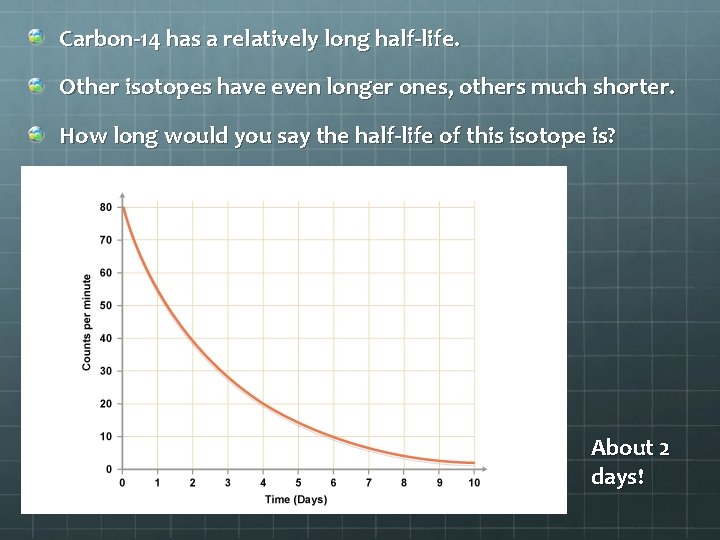
14 Half Life of 6 C Consider carbon-14, a relatively rare and unstable isotope of carbon. If you have a single carbon-14 atom, you have no idea when it will decay. It could be in 5 seconds or a million years from now! However, based on studying large samples of carbon-14 and their rate of decay, we know that the likelihood of a single carbon-14 atom decaying during a time interval of 5, 730 years is 50%. This means if we wait a little less than 6, 000 years, we have a 50 -50 chance of seeing any given carbon-14 nucleus decay.
14 Half Life of 6 C Suppose we have a very large sample of carbon-14 nuclei say, a billion of ‘em! After one half-life of 5, 730 years, we would have no idea which nuclei decayed, and which didn’t…. . . but we could be pretty sure we’d have a half-billion of each: 500, 000 decayed and 500, 000 still unstable. Then, if we waited another 5, 730, we’d lose another half of what was left: ½ (500, 000) or 250, 000, which is ¼ of what we started with. After a third half-life, we’d lose another half of what was left, etc…
Carbon-14 has a relatively long half-life. Other isotopes have even longer ones, others much shorter. How long would you say the half-life of this isotope is? About 2 days!
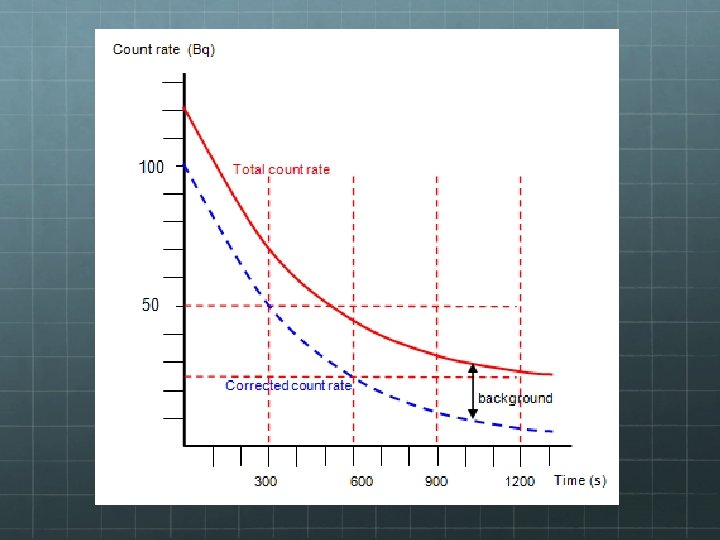
Background Radiation If you count decay events in order to determine halflife you must be careful to take background radiation into account. The Sun emits radiation in the form of cosmic rays which can be detected by the same equipment trying to count decay events from a sample. If the sample’s half-life is very long, or if it’s a small sample with few decay events per unit time, it’s important to adjust for background radiation.
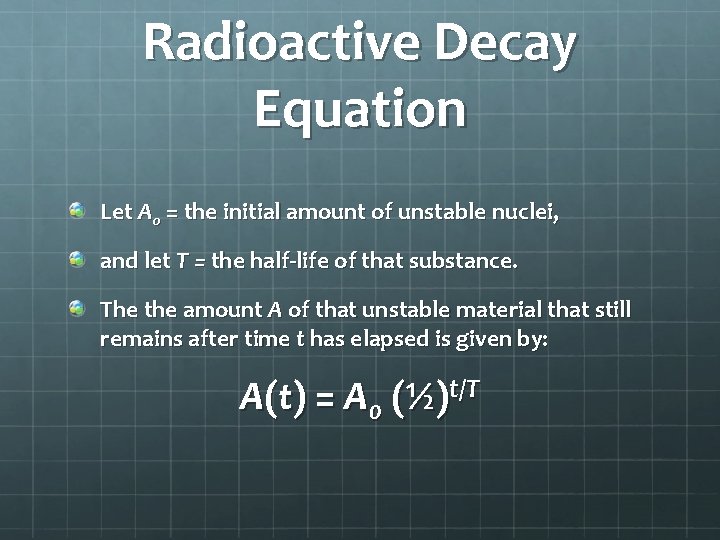
Radioactive Decay Equation Let A 0 = the initial amount of unstable nuclei, and let T = the half-life of that substance. The the amount A of that unstable material that still remains after time t has elapsed is given by: A(t) = A 0 (½)t/T
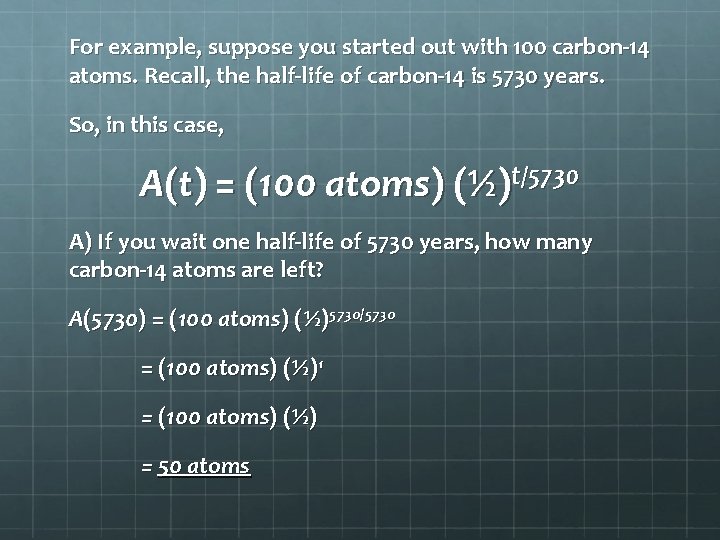
For example, suppose you started out with 100 carbon-14 atoms. Recall, the half-life of carbon-14 is 5730 years. So, in this case, A(t) = (100 atoms) (½)t/5730 A) If you wait one half-life of 5730 years, how many carbon-14 atoms are left? A(5730) = (100 atoms) (½)5730/5730 = (100 atoms) (½)1 = (100 atoms) (½) = 50 atoms
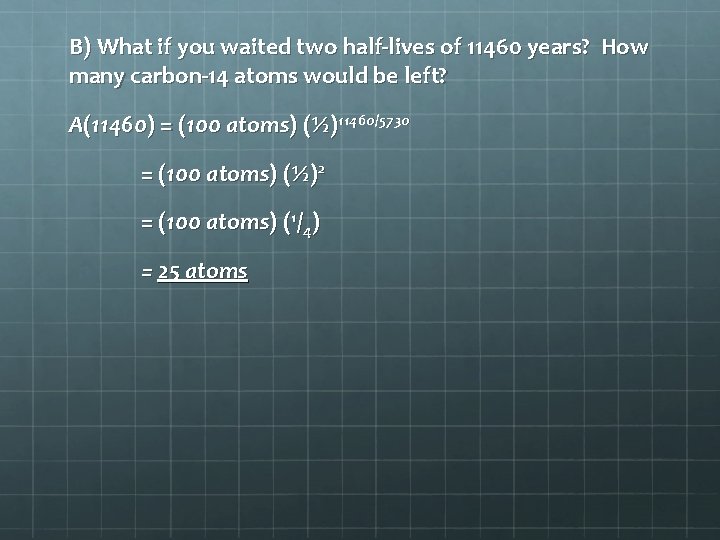
B) What if you waited two half-lives of 11460 years? How many carbon-14 atoms would be left? A(11460) = (100 atoms) (½)11460/5730 = (100 atoms) (½)2 = (100 atoms) (1/4) = 25 atoms
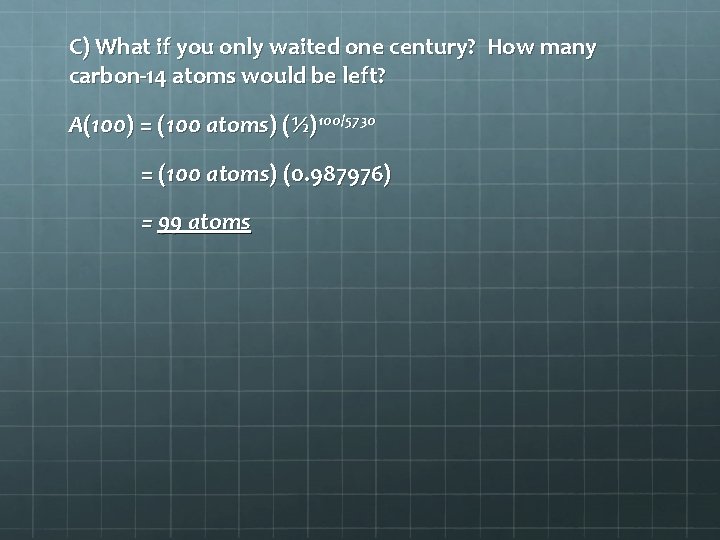
C) What if you only waited one century? How many carbon-14 atoms would be left? A(100) = (100 atoms) (½)100/5730 = (100 atoms) (0. 987976) = 99 atoms
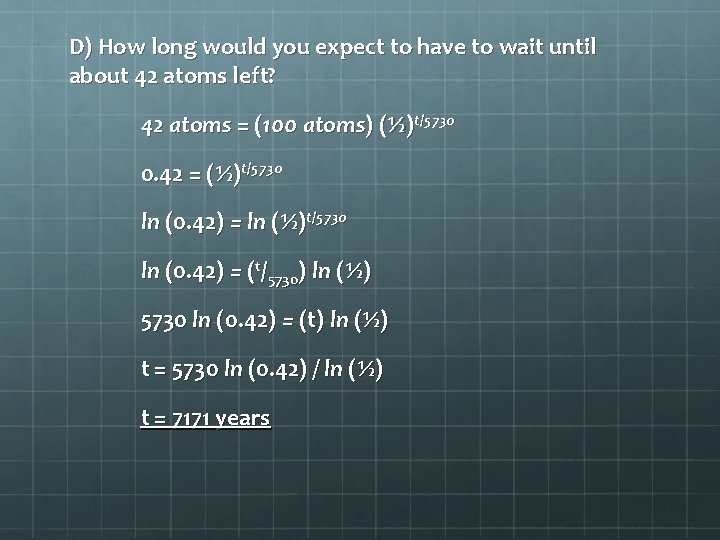
D) How long would you expect to have to wait until about 42 atoms left? 42 atoms = (100 atoms) (½)t/5730 0. 42 = (½)t/5730 ln (0. 42) = ln (½)t/5730 ln (0. 42) = (t/5730) ln (½) 5730 ln (0. 42) = (t) ln (½) t = 5730 ln (0. 42) / ln (½) t = 7171 years
The Fundamental Forces Every push or pull in the Universe can be attributed to just one of four fundamental forces in nature: The Electromagnetic Force – Acts on charged particles; force is infinite in range The Gravitational Force – Force of attraction between objects with mass. VERY weak compared to the electromagnetic force. Since atomic particles have such small mass, gravitational forces between them are negligibly small. This force is infinite in range.
The Fundamental Forces The Strong Nuclear Force – Acts on protons and neutrons to keep them bound together in the nucleus despite electric repulsion that would otherwise push the nucleus apart. Very short range: ~10 -15 m The Weak Nuclear Force – Acts on protons, neutrons, electrons, and neutrinos, allowing beta decay to occur. Very VERY short range: ~10 -18 m Note: these two forces manifest only on the tiny scale of atomic nuclei. Thus any push or pull you’ve ever felt (or will feel) can be attributed to either gravity or electromagnetism only.
Combined Forces It is known that at high enough temperatures, the electromagnetic force and weak nuclear force become indistinguishable from each other, and become known as the electroweak force. In a sense, the two separate forces electromagnetism & weak forces – may be thought of as different manifestations of this same electroweak force. It is thought that at even higher temperatures, the strong force may combine with the electroweak force leaving two fundamental forces: the gravitational force, and the everything-else-force.