
UNIT 7 AMEMORY BY MICHAEL SANTIAGO ENCODING 3
UNIT 7 A-MEMORY BY MICHAEL SANTIAGO
• ENCODING • 3. • Ø Rehearsal boosts memory Ø The spacing effect shows that spaced out Atkinson and Shiffrin came up with the three step model of memory processing 1. 2. rehearsal produces better memory retention Ø Through the serial position effect, one might We encode information as a sensory memory Then we store information into a short-term memory bin rehearse the names of the first few items in a list and forget the rest of the items • Finally, we encode that information into longterm memory for later retrieval We encode visually, acoustically, and semantically (meaning) Ø Semantic encoding produces better information retention The brain processes its environment in many ways Ø We better remember words that lend themselves to imagery, such as car or fire instead of agree or compassion Ø Parallel processing allows it to analyze many aspects of a situation Ø We process verbal information best when we make Ø Autmoatic processing allows it to instantly absorb info about time, space, frequency, and well-learned information Effortful processing, paying attention to stimuli, produces durable and accessible memories it relevant to ourselves • We can organize information for easier encoding Ø Chunking organizes information into familiar and manageable units Ø Hierarchies help us divide broad topics into smaller pieces of information
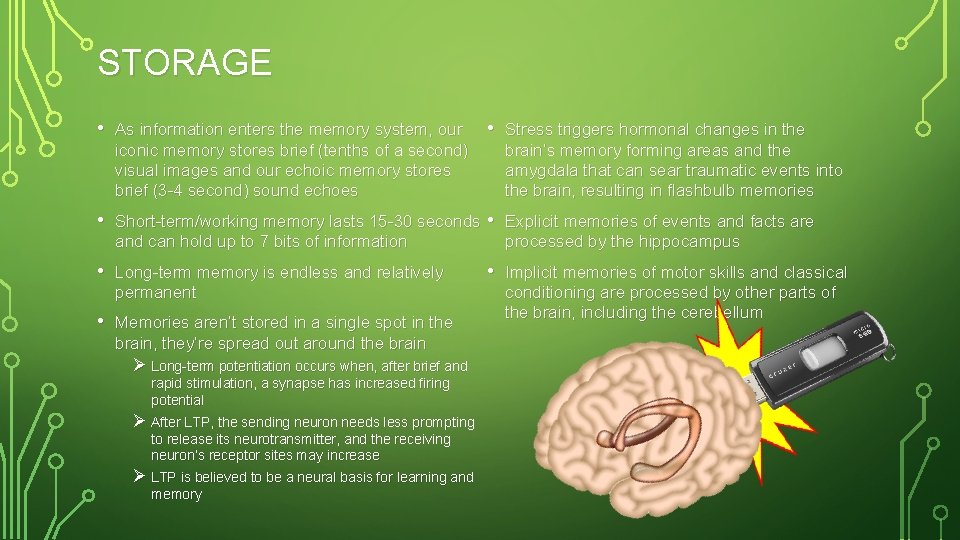
STORAGE • As information enters the memory system, our iconic memory stores brief (tenths of a second) visual images and our echoic memory stores brief (3 -4 second) sound echoes • Stress triggers hormonal changes in the brain’s memory forming areas and the amygdala that can sear traumatic events into the brain, resulting in flashbulb memories • Short-term/working memory lasts 15 -30 seconds and can hold up to 7 bits of information • Explicit memories of events and facts are processed by the hippocampus • Long-term memory is endless and relatively permanent • • Memories aren’t stored in a single spot in the brain, they’re spread out around the brain Implicit memories of motor skills and classical conditioning are processed by other parts of the brain, including the cerebellum Ø Long-term potentiation occurs when, after brief and rapid stimulation, a synapse has increased firing potential Ø After LTP, the sending neuron needs less prompting to release its neurotransmitter, and the receiving neuron’s receptor sites may increase Ø LTP is believed to be a neural basis for learning and memory

RETRIEVAL • Memory can be measured in many ways Ø Recall- retrieving previously learned information from memory Ø Recognition- identifying previously learned items Ø Relearning- measuring the amount of time save learning material for the 2 nd time • Memories are held in storage by a web of associations Ø Retrieval cues are anchor points can use to target information we want to retrieve later Ø Unconsciously activating these retrieval cues is called priming • In a different but similar context, similar retrieval cues can be activated, leading to déjà vu ØIn a similar way, being in a certain mood can prime us to remember memories consistent with our emotions, resulting in moodcongruent memories
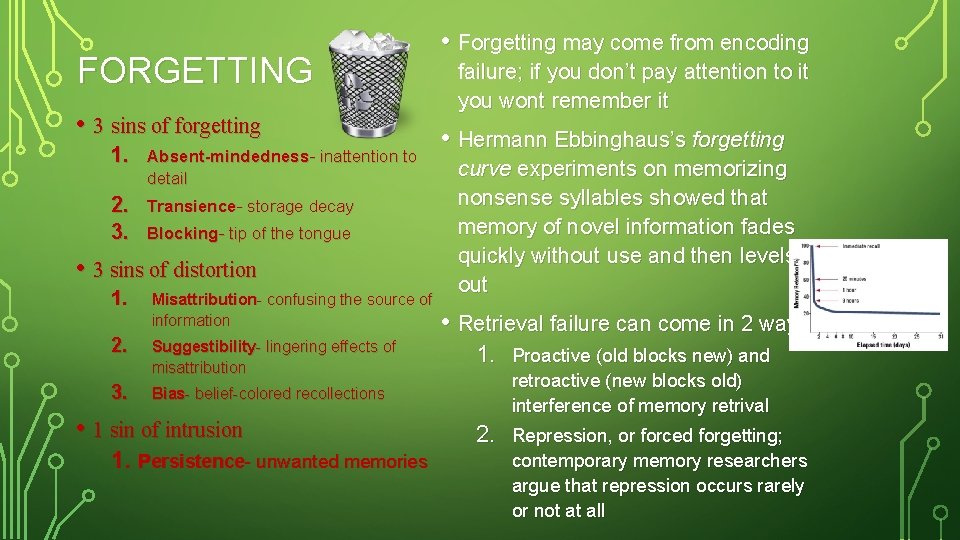
FORGETTING • 3 sins of forgetting 1. Absent-mindedness- inattention to detail 2. 3. Transience- storage decay Blocking- tip of the tongue • 3 sins of distortion 1. Misattribution- confusing the source of information 2. Suggestibility- lingering effects of misattribution 3. Bias- belief-colored recollections • 1 sin of intrusion 1. Persistence- unwanted memories • Forgetting may come from encoding failure; if you don’t pay attention to it you wont remember it • Hermann Ebbinghaus’s forgetting curve experiments on memorizing nonsense syllables showed that memory of novel information fades quickly without use and then levels out • Retrieval failure can come in 2 ways 1. Proactive (old blocks new) and retroactive (new blocks old) interference of memory retrival 2. Repression, or forced forgetting; contemporary memory researchers argue that repression occurs rarely or not at all
MEMORY CONSTRUCTION • The misinformation effect occurs • when we subtly add misleading information into our recall of an event Ø One might recall a coke can as being a water bottle or a yield sign as being a stop sign Ø After repeatedly rehearsing these details, we can ultimately believe they were true • Source amnesia may occur when we assign a certain memory to a wrong source, such as a dream or movie Although real and false memories may feel equally as real, there are ways of discerning the two Ø False memories are restricted to the gist of the event, with details becoming more foggy the more you think about them
EYEWITNESSES AND THE MEMORY WAR • • Suggestive questioning techniques used • Psychologists now agree on the following on children can produce false testimonies 1. Memories of things that occurred before 3 are unreliable Ø Ex. “Did Jim touch you and then tell you not to tell anyone? ” 2. People have been falsely accused Ø Neutral, non-suggestive questioning can produce 3. People may forget abuse more accurate witness statements 4. Recovering memories is normal 5. Memories recovered under hypnosis/drugs Psychology’s Memory War results from a are unreliable controversy over whether childhood 6. Memories can be emotionally upsetting memories of sexual abuse are repressed and can be recovered though means of leading questions and/or hypnosis Ø Elizabeth Loftus has done years of research on the topic and supports the idea that the means used to recover “repressed” memories aren’t reliable
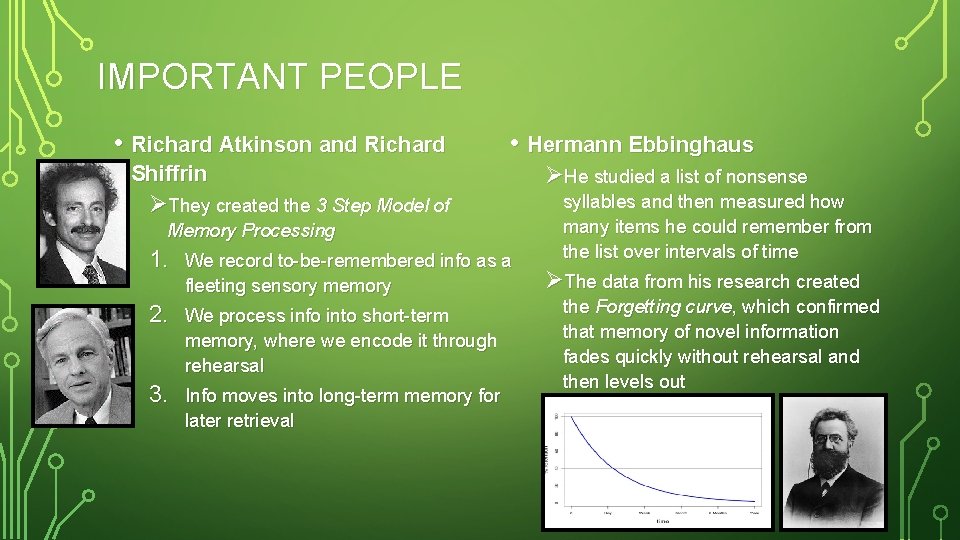
IMPORTANT PEOPLE • Richard Atkinson and Richard • Hermann Ebbinghaus Shiffrin ØThey created the 3 Step Model of Memory Processing 1. We record to-be-remembered info as a fleeting sensory memory 2. We process info into short-term memory, where we encode it through rehearsal 3. Info moves into long-term memory for later retrieval ØHe studied a list of nonsense syllables and then measured how many items he could remember from the list over intervals of time ØThe data from his research created the Forgetting curve, which confirmed that memory of novel information fades quickly without rehearsal and then levels out
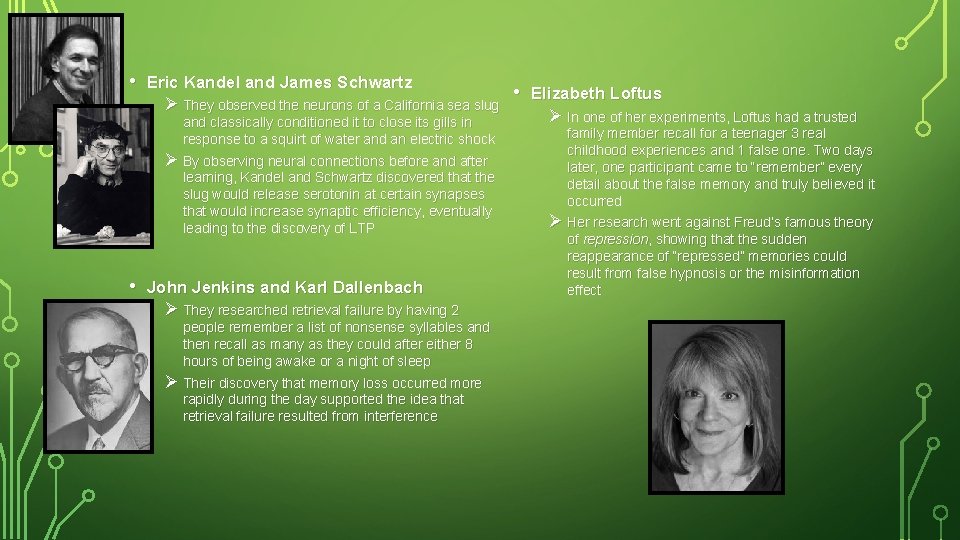
• Eric Kandel and James Schwartz Ø They observed the neurons of a California sea slug and classically conditioned it to close its gills in response to a squirt of water and an electric shock Ø By observing neural connections before and after learning, Kandel and Schwartz discovered that the slug would release serotonin at certain synapses that would increase synaptic efficiency, eventually leading to the discovery of LTP • John Jenkins and Karl Dallenbach Ø They researched retrieval failure by having 2 people remember a list of nonsense syllables and then recall as many as they could after either 8 hours of being awake or a night of sleep Ø Their discovery that memory loss occurred more rapidly during the day supported the idea that retrieval failure resulted from interference • Elizabeth Loftus Ø In one of her experiments, Loftus had a trusted family member recall for a teenager 3 real childhood experiences and 1 false one. Two days later, one participant came to “remember” every detail about the false memory and truly believed it occurred Ø Her research went against Freud’s famous theory of repression, showing that the sudden reappearance of “repressed” memories could result from false hypnosis or the misinformation effect
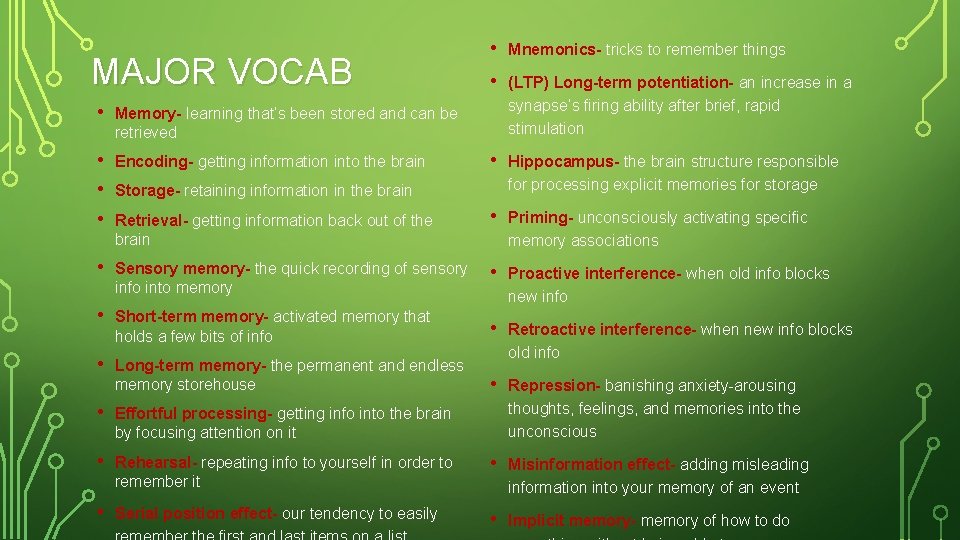
MAJOR VOCAB • Mnemonics- tricks to remember things • (LTP) Long-term potentiation- an increase in a synapse’s firing ability after brief, rapid stimulation • Hippocampus- the brain structure responsible for processing explicit memories for storage • Memory- learning that’s been stored and can be retrieved • • • Encoding- getting information into the brain Retrieval- getting information back out of the brain • Priming- unconsciously activating specific memory associations • Sensory memory- the quick recording of sensory info into memory • • Proactive interference- when old info blocks new info Short-term memory- activated memory that holds a few bits of info • • Long-term memory- the permanent and endless memory storehouse Retroactive interference- when new info blocks old info • Repression- banishing anxiety-arousing thoughts, feelings, and memories into the unconscious Storage- retaining information in the brain • Effortful processing- getting info into the brain by focusing attention on it • Rehearsal- repeating info to yourself in order to remember it • Misinformation effect- adding misleading information into your memory of an event • Serial position effect- our tendency to easily • Implicit memory- memory of how to do
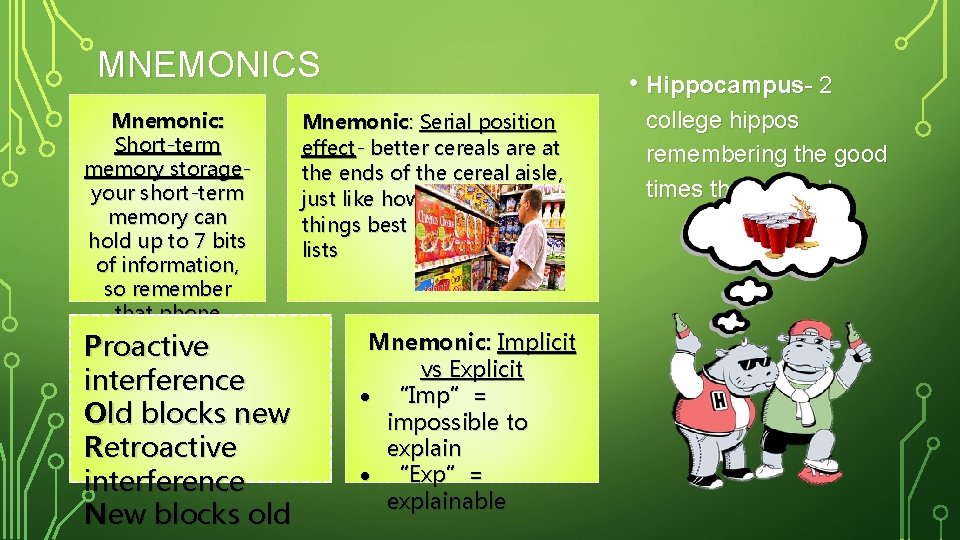
MNEMONICS Mnemonic: Short-term memory storageyour short-term memory can hold up to 7 bits of information, so remember that phone numbers are 7 Proactive numbers: interference 867 -5309 Old blocks new Retroactive interference New blocks old • Hippocampus- 2 Mnemonic: Serial position effect- better cereals are at the ends of the cereal aisle, just like how we remember things best at the ends of lists Mnemonic: Implicit vs Explicit “Imp”= impossible to explain “Exp”= explainable college hippos remembering the good times they’ve had
QUIZ 1. Kandel and Schwartz’s seas slug experiment exhibited the process of____ a) b) c) d) Repression Proactive interference Long-term potentiation Retroactive interference 2. Mnemonic devices rely mainly on___ a) b) c) d) Chunking Imagery Hierarchies Repression
3. Which type of encoding produces the best memory retention? a) b) c) d) Echoic Visual Acoustic Semantic 4. Long-term memory is to endless as short-term memory is to___ a) b) c) d) 7 bits of info Permanent 15 -30 seconds 1 second
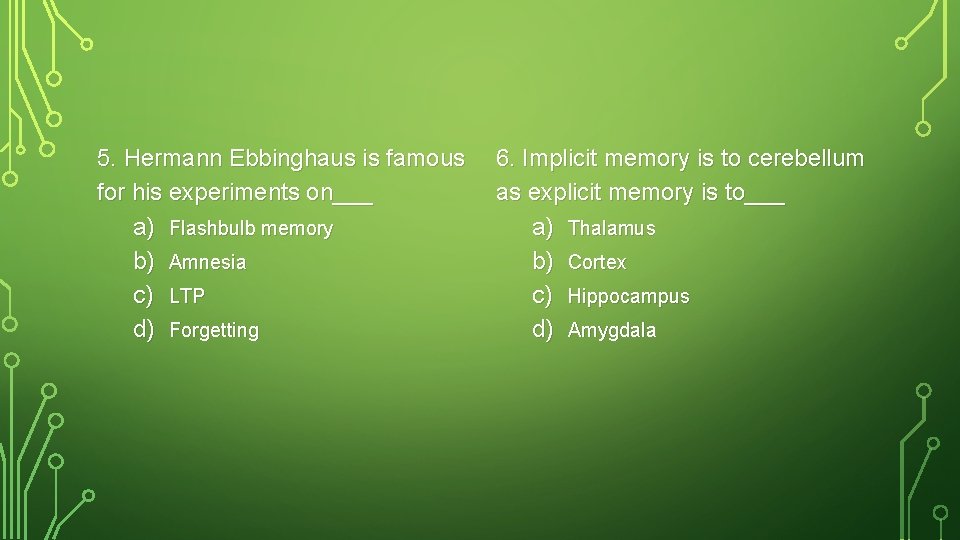
5. Hermann Ebbinghaus is famous for his experiments on___ a) b) c) d) Flashbulb memory Amnesia LTP Forgetting 6. Implicit memory is to cerebellum as explicit memory is to___ a) b) c) d) Thalamus Cortex Hippocampus Amygdala
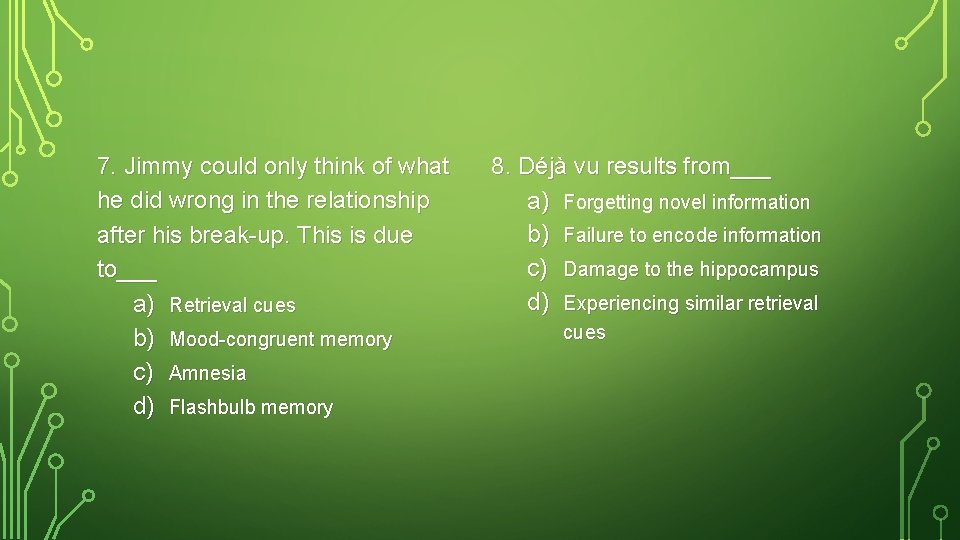
7. Jimmy could only think of what he did wrong in the relationship after his break-up. This is due to___ a) b) c) d) Retrieval cues Mood-congruent memory Amnesia Flashbulb memory 8. Déjà vu results from___ a) b) c) d) Forgetting novel information Failure to encode information Damage to the hippocampus Experiencing similar retrieval cues
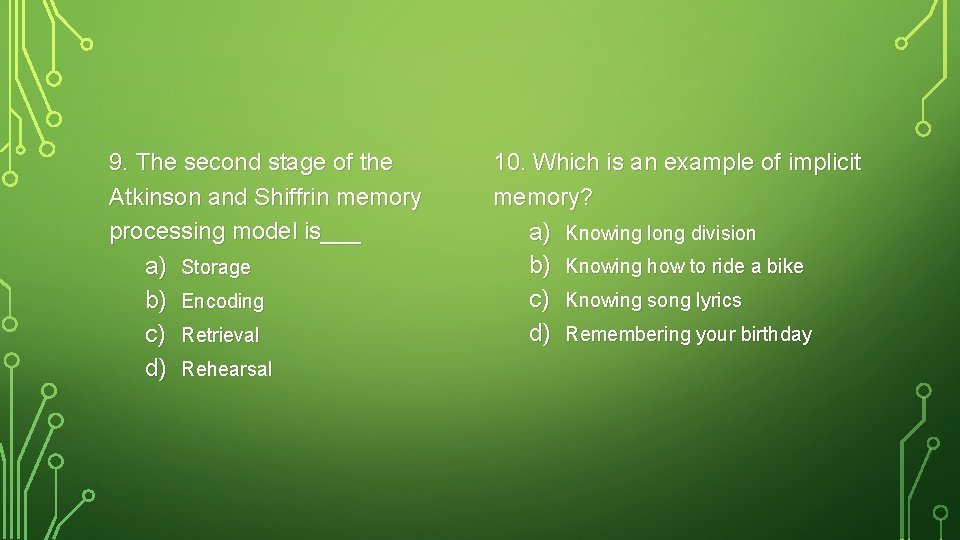
9. The second stage of the Atkinson and Shiffrin memory processing model is___ a) b) c) d) Storage Encoding Retrieval Rehearsal 10. Which is an example of implicit memory? a) b) c) d) Knowing long division Knowing how to ride a bike Knowing song lyrics Remembering your birthday
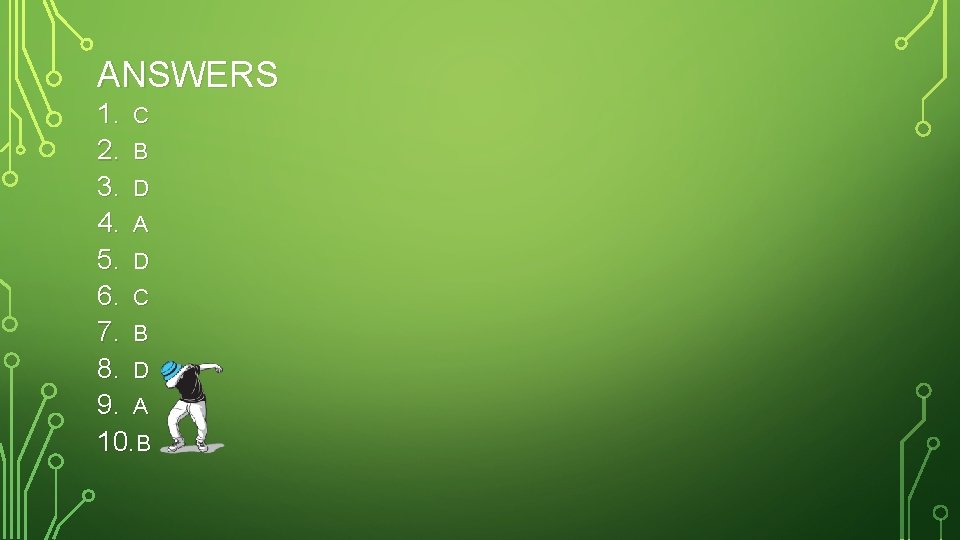
ANSWERS 1. C 2. B 3. D 4. A 5. D 6. C 7. B 8. D 9. A 10. B
- Slides: 17