
Unit 6 The United States on the Brink
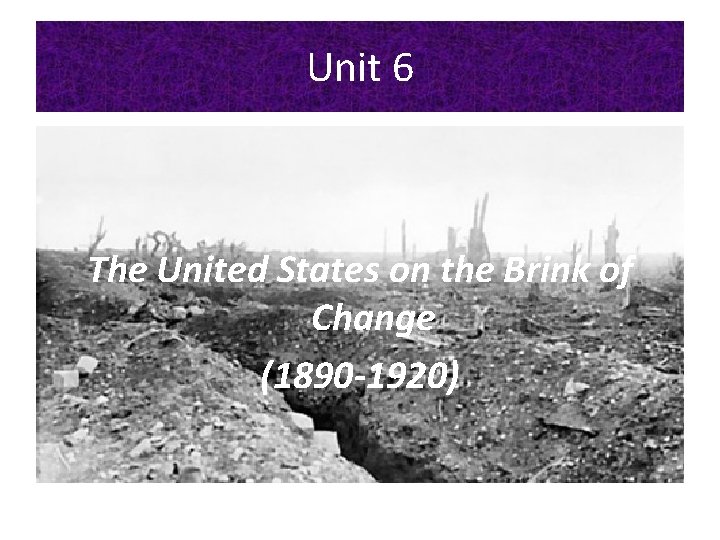
Unit 6 The United States on the Brink of Change (1890 -1920)
Unit Introduction ü We have spent a significant amount of time studying the history of the United States from an internal perspective. (Issues occurring solely within the United States such as slavery, growth of industry, westward expansion, …) ü In this unit we will now begin to look outward as the United States forms its role as an important world leader. ü Meanwhile, we were still facing some of the old internal issues. Such things as immigration, conflicts between rich & poor, still dotted American society. ü Lastly, there were growing tensions in Europe which would eventually compel the US to join a worldwide conflict for the first time…
Chapter 17 Becoming a World Power
Section 1: The Pressure to Expand Main Idea In the late 1800’s, as European nations took over vast areas in Africa and Asia, American leaders looked to extend American influence abroad.
Setting the Scene Given Information ü By the dawn of the 20 th century, the growth of industry had forever changed the American landscape. ü At this time many Americans began to feel as though the country had to protect it’s political, social, and economic interests internationally. IMPERIALISM Stronger nations (financially, technologically, militarily) attempt to create empires by dominating weaker nations economically, culturally, politically, or militarily.
Why Imperialism Grew 1. Economic Factors. a) Industrial growth created a massive need for natural resources which came from undeveloped areas of the world. b) Industrial nations also needed to establish new markets (other nations/areas of the world)in which they could sell their manufactured goods. 2. Nationalistic Factors a) Nationalism-devotion to one’s country. Wanting your country to simply be the best. b) This created competition among nations to create large profitable empires
Why Imperialism Grew 3. Military Factors a) European armies and navies were far superior to any organized defense in either Africa or Asia. b) This was due to advanced military technology. c) Growing navies needed bases at strategic locations around the world. (The USA was no different). 4. Humanitarian Factors a) Colonial officials, doctors, and Christian missionaries (those who wanted to spread the word of their religion) believed that they had a duty to spread the blessings of western civilization
Expanding US Interests A Chronology of US Foreign Policies: 1. George Washington’s Farewell Address -- Early US growth (eco. & geo. ) discouraged US interests in foreign affairs 2. Monroe Doctrine (1820) -- Established US as THE presence in western hemisphere. 3. Manifest Destiny – Mid 19 th Century -- Land acquired from Mexico
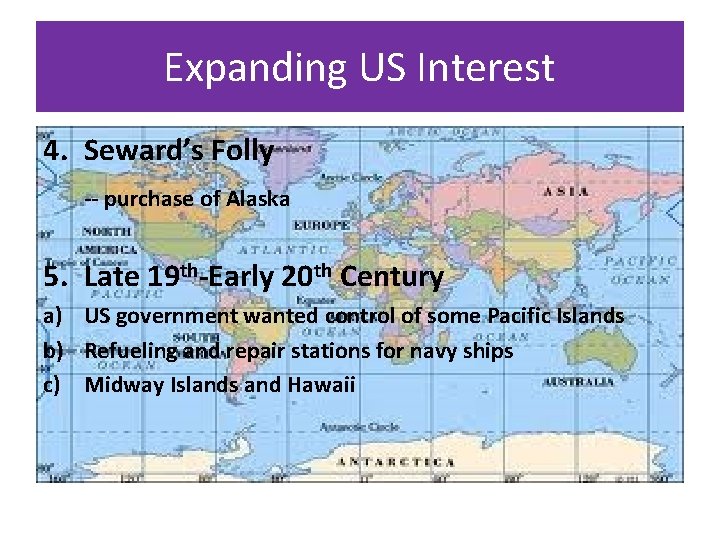
Expanding US Interest 4. Seward’s Folly -- purchase of Alaska 5. Late 19 th-Early 20 th Century a) US government wanted control of some Pacific Islands b) Refueling and repair stations for navy ships c) Midway Islands and Hawaii
Arguments for US Expansion Promotion of Eco. Growth 1. 2. 3. 4. US had a very powerful industrial economy. Americans could not consume everything they produced. Overproduction led to financial panics and eco. Depressions Thus, the US sought to secure new markets abroad. Promoting American Security 1. Many favored a strong US navy. 2. The US needed a strong navy to protect new American markets 3. US navy made larger and modernized
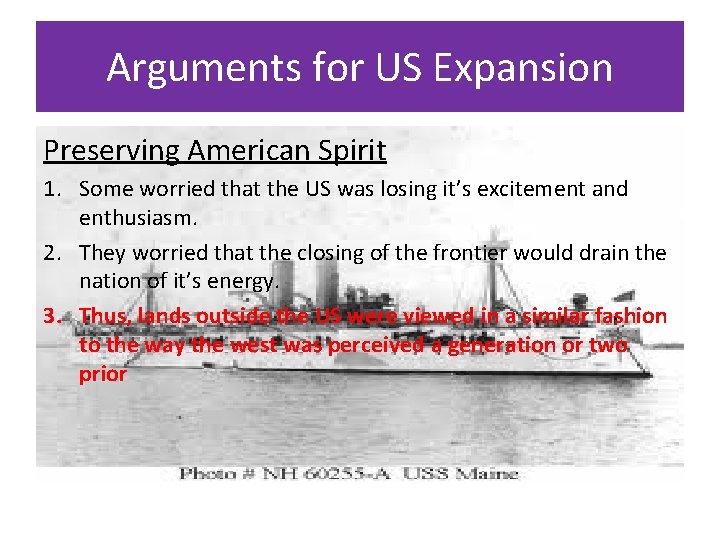
Arguments for US Expansion Preserving American Spirit 1. Some worried that the US was losing it’s excitement and enthusiasm. 2. They worried that the closing of the frontier would drain the nation of it’s energy. 3. Thus, lands outside the US were viewed in a similar fashion to the way the west was perceived a generation or two prior
Section 2: The Spanish-American War Main Idea A swift victory in the Spanish-American War confirmed the United States as a world power, but it left some arguing over how to govern the newly acquired territories
Setting the Scene Given Information ü The United States was on the brink of becoming a world power. ü They were basically looking for that opportunity ü Yellow journalism gave them that chance
Setting the Stage for War Yellow Journalism: ü A form of exaggerated journalism. ü It’s purpose was to sell newspapers. ü As a result, it stirred up demands among American citizens to have the government intervene in the Cuban situation. ü This created a burst of national pride which led to a desire for a more aggressive foreign policy known as Jingoism. ü Public sentiment sided with the Cuban rebels who were seeking their independence from Spain
The Spanish-American War Steps to War 1. The de Lome letter a) b) US newspapers published a letter from the Spanish ambassador Written by Dupuy de Lome, the letter described President Mc. Kinley as a weak leader and created an outcry in the United States 2. The Sinking of the Maine a) b) c) In 1898 President Mc. Kinley sent the USS Maine to Havana as a response riots breaking out in the capital to protect American citizens and property. While in Havana harbor the Maine experienced an explosion which killed 250 American sailors. Although the cause was unknown, many blamed Spain for this and called for war
The Spanish-American War 3. The Philippines a) b) c) Also a Spanish possession The people there were rebelling too The US saw the Philippines as a strategic location in the Pacific to protect its Asian trade 4. Mc. Kinley’s War Message a) b) c) As a last ditch effort to avoid war, President Mc. Kinley sent a list of demands to Spain. All were agreed to except the last one. Mc. Kinley then gave into Congressional demands and recognized Cuban independence.
The Treaty of Paris ü The Spanish government recognized Cuba’s independence ü The United States also acquired The Philippines, Puerto Rico, and Guam
New Challenges After the War The Fate of Cuba ü After the war US involvement in Cuba remained ü President Mc. Kinley installed a military government in an effort to protect American business interests. ü Many Cubans felt that the US had abandoned their promises made prior to the war and had in fact simply replaced Spain as Cuba’s controlling interest. ü The US agreed to remove troops only if Cuba included provisions outlined in the Platt Amendment in the new Cuban constitution
New Challenges After the War The Platt Amendment 1. The Cuban government could not enter any foreign agreements. 2. The US will be allowed to establish naval bases in Cuba. 3. The US will have the right to intervene whenever necessary Other Gains by the United States ü Puerto Rico ü Hawaii. The US was interested in Hawaii’s sugar and pineapples. The US also needed naval stations.
The Open Door Policy ü China’s population and markets became important to American trade. ü At the same time, European nations were also interested in establishing Spheres of Influence ü These areas of economic and political control ü The United States created an Open Door Policy. ü The United States sent notes to the major European nations in an effort to persuade them to keep the door “open” in China. The US wanted equal access to China’s millions of consumers.
Section 3 A New Foreign Policy
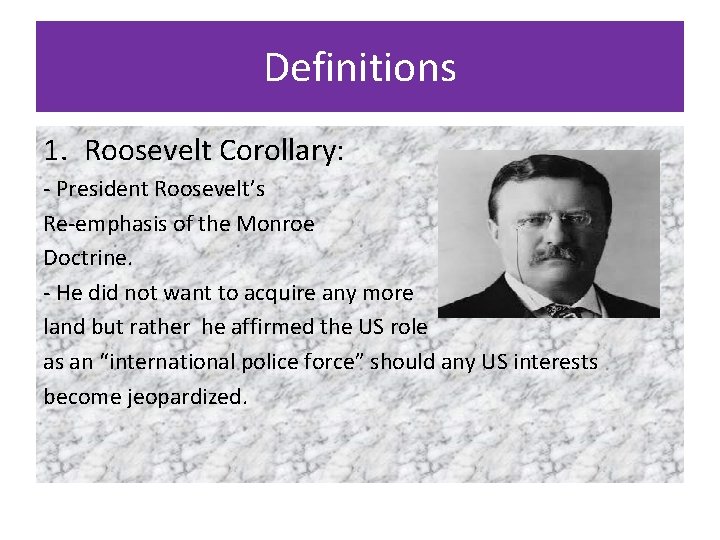
Definitions 1. Roosevelt Corollary: - President Roosevelt’s Re-emphasis of the Monroe Doctrine. - He did not want to acquire any more land but rather he affirmed the US role as an “international police force” should any US interests become jeopardized.
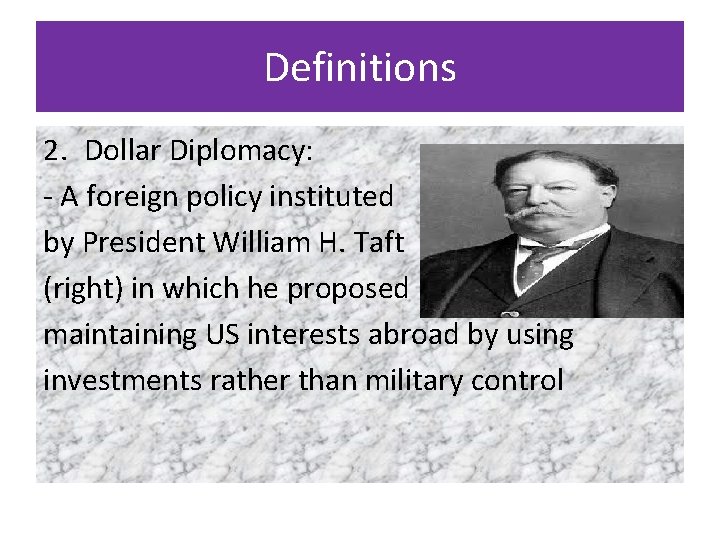
Definitions 2. Dollar Diplomacy: - A foreign policy instituted by President William H. Taft (right) in which he proposed maintaining US interests abroad by using investments rather than military control
The Panama Canal 1. President Roosevelt secretly made it clear to an official with a French company that the US would not interfere should that company organize a Panamanian revolt against Columbia. 2. When the revolt occurred, US warships were stationed offshore to provide support for Panamanian rebels. 3. Upon a Panamanian victory, the US immediately recognized an independent Panama and became it’s protectorate. 4. In return for their support, Panama granted the US a 10 mile strip of land that the US would use for the canal.
Big Stick Diplomacy ü In an effort to protect its newly acquired interests throughout the Pacific & Caribbean, Roosevelt used the expanded navy as his “Big Stick”. ü This would help the US act as an international police force. ü As far as Asia was concerned, Roosevelt’s main concern was to maintain an open door to China.
Big Stick Diplomacy ü On the other hand, Roosevelt was also had grown concerned about Japan’s expanding military power. ü In 1905 Roosevelt mediated a peace agreement for the Russo-Japanese War. ü He was also successful in keeping trade with China open to all nations.
Dollar Diplomacy ü William Howard Taft was not as aggressive as Theodore Roosevelt. ü He too wanted to maintain an open door to China and to preserve stability in Latin America. ü He preferred substituting dollars for military force ü He increased American investments in other countries as a means to exert our influence over them
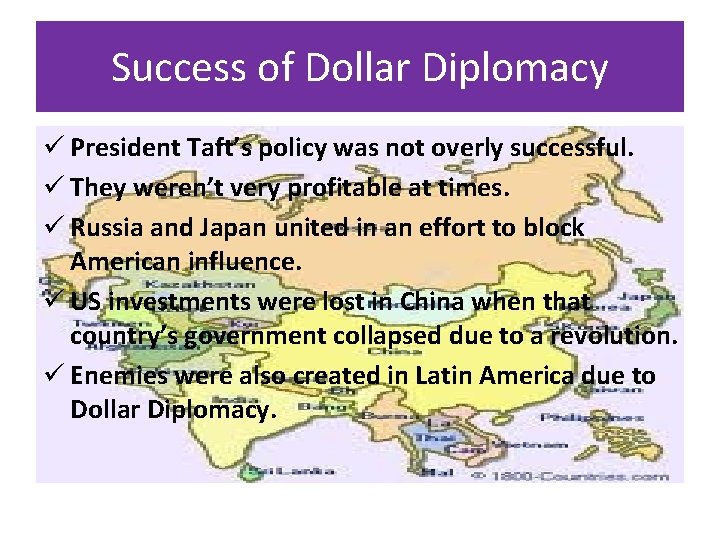
Success of Dollar Diplomacy ü President Taft’s policy was not overly successful. ü They weren’t very profitable at times. ü Russia and Japan united in an effort to block American influence. ü US investments were lost in China when that country’s government collapsed due to a revolution. ü Enemies were also created in Latin America due to Dollar Diplomacy.
Chapter 18 The Progressive Reform Era
Section 1: The Origins of Progressivism Chapter Introduction At the turn of the century, many Americans hoped to change American society for the better. These reform minded citizens, who were called Progressives, worked for many different causes at the national, state, and local levels of government. Many of these reforms have had a lasting effect on our society.
Setting the Scene ü The meatpacking industry is just one example of the many atrocities that were occurring in America. ü Violent accidents, horrible illnesses, and painful deaths were just some of the things occurring in this particular industry. ü Sinclair even questioned the quality of the food itself.
The Progressive Era The Roots of 20 th Century Reform ü Early 20 th century reform were rooted in Populism ü Other “roots” of Progressivism include nativism, prohibition, purity crusades, electoral reform, charity reform, social gospel philosophy, and the settlement movement. ü Industrialization brought great prosperity but it had come at the expense of the workers. ü They experienced low incomes and cycles of unemployment. ü Working conditions were deplorable. ü Political corruption infested government at all three levels.
The Progressives: Their Goals and Beliefs 1. Government should be more accountable to its citizens. 2. Government should curb the power and influence of its wealthy interests. 3. Government should be given expanded powers so that it could become more active in improving the lives of its citizens. 4. Governments should become more efficient and less corrupt so that they could competently handle an expanded role.
Igniting Reform: Writers and Their New Ideas Muckrakers: Those who alerted the public to wrong doing in politics and business. They were exposing the “filth” of society. ü They relied on scientific data and expert testimony. ü Jacob Riis was among the 1 st with his exposure of slum living. ü They published the results of their investigations in an effort to make the public put pressure on legislatures to pass new laws.
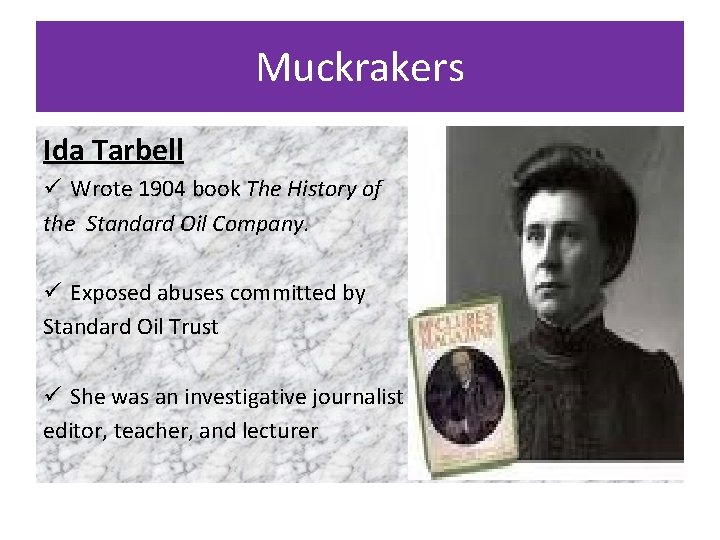
Muckrakers Ida Tarbell ü Wrote 1904 book The History of the Standard Oil Company. ü Exposed abuses committed by Standard Oil Trust ü She was an investigative journalist editor, teacher, and lecturer
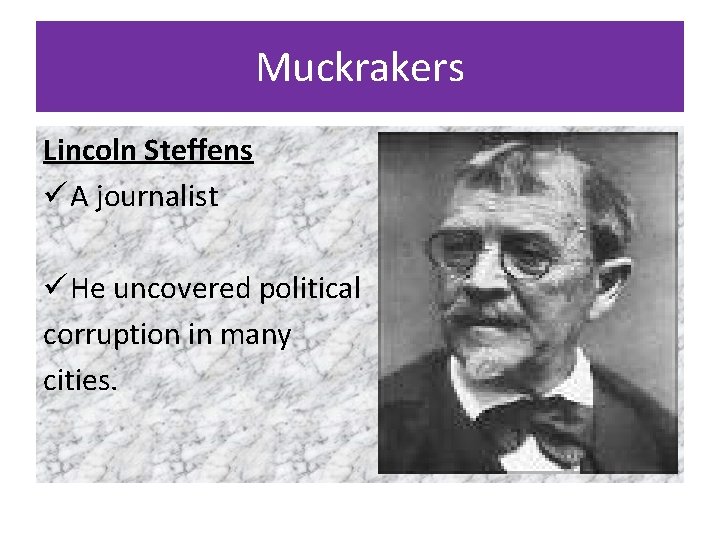
Muckrakers Lincoln Steffens ü A journalist ü He uncovered political corruption in many cities.
Progressive Reform Organizations The Labor Movement ü The union movement began in the 1890’s ü This was discouraged by employers who favored dealing with workers individually rather than collectively ü Employers used injunctions, which were court orders prohibiting a certain action, against employees
Socialists Socialism A political and economic philosophy favoring public or government control of property and income. ü American socialists of this era wanted to see an end to capitalism, a more even distribution of wealth, and government ownership of American industries
Socialism ü Progressives however, did not support such sweeping changes. ü They did not want to lose their high standard of living ü They wanted to maintain the personal liberties afforded by democracy and the free enterprise system ü Progressives wanted to free the existing government from the corruption engulfed in it and for the government to guard the welfare of the workers and the poor.
Women’s Groups Reforms ü Investigated the conditions under which goods were made and sold. ü They encouraged consumers to only purchase goods at shops that did not employ children or require overtime. ü Insisted that factories obey state factory inspection laws and pay a minimum wage.
Chapter 18 Vocabulary Municipal Recall Injunction Federal Trade Commission Bull Moose Party Home Rule Direct Primary 17 th Amend. Referendum Initiative Muckrakers Progressive Era Clayton Anti Trust Act Fed. Reserve
Section 2 Progressive Legislation
Setting the Scene There were many things wrong within society! Here is just one example… The Triangle Shirtwaist Company ü The company was located on the upper floors of a 10 story building ü They made tailored women’s blouses
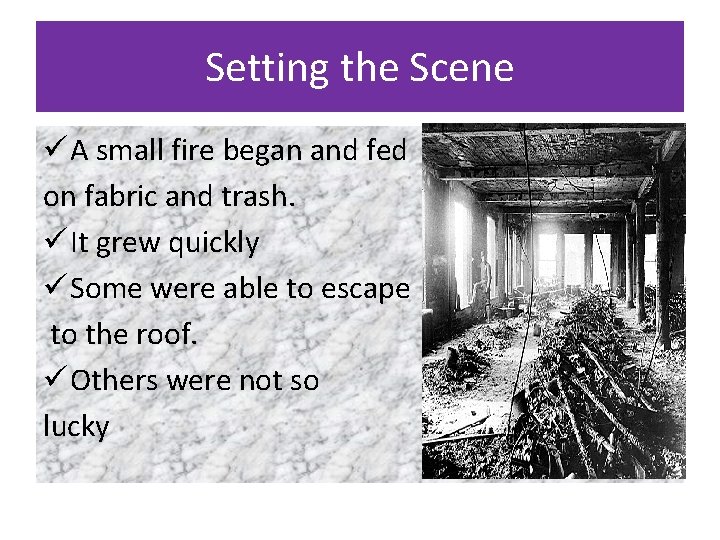
Setting the Scene ü A small fire began and fed on fabric and trash. ü It grew quickly ü Some were able to escape to the roof. ü Others were not so lucky
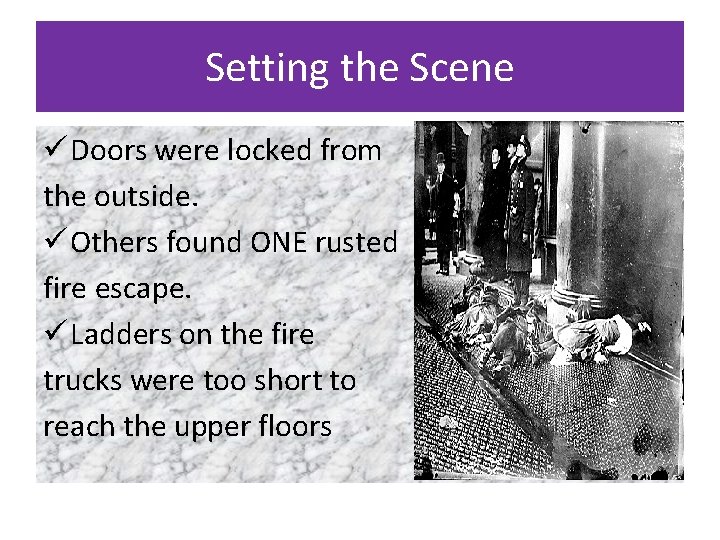
Setting the Scene ü Doors were locked from the outside. ü Others found ONE rusted fire escape. ü Ladders on the fire trucks were too short to reach the upper floors
Setting the Scene ü Those who were desperate leaped into the waiting nets of firefighters below only to have the nets malfunction. ü Others were trapped above and died from the smoke and flames. ü A leader emerged, Rose Schneiderman, who pushed for reforms such as the appointment of fire inspectors, compulsory fire drills, unlocking fireproof exits, and requiring automatic sprinklers
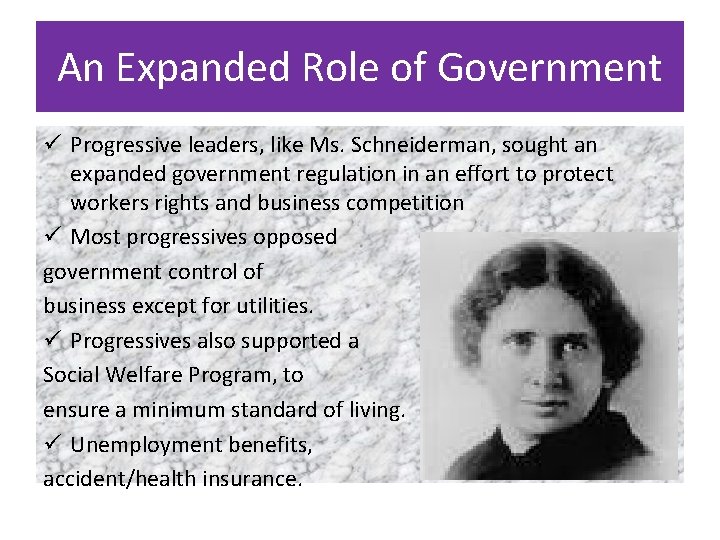
An Expanded Role of Government ü Progressive leaders, like Ms. Schneiderman, sought an expanded government regulation in an effort to protect workers rights and business competition ü Most progressives opposed government control of business except for utilities. ü Progressives also supported a Social Welfare Program, to ensure a minimum standard of living. ü Unemployment benefits, accident/health insurance.
Municipal Reforms These refer to changes on the local level of government. ü Home Rule-a system that gave cities a limited amount of self- rule ü Cities could not be dominated by corrupt state governments, political machines, businesses or rural interests ü Cities took over monopolies that controlled utilities
State Reforms More Power to Voters 1. Direct Primary- an election in which citizens vote for candidates to run in the upcoming general election - before this, party leaders selected such candidates 2. Referendum- a process that allows citizens to either allow or reject a law passed by the state legislature 3. Initiative- a process in which citizens can put a proposed new law directly on the ballot box in the upcoming election 4. Recall- a procedure that permits voters to remove public officials from office prior to their re-election
17 th Amendment Allowed for the direct election of United States Senators. Before this they were simply chosen by their respective state legislatures
Reforms in the Workplace 1. Some states developed their own Labor Departments. 2. Others developed workers’ compensation and accident agencies. 3. Business leaders were against many of these measures claiming that they violated their private property rights 4. The courts generally agreed with business leaders
Supreme Court Cases Lochner v. New York (1905) - the court struck down a law setting maximum hours for employees. - The court maintained that the law was not proven to protect the health of the workers in question and therefore the states police power was used improperly. - The court left the matter open by saying that if the law in question could be proven to protect the workers health then the states’ police power would be permissible
Supreme Court Cases Muller v. Oregon (1908) - The court upheld a law stipulating how many hours certain workers could work in a day. - It was argued by Louis Brandeis who eventually became a famous Supreme Court justice - He used scientific evidence to support the fact that working such long hours was harmful to the health of the workers in this particular case.
Federal Reforms Theodore Roosevelt and the “Square Deal” ü In 1902 he intervened in a strike by the United Mine Workers ü He got both sides involved to agree to arbitration ( when a 3 rd party-someone official but not associated with either side in a dispute- issues a decision that is automatically official) ü An agreement was reached that was agreeable to both sides. It was said to be a “square deal”. ü His presidency filed 42 pieces of anti-trust legislation ü RR’s: He got the Interstate Commerce Commission (ICC) to go from a simple “advisory role to one with actual enforcement powers.
Federal Reforms ü The ICC basically gained both legislative AND judicial powers over commerce in this country. ü Public Health: Pure Food and Drug Act and the Meat Inspection Act. Rating system for meatsstill around today. ü Department of Labor Added in 1913 ü Constitutional Amendments: 16 th- Federal Income Tax (1913) 18 th- Prohibition (1919)
Section 3 Progressivism Under Taft and Wilson
Setting the Scene William Howard Taft ü President from 1909 -1913 ü Essentially hand picked for the Republican nomination by Teddy Roosevelt was a widely popular President. ü Taft was a mild disappointment to Roosevelt and Progressives alike. ü Taft won easily in the 1908 election
Setting the Scene William Howard Taft (1909 -1913) ü Taft was not as aggressive as Roosevelt ü He appointed no Progressives to his cabinet. ü Conservation minded progressives also felt that Taft had let them down. ü The Secretary of the Interior had not supported Progressive conservation policies, instead siding with business interests that wanted to develop the land in the west.
Mid Term Elections of 1910 ü Since Taft was elected in 1908, and he would serve for four years until 1912, the mid point is the year 1910. ü Since the House of Representatives is up for reelection every two years the mid point is known as “mid term elections”. ü Upon returning from vacation Roosevelt began campaigning on behalf of Progressive Republicans. ü He supported business reform, welfare laws, income & inheritance taxes, and workplace protection for women and children
The Election of 1912 üRoosevelt challenged Taft for the republican nomination. üTaft had the support of the Republican party üProgressive republicans formed a new party know as the Progressive party and nicknamed the Bull Moose Party.
The Bull Moose Party Platform ü Tariff reduction. ü Women’s Suffrage ü Regulation of Businesses ü A ban on child labor ü 8 hr. workday ü Federal workers compensation system ü Direct election of US Senators
Taft’s Record Progressive Causes ü Reserved more public lands ü Brought more anti-trust suits ü Supported the Children’s Bureau ü 16 th & 17 th Amendments ü Added regulation of telephone and telegraph rates to the powers of the ICC
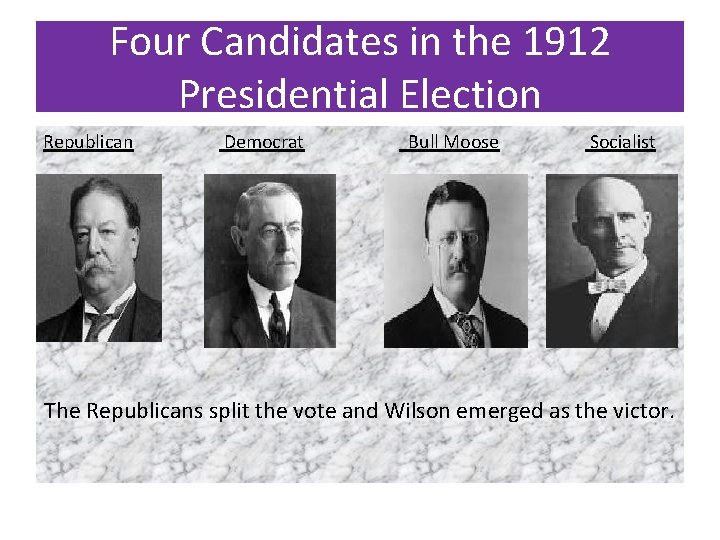
Four Candidates in the 1912 Presidential Election Republican Democrat Bull Moose Socialist The Republicans split the vote and Wilson emerged as the victor.
Wilson’s Policies as President Tariffs and Taxes ü He reduced tariffs ü In order to compensate for this loss of revenue Wilson signed the federal income tax into law Trusts ü Wilson believed that monopolies and trusts led to economic instability and restriction of free enterprise ü The Clayton Anti-Trust Act strengthened Sherman
Wilson’s Policies Clayton Anti-Trust ü Stated that labor unions are not monopolies and should nor be treated as such. ü Actually spelled out specific activities that businesses could not do. FTC & Federal Reserve ü Federal Trade Commission sets up fair trade laws ü Federal Reserve System-sets up a central system for the nation’s banks. Controls the flow of currency in order to meet the nation’s economic needs
The Limits of Progressivism ü ü ü Progressives redefined and expanded the role of government They did little to help tenant and migrant farmers. President Wilson did little to help social justice reforms. He did nothing to address Jim Crow As WWI approached, many people shifted their focus from Progressive issues to the brewing conflict in Europe
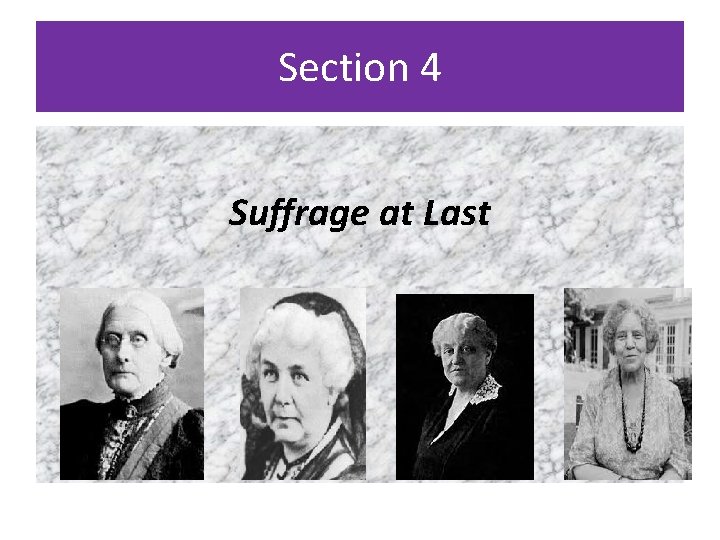
Section 4 Suffrage at Last
Setting the Scene ü Various women’s organizations campaigned actively for the right to vote for nearly 70 years. ü Opponents (men & women) viewed women’s suffrage as something that was unnecessary. ü Others saw it as a threat to the long known stability of American society. ü Critics suggested that women would become “too masculine” and would be distracted from their home duties.
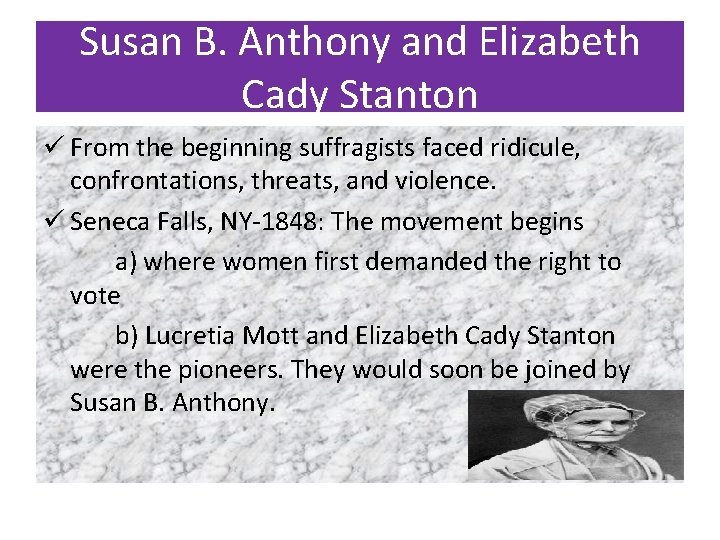
Susan B. Anthony and Elizabeth Cady Stanton ü From the beginning suffragists faced ridicule, confrontations, threats, and violence. ü Seneca Falls, NY-1848: The movement begins a) where women first demanded the right to vote b) Lucretia Mott and Elizabeth Cady Stanton were the pioneers. They would soon be joined by Susan B. Anthony.
The Movement Splits ü Stanton and Anthony formed the National Woman Suffrage Association. ü They fought for a constitutional amendment for suffrage. ü Another organization formed, the American Woman Suffrage Association worked on the state level to win voting rights. ü Wyoming entered the union in 1890 and became the first state to grant women full suffrage.
Susan B. Anthony ü Led a protest in 1872 in New York where she and others went to the polls. ü She was arrested and fined $100, which she never paid. “… it was We the People, not we the white male citizens… who formed the Union. … formed it not to half of ourselves… but to the whole people-women as well as men. ” - Susan B. Anthony
Suffragist Strategies ü Suffragists followed two paths toward their goal. a) Push for constitutional amendment b) 2/3 of each house of Congress had to pass the measure c) Then ¾ of the states had to do the same ü The other path chosen by other women was to push for individual states to let women vote. ü This approach was more successful in the west where frontier survival required the combined efforts of men and women. This promoted a greater sense of equality between them.
Suffrage at the Turn of the Century ü Veteran leaders were joined by younger leaders and formed the National American Woman Suffrage Association (NAWSA). ü Working women were also becoming more active in union activity-picketing for example. ü Sadly Stanton and Anthony died in 1902 and 1906 respectively, neither one ever realizing the reward for their lifelong efforts.
A New Generation ü Carrie Chapman Catt became a new leader. ü Also a woman named Alice Paul ü A split occurred once again. ü Paul and her committee formed the CU (Congressional Union) ü They ran more aggressive and militant campaigns for a constitutional amendment.
A Victory for Suffrage WWI: (1917) Women across the country volunteered for ambulance duty and medical work. They also filled jobs vacated by men who went off to war. In 1918 Congress formally introduced the suffrage amendment. Individual states were passing suffrage and NAWSA was unrelenting. Ratification was achieved in 1920. The 19 th Amendment marked the last major reform of the Progressive Era.
Chapter 21 The World War I Era
Chapter Introduction In the second decade of the 20 th century, a terrible war began in Europe, with the death toll eventually totaling an estimated 8 million soldiers and many more civilians. At first the United States vowed to maintain its neutrality. However, the nation finally declared war in order to support its allies and defend its business interests.
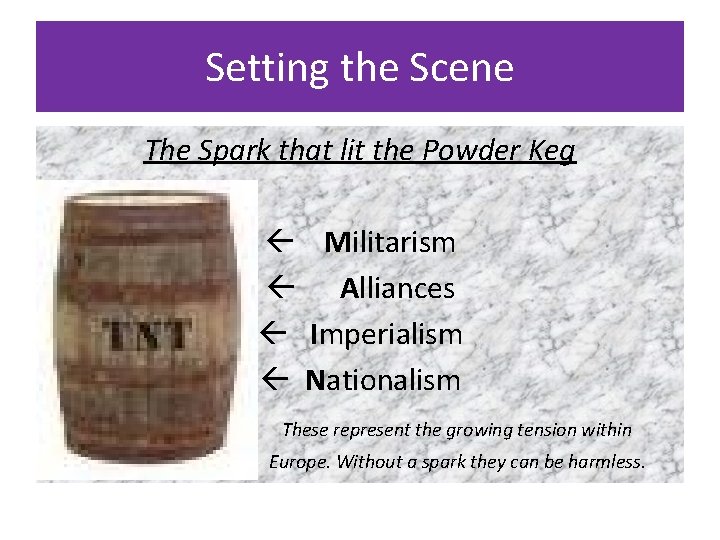
Setting the Scene The Spark that lit the Powder Keg ß Militarism ß Alliances ß Imperialism ß Nationalism These represent the growing tension within Europe. Without a spark they can be harmless.
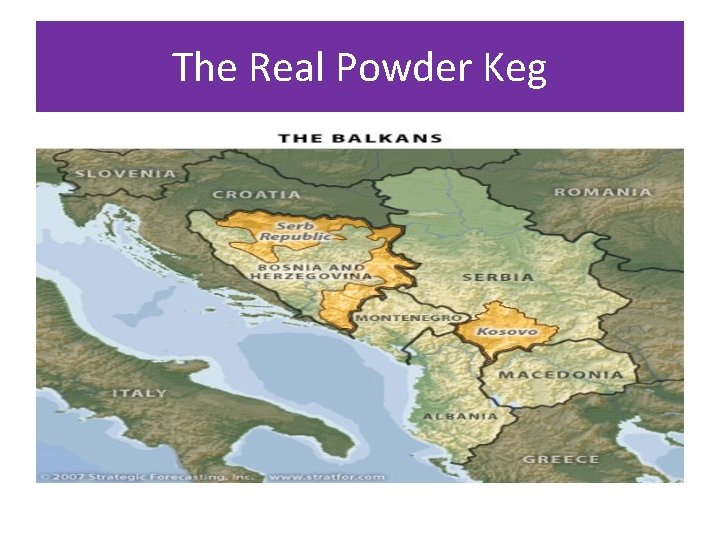
The Real Powder Keg
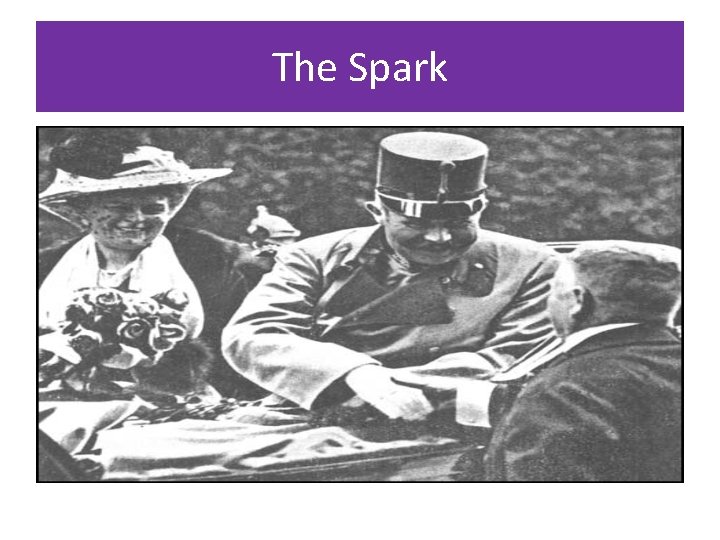
The Spark
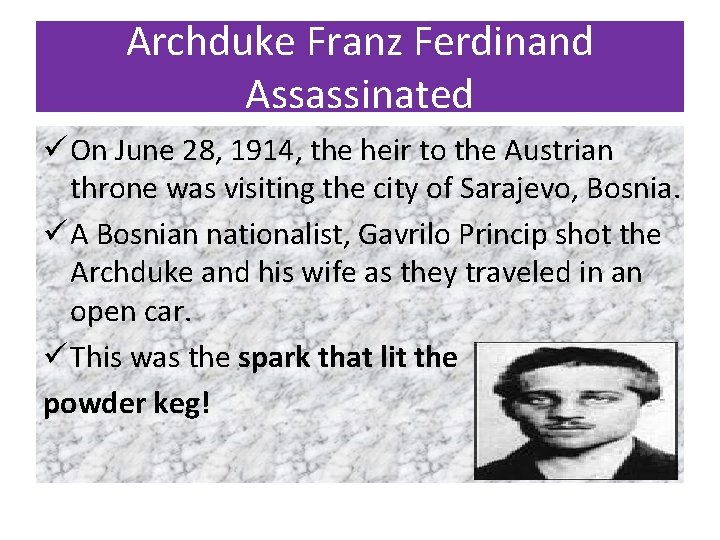
Archduke Franz Ferdinand Assassinated ü On June 28, 1914, the heir to the Austrian throne was visiting the city of Sarajevo, Bosnia. ü A Bosnian nationalist, Gavrilo Princip shot the Archduke and his wife as they traveled in an open car. ü This was the spark that lit the powder keg!
Causes of WWI M A I N Militarism: ü This is a policy of aggressively building up a nation’s armed forces in preparation for war. ü The military may have more authority than the government. ü Austria-Hungary, Great Britain, France, Russia, and Germany spent large sums of money on new weapons and warships.
Causes of WWI Alliances: ü A complicated system of agreements developed among the nations of Europe during the late 19 th century. ü This was done for security purposes. ü The great powers were bound to come to the defense of others should they be attacked. ü For example, Germany and Austria-Hungary were linked by a treaty as was Russia and France to do the same.
Causes of WWI Imperialism: ü A great scramble for colonies took place among the industrial nations of Europe during the late 19 th century. ü This created fierce competition among these nations as they competed to take over land in Africa, Asia, and throughout the Pacific. ü This competition led to conflict.
Causes of WWI Nationalism: ü The great powers of Europe acted in their own national interest. ü If this self serving interest went against the interest of another nation warfare could result. ü Also, some countries/empires contained a very diverse collection of ethnicities and cultures. ü Tension arose as Hungarians and German speaking Austrians governed millions of Czechs, Slovaks, Poles, and others who all sought self government.
Modern Warfare ü The efficiency of modern weapons was amazing and very efficient. ü Machine guns and other rapid fire weapons ü Poison gas ü Poor strategy such as generals thinking that they could outnumber, proved to be particularly costly when taking the modern weapons into account.
The American Response ü Some Americans felt personally attached considering the 92 million new immigrants in the country. ü Many Americans mistrusted the Kaiser (Germany’s leader) ü He was an autocrat. His rule offended supporters of democracy. ü Propaganda, information intended to sway public opinion, turned the American public against Germany.
American Neutrality üTrade strongly influenced America’s position on the war. ü The USA had about $3. 5 billion invested overseas. ü The war placed those investments at risk. ü President Wilson felt that the best way to protect them was through neutrality.
Section 2 The United States Declares War
Setting the Scene ü Many hoped that the US would not be drawn into the war. ü Friction between the US and Germany continued to increase.
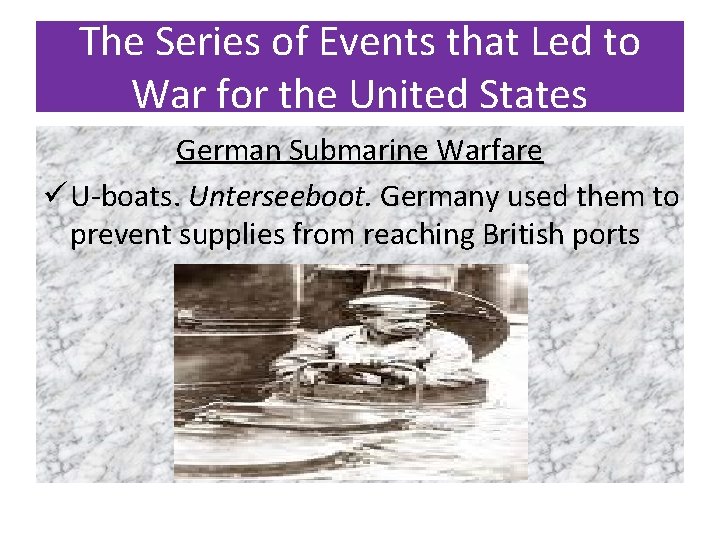
The Series of Events that Led to War for the United States German Submarine Warfare ü U-boats. Unterseeboot. Germany used them to prevent supplies from reaching British ports
The Series of Events… ü Passenger and merchant ships had no defense against the submarine, which could go undetected anywhere in the ocean. ü The sinking of the Lusitania a) A British passenger liner b) While in the Irish Sea, the Germans suspected that the ship was carrying weapons for the allies in addition to passengers c) The ship was fired upon and sank killing 128 Americans who were on board.
The Series of Events… The Sussex Pledge ü President Wilson demanded that Germany stop its submarine warfare. ü Germany agreed to do so as long as the ship’s crew offered no resistance to German search & seizure ü Despite this, Germany continued to torpedo allied ships and on March 24, 1916 the French passenger ship the Sussex was attacked. Americans were on board. ü In what came to be known as The Sussex Pledge the US threatened to cut diplomatic ties with Germany.
Moving Towards War ü Presidential election of 1916: a) President Wilson ran on the slogan: “He kept us out of war”. b) Despite strong Republican criticism, Wilson wins a narrow victory. Germany ends the Sussex Pledge The US broke off diplomatic relations with Germany Wilson asks Congress for permission to arm American merchant ships
Moving Toward War The Zimmermen Note ü Germany’s Foreign Secretary made a secret offer to Mexico. ü If Mexico declared war on the United States and they along with Germany were successful in the war, then as a gesture of gratitude, Germany would reward Mexico with the land they lost to the US during the Mexican. American War (1846 -1848)
Moving Closer Towards War Russian Revolution 1917 ü The Russian army was poorly fed and supplied ü They had suffered significant casualties ü Czar Nicholas II had to give up the throne, the Russian monarchy had was replaced with a Republican government ü Russia had to back out of the war. The War Resolution ü Between March 16 th and March 18 th US ships were sunk. ü On March 20 th the cabinet voted unanimously for war. ü April 6, 1917 war was declared; …the world must be made safe for democracy…”
Section 5 Global Peacemaker
Setting the Scene The war comes to an end in 1918. Wilson’s 14 Points ü Refers to the number of provisions Wilson’s peace plan ü Among the more well known are selfdetermination, an end to entangling alliances, removal of trade barriers, and the reduction of military forces.
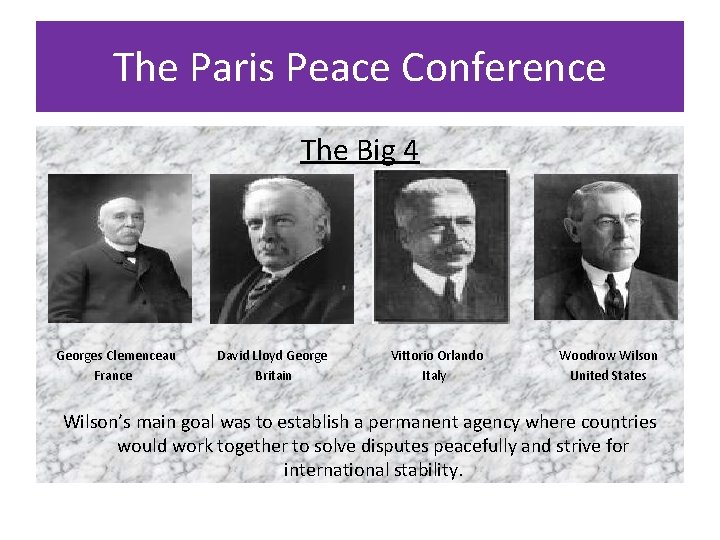
The Paris Peace Conference The Big 4 Georges Clemenceau David Lloyd George Vittorio Orlando Woodrow Wilson France Britain Italy United States Wilson’s main goal was to establish a permanent agency where countries would work together to solve disputes peacefully and strive for international stability.
The Paris Peace Conference The Big 4: a) Wanted to make Germany pay for the war, literally and figuratively. b) Also wanted to divide up Germany’s colonies *This would be land that Germany felt was rightfully theirs at the dawn of WWII. (Russia and Germany were not present at this conference)
The League of Nations This was President Wilson’s idea for permanent global security. It was the precursor to today’s United Nations. ü It’s success depended on the member nations cooperating to resolve issues and ensure worldwide security. ü Wilson left Paris hoping to sell this to Congress. ü Members of the league would consider an attack on one member country as an attack on the entire league. ü The league’s military power to enforce this relied on the respective militaries of member nations. ü The Treaty of Versailles was REJECTED by the US Senate!!!!!!
The Peace Treaty ü Wilson returned to France in a politically weakened state. (No support from Congress) ü Clemenceau saw this as an opportunity to push his idea of punishing Germany further. ü Wilson feared that such demands would lead to other wars. (He was correct!!!!) Language from Actual Treaty • • • Germany had to accept the Blame for starting the war (Clause 231). This was vital because it provided the justification for. . . 2. Germany had to pay £ 6, 600 million (called Reparations) for the damage done during the war. 3. Germany was forbidden to have submarines or an air force. She could have a navy of only six battleships, and an Army of just 100, 000 men. In addition, Germany was not allowed to place any troops in the Rhineland, the strip of land, 50 miles wide, next to France. 4. Germany lost Territory (land) in Europe (see map, below). Germany’s colonies were given to Britain and France. (Also, Germany was forbidden to join the League of Nations, or unite with Austria. )
The Peace Treaty Provisions ü 9 new countries were carved out of the former Austria. Hungary, Germany, & Russia. ü Some of these new countries were Poland, Czechoslovakia, and Romania. ü New geographic boundaries created new ethnic minorities in these new countries. For example, some Germans now lived in Poland. ü The once mighty Ottoman Empire was reduced to a small remnant in what in now Turkey
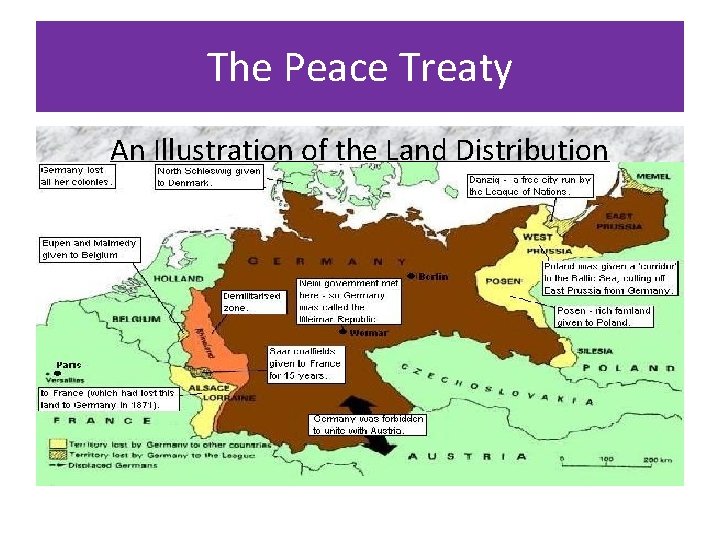
The Peace Treaty An Illustration of the Land Distribution
The Peace Treaty Other Provisions that Contributed to WWII ü Italy did not receive several pieces of the former Austria-Hungary empire as it was promised at the beginning of the war. ü The War Guilt Clause. The blame for the war and subsequent reparations crippled the German economy for years
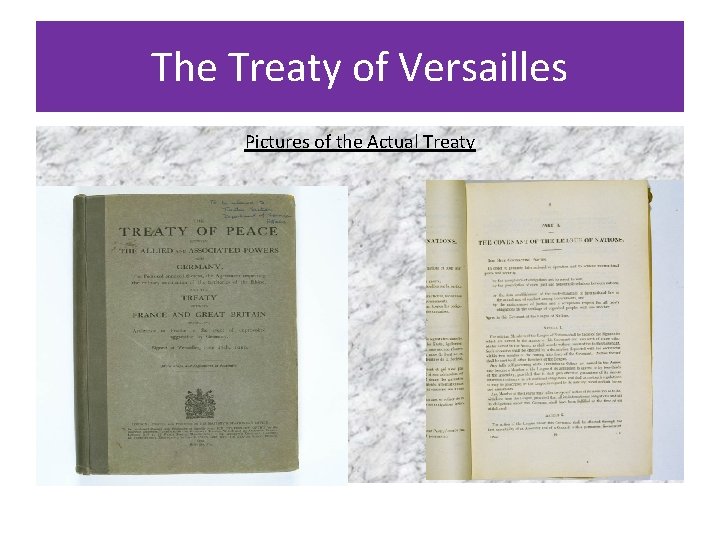
The Treaty of Versailles Pictures of the Actual Treaty
Reactions at Home Wilson Tours the Country ü Wilson toured the country promoting the peace treaty. ü During this trip he suffered a serious stroke. ü Although he survived, he remained somewhat incapacitated the rest of his life. ü He remained in office and it is said that his wife was running the government behind the scenes. ü On May 20, 1920, Congress voted to disregard the treaty and declared the war to be officially over. ü On July 2, 1921, President Harding, a Republican, signed it and the US ratified separate peace treaties with Germany, Austria, & Hungary later that year.
Postwar Adjustments Key Points ü The war boosted the US economy significantly, at first… (more on that later) ü US now world’s largest creditor (nations owed money to us-$11. 5 billion). This is a positive for our economy. ü The decline of prominent European powers shoved the US into a new position of world strength. ü Britain’s power went back at least two centuries and Germany was decimated by the treaty…
Closing Activity A “ 3 -2 -1” 1. In what three ways did supporters of US expansion justify increased involvement in world affairs. 2. Identify two reasons as to why Seward bought Alaska from Russia. 3. What was Commodore Perry’s one goal for visiting Japan?
- Slides: 109