
Unit 6 THE JUDICIAL BRANCH ARTICLE III Group
Unit 6: THE JUDICIAL BRANCH (ARTICLE III)
Group Work: Group 1: Judicial Branch (Article III) Group 2: Vocabulary needed to know Group 3: Civil/Criminal Law Your job is to find information about each subject to teach your class. You will present a prezi or powerpoint Use videos/pictures to help teach information This is what your exit piece will be over Turn it in to me so that I can put it on my website Some of you will need to work together for the vocabulary.
How courts were created: Constitution: Supreme Court- highest in the country Constitution: Allowed Congress to create other inferior courts The Federal Court System was born!
Job of the Judicial Branch: Interpret the Laws Manage the court systems Review cases arising from laws put into effect by Congress
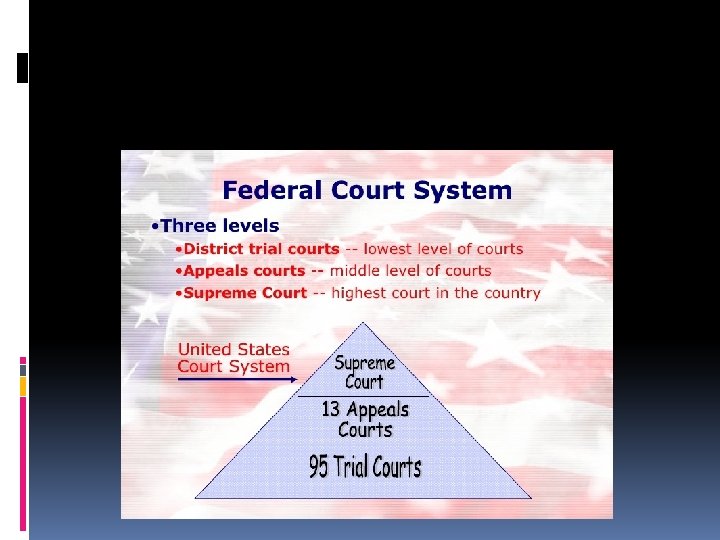
Levels of the federal court system: District courts: (trial court); 94 Circuit courts: first level of appeal; 13 Supreme court: final level of appeal in the federal system; 1
Civil Law Deals with disputes btwn individuals, organizations, or btwn the two, in which compensation is awarded to the victim Case filed by: private party Decision: defendant can be found liable or not liable, the judge decides this Standard of proof: “preponderance of evidence” – claimant must produce evidence beyond the balance of probabilities Burden of Proof: claimant must give proof but it may shift to the defendant in situations of the thing that speaks for itself
Civil law cont Type of punishment: compensation (usually financial) for injuries or damages or an injunction of nuisance Ex) landlord/tenant disputes, divorce proceedings, child custody proceedings, property disputes, personal injury Appeals: either party can appeal a court’s decision Jury opinion: may not have to be unanimous; laws very by state Commencement of proceedings: state/people/prosecution by summons or indictment
Criminal Law The body of law that deals with crime and the legal punishment of criminal offenses Purpose: to maintain the stability of the state and society by punishing offenders and deterring them and others from offending Case filed by: government Decision: defendant is convicted if guilty and acquitted if not guilty, the jury decides this Standard of proof: “beyond reasonable doubt” Burden of Proof: “innocent until proven guilty” the prosecution must prove defendant guilty
Criminal law cont Type of punishment: imprisonment or fines/community service, exceptional cases the death penalty Ex) theft, assault, robbery, trafficking a controlled substance, murder, etc Appeals: only the defendant can appeal, prosecution is not allowed Jury opinion: must agree unanimously before the defendant is convicted Commencement of proceedings: by way of pleadings, Reps of the state, prosecutor, Attorney General
Federal V State Federal: the federal law is the body of law created by the federal govt Created by the US Congress: both houses of Congress must pass a bill and must be signed by the President before it becomes a law Constitution provides for a federal gov that is superior to state govt Jurisdiction: throughout the US like bankruptcy, immigration, patents, Social security, civil rights, money counterfeiting
Federal V State: State law is made through each state legislature and sometimes conflicts with federal law State law is enacted when it is signed by the governor No state law can abolish or reduce the rights afforded by the US Constitution State law is subservient to federal law Criminal, domestic, welfare, and real estate matters, divorce, wills, inheritances, business contracts, personal injuries from a car accident or medical malpractice
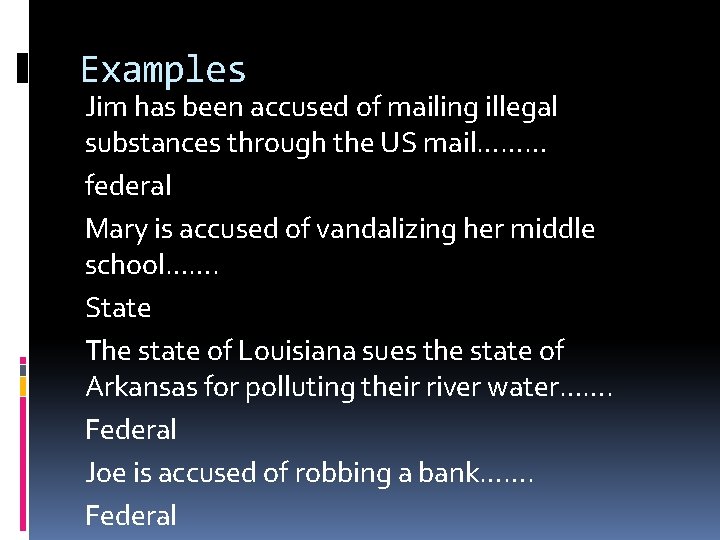
Examples Jim has been accused of mailing illegal substances through the US mail……… federal Mary is accused of vandalizing her middle school……. State The state of Louisiana sues the state of Arkansas for polluting their river water……. Federal Joe is accused of robbing a bank……. Federal
Your exit piece: DUE TODAY!!! Draw a diagram explaining how the Judicial system is set up. Write/TYPE and email a 5 -6 sentence paragraph about the difference in civil and criminal law. Do a voice recording or video of 3 -5 points of the Judicial Branch that we went over in class.
Aaron Burr Treason Trial https: //www. youtube. com/watch? v=OLSsswr 6 z 9 Y https: //www. youtube. com/watch? v=du 6 SZq Q-r 4 M This case was notable for Chief Justice John Marshall’s landmark decision narrowly defining the Constitution’s definition of treason
Marbury v Madison 1803 https: //www. youtube. com/watch? v=YFFZYJz v 8 -I The key to this case was the idea of JUDICIAL REVIEW Judicial review is NOT in the Constitution but is an example of checks and balances Supreme Court case that involved “midnight judges”
Sedition Acts 1798 https: //www. youtube. com/watch? v=guur. Fhe 4 p. Z 8 https: //www. youtube. com/watch? v=w. L 4 ZN 6 4 Yz 3 o Remember that these included numerous cases involving the legal limits of free speech and freedom of press.
Plessy V Ferguson https: //www. youtube. com/watch? v=sl. DTac 8 Ft 4 https: //www. youtube. com/watch? v=u. Gvk. OB xp 0 VY The court upheld the constitutionality of state laws requiring racial segregation in “public facilities” under the doctrine of “separate but equal”.
Brown V Board of Education https: //www. youtube. com/watch? v=TTGHLdr -iak https: //www. youtube. com/watch? v=6 BBEz 3 Ne-z. Y The court ruled state laws establishing separate public schools for black children and for white children to be unconstitutional. This case overturned an 1896 Supreme Court decision allowing state sponsored segregation.
Separation of powers Use the handout provided to identify examples of checks and balances. Use handout to fill in the blanks
Groups What do judges use to make their decisions, or what do they base their decisions on? Discuss as a group and 1 person write down all of your ideas Rank your answers with #1 being the most important for a judges ruling.
Tinker V Des Moines
- Slides: 22