
Unit 6 Reviewing the Basics Chapter 25 The
Unit 6 Reviewing the Basics
Chapter 25 The Simple Sentence 2
Defining and Spotting Subjects Every sentence must contain two basic elements: a subject and a verb. A subject is the who or what word that performs the action or the who or what word about which a statement is made. Some sentences have more than one subject, joined by and. Sometimes an -ing word can be the subject of a sentence. 3
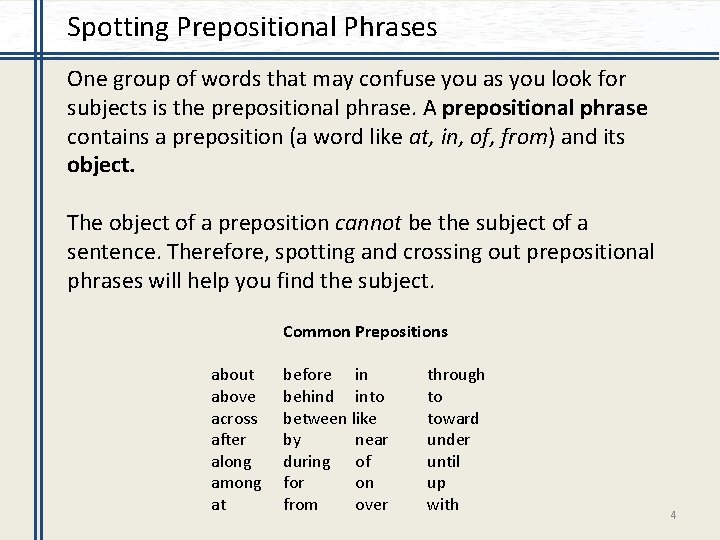
Spotting Prepositional Phrases One group of words that may confuse you as you look for subjects is the prepositional phrase. A prepositional phrase contains a preposition (a word like at, in, of, from) and its object. The object of a preposition cannot be the subject of a sentence. Therefore, spotting and crossing out prepositional phrases will help you find the subject. Common Prepositions about above across after along among at before in behind into between like by near during of for on from over through to toward under until up with 4
Defining and Spotting Verbs Action Verbs In order to be complete, every sentence must contain a verb. One kind of verb, called an action verb, expresses the action that the subject is performing: The star quarterback fumbled. The carpenters worked all day, but the bricklayers went home early. 5
Defining and Spotting Verbs Linking Verbs Another kind of verb, called a linking verb, links the subject to words that describe or identify it: Don is a fine mathematician. This fabric feels rough and scratchy. Common Linking Verbs appear be (am, is, are, was, were, has been, have been, had been. . . ) become feel look seem 6
Verbs of More Than One Word—Helping Verbs Many verbs consist of more than one word: He should have taken the train home. Are Tanya and Joe practicing the piano? The lounge was painted last week. 7
EXPLORING ONLINE http: //a 4 esl. org/a/g 3. html Interactive preposition quizzes: scroll down to “prepositions. ” 8
Chapter 26 Coordination and Subordination 9
Coordination A clause is a group of words that includes a subject and a verb. If a clause can stand alone as a complete idea, it is an independent clause and can be written as a simple sentence. Here are two independent clauses written as simple sentences: The dog barked all night. The neighbors didn’t complain. You can join two clauses together by placing a comma and a coordinating conjunction between them: The dog barked all night, but the neighbors didn’t complain. 10
The coordinating conjunctions but and for join together two clauses. Note that a comma precedes each coordinating conjunction. The Most Common Coordinating Conjunctions and but for nor or so yet 11
Subordination Two clauses can also be joined with a subordinating conjunction. The clause following a subordinating conjunction is called a subordinate or dependent clause because it depends on an independent clause to complete its meaning: We will light the candles when Flora arrives. (When Flora arrives is a subordinate or dependent clause introduced by the subordinating conjunction when. By itself, when Flora arrives is incomplete; it depends on the independent clause to complete its meaning. ) 12
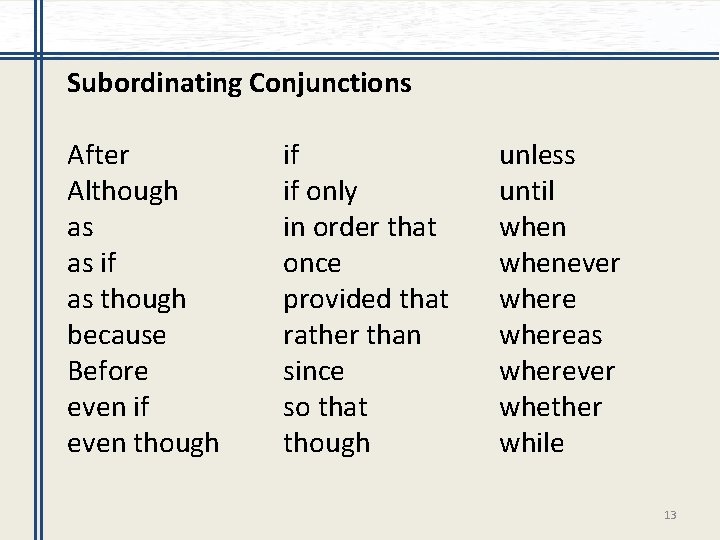
Subordinating Conjunctions After Although as as if as though because Before even if even though if if only in order that once provided that rather than since so that though unless until whenever whereas wherever whether while 13
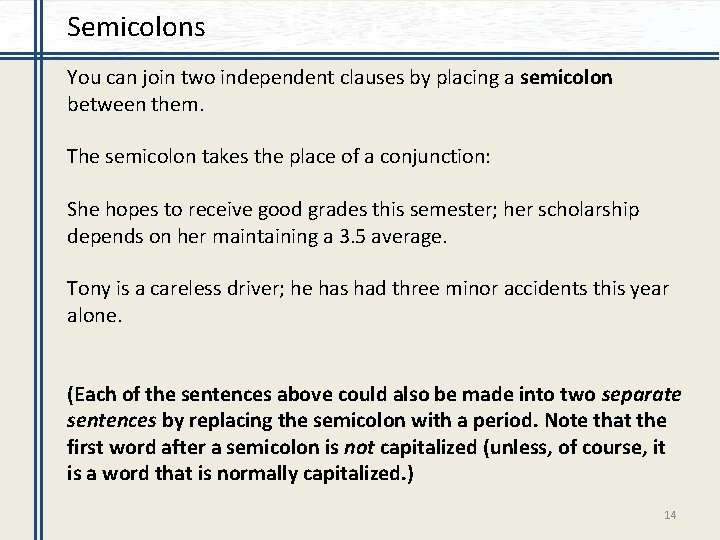
Semicolons You can join two independent clauses by placing a semicolon between them. The semicolon takes the place of a conjunction: She hopes to receive good grades this semester; her scholarship depends on her maintaining a 3. 5 average. Tony is a careless driver; he has had three minor accidents this year alone. (Each of the sentences above could also be made into two separate sentences by replacing the semicolon with a period. Note that the first word after a semicolon is not capitalized (unless, of course, it is a word that is normally capitalized. ) 14
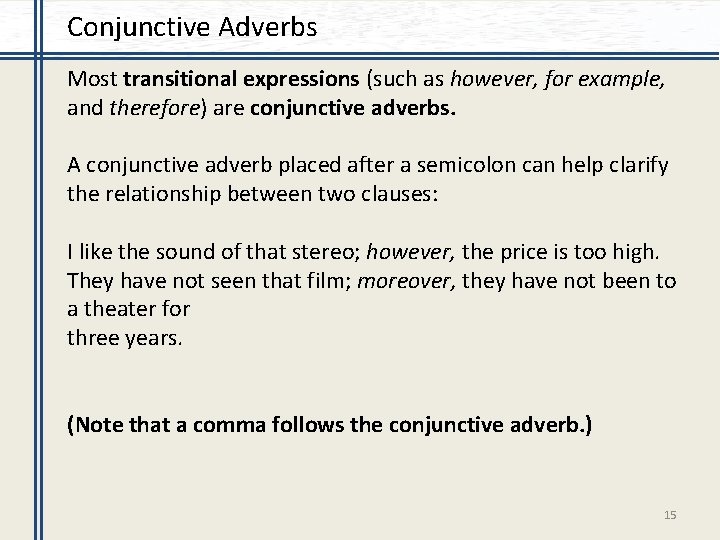
Conjunctive Adverbs Most transitional expressions (such as however, for example, and therefore) are conjunctive adverbs. A conjunctive adverb placed after a semicolon can help clarify the relationship between two clauses: I like the sound of that stereo; however, the price is too high. They have not seen that film; moreover, they have not been to a theater for three years. (Note that a comma follows the conjunctive adverb. ) 15
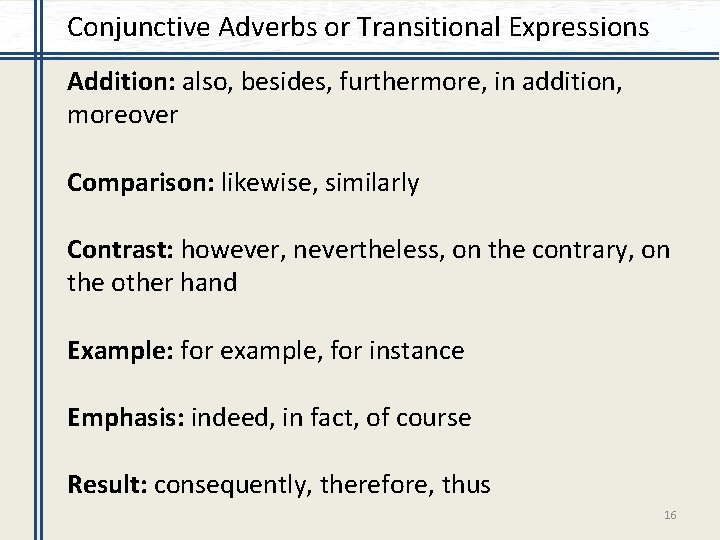
Conjunctive Adverbs or Transitional Expressions Addition: also, besides, furthermore, in addition, moreover Comparison: likewise, similarly Contrast: however, nevertheless, on the contrary, on the other hand Example: for example, for instance Emphasis: indeed, in fact, of course Result: consequently, therefore, thus 16
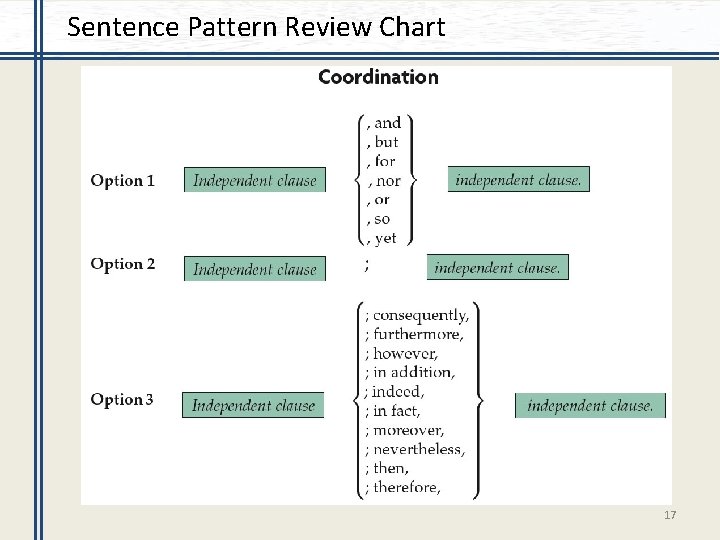
Sentence Pattern Review Chart 17
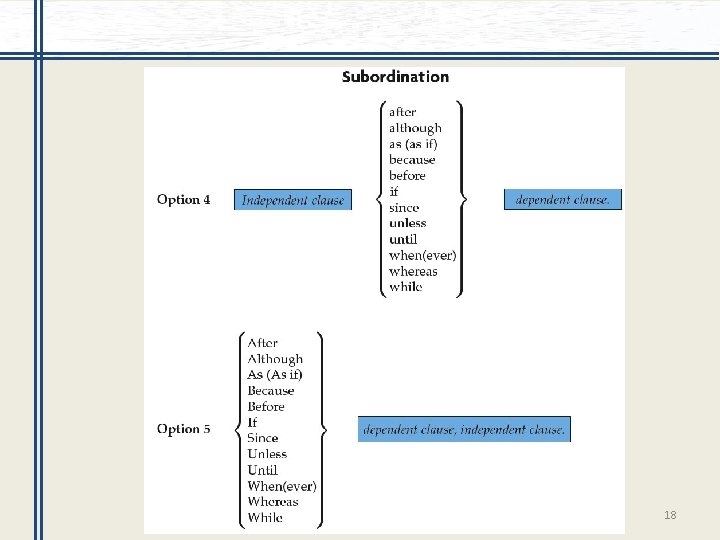
18
EXPLORING ONLINE http: //depts. dyc. edu/learningcenter/owl/exercis es/conjunctions_ex 2. htm Exercises in subordination, with answers 19
Chapter 27 Avoiding Sentence Errors 20
Avoiding Run-Ons A run-on sentence incorrectly runs together two independent clauses without a conjunction or punctuation. This error confuses the reader, who cannot tell where one thought stops and the next begins: My neighbor Mr. Hoffman is seventy-five years old he plays tennis every Saturday afternoon. 21
Avoiding Comma Splices A comma splice incorrectly joins two independent clauses with a comma but no conjunction: My neighbor Mr. Hoffman is seventy-five years old, he plays tennis every Saturday afternoon. 22
The run-on and the comma splice can be corrected in five ways: Use two separate sentences. My neighbor Mr. Hoffman is seventy-five years old. He plays tennis every Saturday afternoon. Use a coordinating conjunction. My neighbor Mr. Hoffman is seventy-five years old, but he plays tennis every Saturday afternoon. 23
Use a subordinating conjunction. Although my neighbor Mr. Hoffman is seventy-five years old, he plays tennis every Saturday afternoon. Use a semicolon. My neighbor Mr. Hoffman is seventy-five years old; he plays tennis every Saturday afternoon. Use a semicolon and a conjunctive adverb. My neighbor Mr. Hoffman is seventy-five years old; however, he plays tennis every Saturday afternoon. 24
Avoiding Fragments A sentence fragment is incomplete. It lacks a subject, a verb, or both—or it does not stand alone as a complete idea. 25
Six common sentence fragments: Dependent Clause Fragments A dependent clause fragment often starts with a subordinating conjunction like although, because, if, and when. Relative Clause Fragments A dependent clause fragment can also start with who, whose, which, or that. -ing Fragments An -ing fragment starts with an -ing verb form. 26
Six common sentence fragments (continued): Prepositional Phrase Fragments Appositive Phrase Fragments Infinitive Phrase Fragments Watch out for fragments beginning with a subordinating conjunction; who, which, or that; or an -ing verb form. These groups of words cannot stand alone, but must be combined with another sentence or changed into a complete sentence. Watch out for phrase fragments. A prepositional phrase, appositive phrase, or infinitive cannot stand alone, but must be combined with another sentence or changed into a complete sentence. 27
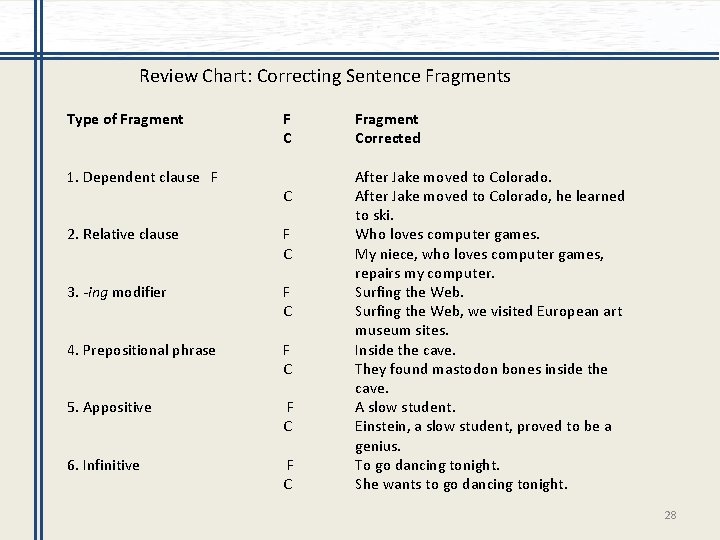
Review Chart: Correcting Sentence Fragments Type of Fragment 1. Dependent clause F F C C 2. Relative clause F C 3. -ing modifier F C 4. Prepositional phrase F C 5. Appositive F C 6. Infinitive F C Fragment Corrected After Jake moved to Colorado, he learned to ski. Who loves computer games. My niece, who loves computer games, repairs my computer. Surfing the Web, we visited European art museum sites. Inside the cave. They found mastodon bones inside the cave. A slow student. Einstein, a slow student, proved to be a genius. To go dancing tonight. She wants to go dancing tonight. 28
EXPLORING ONLINE http: //www. chomp. exercises. htm If you like immediate feedback, you will love this interactive quiz. 29
Chapter 28 Present Tense (Agreement) 30
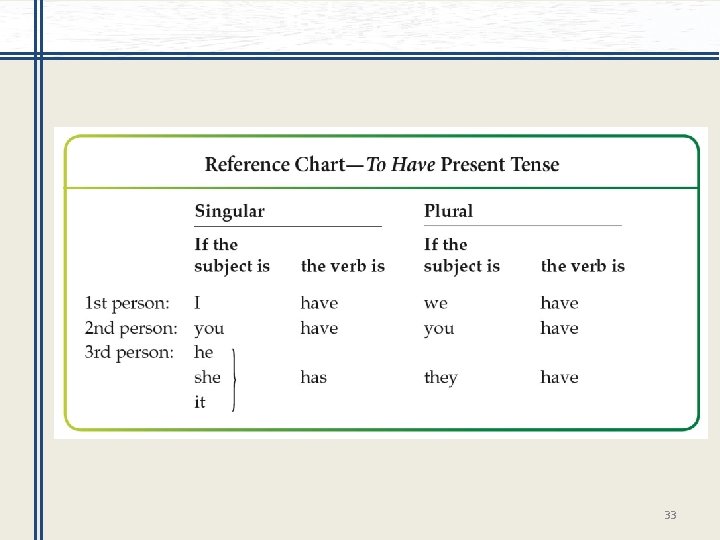
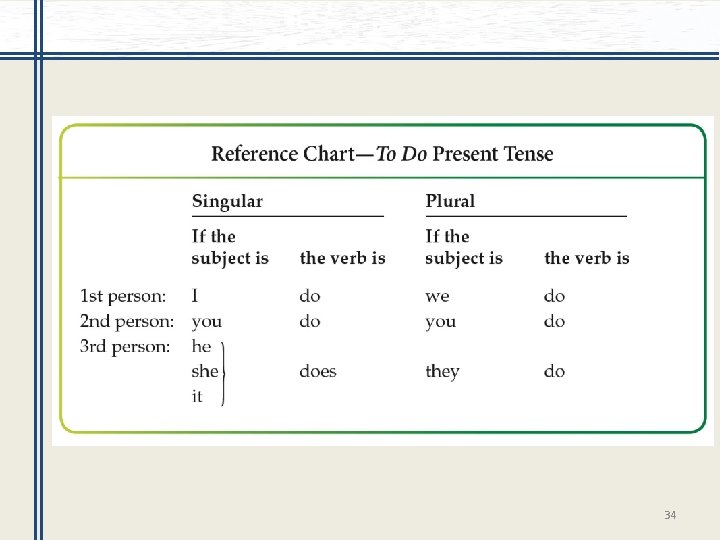
Defining Subject-Verb Agreement Subjects and verbs in the present tense must agree in number; that is, singular subjects take verbs with singular endings, and plural subjects take verbs with plural endings. 31
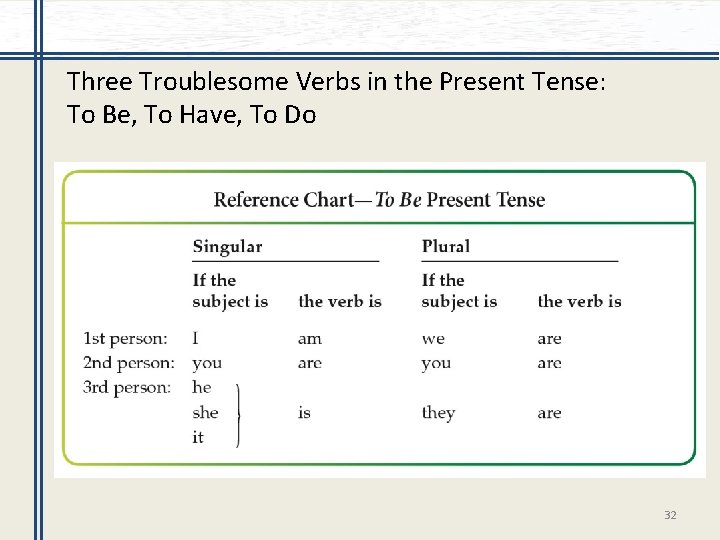
Three Troublesome Verbs in the Present Tense: To Be, To Have, To Do 32
33
34
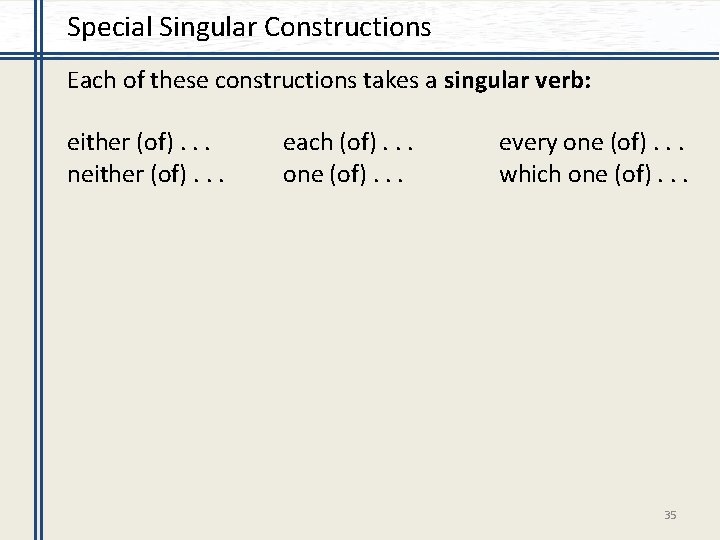
Special Singular Constructions Each of these constructions takes a singular verb: either (of). . . neither (of). . . each (of). . . one (of). . . every one (of). . . which one (of). . . 35
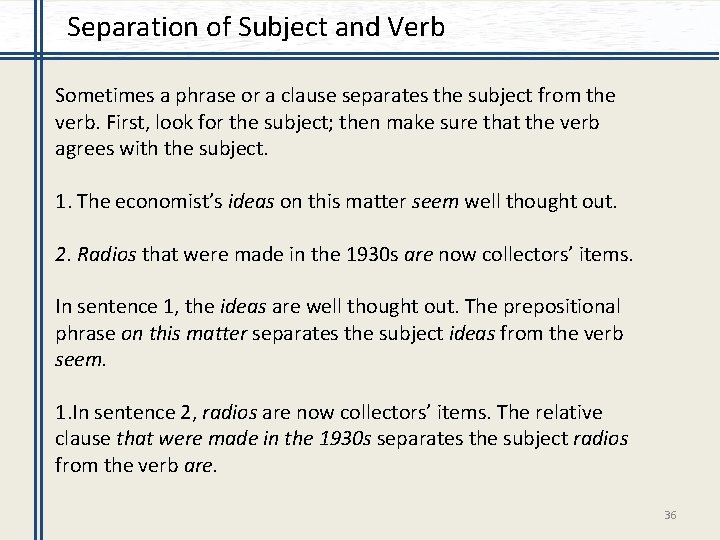
Separation of Subject and Verb Sometimes a phrase or a clause separates the subject from the verb. First, look for the subject; then make sure that the verb agrees with the subject. 1. The economist’s ideas on this matter seem well thought out. 2. Radios that were made in the 1930 s are now collectors’ items. In sentence 1, the ideas are well thought out. The prepositional phrase on this matter separates the subject ideas from the verb seem. 1. In sentence 2, radios are now collectors’ items. The relative clause that were made in the 1930 s separates the subject radios from the verb are. 36
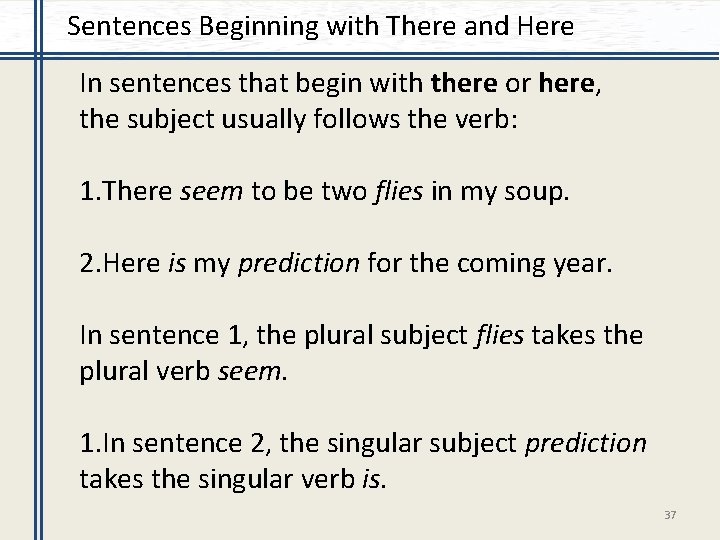
Sentences Beginning with There and Here In sentences that begin with there or here, the subject usually follows the verb: 1. There seem to be two flies in my soup. 2. Here is my prediction for the coming year. In sentence 1, the plural subject flies takes the plural verb seem. 1. In sentence 2, the singular subject prediction takes the singular verb is. 37
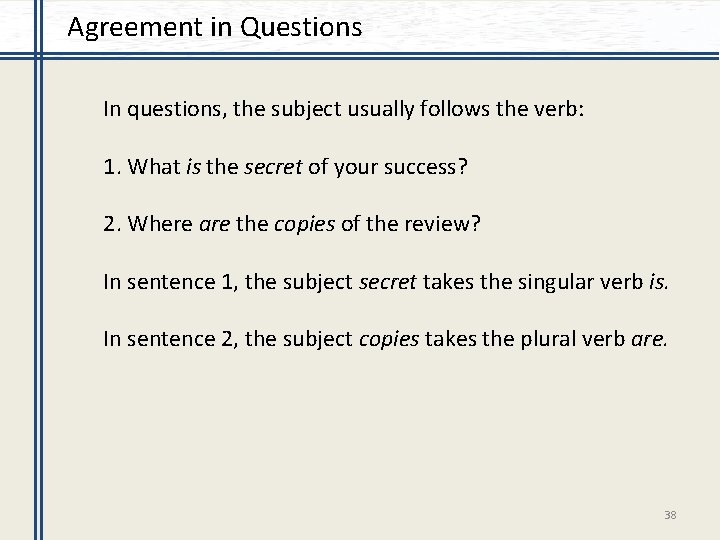
Agreement in Questions In questions, the subject usually follows the verb: 1. What is the secret of your success? 2. Where are the copies of the review? In sentence 1, the subject secret takes the singular verb is. In sentence 2, the subject copies takes the plural verb are. 38
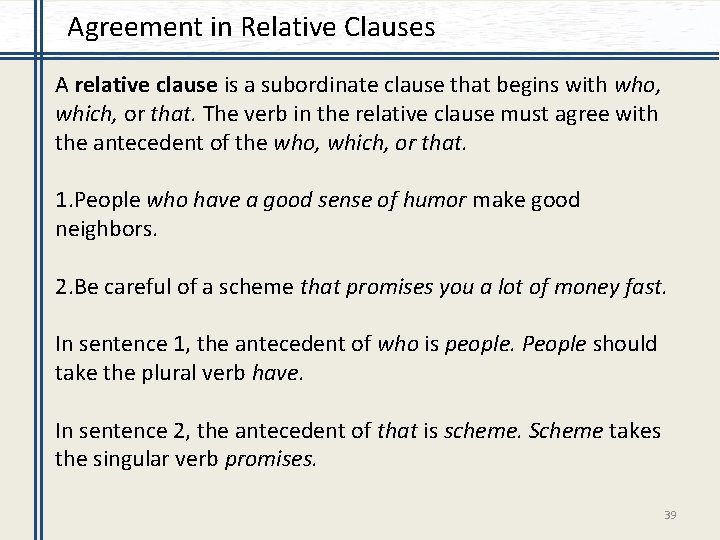
Agreement in Relative Clauses A relative clause is a subordinate clause that begins with who, which, or that. The verb in the relative clause must agree with the antecedent of the who, which, or that. 1. People who have a good sense of humor make good neighbors. 2. Be careful of a scheme that promises you a lot of money fast. In sentence 1, the antecedent of who is people. People should take the plural verb have. In sentence 2, the antecedent of that is scheme. Scheme takes the singular verb promises. 39
EXPLORING ONLINE http: //a 4 esl. org/q/h/vm/svagr. html Take this verb quiz and get instant feedback on your answers. 40
- Slides: 40