
UNIT 6 Random Variables Chapter 6 Section 1
UNIT 6 – Random Variables Chapter 6, Section 1
Lesson Objectives At the end of the lesson, students can: • Identify discrete and continuous random variables. • Draw probability histograms for both discrete and continuous random variables. • Find the mean and variances of discrete random variables.
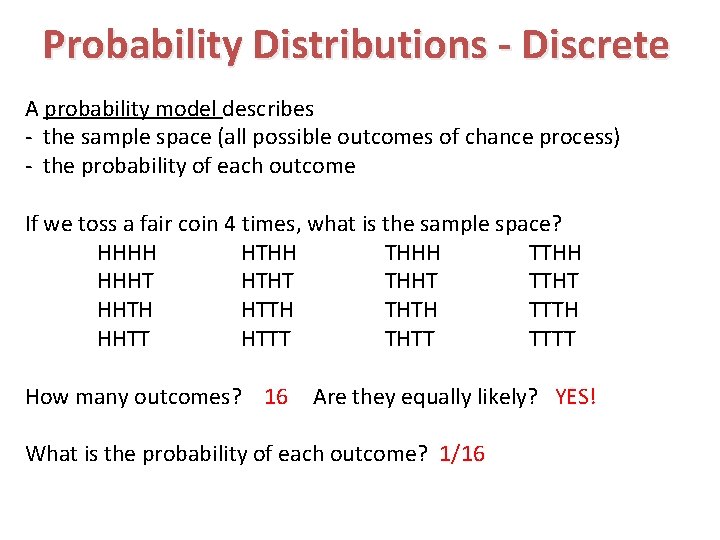
Probability Distributions - Discrete A probability model describes - the sample space (all possible outcomes of chance process) - the probability of each outcome If we toss a fair coin 4 times, what is the sample space? HHHH HTHH THHH TTHH HHHT HTHT THHT TTHT HHTH HTTH THTH TTTH HHTT HTTT THTT TTTT How many outcomes? 16 Are they equally likely? YES! What is the probability of each outcome? 1/16
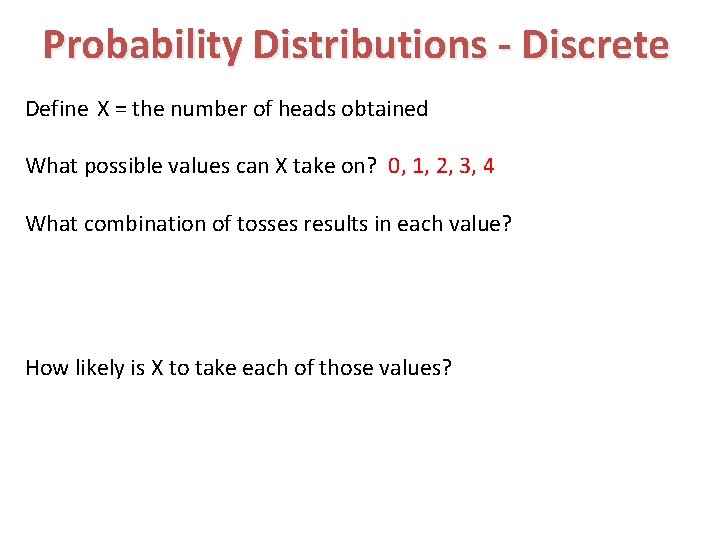
Probability Distributions - Discrete Define X = the number of heads obtained What possible values can X take on? 0, 1, 2, 3, 4 What combination of tosses results in each value? How likely is X to take each of those values?

Probability Distributions - Discrete The probability distribution of X is as follows: Value Probability 0 1 2 3 4 1/16 4/16 6/16 4/16 1/16 Definitions: Random Variable: a variable whose value is a numerical outcome of a random phenomenon (like flipping a coin) Discrete Random Variable (X): a random variable that has a countable number of possible values.
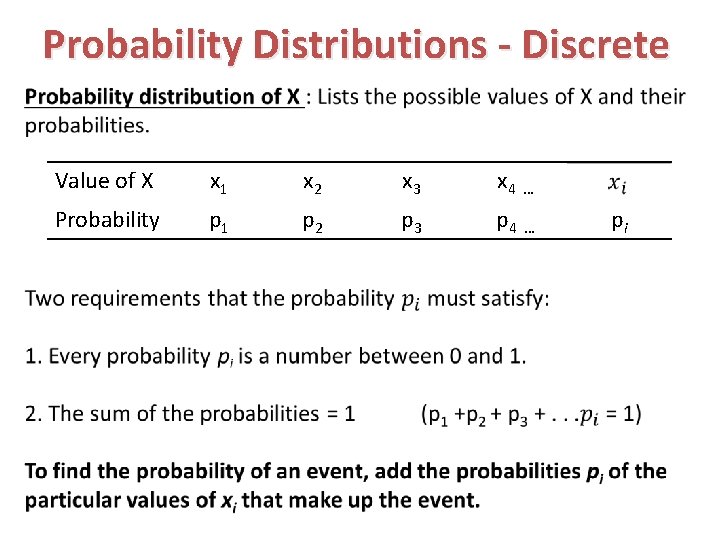
Probability Distributions - Discrete Value of X x 1 x 2 x 3 x 4 … Probability p 1 p 2 p 3 p 4 … pi
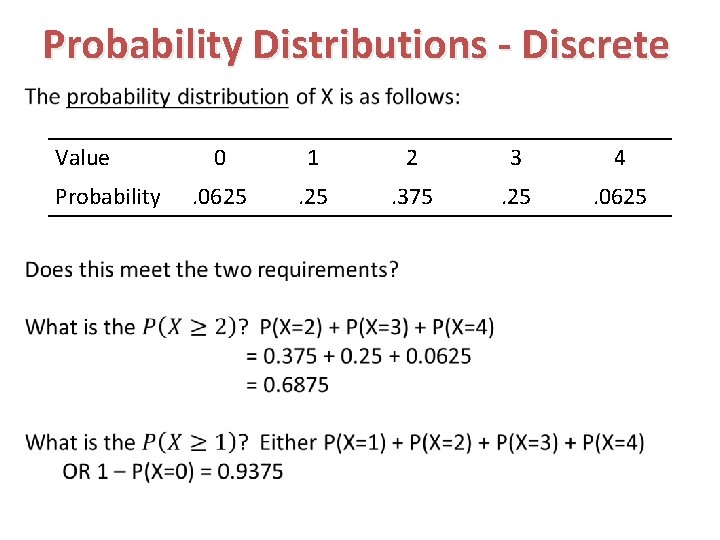
Probability Distributions - Discrete Value Probability 0 1 2 3 4 . 0625 . 375 . 25 . 0625
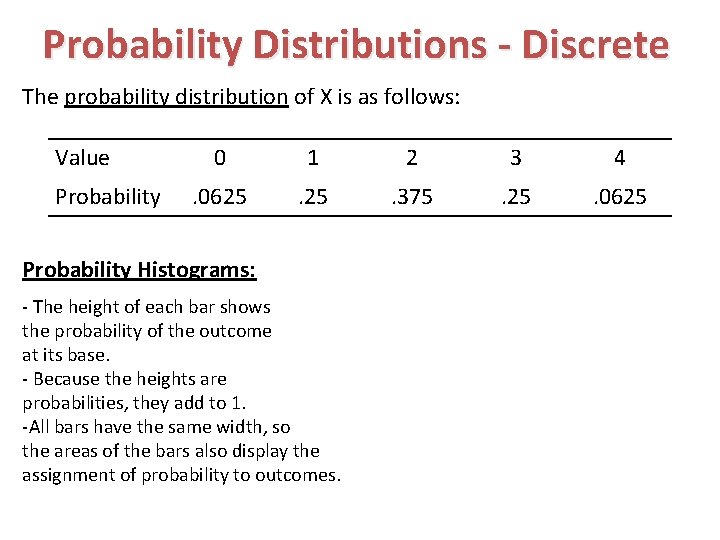
Probability Distributions - Discrete The probability distribution of X is as follows: Value Probability 0 1 2 3 4 . 0625 . 375 . 25 . 0625 Probability Histograms: - The height of each bar shows the probability of the outcome at its base. - Because the heights are probabilities, they add to 1. -All bars have the same width, so the areas of the bars also display the assignment of probability to outcomes.
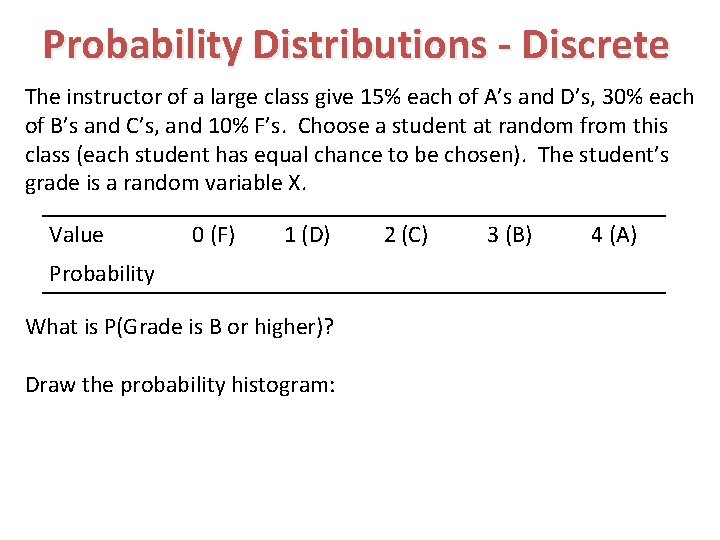
Probability Distributions - Discrete The instructor of a large class give 15% each of A’s and D’s, 30% each of B’s and C’s, and 10% F’s. Choose a student at random from this class (each student has equal chance to be chosen). The student’s grade is a random variable X. Value 0 (F) 1 (D) Probability What is P(Grade is B or higher)? Draw the probability histogram: 2 (C) 3 (B) 4 (A)
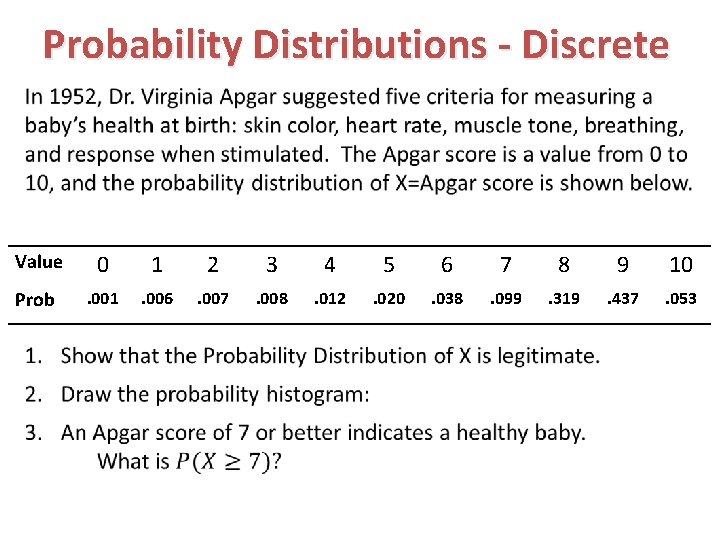
Probability Distributions - Discrete Value 0 1 2 3 4 5 6 7 8 9 10 Prob . 001 . 006 . 007 . 008 . 012 . 020 . 038 . 099 . 319 . 437 . 053
Means of Random Variables In Unit 1, we discussed numerical descriptions of quantitative variables. What four things did we use to describe the distributions of quantitative variables? SOCS!!!
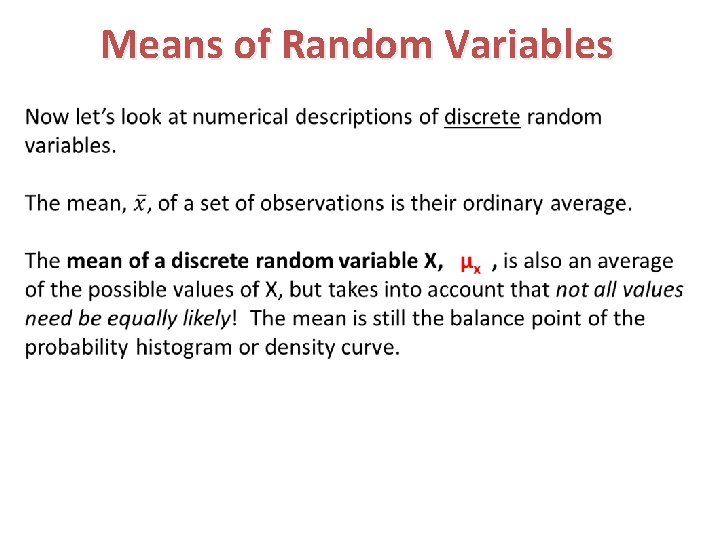
Means of Random Variables

Means of Random Variables Example: You pick a three digit number in the lottery. If your number matches the state’s number, you win $500. To calculate the mean amount of payoff, consider the possible outcomes and their probabilities. Outcome, X (Payoff) Probability What is the ordinary mean of X (average)? What is the mean of random variable, X?
Means of Random Variables Probabilities are an idealized description of long-run proportions, so the mean of a probability distribution describes the long-run average outcome. In other words, if you were to repeat the random sampling process over and over again, the mean number would be the long run average.
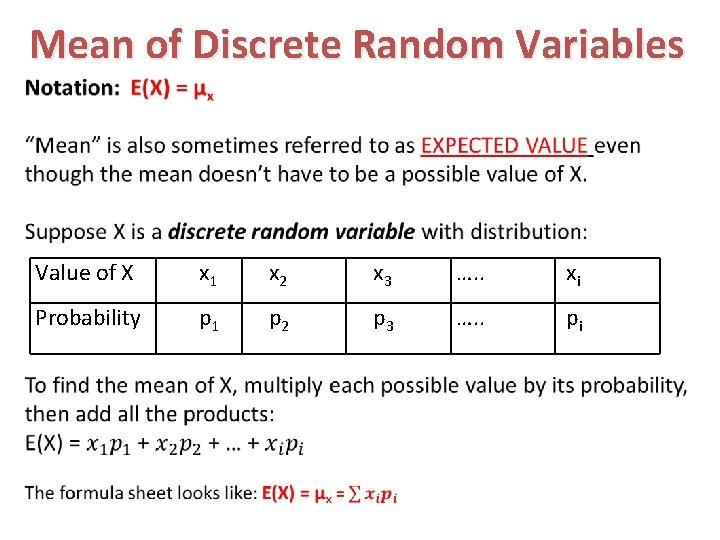
Mean of Discrete Random Variables Value of X x 1 x 2 x 3 …. . xi Probability p 1 p 2 p 3 …. . pi
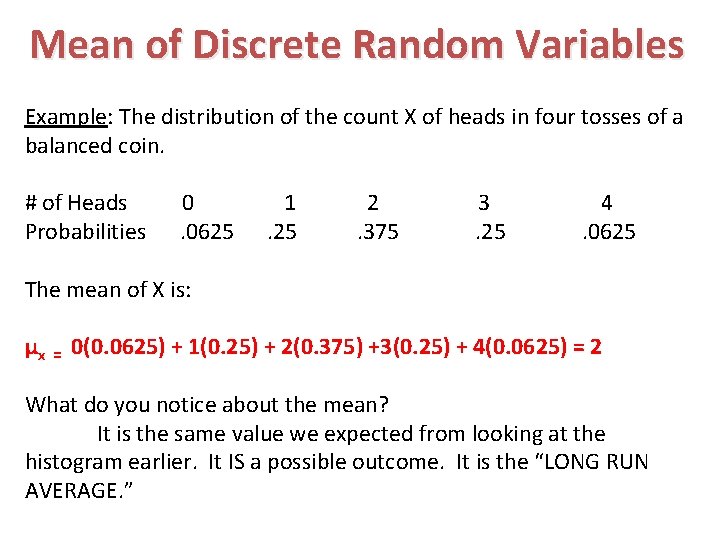
Mean of Discrete Random Variables Example: The distribution of the count X of heads in four tosses of a balanced coin. # of Heads Probabilities 0. 0625 1. 25 2. 375 3. 25 4. 0625 The mean of X is: μx = 0(0. 0625) + 1(0. 25) + 2(0. 375) +3(0. 25) + 4(0. 0625) = 2 What do you notice about the mean? It is the same value we expected from looking at the histogram earlier. It IS a possible outcome. It is the “LONG RUN AVERAGE. ”
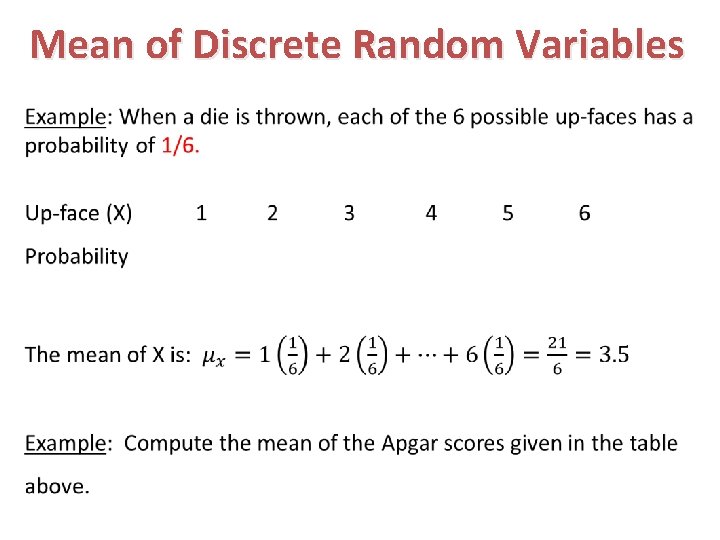
Mean of Discrete Random Variables
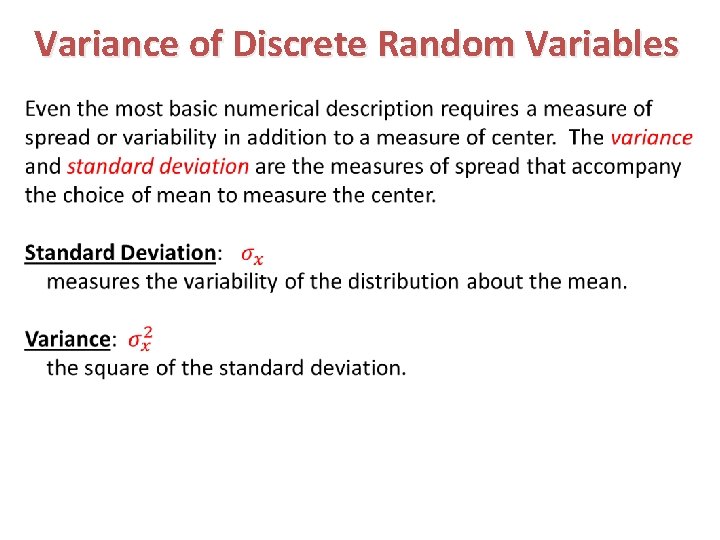
Variance of Discrete Random Variables
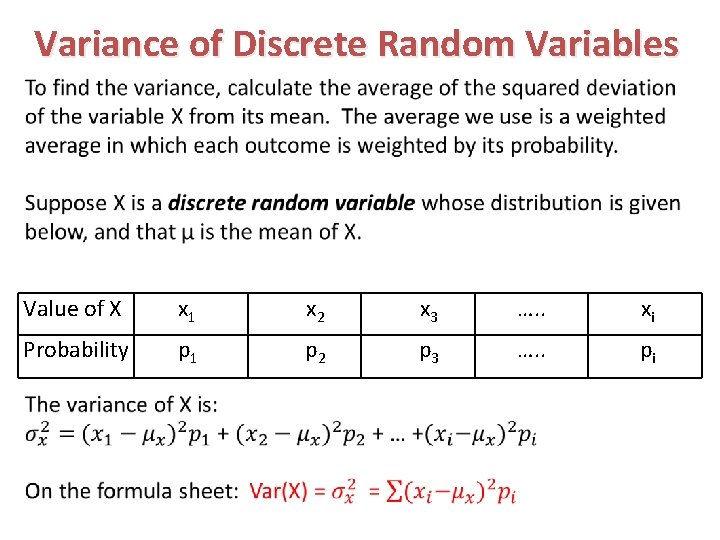
Variance of Discrete Random Variables Value of X x 1 x 2 x 3 …. . xi Probability p 1 p 2 p 3 …. . pi
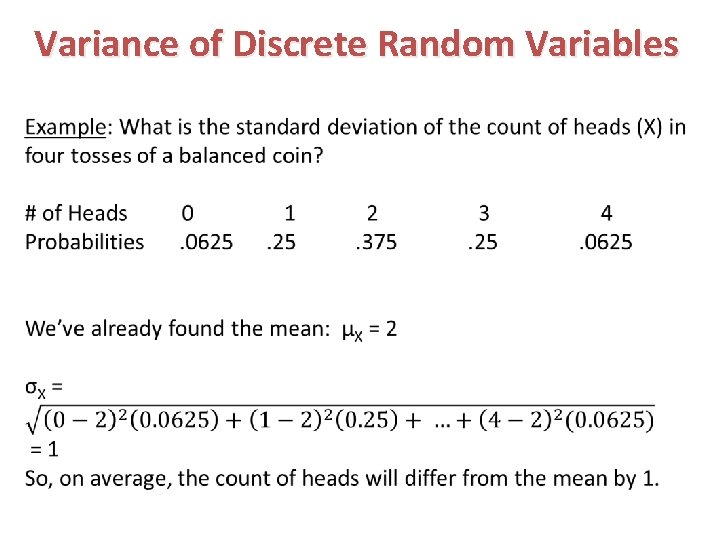
Variance of Discrete Random Variables
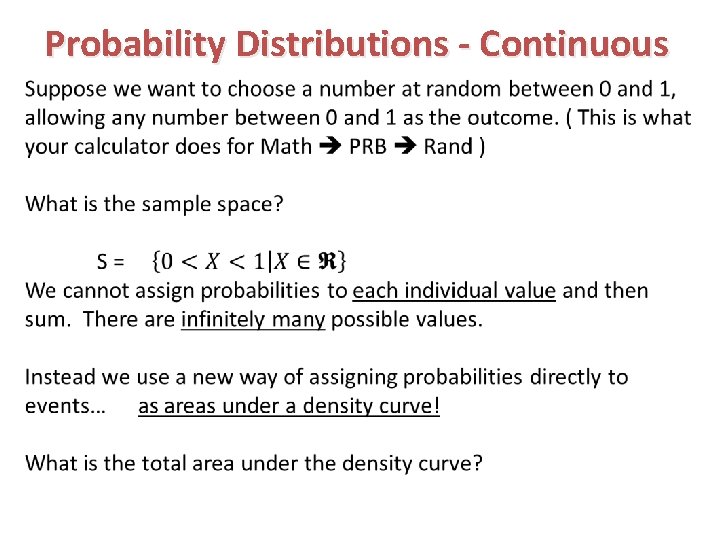
Probability Distributions - Continuous
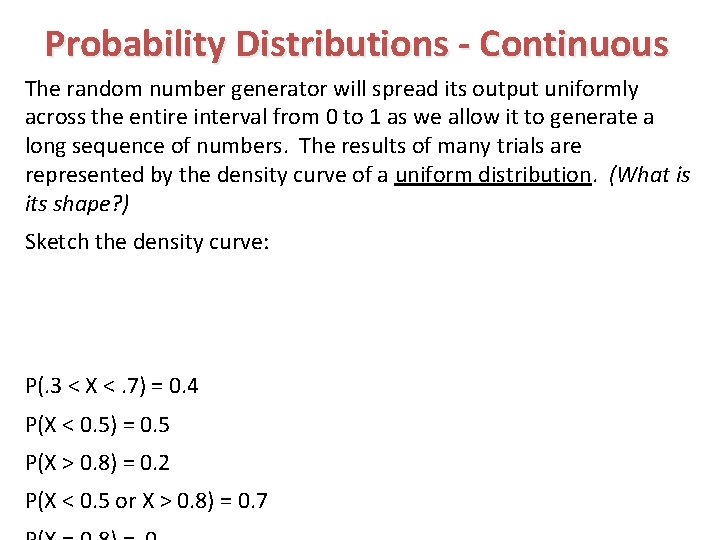
Probability Distributions - Continuous The random number generator will spread its output uniformly across the entire interval from 0 to 1 as we allow it to generate a long sequence of numbers. The results of many trials are represented by the density curve of a uniform distribution. (What is its shape? ) Sketch the density curve: P(. 3 < X <. 7) = 0. 4 P(X < 0. 5) = 0. 5 P(X > 0. 8) = 0. 2 P(X < 0. 5 or X > 0. 8) = 0. 7
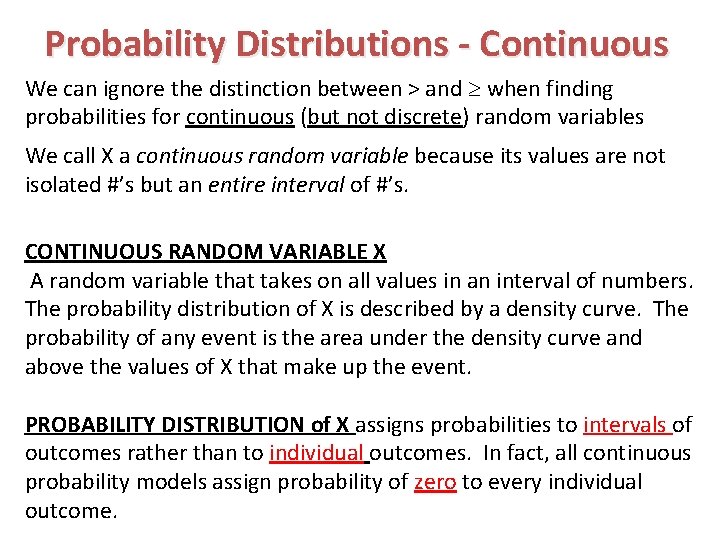
Probability Distributions - Continuous We can ignore the distinction between > and when finding probabilities for continuous (but not discrete) random variables We call X a continuous random variable because its values are not isolated #’s but an entire interval of #’s. CONTINUOUS RANDOM VARIABLE X A random variable that takes on all values in an interval of numbers. The probability distribution of X is described by a density curve. The probability of any event is the area under the density curve and above the values of X that make up the event. PROBABILITY DISTRIBUTION of X assigns probabilities to intervals of outcomes rather than to individual outcomes. In fact, all continuous probability models assign probability of zero to every individual outcome.
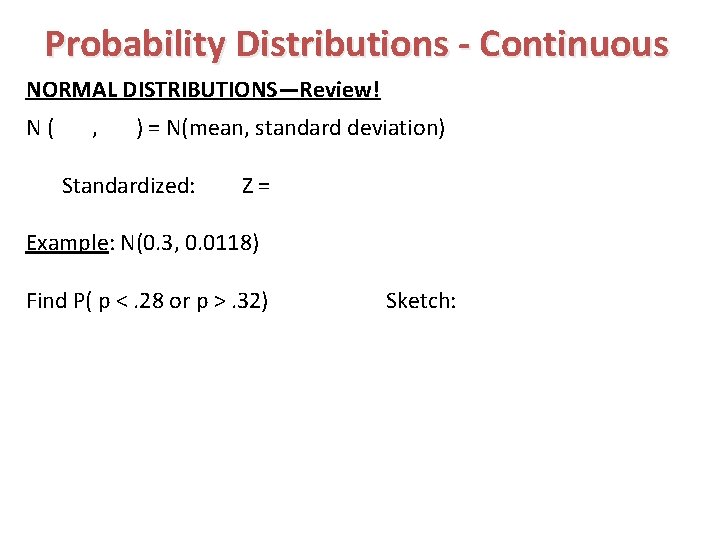
Probability Distributions - Continuous NORMAL DISTRIBUTIONS—Review! N( , ) = N(mean, standard deviation) Standardized: Z= Example: N(0. 3, 0. 0118) Find P( p <. 28 or p >. 32) Sketch:
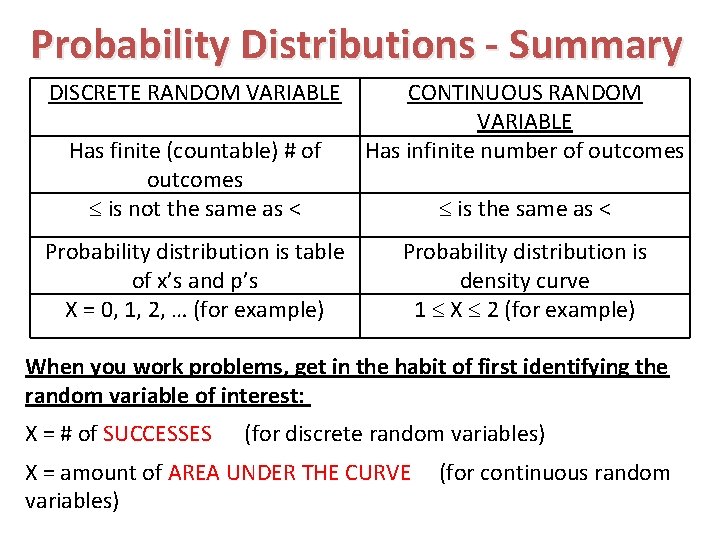
Probability Distributions - Summary DISCRETE RANDOM VARIABLE Has finite (countable) # of outcomes is not the same as < Probability distribution is table of x’s and p’s X = 0, 1, 2, … (for example) CONTINUOUS RANDOM VARIABLE Has infinite number of outcomes is the same as < Probability distribution is density curve 1 X 2 (for example) When you work problems, get in the habit of first identifying the random variable of interest: X = # of SUCCESSES (for discrete random variables) X = amount of AREA UNDER THE CURVE variables) (for continuous random
Homework Day 1: • READ section 6. 1 • DO #1, 3 -7 Day 2: • Do #9, 11, 14, 15, 18, 20, 21, 24, 27 -30
- Slides: 26