
UNIT 6 Quit Chez nous LEON 23 MenthonSaintBernard
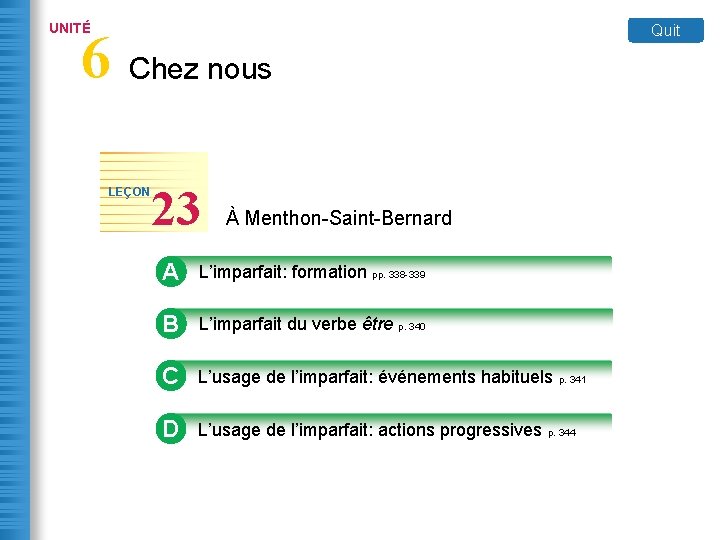
UNITÉ 6 Quit Chez nous LEÇON 23 À Menthon-Saint-Bernard A L’imparfait: formation pp. 338 -339 B L’imparfait du verbe être p. 340 C L’usage de l’imparfait: événements habituels p. 341 D L’usage de l’imparfait: actions progressives p. 344
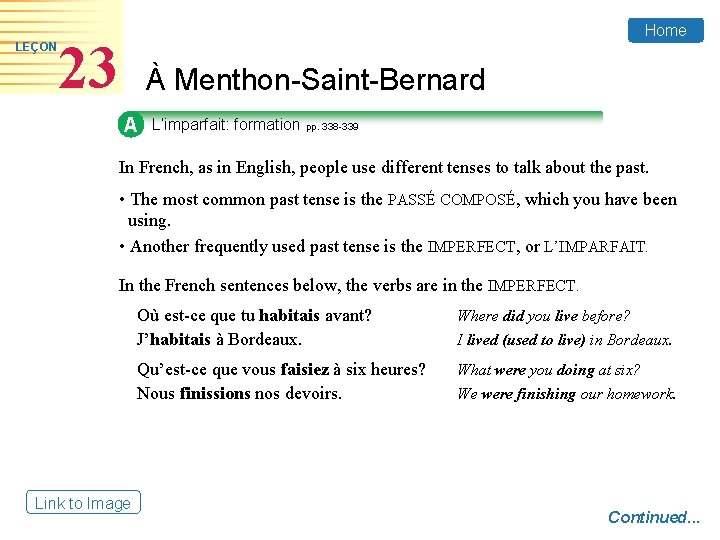
LEÇON Home 23 À Menthon-Saint-Bernard A L’imparfait: formation pp. 338 -339 In French, as in English, people use different tenses to talk about the past. • The most common past tense is the PASSÉ COMPOSÉ, which you have been using. • Another frequently used past tense is the IMPERFECT, or L’IMPARFAIT. In the French sentences below, the verbs are in the IMPERFECT. Link to Image Où est-ce que tu habitais avant? J’habitais à Bordeaux. Where did you live before? I lived (used to live) in Bordeaux. Qu’est-ce que vous faisiez à six heures? Nous finissions nos devoirs. What were you doing at six? We were finishing our homework. Continued. . .
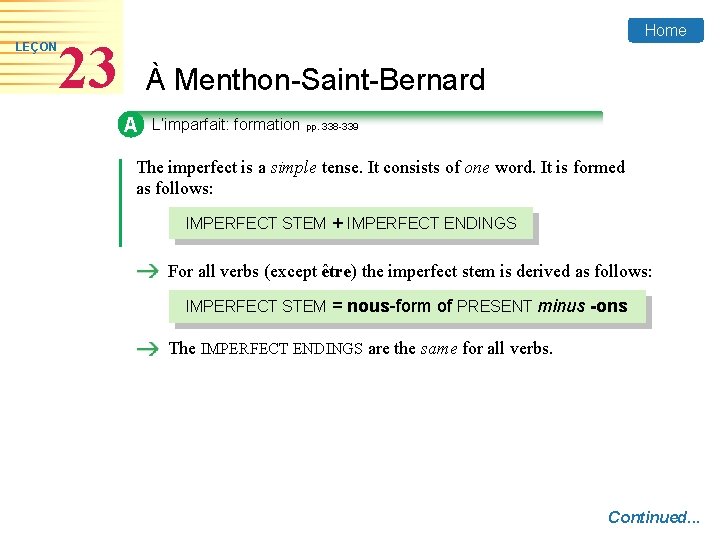
LEÇON Home 23 À Menthon-Saint-Bernard A L’imparfait: formation pp. 338 -339 The imperfect is a simple tense. It consists of one word. It is formed as follows: IMPERFECT STEM + IMPERFECT ENDINGS For all verbs (except être) the imperfect stem is derived as follows: IMPERFECT STEM = nous-form of PRESENT minus -ons The IMPERFECT ENDINGS are the same for all verbs. Continued. . .
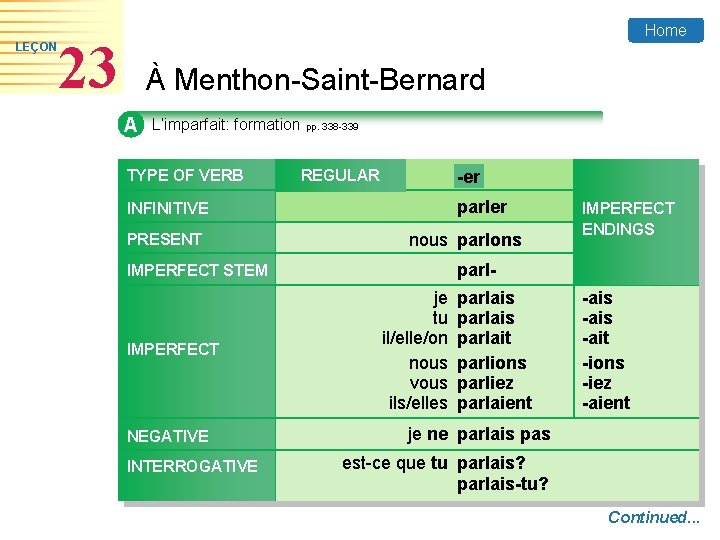
LEÇON Home 23 À Menthon-Saint-Bernard A L’imparfait: formation pp. 338 -339 TYPE OF VERB REGULAR -er lave parler INFINITIVE PRESENT nous parlons parl- IMPERFECT STEM IMPERFECT NEGATIVE INTERROGATIVE IMPERFECT ENDINGS je tu il/elle/on nous vous ils/elles parlais parlait parlions parliez parlaient -ais -ait -ions -iez -aient je ne parlais pas est-ce que tu parlais? parlais-tu? Continued. . .
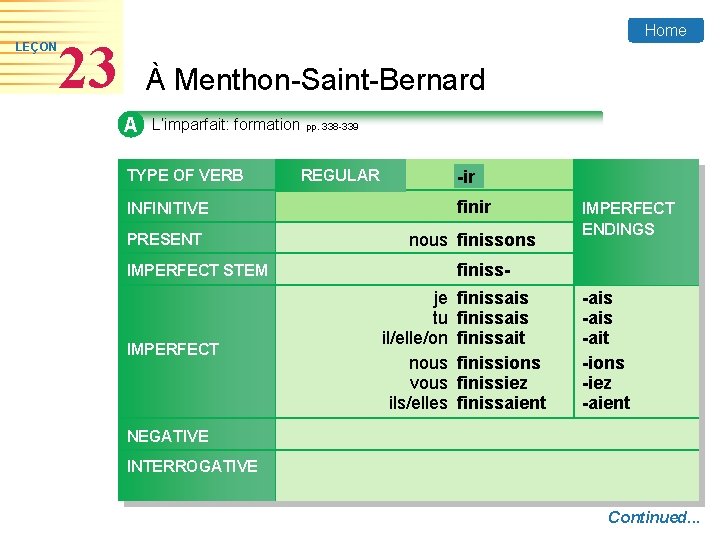
LEÇON Home 23 À Menthon-Saint-Bernard A L’imparfait: formation pp. 338 -339 TYPE OF VERB REGULAR -ir INFINITIVE lave finir PRESENT nous finissons finiss- IMPERFECT STEM IMPERFECT ENDINGS je tu il/elle/on nous vous ils/elles finissais finissait finissions finissiez finissaient -ais -ait -ions -iez -aient NEGATIVE INTERROGATIVE Continued. . .
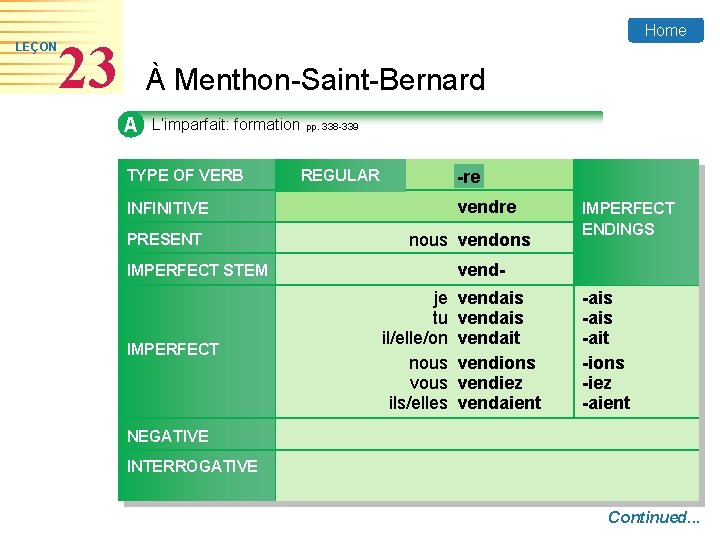
LEÇON Home 23 À Menthon-Saint-Bernard A L’imparfait: formation pp. 338 -339 TYPE OF VERB REGULAR -re lave vendre INFINITIVE PRESENT nous vendons vend- IMPERFECT STEM IMPERFECT ENDINGS je tu il/elle/on nous vous ils/elles vendais vendait vendions vendiez vendaient -ais -ait -ions -iez -aient NEGATIVE INTERROGATIVE Continued. . .
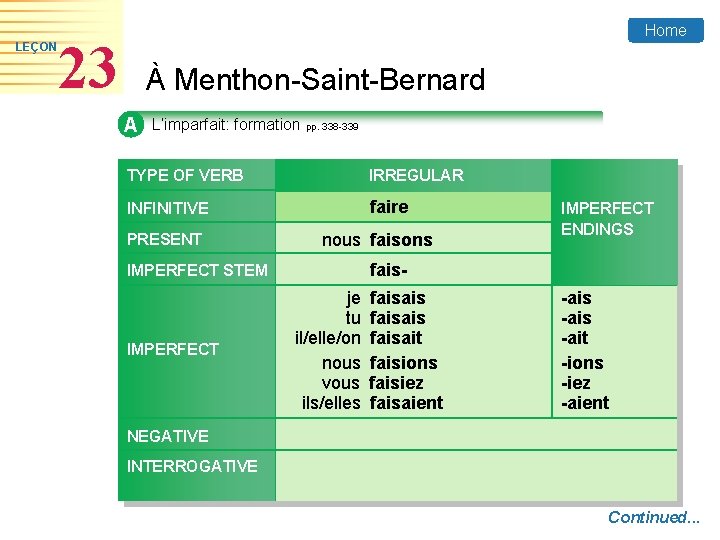
LEÇON Home 23 À Menthon-Saint-Bernard A L’imparfait: formation pp. 338 -339 TYPE OF VERB IRREGULAR INFINITIVE faire PRESENT nous faisons IMPERFECT ENDINGS fais- IMPERFECT STEM IMPERFECT lave je tu il/elle/on nous vous ils/elles faisais faisait faisions faisiez faisaient -ais -ait -ions -iez -aient NEGATIVE INTERROGATIVE Continued. . .
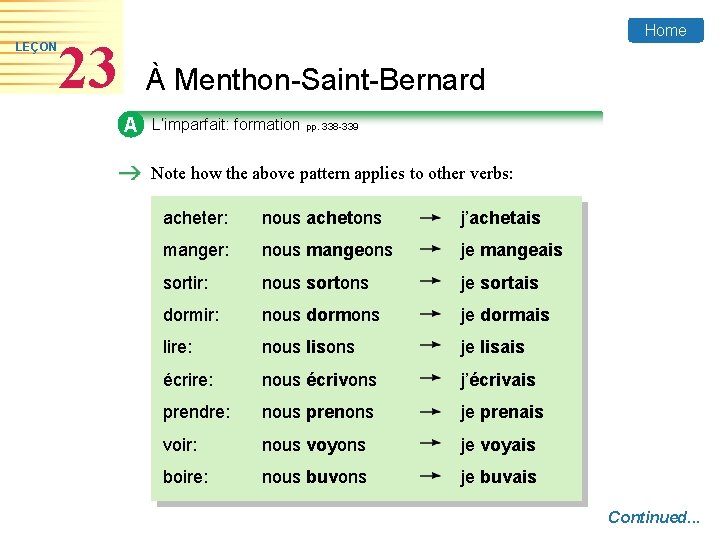
LEÇON Home 23 À Menthon-Saint-Bernard A L’imparfait: formation pp. 338 -339 Note how the above pattern applies to other verbs: acheter: nous achetons j’achetais manger: nous mangeons je mangeais sortir: nous sortons je sortais dormir: nous dormons je dormais lire: nous lisons je lisais écrire: nous écrivons j’écrivais prendre: nous prenons je prenais voir: nous voyons je voyais boire: nous buvons je buvais Continued. . .
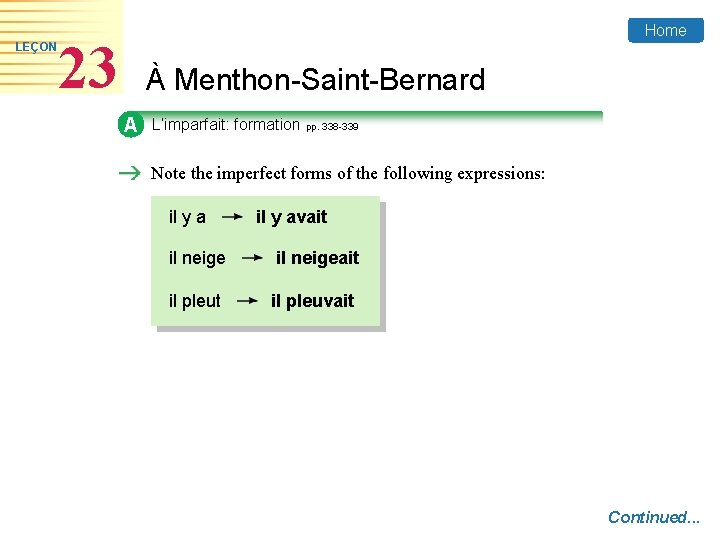
LEÇON Home 23 À Menthon-Saint-Bernard A L’imparfait: formation pp. 338 -339 Note the imperfect forms of the following expressions: il y avait il neigeait il pleuvait Continued. . .
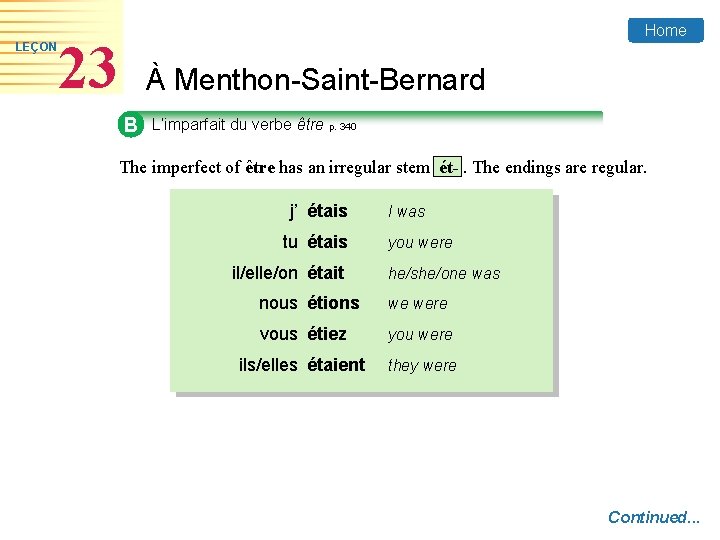
LEÇON Home 23 À Menthon-Saint-Bernard B L’imparfait du verbe être p. 340 The imperfect of être has an irregular stem ét-. The endings are regular. j’ étais tu étais il/elle/on était I was you were he/she/one was nous étions we were vous étiez you were ils/elles étaient they were Continued. . .
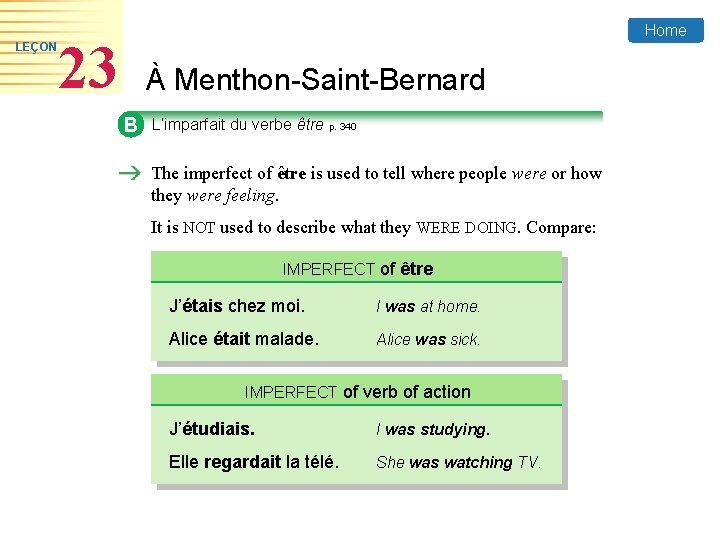
LEÇON Home 23 À Menthon-Saint-Bernard B L’imparfait du verbe être p. 340 The imperfect of être is used to tell where people were or how they were feeling. It is NOT used to describe what they WERE DOING. Compare: IMPERFECT of être J’étais chez moi. I was at home. Alice était malade. Alice was sick. IMPERFECT of verb of action J’étudiais. I was studying. Elle regardait la télé. She was watching TV.
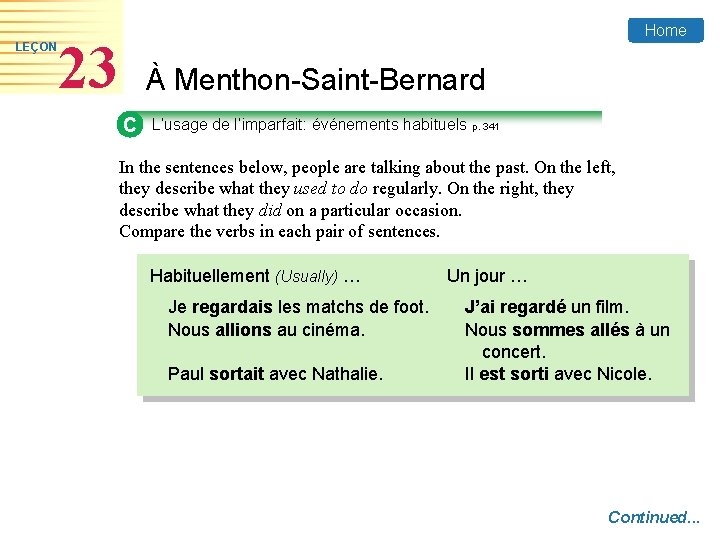
LEÇON Home 23 À Menthon-Saint-Bernard C L’usage de l’imparfait: événements habituels p. 341 In the sentences below, people are talking about the past. On the left, they describe what they used to do regularly. On the right, they describe what they did on a particular occasion. Compare the verbs in each pair of sentences. Habituellement (Usually) … Je regardais les matchs de foot. Nous allions au cinéma. Paul sortait avec Nathalie. Un jour … J’ai regardé un film. Nous sommes allés à un concert. Il est sorti avec Nicole. Continued. . .
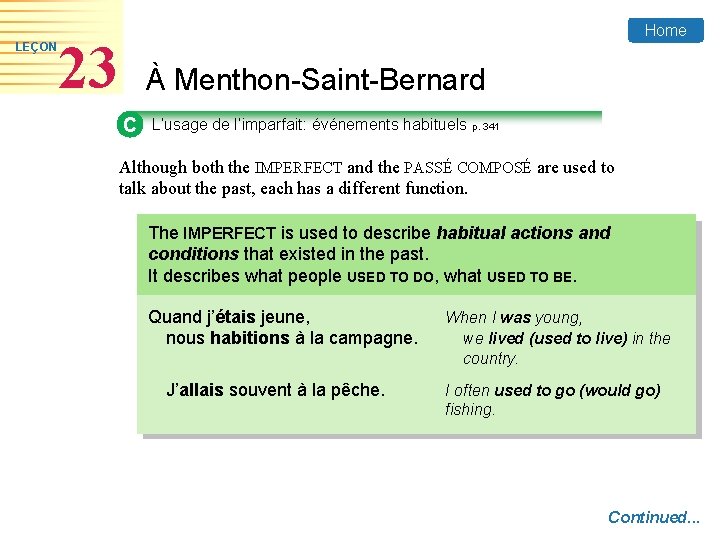
LEÇON Home 23 À Menthon-Saint-Bernard C L’usage de l’imparfait: événements habituels p. 341 Although both the IMPERFECT and the PASSÉ COMPOSÉ are used to talk about the past, each has a different function. The IMPERFECT is used to describe habitual actions and conditions that existed in the past. It describes what people USED TO DO, what USED TO BE. Quand j’étais jeune, nous habitions à la campagne. J’allais souvent à la pêche. When I was young, we lived (used to live) in the country. I often used to go (would go) fishing. Continued. . .
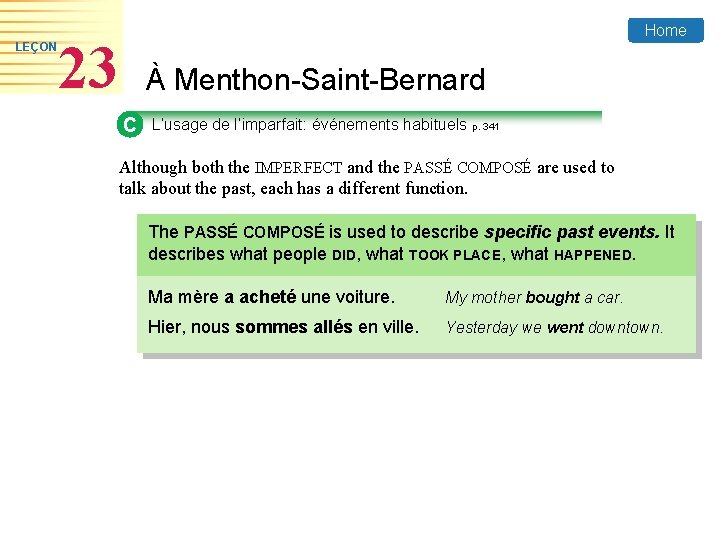
LEÇON Home 23 À Menthon-Saint-Bernard C L’usage de l’imparfait: événements habituels p. 341 Although both the IMPERFECT and the PASSÉ COMPOSÉ are used to talk about the past, each has a different function. The PASSÉ COMPOSÉ is used to describe specific past events. It describes what people DID, what TOOK PLACE, what HAPPENED. Ma mère a acheté une voiture. My mother bought a car. Hier, nous sommes allés en ville. Yesterday we went downtown.
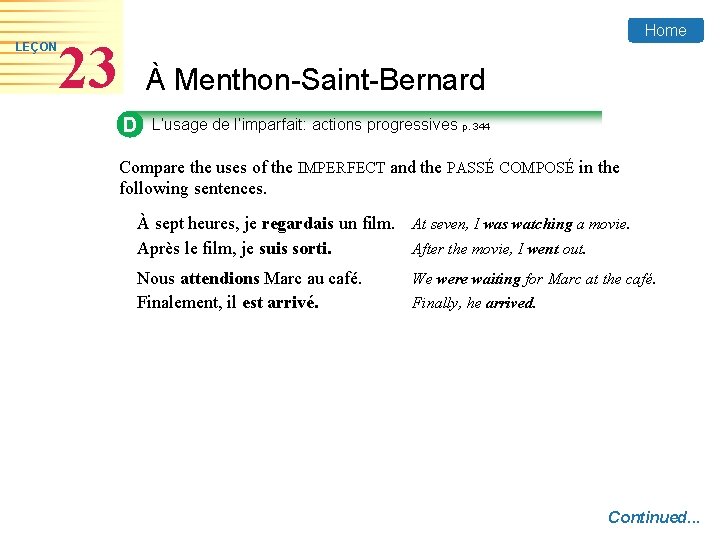
LEÇON Home 23 À Menthon-Saint-Bernard D L’usage de l’imparfait: actions progressives p. 344 Compare the uses of the IMPERFECT and the PASSÉ COMPOSÉ in the following sentences. À sept heures, je regardais un film. At seven, I was watching a movie. Après le film, je suis sorti. After the movie, I went out. Nous attendions Marc au café. Finalement, il est arrivé. We were waiting for Marc at the café. Finally, he arrived. Continued. . .
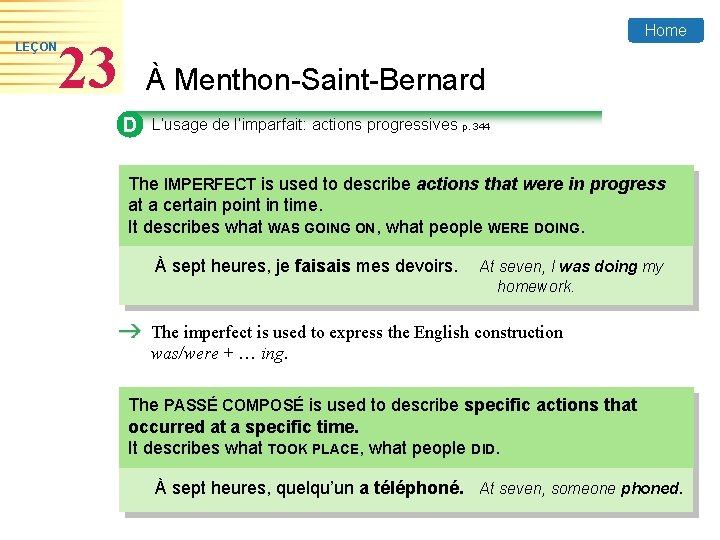
LEÇON Home 23 À Menthon-Saint-Bernard D L’usage de l’imparfait: actions progressives p. 344 The IMPERFECT is used to describe actions that were in progress at a certain point in time. It describes what WAS GOING ON, what people WERE DOING. À sept heures, je faisais mes devoirs. At seven, I was doing my homework. The imperfect is used to express the English construction was/were + … ing. The PASSÉ COMPOSÉ is used to describe specific actions that occurred at a specific time. It describes what TOOK PLACE, what people DID. À sept heures, quelqu’un a téléphoné. At seven, someone phoned.
- Slides: 16