
UNIT 6 Light and Optics Chapter 16 Light
- Slides: 42
UNIT 6: Light and Optics § Chapter 16: Light and Color § Chapter 17: Optics § Chapter 18: Wave Properties of Light
Chapter 16 Light and Color § 16. 1 Properties and Sources of Light § 16. 2 Color and Vision § 16. 3 Photons and Atoms
Chapter 16 Objectives § Describe at least five properties of light. § Describe the meaning of the term “intensity. ” § Use the speed of light to calculate the time or distance traveled by light. § Explain how we perceive color in terms of the three primary colors. § Explain the difference between the additive and subtractive color processes. § Arrange the colors of light in order of increasing energy, starting with red. § Describe light in terms of photons, energy, and color.
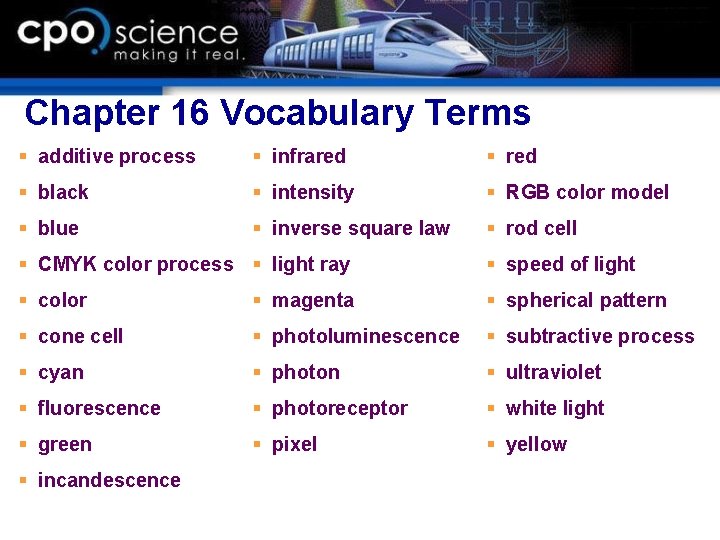
Chapter 16 Vocabulary Terms § additive process § infrared § black § intensity § RGB color model § blue § inverse square law § rod cell § CMYK color process § light ray § speed of light § color § magenta § spherical pattern § cone cell § photoluminescence § subtractive process § cyan § photon § ultraviolet § fluorescence § photoreceptor § white light § green § pixel § yellow § incandescence
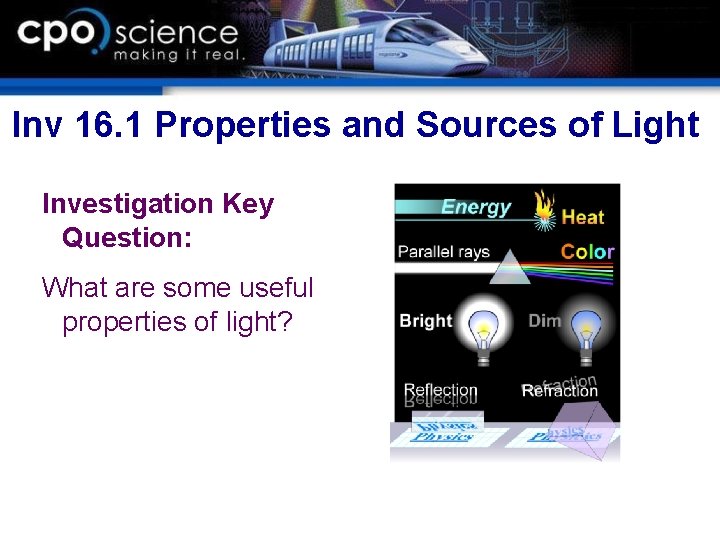
Inv 16. 1 Properties and Sources of Light Investigation Key Question: What are some useful properties of light?
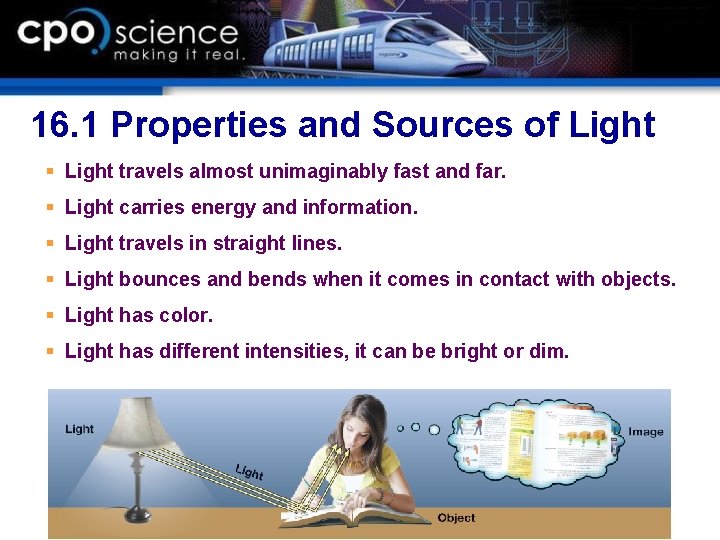
16. 1 Properties and Sources of Light § Light travels almost unimaginably fast and far. § Light carries energy and information. § Light travels in straight lines. § Light bounces and bends when it comes in contact with objects. § Light has color. § Light has different intensities, it can be bright or dim.
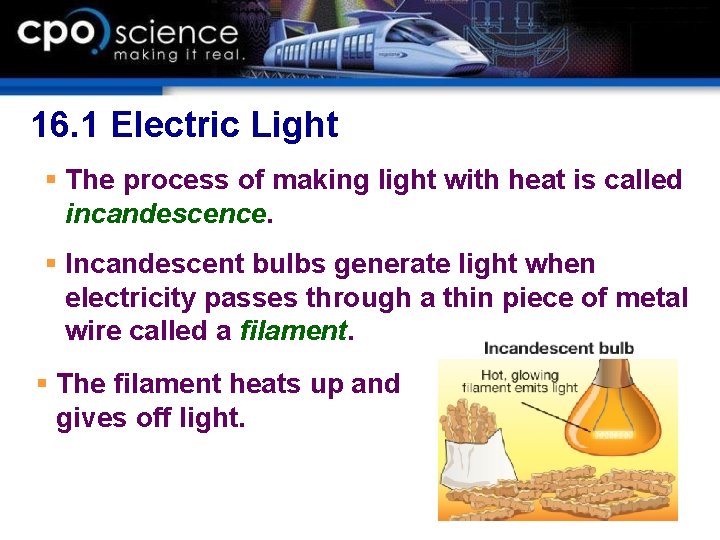
16. 1 Electric Light § The process of making light with heat is called incandescence. § Incandescent bulbs generate light when electricity passes through a thin piece of metal wire called a filament. § The filament heats up and gives off light.
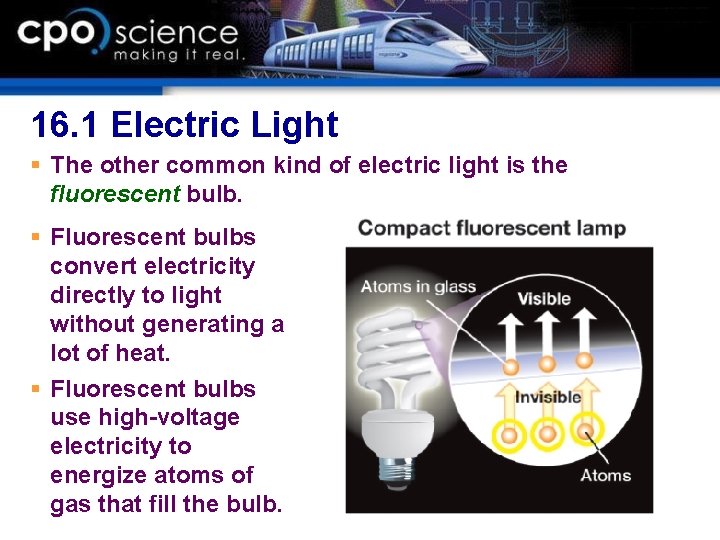
16. 1 Electric Light § The other common kind of electric light is the fluorescent bulb. § Fluorescent bulbs convert electricity directly to light without generating a lot of heat. § Fluorescent bulbs use high-voltage electricity to energize atoms of gas that fill the bulb.
16. 1 Light carries energy and power § Light is a form of energy that travels. § The intensity of light is the amount of energy per second falling on a surface. § Most light sources distribute their light equally in all directions, making a spherical pattern. § Because light spreads out in a sphere, the intensity decreases the farther you get from the source.
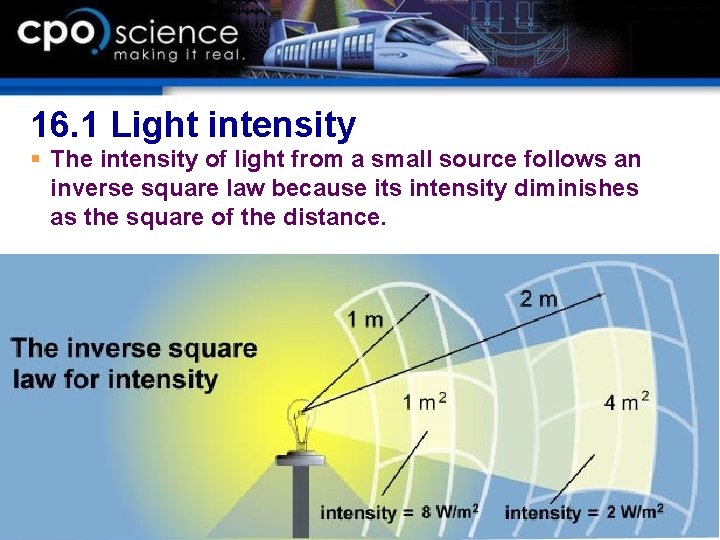
16. 1 Light intensity § The intensity of light from a small source follows an inverse square law because its intensity diminishes as the square of the distance.
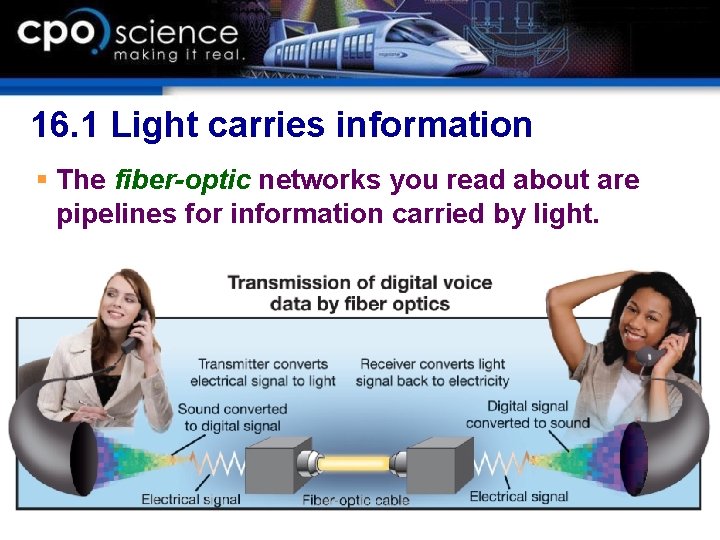
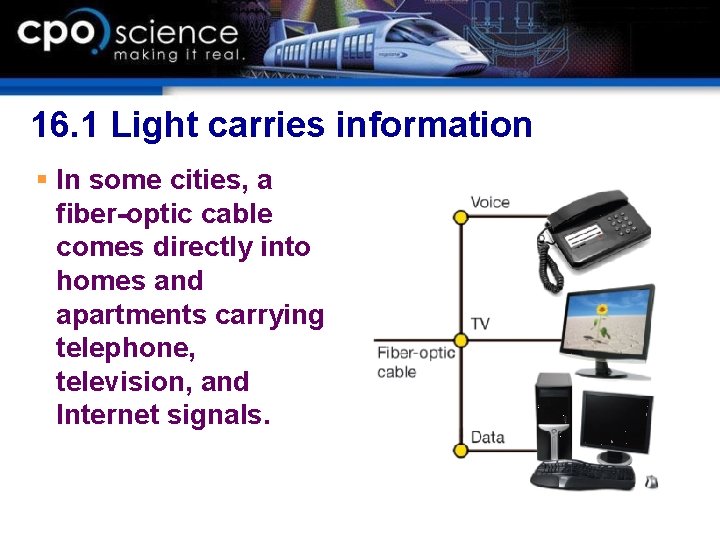
16. 1 Light carries information § The fiber-optic networks you read about are pipelines for information carried by light.
16. 1 Light carries information § In some cities, a fiber-optic cable comes directly into homes and apartments carrying telephone, television, and Internet signals.
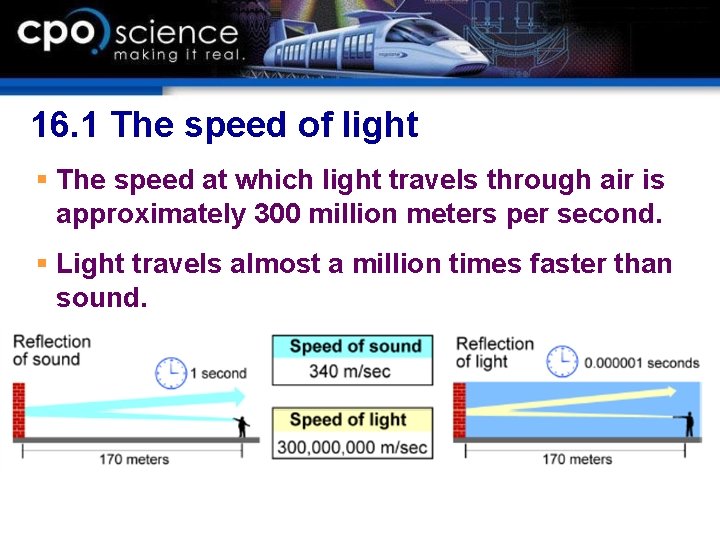
16. 1 The speed of light § The speed at which light travels through air is approximately 300 million meters per second. § Light travels almost a million times faster than sound.
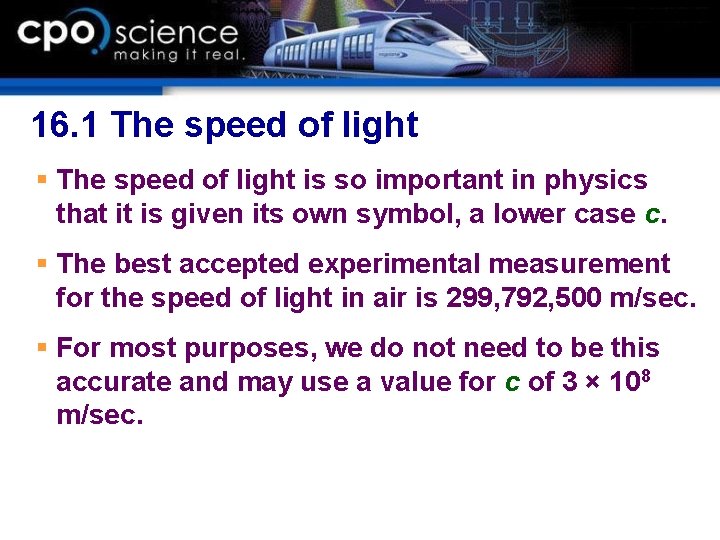
16. 1 The speed of light § The speed of light is so important in physics that it is given its own symbol, a lower case c. § The best accepted experimental measurement for the speed of light in air is 299, 792, 500 m/sec. § For most purposes, we do not need to be this accurate and may use a value for c of 3 × 10⁸ m/sec.
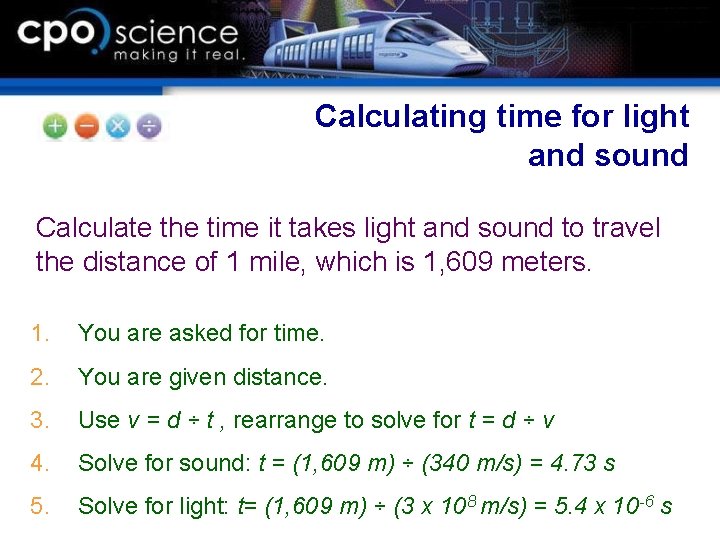
Calculating time for light and sound Calculate the time it takes light and sound to travel the distance of 1 mile, which is 1, 609 meters. 1. You are asked for time. 2. You are given distance. 3. Use v = d ÷ t , rearrange to solve for t = d ÷ v 4. Solve for sound: t = (1, 609 m) ÷ (340 m/s) = 4. 73 s 5. Solve for light: t= (1, 609 m) ÷ (3 x 10⁸ m/s) = 5. 4 x 10 -6 s
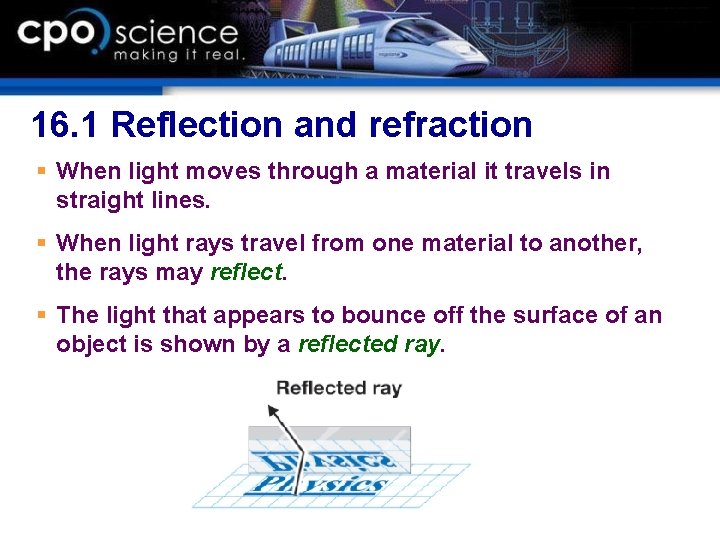
16. 1 Reflection and refraction § When light moves through a material it travels in straight lines. § When light rays travel from one material to another, the rays may reflect. § The light that appears to bounce off the surface of an object is shown by a reflected ray.
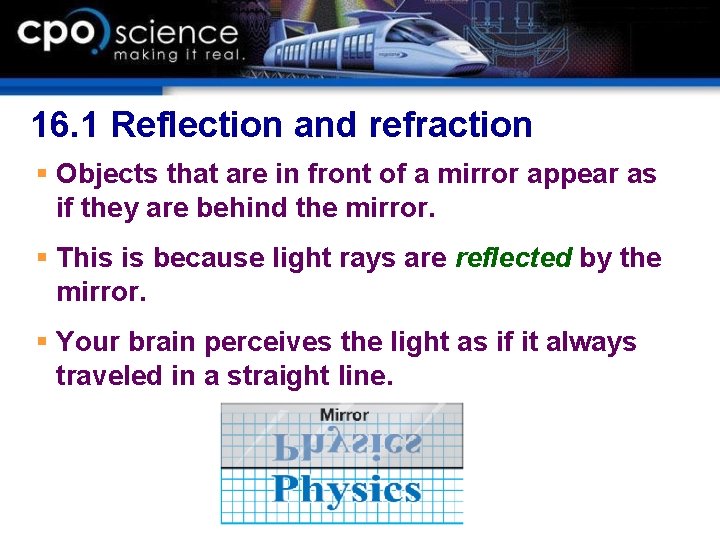
16. 1 Reflection and refraction § Objects that are in front of a mirror appear as if they are behind the mirror. § This is because light rays are reflected by the mirror. § Your brain perceives the light as if it always traveled in a straight line.
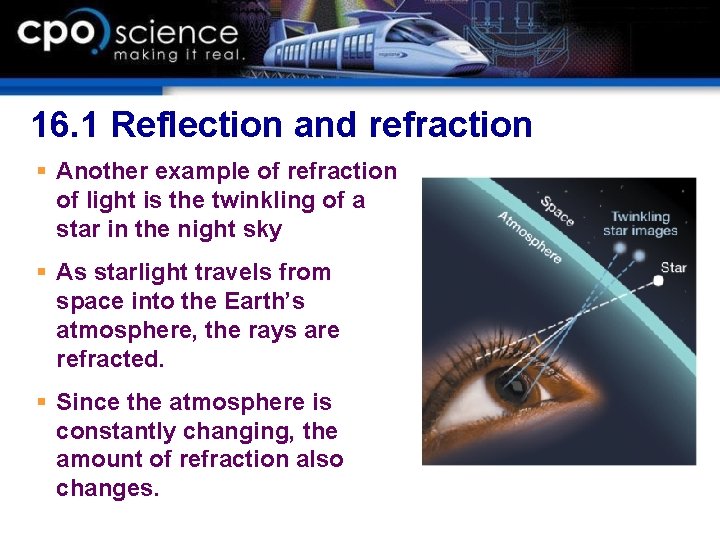
16. 1 Reflection and refraction § Another example of refraction of light is the twinkling of a star in the night sky § As starlight travels from space into the Earth’s atmosphere, the rays are refracted. § Since the atmosphere is constantly changing, the amount of refraction also changes.
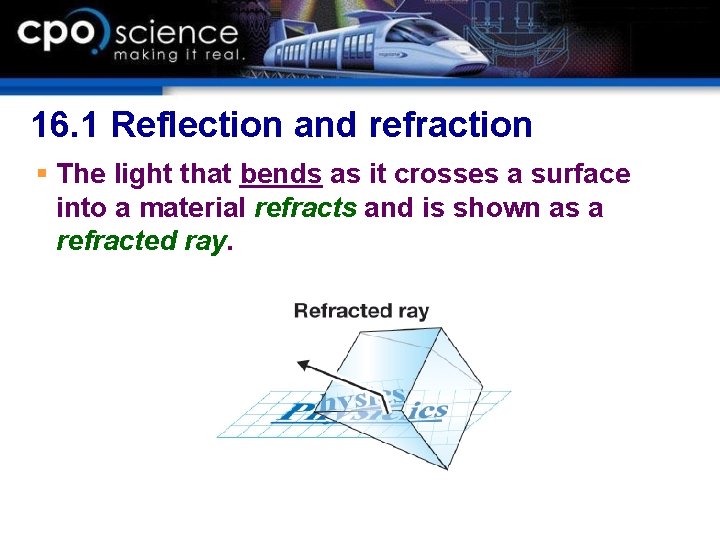
16. 1 Reflection and refraction § The light that bends as it crosses a surface into a material refracts and is shown as a refracted ray.
Chapter 16 Light and Color § 16. 1 Properties and Sources of Light § 16. 2 Color and Vision § 16. 3 Photons and Atoms
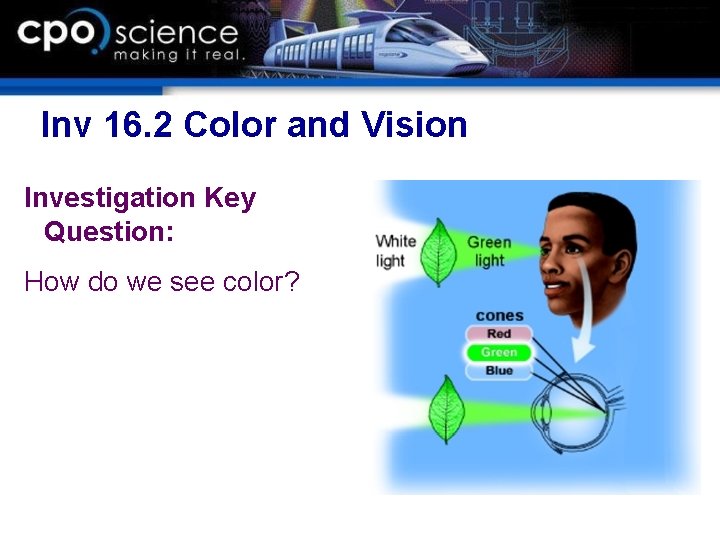
Inv 16. 2 Color and Vision Investigation Key Question: How do we see color?
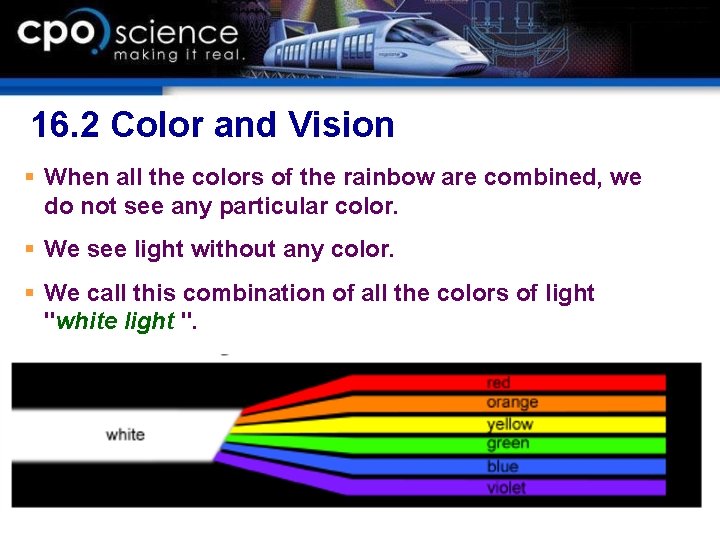
16. 2 Color and Vision § When all the colors of the rainbow are combined, we do not see any particular color. § We see light without any color. § We call this combination of all the colors of light "white light ".
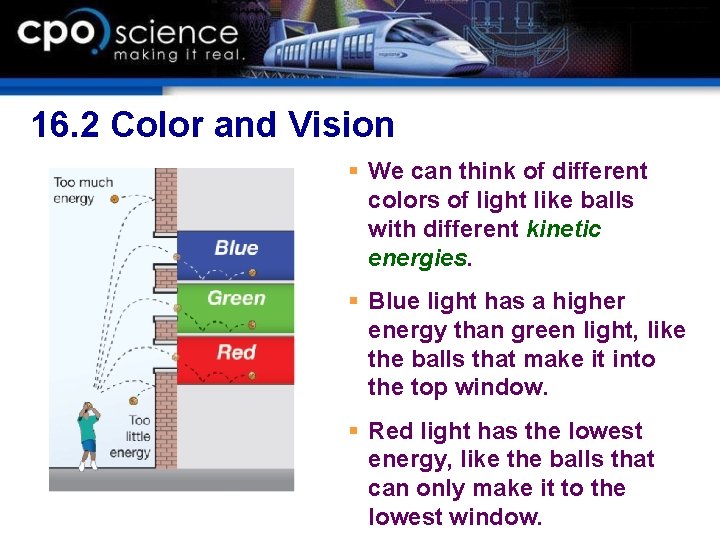
16. 2 Color and Vision § We can think of different colors of light like balls with different kinetic energies. § Blue light has a higher energy than green light, like the balls that make it into the top window. § Red light has the lowest energy, like the balls that can only make it to the lowest window.
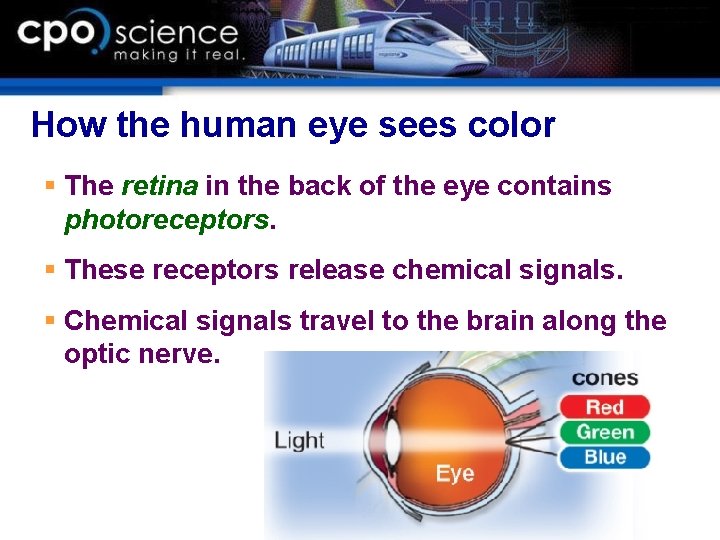
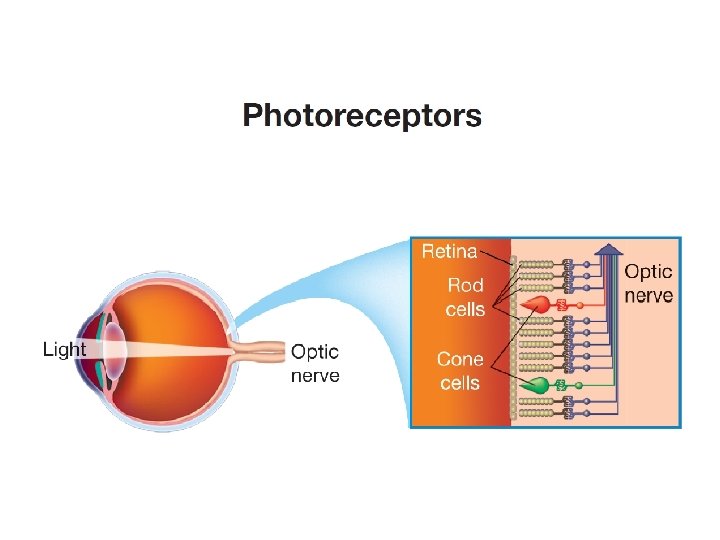
How the human eye sees color § The retina in the back of the eye contains photoreceptors. § These receptors release chemical signals. § Chemical signals travel to the brain along the optic nerve.
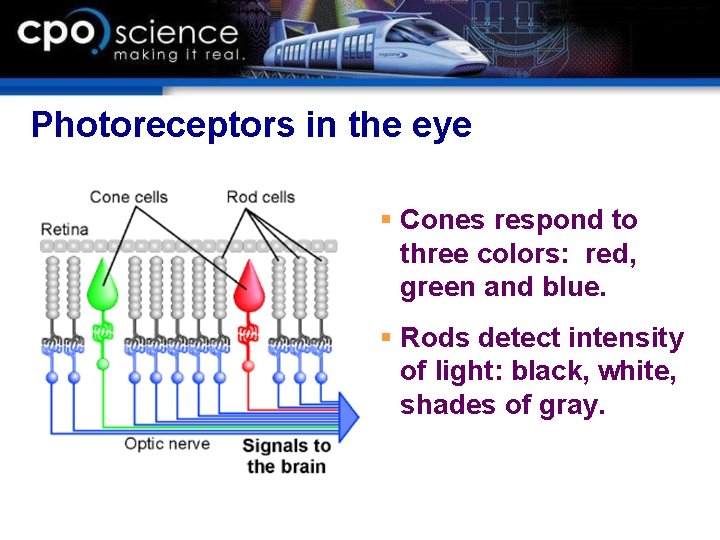
Photoreceptors in the eye § Cones respond to three colors: red, green and blue. § Rods detect intensity of light: black, white, shades of gray.
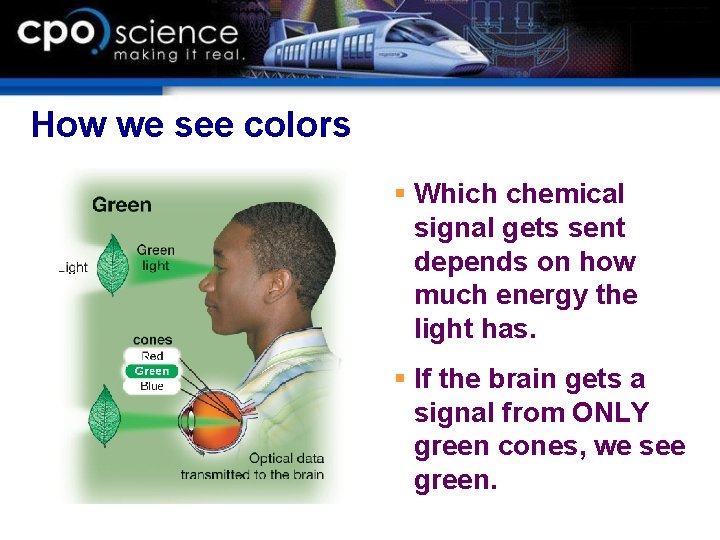
How we see colors § Which chemical signal gets sent depends on how much energy the light has. § If the brain gets a signal from ONLY green cones, we see green.
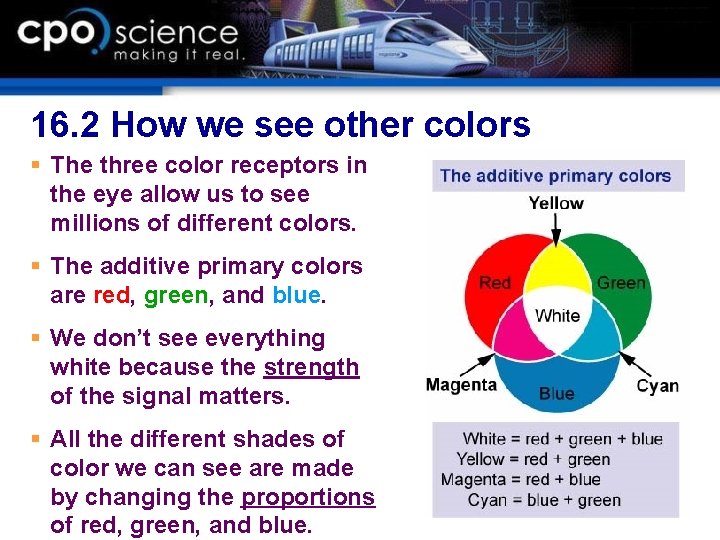
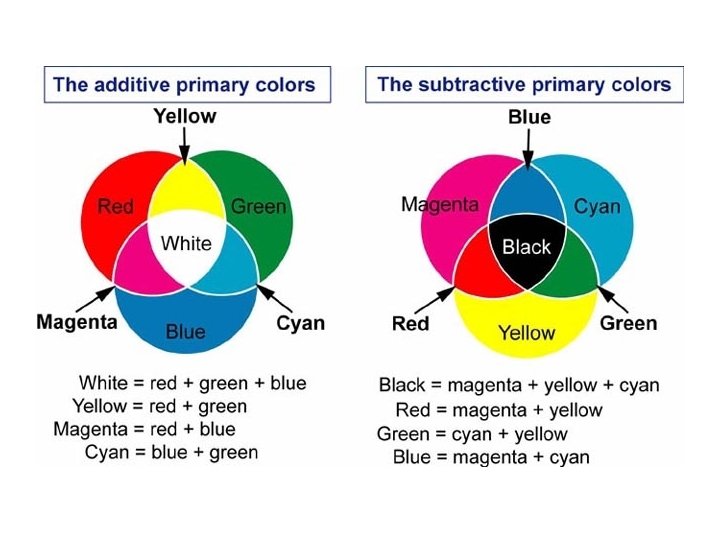
16. 2 How we see other colors § The three color receptors in the eye allow us to see millions of different colors. § The additive primary colors are red, green, and blue. § We don’t see everything white because the strength of the signal matters. § All the different shades of color we can see are made by changing the proportions of red, green, and blue.
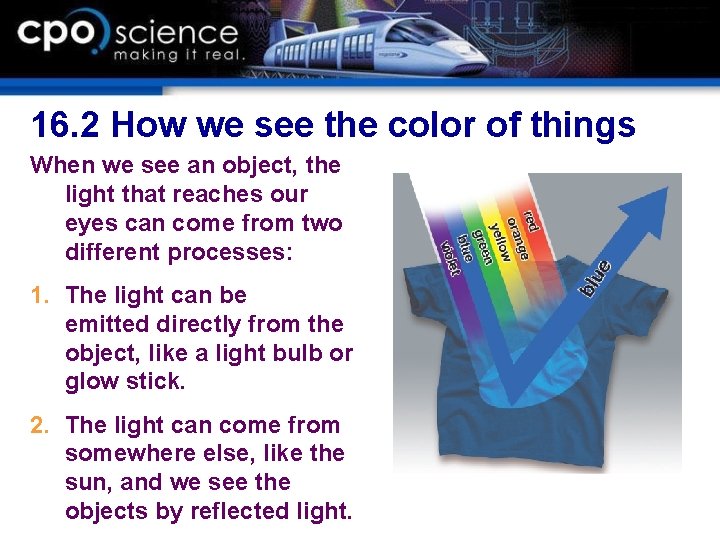
16. 2 How we see the color of things When we see an object, the light that reaches our eyes can come from two different processes: 1. The light can be emitted directly from the object, like a light bulb or glow stick. 2. The light can come from somewhere else, like the sun, and we see the objects by reflected light.
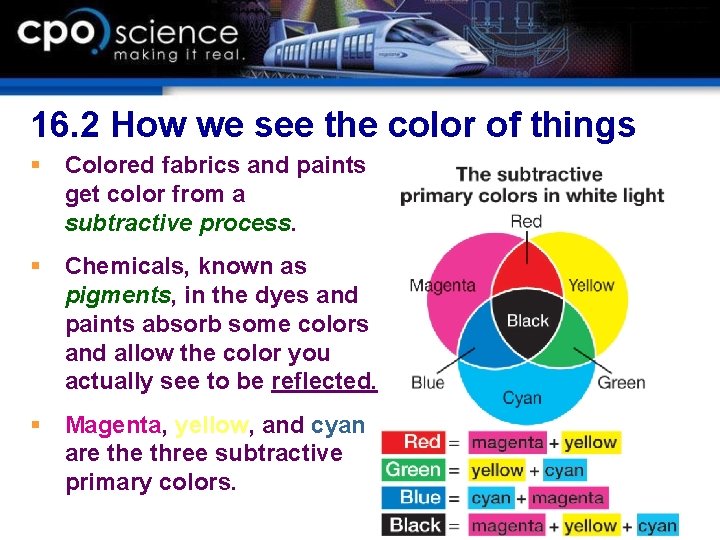
16. 2 How we see the color of things § Colored fabrics and paints get color from a subtractive process. § Chemicals, known as pigments, in the dyes and paints absorb some colors and allow the color you actually see to be reflected. § Magenta, yellow, and cyan are three subtractive primary colors.
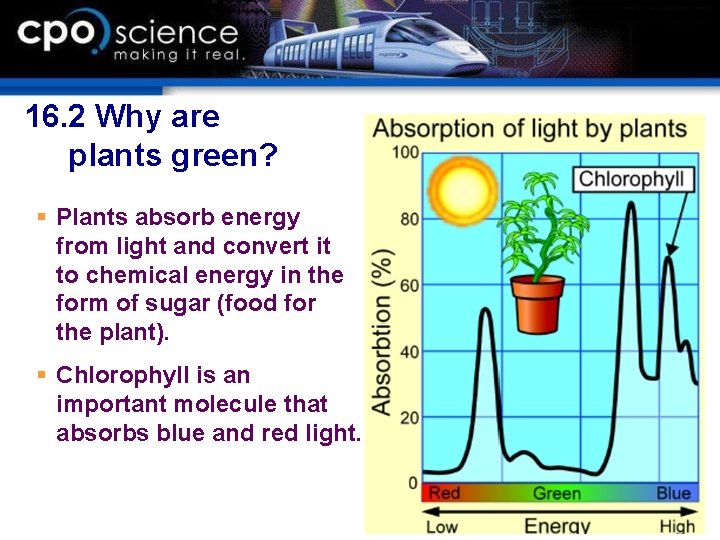
16. 2 Why are plants green? § Plants absorb energy from light and convert it to chemical energy in the form of sugar (food for the plant). § Chlorophyll is an important molecule that absorbs blue and red light.
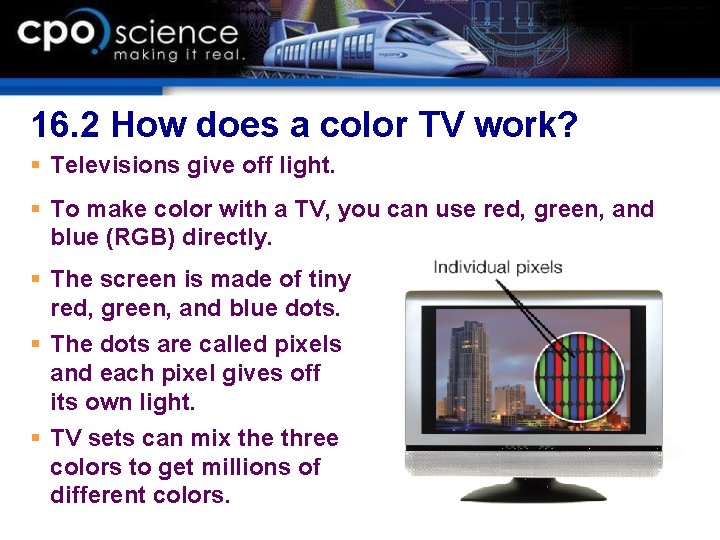
16. 2 How does a color TV work? § Televisions give off light. § To make color with a TV, you can use red, green, and blue (RGB) directly. § The screen is made of tiny red, green, and blue dots. § The dots are called pixels and each pixel gives off its own light. § TV sets can mix the three colors to get millions of different colors.
Chapter 16 Light and Color § 16. 1 Properties and Sources of Light § 16. 2 Color and Vision § 16. 3 Photons and Atoms
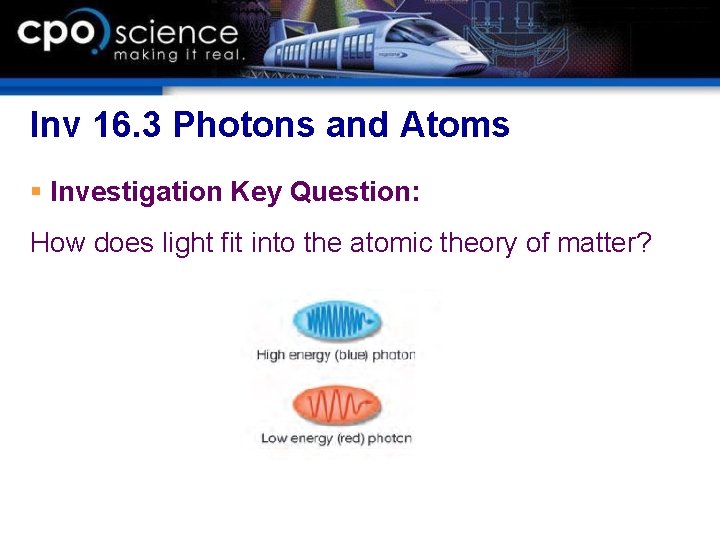
Inv 16. 3 Photons and Atoms § Investigation Key Question: How does light fit into the atomic theory of matter?
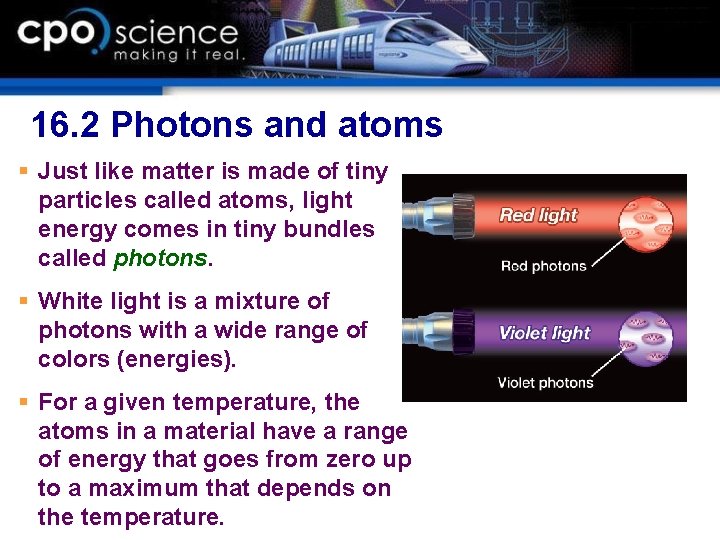
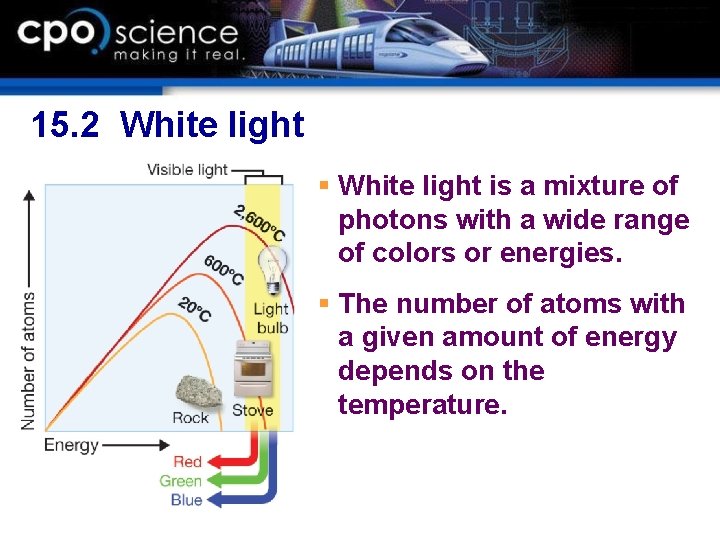
16. 2 Photons and atoms § Just like matter is made of tiny particles called atoms, light energy comes in tiny bundles called photons. § White light is a mixture of photons with a wide range of colors (energies). § For a given temperature, the atoms in a material have a range of energy that goes from zero up to a maximum that depends on the temperature.
15. 2 White light § White light is a mixture of photons with a wide range of colors or energies. § The number of atoms with a given amount of energy depends on the temperature.
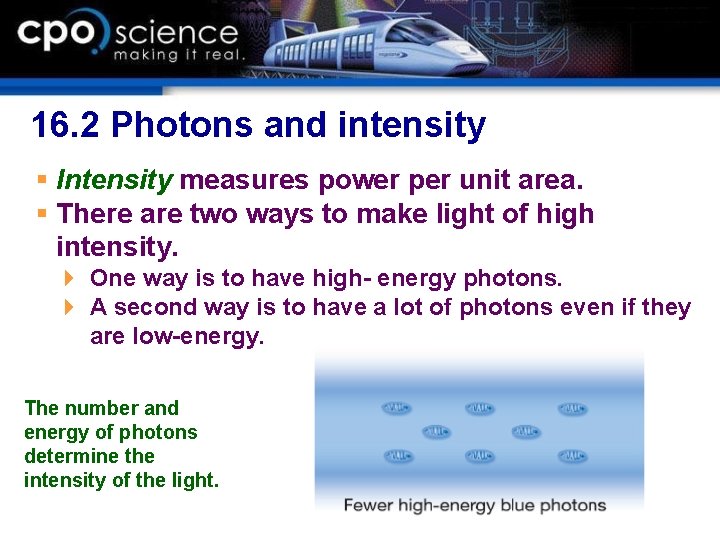
16. 2 Photons and intensity § Intensity measures power per unit area. § There are two ways to make light of high intensity. 4 One way is to have high- energy photons. 4 A second way is to have a lot of photons even if they are low-energy. The number and energy of photons determine the intensity of the light.
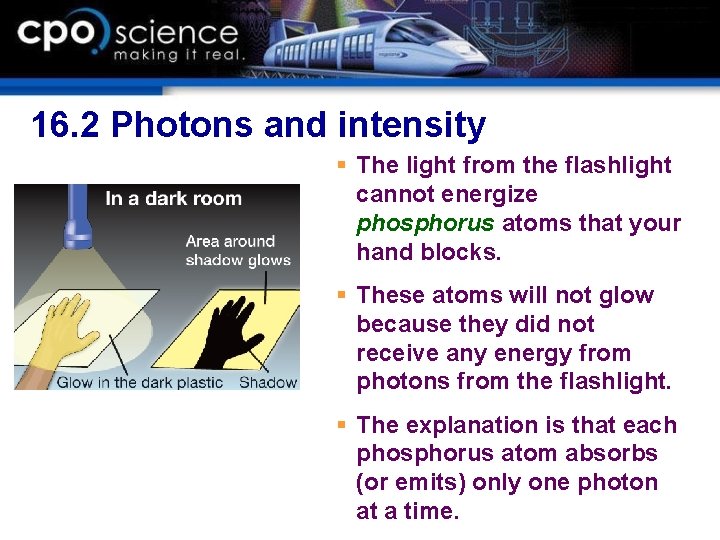
16. 2 Photons and intensity § The light from the flashlight cannot energize phosphorus atoms that your hand blocks. § These atoms will not glow because they did not receive any energy from photons from the flashlight. § The explanation is that each phosphorus atom absorbs (or emits) only one photon at a time.
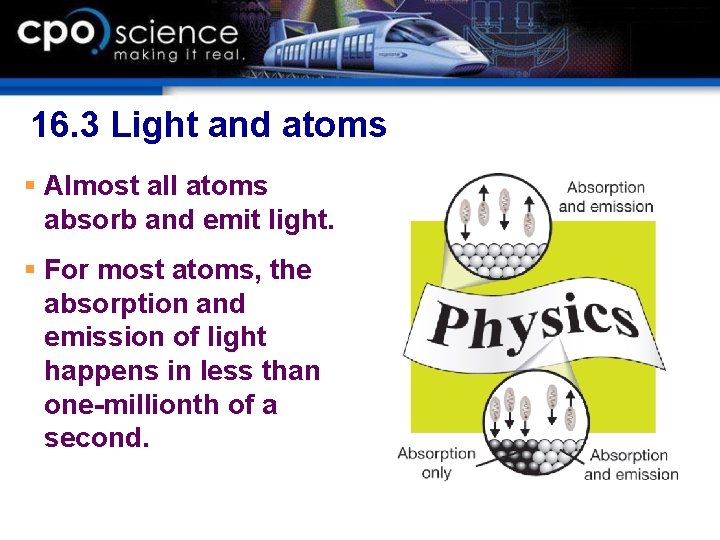
16. 3 Light and atoms § Almost all atoms absorb and emit light. § For most atoms, the absorption and emission of light happens in less than one-millionth of a second.
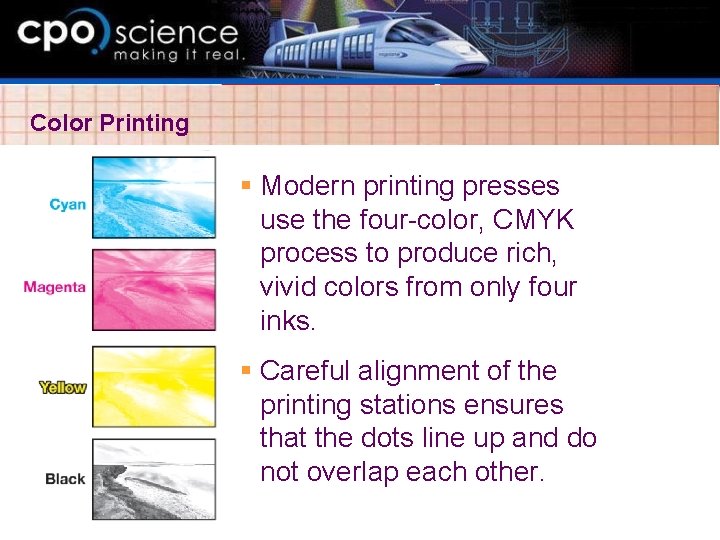
Color Printing § Modern printing presses use the four-color, CMYK process to produce rich, vivid colors from only four inks. § Careful alignment of the printing stations ensures that the dots line up and do not overlap each other.