
Unit 6 Lesson 6 Classification of Living Things
- Slides: 19
Unit 6 Lesson 6 Classification of Living Things Copyright © Houghton Mifflin Harcourt Publishing Company
Unit 6 Lesson 6 Classification of Living Things Florida Benchmark • SC. 6. N. 2. 2 Explain that scientific knowledge is durable because it is open to change as new evidence or interpretations are encountered. • SC. 6. N. 3. 4 Identify the role of models in the context of the sixth grade science benchmarks. • SC. 6. L. 15. 1 Analyze and describe how and why organisms are classified according to shared characteristics with emphasis on the Linnaean system combined with the concept of Domains. Copyright © Houghton Mifflin Harcourt Publishing Company
Unit 6 Lesson 6 Classification of Living Things Sorting Things Out! Why do we classify living things? • Scientists classify living things based on characteristics that living things share. • Classification helps scientists to answer questions about organisms. • Classification helps a scientist keep living things organized. Copyright © Houghton Mifflin Harcourt Publishing Company
Unit 6 Lesson 6 Classification of Living Things How do scientists know living things are related? • Physical characteristics can indicate that two organisms are similar or related. • Scientists also study how organisms develop from an egg to an adult to determine if organisms are related. Copyright © Houghton Mifflin Harcourt Publishing Company
Unit 6 Lesson 6 Classification of Living Things How do scientists know living things are related? • Chemical characteristics can indicate whether organisms are similar or related. • Scientists use genetic material to look for mutations and genetic similarities. • Proteins and hormones also can show if organisms are related. Copyright © Houghton Mifflin Harcourt Publishing Company
Unit 6 Lesson 6 Classification of Living Things What’s in a Name? How are living things named? • Carolus Linnaeus simplified classification with a two-part scientific name. • A species is a group of organisms that are very closely related. • Members of the same species can mate and produce fertile offspring. Copyright © Houghton Mifflin Harcourt Publishing Company
Unit 6 Lesson 6 Classification of Living Things How are living things named? • A genus includes similar species. • The genus is the first part of a scientific name. The genus name is always capitalized. The species name follows and is lowercase. • All organisms have a unique two-part scientific name that is italicized or underlined. Copyright © Houghton Mifflin Harcourt Publishing Company
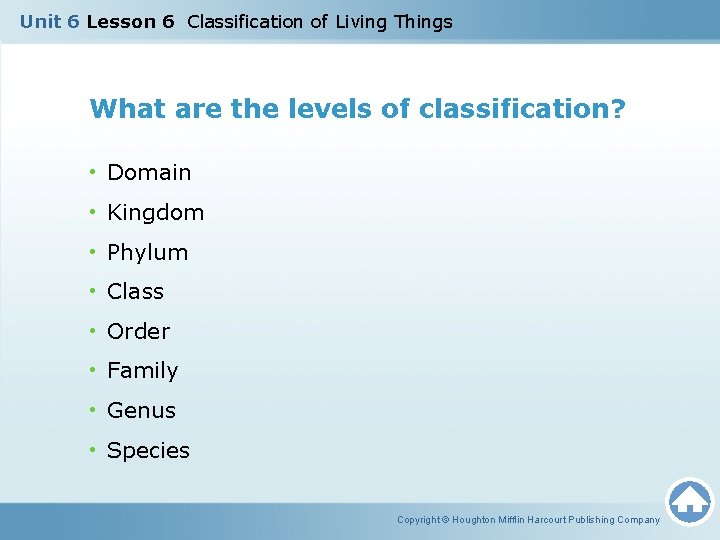
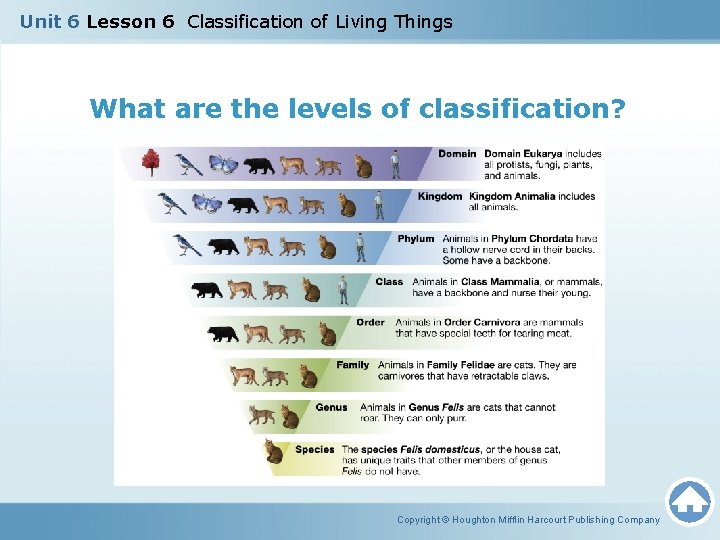
Unit 6 Lesson 6 Classification of Living Things What are the levels of classification? • Taxonomy is the science of describing, classifying, and naming living things. • Scientists use an eight-level classification system. • Each level is more specific than the one before it and contains a smaller group of living things. Copyright © Houghton Mifflin Harcourt Publishing Company
Unit 6 Lesson 6 Classification of Living Things What are the levels of classification? • Domain • Kingdom • Phylum • Class • Order • Family • Genus • Species Copyright © Houghton Mifflin Harcourt Publishing Company
Unit 6 Lesson 6 Classification of Living Things What are the levels of classification? Copyright © Houghton Mifflin Harcourt Publishing Company
Unit 6 Lesson 6 Classification of Living Things Triple Play What are three domains? • Scientists used to use a six-kingdom classification system, but later added the domain. • A domain represents the largest differences among organisms in classification. • The three domains are Bacteria, Archaea, and Eukarya. Copyright © Houghton Mifflin Harcourt Publishing Company
Unit 6 Lesson 6 Classification of Living Things What are three domains? • Domain Bacteria is made up of prokaryotes that typically have a cell wall and reproduce by cell division. • Domain Archaea is made up of prokaryotes that differ from bacteria in their genetics and in the makeup of their cell walls. Copyright © Houghton Mifflin Harcourt Publishing Company
Unit 6 Lesson 6 Classification of Living Things What are three domains? • Domain Eukarya is made up of all eukaryotes. • Eukaryotes have cells with a nucleus and membrane-bound organelles. • Plants, animals, protists, and fungi in the Domain Eukarya can be single-celled or multicellular. Copyright © Houghton Mifflin Harcourt Publishing Company
Unit 6 Lesson 6 Classification of Living Things My Kingdom for a Eukaryote! What kingdoms are in Eukarya? • Kingdom Animalia contains multicellular organisms that lack cell walls, are typically able to move around, and have specialized sense organs. • Kingdom Plantae consists of multicellular organisms that have cell walls, cannot move around, and make their own food. Copyright © Houghton Mifflin Harcourt Publishing Company
Unit 6 Lesson 6 Classification of Living Things What kingdoms are in Eukarya? • Kingdom Protista are single-celled or simple multicellular organisms such as algae, protozoans, and slime molds. • Kingdom Fungi are single-celled or multicellular organisms that get energy by absorbing materials and have cells with cell walls but no chloroplasts. Copyright © Houghton Mifflin Harcourt Publishing Company
Unit 6 Lesson 6 Classification of Living Things How do classification systems change? • Millions of organisms are not named. • New organisms do not always fit into the existing classification system. • Scientists are constantly changing their thoughts on classification based on new information. Copyright © Houghton Mifflin Harcourt Publishing Company
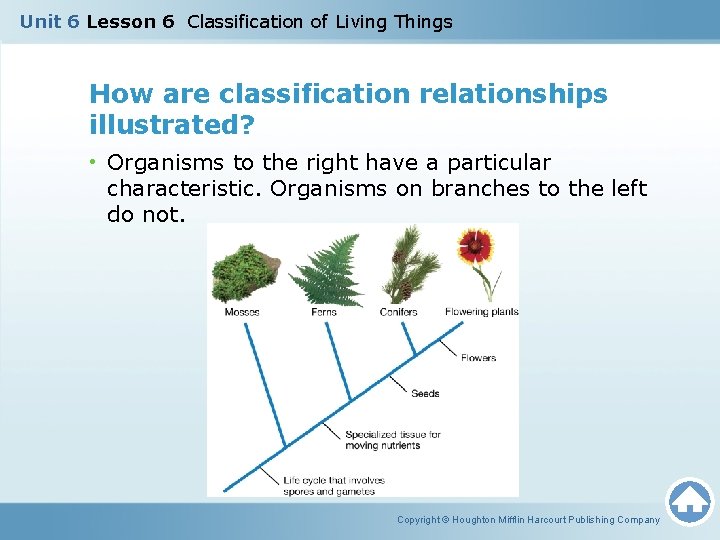
Unit 6 Lesson 6 Classification of Living Things How are classification relationships illustrated? • Branching diagrams are often used in classification. • A cladogram is a branching diagram that shows relationships among species. • Organisms to the right have a particular characteristic. Organisms on branches to the left do not. Copyright © Houghton Mifflin Harcourt Publishing Company
Unit 6 Lesson 6 Classification of Living Things How are classification relationships illustrated? • Organisms to the right have a particular characteristic. Organisms on branches to the left do not. Copyright © Houghton Mifflin Harcourt Publishing Company
Unit 6 Lesson 6 Classification of Living Things Keys to Success How can organisms be identified? • A dichotomous key uses a series of paired statements to identify organisms. • The pairs of statements are numbered. • Once you choose a correct statement from a pair, you are directed to a new pair of statements until the organism is identified. Copyright © Houghton Mifflin Harcourt Publishing Company