
Unit 6 Kinetics IB Topics 6 16 Part
Unit 6: Kinetics IB Topics 6 & 16 Part 2: Reaction Order & Half Life
![Expressing rxn rates in quantitative terms: Note: [ ] written around an expression is](http://slidetodoc.com/presentation_image_h2/6c6848defd7f0fd0805f2c7551b8dd12/image-2.jpg "Expressing rxn rates in quantitative terms: Note: [ ] written around an expression is")
Expressing rxn rates in quantitative terms: Note: [ ] written around an expression is read as the concentration of the substance. {example: [Na. OH] is read as the concentration of sodium hydroxide}
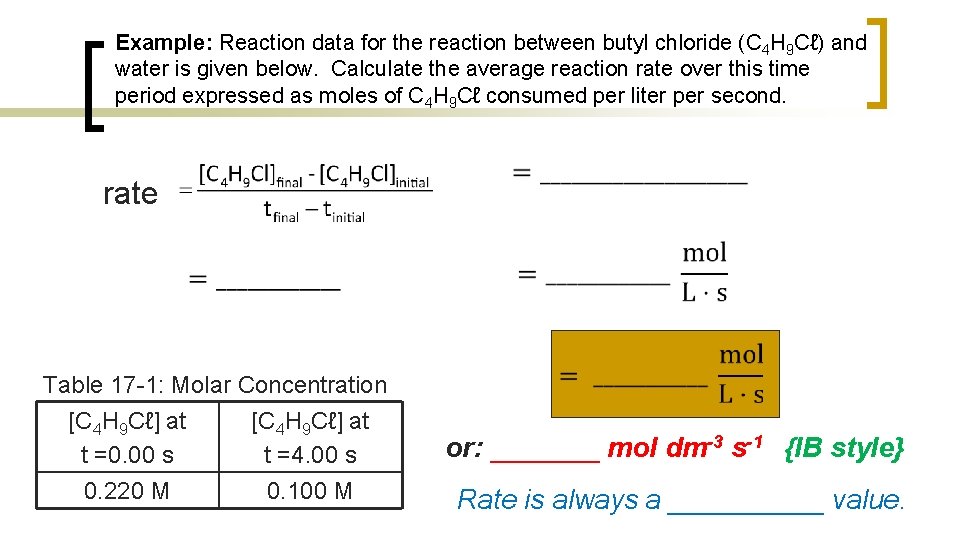
Example: Reaction data for the reaction between butyl chloride (C 4 H 9 Cℓ) and water is given below. Calculate the average reaction rate over this time period expressed as moles of C 4 H 9 Cℓ consumed per liter per second. rate Table 17 -1: Molar Concentration [C 4 H 9 Cℓ] at t =0. 00 s t =4. 00 s 0. 220 M 0. 100 M or: _______ mol dm-3 s-1 {IB style} Rate is always a _____ value.
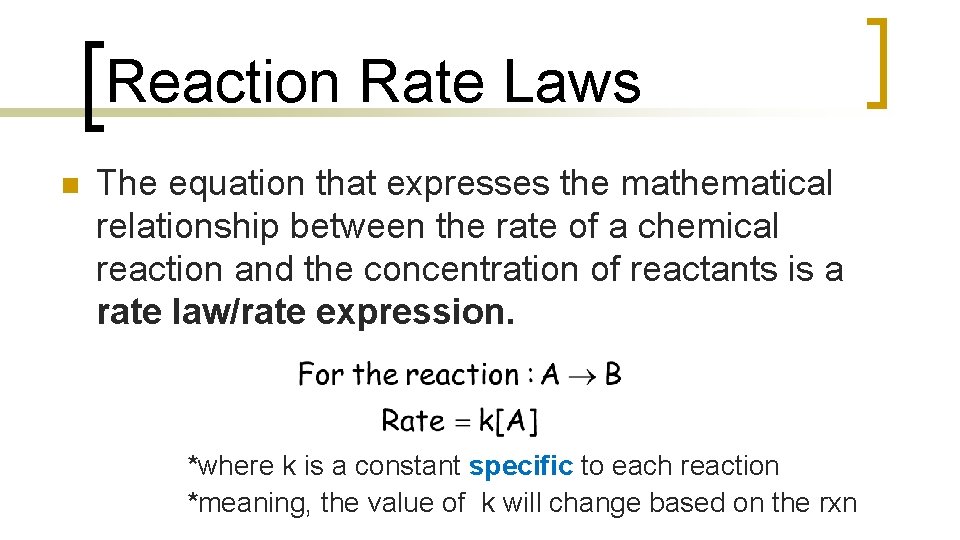
Reaction Rate Laws n The equation that expresses the mathematical relationship between the rate of a chemical reaction and the concentration of reactants is a rate law/rate expression. *where k is a constant specific to each reaction *meaning, the value of k will change based on the rxn
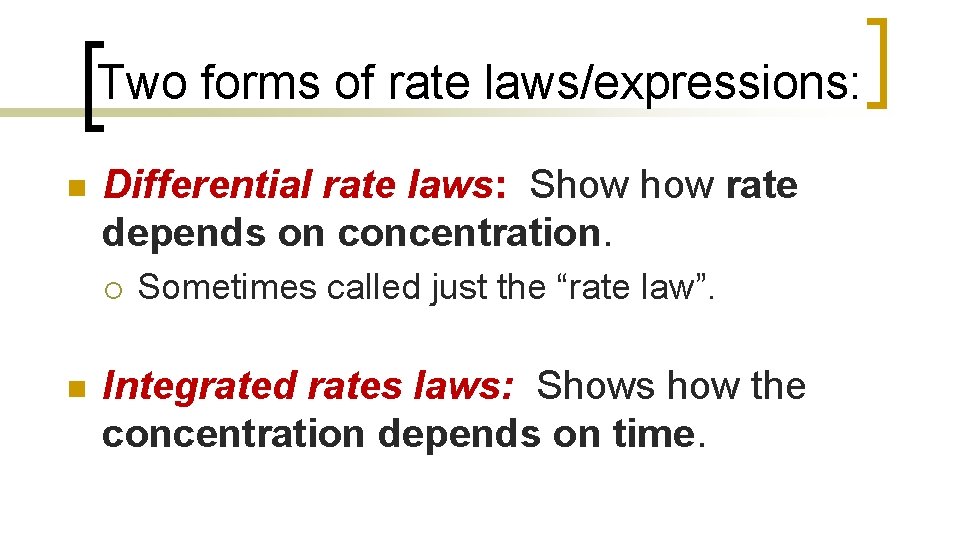
Two forms of rate laws/expressions: n Differential rate laws: Show rate depends on concentration. ¡ n Sometimes called just the “rate law”. Integrated rates laws: Shows how the concentration depends on time.
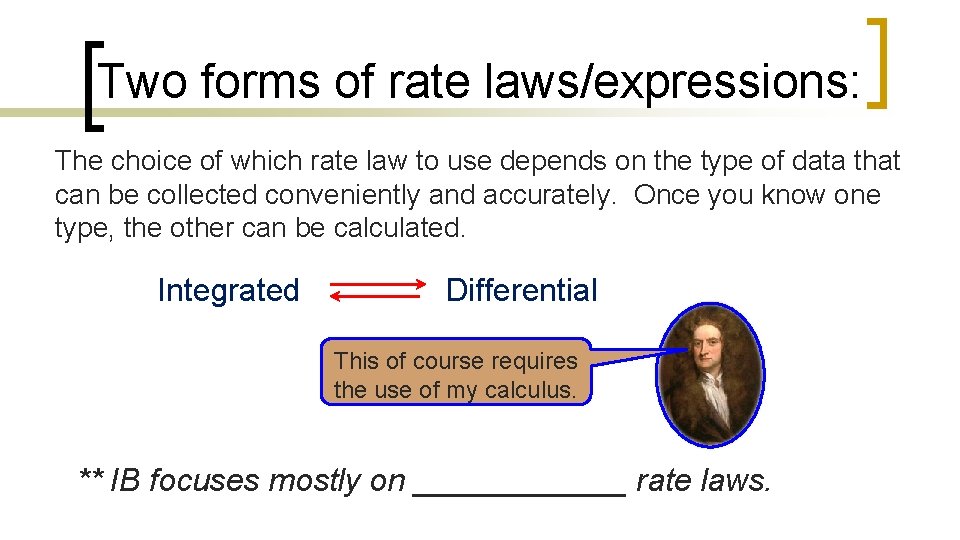
Two forms of rate laws/expressions: The choice of which rate law to use depends on the type of data that can be collected conveniently and accurately. Once you know one type, the other can be calculated. Integrated Differential This of course requires the use of my calculus. ** IB focuses mostly on ______ rate laws.
Reaction Order n The reaction order for a reactant defines how the rate is affected by the concentration of that reactant. n The overall reaction order of a chemical reaction is the sum of the orders for the individual reactants in the rate law.
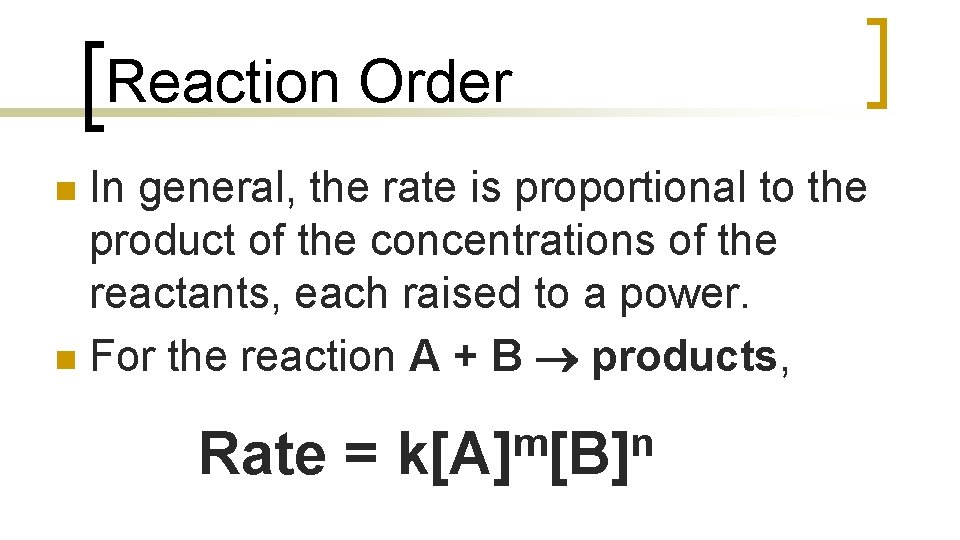
Reaction Order In general, the rate is proportional to the product of the concentrations of the reactants, each raised to a power. n For the reaction A + B products, n Rate = m n k[A] [B]
![Reaction Order Rate = n m n k[A] [B] The exponents m and n](http://slidetodoc.com/presentation_image_h2/6c6848defd7f0fd0805f2c7551b8dd12/image-9.jpg "Reaction Order Rate = n m n k[A] [B] The exponents m and n")
Reaction Order Rate = n m n k[A] [B] The exponents m and n are called reaction orders. ¡ ¡ ¡ The value of m is the order of the rxn with respect to A. The value of n is the order of the rxn with respect to B. The sum (m + n) is called the overall reaction order.
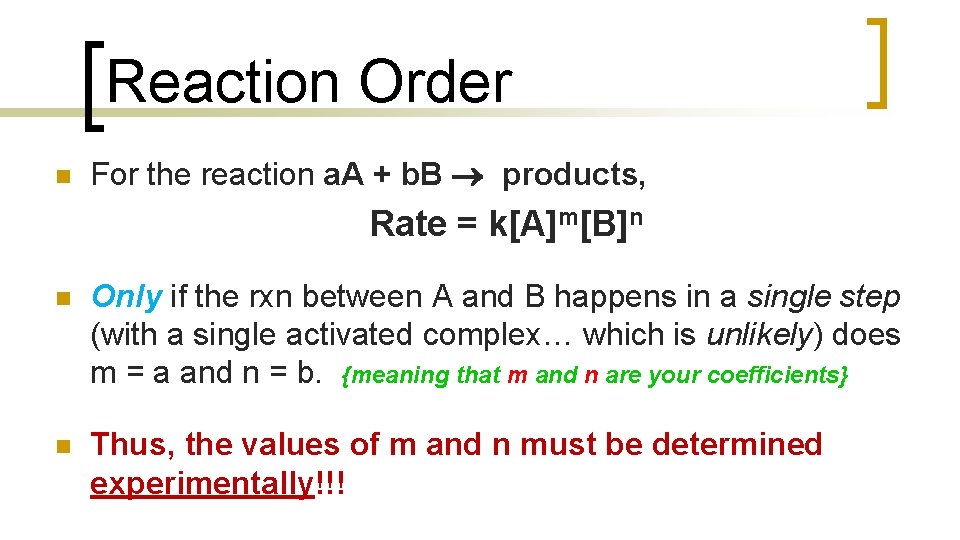
Reaction Order n For the reaction a. A + b. B products, Rate = k[A]m[B]n n Only if the rxn between A and B happens in a single step (with a single activated complex… which is unlikely) does m = a and n = b. {meaning that m and n are your coefficients} n Thus, the values of m and n must be determined experimentally!!!
Reaction Order Rate laws cannot be predicted by looking at a balanced chemical equation.
Finding the rate law n The most common method for experimentally determining the differential rate law is the method of initial rates. n In this method several experiments are run at different initial concentrations and the instantaneous rates are determined for each at the same value of time (as near t = 0 as possible)
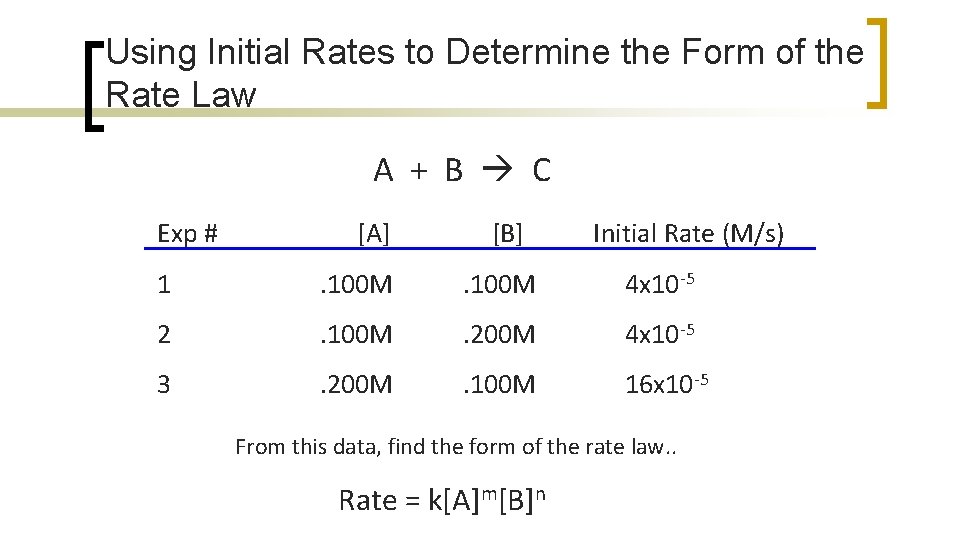
Using Initial Rates to Determine the Form of the Rate Law A + B C Exp # [A] [B] Initial Rate (M/s) 1 . 100 M 4 x 10 -5 2 . 100 M . 200 M 4 x 10 -5 3 . 200 M . 100 M 16 x 10 -5 From this data, find the form of the rate law. . Rate = k[A]m[B]n
![Exp # [A] [B] Initial Rate (M/s) 1 . 100 M 4 x 10](http://slidetodoc.com/presentation_image_h2/6c6848defd7f0fd0805f2c7551b8dd12/image-14.jpg "Exp # [A] [B] Initial Rate (M/s) 1 . 100 M 4 x 10")
Exp # [A] [B] Initial Rate (M/s) 1 . 100 M 4 x 10 -5 2 . 100 M . 200 M 4 x 10 -5 3 . 200 M . 100 M 16 x 10 -5 Rate = k[A]m[B]n = = n = ___
![Exp # [A] [B] Initial Rate (M/s) 1 . 100 M 4 x 10](http://slidetodoc.com/presentation_image_h2/6c6848defd7f0fd0805f2c7551b8dd12/image-15.jpg "Exp # [A] [B] Initial Rate (M/s) 1 . 100 M 4 x 10")
Exp # [A] [B] Initial Rate (M/s) 1 . 100 M 4 x 10 -5 2 . 100 M . 200 M 4 x 10 -5 3 . 200 M . 100 M 16 x 10 -5 Rate = k[A]m[B]n = = m = ___
![Exp # [A] [B] Initial Rate (M/s) 1 . 100 M 4 x 10](http://slidetodoc.com/presentation_image_h2/6c6848defd7f0fd0805f2c7551b8dd12/image-16.jpg "Exp # [A] [B] Initial Rate (M/s) 1 . 100 M 4 x 10")
Exp # [A] [B] Initial Rate (M/s) 1 . 100 M 4 x 10 -5 2 . 100 M . 200 M 4 x 10 -5 3 . 200 M . 100 M 16 x 10 -5 Rate = k[A]m[B]n Rate = ______ Rate = _____
![Exp # [A] [B] Initial Rate (M/s) 1 . 100 M 4 x 10](http://slidetodoc.com/presentation_image_h2/6c6848defd7f0fd0805f2c7551b8dd12/image-17.jpg "Exp # [A] [B] Initial Rate (M/s) 1 . 100 M 4 x 10")
Exp # [A] [B] Initial Rate (M/s) 1 . 100 M 4 x 10 -5 2 . 100 M . 200 M 4 x 10 -5 3 . 200 M . 100 M 16 x 10 -5 Now, solve for k…using you new rate law Units of k? ? ? rate =
Deriving a rate expression by inspection of data! n While being so thorough is nice, you will have very limited time on your exams, so instead of showing all that work you may wish to solve by inspection and justify your answer in words…
Think about this… n n n If a reaction is 1 st order with respect to a reactant (11=1), then the effect of doubling that reactant conc. (while holding the other constant) is a doubling (21=2) of the rate. Tripling the reactant conc. will triple (31=3) the rate and so on. If a reaction is 2 nd order with respect to a reactant (12=1), then the effect of doubling that reactant conc. is a quadrupling of the rate (22=4). Tripling the reactant conc. will cause the rate to become 9 times faster (32=9) and so on. Note: If a reaction is zero order w/ respect to a reactant (10=1), then changing its concentration will have no effect on the rate of reaction. (20=1; 30=1, etc. , so the rate will remain unchanged even if reactant concentration changes).
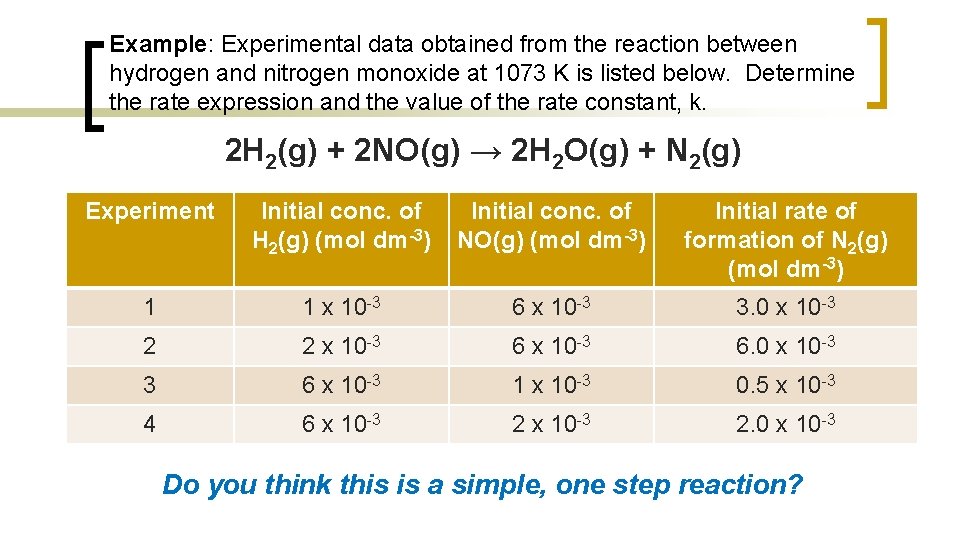
Example: Experimental data obtained from the reaction between hydrogen and nitrogen monoxide at 1073 K is listed below. Determine the rate expression and the value of the rate constant, k. 2 H 2(g) + 2 NO(g) → 2 H 2 O(g) + N 2(g) Experiment Initial conc. of H 2(g) (mol dm-3) Initial conc. of NO(g) (mol dm-3) Initial rate of formation of N 2(g) (mol dm-3) 1 1 x 10 -3 6 x 10 -3 3. 0 x 10 -3 2 2 x 10 -3 6. 0 x 10 -3 3 6 x 10 -3 1 x 10 -3 0. 5 x 10 -3 4 6 x 10 -3 2. 0 x 10 -3 Do you think this is a simple, one step reaction?
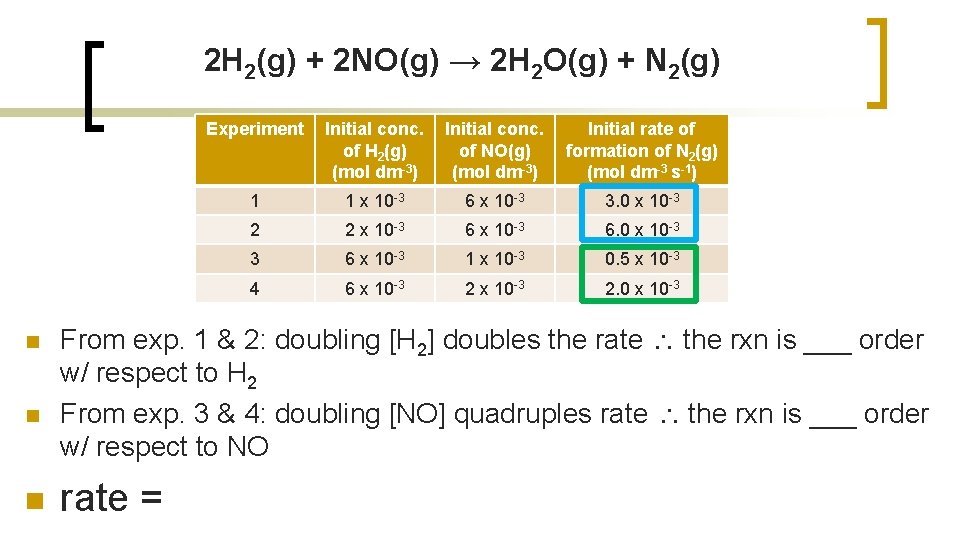
2 H 2(g) + 2 NO(g) → 2 H 2 O(g) + N 2(g) n n n Experiment Initial conc. of H 2(g) (mol dm-3) Initial conc. of NO(g) (mol dm-3) Initial rate of formation of N 2(g) (mol dm-3 s-1) 1 1 x 10 -3 6 x 10 -3 3. 0 x 10 -3 2 2 x 10 -3 6. 0 x 10 -3 3 6 x 10 -3 1 x 10 -3 0. 5 x 10 -3 4 6 x 10 -3 2. 0 x 10 -3 From exp. 1 & 2: doubling [H 2] doubles the rate the rxn is ___ order w/ respect to H 2 From exp. 3 & 4: doubling [NO] quadruples rate the rxn is ___ order w/ respect to NO rate =
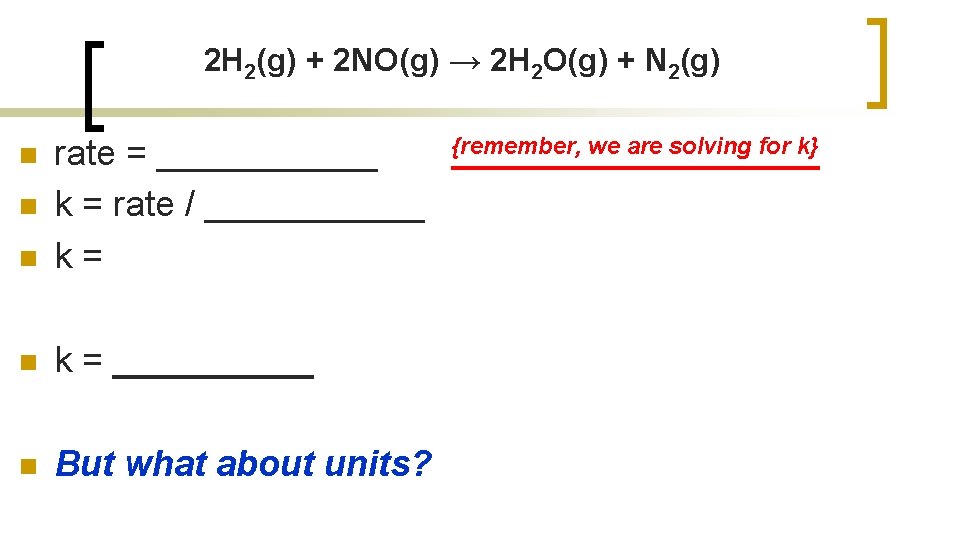
2 H 2(g) + 2 NO(g) → 2 H 2 O(g) + N 2(g) n rate = ______ k = rate / ______ k= n k = _____ n But what about units? n n {remember, we are solving for k}
2 H 2(g) + 2 NO(g) → 2 H 2 O(g) + N 2(g) n n n rate = ______ {now, do it again but with units} k = rate / ______ k= k = _____ Now bring the number and units together. k = __________
![Rate Constant k has UNITS! Zero Order Reactions rate = k[A]0 k units: M/s,](http://slidetodoc.com/presentation_image_h2/6c6848defd7f0fd0805f2c7551b8dd12/image-24.jpg "Rate Constant k has UNITS! Zero Order Reactions rate = k[A]0 k units: M/s,")
Rate Constant k has UNITS! Zero Order Reactions rate = k[A]0 k units: M/s, M/min, M/hr, etc. First Order Reactions rate = k[A] k units: s-1, min-1, hr-1, etc. Second Order Reactions rate = k[A]2 rate = k[A][B] k units: M-1 s-1, M-1 min-1, M-1 hr-1, etc. Remember that M is the same as mol dm-3.
![Rate Constant k has UNITS! Third Order Reactions rate = k[A]3 rate = k[A]2[B]](http://slidetodoc.com/presentation_image_h2/6c6848defd7f0fd0805f2c7551b8dd12/image-25.jpg "Rate Constant k has UNITS! Third Order Reactions rate = k[A]3 rate = k[A]2[B]")
Rate Constant k has UNITS! Third Order Reactions rate = k[A]3 rate = k[A]2[B] rate = k[A][B][C] k units: M-2 s-1, M-2 min-1, M-2 hr-1, etc. n Order Reactions rate = k[A]n k units: M-(n-1)s-1, etc. Remember that M is the same as mol dm-3.
![Graphical representations of reaction kinetics Zero-order reaction n rate = k[A]0 or rate =](http://slidetodoc.com/presentation_image_h2/6c6848defd7f0fd0805f2c7551b8dd12/image-26.jpg "Graphical representations of reaction kinetics Zero-order reaction n rate = k[A]0 or rate =")
Graphical representations of reaction kinetics Zero-order reaction n rate = k[A]0 or rate = k n Concentration of reactant A does not affect the rate of rxn.
![Graphical representations of reaction kinetics First-order reaction n rate = k[A] n Rate is](http://slidetodoc.com/presentation_image_h2/6c6848defd7f0fd0805f2c7551b8dd12/image-27.jpg "Graphical representations of reaction kinetics First-order reaction n rate = k[A] n Rate is")
Graphical representations of reaction kinetics First-order reaction n rate = k[A] n Rate is directly proportional to the concentration of the reactant.
![Graphical representations of reaction kinetics Second-order reaction n rate = k[A]2 or rate =](http://slidetodoc.com/presentation_image_h2/6c6848defd7f0fd0805f2c7551b8dd12/image-28.jpg "Graphical representations of reaction kinetics Second-order reaction n rate = k[A]2 or rate =")
Graphical representations of reaction kinetics Second-order reaction n rate = k[A]2 or rate = k[A]1[B]1 n Rate is exponentially proportional to the concentration of the reactant(s).
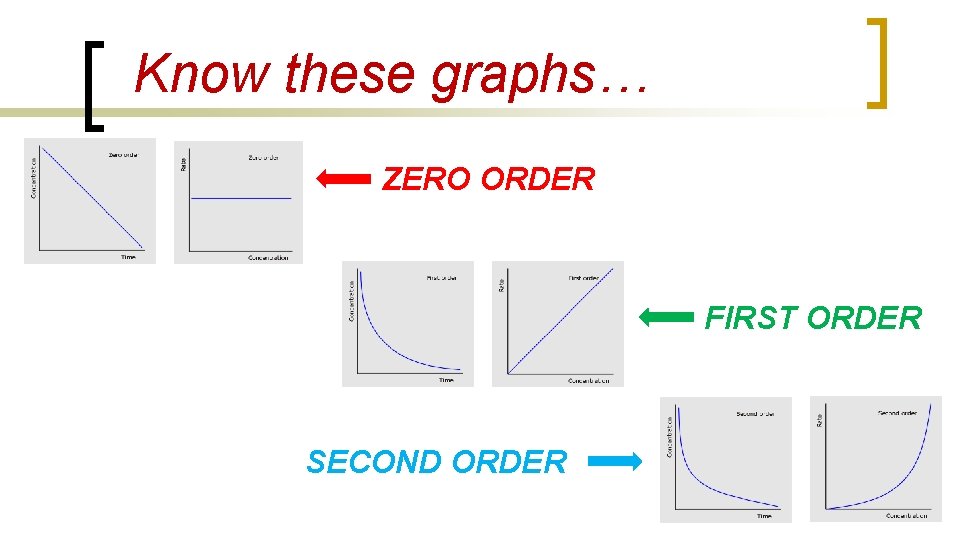
Know these graphs… ZERO ORDER FIRST ORDER SECOND ORDER
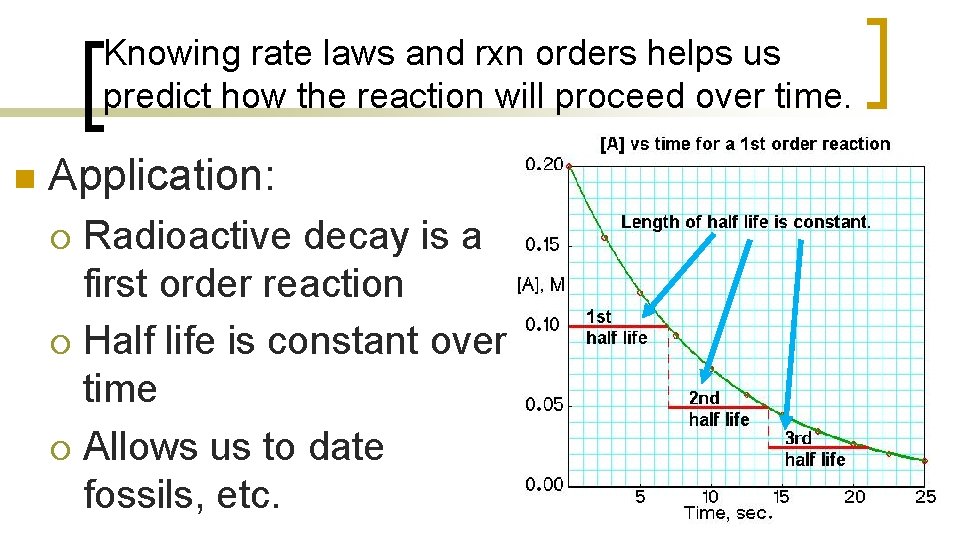
Knowing rate laws and rxn orders helps us predict how the reaction will proceed over time. n Application: Radioactive decay is a first order reaction ¡ Half life is constant over time ¡ Allows us to date fossils, etc. ¡
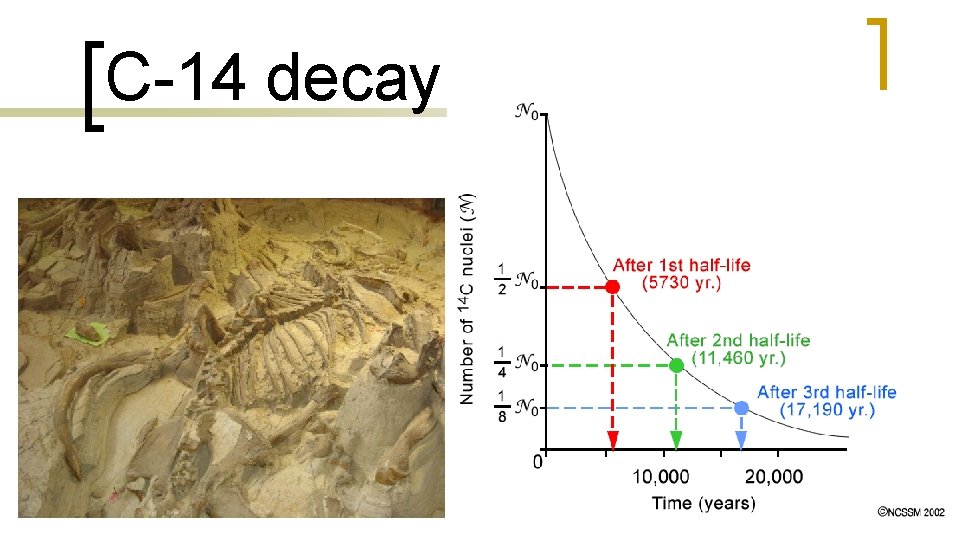
C-14 decay
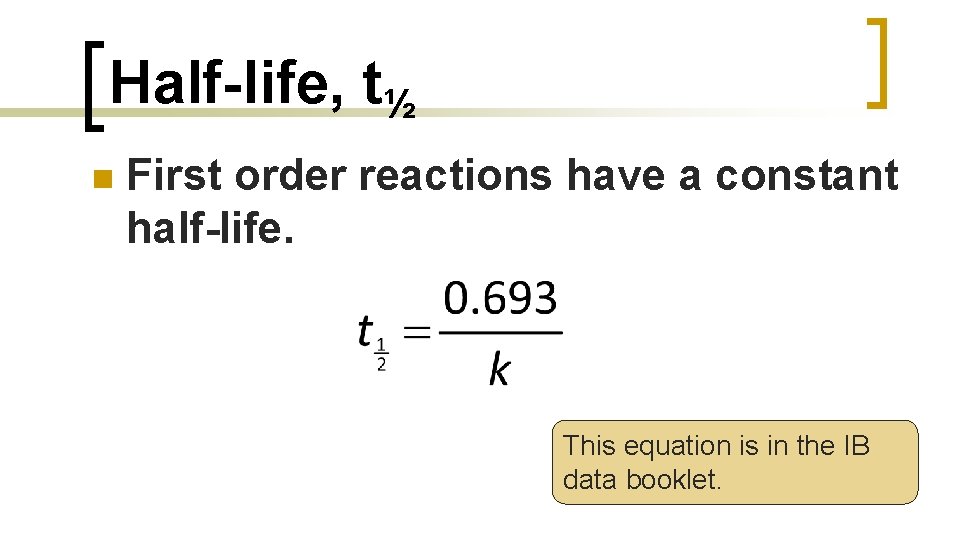
Half-life, t½ n First order reactions have a constant half-life. This equation is in the IB data booklet.
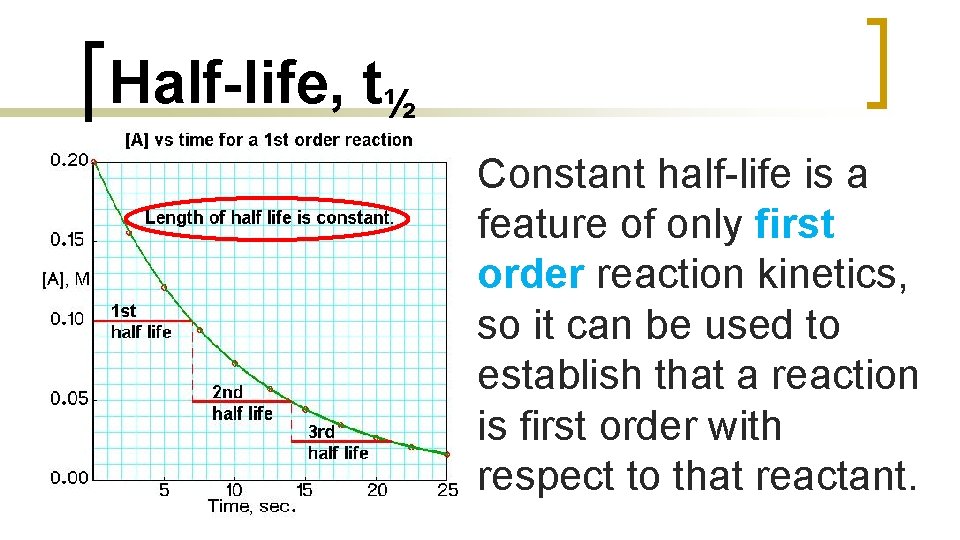
Half-life, t½ Constant half-life is a feature of only first order reaction kinetics, so it can be used to establish that a reaction is first order with respect to that reactant.
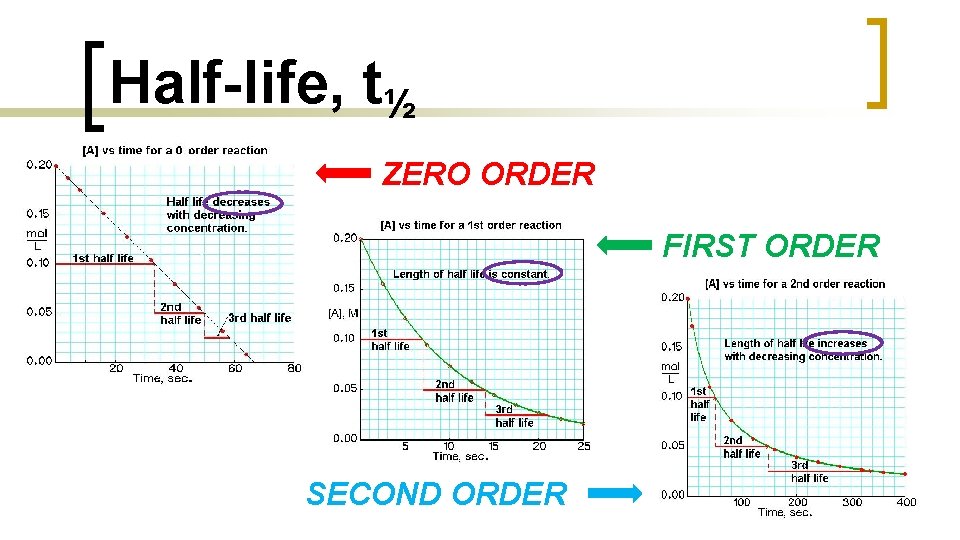
Half-life, t½ ZERO ORDER FIRST ORDER SECOND ORDER
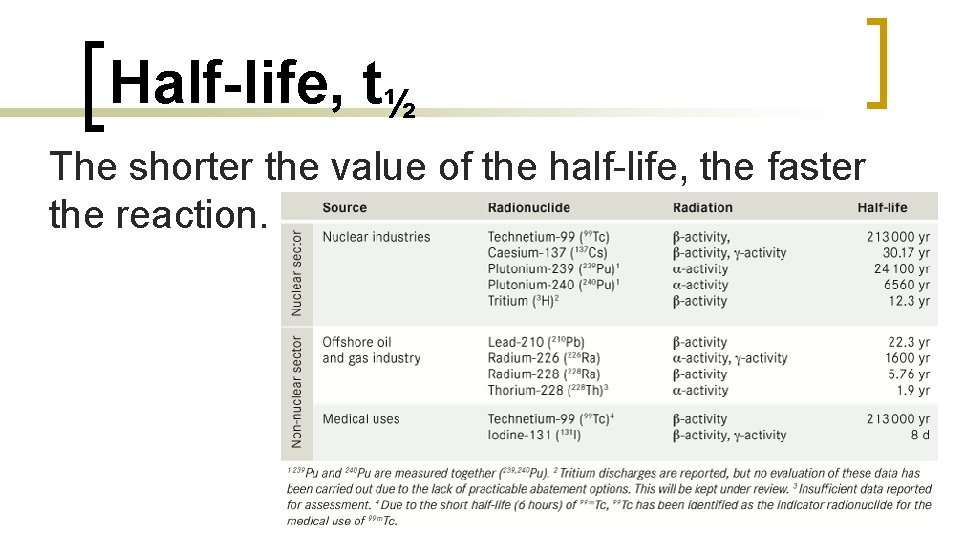
Half-life, t½ The shorter the value of the half-life, the faster the reaction.
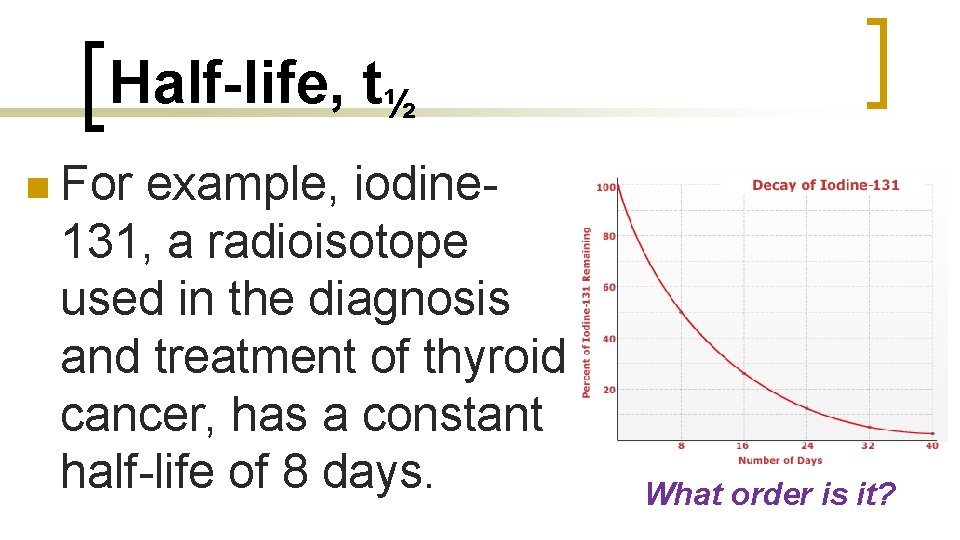
Half-life, t½ n For example, iodine 131, a radioisotope used in the diagnosis and treatment of thyroid cancer, has a constant half-life of 8 days. What order is it?
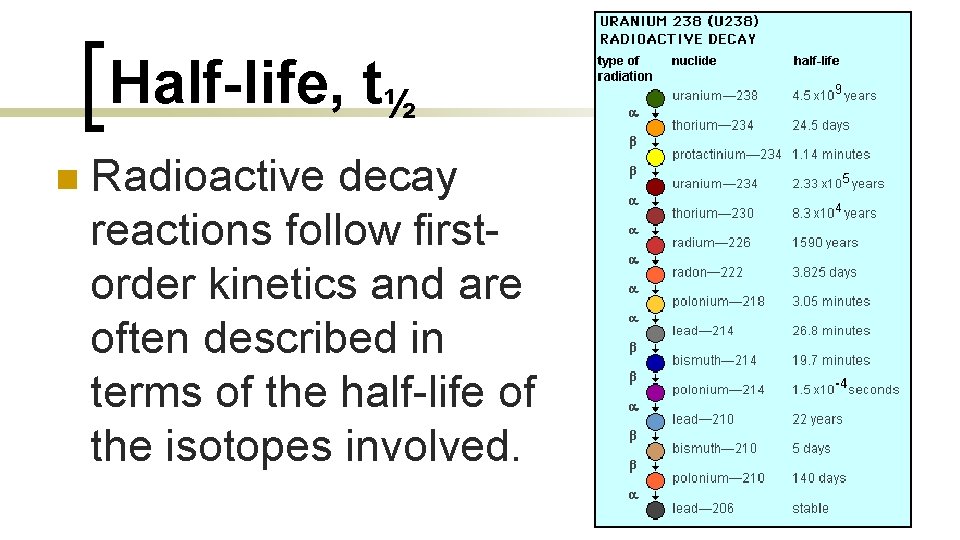
Half-life, t½ n Radioactive decay reactions follow firstorder kinetics and are often described in terms of the half-life of the isotopes involved.

- Slides: 39