
UNIT 6 GEOLOGICAL STRUCTURES GEO 281 GEOLOGY FOR
- Slides: 22
UNIT 6: GEOLOGICAL STRUCTURES GEO 281: GEOLOGY FOR ENGINEERS GEOLOGY AND GEOPHYSICS DEPARTMENT KING SAUD UNIVERSITY
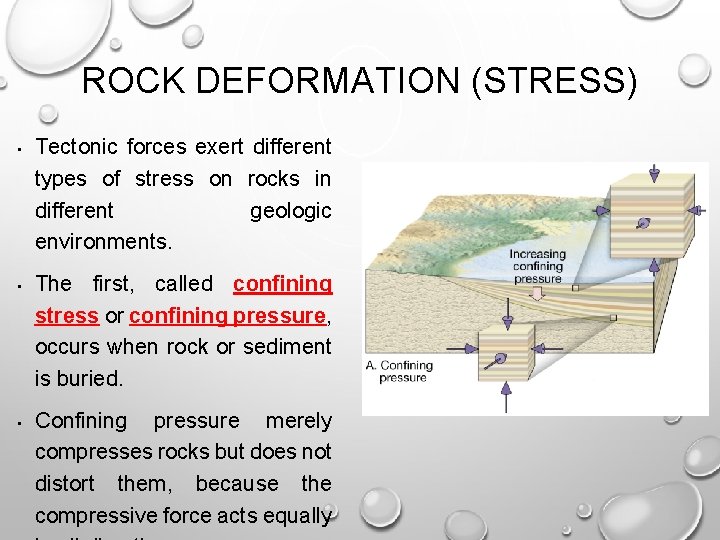
ROCK DEFORMATION (STRESS) • • • Tectonic forces exert different types of stress on rocks in different geologic environments. The first, called confining stress or confining pressure, occurs when rock or sediment is buried. Confining pressure merely compresses rocks but does not distort them, because the compressive force acts equally
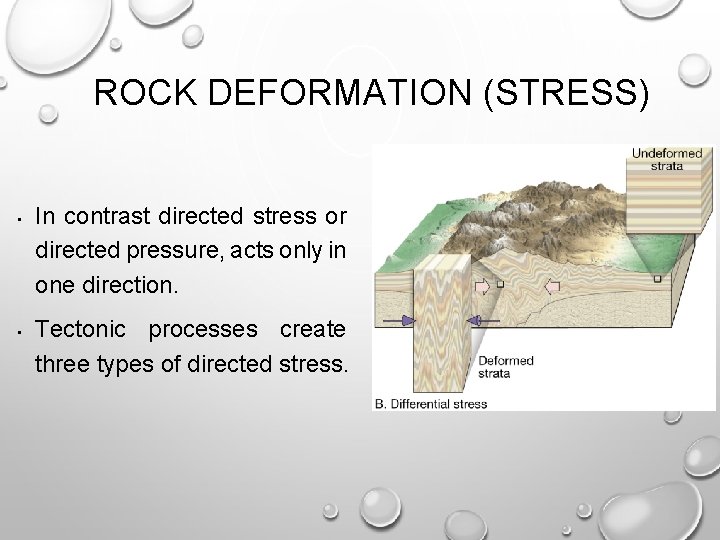
ROCK DEFORMATION (STRESS) • • In contrast directed stress or directed pressure, acts only in one direction. Tectonic processes create three types of directed stress.
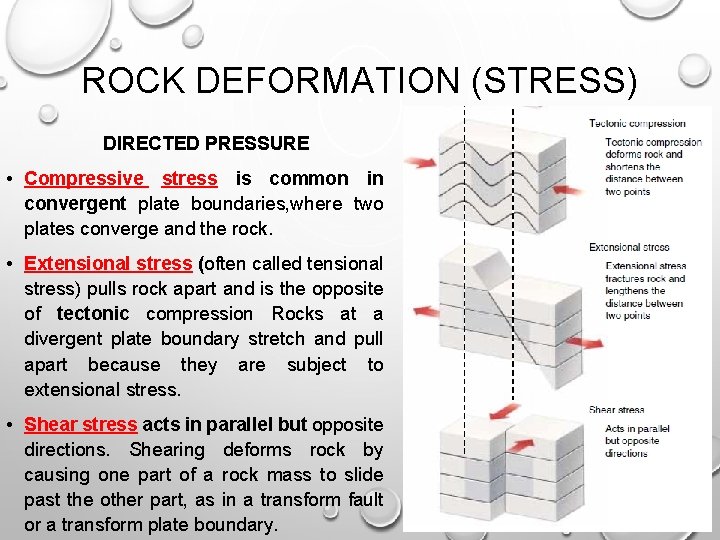
ROCK DEFORMATION (STRESS) DIRECTED PRESSURE • Compressive stress is common in convergent plate boundaries, where two plates converge and the rock. • Extensional stress (often called tensional stress) pulls rock apart and is the opposite of tectonic compression Rocks at a divergent plate boundary stretch and pull apart because they are subject to extensional stress. • Shear stress acts in parallel but opposite directions. Shearing deforms rock by causing one part of a rock mass to slide past the other part, as in a transform fault or a transform plate boundary.
ROCK DEFORMATION (STRAIN) • Strain is the deformation produced by stress. • Deformation can be of two types 1. Elastic deformation: An elastically deformed rock springs back to its original size and shape when the stress is removed. 2. Plastic deformation : During plastic deformation, a rock deforms like putty and retains its new shape. • Once the substance/rock has reached the limit of plastic deformation, it breaks or ruptures. This is known as the brittle deformation.
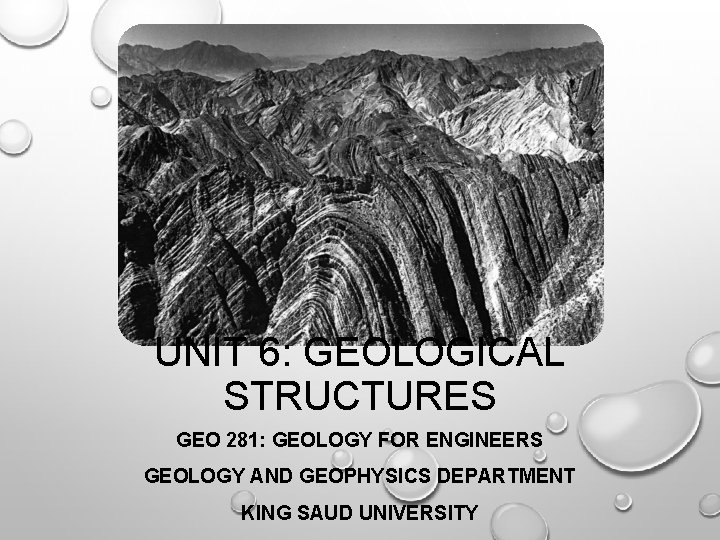
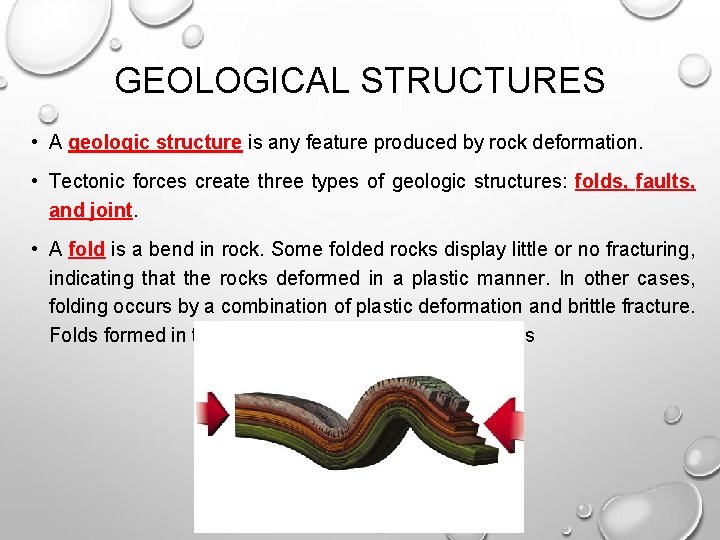
GEOLOGICAL STRUCTURES • A geologic structure is any feature produced by rock deformation. • Tectonic forces create three types of geologic structures: folds, faults, and joint. • A fold is a bend in rock. Some folded rocks display little or no fracturing, indicating that the rocks deformed in a plastic manner. In other cases, folding occurs by a combination of plastic deformation and brittle fracture. Folds formed in this manner exhibit many tiny fractures
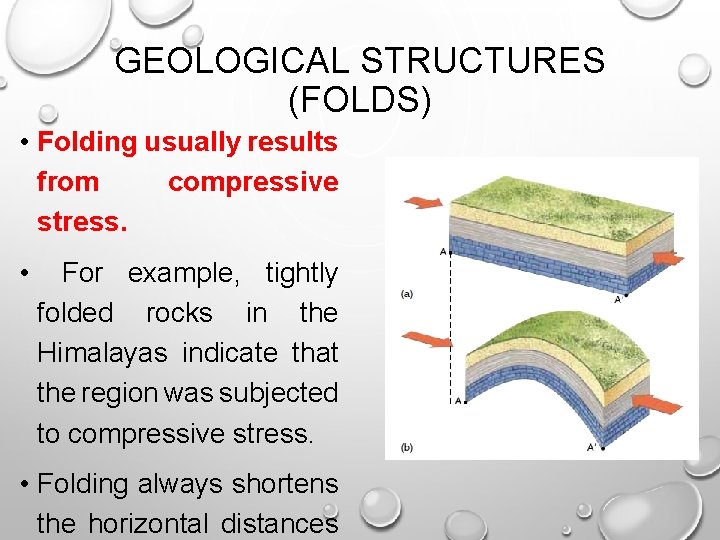
GEOLOGICAL STRUCTURES (FOLDS) • Folding usually results from compressive stress. • For example, tightly folded rocks in the Himalayas indicate that the region was subjected to compressive stress. • Folding always shortens the horizontal distances
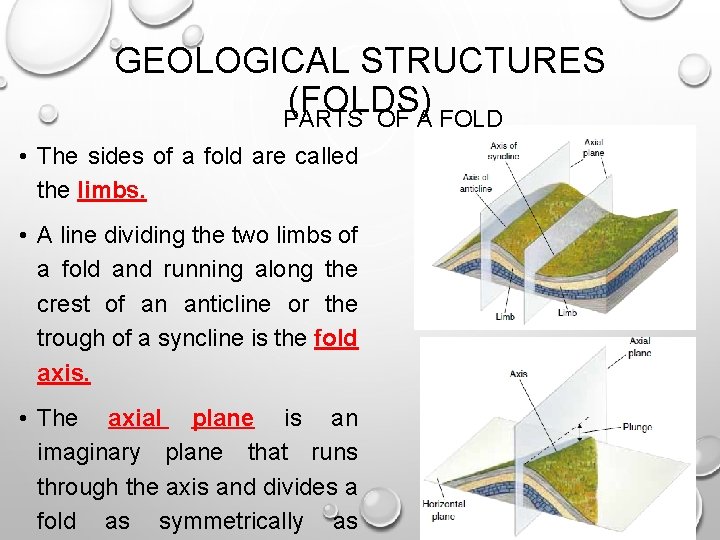
GEOLOGICAL STRUCTURES (FOLDS) PARTS OF A FOLD • The sides of a fold are called the limbs. • A line dividing the two limbs of a fold and running along the crest of an anticline or the trough of a syncline is the fold axis. • The axial plane is an imaginary plane that runs through the axis and divides a fold as symmetrically as
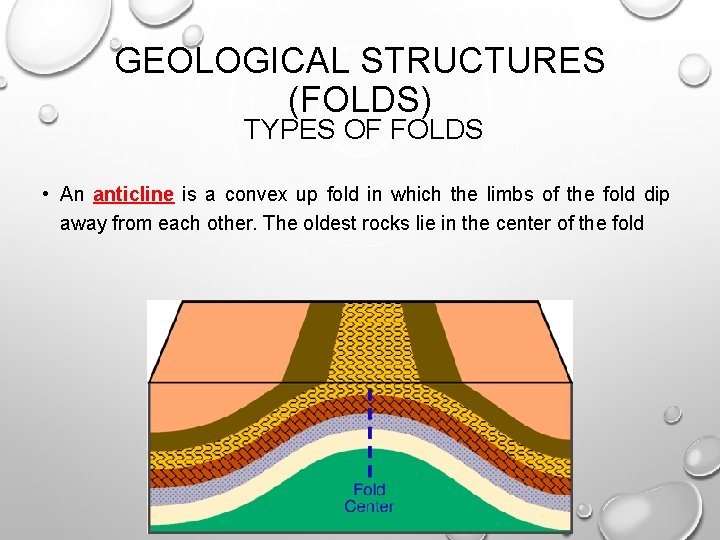
GEOLOGICAL STRUCTURES (FOLDS) TYPES OF FOLDS • An anticline is a convex up fold in which the limbs of the fold dip away from each other. The oldest rocks lie in the center of the fold
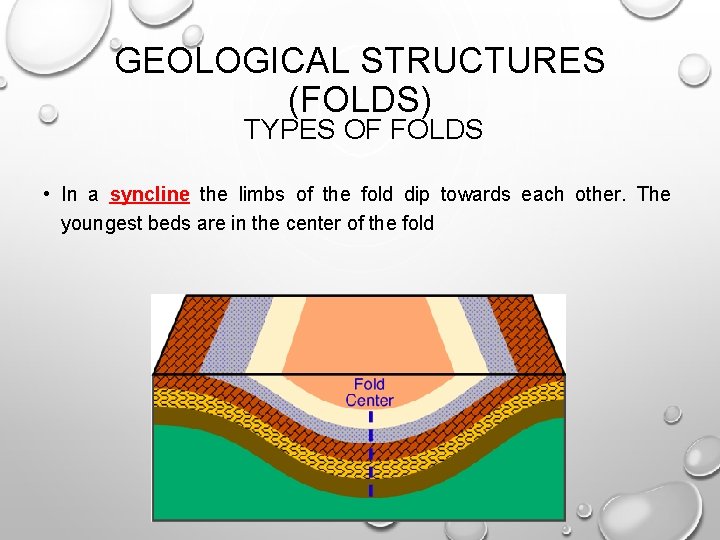
GEOLOGICAL STRUCTURES (FOLDS) TYPES OF FOLDS • In a syncline the limbs of the fold dip towards each other. The youngest beds are in the center of the fold
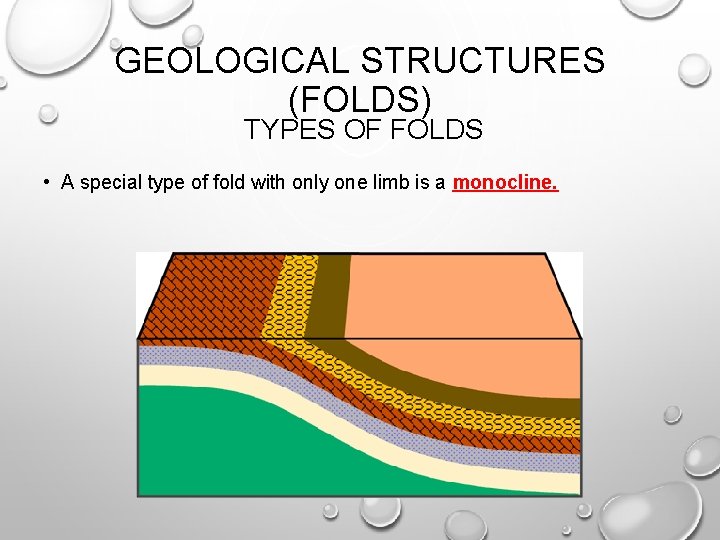
GEOLOGICAL STRUCTURES (FOLDS) TYPES OF FOLDS • A special type of fold with only one limb is a monocline.
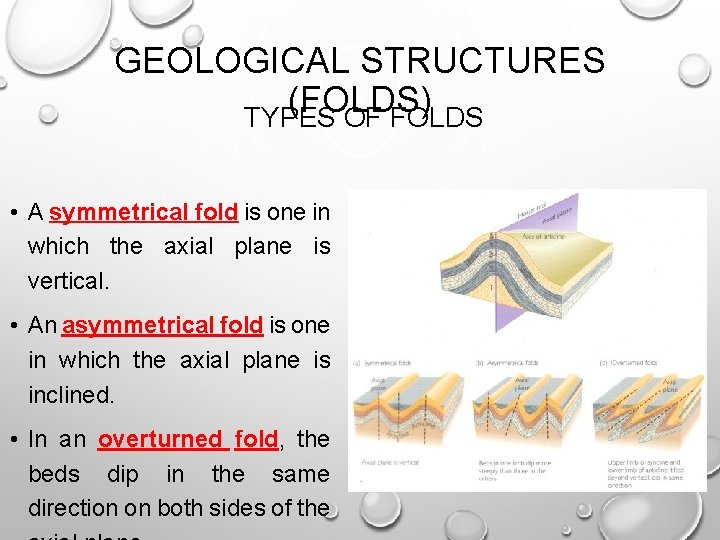
GEOLOGICAL STRUCTURES (FOLDS) TYPES OF FOLDS • A symmetrical fold is one in which the axial plane is vertical. • An asymmetrical fold is one in which the axial plane is inclined. • In an overturned fold, the beds dip in the same direction on both sides of the
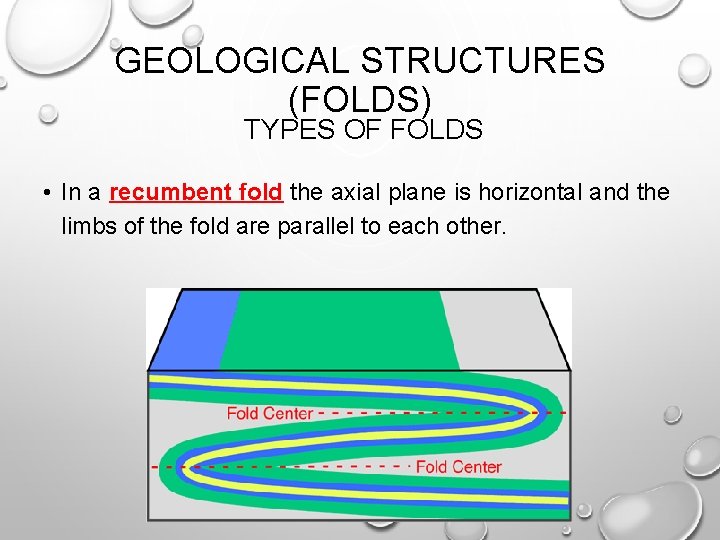
GEOLOGICAL STRUCTURES (FOLDS) TYPES OF FOLDS • In a recumbent fold the axial plane is horizontal and the limbs of the fold are parallel to each other.
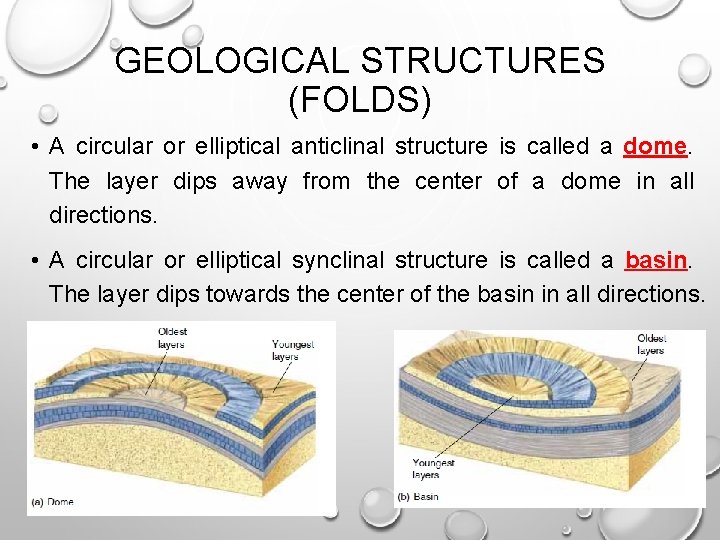
GEOLOGICAL STRUCTURES (FOLDS) • A circular or elliptical anticlinal structure is called a dome. The layer dips away from the center of a dome in all directions. • A circular or elliptical synclinal structure is called a basin. The layer dips towards the center of the basin in all directions.
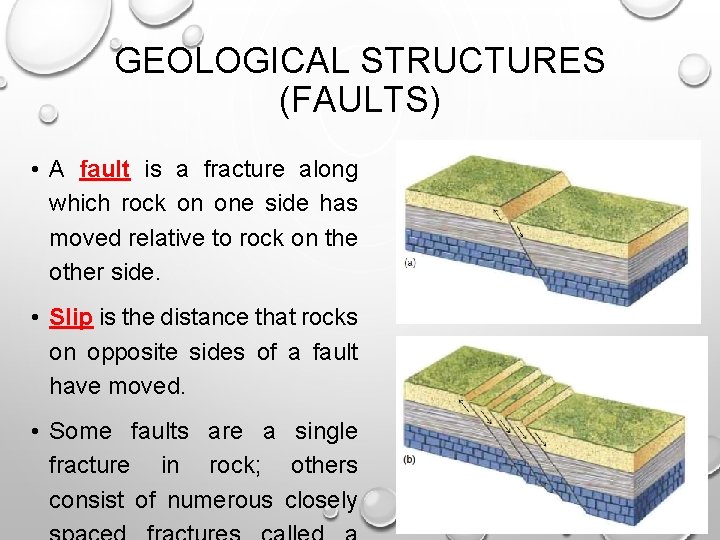
GEOLOGICAL STRUCTURES (FAULTS) • A fault is a fracture along which rock on one side has moved relative to rock on the other side. • Slip is the distance that rocks on opposite sides of a fault have moved. • Some faults are a single fracture in rock; others consist of numerous closely
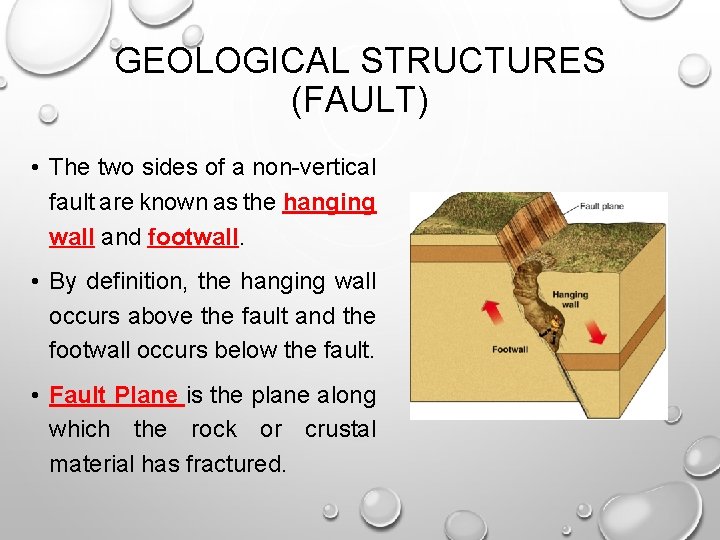
GEOLOGICAL STRUCTURES (FAULT) • The two sides of a non-vertical fault are known as the hanging wall and footwall. • By definition, the hanging wall occurs above the fault and the footwall occurs below the fault. • Fault Plane is the plane along which the rock or crustal material has fractured.
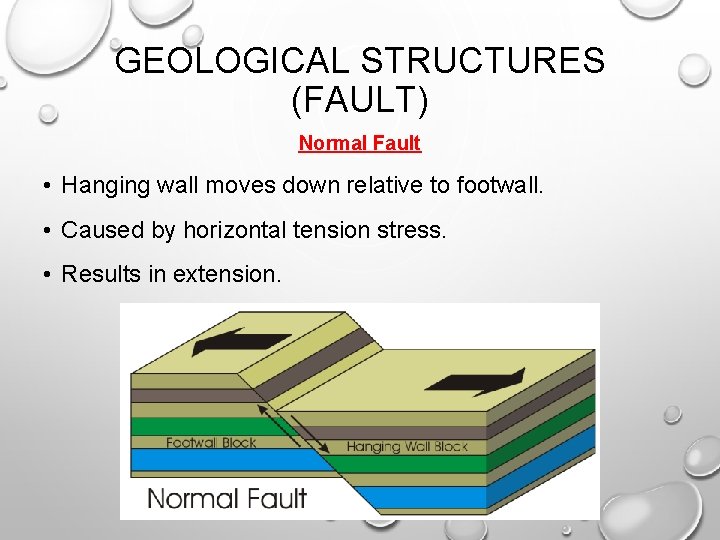
GEOLOGICAL STRUCTURES (FAULT) Normal Fault • Hanging wall moves down relative to footwall. • Caused by horizontal tension stress. • Results in extension.
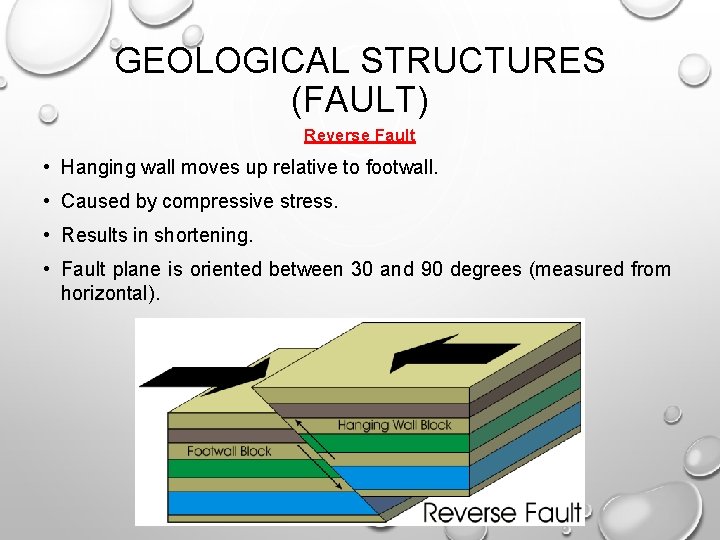
GEOLOGICAL STRUCTURES (FAULT) Reverse Fault • Hanging wall moves up relative to footwall. • Caused by compressive stress. • Results in shortening. • Fault plane is oriented between 30 and 90 degrees (measured from horizontal).
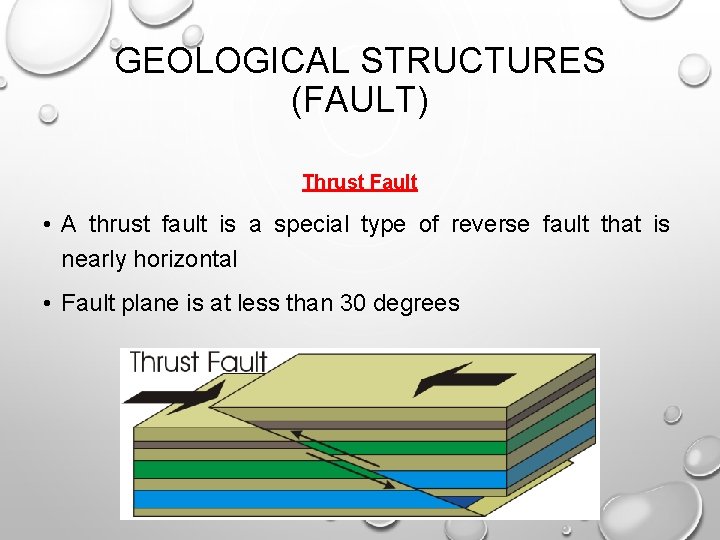
GEOLOGICAL STRUCTURES (FAULT) Thrust Fault • A thrust fault is a special type of reverse fault that is nearly horizontal • Fault plane is at less than 30 degrees
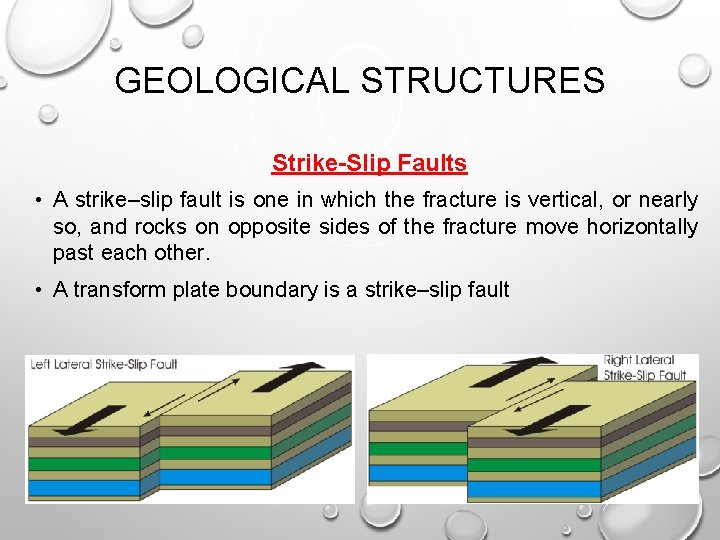
GEOLOGICAL STRUCTURES Strike-Slip Faults • A strike–slip fault is one in which the fracture is vertical, or nearly so, and rocks on opposite sides of the fracture move horizontally past each other. • A transform plate boundary is a strike–slip fault
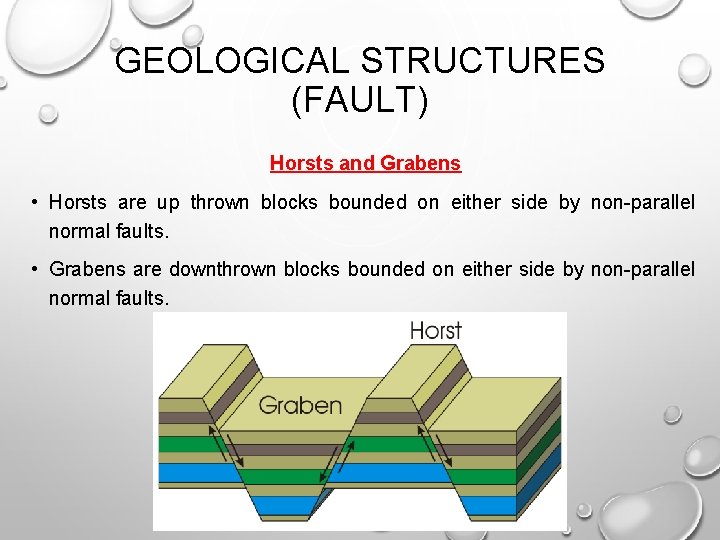
GEOLOGICAL STRUCTURES (FAULT) Horsts and Grabens • Horsts are up thrown blocks bounded on either side by non-parallel normal faults. • Grabens are downthrown blocks bounded on either side by non-parallel normal faults.
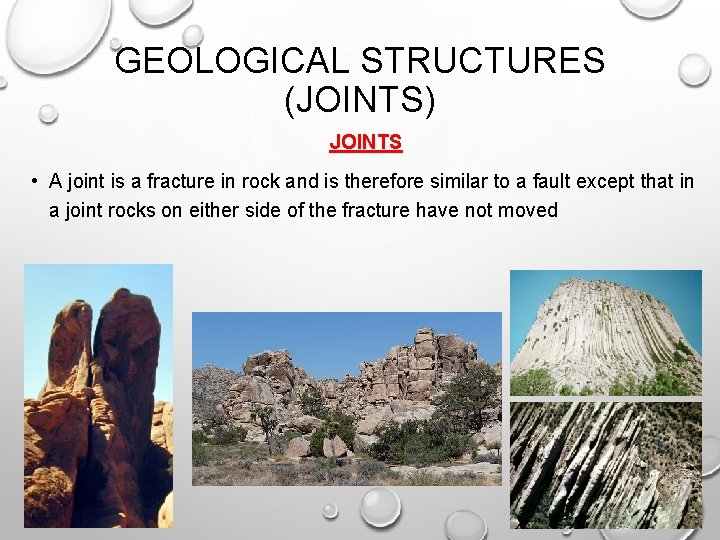
GEOLOGICAL STRUCTURES (JOINTS) JOINTS • A joint is a fracture in rock and is therefore similar to a fault except that in a joint rocks on either side of the fracture have not moved