
UNIT 6 FOSSILS EVOLUTION cast fossils formed when


- Slides: 36
UNIT 6 FOSSILS+ EVOLUTION
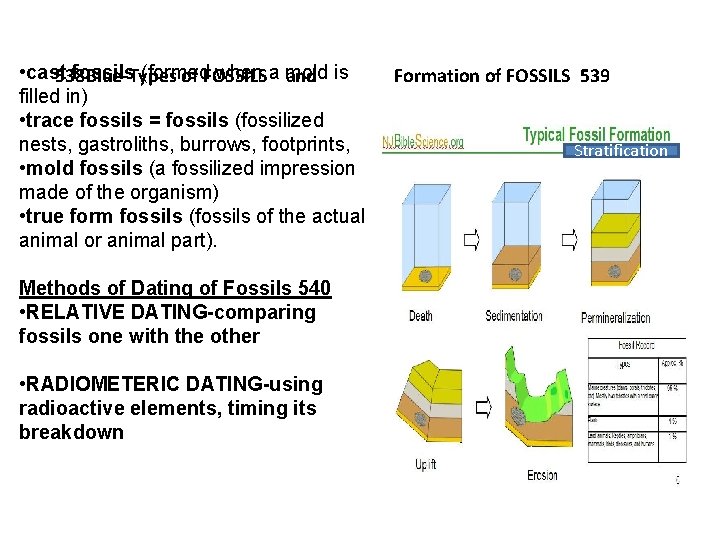
• cast fossils (formed when a mold 538 Blue-Types of FOSSILS and is filled in) • trace fossils = fossils (fossilized nests, gastroliths, burrows, footprints, • mold fossils (a fossilized impression made of the organism) • true form fossils (fossils of the actual animal or animal part). Methods of Dating of Fossils 540 • RELATIVE DATING-comparing fossils one with the other • RADIOMETERIC DATING-using radioactive elements, timing its breakdown Formation of FOSSILS 539 Stratification
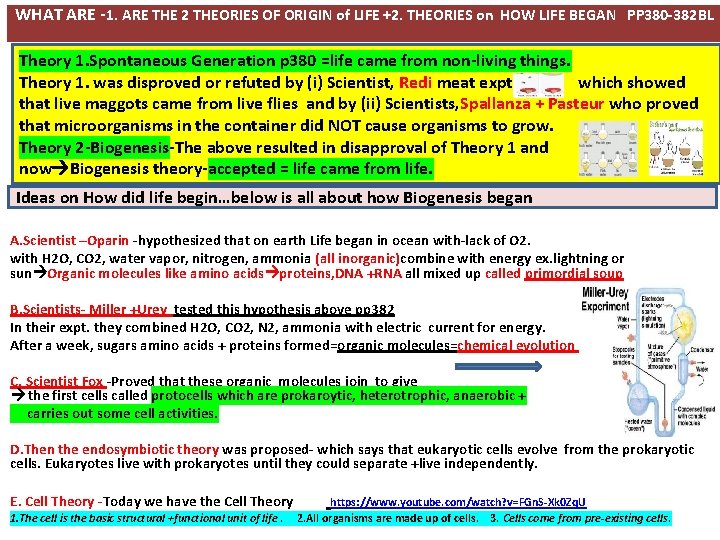
WHAT ARE -1. ARE THE 2 THEORIES OF ORIGIN of LIFE +2. THEORIES on HOW LIFE BEGAN PP 380 -382 BL Theory 1. Spontaneous Generation p 380 =life came from non-living things. Theory 1. was disproved or refuted by (i) Scientist, Redi meat expt. which showed that live maggots came from live flies and by (ii) Scientists, Spallanza + Pasteur who proved that microorganisms in the container did NOT cause organisms to grow. Theory 2 -Biogenesis-The above resulted in disapproval of Theory 1 and now Biogenesis theory-accepted = life came from life. Ideas on How did life begin…below is all about how Biogenesis began A. Scientist –Oparin -hypothesized that on earth Life began in ocean with-lack of O 2. with H 2 O, CO 2, water vapor, nitrogen, ammonia (all inorganic)combine with energy ex. lightning or sun Organic molecules like amino acids proteins, DNA +RNA all mixed up called primordial soup B. Scientists- Miller +Urey tested this hypothesis above pp 382 In their expt. they combined H 2 O, CO 2, N 2, ammonia with electric current for energy. After a week, sugars amino acids + proteins formed=organic molecules=chemical evolution C. Scientist Fox -Proved that these organic molecules join to give the first cells called protocells which are prokaroytic, heterotrophic, anaerobic + carries out some cell activities. D. Then the endosymbiotic theory was proposed- which says that eukaryotic cells evolve from the prokaryotic cells. Eukaryotes live with prokaryotes until they could separate +live independently. E. Cell Theory -Today we have the Cell Theory 1. The cell is the basic structural +functional unit of life. https: //www. youtube. com/watch? v=FGn. S-Xk 0 Zq. U 2. All organisms are made up of cells. 3. Cells come from pre-existing cells.
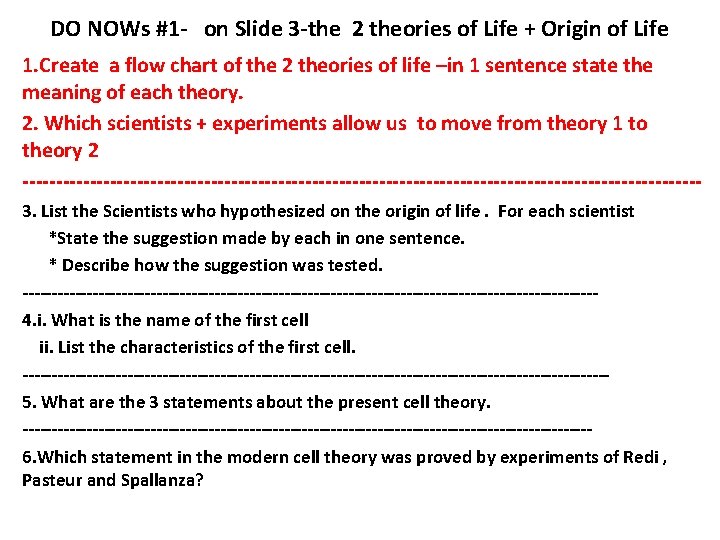
DO NOWs #1 - on Slide 3 -the 2 theories of Life + Origin of Life 1. Create a flow chart of the 2 theories of life –in 1 sentence state the meaning of each theory. 2. Which scientists + experiments allow us to move from theory 1 to theory 2 --------------------------------------------------3. List the Scientists who hypothesized on the origin of life. For each scientist *State the suggestion made by each in one sentence. * Describe how the suggestion was tested. -------------------------------------------------4. i. What is the name of the first cell ii. List the characteristics of the first cell. --------------------------------------------------5. What are the 3 statements about the present cell theory. -------------------------------------------------6. Which statement in the modern cell theory was proved by experiments of Redi , Pasteur and Spallanza?
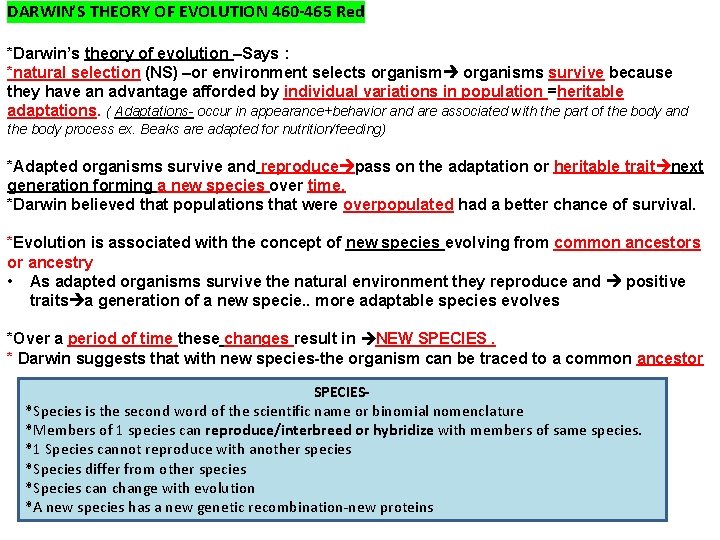
DARWIN’S THEORY OF EVOLUTION 460 -465 Red *Darwin’s theory of evolution –Says : *natural selection (NS) –or environment selects organisms survive because they have an advantage afforded by individual variations in population =heritable adaptations. ( Adaptations- occur in appearance+behavior and are associated with the part of the body and the body process ex. Beaks are adapted for nutrition/feeding) *Adapted organisms survive and reproduce pass on the adaptation or heritable trait next generation forming a new species over time. *Darwin believed that populations that were overpopulated had a better chance of survival. *Evolution is associated with the concept of new species evolving from common ancestors or ancestry • As adapted organisms survive the natural environment they reproduce and positive traits a generation of a new specie. . more adaptable species evolves *Over a period of time these changes result in NEW SPECIES. * Darwin suggests that with new species-the organism can be traced to a common ancestor SPECIES*Species is the second word of the scientific name or binomial nomenclature *Members of 1 species can reproduce/interbreed or hybridize with members of same species. *1 Species cannot reproduce with another species *Species differ from other species *Species can change with evolution *A new species has a new genetic recombination-new proteins
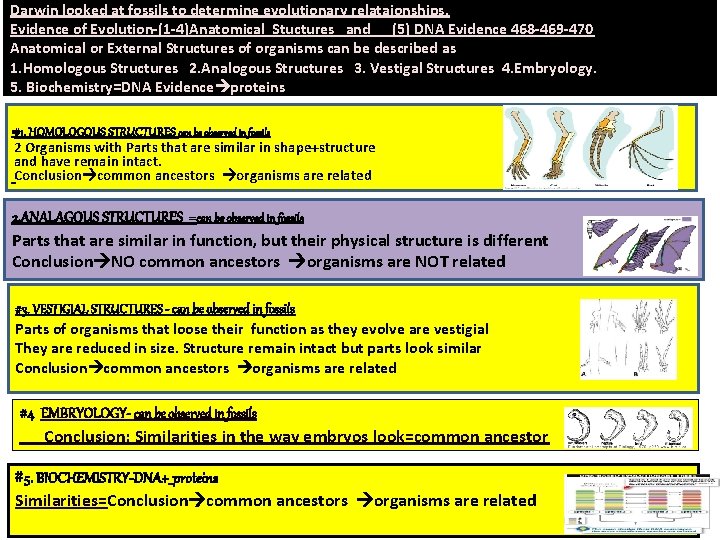
Darwin looked at fossils to determine evolutionary relataionships. Evidence of Evolution-(1 -4)Anatomical Stuctures and (5) DNA Evidence 468 -469 -470 Anatomical or External Structures of organisms can be described as 1. Homologous Structures 2. Analogous Structures 3. Vestigal Structures 4. Embryology. 5. Biochemistry=DNA Evidence proteins =#1. HOMOLOGOUS STRUCTURES can be observed in fossils 2 Organisms with Parts that are similar in shape+structure and have remain intact. Conclusion common ancestors organisms are related 2. ANALAGOUS STRUCTURES =can be observed in fossils Parts that are similar in function, but their physical structure is different Conclusion NO common ancestors organisms are NOT related #3. VESTIGIAL STRUCTURES - can be observed in fossils Parts of organisms that loose their function as they evolve are vestigial They are reduced in size. Structure remain intact but parts look similar Conclusion common ancestors organisms are related #4 EMBRYOLOGY- can be observed in fossils Conclusion: Similarities in the way embryos look=common ancestor #5. BIOCHEMISTRY-DNA+ proteins Similarities=Conclusion common ancestors organisms are related
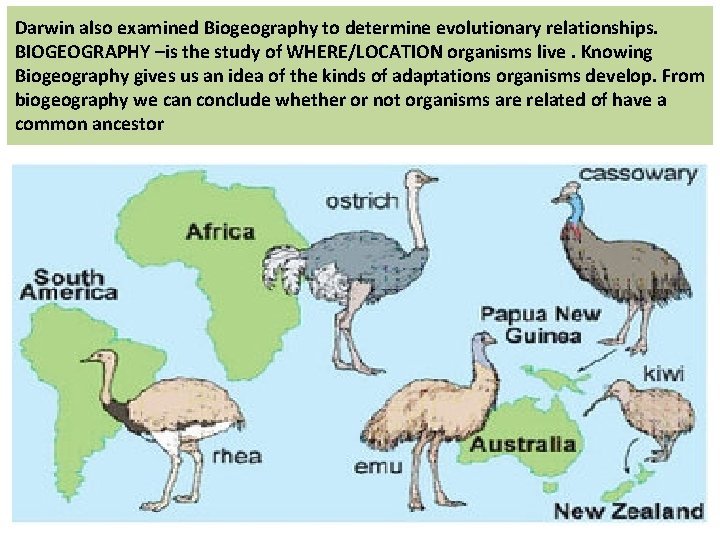
Darwin also examined Biogeography to determine evolutionary relationships. BIOGEOGRAPHY –is the study of WHERE/LOCATION organisms live. Knowing Biogeography gives us an idea of the kinds of adaptations organisms develop. From biogeography we can conclude whether or not organisms are related of have a common ancestor
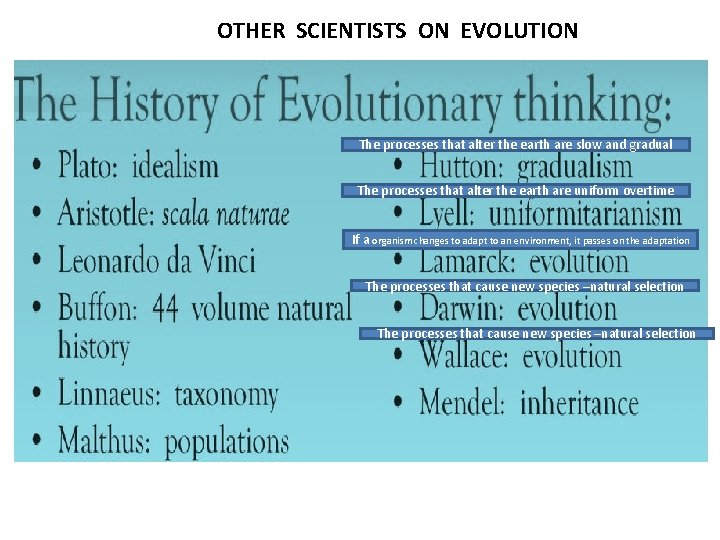
OTHER SCIENTISTS ON EVOLUTION The processes that alter the earth are slow and gradual The processes that alter the earth are uniform overtime If a organism changes to adapt to an environment, it passes on the adaptation The processes that cause new species –natural selection
DO NOW #2 -Slide 6 + slide 5 +7 +8 1. List the Words and its meaning in 1 sentence that can cause a Scientist to conclude that species or organisms are related. Sl. 6 2. List the words and its meaning in 1 sentence that can cause a Scientist to conclude that species or organisms are NOT related Sl. 6 3. What does the term “common ancestor” mean? Sl. 6 4. 5. Write 5 important facts connected to “species” Slide 5 5. Slide 6 -List at least 10 words connected to Darwin’s concepts of evolution. Sl. 5 6. List the 3 main scientists who believe din evolution. 7. MC 1 -20
Do Nows #2 -Slide 5 +6+7 +8 Do Nows #2 -Slides 5, 6, 7, 8 1. List the Words and its meaning in 1 sentence that can cause a Scientist to conclude that species or organisms are related. Sl. 6 2. List the words and its meaning in 1 sentence that can cause a Scientist to conclude that species or organisms are NOT related Sl. 6 3. What does the term “common ancestor” mean? Sl. 6 4. 5. Write 5 important facts connected to “species” Slide 5 5. Slide 6 -List at least 10 words connected to Darwin’s concepts of evolution. Sl. 5 6. List the 3 main scientists who believe din evolution. Sl. 8 7. MC 1 -20 --------------------------------------------------------------------------------------------------------------------------------------------------------------------------------Do Nows #2 -Slides 5, 6, 7, 8 1. List the Words and its meaning in 1 sentence that can cause a Scientist to conclude that species or organisms are related. Sl. 6 2. List the words and its meaning in 1 sentence that can cause a Scientist to conclude that species or organisms are NOT related Sl. 6 3. What does the term “common ancestor” mean? Sl. 6 4. 5. Write 5 important facts connected to “species” Slide 5 5. Slide 6 -List at least 10 words connected to Darwin’s concepts of evolution. Sl. 5 6. List the 3 main scientists who believe din evolution. Sl. 8 7. MC 1 -20
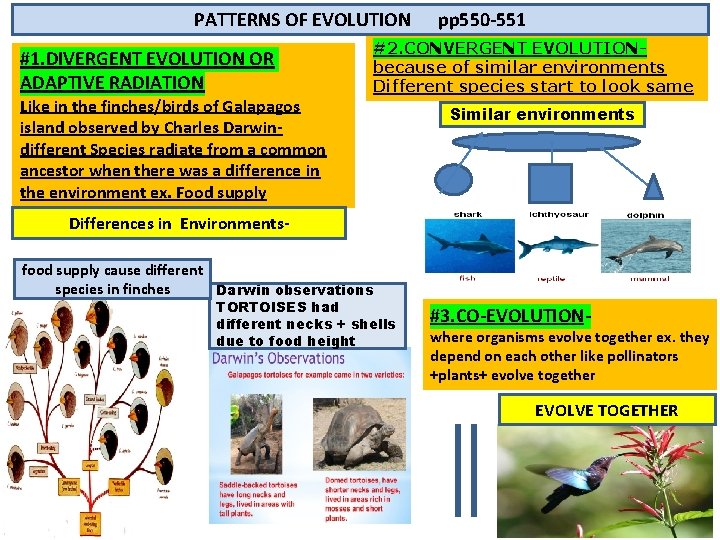
PATTERNS OF EVOLUTION #1. DIVERGENT EVOLUTION OR ADAPTIVE RADIATION Like in the finches/birds of Galapagos island observed by Charles Darwindifferent Species radiate from a common ancestor when there was a difference in the environment ex. Food supply pp 550 -551 #2. CONVERGENT EVOLUTIONbecause of similar environments Different species start to look same Similar environments Differences in Environmentsfood supply cause different species in finches Darwin observations TORTOISES had different necks + shells due to food height #3. CO-EVOLUTION- where organisms evolve together ex. they depend on each other like pollinators +plants+ evolve together EVOLVE TOGETHER
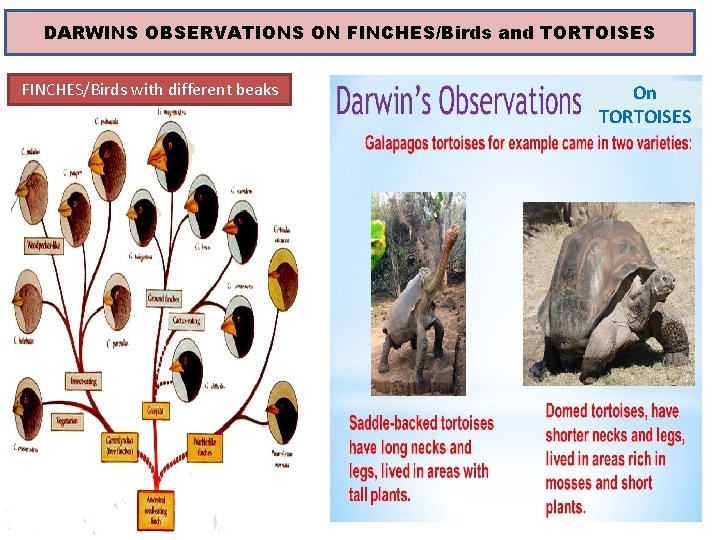
DARWINS OBSERVATIONS ON FINCHES/Birds and TORTOISES FINCHES/Birds with different beaks On TORTOISES
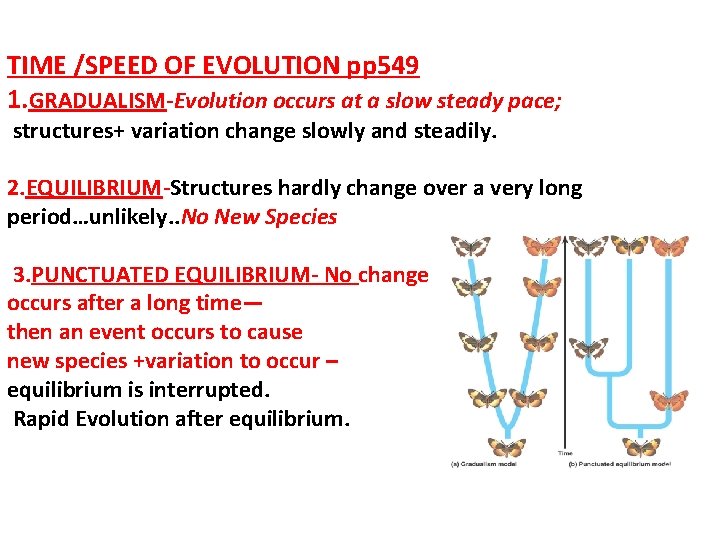
TIME /SPEED OF EVOLUTION pp 549 1. GRADUALISM-Evolution occurs at a slow steady pace; structures+ variation change slowly and steadily. 2. EQUILIBRIUM-Structures hardly change over a very long period…unlikely. . No New Species 3. PUNCTUATED EQUILIBRIUM- No change occurs after a long time— then an event occurs to cause new species +variation to occur – equilibrium is interrupted. Rapid Evolution after equilibrium.
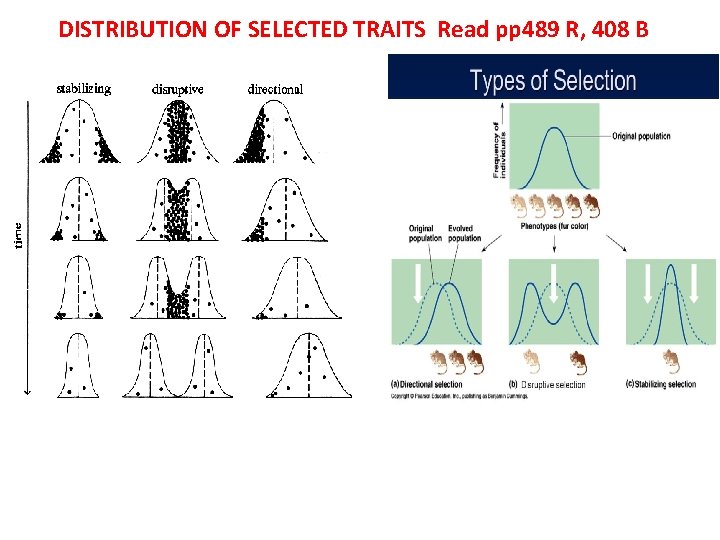
DISTRIBUTION OF SELECTED TRAITS Read pp 489 R, 408 B
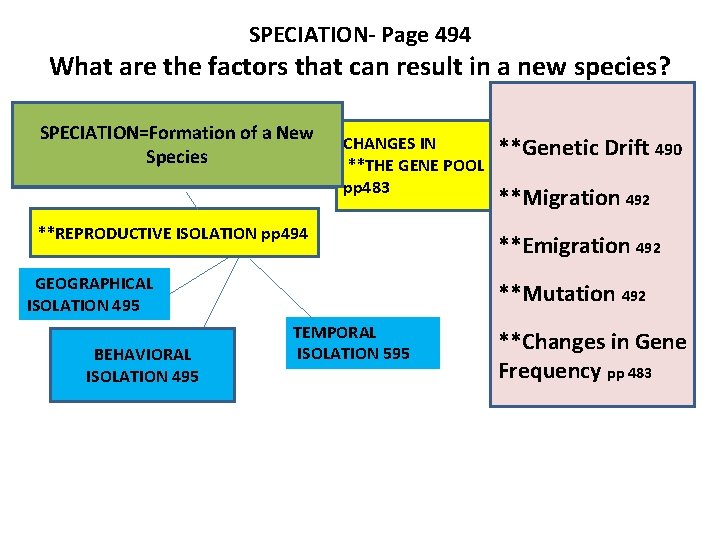
SPECIATION- Page 494 What are the factors that can result in a new species? SPECIATION=Formation of a New Species CHANGES IN **THE GENE POOL pp 483 **REPRODUCTIVE ISOLATION pp 494 GEOGRAPHICAL ISOLATION 495 BEHAVIORAL ISOLATION 495 **Genetic Drift 490 **Migration 492 **Emigration 492 **Mutation 492 TEMPORAL ISOLATION 595 **Changes in Gene Frequency pp 483
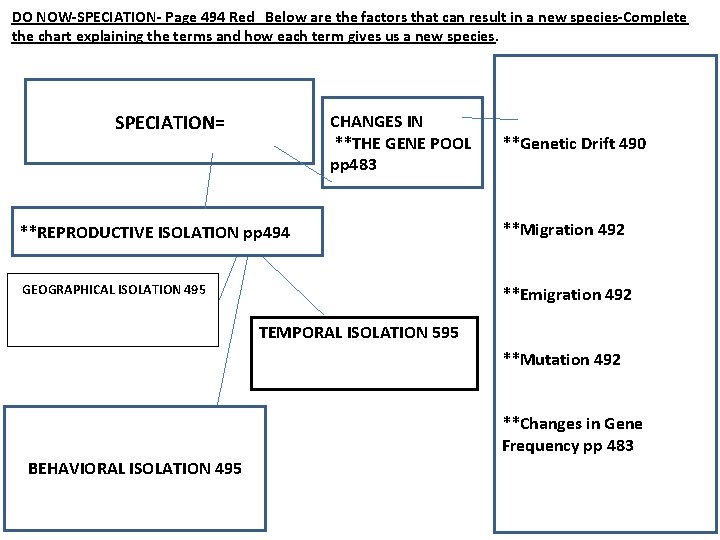
DO NOW-SPECIATION- Page 494 Red Below are the factors that can result in a new species-Complete the chart explaining the terms and how each term gives us a new species. SPECIATION= CHANGES IN **THE GENE POOL pp 483 **Genetic Drift 490 **REPRODUCTIVE ISOLATION pp 494 **Migration 492 GEOGRAPHICAL ISOLATION 495 **Emigration 492 TEMPORAL ISOLATION 595 **Mutation 492 **Changes in Gene Frequency pp 483 BEHAVIORAL ISOLATION 495
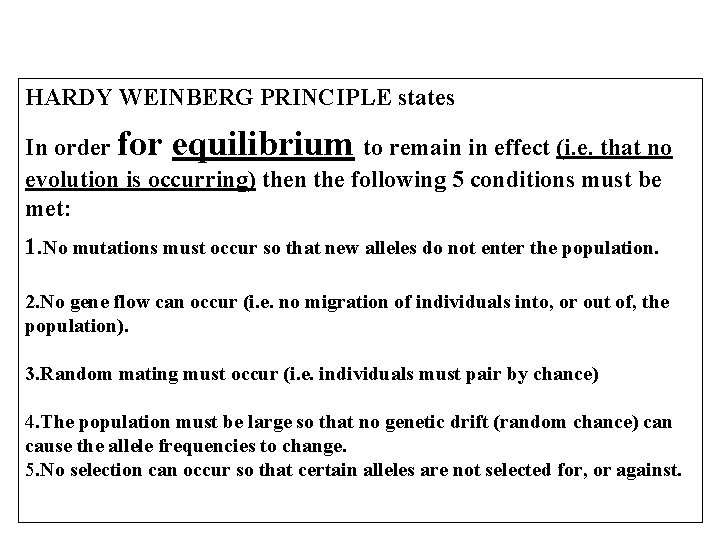
HARDY WEINBERG PRINCIPLE states In order for equilibrium to remain in effect (i. e. that no evolution is occurring) then the following 5 conditions must be met: 1. No mutations must occur so that new alleles do not enter the population. 2. No gene flow can occur (i. e. no migration of individuals into, or out of, the population). 3. Random mating must occur (i. e. individuals must pair by chance) 4. The population must be large so that no genetic drift (random chance) can cause the allele frequencies to change. 5. No selection can occur so that certain alleles are not selected for, or against.
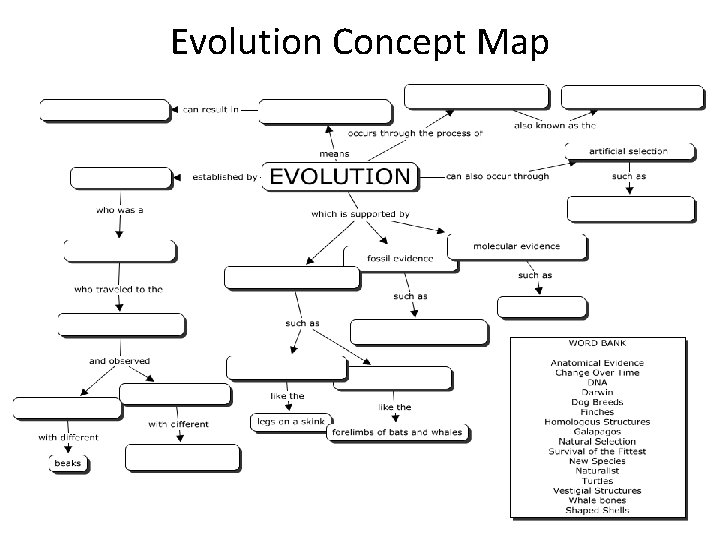
Evolution Concept Map
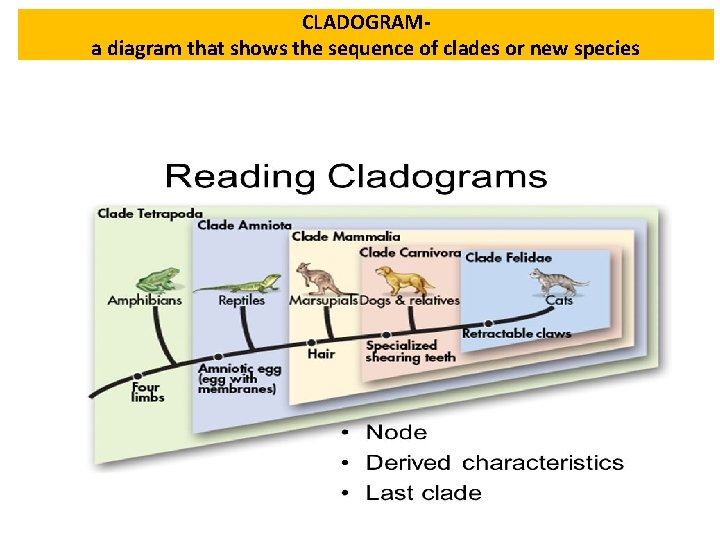
CLADOGRAMa diagram that shows the sequence of clades or new species
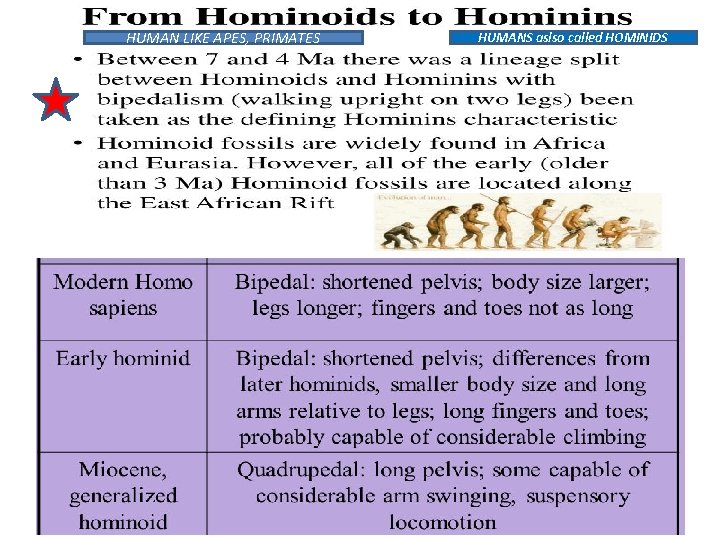
* HOMINOIDS to HOMININ/HUMAN EVOLUTION * PRIMATE EVOLUTION
HUMAN LIKE APES, PRIMATES HUMANS aslso called HOMINIDS
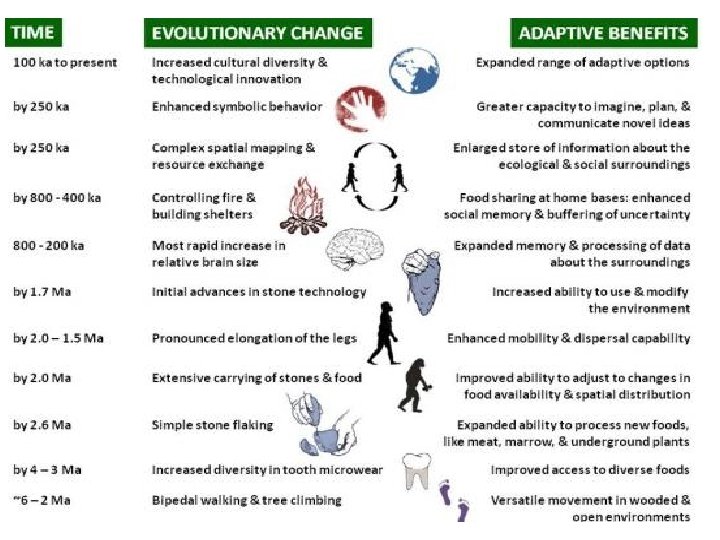
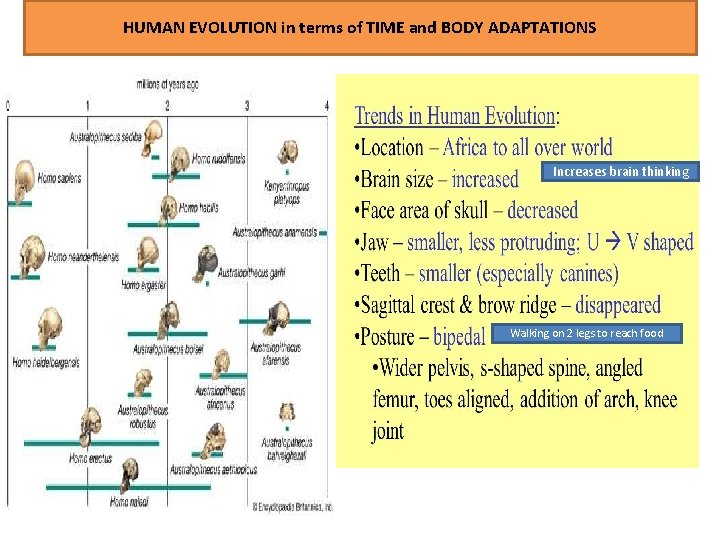
HUMAN EVOLUTION in terms of TIME and BODY ADAPTATIONS Increases brain thinking Walking on 2 legs to reach food
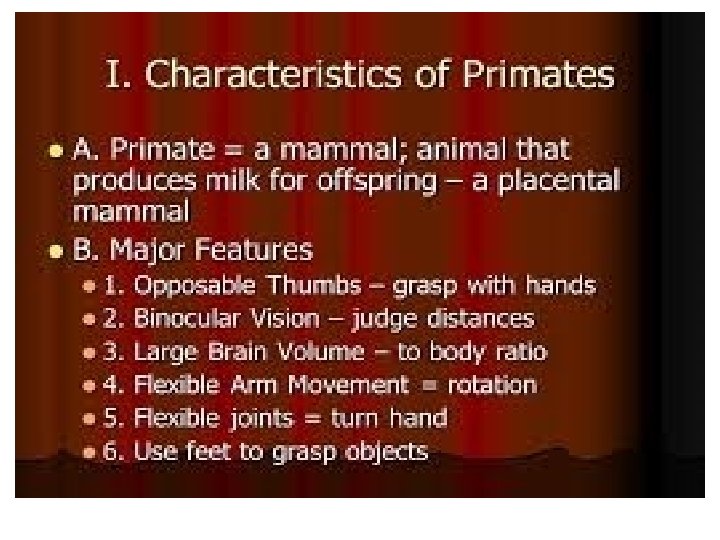
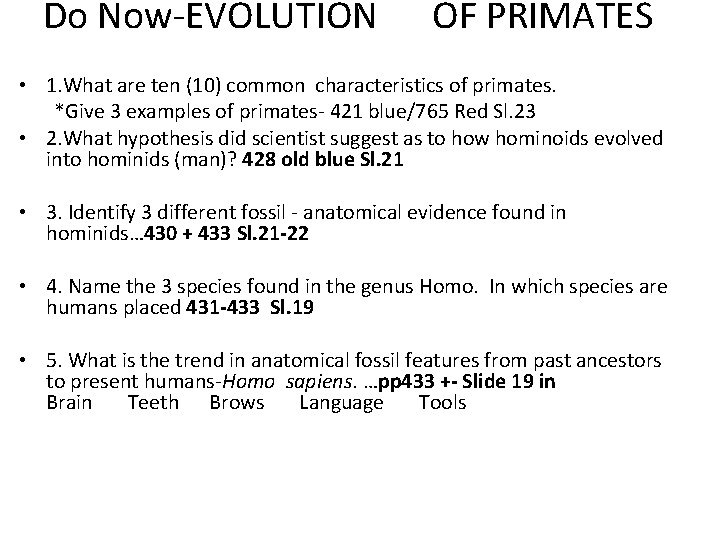
Do Now-EVOLUTION OF PRIMATES • 1. What are ten (10) common characteristics of primates. *Give 3 examples of primates- 421 blue/765 Red Sl. 23 • 2. What hypothesis did scientist suggest as to how hominoids evolved into hominids (man)? 428 old blue Sl. 21 • 3. Identify 3 different fossil - anatomical evidence found in hominids… 430 + 433 Sl. 21 -22 • 4. Name the 3 species found in the genus Homo. In which species are humans placed 431 -433 Sl. 19 • 5. What is the trend in anatomical fossil features from past ancestors to present humans-Homo sapiens. …pp 433 +- Slide 19 in Brain Teeth Brows Language Tools
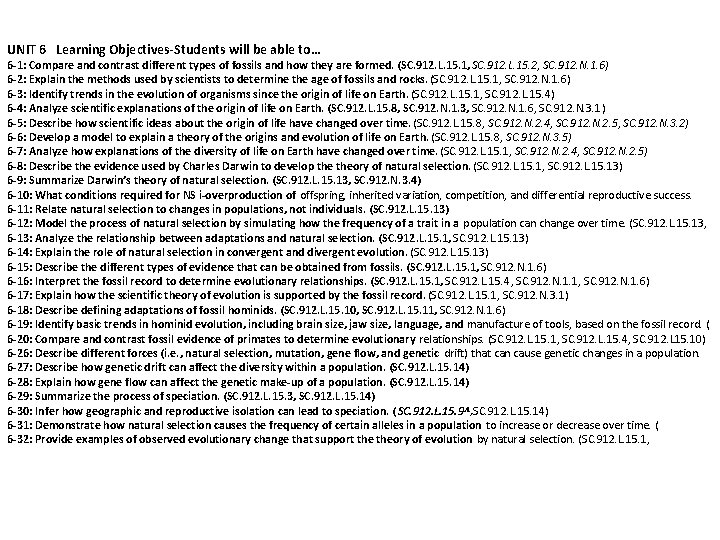
UNIT 6 Learning Objectives-Students will be able to… 6 -1: Compare and contrast different types of fossils and how they are formed. (SC. 912. L. 15. 1, SC. 912. L. 15. 2, SC. 912. N. 1. 6) 6 -2: Explain the methods used by scientists to determine the age of fossils and rocks. (SC. 912. L. 15. 1, SC. 912. N. 1. 6) 6 -3: Identify trends in the evolution of organisms since the origin of life on Earth. (SC. 912. L. 15. 1, SC. 912. L. 15. 4) 6 -4: Analyze scientific explanations of the origin of life on Earth. (SC. 912. L. 15. 8, SC. 912. N. 1. 3, SC. 912. N. 1. 6, SC. 912. N. 3. 1) 6 -5: Describe how scientific ideas about the origin of life have changed over time. (SC. 912. L. 15. 8, SC. 912. N. 2. 4, SC. 912. N. 2. 5, SC. 912. N. 3. 2) 6 -6: Develop a model to explain a theory of the origins and evolution of life on Earth. (SC. 912. L. 15. 8, SC. 912. N. 3. 5) 6 -7: Analyze how explanations of the diversity of life on Earth have changed over time. (SC. 912. L. 15. 1, SC. 912. N. 2. 4, SC. 912. N. 2. 5) 6 -8: Describe the evidence used by Charles Darwin to develop theory of natural selection. (SC. 912. L. 15. 1, SC. 912. L. 15. 13) 6 -9: Summarize Darwin’s theory of natural selection. (SC. 912. L. 15. 13, SC. 912. N. 3. 4) 6 -10: What conditions required for NS i-overproduction of offspring, inherited variation, competition, and differential reproductive success. 6 -11: Relate natural selection to changes in populations, not individuals. (SC. 912. L. 15. 13) 6 -12: Model the process of natural selection by simulating how the frequency of a trait in a population can change over time. (SC. 912. L. 15. 13, 6 -13: Analyze the relationship between adaptations and natural selection. (SC. 912. L. 15. 1, SC. 912. L. 15. 13) 6 -14: Explain the role of natural selection in convergent and divergent evolution. (SC. 912. L. 15. 13) 6 -15: Describe the different types of evidence that can be obtained from fossils. (SC. 912. L. 15. 1, SC. 912. N. 1. 6) 6 -16: Interpret the fossil record to determine evolutionary relationships. (SC. 912. L. 15. 1, SC. 912. L. 15. 4, SC. 912. N. 1. 1, SC. 912. N. 1. 6) 6 -17: Explain how the scientific theory of evolution is supported by the fossil record. (SC. 912. L. 15. 1, SC. 912. N. 3. 1) 6 -18: Describe defining adaptations of fossil hominids. (SC. 912. L. 15. 10, SC. 912. L. 15. 11, SC. 912. N. 1. 6) 6 -19: Identify basic trends in hominid evolution, including brain size, jaw size, language, and manufacture of tools, based on the fossil record. ( 6 -20: Compare and contrast fossil evidence of primates to determine evolutionary relationships. (SC. 912. L. 15. 1, SC. 912. L. 15. 4, SC. 912. L 15. 10) 6 -26: Describe different forces (i. e. , natural selection, mutation, gene flow, and genetic drift) that can cause genetic changes in a population. 6 -27: Describe how genetic drift can affect the diversity within a population. (SC. 912. L. 15. 14) 6 -28: Explain how gene flow can affect the genetic make-up of a population. (SC. 912. L. 15. 14) 6 -29: Summarize the process of speciation. (SC. 912. L. 15. 3, SC. 912. L. 15. 14) 6 -30: Infer how geographic and reproductive isolation can lead to speciation. ( SC. 912. L. 15. 9^, SC. 912. L. 15. 14) 6 -31: Demonstrate how natural selection causes the frequency of certain alleles in a population to increase or decrease over time. ( 6 -32: Provide examples of observed evolutionary change that support theory of evolution by natural selection. (SC. 912. L. 15. 1,
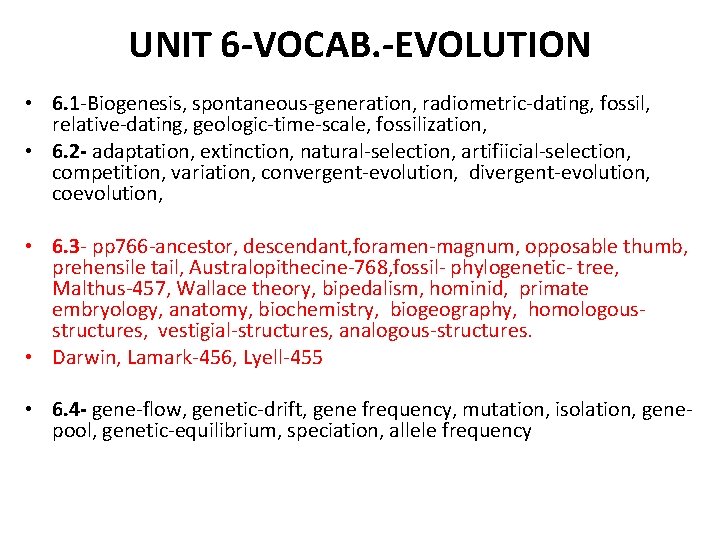
UNIT 6 -VOCAB. -EVOLUTION • 6. 1 -Biogenesis, spontaneous-generation, radiometric-dating, fossil, relative-dating, geologic-time-scale, fossilization, • 6. 2 - adaptation, extinction, natural-selection, artifiicial-selection, competition, variation, convergent-evolution, divergent-evolution, coevolution, • 6. 3 - pp 766 -ancestor, descendant, foramen-magnum, opposable thumb, prehensile tail, Australopithecine-768, fossil- phylogenetic- tree, Malthus-457, Wallace theory, bipedalism, hominid, primate embryology, anatomy, biochemistry, biogeography, homologousstructures, vestigial-structures, analogous-structures. • Darwin, Lamark-456, Lyell-455 • 6. 4 - gene-flow, genetic-drift, gene frequency, mutation, isolation, genepool, genetic-equilibrium, speciation, allele frequency
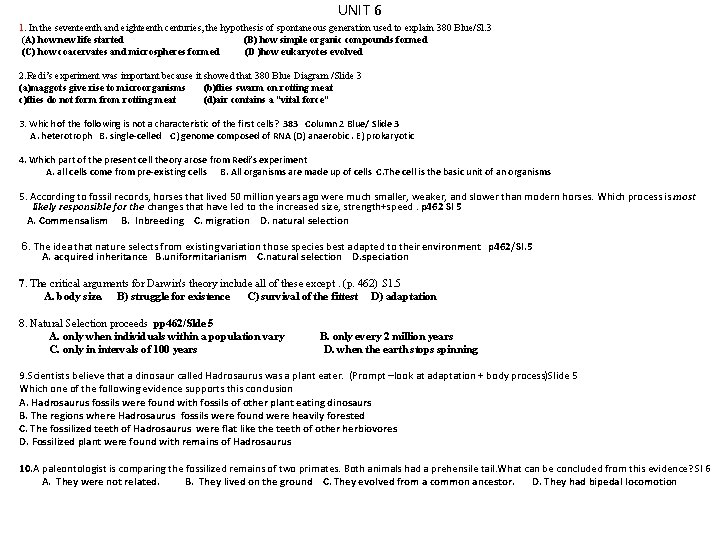
UNIT 6 1. In the seventeenth and eighteenth centuries, the hypothesis of spontaneous generation used to explain 380 Blue/Sl. 3 (A) how new life started (B) how simple organic compounds formed (C) how coacervates and microspheres formed (D )how eukaryotes evolved 2. Redi’s experiment was important because it showed that 380 Blue Diagram /Slide 3 (a)maggots give rise to microorganisms (b)flies swarm on rotting meat c)flies do not form from rotting meat (d)air contains a “vital force” 3. Which of the following is not a characteristic of the first cells? 383 Column 2 Blue/ Slide 3 A. heterotroph B. single-celled C) genome composed of RNA (D) anaerobic. E) prokaryotic 4. Which part of the present cell theory arose from Redi’s experiment A. all cells come from pre-existing cells B. All organisms are made up of cells C. The cell is the basic unit of an organisms 5. According to fossil records, horses that lived 50 million years ago were much smaller, weaker, and slower than modern horses. Which process is most likely responsible for the changes that have led to the increased size, strength+speed. p 462 Sl 5 A. Commensalism B. Inbreeding C. migration D. natural selection 6. The idea that nature selects from existing variation those species best adapted to their environment p 462/Sl. 5 A. acquired inheritance B. uniformitarianism C. natural selection D. speciation 7. The critical arguments for Darwin's theory include all of these except. (p. 462). Sl. 5 A. body size. B) struggle for existence C) survival of the fittest D) adaptation 8. Natural Selection proceeds pp 462/Slde 5 A. only when individuals within a population vary C. only in intervals of 100 years B. only every 2 million years D. when the earth stops spinning 9. Scientists believe that a dinosaur called Hadrosaurus was a plant eater. (Prompt –look at adaptation + body process)Slide 5 Which one of the following evidence supports this conclusion A. Hadrosaurus fossils were found with fossils of other plant eating dinosaurs B. The regions where Hadrosaurus fossils were found were heavily forested C. The fossilized teeth of Hadrosaurus were flat like the teeth of other herbiovores D. Fossilized plant were found with remains of Hadrosaurus 10. A paleontologist is comparing the fossilized remains of two primates. Both animals had a prehensile tail. What can be concluded from this evidence? Sl 6 A. They were not related. B. They lived on the ground C. They evolved from a common ancestor. D. They had bipedal locomotion
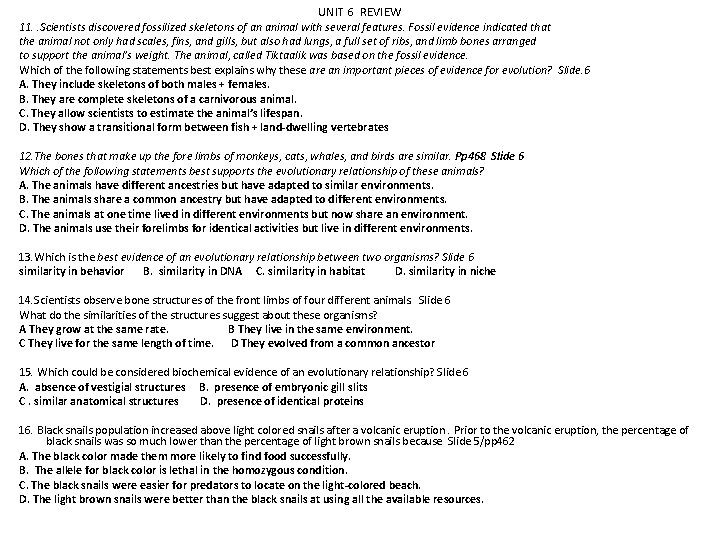
UNIT 6 REVIEW 11. . Scientists discovered fossilized skeletons of an animal with several features. Fossil evidence indicated that the animal not only had scales, fins, and gills, but also had lungs, a full set of ribs, and limb bones arranged to support the animal’s weight. The animal, called Tiktaalik was based on the fossil evidence. Which of the following statements best explains why these are an important pieces of evidence for evolution? Slide. 6 A. They include skeletons of both males + females. B. They are complete skeletons of a carnivorous animal. C. They allow scientists to estimate the animal’s lifespan. D. They show a transitional form between fish + land-dwelling vertebrates 12. The bones that make up the fore limbs of monkeys, cats, whales, and birds are similar. Pp 468 Slide 6 Which of the following statements best supports the evolutionary relationship of these animals? A. The animals have different ancestries but have adapted to similar environments. B. The animals share a common ancestry but have adapted to different environments. C. The animals at one time lived in different environments but now share an environment. D. The animals use their forelimbs for identical activities but live in different environments. 13. Which is the best evidence of an evolutionary relationship between two organisms? Slide 6 similarity in behavior B. similarity in DNA C. similarity in habitat D. similarity in niche 14. Scientists observe bone structures of the front limbs of four different animals. Slide 6 What do the similarities of the structures suggest about these organisms? A They grow at the same rate. B They live in the same environment. C They live for the same length of time. D They evolved from a common ancestor 15. Which could be considered biochemical evidence of an evolutionary relationship? Slide 6 A. absence of vestigial structures B. presence of embryonic gill slits C. similar anatomical structures D. presence of identical proteins 16. Black snails population increased above light colored snails after a volcanic eruption. Prior to the volcanic eruption, the percentage of black snails was so much lower than the percentage of light brown snails because Slide 5/pp 462 A. The black color made them more likely to find food successfully. B. The allele for black color is lethal in the homozygous condition. C. The black snails were easier for predators to locate on the light-colored beach. D. The light brown snails were better than the black snails at using all the available resources.
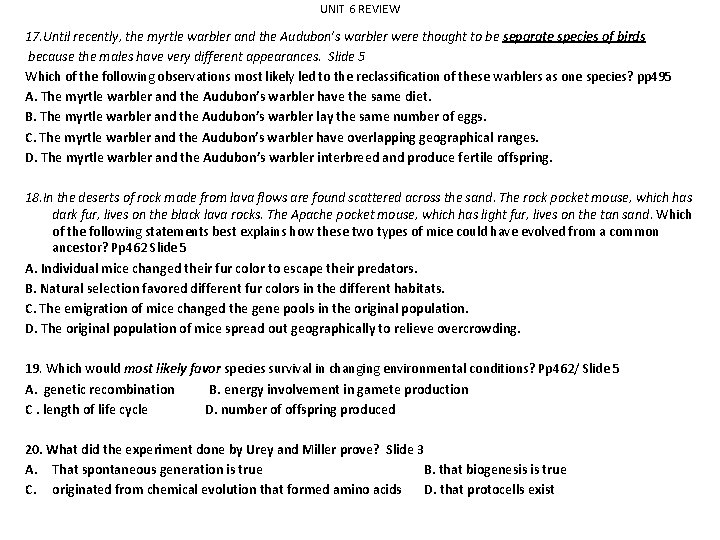
UNIT 6 REVIEW 17. Until recently, the myrtle warbler and the Audubon’s warbler were thought to be separate species of birds because the males have very different appearances. Slide 5 Which of the following observations most likely led to the reclassification of these warblers as one species? pp 495 A. The myrtle warbler and the Audubon’s warbler have the same diet. B. The myrtle warbler and the Audubon’s warbler lay the same number of eggs. C. The myrtle warbler and the Audubon’s warbler have overlapping geographical ranges. D. The myrtle warbler and the Audubon’s warbler interbreed and produce fertile offspring. 18. In the deserts of rock made from lava flows are found scattered across the sand. The rock pocket mouse, which has dark fur, lives on the black lava rocks. The Apache pocket mouse, which has light fur, lives on the tan sand. Which of the following statements best explains how these two types of mice could have evolved from a common ancestor? Pp 462 Slide 5 A. Individual mice changed their fur color to escape their predators. B. Natural selection favored different fur colors in the different habitats. C. The emigration of mice changed the gene pools in the original population. D. The original population of mice spread out geographically to relieve overcrowding. 19. Which would most likely favor species survival in changing environmental conditions? Pp 462/ Slide 5 A. genetic recombination B. energy involvement in gamete production C. length of life cycle D. number of offspring produced 20. What did the experiment done by Urey and Miller prove? Slide 3 A. That spontaneous generation is true B. that biogenesis is true C. originated from chemical evolution that formed amino acids D. that protocells exist
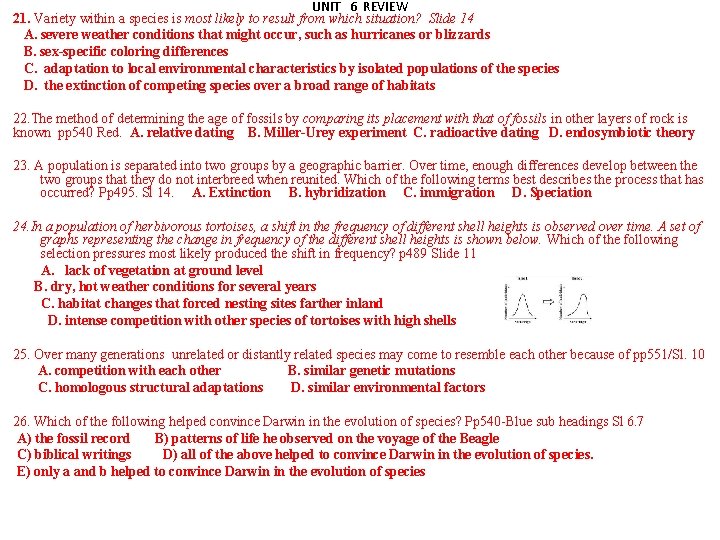
UNIT 6 REVIEW 21. Variety within a species is most likely to result from which situation? Slide 14 A. severe weather conditions that might occur, such as hurricanes or blizzards B. sex-specific coloring differences C. adaptation to local environmental characteristics by isolated populations of the species D. the extinction of competing species over a broad range of habitats 22. The method of determining the age of fossils by comparing its placement with that of fossils in other layers of rock is known pp 540 Red. A. relative dating B. Miller-Urey experiment C. radioactive dating D. endosymbiotic theory 23. A population is separated into two groups by a geographic barrier. Over time, enough differences develop between the two groups that they do not interbreed when reunited. Which of the following terms best describes the process that has occurred? Pp 495. Sl 14. A. Extinction B. hybridization C. immigration D. Speciation 24. In a population of herbivorous tortoises, a shift in the frequency of different shell heights is observed over time. A set of graphs representing the change in frequency of the different shell heights is shown below. Which of the following selection pressures most likely produced the shift in frequency? p 489 Slide 11 A. lack of vegetation at ground level B. dry, hot weather conditions for several years C. habitat changes that forced nesting sites farther inland D. intense competition with other species of tortoises with high shells 25. Over many generations unrelated or distantly related species may come to resemble each other because of pp 551/Sl. 10 A. competition with each other B. similar genetic mutations C. homologous structural adaptations D. similar environmental factors 26. Which of the following helped convince Darwin in the evolution of species? Pp 540 -Blue sub headings Sl 6. 7 A) the fossil record B) patterns of life he observed on the voyage of the Beagle C) biblical writings D) all of the above helped to convince Darwin in the evolution of species. E) only a and b helped to convince Darwin in the evolution of species
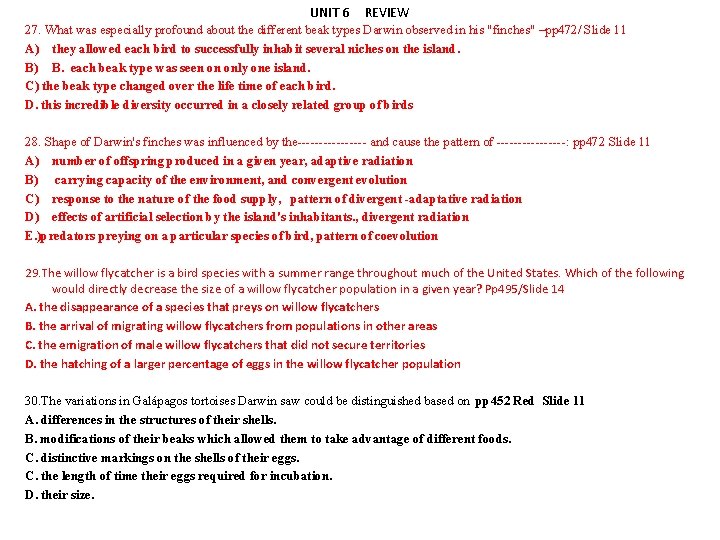
UNIT 6 REVIEW 27. What was especially profound about the different beak types Darwin observed in his "finches" –pp 472/ Slide 11 A) they allowed each bird to successfully inhabit several niches on the island. B) B. each beak type was seen on only one island. C) the beak type changed over the life time of each bird. D. this incredible diversity occurred in a closely related group of birds 28. Shape of Darwin's finches was influenced by the-------- and cause the pattern of --------: pp 472 Slide 11 A) number of offspring produced in a given year, adaptive radiation B) carrying capacity of the environment, and convergent evolution C) response to the nature of the food supply, pattern of divergent -adaptative radiation D) effects of artificial selection by the island's inhabitants. , divergent radiation E. )predators preying on a particular species of bird, pattern of coevolution 29. The willow flycatcher is a bird species with a summer range throughout much of the United States. Which of the following would directly decrease the size of a willow flycatcher population in a given year? Pp 495/Slide 14 A. the disappearance of a species that preys on willow flycatchers B. the arrival of migrating willow flycatchers from populations in other areas C. the emigration of male willow flycatchers that did not secure territories D. the hatching of a larger percentage of eggs in the willow flycatcher population 30. The variations in Galápagos tortoises Darwin saw could be distinguished based on pp 452 Red Slide 11 A. differences in the structures of their shells. B. modifications of their beaks which allowed them to take advantage of different foods. C. distinctive markings on the shells of their eggs. C. the length of time their eggs required for incubation. D. their size.
UNIT 6 REVIEW. 31 The nonpoisonous eastern scarlet snake has colored bands that closely resemble the poisonous coral snake. This selective adaptation provides the eastern scarlet snake with —(pp 398 Blue) A. a method of avoiding predation B. the ability to attract prey C. increased breeding opportunities D. increased feeding opportunities 32. The process by which a single species or small group of species evolves into several different forms that live in different ways; rapid growth in the diversity of a group of organisms. Pp 551. Slide 10 A. Coevolution B. Adaptive radiation C. Punctuated equilibrium D. Macroevolution. 33. The movement of new genes into a population as a result of migration or hybridization is called pp 490/ Slide 14 A. founder principle B) selection C) gene flow D) bottleneck effect E) adaptation 34. The process by which two species evolve in response to changes in each other is 551 Red Sl. 10 A. macroevolution B. convergent evolution C. coevolution D. adaptive radiation 35. The pattern of evolution where long stable periods are interrupted by brief periods of more rapid change. 549 Red/Sl. 12 A. Punctuated equilibrium B. Macroevolution C. Convergent evolution D. Coevolution 36. Scientists found the fossilized remains of a canine’s jaw and leg. What information must first be obtained before the scientists can place the fossils in the ancestral time line of the dog? Pp 551 A. The continent where the fossils were found. B. The age of the fossils. C. The rest of the skeleton D. The population trends for the species 37. The ability to learn in primates is primarily associated with _______. Slide 21 A) good vision B) a large forebrain C) a keen sense of smell D) walking erect 38. This hominid is dated as early as 2 MYA, the name means "handy man, " and was found accompanied by tools. 39. Homo erectus _______. Pp 432 Blue Sl 21 A) made advanced tools B) had knowledge of fire C) fossils were found in Africa and Europe D) All of above 40. Primates are adapted to _______. Pp. 765 Slide 21 A) a marine life B) living in trees C) killing others of their own kind D) cold weather
UNIT 6 REVIEW 41. Opposable thumbs make grasping possible _______. pp 767 In all animals B) only in primates C) only in mammals D) in knuckle-walking animals 42. Which single characteristic most clearly distinguishes Hominins (man) from hominoids A. Bipedalism B. brain size C. teeth D. height
UNIT 6 REVIEW