
UNIT 6 Evolution and Classification Chapter 10 Principles




- Slides: 21
UNIT 6: Evolution and Classification Chapter 10 Principles of Evolution
Ch. 10. 1 Early Ideas About Evolution • Early ideas set the stage for Darwin’s theory – Early scientists proposed many ideas. • George Cuvier (anatomist) promoted the idea of catastrophism – the idea that sudden geologic catastrophes caused the extinction of large groups of organisms. • Charles Lyell (geologist) shared Cuvier’s ideas but thought geologic processes always work the same - uniformitarianism.
Ch. 10. 1 Early Ideas About Evolution
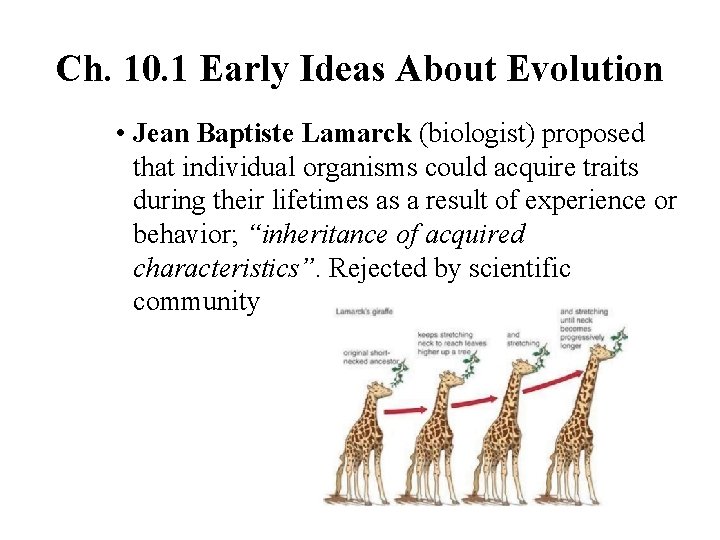
Ch. 10. 1 Early Ideas About Evolution • Jean Baptiste Lamarck (biologist) proposed that individual organisms could acquire traits during their lifetimes as a result of experience or behavior; “inheritance of acquired characteristics”. Rejected by scientific community
Ch. 10. 2 Darwin’s Observations • Darwin’s Voyage – In 1831, the HMS Beagle set sail from England to map the coast of South America & Pacific Islands. • Charles Darwin was hired to travel with the captain and observe the land its inhabitants along the way. • Darwin read Lyell’s Principles of Geology and found evidence supporting his ideas. Darwin started forming his own ideas… about evolution. – However, Alfred Russel Wallace was also coming up with similar ideas about evolution at the same time.
Ch. 10. 2 Darwin’s Observations • “Descent with Modification” – Darwin used this phrase to describe the process of evolution. • He reviewed evidence that every species must have descended by reproduction from preexisting species. • These species were able to change over time. – He was the first to argue that all species descended from one or only a few original kinds of life.
Ch. 10. 2 Darwin’s Observations • The Galapagos Islands – Darwin saw the animals of the Galapagos Islands as evidence of descent with modification. • 13 similar species of finches, all with different beaks adapted for different foods. • Many similar species of tortoises adapted to feeding on different vegetation or in different terrain.
Ch. 10. 2 Darwin’s Observations
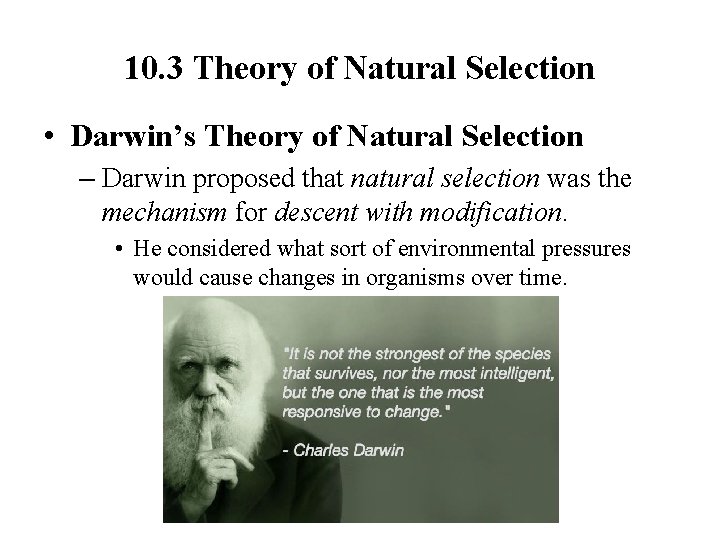
10. 3 Theory of Natural Selection • Darwin’s Theory of Natural Selection – Darwin proposed that natural selection was the mechanism for descent with modification. • He considered what sort of environmental pressures would cause changes in organisms over time.
10. 3 Theory of Natural Selection
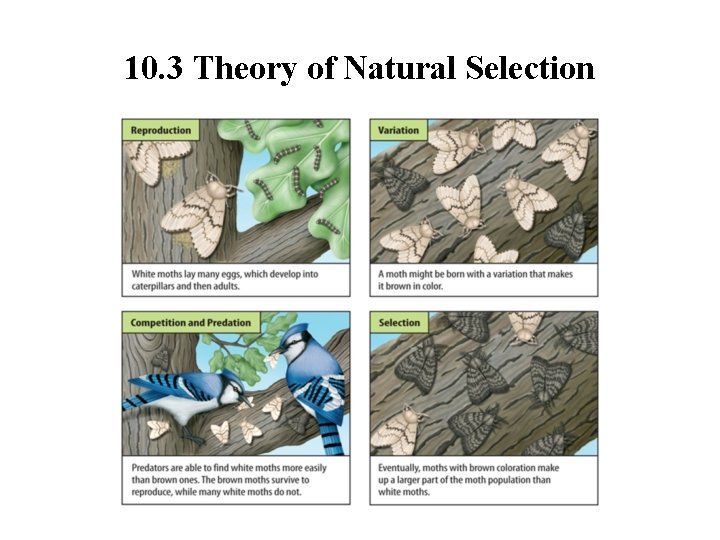
10. 3 Theory of Natural Selection 1. Overproduction: Drawing from economist Thomas Malthus, Darwin knew populations can increase more quickly than food supplies. • Populations are limited by conditions of their environment (food, predators, disease, geography). • So not all offspring live very long. • Darwin realized that the environment limits the populations of all organisms by causing deaths and limiting births.
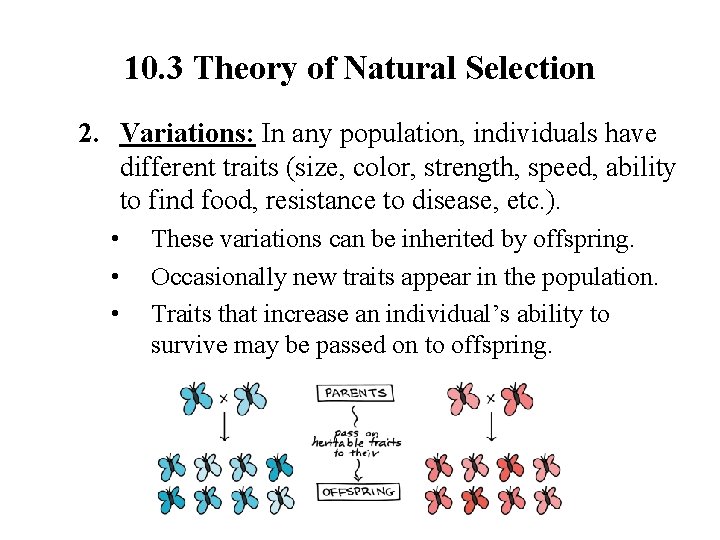
10. 3 Theory of Natural Selection 2. Variations: In any population, individuals have different traits (size, color, strength, speed, ability to find food, resistance to disease, etc. ). • • • These variations can be inherited by offspring. Occasionally new traits appear in the population. Traits that increase an individual’s ability to survive may be passed on to offspring.
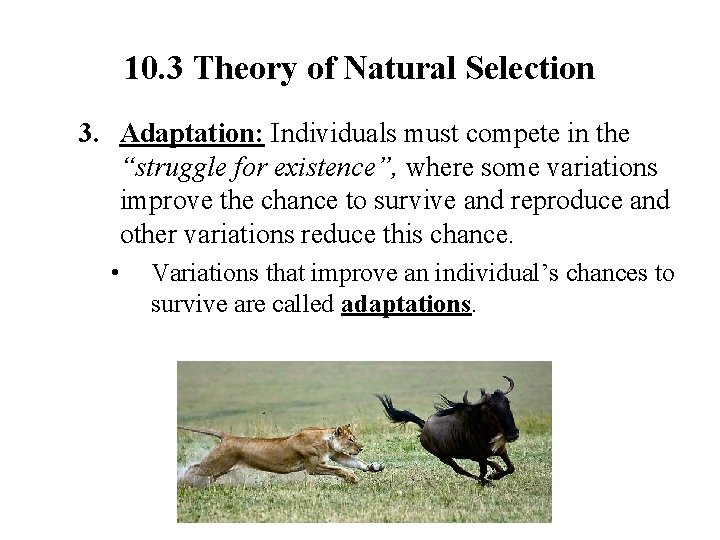
10. 3 Theory of Natural Selection 3. Adaptation: Individuals must compete in the “struggle for existence”, where some variations improve the chance to survive and reproduce and other variations reduce this chance. • Variations that improve an individual’s chances to survive are called adaptations.
10. 3 Theory of Natural Selection 4. Descent with Modification: Darwin concluded that organisms with the best adaptations are most likely to survive and reproduce. • • • Through inheritance, those adaptations become more frequent in the population. Populations may begin to differ as the adapt to different environments, even if they descended from a common ancestor. This conclusion is the core idea of Darwin’s theory.
10. 3 Theory of Natural Selection • “Survival of the Fittest” – Darwin sometimes used this phrase to describe the struggle for existence/survival. It does not mean “the fastest, strongest, biggest” survives! – Fitness is the measure of an individual’s hereditary contribution to the next generation. • A “fit” individual is one that has offspring that also live long enough to reproduce in a given environment.
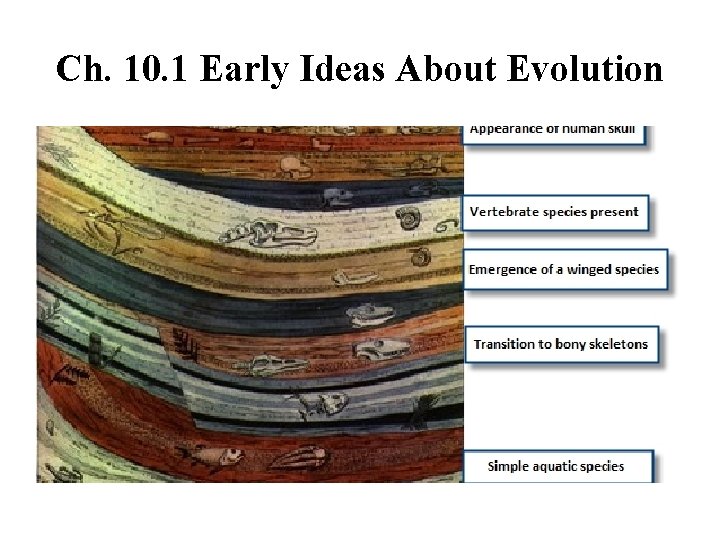
10. 4 Evidence of Evolution • The Fossil Record – Superposition is the geologic principle that states if the rock strata (layer) has not been disturbed, the lowest stratum was formed before the strata above. • A fossil found in a lower layer will be older than one found in a higher layer. – Using this principle we can infer: 1. Different organisms lived at different times. 2. Today’s organisms are different from those in the past. 3. Fossils found in adjacent layers will be more similar.
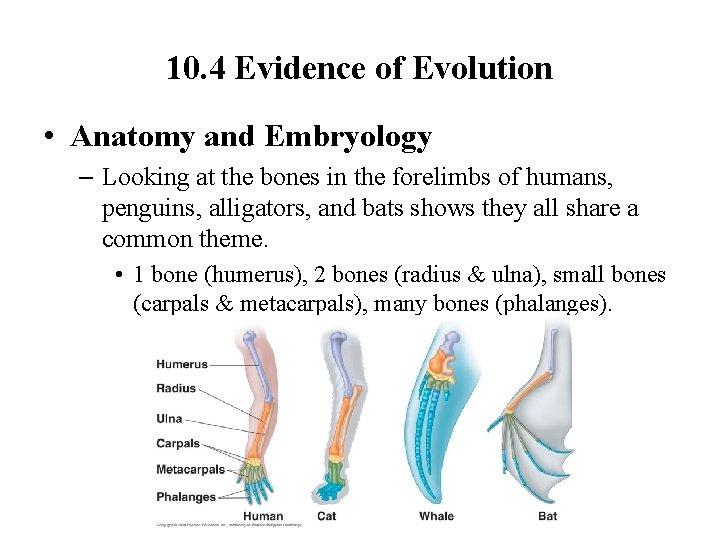
10. 4 Evidence of Evolution • Anatomy and Embryology – Looking at the bones in the forelimbs of humans, penguins, alligators, and bats shows they all share a common theme. • 1 bone (humerus), 2 bones (radius & ulna), small bones (carpals & metacarpals), many bones (phalanges).
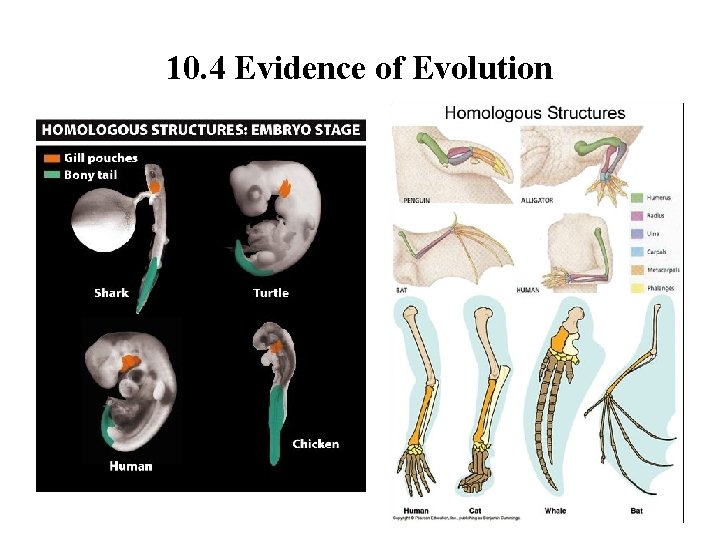
10. 4 Evidence of Evolution • Anatomy & Embryology (contd. ) – Homologous Structures: are features that are similar in structure but appear in different organisms. – Analogous Structures: perform similar functions, but are not similar in origin. • Example: Bats and dragonflies both have wings to fly, but the structures of each are very different.
10. 4 Evidence of Evolution
10. 4 Evidence of Evolution Analogous Structures
10. 4 Evidence of Evolution – Vestigial Structures: “transitional structures” or remnants of organs or structures that had a function in an early ancestor. • Example: the human coccyx, or “tailbone”, is made of four fused vertebrae that resemble bones in an animal’s tail. Other examples include pelvic bones in whales and the human appendix.