
Unit 6 Designing principles Title Communication of design

- Slides: 29
Unit 6: Designing principles Title : Communication of design ideas Objectives • Understand how to develop, communicate, record and justify design ideas • Be aware of a range of techniques to support clear communication of design ideas • Know how to design and develop prototypes in response to client wants and needs • Be able to critically evaluate prototypes and suggest modifications
Communication of design ideas Unit 6 Designing principles Methods of communication Working on the presentation of a design is a useful skill • A portfolio is a good format for communicating designs • It should be accompanied by any working notes, sketches and mood boards that led to the final design • Losing any stages of work can be frustrating and time consuming • What would be a good method of safely collating all the elements that make up a portfolio of work?
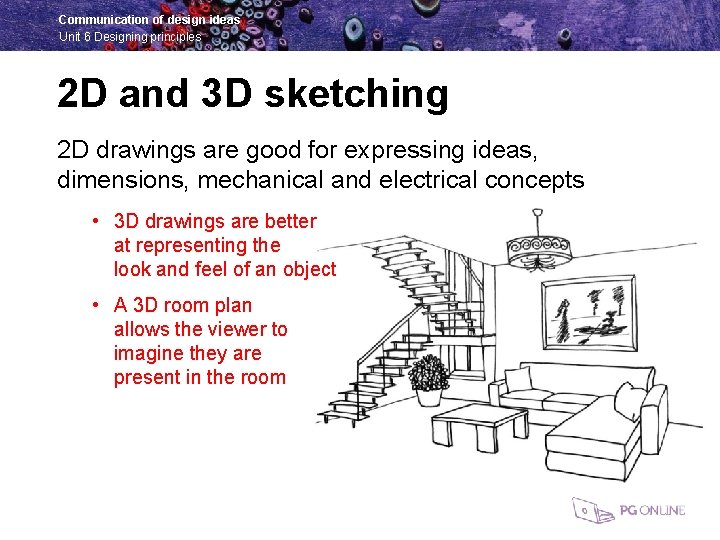
Communication of design ideas Unit 6 Designing principles 2 D and 3 D sketching 2 D drawings are good for expressing ideas, dimensions, mechanical and electrical concepts • 3 D drawings are better at representing the look and feel of an object • A 3 D room plan allows the viewer to imagine they are present in the room
Communication of design ideas Unit 6 Designing principles Drawing techniques Graphical projection and perspective are useful drawing skills for presenting designs • There are three key types of 3 D drawing styles: • Oblique projection • Isometric projection • Two point perspective
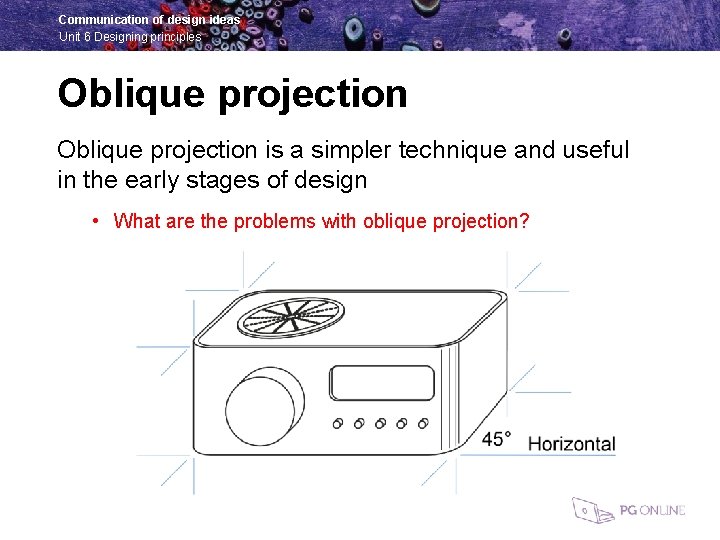
Communication of design ideas Unit 6 Designing principles Oblique projection is a simpler technique and useful in the early stages of design • What are the problems with oblique projection?
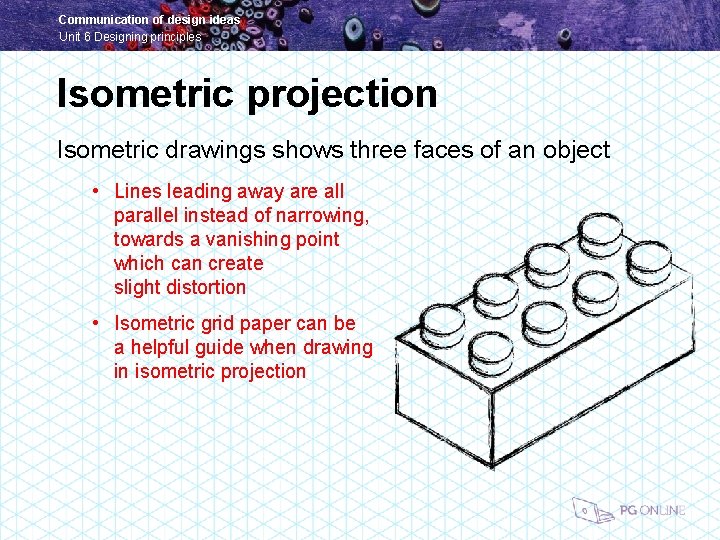
Communication of design ideas Unit 6 Designing principles Isometric projection Isometric drawings shows three faces of an object • Lines leading away are all parallel instead of narrowing, towards a vanishing point which can create slight distortion • Isometric grid paper can be a helpful guide when drawing in isometric projection
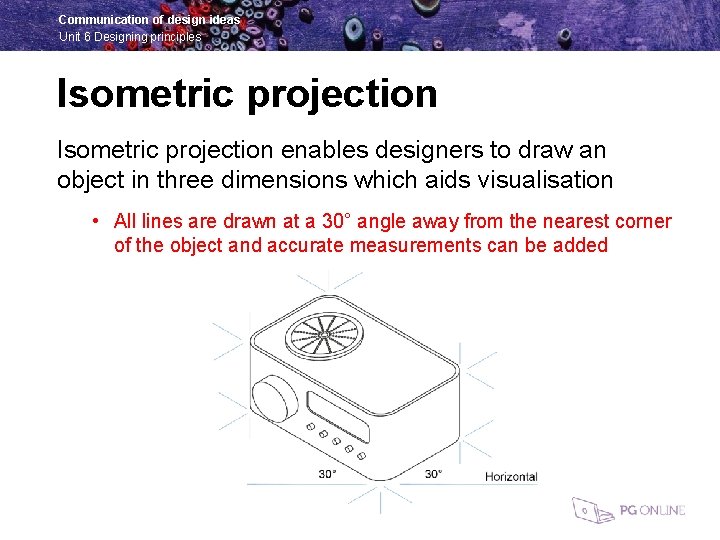
Communication of design ideas Unit 6 Designing principles Isometric projection enables designers to draw an object in three dimensions which aids visualisation • All lines are drawn at a 30° angle away from the nearest corner of the object and accurate measurements can be added
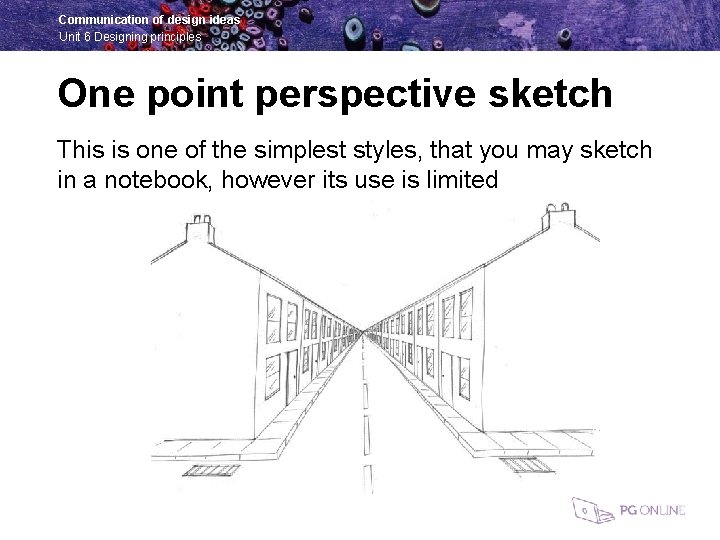
Communication of design ideas Unit 6 Designing principles One point perspective sketch This is one of the simplest styles, that you may sketch in a notebook, however its use is limited
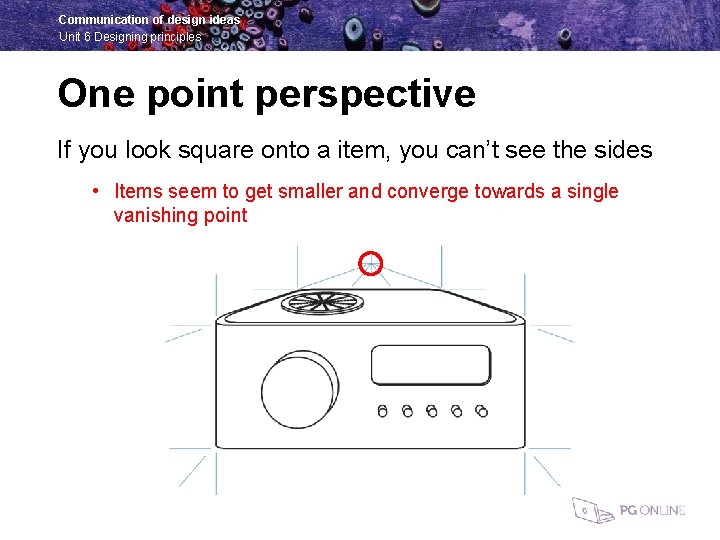
Communication of design ideas Unit 6 Designing principles One point perspective If you look square onto a item, you can’t see the sides • Items seem to get smaller and converge towards a single vanishing point
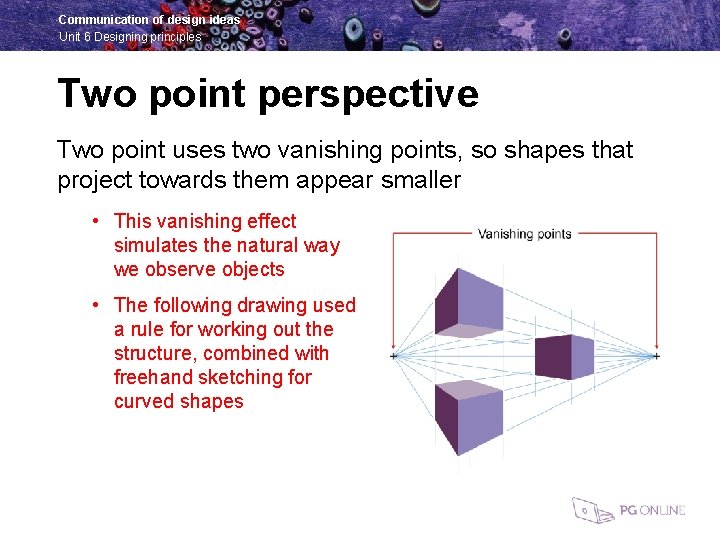
Communication of design ideas Unit 6 Designing principles Two point perspective Two point uses two vanishing points, so shapes that project towards them appear smaller • This vanishing effect simulates the natural way we observe objects • The following drawing used a rule for working out the structure, combined with freehand sketching for curved shapes
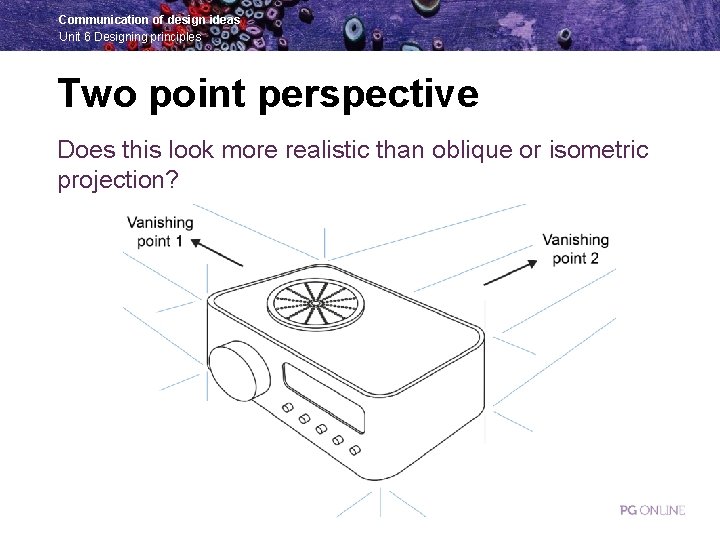
Communication of design ideas Unit 6 Designing principles Two point perspective Does this look more realistic than oblique or isometric projection?
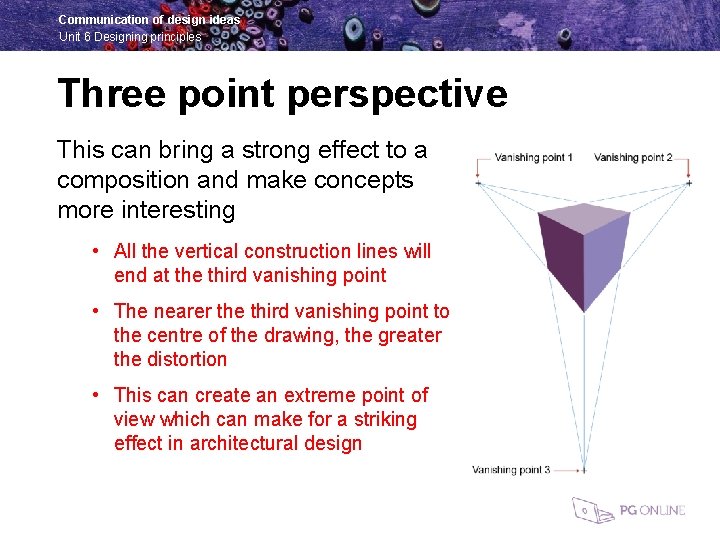
Communication of design ideas Unit 6 Designing principles Three point perspective This can bring a strong effect to a composition and make concepts more interesting • All the vertical construction lines will end at the third vanishing point • The nearer the third vanishing point to the centre of the drawing, the greater the distortion • This can create an extreme point of view which can make for a striking effect in architectural design
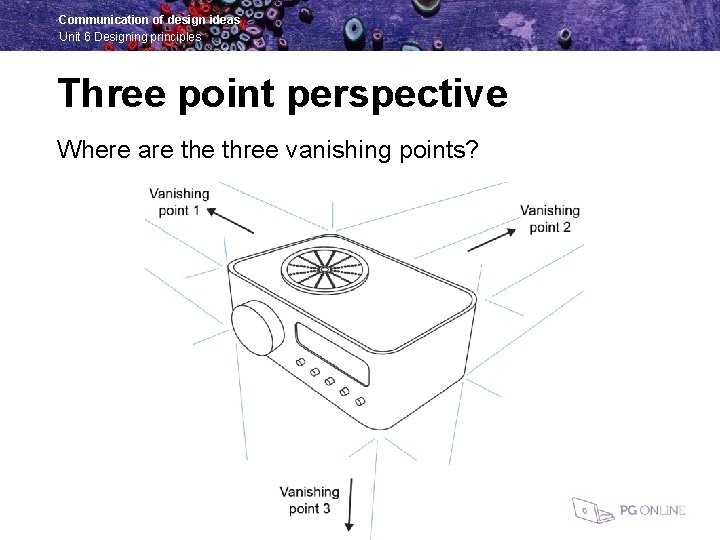
Communication of design ideas Unit 6 Designing principles Three point perspective Where are three vanishing points?
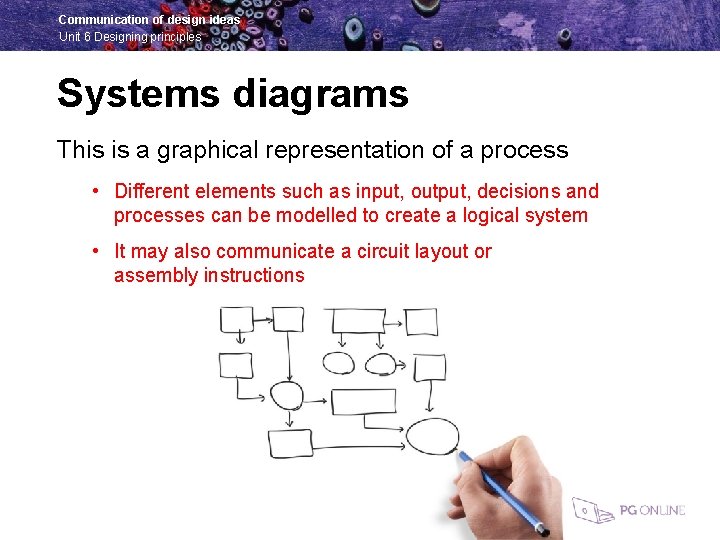
Communication of design ideas Unit 6 Designing principles Systems diagrams This is a graphical representation of a process • Different elements such as input, output, decisions and processes can be modelled to create a logical system • It may also communicate a circuit layout or assembly instructions
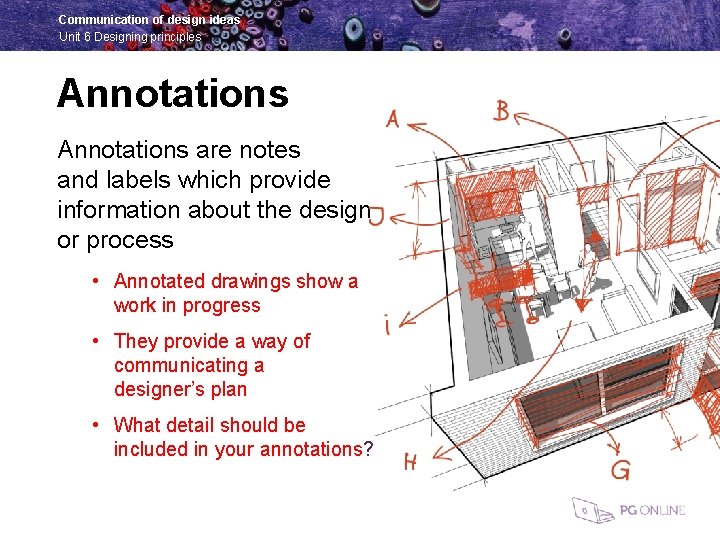
Communication of design ideas Unit 6 Designing principles Annotations are notes and labels which provide information about the design or process • Annotated drawings show a work in progress • They provide a way of communicating a designer’s plan • What detail should be included in your annotations?
Communication of design ideas Unit 6 Designing principles Annotated drawings Annotations should clearly indicate information that the drawing may not convey • These may include: • Materials • Manufacturing processes • Use of sustainable materials • For the client, they will also be looking to see if it meets their specification points
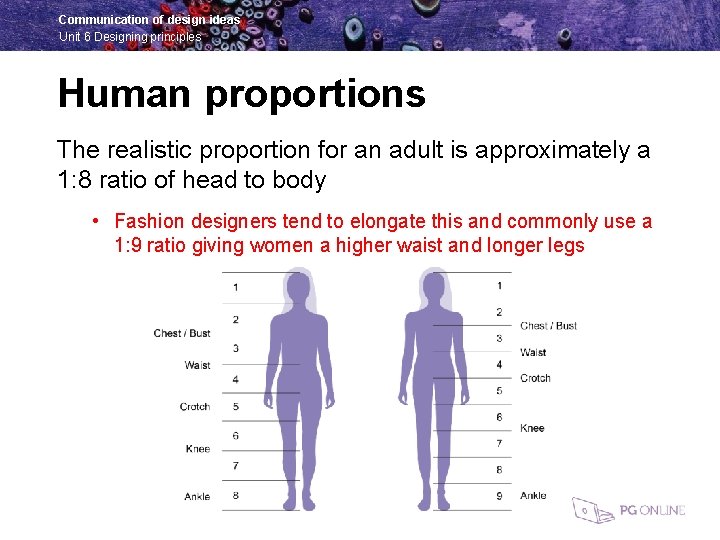
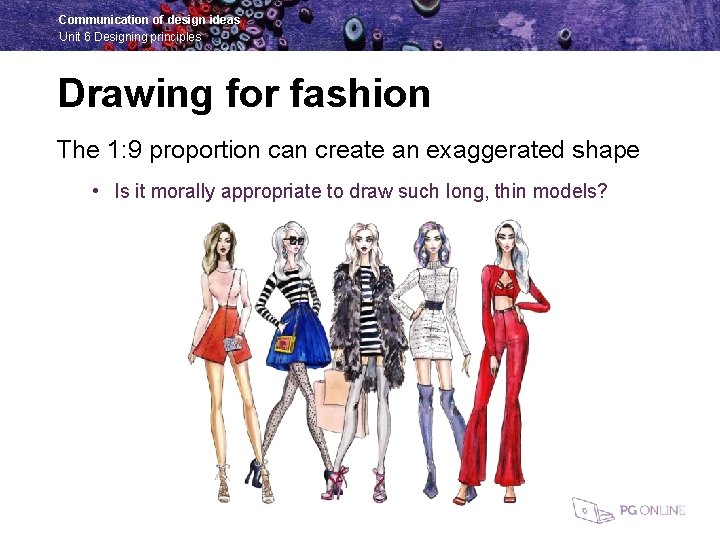
Communication of design ideas Unit 6 Designing principles Human proportions The realistic proportion for an adult is approximately a 1: 8 ratio of head to body • Fashion designers tend to elongate this and commonly use a 1: 9 ratio giving women a higher waist and longer legs
Communication of design ideas Unit 6 Designing principles Drawing for fashion The 1: 9 proportion can create an exaggerated shape • Is it morally appropriate to draw such long, thin models?
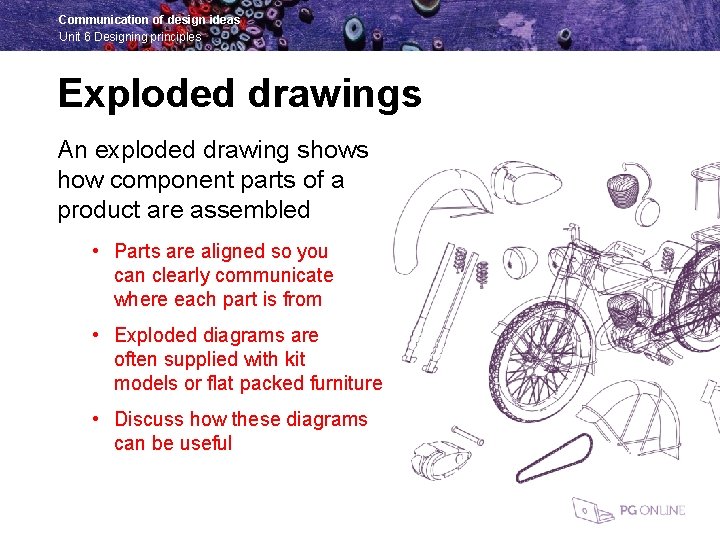
Communication of design ideas Unit 6 Designing principles Exploded drawings An exploded drawing shows how component parts of a product are assembled • Parts are aligned so you can clearly communicate where each part is from • Exploded diagrams are often supplied with kit models or flat packed furniture • Discuss how these diagrams can be useful
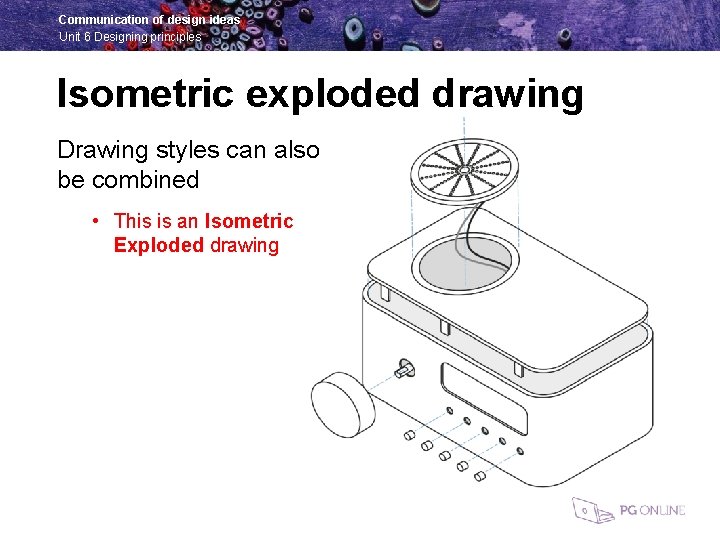
Communication of design ideas Unit 6 Designing principles Isometric exploded drawing Drawing styles can also be combined • This is an Isometric Exploded drawing
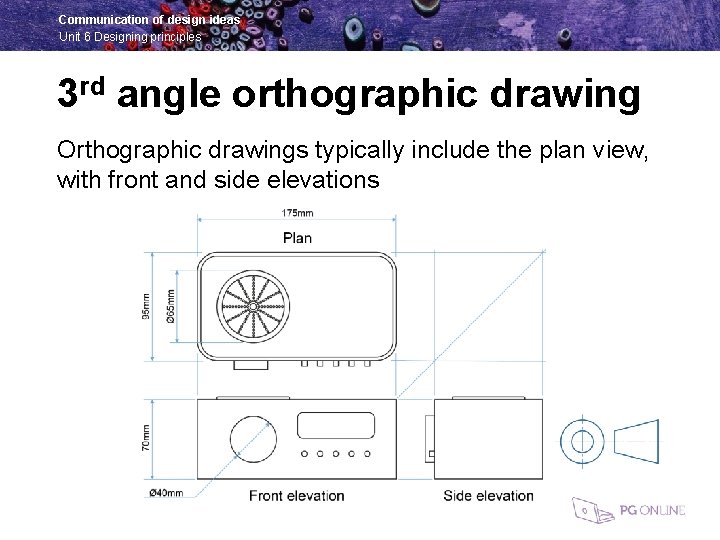
Communication of design ideas Unit 6 Designing principles 3 rd angle orthographic drawing Orthographic drawings typically include the plan view, with front and side elevations
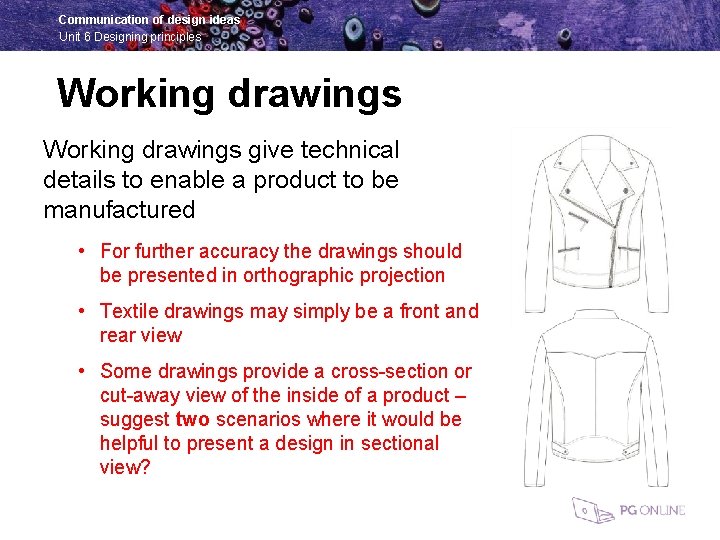
Communication of design ideas Unit 6 Designing principles Working drawings give technical details to enable a product to be manufactured • For further accuracy the drawings should be presented in orthographic projection • Textile drawings may simply be a front and rear view • Some drawings provide a cross-section or cut-away view of the inside of a product – suggest two scenarios where it would be helpful to present a design in sectional view?
Communication of design ideas Unit 6 Designing principles Mathematical modelling The process of design often entails using some maths • Consider all the different aspects of design that will need careful calculation and list your findings
Communication of design ideas Unit 6 Designing principles Mathematical modelling The different aspects of design that will need careful calculation include: • • How much material is required to make the item Economical use of materials to ensure minimal waste How much will the selected material weigh? Is there a lighter option than works as well? How strong is the material? Check the upper and lower limits of component tolerances Scales of economy – will it be cheaper to buy in bulk? Aesthetics • How do aesthetic factors affect the making process?
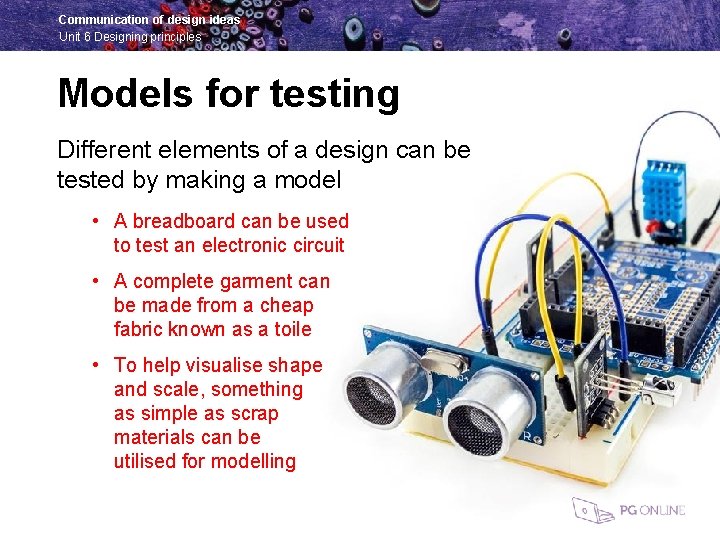
Communication of design ideas Unit 6 Designing principles Models for testing Different elements of a design can be tested by making a model • A breadboard can be used to test an electronic circuit • A complete garment can be made from a cheap fabric known as a toile • To help visualise shape and scale, something as simple as scrap materials can be utilised for modelling
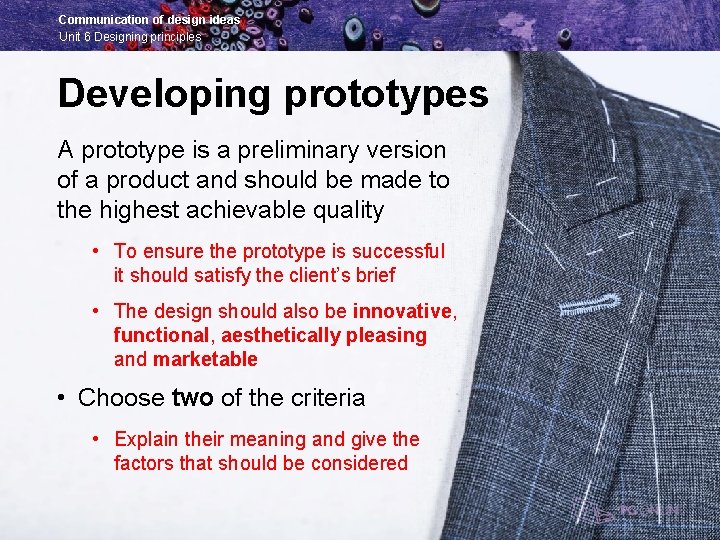
Communication of design ideas Unit 6 Designing principles Developing prototypes A prototype is a preliminary version of a product and should be made to the highest achievable quality • To ensure the prototype is successful it should satisfy the client’s brief • The design should also be innovative, functional, aesthetically pleasing and marketable • Choose two of the criteria • Explain their meaning and give the factors that should be considered
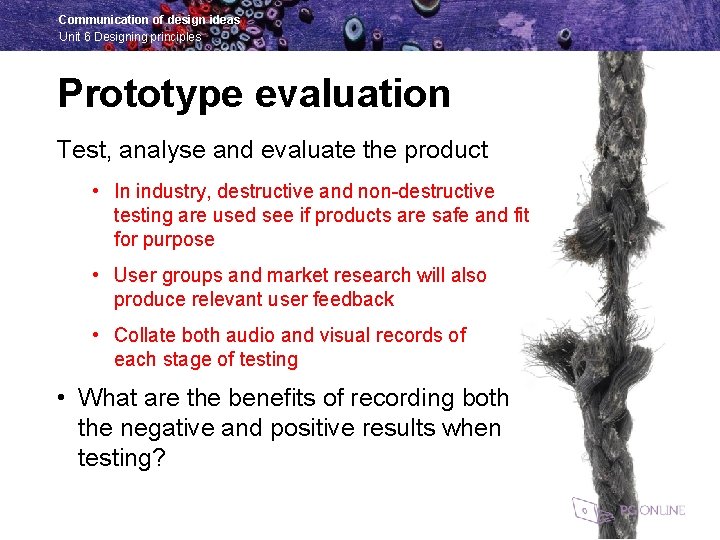
Communication of design ideas Unit 6 Designing principles Prototype evaluation Test, analyse and evaluate the product • In industry, destructive and non-destructive testing are used see if products are safe and fit for purpose • User groups and market research will also produce relevant user feedback • Collate both audio and visual records of each stage of testing • What are the benefits of recording both the negative and positive results when testing?
Communication of design ideas Unit 6 Designing principles Unit Linked Video: https: //www. youtube. com/watch? v=hrtvo. BGu. Bzg
Communication of design ideas Unit 6 Designing principles Plenary • Identify three methods for communicating design ideas • What are the benefits of sketching in three dimensions? • What is the purpose of a systems diagram? • What are the advantages of modelling?