
Unit 6 Cognitive Psychology Lesson 5 MEASURING Intelligence
![Write comments: • “two weaknesses in [this] argument become evident. The first is the](https://slidetodoc.com/presentation_image_h2/69517e77267c8edb4deb7d9e76b6af84/image-26.jpg "Write comments: • “two weaknesses in [this] argument become evident. The first is the")


- Slides: 39
Unit 6: Cognitive Psychology; Lesson 5: MEASURING Intelligence WARM UP PART ONE: WARM UP: PART TWO Ø List and describe: Ø All students take the SAME test when taking the SAT, ACT, AP Psychology exam, or other state tests. WHY do you think all students must take the same standardized tests regardless of their level of preparation or skill? Gardner’s multiple intelligences Sternberg’s breakdown of intelligence categories Deadlines & Reminders: • Memory Memo to Freshman Academy: • Due before break; Now Late • Tomorrow: Intelligence Readings & Double response journals • Cognition Quiz: Wednesday Today’s Agenda / Plan: • Warm up • Memory Techniques • Memory Memo Tomorrow: • Socratic Seminar on Intelligence
Unit 6: Cognitive Psychology; Lesson 5: MEASURING Intelligence UNIT Statement of Inquiry: Students will understand the relationship between thinking, memory, and language through inquiry into three stage memory model and various approaches to studying intelligence. Factual Question: How does the brain encode, store, and retrieve information? Debatable Question: How do cognitive processes both facilitate and complicate problem solving? Conceptual Question: What is intelligence and how can we study it to understand it? • Essential Question: What is intelligence and how can we study it to understand it? Lesson Goals: • assess the validity and value of intelligence testing and standardized tests in schools
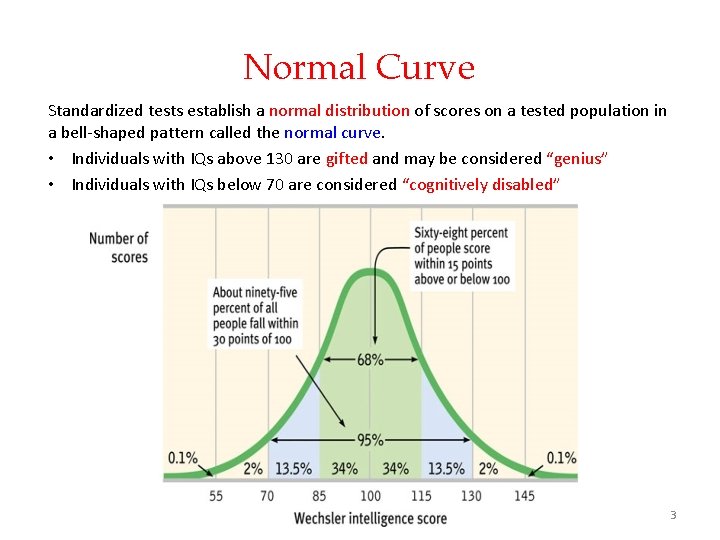
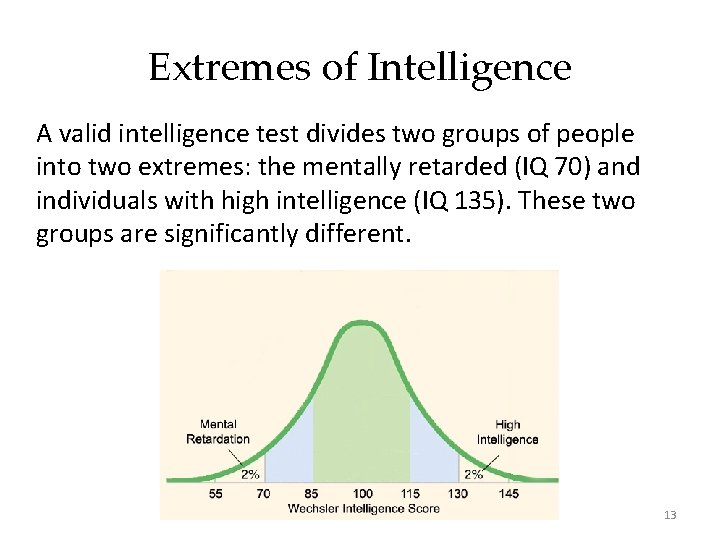
Normal Curve Standardized tests establish a normal distribution of scores on a tested population in a bell-shaped pattern called the normal curve. • Individuals with IQs above 130 are gifted and may be considered “genius” • Individuals with IQs below 70 are considered “cognitively disabled” 3
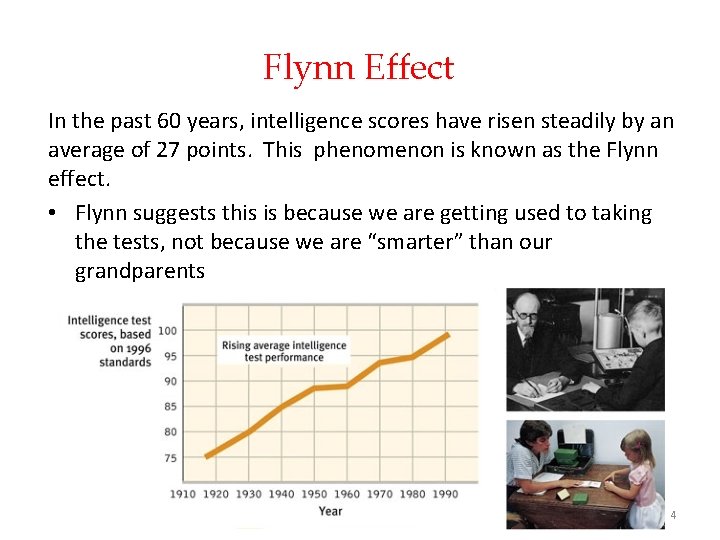
Flynn Effect In the past 60 years, intelligence scores have risen steadily by an average of 27 points. This phenomenon is known as the Flynn effect. • Flynn suggests this is because we are getting used to taking the tests, not because we are “smarter” than our grandparents 4
Sample IQ test • Do this at home, not in class: – http: //www. free-iqtest. net/score. asp – I (Mr. G-G) got a 136 the last time I did this…am I a genius? • Probably not. I’ve taken the same 2 -3 times. According to the _____ effect, I likely got better at taking the test. • (136 is still pretty darned good though, even with the Flynn effect – this is likely to increase my self efficacy, which folks like Rogers say is important to my mental health)
Principles of Test Construction For a psychological test to be acceptable it must fulfill the following three criteria: 1. Standardization 2. Reliability 3. Validity 6
Standardization Standardizing a test involves administering the test to a representative sample of future test takers in order to establish a basis for meaningful comparison. 7
Reliability A test is reliable when it yields consistent results. To establish reliability researchers establish different procedures: 1. 2. 3. Split-half Reliability: Dividing the test into two equal halves and assessing how consistent the scores are. Reliability using different tests: Using different forms of the test to measure consistency between them. Test-Retest Reliability: Using the same test on two occasions to measure consistency. 8
Validity Reliability of a test does not ensure validity. Validity of a test refers to what the test is supposed to measure or predict. 1. Content Validity: Refers to the extent a test measures a particular behavior or trait. 2. Predictive Validity: Refers to the function of a test in predicting a particular behavior or trait. 9
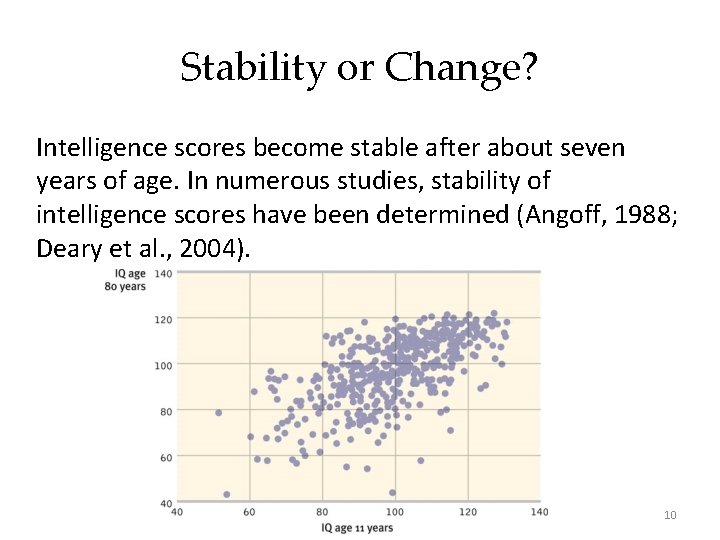
Stability or Change? Intelligence scores become stable after about seven years of age. In numerous studies, stability of intelligence scores have been determined (Angoff, 1988; Deary et al. , 2004). 10
Problems with Intelligence Tests • They don’t measure all types of intelligence • They don’t measure effort, commitment, or emotional stability
The Dynamics of Intelligence Does intelligence remain stable over a lifetime or does it change? Are individuals on the two extremes of the intelligence scale really that different? 12
Extremes of Intelligence A valid intelligence test divides two groups of people into two extremes: the mentally retarded (IQ 70) and individuals with high intelligence (IQ 135). These two groups are significantly different. 13
Quick Write: EXPLAIN THE DIFFERENCE • Between the reliability & validity of a test. – Identify the criteria required for a test to be considered reliable, and for a test to be considered valid. – What is necessary in order for a test to be “standardized? ” Why is standardization necessary?
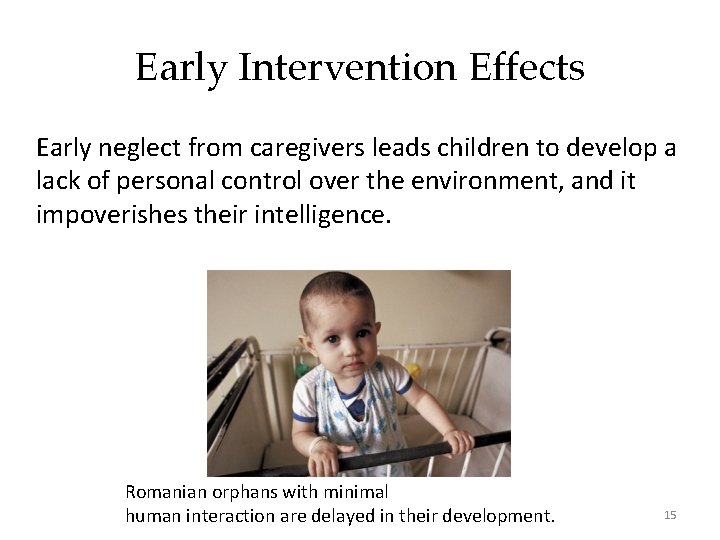
Early Intervention Effects Early neglect from caregivers leads children to develop a lack of personal control over the environment, and it impoverishes their intelligence. Romanian orphans with minimal human interaction are delayed in their development. 15
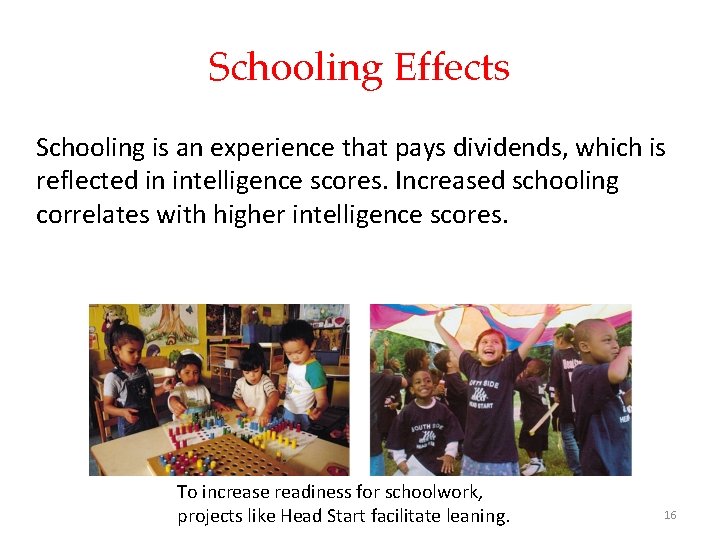
Schooling Effects Schooling is an experience that pays dividends, which is reflected in intelligence scores. Increased schooling correlates with higher intelligence scores. To increase readiness for schoolwork, projects like Head Start facilitate leaning. 16
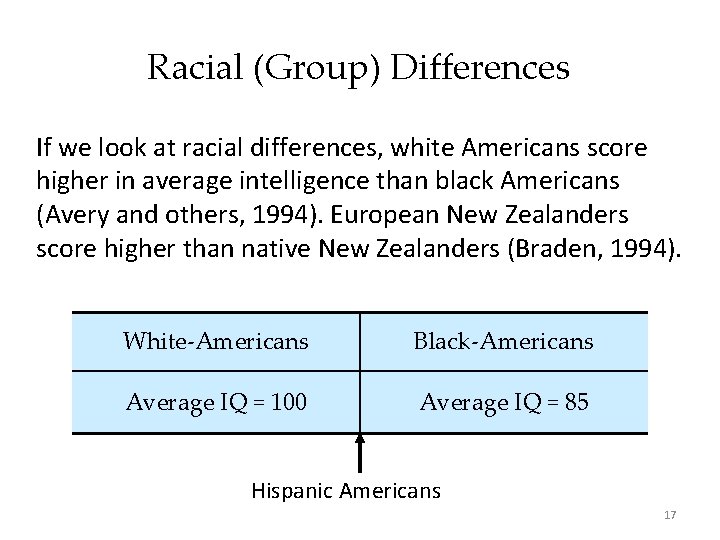
Racial (Group) Differences If we look at racial differences, white Americans score higher in average intelligence than black Americans (Avery and others, 1994). European New Zealanders score higher than native New Zealanders (Braden, 1994). White-Americans Black-Americans Average IQ = 100 Average IQ = 85 Hispanic Americans 17
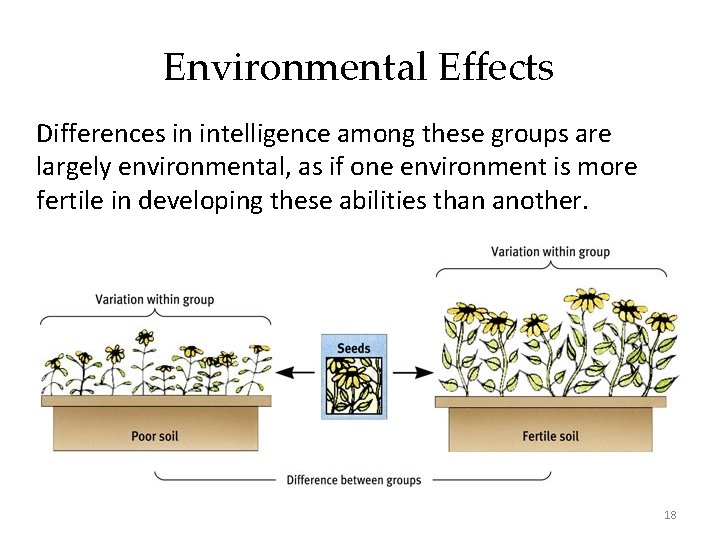
Environmental Effects Differences in intelligence among these groups are largely environmental, as if one environment is more fertile in developing these abilities than another. 18
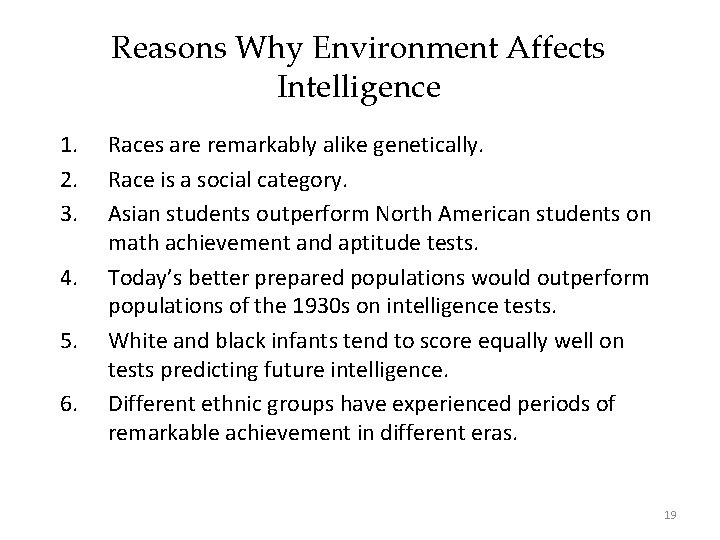
Reasons Why Environment Affects Intelligence 1. 2. 3. 4. 5. 6. Races are remarkably alike genetically. Race is a social category. Asian students outperform North American students on math achievement and aptitude tests. Today’s better prepared populations would outperform populations of the 1930 s on intelligence tests. White and black infants tend to score equally well on tests predicting future intelligence. Different ethnic groups have experienced periods of remarkable achievement in different eras. 19
Prep for Socratic Seminar
Race, Intelligence Tests, & Education • Race Science – some intelligence tests were originally designed to prove that blacks had a lower natural intelligence level than whites – Some social scientists argue out that for minorities to succeed in a white-dominated world requires “acting” white, and point out that refusing to do so is a form or resistance against oppression – Donald Glover clip: http: //www. huffingtonpost. com/2010/03/18/donaldglover-obama-is-a_n_504645. html
Race, Intelligence Tests, & Education • Affirmative Action – What is it? – Bakke v. California; & Grutter v. Bollinger – Fisher v. Texas (current case)
Daily Commentary: RESPOND: Jencks & Phillips (1998) • “The average black child now attends school in a district that spends as much per pupil as the average white child’s district…studies of mixed -race children and black children adopted by white parents suggest, however, that racial differences in test performance are largely if not entirely environmental in origin. ”
RESPOND: Jencks & Phillips (1998) • “successful theories will take more account of the factors that psychologists have traditionally emphasized…A good explanation of why white five-year-olds have bigger vocabularies than black five-year olds is likely to focus on how much the parents talk to their children, how they deal with children’s questions, and how they react when their children either learn or fail to learn something, not on how much money the parents have. ”
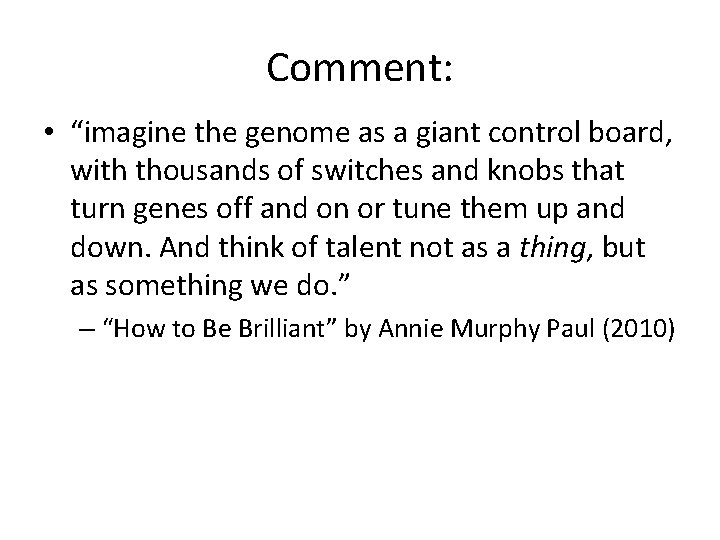
Comment: • “imagine the genome as a giant control board, with thousands of switches and knobs that turn genes off and on or tune them up and down. And think of talent not as a thing, but as something we do. ” – “How to Be Brilliant” by Annie Murphy Paul (2010)
Write comments: • “two weaknesses in [this] argument become evident. The first is the matter of where the extreme drive and discipline that greatnesss requires are supposed to come from. Shenk tells us about Beethoven wrting 60 to 70 drafts of a single phrase of music, and Ted Williams hitting practive pitches until his hands bled. Shenk would be the last to argue that such fierece dedication is “inborn” or “innate” – but if it isn’t, are the rest of us equally capable of mustering it? ” – “How to Be Brilliant” by Annie Murphy Paul (2010)
Respond in writing: “Eugenics gave rise to laws in at least 30 states authorizing forced sterilization of the ostensibly feeble minded and hereditarily criminal…While blacks and American Indians were disproporitonately victimized, intelligence testing added many immigrants and others of “inferior stock, ” preodminantly Appalachian whites, to the rolls of the sterilized. “In the long run, the project of measuring “intelligence probably did more than eugenics to stigmatize and hold back the nonwhite. ” – Linda Gordon. “Who’s White. ” New York Times March 25, 2010
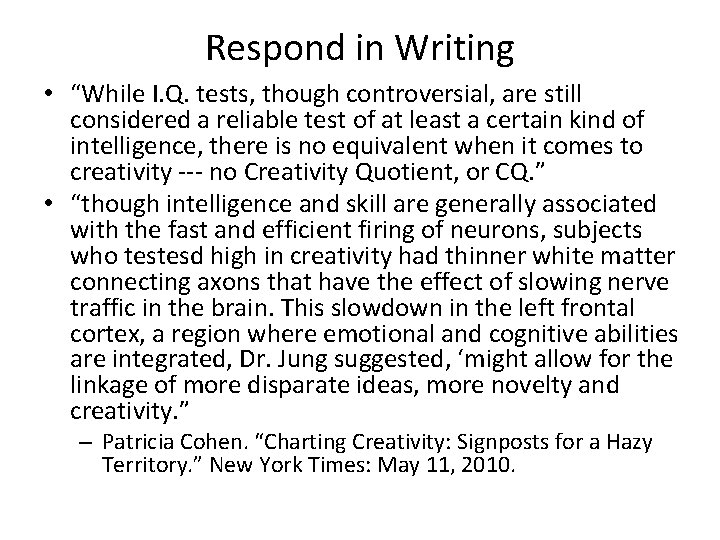
Respond in Writing • “While I. Q. tests, though controversial, are still considered a reliable test of at least a certain kind of intelligence, there is no equivalent when it comes to creativity --- no Creativity Quotient, or CQ. ” • “though intelligence and skill are generally associated with the fast and efficient firing of neurons, subjects who testesd high in creativity had thinner white matter connecting axons that have the effect of slowing nerve traffic in the brain. This slowdown in the left frontal cortex, a region where emotional and cognitive abilities are integrated, Dr. Jung suggested, ‘might allow for the linkage of more disparate ideas, more novelty and creativity. ” – Patricia Cohen. “Charting Creativity: Signposts for a Hazy Territory. ” New York Times: May 11, 2010.
Discussion Group Norms • Respect and LISTEN TO each other’s viewpoints – Summarize the point made by the previous speaker before you make your point – Balanced speaking time: give everyone a chance to participate • Use readings to support your opinions when you speak. – Cite the article you refer to, and bring in direct quotes for discussion if you have one ready • Respond to: – Discussion prompts – Your own discussion questions
Discussion Prompt: • Based on your reading and our experience with standardized tests like the SAT, are these a good measure of intelligence? Why or why not.
Discussion Prompt • Research suggests that the achievement gap may be caused by various social and psychological issues including: – Parenting styles – Child development & language acquisition • Is it the job of schools and education experts to address these concerns? – If so, how can this be done while still respecting the rights of parents make choices in how they raise their children. – Many parents have never studied child development. Is this a problem and how might it be addressed?
Discussion Prompt: • Suppose you are a Dean of Admission for a University. – What types of intelligences would you most value in your students? Only general intelligence? Or… • linguistic? logical/mathematical? Musical? Spatial? Kinesthetic? Intrapersonal? Interpersonal? naturalist? – Would you consider emotional intelligence as a factor in admissions?
Discussion Prompt • A strict reading of the 14 th amendment suggests that the use of race in college admissions is unconstitutional. Do we live in a color-blind society? Should University admissions be “race blind. ” – Is affirmative action a fair or unfair policy? Why? – How do you think the Court should rule in Fisher v. Texas? • BEFORE YOU LEAVE, place on the center table: – All article packets, in separate stacks based on the artice
Finish your KWL Charts 1. In the first column, write what you know (or think you know) about intelligence 2. In the second column, write questions you have about intelligence and how we measure it. 3. At the end of class, write what you learned through your reading and our discussion in the third column.
Take out your intelligence test • How long did it take you to finish? • +5 if you finished in under 20 minutes • +3 if you finished in under 30 minutes
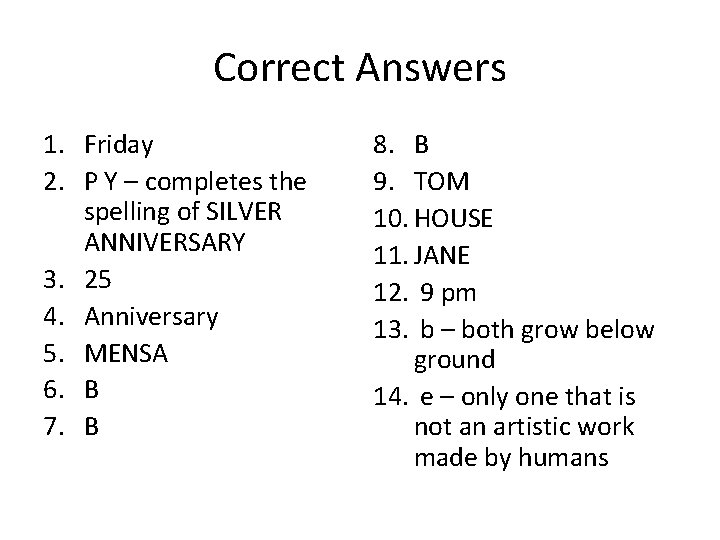
Correct Answers 1. Friday 2. P Y – completes the spelling of SILVER ANNIVERSARY 3. 25 4. Anniversary 5. MENSA 6. B 7. B 8. B 9. TOM 10. HOUSE 11. JANE 12. 9 pm 13. b – both grow below ground 14. e – only one that is not an artistic work made by humans
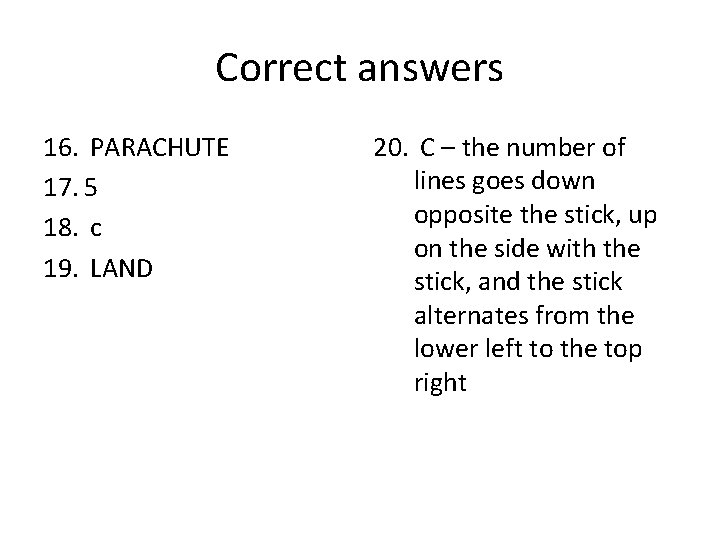
Correct answers 16. PARACHUTE 17. 5 18. c 19. LAND 20. C – the number of lines goes down opposite the stick, up on the side with the stick, and the stick alternates from the lower left to the top right
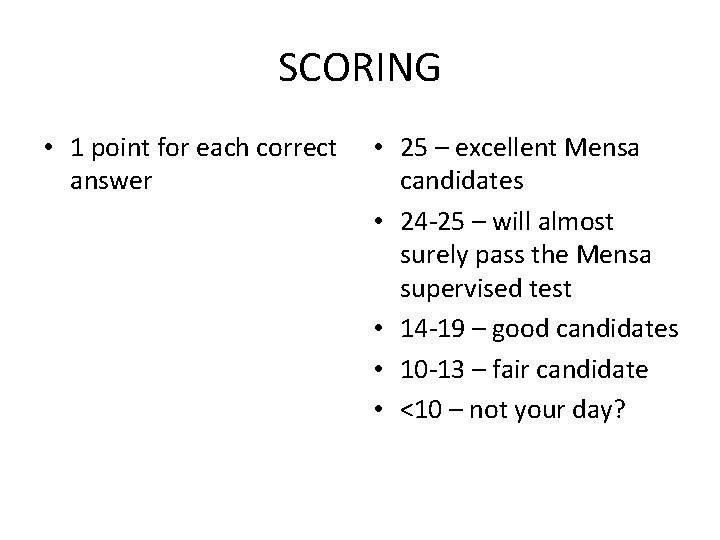
SCORING • 1 point for each correct answer • 25 – excellent Mensa candidates • 24 -25 – will almost surely pass the Mensa supervised test • 14 -19 – good candidates • 10 -13 – fair candidate • <10 – not your day?