
Unit 6 Cognitive Psychology Lesson 4 Defining Intelligence






- Slides: 25
Unit 6: Cognitive Psychology; Lesson 4: Defining Intelligence WARM UP PART ONE: WARM UP: PART TWO Fill out the first two columns of your KWL Chart. Please fill out the survey I gave you as you came in. I gave this before the break but have more copies now. VERBAL: What do you believe makes a person “smart”? Deadlines & Reminders: • Memory Memo to Freshman Academy: • Due before break; Now Late • Tomorrow: Intelligence Readings & Double response journals • Cognition Quiz: Wednesday Today’s Agenda / Plan: • Warm up • Memory Techniques • Memory Memo Tomorrow: • Socratic Seminar on Intelligence
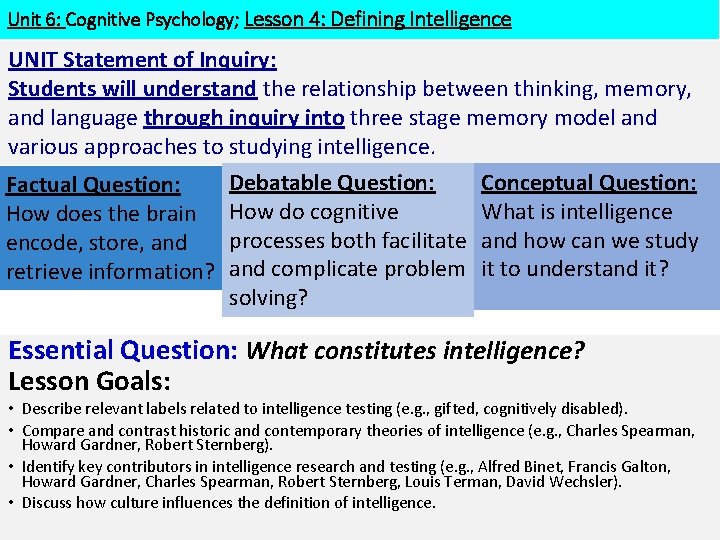
Unit 6: Cognitive Psychology; Lesson 4: Defining Intelligence UNIT Statement of Inquiry: Students will understand the relationship between thinking, memory, and language through inquiry into three stage memory model and various approaches to studying intelligence. Factual Question: How does the brain encode, store, and retrieve information? Debatable Question: How do cognitive processes both facilitate and complicate problem solving? Conceptual Question: What is intelligence and how can we study it to understand it? Essential Question: What constitutes intelligence? Lesson Goals: • Describe relevant labels related to intelligence testing (e. g. , gifted, cognitively disabled). • Compare and contrast historic and contemporary theories of intelligence (e. g. , Charles Spearman, Howard Gardner, Robert Sternberg). • Identify key contributors in intelligence research and testing (e. g. , Alfred Binet, Francis Galton, Howard Gardner, Charles Spearman, Robert Sternberg, Louis Terman, David Wechsler). • Discuss how culture influences the definition of intelligence.
Scoring Your Multiple Intelligence Survey Follow Instructions on the Back: Put an X for each question you answered TRUE for. A. B. C. D. E. F. G. Verbal Logic/Math Visual-spatial Kinesthetic / body Musical Intrapersonal interpersonal
What does it mean to be intelligent? • To learn from experience • How well you retain info • Adapting to new situations • Knowing things • Problem solving
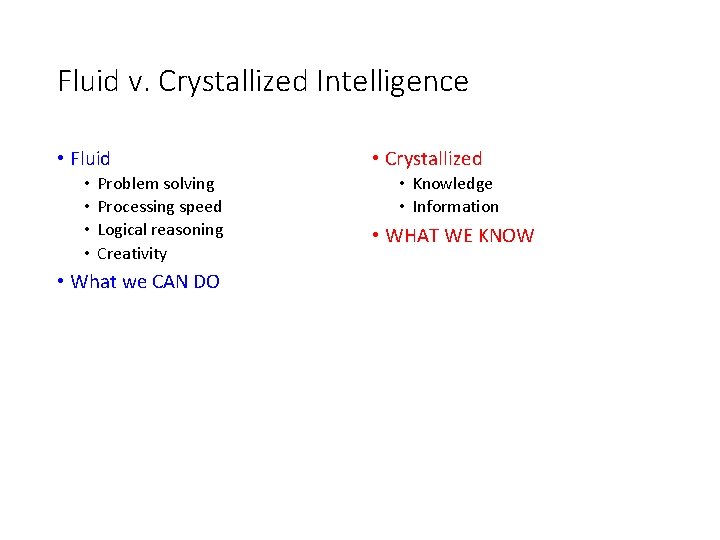
Fluid v. Crystallized Intelligence • Fluid • • Problem solving Processing speed Logical reasoning Creativity • What we CAN DO • Crystallized • Knowledge • Information • WHAT WE KNOW
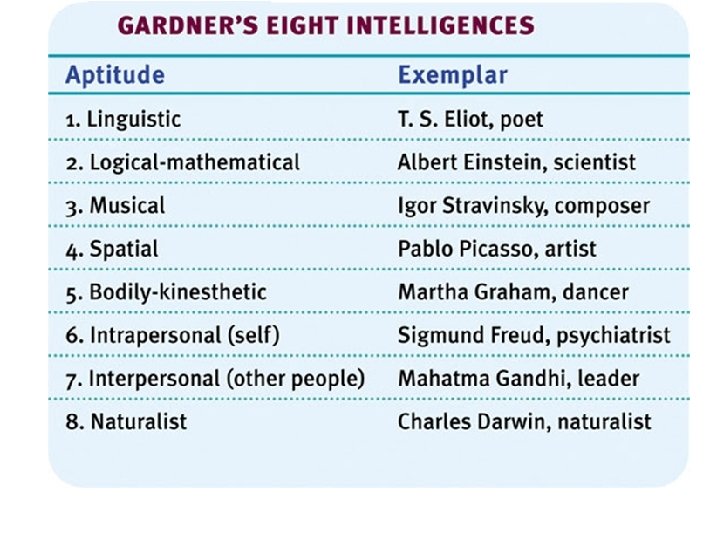
Howard Gardner proposes eight types of intelligences • speculates about a ninth one — existential intelligence. Existential intelligence is the ability to think about the question of life, death and existence. 6
Robert Sternberg (1985, 1999, 2003) also agrees with Gardner, but suggests three intelligences rather than eight. 1. 2. 3. Analytical Intelligence: Intelligence that is assessed by intelligence tests. Creative Intelligence: Intelligence that makes us adapt to novel situations, generating novel ideas. Practical Intelligence: Intelligence that is required for everyday tasks (e. g. street smarts). 8
Emotional Intelligence Emotional intelligence is the ability to perceive, understand, and use emotions (Salovey and colleagues, 2005). The test of emotional intelligence measures overall emotional intelligence and its four components. 9
Emotional Intelligence: Components Component Perceive emotion Understand emotion Manage emotion Use emotion Description Recognize emotions in faces, music and stories Predict emotions, how they change and blend Express emotions in different situations Utilize emotions to adapt or be creative 10
Emotional Intelligence: Criticism Gardner and others criticize the idea of emotional intelligence and question whether we stretch this idea of intelligence too far when we apply it to our emotions. 11
Theories: Comparison 12
Environmental Influences Studies of twins and adopted children also show the following: 1. Fraternal twins raised together tend to show similarity in intelligence scores. 2. Identical twins raised apart show slightly less similarity in their intelligence scores. 13
Ethnic Similarities and Differences To discuss this issue we begin with two disturbing but agreed upon “facts”: 1. Racial groups differ in their average “intelligence” scores. 2. High-scoring people (and groups) are more likely to attain high levels of education and income. 14
Gender Similarities and Differences: Correlation? Causation? Social Constructs? There are seven ways in which males and females differ in various abilities. 1. Girls are better spellers 2. Girls are verbally fluent and have large vocabularies 3. Girls are better at locating objects 4. Girls are more sensitive to touch, taste, and color 5. Boys outnumber girls in counts of underachievement 6. Boys outperform girls at math problem solving, but under perform at math computation 7. Women detect emotions more easily than men do 15
Quick Write - Classroom • Based on your understanding of Gardner’s work, which intelligences do you are strongest with? • Weakest?
Is Intelligence Neurologically Measurable? Recent Studies indicate some correlation (about +. 40) between brain size and intelligence. As brain size decreases with age, scores on verbal intelligence tests also decrease. Gray matter concentration in people with high intelligence. 17
Brain Function Studies of brain functions show that people who score high on intelligence tests perceive stimuli faster, retrieve information from memory quicker, and show faster brain response times. People with higher intelligence respond correctly and quickly to the above question. 18
Alfred Binet & Theodore Simon • Developed the first “modern” intelligence test • developed questions designed to PREDICT children’s future progress in the Paris school system. 19
Lewis Terman Ø Lewis Terman adapted Binet’s test for American school children and named the test the Stanford. Binet Test. Ø Terman used racial differences in test scores to justify white supremacy, and used race science to support eugenics Ø Terman’s work led to William Stern developing the formula of Intelligence Quotient (IQ): 20
Race, Intelligence Tests, & Education • Race Science – some intelligence tests were originally designed to prove that blacks had a lower natural intelligence level than whites • Some social scientists argue out that for minorities to succeed in a white-dominated world requires “acting” white, and point out that refusing to do so is a form or resistance against oppression • Donald Glover clip: http: //www. huffingtonpost. com/2010/03/18/donald -glover-obama-is-a_n_504645. html
Aptitude and Achievement Tests Ø Aptitude tests are intended to predict your ability to learn a new skill (FLUID INTELLIGENCE) Ø achievement tests are intended to reflect what you have already learned (CRYSTALLIZED INTELLIGENCE) 22
David Wechsler Ø developed the Wechsler Adult Intelligence Scale (WAIS) Ø also the Wechsler Intelligence Scale for Children (WISC), an intelligence test for preschoolers. 23
Quick Write • Give an example of an aptitude test you have taken and an example of an achievement test you have taken. • What type of intelligence is required for each test?
Now & Tonight: 1. 2. Now: Complete the intelligence test provided. If you finish: Get Smart module on Psych. Sim 5 • Tonight: • Do your reading for THURSDAY’S socratic seminar