
UNIT 6 Chemical Equilibrium Do Now 1 What
UNIT 6: Chemical Equilibrium Do Now: 1. What does the term chemical equilibrium mean? 2. TRUE/FALSE: When a system is at equilibrium the concentrations of reactants and products is equal. 3. What will happen to a previously established equilibrium if you add a product substance to the reaction mixture?
Dynamic Equilibrium �Many chemical reactions and processes in a given system are reversible �Biological/Environmental Examples: � Oxygen binding and releasing from hemoglobin � Evaporation and condensation of water in the atmosphere � Carbon cycle �Chemical systems � Solid dissolving and then crystallizing � Electrons being lost and gained in REDOX reactions � H+ ions being exchanged in acid-base reactions �Many of these reversible processes are accompanied by observable events Color change: titrations � Gas being released �
�Dynamic equilibrium �Exists in a reversible reaction when the RATE of the forward reaction is EQUAL to the RATE of the reverse reaction �***ALERT: COMMON MISCONCEPTION: NOT the same as having equal concentrations of reactant and product substances—that will depend on the stoichiometry, starting concentrations and other factors (discussed later).

�Establishing Dynamic Equilibrium �At the beginning of a reversible reaction � Reactant concentrations are high � There is no product (time = zero) to low product � Rate of forward reaction is high � Rate of backward reaction is very low �As reaction progresses � Reactant concentrations will fall (since reactants are used up) � Product concentrations will increase (since products are formed) � Rate of forward reaction will begin to decrease � Rate of backward reaction will begin to increase �Equilibrium � The point at which the rates of forward and backward reaction are the same � Reactants and products converted into each other at the same rate, therefore, concentrations become stable (NOT EQUAL) and do not change (in graphical representation, shown as a horizontal line)
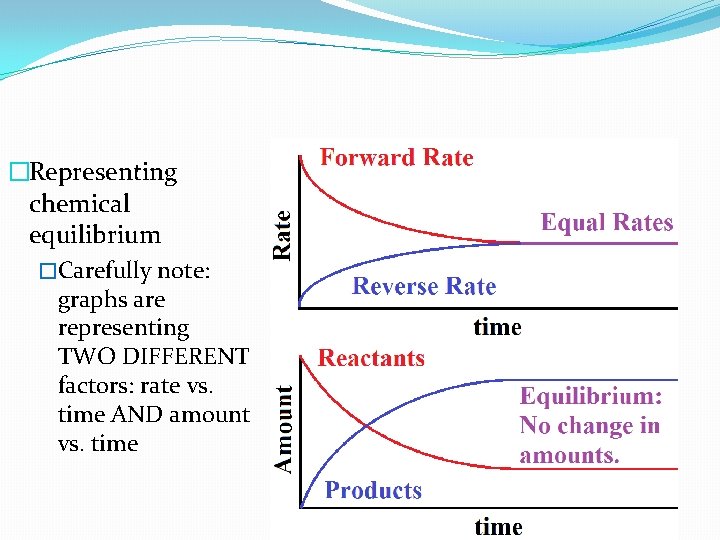
�Representing chemical equilibrium �Carefully note: graphs are representing TWO DIFFERENT factors: rate vs. time AND amount vs. time

�Disrupting Equilibrium �Once equilibrium has been established, it can be disrupted in many ways a sudden introduction of reactants (an increase in concentration of reactants) results in a sudden dramatic increase in the forward reaction � After a spike in the forward rate, a new, constant forward reaction rate will be established � The same effect can be observed in the reverse reaction rate when a product is introduced. �
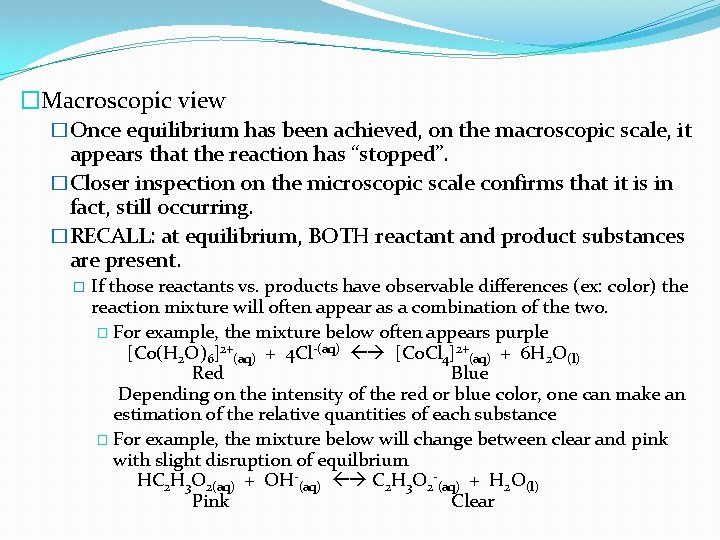
�Macroscopic view �Once equilibrium has been achieved, on the macroscopic scale, it appears that the reaction has “stopped”. �Closer inspection on the microscopic scale confirms that it is in fact, still occurring. �RECALL: at equilibrium, BOTH reactant and product substances are present. � If those reactants vs. products have observable differences (ex: color) the reaction mixture will often appear as a combination of the two. � For example, the mixture below often appears purple [Co(H 2 O)6]2+(aq) + 4 Cl-(aq) [Co. Cl 4]2+(aq) + 6 H 2 O(l) Red Blue Depending on the intensity of the red or blue color, one can make an estimation of the relative quantities of each substance � For example, the mixture below will change between clear and pink with slight disruption of equilbrium HC 2 H 3 O 2(aq) + OH-(aq) C 2 H 3 O 2 -(aq) + H 2 O(l) Pink Clear
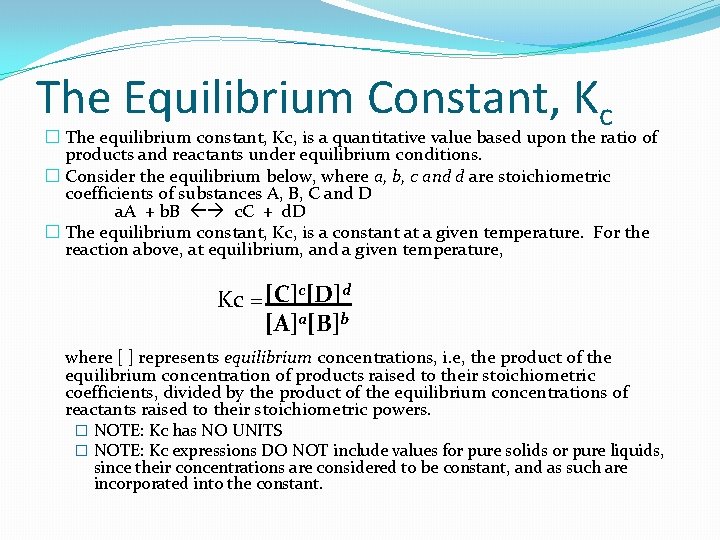
The Equilibrium Constant, Kc � The equilibrium constant, Kc, is a quantitative value based upon the ratio of products and reactants under equilibrium conditions. � Consider the equilibrium below, where a, b, c and d are stoichiometric coefficients of substances A, B, C and D a. A + b. B c. C + d. D � The equilibrium constant, Kc, is a constant at a given temperature. For the reaction above, at equilibrium, and a given temperature, c d Kc = [C] [D] [A]a[B]b where [ ] represents equilibrium concentrations, i. e, the product of the equilibrium concentration of products raised to their stoichiometric coefficients, divided by the product of the equilibrium concentrations of reactants raised to their stoichiometric powers. � NOTE: Kc has NO UNITS � NOTE: Kc expressions DO NOT include values for pure solids or pure liquids, since their concentrations are considered to be constant, and as such are incorporated into the constant.
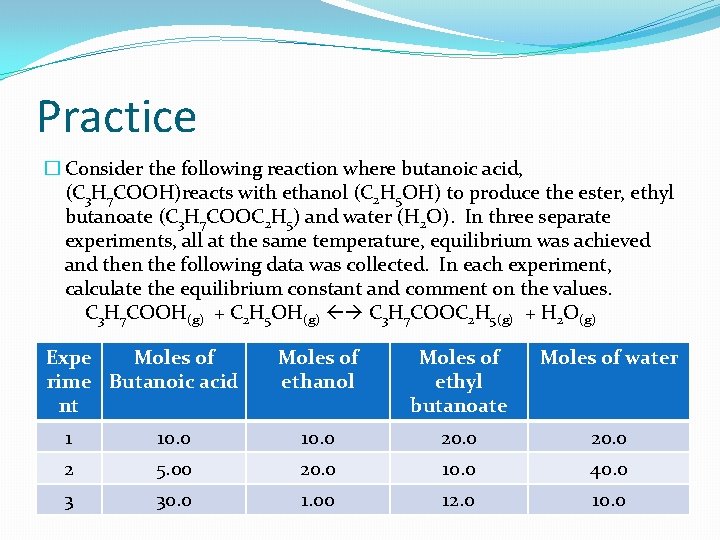
Practice � Consider the following reaction where butanoic acid, (C 3 H 7 COOH)reacts with ethanol (C 2 H 5 OH) to produce the ester, ethyl butanoate (C 3 H 7 COOC 2 H 5) and water (H 2 O). In three separate experiments, all at the same temperature, equilibrium was achieved and then the following data was collected. In each experiment, calculate the equilibrium constant and comment on the values. C 3 H 7 COOH(g) + C 2 H 5 OH(g) C 3 H 7 COOC 2 H 5(g) + H 2 O(g) Expe Moles of rime Butanoic acid nt Moles of ethanol Moles of ethyl butanoate Moles of water 1 10. 0 20. 0 2 5. 00 20. 0 10. 0 40. 0 3 30. 0 1. 00 12. 0 10. 0
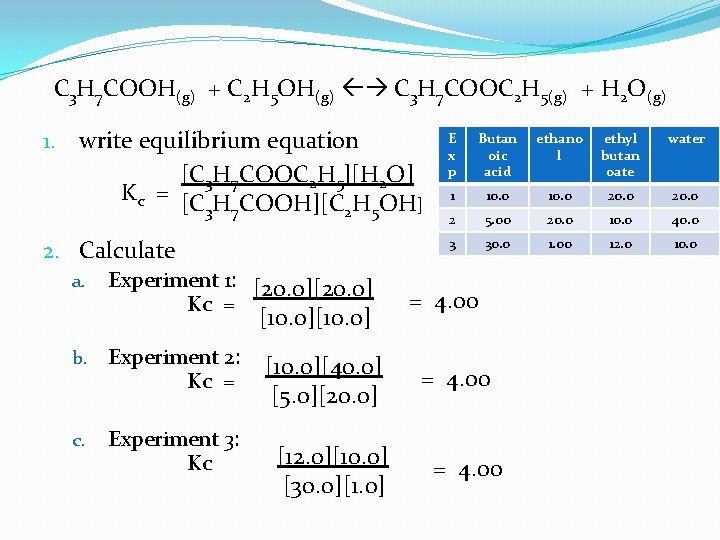
C 3 H 7 COOH(g) + C 2 H 5 OH(g) C 3 H 7 COOC 2 H 5(g) + H 2 O(g) 1. write equilibrium equation [C 3 H 7 COOC 2 H 5][H 2 O] Kc = [C H COOH][C H OH] 3 7 2 5 E x p Butan oic acid ethano l ethyl butan oate water 1 10. 0 20. 0 2 5. 00 20. 0 10. 0 40. 0 2. Calculate 3 30. 0 1. 00 12. 0 10. 0 a. Experiment 1: [20. 0] Kc = [10. 0] b. Experiment 2: Kc = c. Experiment 3: Kc [10. 0][40. 0] [5. 0][20. 0] [12. 0][10. 0] [30. 0][1. 0] = 4. 00
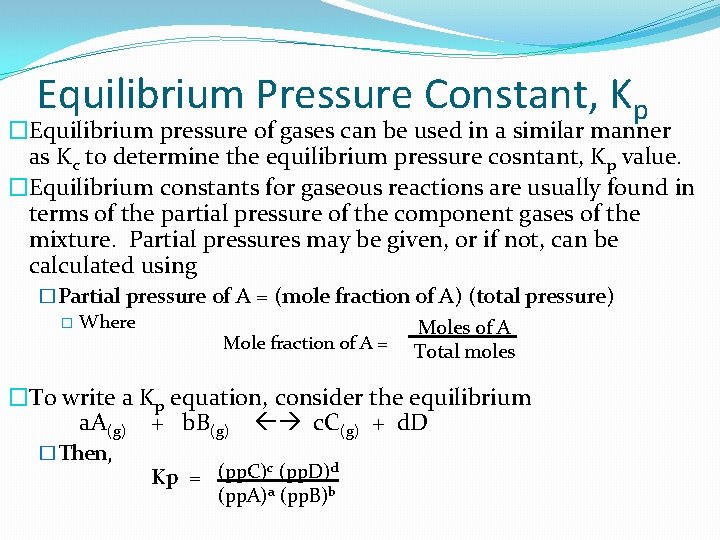
Equilibrium Pressure Constant, Kp �Equilibrium pressure of gases can be used in a similar manner as Kc to determine the equilibrium pressure cosntant, Kp value. �Equilibrium constants for gaseous reactions are usually found in terms of the partial pressure of the component gases of the mixture. Partial pressures may be given, or if not, can be calculated using �Partial pressure of A = (mole fraction of A) (total pressure) � Where Moles of A Mole fraction of A = Total moles �To write a Kp equation, consider the equilibrium a. A(g) + b. B(g) c. C(g) + d. D �Then, c d Kp = (pp. C) (pp. D) (pp. A)a (pp. B)b
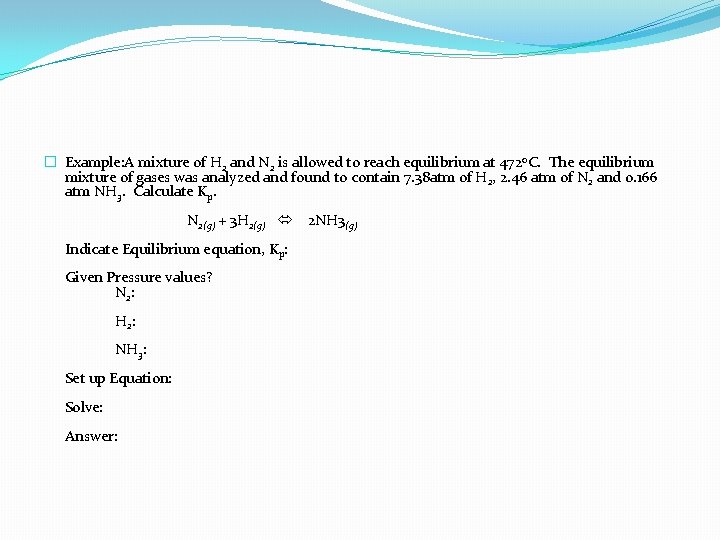
� Example: A mixture of H 2 and N 2 is allowed to reach equilibrium at 472 o. C. The equilibrium mixture of gases was analyzed and found to contain 7. 38 atm of H 2, 2. 46 atm of N 2 and 0. 166 atm NH 3. Calculate Kp. N 2(g) + 3 H 2(g) Indicate Equilibrium equation, Kp: Given Pressure values? N 2: H 2: NH 3: Set up Equation: Solve: Answer: 2 NH 3(g)
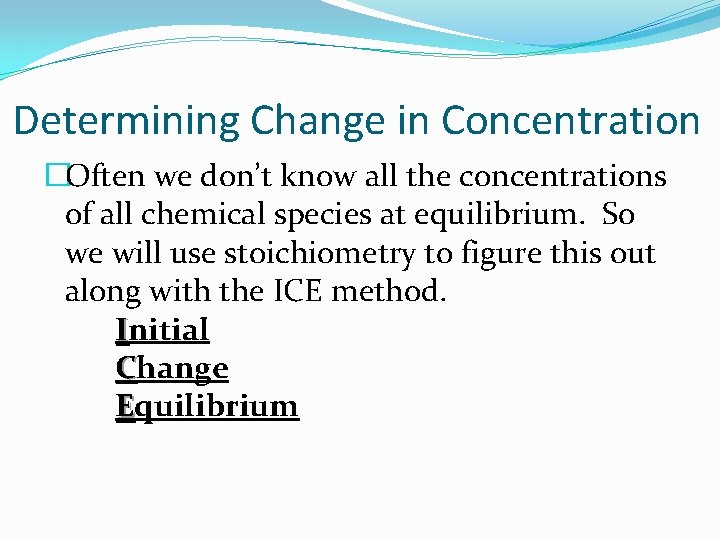
Determining Change in Concentration �Often we don’t know all the concentrations of all chemical species at equilibrium. So we will use stoichiometry to figure this out along with the ICE method. Initial Change Equilibrium
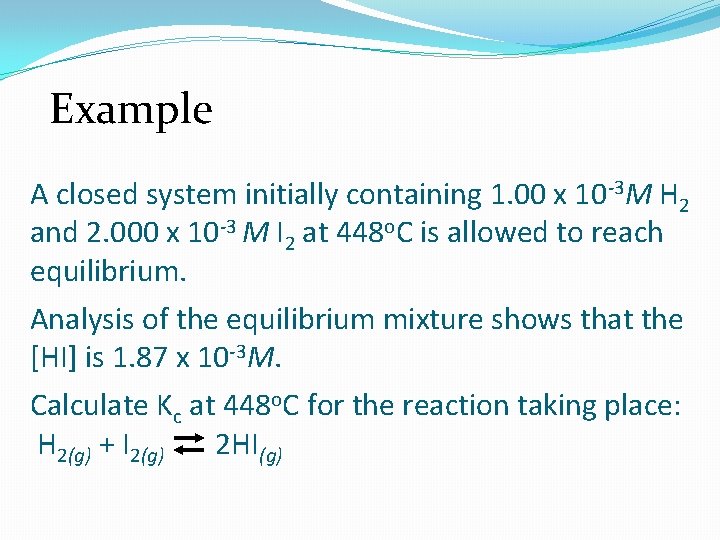
Example A closed system initially containing 1. 00 x 10 -3 M H 2 and 2. 000 x 10 -3 M I 2 at 448 o. C is allowed to reach equilibrium. Analysis of the equilibrium mixture shows that the [HI] is 1. 87 x 10 -3 M. Calculate Kc at 448 o. C for the reaction taking place: H 2(g) + I 2(g) 2 HI(g)
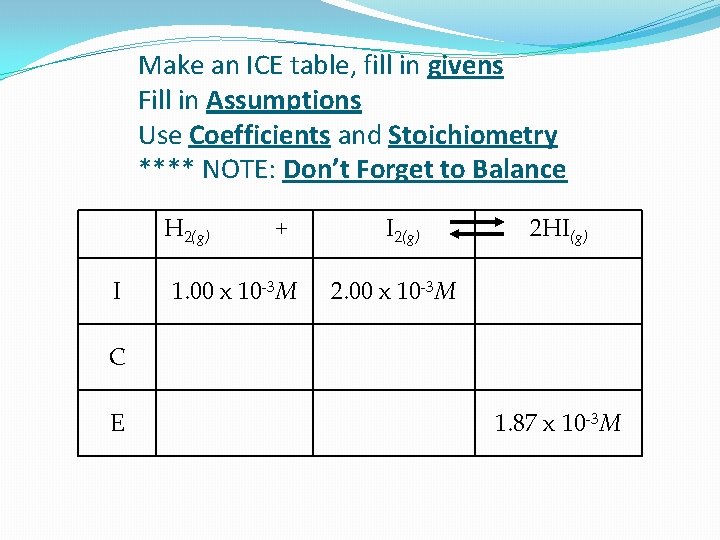
Make an ICE table, fill in givens Fill in Assumptions Use Coefficients and Stoichiometry **** NOTE: Don’t Forget to Balance H 2(g) I + 1. 00 x 10 -3 M I 2(g) 2 HI(g) 2. 00 x 10 -3 M C E 1. 87 x 10 -3 M
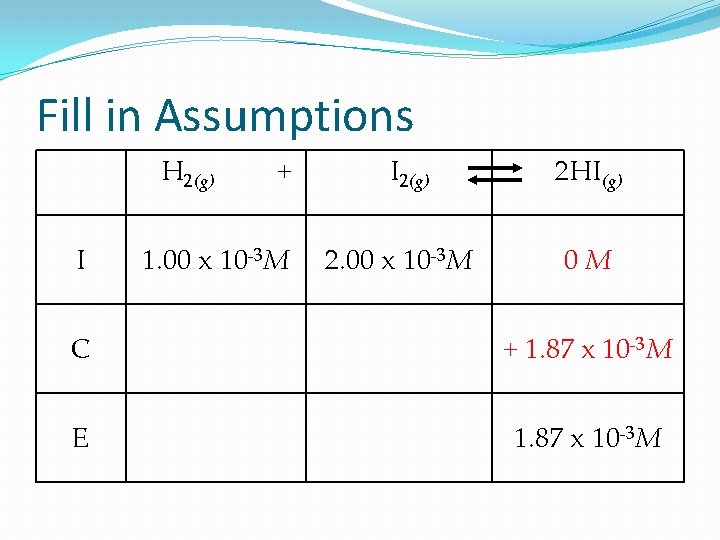
Fill in Assumptions H 2(g) I + 1. 00 x 10 -3 M I 2(g) 2. 00 x 10 -3 M 2 HI(g) 0 M C + 1. 87 x 10 -3 M E 1. 87 x 10 -3 M
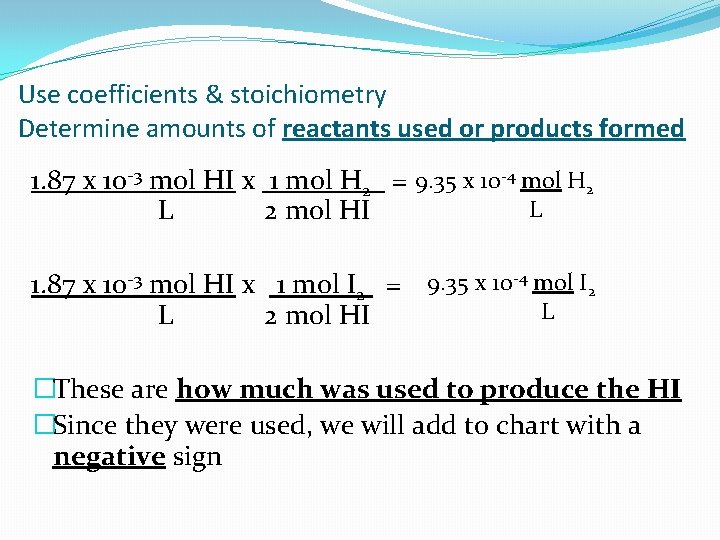
Use coefficients & stoichiometry Determine amounts of reactants used or products formed 1. 87 x 10 -3 mol HI x 1 mol H 2 = 9. 35 x 10 -4 mol H 2 L L 2 mol HI 1. 87 x 10 -3 mol HI x 1 mol I 2 = 9. 35 x 10 -4 mol I 2 L L 2 mol HI �These are how much was used to produce the HI �Since they were used, we will add to chart with a negative sign
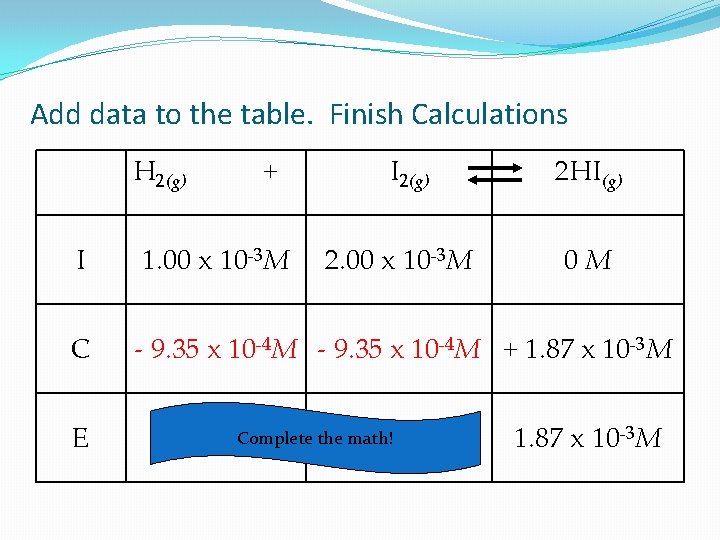
Add data to the table. Finish Calculations H 2(g) + I 2(g) I 1. 00 x 10 -3 M C - 9. 35 x 10 -4 M + 1. 87 x 10 -3 M E 2. 00 x 10 -3 M 2 HI(g) -5 M the math!x 10 -3 M 6. 5 x 10 Complete 1. 065 0 M 1. 87 x 10 -3 M
![Write Kc Equation: Kc = [HI]2 [H 2][I 2] Finally, calculate the Kc! [HI]2](http://slidetodoc.com/presentation_image_h2/793e2f074ef5ec91172c1cfa0fe53f7d/image-19.jpg "Write Kc Equation: Kc = [HI]2 [H 2][I 2] Finally, calculate the Kc! [HI]2")
Write Kc Equation: Kc = [HI]2 [H 2][I 2] Finally, calculate the Kc! [HI]2 (1. 87 x 10 -3)2 Kc = = (6. 5 x 10 -5)(1. 065 x 10 -3) [H 2][I 2] Kc = 51
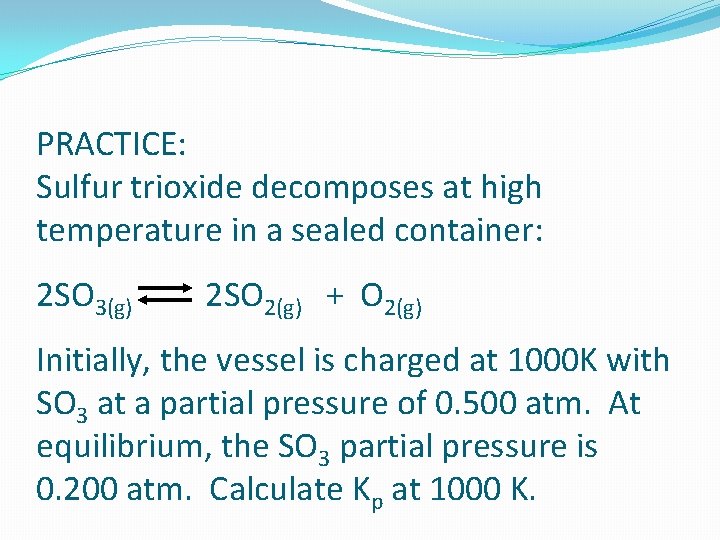
PRACTICE: Sulfur trioxide decomposes at high temperature in a sealed container: 2 SO 3(g) 2 SO 2(g) + O 2(g) Initially, the vessel is charged at 1000 K with SO 3 at a partial pressure of 0. 500 atm. At equilibrium, the SO 3 partial pressure is 0. 200 atm. Calculate Kp at 1000 K.
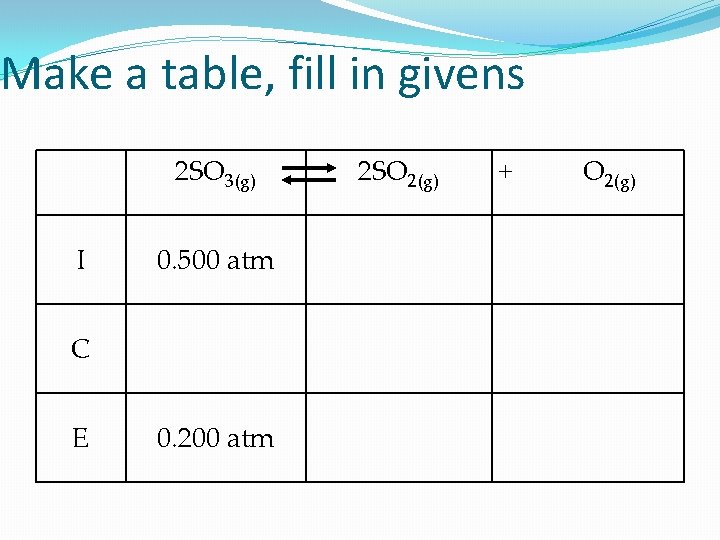
Make a table, fill in givens 2 SO 3(g) I 0. 500 atm C E 0. 200 atm 2 SO 2(g) + O 2(g)
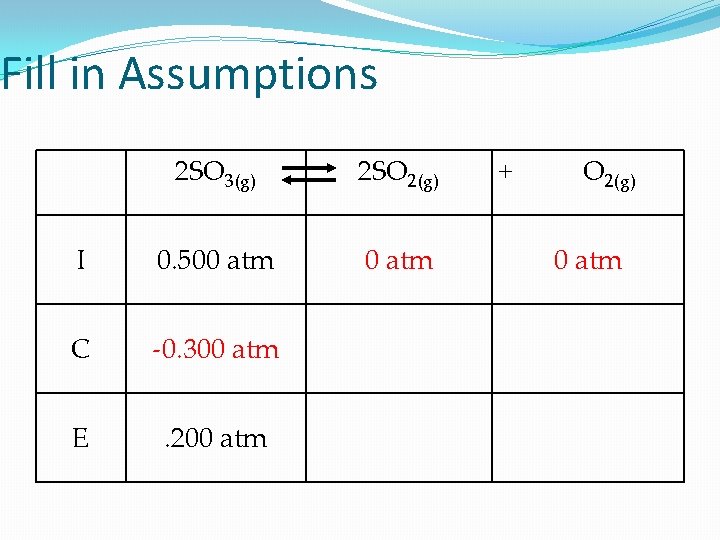
Fill in Assumptions 2 SO 3(g) 2 SO 2(g) I 0. 500 atm C -0. 300 atm E . 200 atm + O 2(g) 0 atm
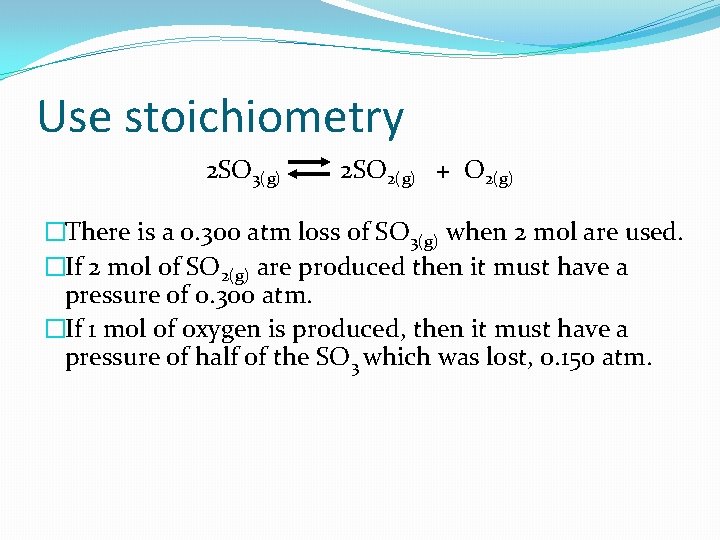
Use stoichiometry 2 SO 3(g) 2 SO 2(g) + O 2(g) �There is a 0. 300 atm loss of SO 3(g) when 2 mol are used. �If 2 mol of SO 2(g) are produced then it must have a pressure of 0. 300 atm. �If 1 mol of oxygen is produced, then it must have a pressure of half of the SO 3 which was lost, 0. 150 atm.
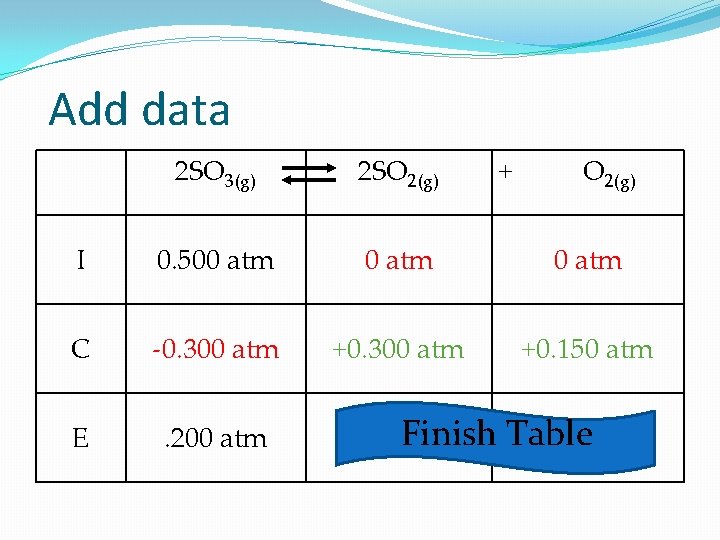
Add data 2 SO 3(g) 2 SO 2(g) I 0. 500 atm C -0. 300 atm +0. 150 atm E . 200 atm 0. 300 Finish atm + O 2(g) Table 0. 150 atm
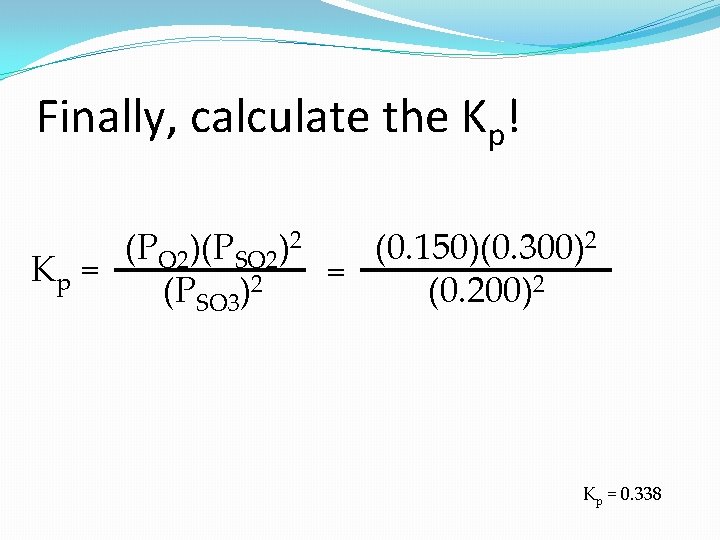
Finally, calculate the Kp! (PO 2)(PSO 2)2 (0. 150)(0. 300)2 Kp = = 2 (PSO 3) (0. 200)2 Kp = 0. 338
�What is you don’t have enough “assumptions” to fill in? �Use a variable (x) �Use quadratic equation to solve for x.
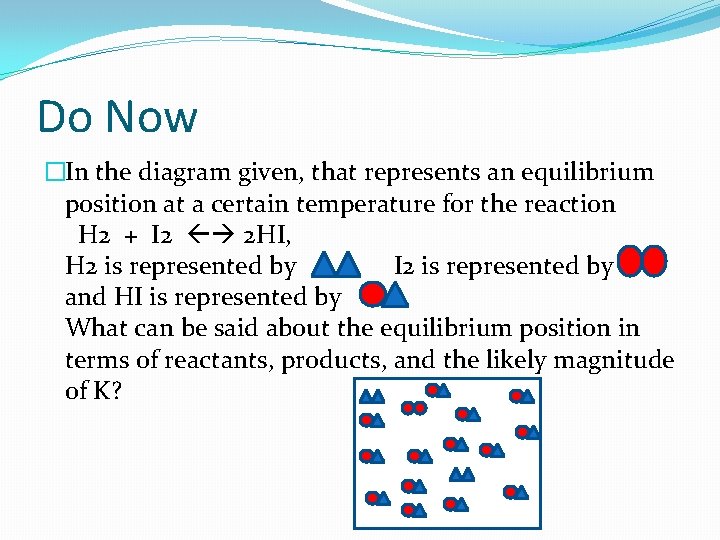
Do Now �In the diagram given, that represents an equilibrium position at a certain temperature for the reaction H 2 + I 2 2 HI, H 2 is represented by I 2 is represented by and HI is represented by What can be said about the equilibrium position in terms of reactants, products, and the likely magnitude of K?
The relationship between Kc and Kp �When a homogeneous gaseous equilibria is established, it is possible to express the equilibrium constant for the reaction in one of two ways: � In terms of concentration as Kc � In terms of partial pressure as Kp �It is often helpful to use the two terms interchangeably � Can be achieved using the following expression where � � � Kp = Kc (RT)∆n ∆n = stoichiometric number of moles of gaseous products – stoichiometric number of moles of gaseous reactants T = temperature in Kelvin R = 0. 08206 atm L k-1 mol-1 (Kp must have been calculated using atm) �NOTE 1: when ∆n = 0, i. e. there is NO change in moles of gas, Kc = Kp �NOTE 2: This equation is no longer given on the equations and constants sheets, so you will not be expected to use it quantitatively. Any qualitative question asking you to explain relationship is valid.
The Reaction Quotient, Q �When equilibrium is in the process of being established, i. e, at the beginning of the reaction, before forward and reverse rates are equal, we can use the reaction quotient, Q, to determine to what extent the reaction has proceeded. �Considering the generic equation (from earlier) a. A + b. B c. C + d. D Q can be calculated in a manner similar to Kc, using the following expression c d Q = [C] [D] [A]a[B]b
�Q seems to be essentially the same as K, and the expression is determined similarly, EXCEPT, Q is the same ratio at any other point (before equilibrium has been established or after equilibrium when a disruption is introduced) �Q allows us to make predictions about what a reaction will do, with any given set of conditions, in order to establish the equilibrium position, and convert Q to K �Think about it: �What does a value of Q > K tell you about the ratio of products to reactants? Q < K?
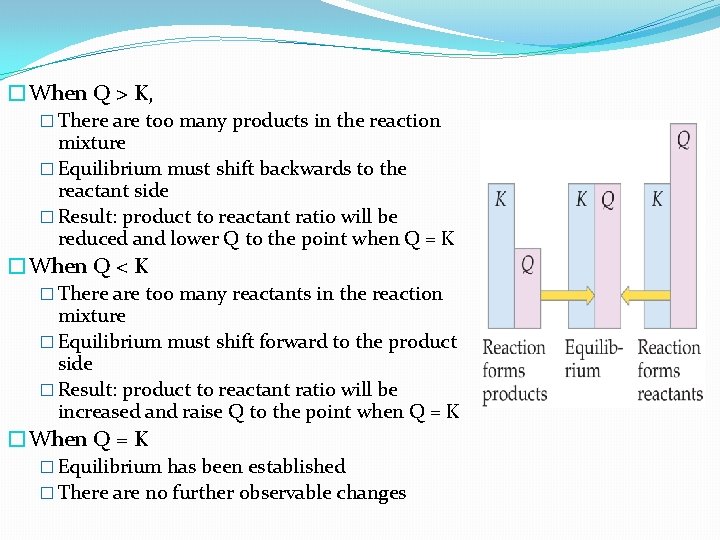
�When Q > K, � There are too many products in the reaction mixture � Equilibrium must shift backwards to the reactant side � Result: product to reactant ratio will be reduced and lower Q to the point when Q = K �When Q < K � There are too many reactants in the reaction mixture � Equilibrium must shift forward to the product side � Result: product to reactant ratio will be increased and raise Q to the point when Q = K �When Q = K � Equilibrium has been established � There are no further observable changes
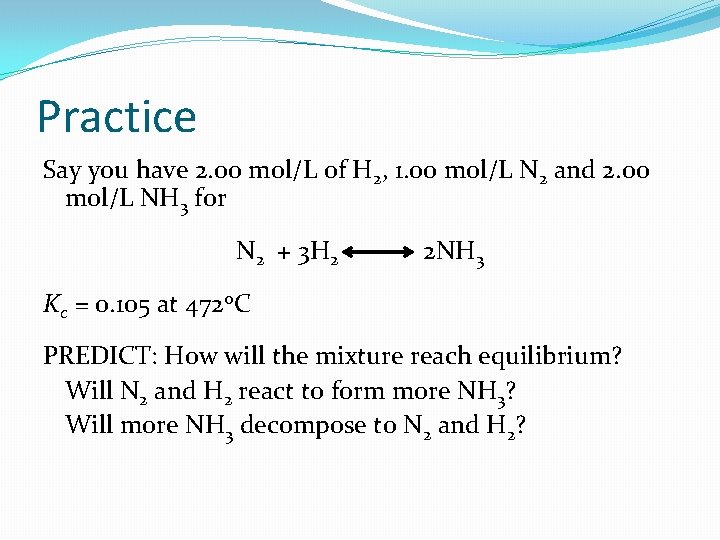
Practice Say you have 2. 00 mol/L of H 2, 1. 00 mol/L N 2 and 2. 00 mol/L NH 3 for N 2 + 3 H 2 2 NH 3 Kc = 0. 105 at 472 o. C PREDICT: How will the mixture reach equilibrium? Will N 2 and H 2 react to form more NH 3? Will more NH 3 decompose to N 2 and H 2?
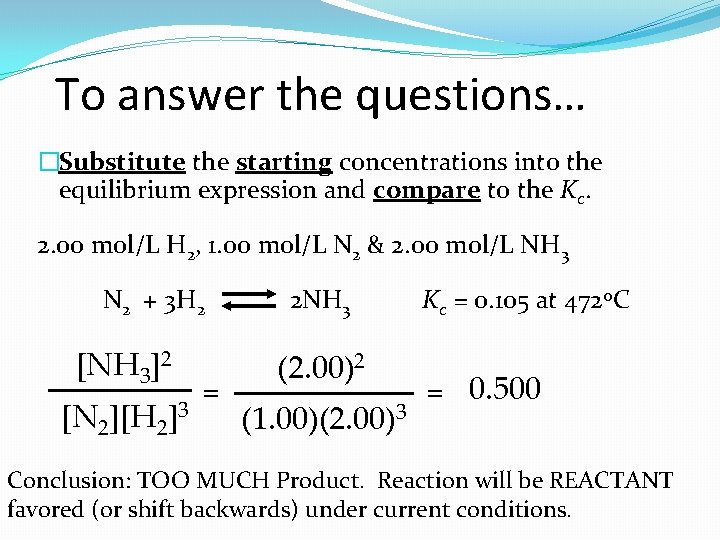
To answer the questions… �Substitute the starting concentrations into the equilibrium expression and compare to the Kc. 2. 00 mol/L H 2, 1. 00 mol/L N 2 & 2. 00 mol/L NH 3 N 2 + 3 H 2 [NH 3]2 [N 2][H 2]3 = 2 NH 3 (2. 00)2 (1. 00)(2. 00)3 Kc = 0. 105 at 472 o. C = 0. 500 Conclusion: TOO MUCH Product. Reaction will be REACTANT favored (or shift backwards) under current conditions.
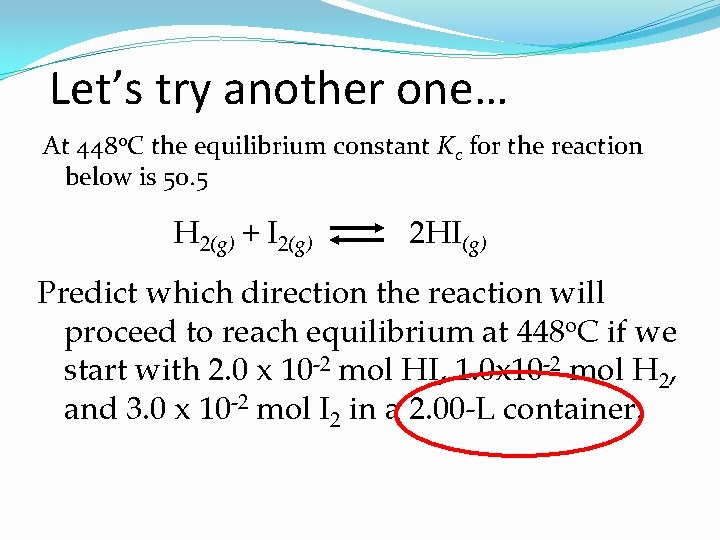
Let’s try another one… At 448 o. C the equilibrium constant Kc for the reaction below is 50. 5 H 2(g) + I 2(g) 2 HI(g) Predict which direction the reaction will proceed to reach equilibrium at 448 o. C if we start with 2. 0 x 10 -2 mol HI, 1. 0 x 10 -2 mol H 2, and 3. 0 x 10 -2 mol I 2 in a 2. 00 -L container.
![Get initial concentrations [HI] = 2. 0 x 10 -2 mol HI / 2.](http://slidetodoc.com/presentation_image_h2/793e2f074ef5ec91172c1cfa0fe53f7d/image-35.jpg "Get initial concentrations [HI] = 2. 0 x 10 -2 mol HI / 2.")
Get initial concentrations [HI] = 2. 0 x 10 -2 mol HI / 2. 00 L = 1. 0 x 10 -2 M [H 2] = 1. 0 x 10 -2 mol H 2 / 2. 00 L = 5. 0 x 10 -3 M [I 2] = 3. 0 x 10 -2 mol I 2 / 2. 00 L = 1. 5 x 10 -2 M [HI]2 [H 2][I 2] = (1. 0 x 10 -2)2 (5. 0 x 10 -3)(1. 5 x 10 -2) = 1. 3 = Q CONCLUSION: Q <<< K, therefore too much reactant is present. Reaction will be product favored, or shift to the product side.
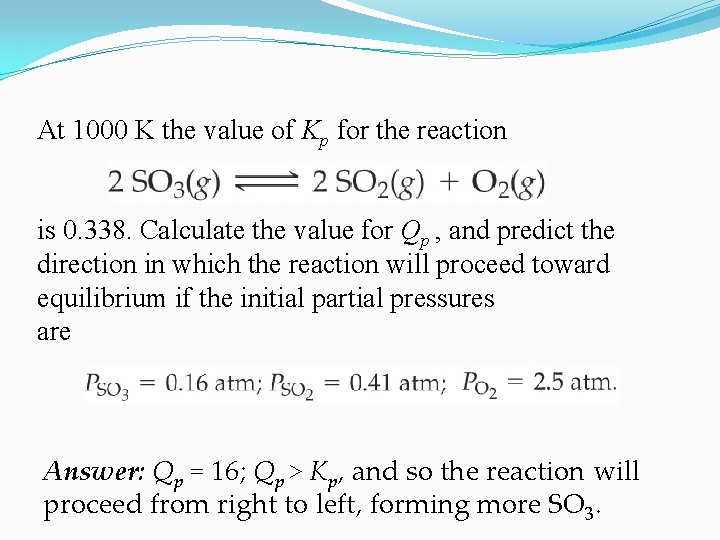
At 1000 K the value of Kp for the reaction is 0. 338. Calculate the value for Qp , and predict the direction in which the reaction will proceed toward equilibrium if the initial partial pressures are Answer: Qp = 16; Qp > Kp, and so the reaction will proceed from right to left, forming more SO 3.
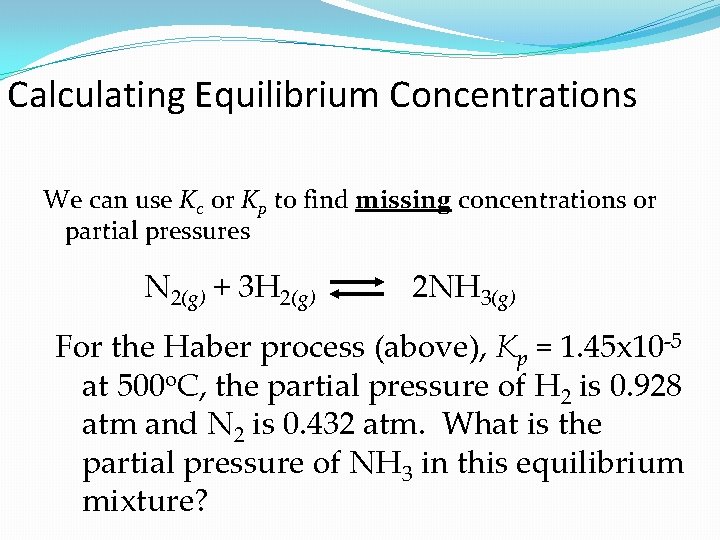
Calculating Equilibrium Concentrations We can use Kc or Kp to find missing concentrations or partial pressures N 2(g) + 3 H 2(g) 2 NH 3(g) For the Haber process (above), Kp = 1. 45 x 10 -5 at 500 o. C, the partial pressure of H 2 is 0. 928 atm and N 2 is 0. 432 atm. What is the partial pressure of NH 3 in this equilibrium mixture?
![N 2(g) + 3 H 2(g) atm Kp = 0. 438 [NH 3]2 [N](http://slidetodoc.com/presentation_image_h2/793e2f074ef5ec91172c1cfa0fe53f7d/image-38.jpg "N 2(g) + 3 H 2(g) atm Kp = 0. 438 [NH 3]2 [N")
N 2(g) + 3 H 2(g) atm Kp = 0. 438 [NH 3]2 [N 2][H 2]3 2 NH 3(g) 0. 928 = x x 2 [. 438][. 928] -5 = 1. 45 x 10 3 x 2 = 5. 01 x 10 -6 x = 2. 24 x 10 -3 atm = PNH 3
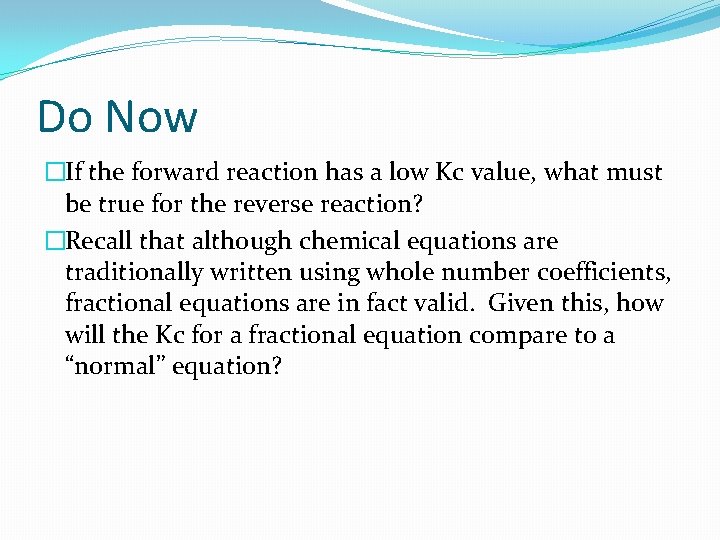
Do Now �If the forward reaction has a low Kc value, what must be true for the reverse reaction? �Recall that although chemical equations are traditionally written using whole number coefficients, fractional equations are in fact valid. Given this, how will the Kc for a fractional equation compare to a “normal” equation?
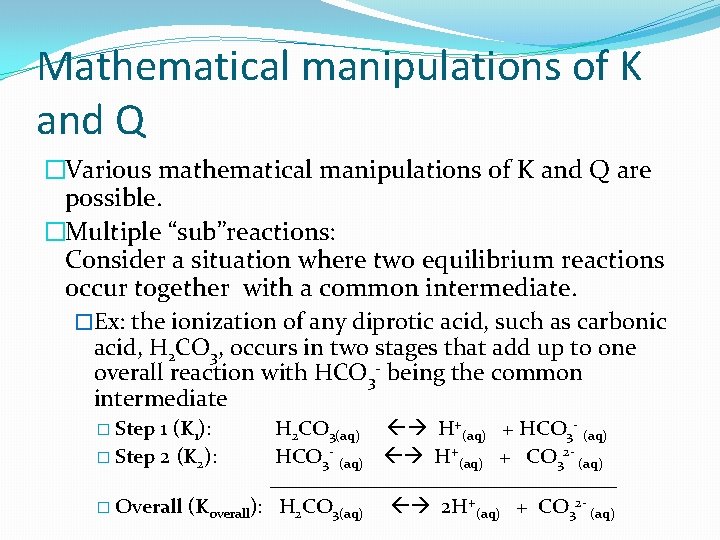
Mathematical manipulations of K and Q �Various mathematical manipulations of K and Q are possible. �Multiple “sub”reactions: Consider a situation where two equilibrium reactions occur together with a common intermediate. �Ex: the ionization of any diprotic acid, such as carbonic acid, H 2 CO 3, occurs in two stages that add up to one overall reaction with HCO 3 - being the common intermediate � Step 1 (K 1): � Step 2 (K 2): H 2 CO 3(aq) H+(aq) + HCO 3 - (aq) H+(aq) + CO 32 - (aq) _________________ � Overall (Koverall): H 2 CO 3(aq) 2 H+(aq) + CO 32 - (aq)
![� Write the K expressions for EACH of these equilibria [H+] [HCO 3 -]](http://slidetodoc.com/presentation_image_h2/793e2f074ef5ec91172c1cfa0fe53f7d/image-41.jpg "� Write the K expressions for EACH of these equilibria [H+] [HCO 3 -]")
� Write the K expressions for EACH of these equilibria [H+] [HCO 3 -] K 1 = � Step 1: [H 2 CO 3] � Step 2: � Overall: K 2 = [H+] [CO 32 -] [HCO 3 -] Koverall = [H+]2 [CO 32 -] [H 2 CO 3] � Identify any common intermediates (RECALL: intermediates are species that are produced in one step and consumed in another) � HCO 3� Based on these observations, we show that Koverall is the product of K 1 and K 2 � Therefore, Koverall = (K 1)(K 2) � This is true of all multiple, simultaneous equilibria with common intermediates.
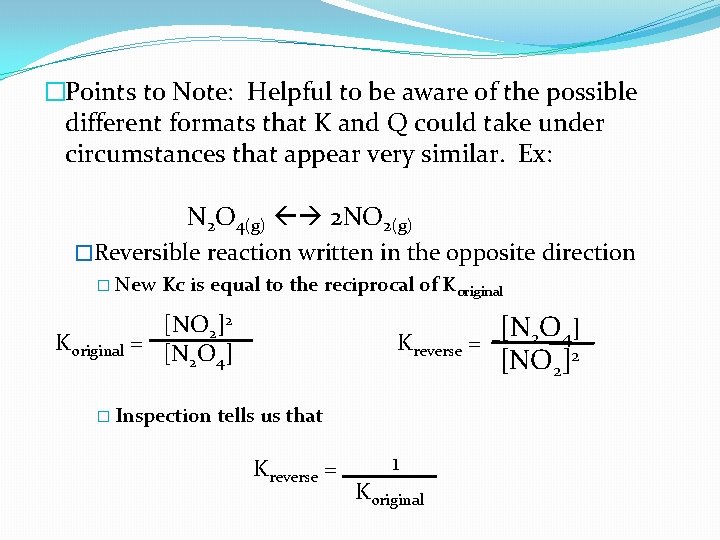
�Points to Note: Helpful to be aware of the possible different formats that K and Q could take under circumstances that appear very similar. Ex: N 2 O 4(g) 2 NO 2(g) �Reversible reaction written in the opposite direction � New Kc is equal to the reciprocal of Koriginal [N 2 O 4] Kreverse = [NO 2]2 Koriginal = [N O ] 2 4 � Inspection tells us that Kreverse = 1 Koriginal
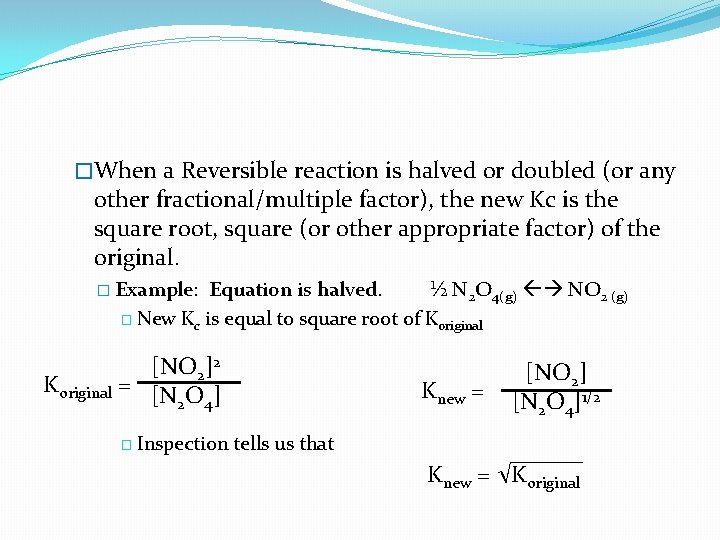
�When a Reversible reaction is halved or doubled (or any other fractional/multiple factor), the new Kc is the square root, square (or other appropriate factor) of the original. � Example: Equation is halved. ½ N 2 O 4(g) NO 2 (g) � New Kc is equal to square root of Koriginal [NO 2]2 Koriginal = [N O ] 2 4 � Inspection Knew = [NO 2] [N 2 O 4]1/2 tells us that Knew = √Koriginal
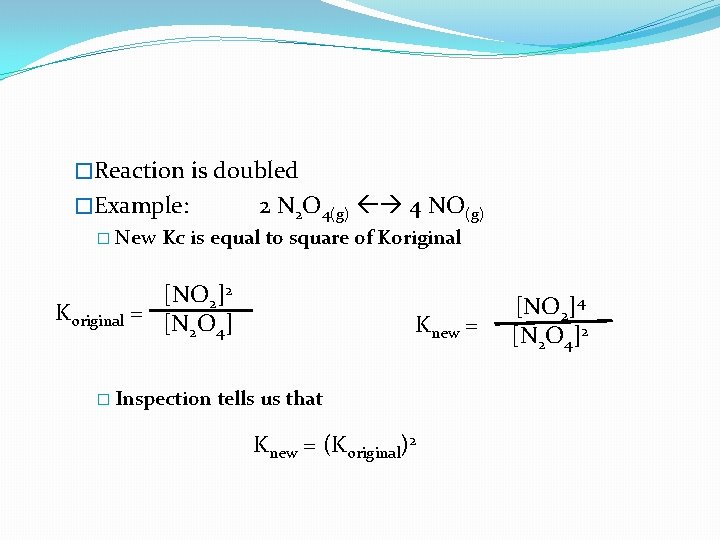
�Reaction is doubled �Example: 2 N 2 O 4(g) 4 NO(g) � New Kc is equal to square of Koriginal [NO 2]2 Koriginal = [N O ] 2 4 � Inspection Knew = tells us that Knew = (Koriginal)2 [NO 2]4 [N 2 O 4]2
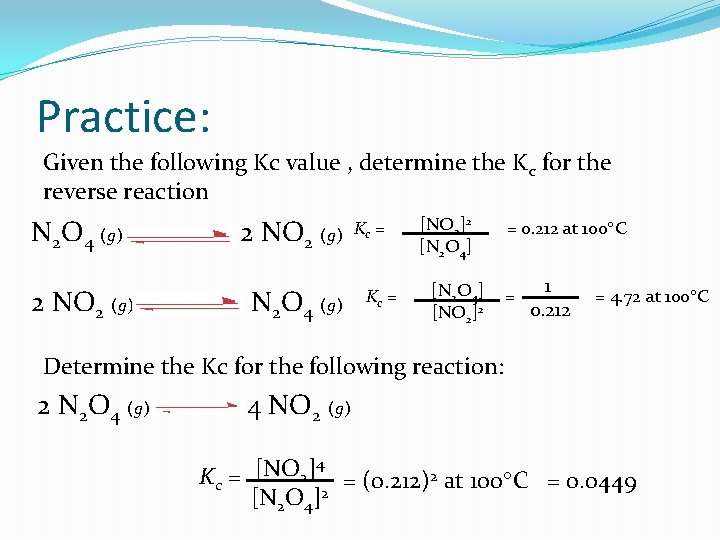
Practice: Given the following Kc value , determine the Kc for the reverse reaction N 2 O 4 (g) 2 NO 2 (g) Kc = N 2 O 4 (g) Kc = [NO 2]2 [N 2 O 4] [NO 2]2 = 0. 212 at 100 C = 1 0. 212 = 4. 72 at 100 C Determine the Kc for the following reaction: 2 N 2 O 4 (g) 4 NO 2 (g) 4 [NO ] 2 at 100 C = 0. 0449 2 Kc = = (0. 212) [N 2 O 4]2
TOPIC 6 B: Le Chatelier’s Principle
Le Chatelier’s Principle and Optimum Conditions �Le Chatelier’s Principle states that in any equilibrium system, when a stress is placed upon the system, such as �temperature �pressure �concentration � then, there is a shift in the position of the equilibrium to oppose that stress �The shift occurs because the stress will cause Q (or in case of temperature stress, K) to change �then equilibrium will have to shift in order to bring Q back into numerical agreement with K.
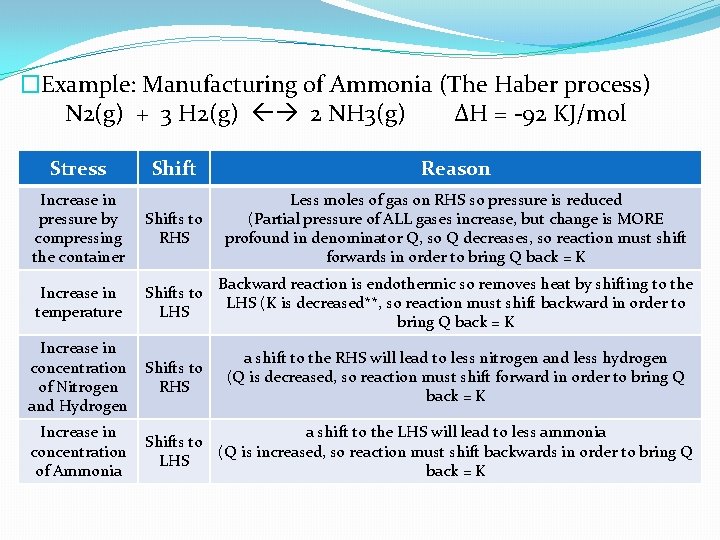
�Example: Manufacturing of Ammonia (The Haber process) N 2(g) + 3 H 2(g) 2 NH 3(g) ∆H = -92 KJ/mol Stress Shift Reason Increase in pressure by compressing the container Shifts to RHS Less moles of gas on RHS so pressure is reduced (Partial pressure of ALL gases increase, but change is MORE profound in denominator Q, so Q decreases, so reaction must shift forwards in order to bring Q back = K Increase in temperature Shifts to LHS Backward reaction is endothermic so removes heat by shifting to the LHS (K is decreased**, so reaction must shift backward in order to bring Q back = K Increase in concentration of Nitrogen and Hydrogen Shifts to RHS a shift to the RHS will lead to less nitrogen and less hydrogen (Q is decreased, so reaction must shift forward in order to bring Q back = K Increase in concentration of Ammonia a shift to the LHS will lead to less ammonia Shifts to (Q is increased, so reaction must shift backwards in order to bring Q LHS back = K
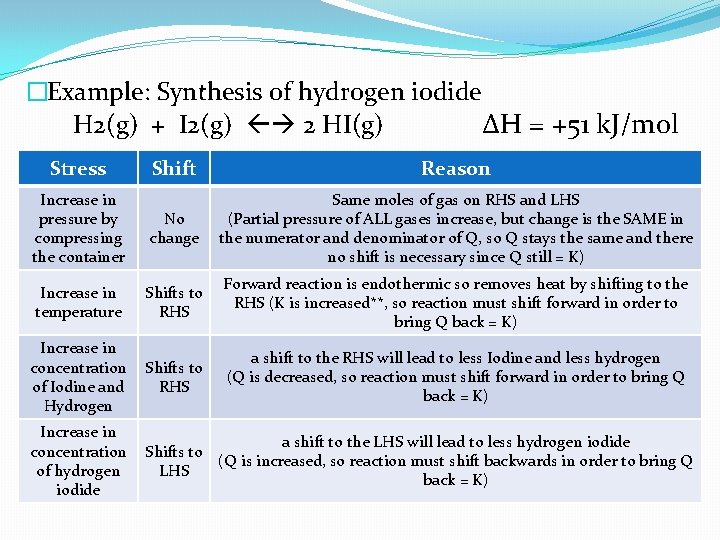
�Example: Synthesis of hydrogen iodide H 2(g) + I 2(g) 2 HI(g) ∆H = +51 k. J/mol Stress Shift Reason Increase in pressure by compressing the container No change Same moles of gas on RHS and LHS (Partial pressure of ALL gases increase, but change is the SAME in the numerator and denominator of Q, so Q stays the same and there no shift is necessary since Q still = K) Increase in temperature Shifts to RHS Forward reaction is endothermic so removes heat by shifting to the RHS (K is increased**, so reaction must shift forward in order to bring Q back = K) Increase in concentration of Iodine and Hydrogen Shifts to RHS a shift to the RHS will lead to less Iodine and less hydrogen (Q is decreased, so reaction must shift forward in order to bring Q back = K) Increase in concentration of hydrogen iodide a shift to the LHS will lead to less hydrogen iodide Shifts to (Q is increased, so reaction must shift backwards in order to bring Q LHS back = K)
Catalyst and Le Chatelier �RECALL that a catalyst increases the RATE of the reaction (both forward and backwards by the SAME factor) �There is no change in the enthalpy of reaction �There is no change in [product] or [reactant] �Therefore, there is NO CHANGE in the ratio of kforward to kreverse �A catalyst causes NO CHANGE in Q or K �Therefore causes no shift in the equilibrium position �Since a catalyst does increase the rate of BOTH the forward and reverse reaction by the SAME factor �therefore equilibrium is established faster.
Effect of Pressure (at constant temperature) �When pressure of a system is increased by compressing the container (reducing volume), �Equilibrium shifts towards the side with FEWER gaseous moles � Pressure on ALL gases will increase � However, since partial pressure is function of the mole ratio of the component gases in a mixture, the effect of increase in pressure is greatest on the side with MORE moles of gas particles � Hence equilibrium shifts AWAY from the side with greater pressure to the side with lower pressure.
Practice �At equilibrium, the following system has the partial pressures given. �Determine the partial pressures of each substance when total pressure is increased to 3 atm. �Determine value of Q given the new partial pressures �Determine the direction of the shift required to re-establish equilibrium N 2(g) + 3 H 2(g) 2 NH 3(g) 0. 78 atm 0. 99 atm 0. 23 atm
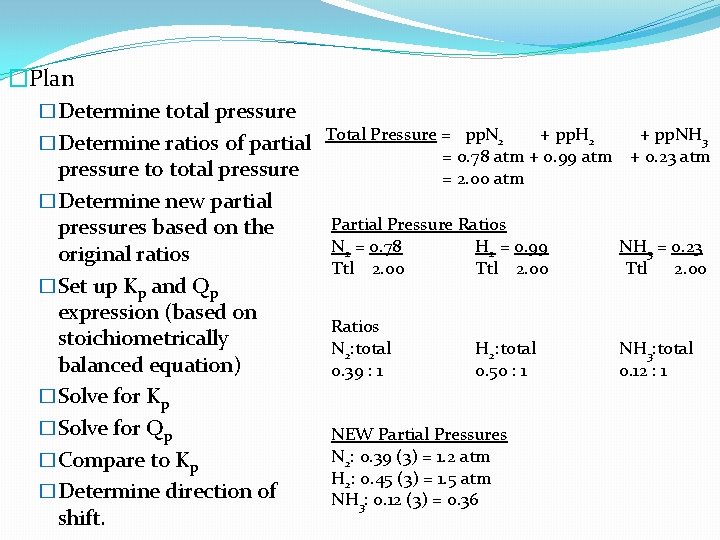
�Plan �Determine total pressure �Determine ratios of partial Total Pressure = pp. N 2 pressure to total pressure �Determine new partial pressures based on the original ratios �Set up Kp and Qp expression (based on stoichiometrically balanced equation) �Solve for Kp �Solve for Qp �Compare to Kp �Determine direction of shift. + pp. H 2 = o. 78 atm + 0. 99 atm = 2. 00 atm + pp. NH 3 + 0. 23 atm Partial Pressure Ratios N 2 = 0. 78 H 2 = 0. 99 Ttl 2. 00 NH 3 = 0. 23 Ttl 2. 00 Ratios N 2: total 0. 39 : 1 NH 3: total 0. 12 : 1 H 2: total 0. 50 : 1 NEW Partial Pressures N 2: 0. 39 (3) = 1. 2 atm H 2: 0. 45 (3) = 1. 5 atm NH 3: 0. 12 (3) = 0. 36
![�Plan �Determine total pressure �Determine ratios of partial Kp = [NH 3]2 (0. 23)2](http://slidetodoc.com/presentation_image_h2/793e2f074ef5ec91172c1cfa0fe53f7d/image-54.jpg "�Plan �Determine total pressure �Determine ratios of partial Kp = [NH 3]2 (0. 23)2")
�Plan �Determine total pressure �Determine ratios of partial Kp = [NH 3]2 (0. 23)2 = = 0. 070 3 3 [N 2][H 2] (0. 78)(0. 99) pressure to total pressure �Determine new partial pressures based on the [NH 3]2 (0. 36)2 Q = = = 0. 032 p original ratios 3 3 [N 2][H 2] (1. 2)(1. 5) �Set up Kp and Qp expression (based on stoichiometrically balanced equation) Qp < K p **too much reactant �Solve for Kp Translation: shift forward in order to bring Q �Solve for Qp back = K Notice: shift towards FEWER moles in �Compare to Kp stoichiometrically balanced equation �Determine direction of shift.
Effect of Temperature �Increase in temperature favors the endothermic reaction � Shift towards endothermic direction �Rationale � RECALL: increase in temperature affects rate, k of reaction � Consider the energy profiles for a reversible reaction Forward reaction: • Exothermic • Smaller activation energy • Less energy is needed, therefore an increase in temperature has less/smaller effect. • Computations using Arrhenius equation “support” the observation that an increase in temperature causes a smaller increase in rate of reaction, k Reverse reaction: • Endothermic • LARGER activation energy • More energy is needed, therefore an increase in temperature has more/larger effect. • Computations using Arrhenius equation “support” the observation that an increase in temperature causes a larger increase in rate of reaction, k
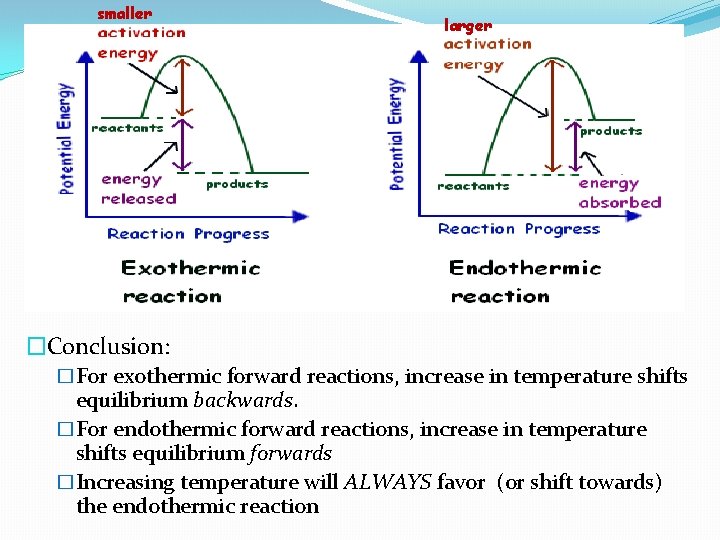
smaller larger �Conclusion: �For exothermic forward reactions, increase in temperature shifts equilibrium backwards. �For endothermic forward reactions, increase in temperature shifts equilibrium forwards �Increasing temperature will ALWAYS favor (or shift towards) the endothermic reaction
![Summary: Le Chatelier’s Principle �Increase [reactant] = shift forward to products �Remove reactant =](http://slidetodoc.com/presentation_image_h2/793e2f074ef5ec91172c1cfa0fe53f7d/image-57.jpg "Summary: Le Chatelier’s Principle �Increase [reactant] = shift forward to products �Remove reactant =")
Summary: Le Chatelier’s Principle �Increase [reactant] = shift forward to products �Remove reactant = shift backwards to reactants �Increase [product] = shift backwards to reactants �Remove product = shift forward to product �Increase pressure (gaseous system) = shift towards FEWER moles of gases OVERALL �Increase temperature = shift towards endothermic direction �Catalyst = no effect. Equilibrium achieved faster.
TOPIC 6 C: Acid Base Equilibria and Ksp DO NOW: Give the Arrhenius definition and Bronsted-Lowry definition of acid vs. base
Arrhenius Definition �Acids are substances that produce hydrogen ions when dissolved in water. HCl → H+ + Cl�Bases are substances that produce hydroxide ions when dissolved in water. Na. OH → Na+ + OH- �Problem: NH 3 (ammonia) when dissolved in water forms NH 4 OH, a weak base, but NH 3 could not be an Arrhenius based on traditional definition because NH 3 does not have a hydroxide to donate.
Brønsted-Lowry Definitions A Brønsted–Lowry acid… …must have a removable (acidic) proton. A Brønsted–Lowry base… …must have a pair of nonbonding electrons.
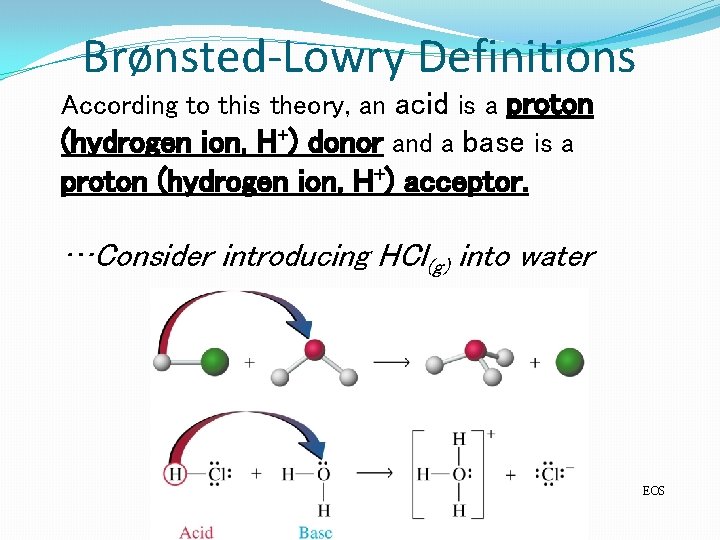
Brønsted-Lowry Definitions According to this theory, an acid is a proton (hydrogen ion, H+) donor and a base is a proton (hydrogen ion, H+) acceptor. …Consider introducing HCl(g) into water EOS
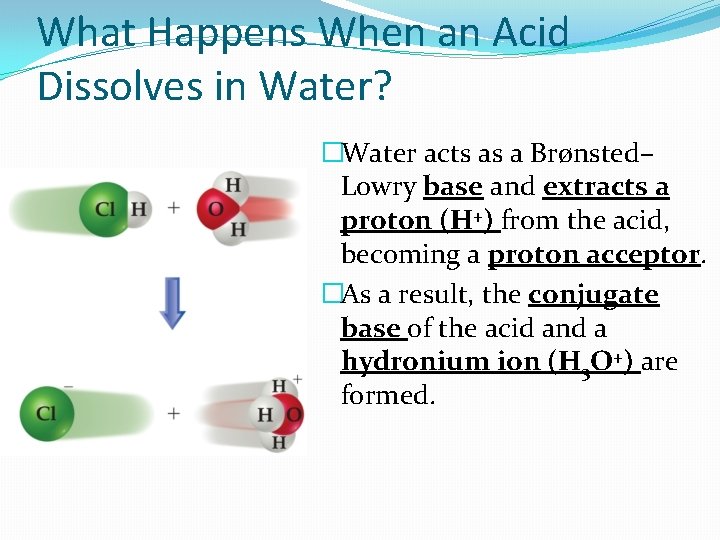
What Happens When an Acid Dissolves in Water? �Water acts as a Brønsted– Lowry base and extracts a proton (H+) from the acid, becoming a proton acceptor. �As a result, the conjugate base of the acid and a hydronium ion (H 3 O+) are formed.
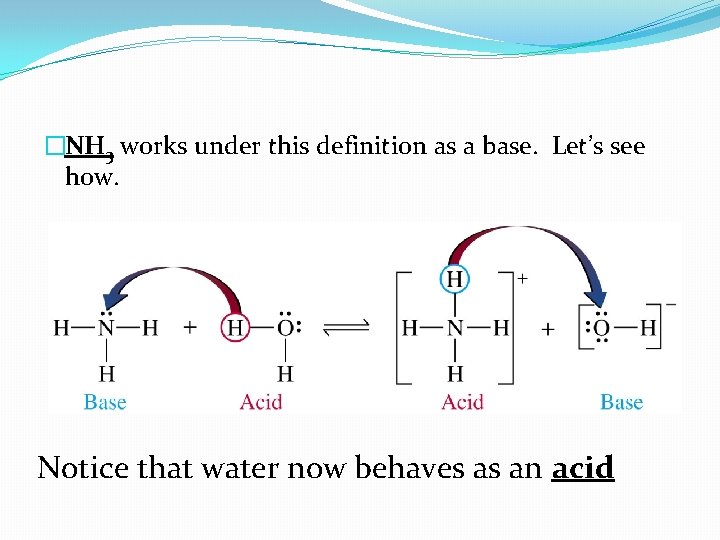
�NH 3 works under this definition as a base. Let’s see how. Notice that water now behaves as an acid
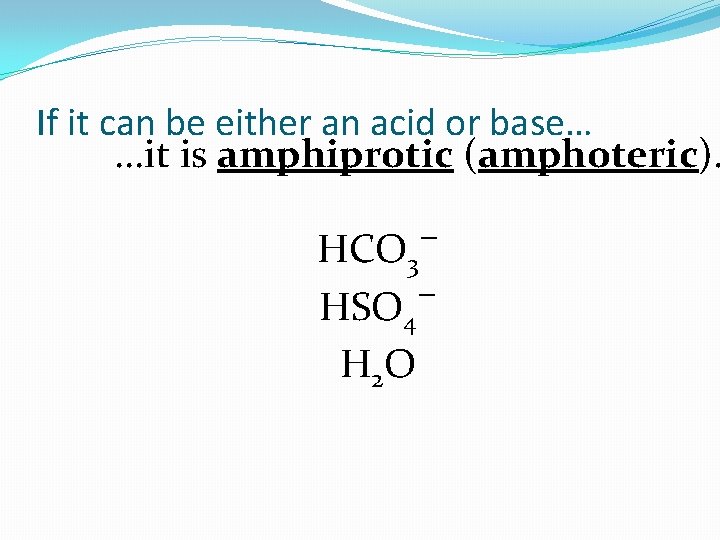
If it can be either an acid or base…. . . it is amphiprotic (amphoteric). − HCO 3 − HSO 4 H 2 O
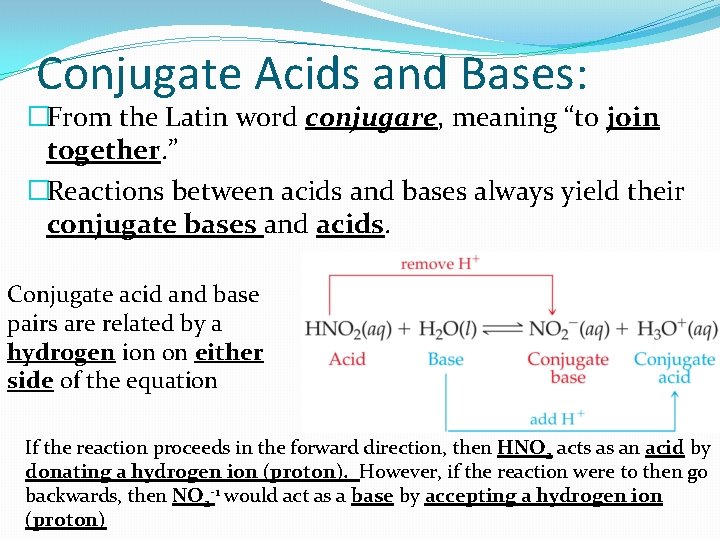
Conjugate Acids and Bases: �From the Latin word conjugare, meaning “to join together. ” �Reactions between acids and bases always yield their conjugate bases and acids. Conjugate acid and base pairs are related by a hydrogen ion on either side of the equation If the reaction proceeds in the forward direction, then HNO 2 acts as an acid by donating a hydrogen ion (proton). However, if the reaction were to then go backwards, then NO 2 -1 would act as a base by accepting a hydrogen ion (proton)
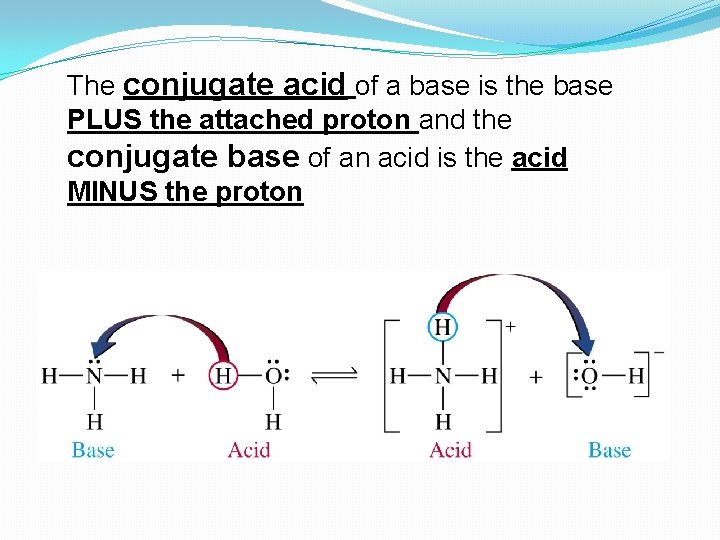
The conjugate acid of a base is the base PLUS the attached proton and the conjugate base of an acid is the acid MINUS the proton
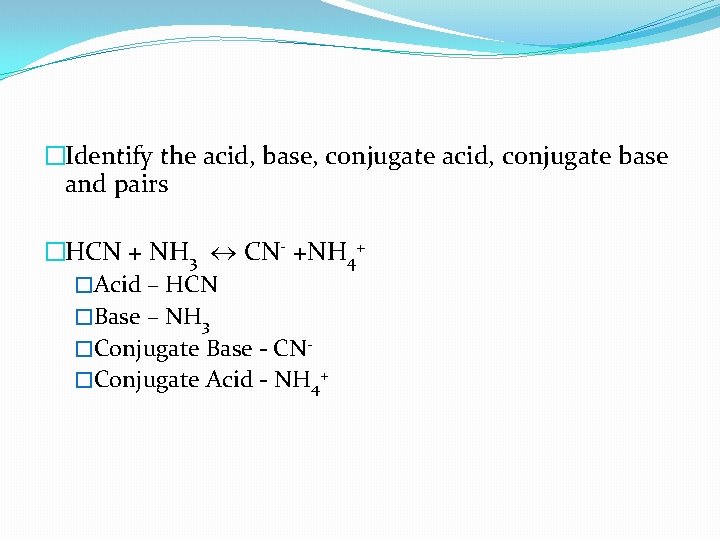
�Identify the acid, base, conjugate acid, conjugate base and pairs �HCN + NH 3 CN- +NH 4+ �Acid – HCN �Base – NH 3 �Conjugate Base - CN�Conjugate Acid - NH 4+
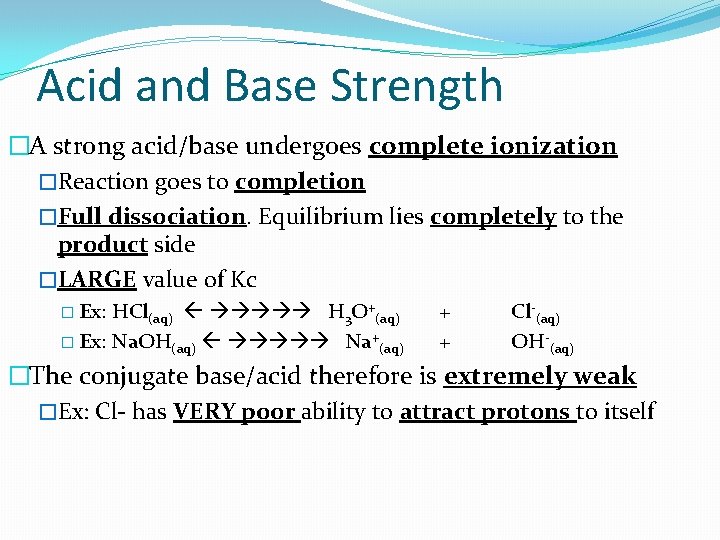
Acid and Base Strength �A strong acid/base undergoes complete ionization �Reaction goes to completion �Full dissociation. Equilibrium lies completely to the product side �LARGE value of Kc � Ex: HCl(aq) H 3 O+(aq) � Ex: Na. OH(aq) Na+(aq) + + Cl-(aq) OH-(aq) �The conjugate base/acid therefore is extremely weak �Ex: Cl- has VERY poor ability to attract protons to itself
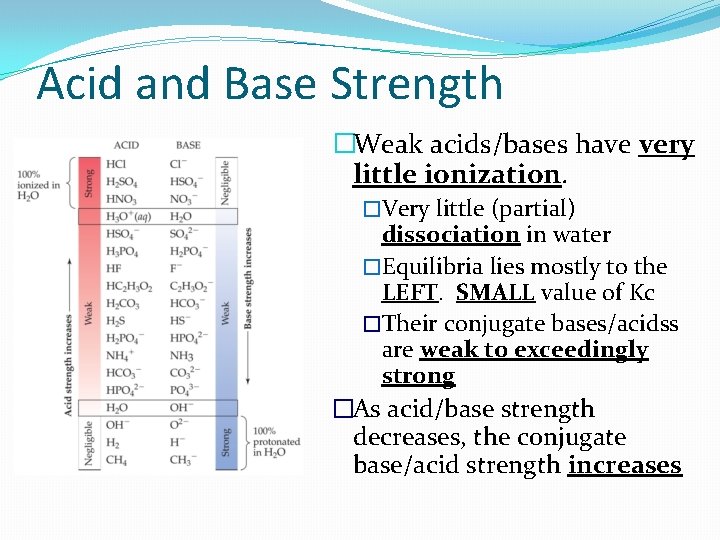
Acid and Base Strength �Weak acids/bases have very little ionization. �Very little (partial) dissociation in water �Equilibria lies mostly to the LEFT. SMALL value of Kc �Their conjugate bases/acidss are weak to exceedingly strong �As acid/base strength decreases, the conjugate base/acid strength increases
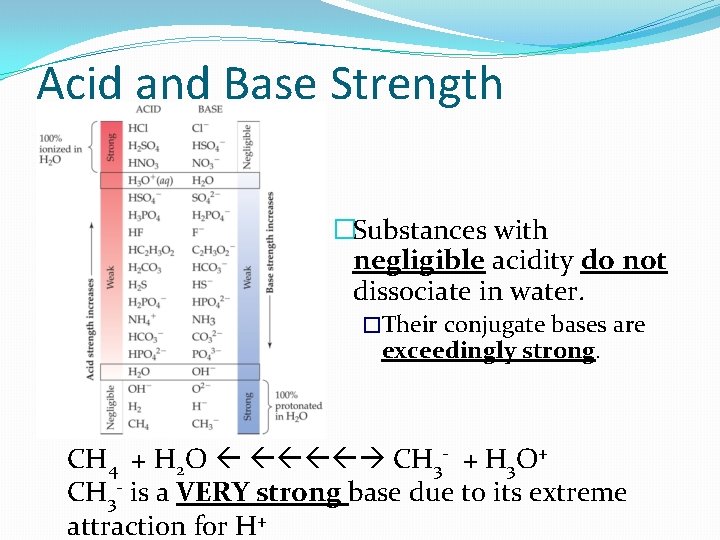
Acid and Base Strength �Substances with negligible acidity do not dissociate in water. �Their conjugate bases are exceedingly strong. CH 4 + H 2 O CH 3 - + H 3 O+ CH 3 - is a VERY strong base due to its extreme attraction for H+
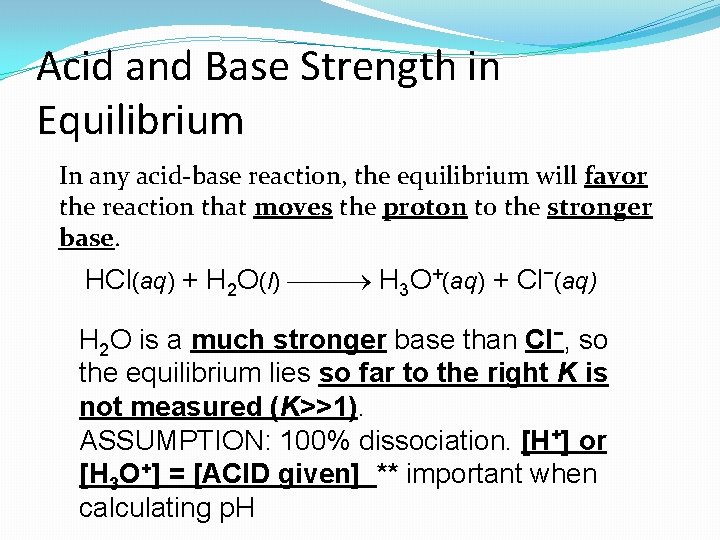
Acid and Base Strength in Equilibrium In any acid-base reaction, the equilibrium will favor the reaction that moves the proton to the stronger base. HCl(aq) + H 2 O(l) H 3 O+(aq) + Cl−(aq) H 2 O is a much stronger base than Cl−, so the equilibrium lies so far to the right K is not measured (K>>1). ASSUMPTION: 100% dissociation. [H+] or [H 3 O+] = [ACID given] ** important when calculating p. H
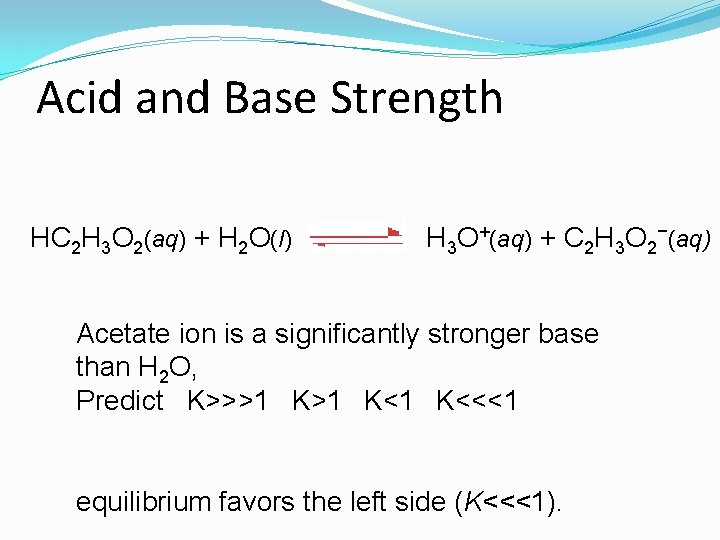
Acid and Base Strength HC 2 H 3 O 2(aq) + H 2 O(l) H 3 O+(aq) + C 2 H 3 O 2−(aq) Acetate ion is a significantly stronger base than H 2 O, Predict K>>>1 K<1 K<<<1 equilibrium favors the left side (K<<<1).
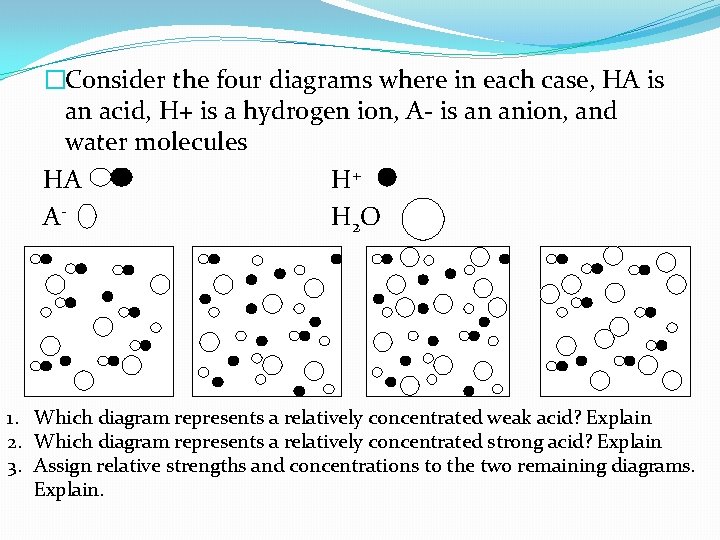
�Consider the four diagrams where in each case, HA is an acid, H+ is a hydrogen ion, A- is an anion, and water molecules HA H+ AH 2 O 1. Which diagram represents a relatively concentrated weak acid? Explain 2. Which diagram represents a relatively concentrated strong acid? Explain 3. Assign relative strengths and concentrations to the two remaining diagrams. Explain.
�Carefully note that the concentration of H+ and OH- are dependent upon TWO, separate factors. �Strength of acid or base, i. e, degree of dissociation/ionization �Amount of water present, i. e. concentration of sample solution �It is possible to have a dilute, strong acid and a weak, concentrated acid with the SAME hydronium ion concentration �Therefore, the same p. H value
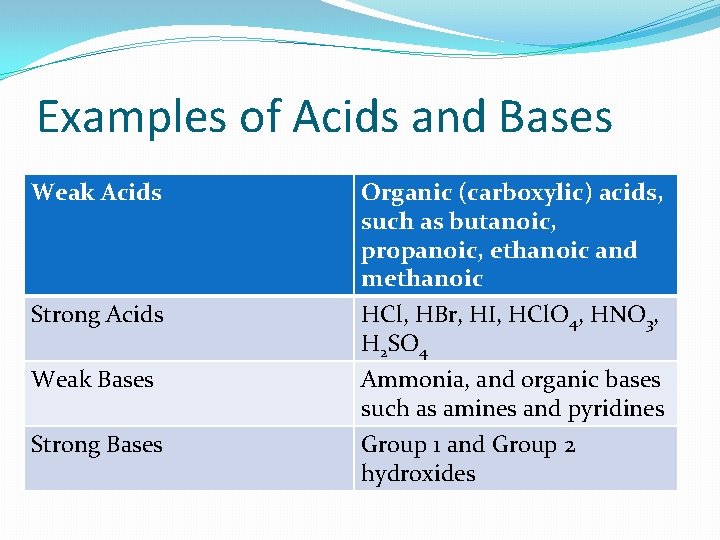
Examples of Acids and Bases Weak Acids Strong Acids Organic (carboxylic) acids, such as butanoic, propanoic, ethanoic and methanoic HCl, HBr, HI, HCl. O 4, HNO 3, H 2 SO 4 Weak Bases Ammonia, and organic bases such as amines and pyridines Strong Bases Group 1 and Group 2 hydroxides
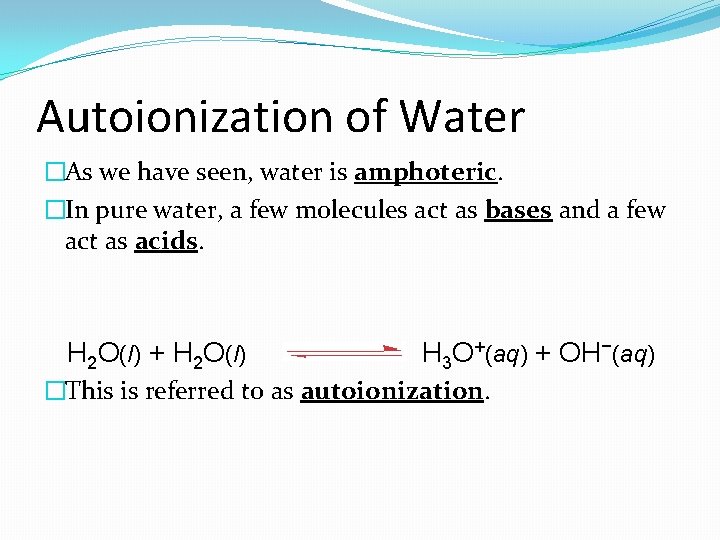
Autoionization of Water �As we have seen, water is amphoteric. �In pure water, a few molecules act as bases and a few act as acids. H 2 O(l) + H 2 O(l) H 3 O+(aq) + OH−(aq) �This is referred to as autoionization.
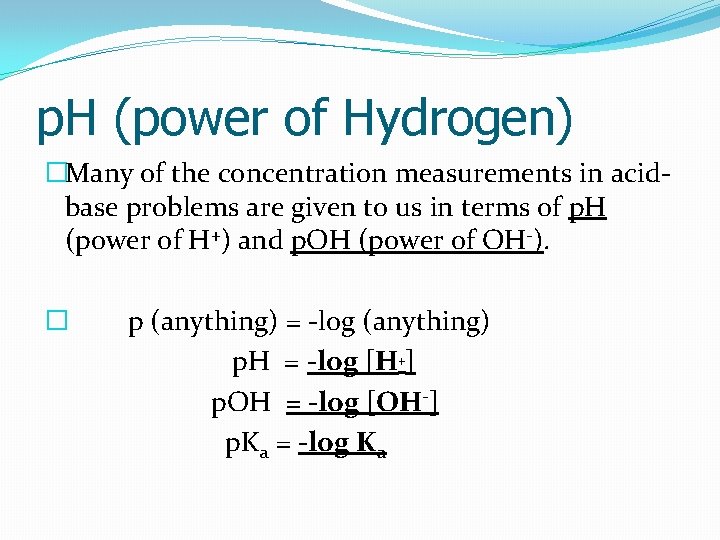
p. H (power of Hydrogen) �Many of the concentration measurements in acidbase problems are given to us in terms of p. H (power of H+) and p. OH (power of OH-). � p (anything) = -log (anything) p. H = -log [H+] p. OH = -log [OH-] p. Ka = -log Ka
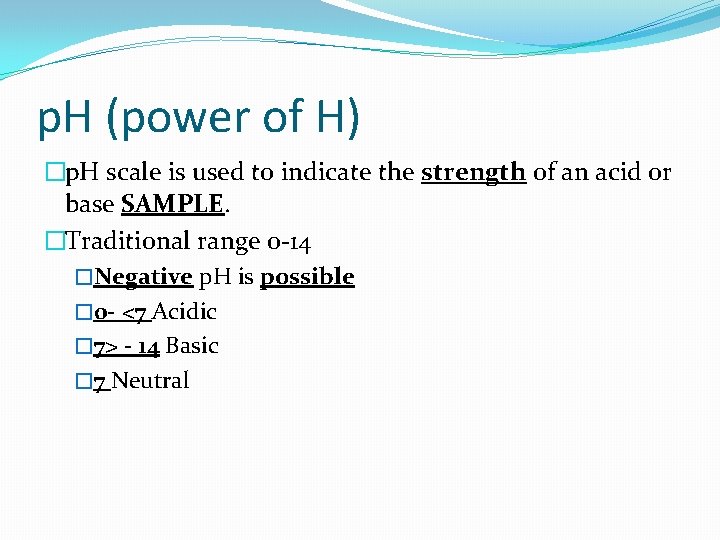
p. H (power of H) �p. H scale is used to indicate the strength of an acid or base SAMPLE. �Traditional range 0 -14 �Negative p. H is possible � 0 - <7 Acidic � 7> - 14 Basic � 7 Neutral
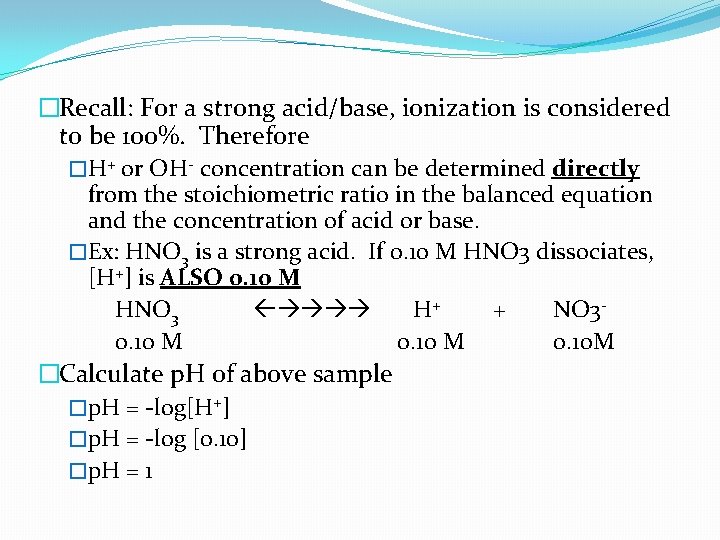
�Recall: For a strong acid/base, ionization is considered to be 100%. Therefore �H+ or OH- concentration can be determined directly from the stoichiometric ratio in the balanced equation and the concentration of acid or base. �Ex: HNO 3 is a strong acid. If 0. 10 M HNO 3 dissociates, [H+] is ALSO 0. 10 M HNO 3 H+ + NO 30. 10 M 0. 10 M �Calculate p. H of above sample �p. H = -log[H+] �p. H = -log [0. 10] �p. H = 1
![p. H �Why use –log value? �Used because [H+] in samples of interest is](http://slidetodoc.com/presentation_image_h2/793e2f074ef5ec91172c1cfa0fe53f7d/image-80.jpg "p. H �Why use –log value? �Used because [H+] in samples of interest is")
p. H �Why use –log value? �Used because [H+] in samples of interest is usually very small �As numerical value of p. H decreases, [H+] increases exponentially
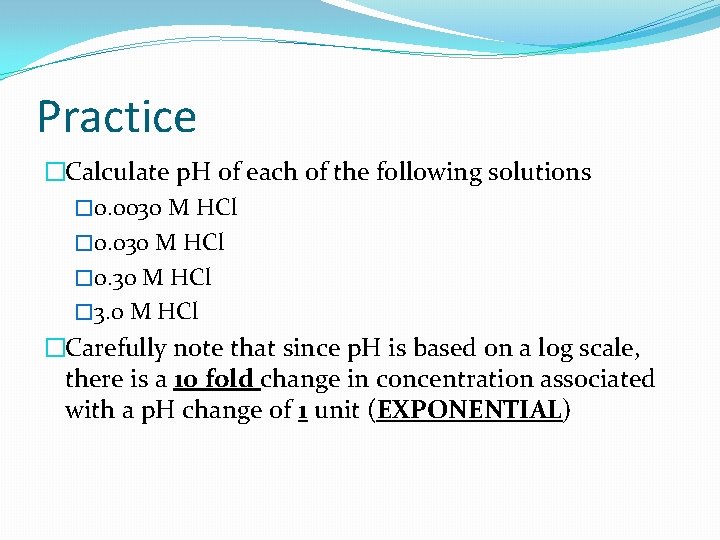
Practice �Calculate p. H of each of the following solutions � 0. 0030 M HCl � 0. 30 M HCl � 3. 0 M HCl �Carefully note that since p. H is based on a log scale, there is a 10 fold change in concentration associated with a p. H change of 1 unit (EXPONENTIAL)
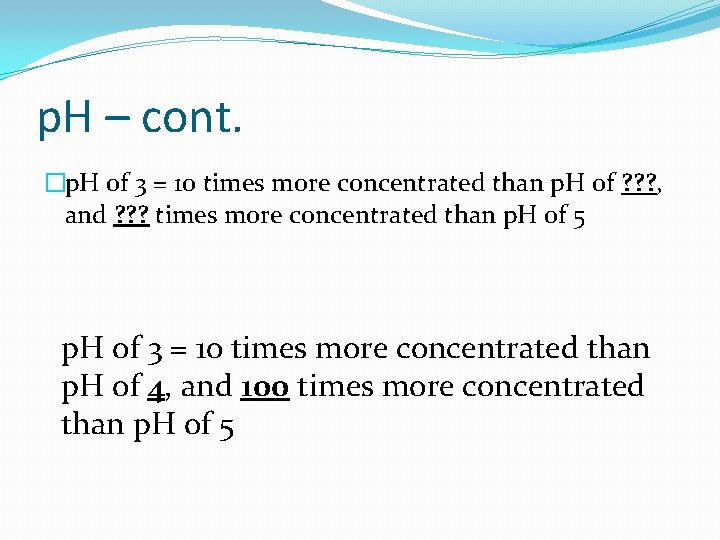
p. H – cont. �p. H of 3 = 10 times more concentrated than p. H of ? ? ? , and ? ? ? times more concentrated than p. H of 5 p. H of 3 = 10 times more concentrated than p. H of 4, and 100 times more concentrated than p. H of 5
![Determining [conc] from p. H/p. OH p. H is a measure of the p.](http://slidetodoc.com/presentation_image_h2/793e2f074ef5ec91172c1cfa0fe53f7d/image-83.jpg "Determining [conc] from p. H/p. OH p. H is a measure of the p.")
Determining [conc] from p. H/p. OH p. H is a measure of the p. OH is a measure of the strength of an acid sample; strength of a base sample; low p. H = stronger acid low p. OH = stronger base (also means HIGH p. H = –log[H 3 O+] and –] and p. OH = –log[OH [H 3 O+] = 10(–p. H) [OH–] = 10(–p. OH) EOS
![�Practice: Rate the following from highest to lowest [H+]. Then determine [H+] if p.](http://slidetodoc.com/presentation_image_h2/793e2f074ef5ec91172c1cfa0fe53f7d/image-84.jpg "�Practice: Rate the following from highest to lowest [H+]. Then determine [H+] if p.")
�Practice: Rate the following from highest to lowest [H+]. Then determine [H+] if p. H is 1. 58 9. 5 14 -0. 87 4. 2
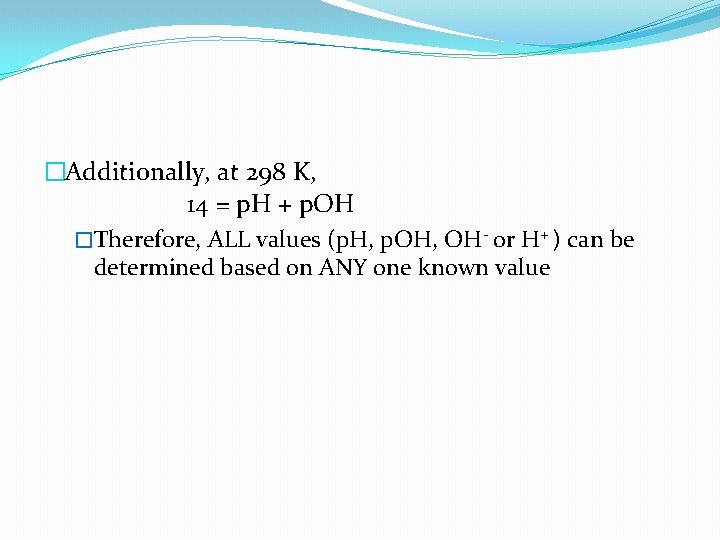
�Additionally, at 298 K, 14 = p. H + p. OH �Therefore, ALL values (p. H, p. OH, OH- or H+ ) can be determined based on ANY one known value
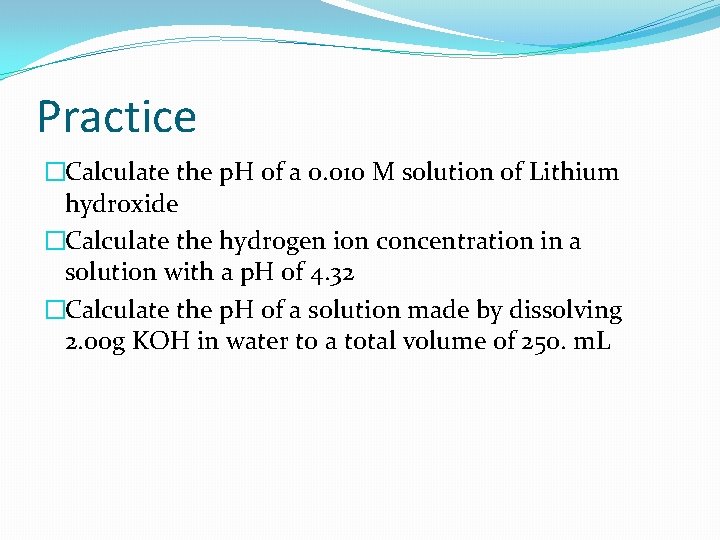
Practice �Calculate the p. H of a 0. 010 M solution of Lithium hydroxide �Calculate the hydrogen ion concentration in a solution with a p. H of 4. 32 �Calculate the p. H of a solution made by dissolving 2. 00 g KOH in water to a total volume of 250. m. L
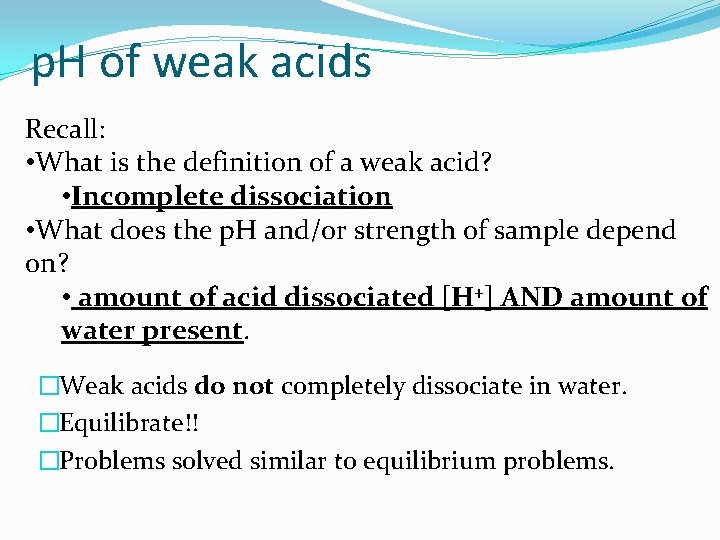
p. H of weak acids Recall: • What is the definition of a weak acid? • Incomplete dissociation • What does the p. H and/or strength of sample depend on? • amount of acid dissociated [H+] AND amount of water present. �Weak acids do not completely dissociate in water. �Equilibrate!! �Problems solved similar to equilibrium problems.
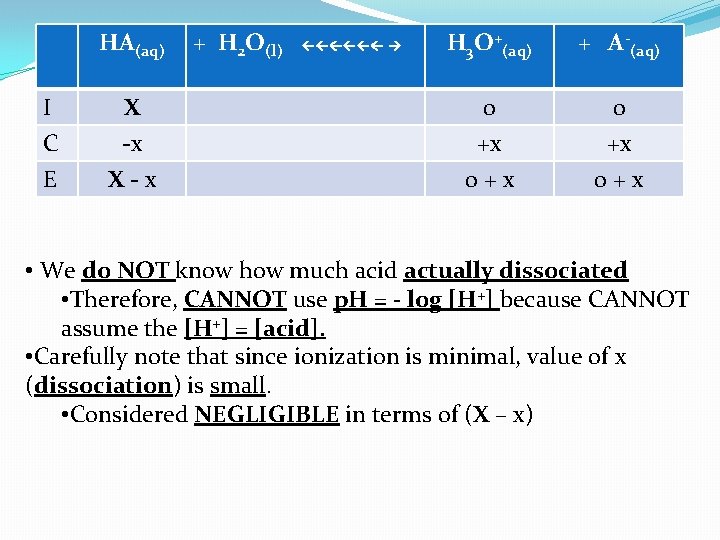
HA(aq) + H 2 O(l) H 3 O+(aq) + A-(aq) I C X -x 0 +x E X-x 0+x • We do NOT know how much acid actually dissociated • Therefore, CANNOT use p. H = - log [H+] because CANNOT assume the [H+] = [acid]. • Carefully note that since ionization is minimal, value of x (dissociation) is small. • Considered NEGLIGIBLE in terms of (X – x)
![• Additionally • [H+] = [A-] • H 2 O (pure liquid) does](http://slidetodoc.com/presentation_image_h2/793e2f074ef5ec91172c1cfa0fe53f7d/image-89.jpg "• Additionally • [H+] = [A-] • H 2 O (pure liquid) does")
• Additionally • [H+] = [A-] • H 2 O (pure liquid) does not appear in Ka (Acid dissociation constant) expression • Therefore, the following Ka expression can be derived + ]2 [H Ka = [H+][A-] [HA] Ka = [HA] OR �And p. Ka = -log Ka Mathematically equal. MUST NOT use as the EQUATION on ap frq. SHOW the ACTUAL equation.
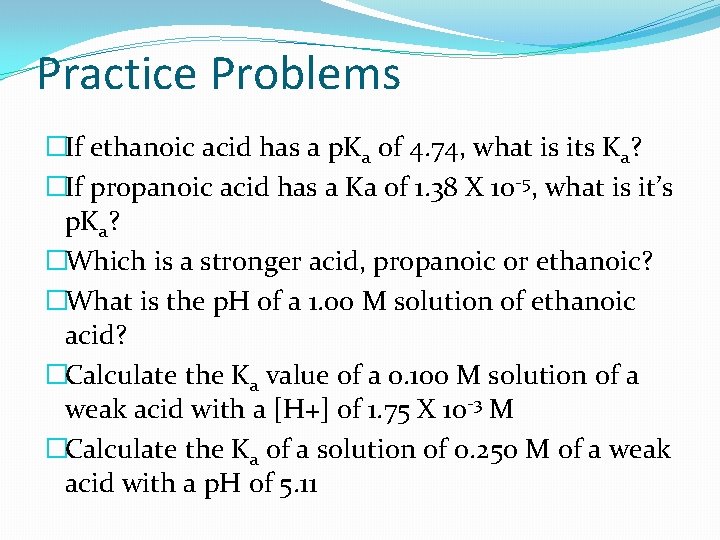
Practice Problems �If ethanoic acid has a p. Ka 0 f 4. 74, what is its Ka? �If propanoic acid has a Ka of 1. 38 X 10 -5, what is it’s p. Ka? �Which is a stronger acid, propanoic or ethanoic? �What is the p. H of a 1. 00 M solution of ethanoic acid? �Calculate the Ka value of a 0. 100 M solution of a weak acid with a [H+] of 1. 75 X 10 -3 M �Calculate the Ka of a solution of 0. 250 M of a weak acid with a p. H of 5. 11
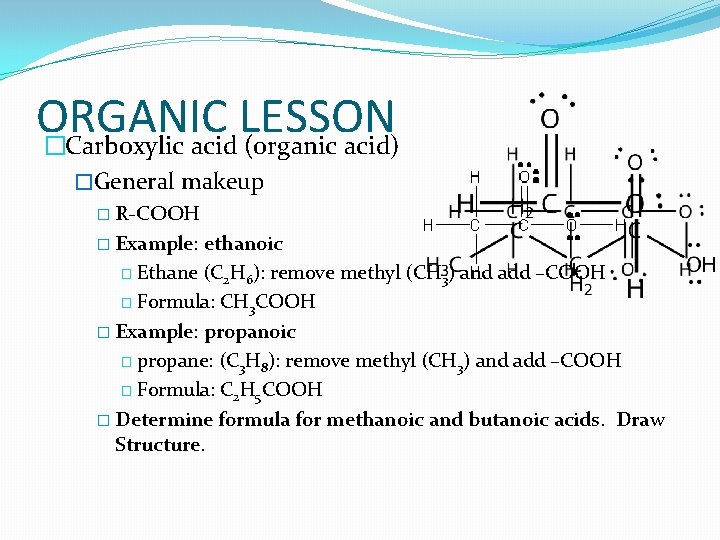
ORGANIC LESSON �Carboxylic acid (organic acid) �General makeup � R-COOH � Example: ethanoic � Ethane (C 2 H 6): remove methyl (CH 3) and add –COOH � Formula: CH 3 COOH � Example: propanoic � propane: (C 3 H 8): remove methyl (CH 3) and add –COOH � Formula: C 2 H 5 COOH � Determine formula for methanoic and butanoic acids. Draw Structure.
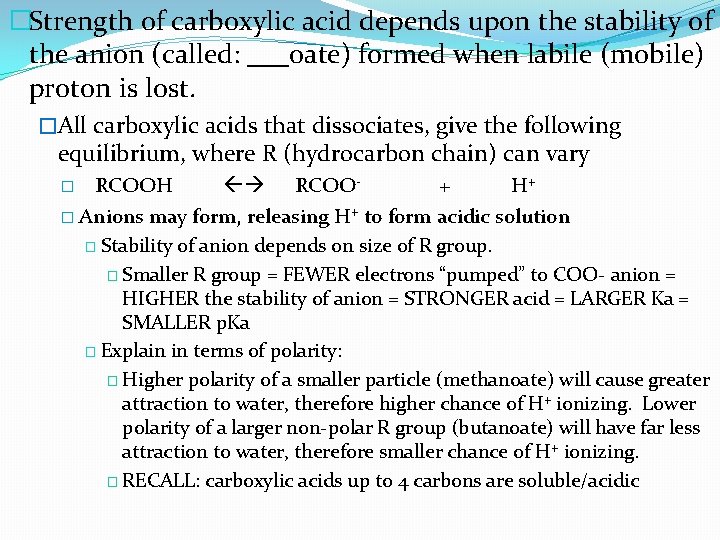
�Strength of carboxylic acid depends upon the stability of the anion (called: ___oate) formed when labile (mobile) proton is lost. �All carboxylic acids that dissociates, give the following equilibrium, where R (hydrocarbon chain) can vary RCOOH RCOO+ H+ � Anions may form, releasing H+ to form acidic solution � Stability of anion depends on size of R group. � Smaller R group = FEWER electrons “pumped” to COO- anion = HIGHER the stability of anion = STRONGER acid = LARGER Ka = SMALLER p. Ka � Explain in terms of polarity: � Higher polarity of a smaller particle (methanoate) will cause greater attraction to water, therefore higher chance of H+ ionizing. Lower polarity of a larger non-polar R group (butanoate) will have far less attraction to water, therefore smaller chance of H+ ionizing. � RECALL: carboxylic acids up to 4 carbons are soluble/acidic �
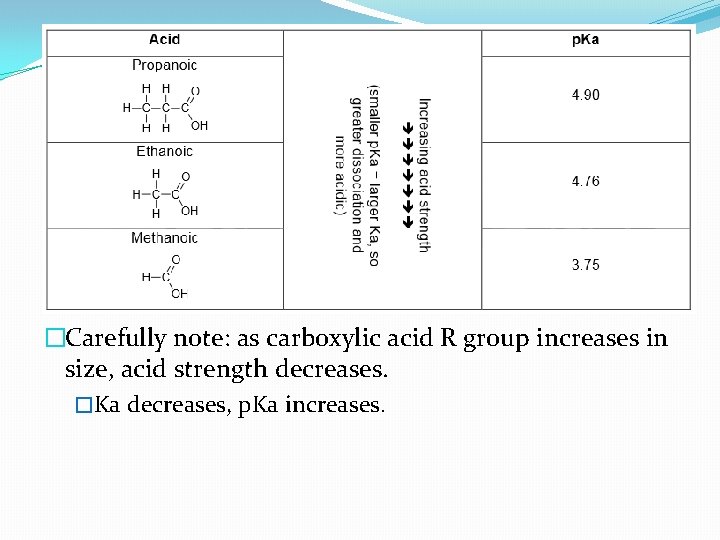
�Carefully note: as carboxylic acid R group increases in size, acid strength decreases. �Ka decreases, p. Ka increases.
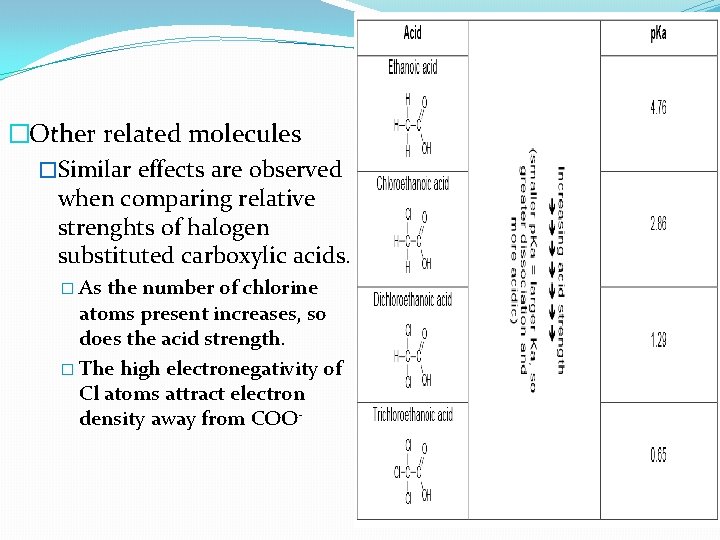
�Other related molecules �Similar effects are observed when comparing relative strenghts of halogen substituted carboxylic acids. � As the number of chlorine atoms present increases, so does the acid strength. � The high electronegativity of Cl atoms attract electron density away from COO-
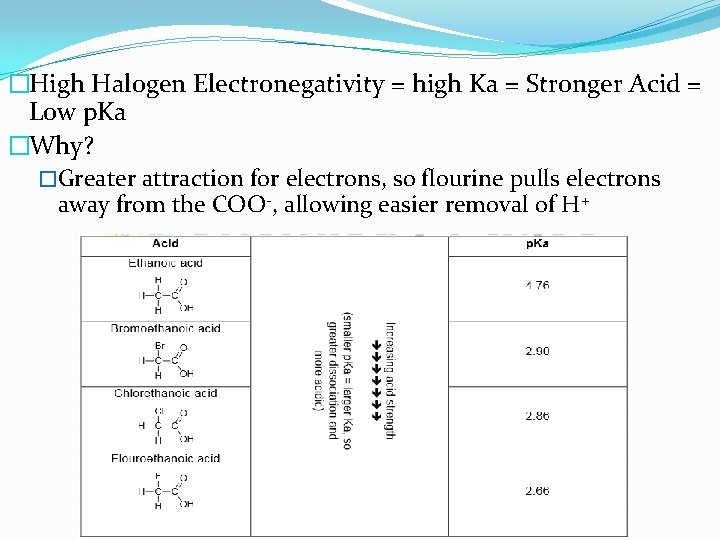
�High Halogen Electronegativity = high Ka = Stronger Acid = Low p. Ka �Why? �Greater attraction for electrons, so flourine pulls electrons away from the COO-, allowing easier removal of H+
Kb: Equilibrium Constant for Weak Bases �Similar to weak acid equilibria, weak base ionization is incomplete �Cannot directly determine amount of base dissociated based on Molarity of solution �Cannot use p. OH = -log [Base] � Must determine and use ACTUAL [OH-] �Same assumptions as weak acid equilibria calculations �Assume x (dissociated ion) is negligible relative to X (base molarity) �Assume [cation] = [OH-]
![NH 3 + H 2 O NH 4+ + OHTherefore: -][NH +] [OH 4](http://slidetodoc.com/presentation_image_h2/793e2f074ef5ec91172c1cfa0fe53f7d/image-97.jpg "NH 3 + H 2 O NH 4+ + OHTherefore: -][NH +] [OH 4")
NH 3 + H 2 O NH 4+ + OHTherefore: -][NH +] [OH 4 Kb = [NH 3] Often written as Kb = [OH-]2 [NH 3] And p. Kb = -log Kb DO NOT USE ON AP FRQ. Use ACTUAL Kb expression. CLEARLY SPECIFY that you are ASSUMING [OH-] = [Cation] CLEARLY SPECIFY that you are ASSUMING [OH-] to be negligible, therefore using [Base] as given
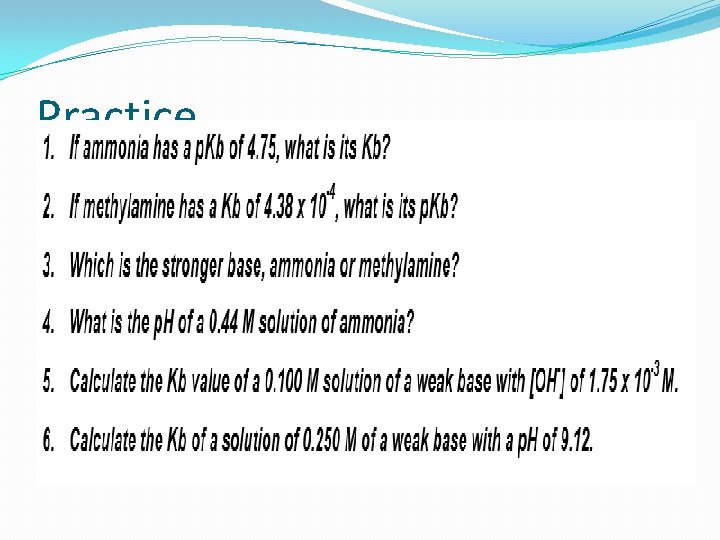
Practice
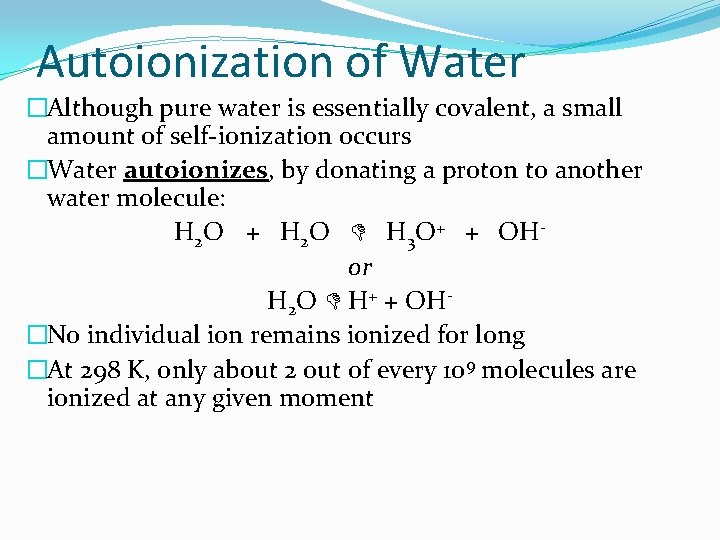
Autoionization of Water �Although pure water is essentially covalent, a small amount of self-ionization occurs �Water autoionizes, by donating a proton to another water molecule: H 2 O + H 2 O H 3 O+ + OHor H 2 O H+ + OH�No individual ion remains ionized for long �At 298 K, only about 2 out of every 109 molecules are ionized at any given moment
![Autoionization of Water �Equilibrium constant, Kw, written as Kw = [H+][OH-] �At 298 K,](http://slidetodoc.com/presentation_image_h2/793e2f074ef5ec91172c1cfa0fe53f7d/image-100.jpg "Autoionization of Water �Equilibrium constant, Kw, written as Kw = [H+][OH-] �At 298 K,")
Autoionization of Water �Equilibrium constant, Kw, written as Kw = [H+][OH-] �At 298 K, Kw = 1. 0 X 10 -14 �Since [H+] = [OH-], therefore 1. 0 X 10 -14 = [H+][OH-] �and [H+] = [OH-] = √ 1. 0 X 10 -14 = 1. 0 X 10 -7 M �Therefore, p. H = -log [1. 0 X 10 -7 M] = 7
![�Determine p. Kw �p. Kw = -log [1. 0 X 10 -14] = 14](http://slidetodoc.com/presentation_image_h2/793e2f074ef5ec91172c1cfa0fe53f7d/image-101.jpg "�Determine p. Kw �p. Kw = -log [1. 0 X 10 -14] = 14")
�Determine p. Kw �p. Kw = -log [1. 0 X 10 -14] = 14 �Since we know that Kw = [H+][OH-] Kw = K a · K b p. Kw = p. Ka + p. Kb 14 = p. H + p. OH *** KNOW THIS therefore
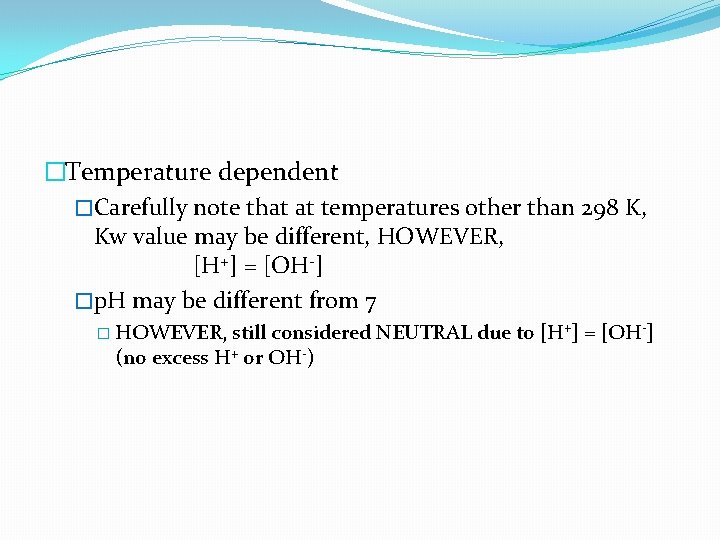
�Temperature dependent �Carefully note that at temperatures other than 298 K, Kw value may be different, HOWEVER, [H+] = [OH-] �p. H may be different from 7 � HOWEVER, still considered NEUTRAL due to [H+] = [OH-] (no excess H+ or OH-)
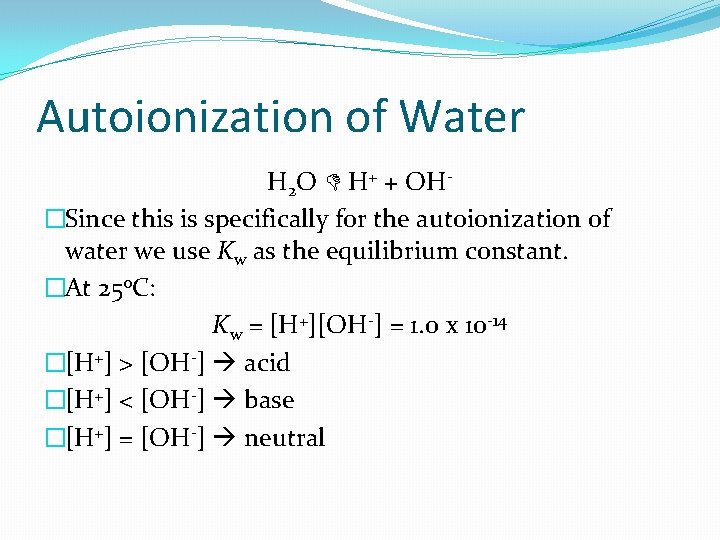
Autoionization of Water H 2 O H+ + OH�Since this is specifically for the autoionization of water we use Kw as the equilibrium constant. �At 25 o. C: Kw = [H+][OH-] = 1. 0 x 10 -14 �[H+] > [OH-] acid �[H+] < [OH-] base �[H+] = [OH-] neutral
![Autoionization of Water H 2 O H+ + OHKw = [H+][OH-] = 1. 0](http://slidetodoc.com/presentation_image_h2/793e2f074ef5ec91172c1cfa0fe53f7d/image-104.jpg "Autoionization of Water H 2 O H+ + OHKw = [H+][OH-] = 1. 0")
Autoionization of Water H 2 O H+ + OHKw = [H+][OH-] = 1. 0 x 10 -14 �At this point it is very useful to remember that p. H = log [H+] �Since Kw is a constant, if we are given [OH-] it is a very simple matter to calculate p. H �Since p. H, p. OH, [H+], [OH-], p. Ka, p. Kb, p. Kw and Kw are ALL related, knowing ANY of these values is sufficient to calculate ALL others.
Titrations �Titration: experimental technique to perform a stoichiometrically balanced neutralization reaction. �Accurately graduated glassware (volumetric flasks, graduated glass pipets and burets) is used in quantitative manner � Helps determine unknown concentration of an acid or a base
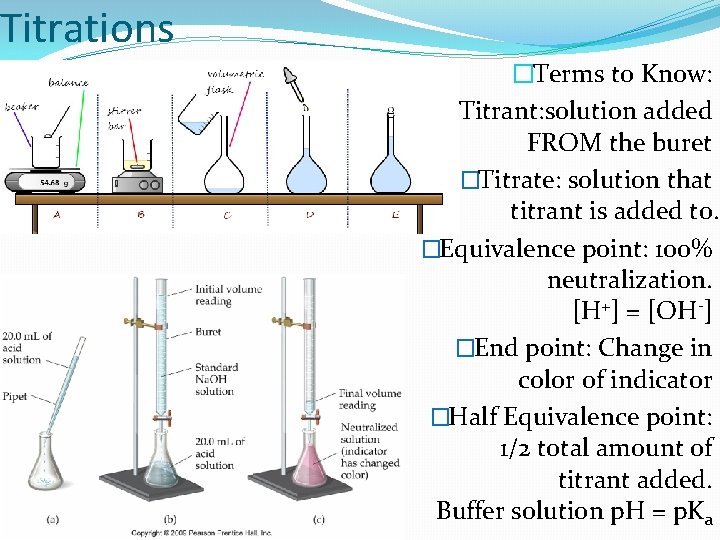
Titrations �Terms to Know: �Titrant: solution added FROM the buret �Titrate: solution that titrant is added to. �Equivalence point: 100% neutralization. [H+] = [OH-] �End point: Change in color of indicator �Half Equivalence point: 1/2 total amount of titrant added. Buffer solution p. H = p. Ka
Titrations �As acid or base is added, there is �Very little change in p. H �p. H change of less than 1. 5 units expected upto the point where 90% of acid/base is neutralized �At equivalence point, when 100% of acid or base is neutralized, RAPID change in p. H is observed �Summarized using titration curve plots
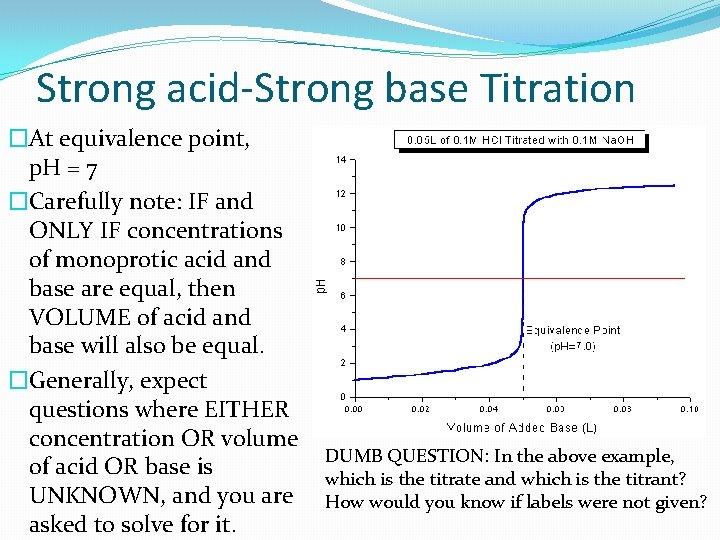
Strong acid-Strong base Titration �At equivalence point, p. H = 7 �Carefully note: IF and ONLY IF concentrations of monoprotic acid and base are equal, then VOLUME of acid and base will also be equal. �Generally, expect questions where EITHER concentration OR volume of acid OR base is UNKNOWN, and you are asked to solve for it. DUMB QUESTION: In the above example, which is the titrate and which is the titrant? How would you know if labels were not given?
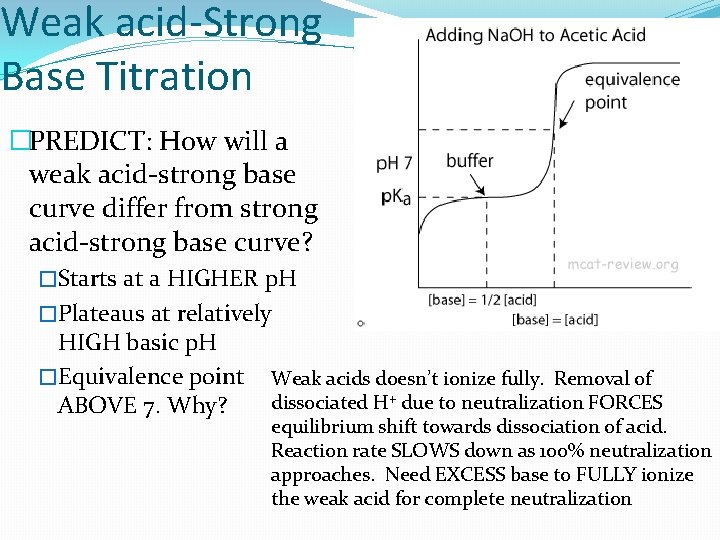
Weak acid-Strong Base Titration �PREDICT: How will a weak acid-strong base curve differ from strong acid-strong base curve? �Starts at a HIGHER p. H �Plateaus at relatively HIGH basic p. H �Equivalence point ABOVE 7. Why? Weak acids doesn’t ionize fully. Removal of dissociated H+ due to neutralization FORCES equilibrium shift towards dissociation of acid. Reaction rate SLOWS down as 100% neutralization approaches. Need EXCESS base to FULLY ionize the weak acid for complete neutralization
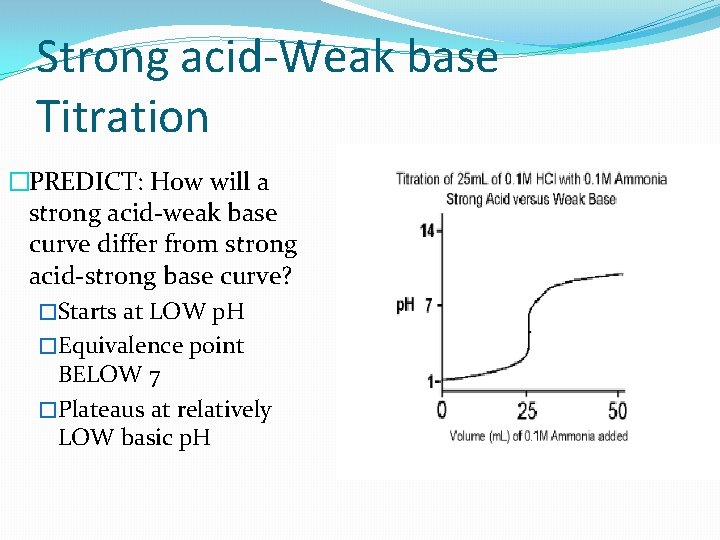
Strong acid-Weak base Titration �PREDICT: How will a strong acid-weak base curve differ from strong acid-strong base curve? �Starts at LOW p. H �Equivalence point BELOW 7 �Plateaus at relatively LOW basic p. H
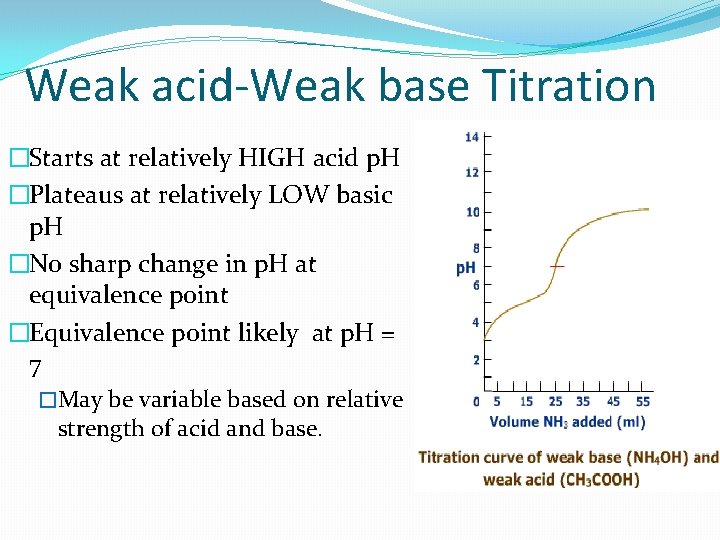
Weak acid-Weak base Titration �Starts at relatively HIGH acid p. H �Plateaus at relatively LOW basic p. H �No sharp change in p. H at equivalence point �Equivalence point likely at p. H = 7 �May be variable based on relative strength of acid and base.
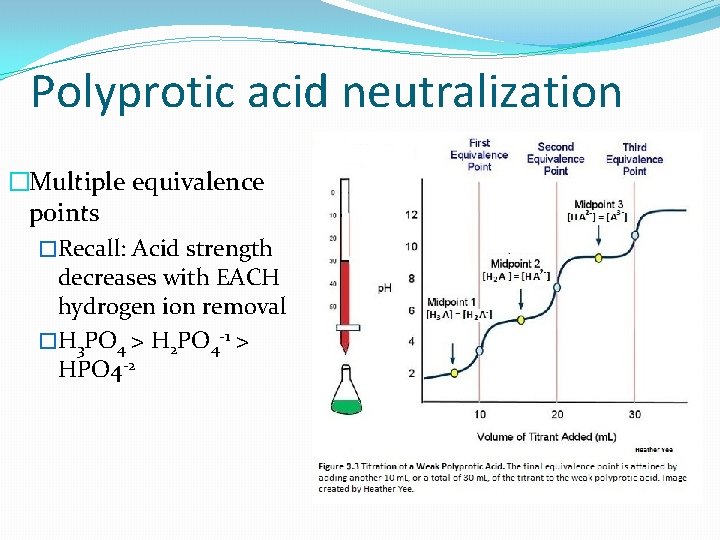
Polyprotic acid neutralization �Multiple equivalence points �Recall: Acid strength decreases with EACH hydrogen ion removal �H 3 PO 4 > H 2 PO 4 -1 > HPO 4 -2
Indicators �Most acids and bases form colorless solutions �Driving force of neutralization reaction (formation of water) does not produce an observable change. �Need a method of determining when equivalence point has been reached. �Indicator: chemical that changes color at various p. H’s �Often weak acids, where ionized and unionized form have different colors. �Ideal indicators change color over a small, given range of p. H
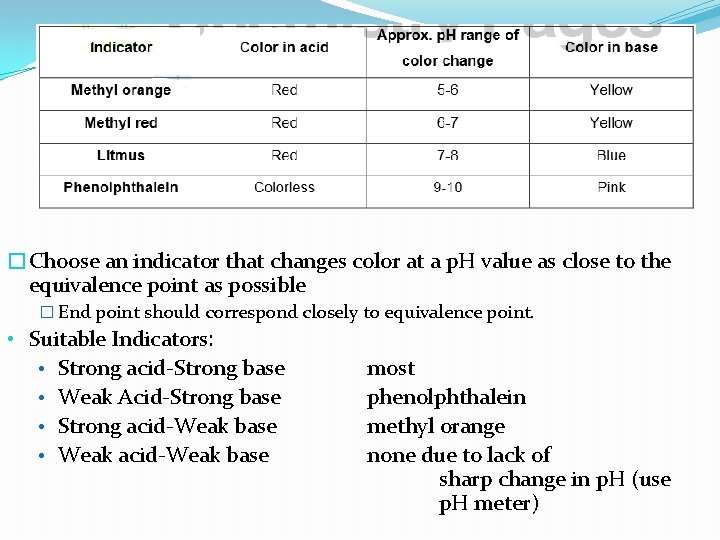
Indicators �Choose an indicator that changes color at a p. H value as close to the equivalence point as possible � End point should correspond closely to equivalence point. • Suitable Indicators: • Strong acid-Strong base • Weak Acid-Strong base • Strong acid-Weak base • Weak acid-Weak base most phenolphthalein methyl orange none due to lack of sharp change in p. H (use p. H meter)
Buffer Solutions �A buffer solution is one that resists changes in p. H, when either a small amount of acid or base is added to it. �General composition �Weak acid and one of its salts (i. e. its conjugate base) �Weak base and one of its salts (i. e its conjugate acid) �Example: ethanoic acid and sodium ethanoate
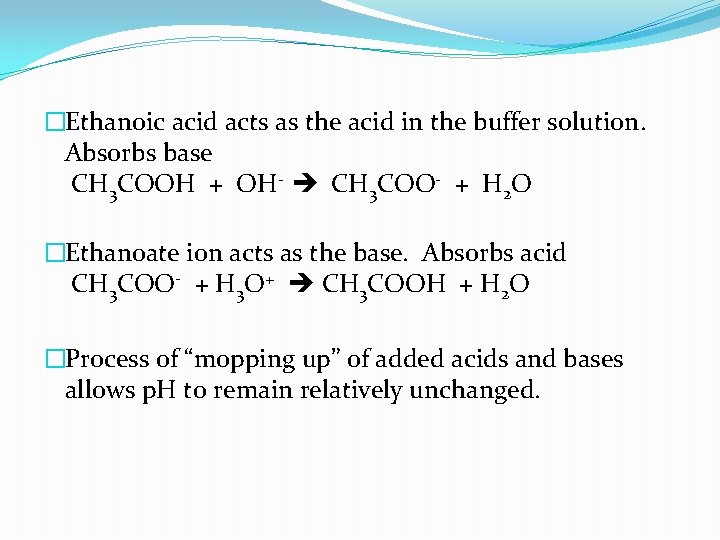
�Ethanoic acid acts as the acid in the buffer solution. Absorbs base CH 3 COOH + OH- CH 3 COO- + H 2 O �Ethanoate ion acts as the base. Absorbs acid CH 3 COO- + H 3 O+ CH 3 COOH + H 2 O �Process of “mopping up” of added acids and bases allows p. H to remain relatively unchanged.
Capacity of buffers �Capacity defined as the ability to continue reacting as extra acid/base is added. Depends upon �Concentration of components � Higher the concentration, the more acid or base it can absorb, the higher its capacity
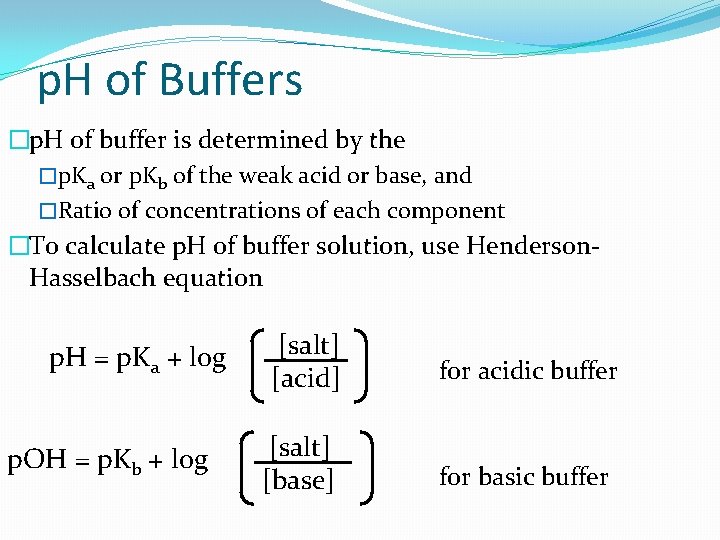
p. H of Buffers �p. H of buffer is determined by the �p. Ka or p. Kb of the weak acid or base, and �Ratio of concentrations of each component �To calculate p. H of buffer solution, use Henderson. Hasselbach equation p. H = p. Ka + log p. OH = p. Kb + log [salt] [acid] for acidic buffer [salt] [base] for basic buffer
�Carefully note a crucial application of buffer solutions (expect ** AP ** question) �Weak acid-strong base or weak base-strong acid titrations produce a buffer region on the graph �Gradual addition of Strong base to weak acid results in = BUF F �Some weak acid neutralization SOL ER U TIO �Production of the salt of weak acid N �Production of water
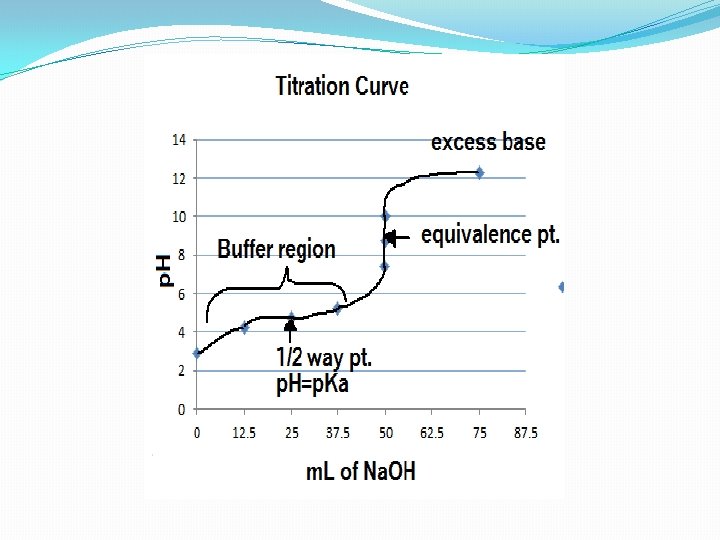
�When 1/2 the acid is neutralized, what is the ratio of acid to salt? � 1: 1 �Plugging into Henderson-Hasselbach, we get log (1) = 0 �Therefore when acid to salt ratio 1: 1, then p. H = p. Ka � True at ½ equivalence point
Ksp – The Solubility Product �Recall: �Sodium, potassium, ammonium, and nitrate salts are SOLUBLE / INSOLUBLE / PARTIALLY SOLUBLE �Phosphates, carbonates, sulfides are SOLUBLE / INSOLUBLE / PARTIALLY SOLUBLE �Give 2 examples of INSOLUBLE salts �Some salts are COMPLETELY soluble in water � 100% dissociation (ionization) �Extremely large Ksp—not measured � **same as strong acids
�In reality, for salts that are NOT completely soluble, there are degrees or levels of “insolubility” �An equilibrium situation is set up in solution. � Known as SOLUBILITY PRODUCT EQUILIBRIUM CONSTANT (Ksp) �For example, it is possible to set up an equilibrium where a saturated solution (one where the maximum amount of solute has been dissolved) of silver chloride is in contact with undissolved solid silver chloride Ag. Cl(s) Ag+1(aq) + Cl-(aq) � Since solids are left out of equilibrium expressions, the Ksp can be written as Ksp = [Ag+][Cl-]
�Definition: �Ksp is defined as the product of the equilibrium concentrations of the constituent ions raised to their stoichiometric coefficients � Smaller value of Ksp = FEWER dissociated ions in solution = less soluble compound in water. �Concentration of ions that are in solution is usually expressed in terms of molar solubility. i. e. the number of moles of solute in a 1. 0 L of a saturated solution. � However, solubility may be expressed in terms of grams of solute in 1. 0 L of a saturated solution. � **remember to convert to moles of solute FIRST, before using in a Ksp expression. �
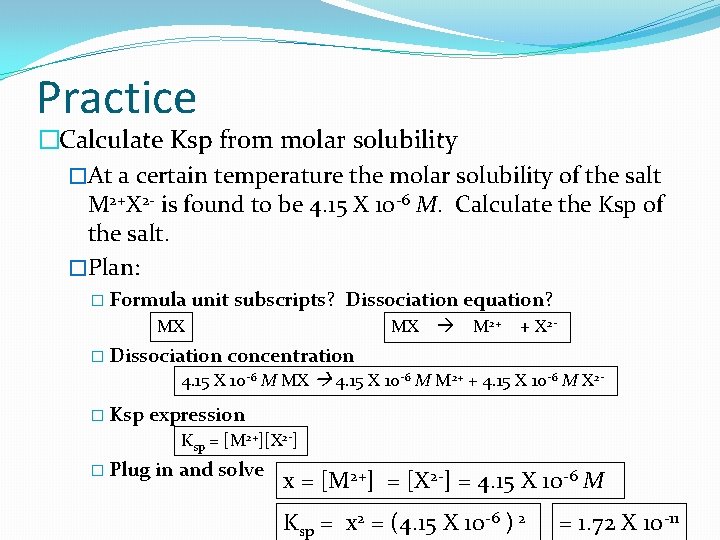
Practice �Calculate Ksp from molar solubility �At a certain temperature the molar solubility of the salt M 2+X 2 - is found to be 4. 15 X 10 -6 M. Calculate the Ksp of the salt. �Plan: � Formula unit subscripts? Dissociation equation? MX � Dissociation MX M 2+ + X 2 - concentration 4. 15 X 10 -6 M MX 4. 15 X 10 -6 M M 2+ + 4. 15 X 10 -6 M X 2� Ksp expression Ksp = [M 2+][X 2 -] � Plug in and solve x = [M 2+] = [X 2 -] = 4. 15 X 10 -6 M Ksp = x 2 = (4. 15 X 10 -6 ) 2 = 1. 72 X 10 -11
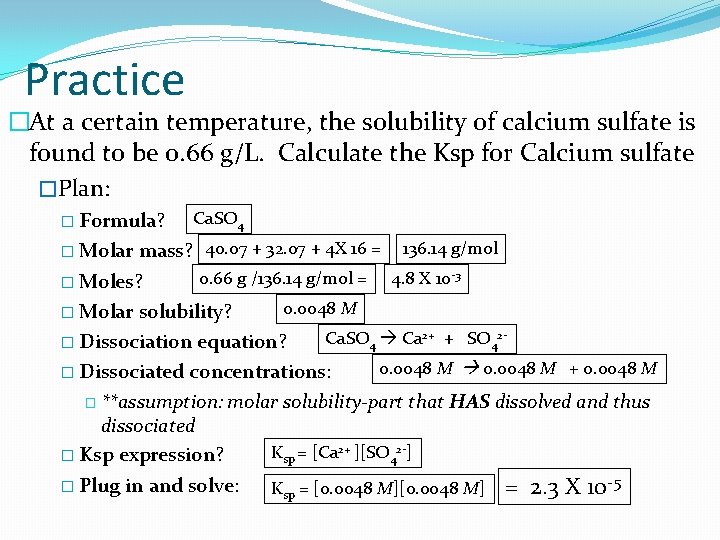
Practice �At a certain temperature, the solubility of calcium sulfate is found to be 0. 66 g/L. Calculate the Ksp for Calcium sulfate �Plan: � Formula? Ca. SO 4 mass? 40. 07 + 32. 07 + 4 X 16 = 136. 14 g/mol 0. 66 g /136. 14 g/mol = 4. 8 X 10 -3 � Moles? 0. 0048 M � Molar solubility? Ca. SO 4 Ca 2+ + SO 42� Dissociation equation? 0. 0048 M + 0. 0048 M � Dissociated concentrations: � **assumption: molar solubility-part that HAS dissolved and thus dissociated Ksp = [Ca 2+ ][SO 42 -] � Ksp expression? � Plug in and solve: Ksp = [0. 0048 M] = 2. 3 X 10 -5 � Molar
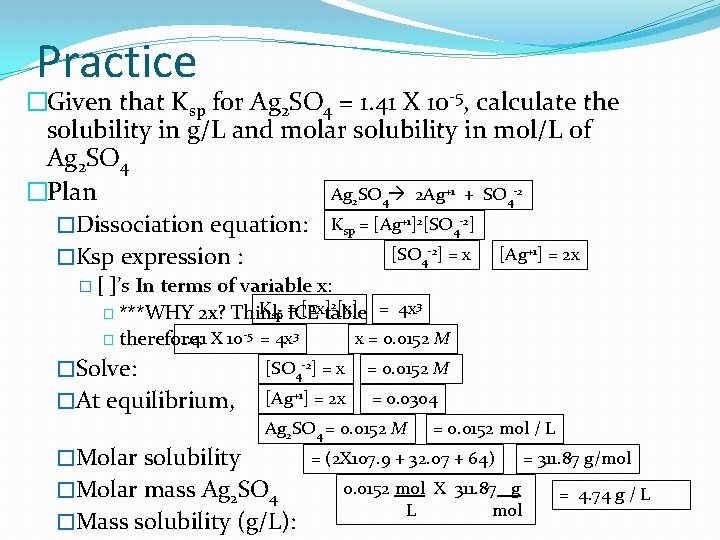
Practice �Given that Ksp for Ag 2 SO 4 = 1. 41 X 10 -5, calculate the solubility in g/L and molar solubility in mol/L of Ag 2 SO 4 �Plan Ag 2 SO 4 2 Ag+1 + SO 4 -2 �Dissociation equation: Ksp = [Ag+1]2[SO 4 -2] = x [Ag+1] = 2 x �Ksp expression : �[ ]’s In terms of variable x: 2[x] Ksp = [2 x]table = 4 x 3 � ***WHY 2 x? Think ICE 1. 41 X 10 -5 = 4 x 3 x = 0. 0152 M � therefore: �Solve: [SO 4 -2] = x = 0. 0152 M �At equilibrium, [Ag+1] = 2 x = 0. 0304 Ag 2 SO 4 = 0. 0152 M �Molar solubility �Molar mass Ag 2 SO 4 �Mass solubility (g/L): = 0. 0152 mol / L = (2 X 10⁷. 9 + 32. 07 + 64) 0. 0152 mol X 311. 87 g L mol = 311. 87 g/mol = 4. 74 g / L
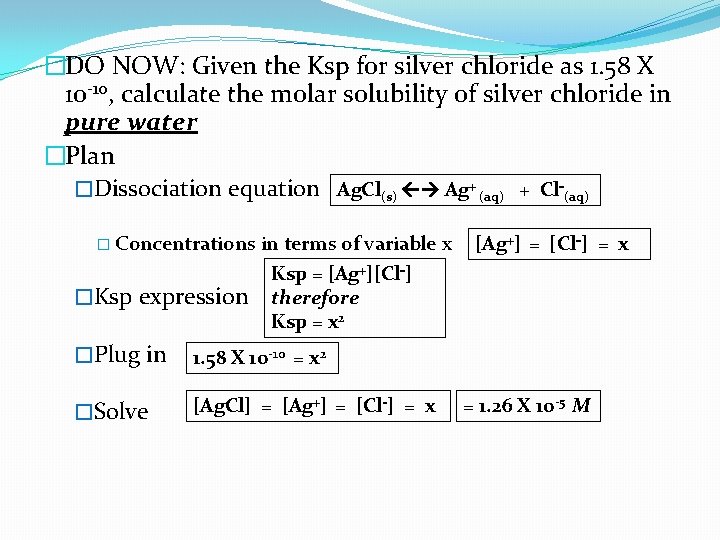
�DO NOW: Given the Ksp for silver chloride as 1. 58 X 10 -10, calculate the molar solubility of silver chloride in pure water �Plan �Dissociation equation Ag. Cl(s) Ag+ (aq) + Cl-(aq) � Concentrations in terms of variable x Ksp = [Ag+][Cl-] �Ksp expression therefore Ksp = x 2 �Plug in 1. 58 X 10 -10 = x 2 �Solve [Ag. Cl] = [Ag+] = [Cl-] = x = 1. 26 X 10 -5 M
Practice �If 150. m. L of 0. 00395 M Ba. Cl 2 and 550. m. L of 0. 0075 M K 2 SO 4 are mixed, will a precipitate form? (Ksp for Barium sulfate is 1. 1 X 10 -10) �Plan � Limiting reactant problem � Determine L. R determine mole of theoretical yield of Ba. SO 4. � Ksp expression � Solve for molar concentration of Ba. SO 4 � Compare molar solubility to theoretical yield. � If theoretical yield is MORE than molar solubility, YES precipitate forms � If theoretical yield is LESS than molar solubility, then ALL product formed remains DISSOLVED and precipitate does NOT form.
The Common Ion Effect �If a solution contains two dissolved substances that share a common ion, then the solubility of the salt becomes a more complex matter to determine �Relatively easy to perform calculations relating to the solubility of a saturated solution of silver chloride � ALL silver ions and chloride ions come from one compound �Consider a solution which contains both silver chloride and silver nitrate (a relatively very soluble salt) � Two sources of silver ion � Complex situation � Predict what will happen to molar solubility of silver chloride � Stay the same / decrease / increase � HINT: Le Chatelier’s Principle
�Molar solubility will DECREASE for a given compound if multiple sources of ion are present. How much? �By the ratio of amount contributed by the other compound relative to its Ksp value �Example Given the Ksp for silver chloride as 1. 58 X 10 -10, calculate the molar solubility of silver chloride in �Pure water �A solution that has a silver ion concentration of 5. 5 X 10 -3 M �A KCl solution with 8. 00 X 10 -4 g KCl in 1. oo L solution
�DO NOW: Given the Ksp for silver chloride as 1. 58 X 10 -10, calculate the molar solubility of silver chloride in pure water �Plan �Dissociation equation Ag. Cl(s) Ag+ (aq) + Cl-(aq) � Concentrations in terms of variable x Ksp = [Ag+][Cl-] �Ksp expression therefore Ksp = x 2 �Plug in 1. 58 X 10 -10 = x 2 �Solve [Ag. Cl] = [Ag+] = [Cl-] = x � Translation: [Ag+] = [Cl-] = x = 1. 26 X 10 -5 M in a solution containing silver chloride at a given temperature, at any given time, the maximum concentration of silver ion = chloride ion = 1. 26 X 10 -5 M
�Given the Ksp for silver chloride as 1. 58 X 10 -10, calculate the molar solubility of silver chloride in �A solution that has a silver ion concentration of 5. 5 X 10 -3 M �Plan �Set up ICE table �Determine initial concentrations �Determine change �Determine equilibrium concentrations �IGNORE “x” for the common ion � ***generally change is so small that it can be ignored �Set up Ksp expression �Solve for X � **generally good idea to compare to molar solubility in pure water to help recognize that solubility decreases significantly with the presence of a common ion.
�Given the Ksp for silver chloride as 1. 58 X 10 -10, calculate the molar solubility of silver chloride in a KCl solution where 0. 800 g KCl is dissolved in sufficient water to make a 1. 00 L solution. �Plan � Determine solubility of KCl � Determine moles of KCl � Soluble, potassium salt 0. 800 g / (39. 10 + 35. 45 g/mol) = 1. 07 X 10 -2 moles Determine concentration of Cl- in solution (ICE) 1. 07 X 10 -2 moles / 1. 00 L = 1. 07 X 10 -2 M KCl = 1. 07 X 10 -2 M K+ = 1. 07 X 10 -2 M Cl� Consider Ksp expression of Ag. Cl Ksp = [Ag+][Cl-] Plug in known values: 1. 58 X 10 -10 = [Ag+][1. 07 X 10 -2 Cl- ] � Solve for [Ag+] = 1. 48 X 10 -8 M � Determine molar solubility in given solution 1. 48 X 10 -8 M Ag. Cl � Since [Ag. Cl] = [Ag+], therefore molar solubility of Ag. Cl � Compare to known molar solubility of Ag. Cl in pure water (1. 26 X 10 -5) � 1. 48 X 10 -8 M Ag. Cl < 1. 26 X 10 -5
�Predict �What will happen if the following substances are added to a saturated solution of Ag. C 2 H 3 O 2 � KC 2 H 3 O 2 � Silver acetate will precipitate because the dissociated acetate ions are equivalent of adding a product, shifting equilibrium to the left. � H 2 SO 4 � Additional silver acetate will dissolve because adding hydrogen ions will react with the acetate ions to form acetic acid (recall: a weak acid stays in its molecular form), thus removing acetate ions and shifting equilibrium to the right.
Predict Given the following Ksp values, identify the order of precipitate formation in a mixture where the given ions are present �Ksp values � Chromium II hydroxide 2 X 10 -17 � Barium sulfate 1. 08 X 10 -10 � Barium sulfite 8 X 10 -7 � Calcium phosphate 2. 07 X 10 -33 � Calcium sulfate 9. 1 X 10 -6 � Cobalt carbonate 1. 11 X 10 -10 �Chromium �Barium ions �Calcium ions �Cobalt II ions �Sulfate ions �Chromate ions �Sulfite ions �Phosphate ions �Carbonate ions �Hydroxide Salt with the LOWEST Ksp value precipitates first. Why? Low Ksp value indicates low molar solubility, very little dissociation --. translation --. > very high precipitate formation (or faster precipitate formation 0
The Effect of p. H on salt solubility �When one of the ions in a salt can act as an acid or a base, p. H can influence solubility. �Consider the solubility of iron (III) hydroxide where the following equilibrium can be established Fe(OH)3(s) Fe+3(aq) + 3 OH-(aq) �Adding an acid (H+) to the equilibrium mixture will cause the hydroxide ions to be removed in a neutralization reaction � Result equilibrium shifts forward (according to Le Chatelier’s principle, removal of a product causes reaction to shift forward) � Therefore, solubility of solid Fe(OH)3 increases �Addition of a base (OH-) to the equilibrium mixture will shift it backwards (according to Le Chatelier’s principle, addition of a product causes reaction to shift backwards) � Result solubility of solid Fe(OH)3 decreases
Unit 6 D: Gibbs Free Energy and Equilibrium �RECALL: What does ∆Go represent? �Change in Standard Gibbs Free Energy in a reaction at equilibrium. �Standard implies? ? � All substances in standard state � 1. 0 M (solutions) � 1. 0 atm (gases) � Temperature = 298 K �Can be calculated using methods analogous to ∆H calculations: ∆Go = ∑Gfoproducts - ∑Gforeactants
Gibbs Free energy and equilibrium �The relationship between Gibbs Free Energy and Equilibrium constant, K is given by ∆Go = -RT ln K OR K= o e-∆G /RT
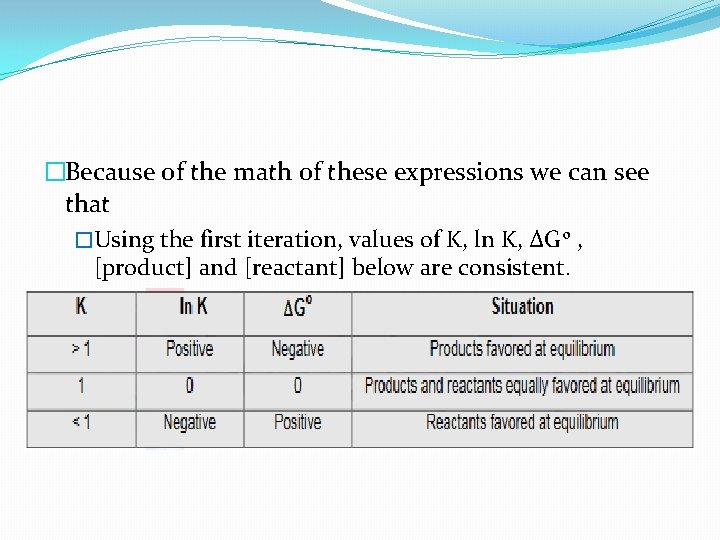
�Because of the math of these expressions we can see that �Using the first iteration, values of K, ln K, ∆G o , [product] and [reactant] below are consistent.
�Using the second iteration, we that RT (known as thermal energy) has a value of +24. 4 KJ / mol at room temperature, therefore: �When ∆Go has magnitude of approximately 2. 4 k. J/mol, i. e. , when ∆Go is close to 0, then K is close to 1 � Products and reactants are approximately equally favored. � [products] ≈ [reactants] �When ∆Go is significantly less than 0 (negative) the power to which e is raised is positive, and K > 1 � Reaction is product favored at equilibrium. � [products] > [reactants] �When ∆Go is significantly greater than o (positive) the power to which e is raised is negative, and K < 1 � Reaction is reactant favored at equilibrium. � [products] < [reactants]
- Slides: 141