
Unit 5 Understanding Multiple Choice Questions Written by

Unit 5: Understanding Multiple. Choice Questions Written by Kathleen Mc. Cullough-Zander, MA, RN, CTN

Levels of knowledge • • Knowledge – remember information (memorization) Comprehension – understanding the meaning of information Application – use information in a particular situation Analysis – finding the commonalities, differences and connections in information, data and concepts

Test questions in nursing • Usually at the level of application or analysis • Need to apply more than one fact or concept to a situation • There may be more than one right answer: need to select the best answer

Parts of a multiple-choice question What is the primary purpose of leg exercises after abdominal surgery? 1. Promote venous return 2. Prevent muscle atrophy 3. Increase muscle strength 4. Limit disabling contractures Stem Correct answer Distractor

Alternative format questions • • • Matching Multiple answers – select all that apply Fill in the blank Ranking Mark a part on a picture

Strategy for multiple-choice questions • • Identify the key concepts in the stem – underline them Identify who is the central person in the question Put the question into your own words Think of the answer in your mind! Read all four answers Immediately cross out the answers you know are wrong You are usually left with two answers to choice from Which one is closest to the answer you had in mind?

Tips for success • • Do not additional information into the stem or answers Be sure to notice specific words such as “always, never, all, none” Use time wisely – skip a difficult question and come back later Cover the answers while you analyze the stem Wear earplugs if distracted by noise Be sure to fill in the correct circle on scanform 55. 3% of the time students gain a point when changing an answer (Jordan & Johnson, 1990)

Test analysis • • • Test analysis helps you to improve skills in studying and test taking It provides you with feedback to improve It is “thinking about your thinking” Make copies of handout to use in test review You are looking for patterns!

What is the most common reason why older adults become incontinent of urine? A. They use incontinence to manipulate others. B. The muscles that control urination become weak. C. They tend to drink less fluid than younger patients. D. Their increase in weight places pressure on the bladder.

To best understand what a patient is saying, the nurse should: A. Listen carefully. B. Employ touch. C. Show interest. D. Remain silent.
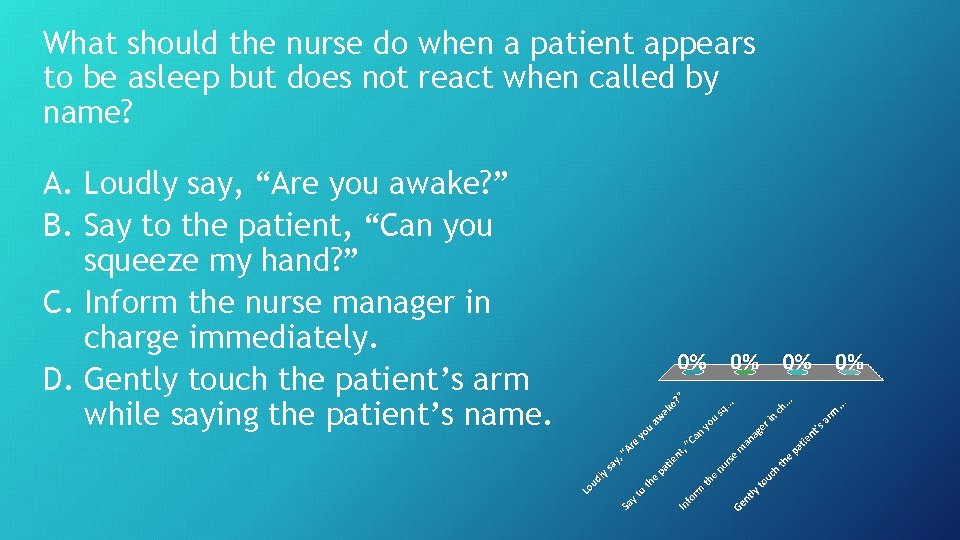
What should the nurse do when a patient appears to be asleep but does not react when called by name? A. Loudly say, “Are you awake? ” B. Say to the patient, “Can you squeeze my hand? ” C. Inform the nurse manager in charge immediately. D. Gently touch the patient’s arm while saying the patient’s name.

The nurse determines that range-of-motion (ROM) exercises should NOT be done: A. For comatose patients. B. On limbs that are paralyzed. C. Beyond the point of resistance. D. For patients with chronic joint disease.

Before performing a procedure, what should the nurse do first? A. Collect the equipment for the procedure. B. Position the patient for the procedure. C. Explain the procedure to the patient. D. Raise the bed to its highest position.

The nurse understands that the primary etiology of obesity is: A. Lack of balance in the variety of nutrients. B. Glandular disorder that prevents weight loss, C. Caloric intake that exceeds metabolic needs. D. Psychological problem that causes overeating.

Which is a primary source for obtaining information related to the independent functions of a nurse? A. Chart B. Patient C. Nursing supervisor D. Health-care provider

You all get an “A” on this examination!
- Slides: 16