
Unit 5 The Legislative Branch 1 Purpose Membership
Unit 5: The Legislative Branch 1. Purpose & Membership

Purpose • The purpose of Congress is to make laws for the US that help it achieve the goals listed in the Preamble of the US Constitution. The powers of Congress include: – – – – – Making laws To tax Borrow money Regulate trade Naturalization Print money Create a postal service and military Copyrights and patents Govern the military and declare war Anything they need to accomplish these things
Membership • The United States Congress is a bicameral legislature. – This means what? – What are those two houses? • This also means that Congress is representative of the states in two ways. – So how are states represented in each house? – Who came up with such an idea? • There are currently 535 members of Congress. – So how many people are in each house?
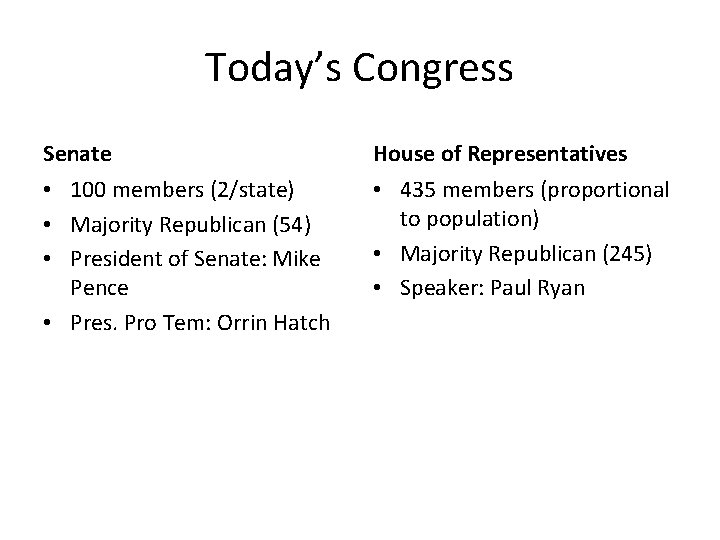
Today’s Congress Senate House of Representatives • 100 members (2/state) • Majority Republican (54) • President of Senate: Mike Pence • Pres. Pro Tem: Orrin Hatch • 435 members (proportional to population) • Majority Republican (245) • Speaker: Paul Ryan
Membership • Most members of Congress are lawyers. This only makes sense since Congress is responsible for making laws. • Over time, Congressional membership has become more diverse to reflect the changes in the American population. – 104 women, 50 African-Americans, 39 Hispanic American, 15 Asian American/Pacific Islander, and 2 Native American – Average 10+ years service – Average age… 60
Membership • How does one get to be a member of the Senate? • The answer appears in Article ______, section _______ of the US Constitution. – Min. Age: 30 – Citizenship: 9 years – Resident of state representing – Elected to office
Membership • How does one get to be a member of the House? • The answer appears in Article _____, section ____ of the US Constitution. – Min. Age: 25 – Citizenship: 7 years – Resident of state representing – Elected to office
Purpose • Congress is entirely comprised of representatives from the states. – This is because the writers of the Constitution wanted to create a stronger central government, but also include the states in the legislative process. – This also allows for a representative democracy where the people are represented but still able to participate in politics.
Terms • Representatives have two year terms, while Senators have six year terms. • Because Senators have a longer term, they provide the Congress with a sense of continuity. This is especially true since most win re-election. – An official in office seeking re-election is known as an incumbent. • The number of Representatives a state has is decided by the Census, which occurs every ten years. – The people that are represented are known as constituents.
Terms • Congressional sessions are mandated to start on January 3 by the 20 th Amendment. – Most sessions last until November or December. – While Congress only needs to meet once a year, their meetings last most of the year. • Each house of the Congress must ask the other’s permission before adjourning for more than three days.
Terms • Congressional salaries are set by Congress. However the 27 th Amendment (originally proposed in 1789) prevents a sitting Congress from giving themselves a raise. • On average, members of Congress are paid about $200, 000 a year, and receive several tax credits, allowances, and privileges. Retirees can also receive a $150, 000 a year pension. • Congress’ last pay raise was in 2009 (does not include cost-of-living increase).
- Slides: 11