
Unit 5 Staff Fleet Scheduling Vehicle Crew Scheduling
- Slides: 40
Unit 5: Staff & Fleet Scheduling Vehicle & Crew Scheduling Materials developed by K. Watkins, J. La. Mondia and C. Brakewood
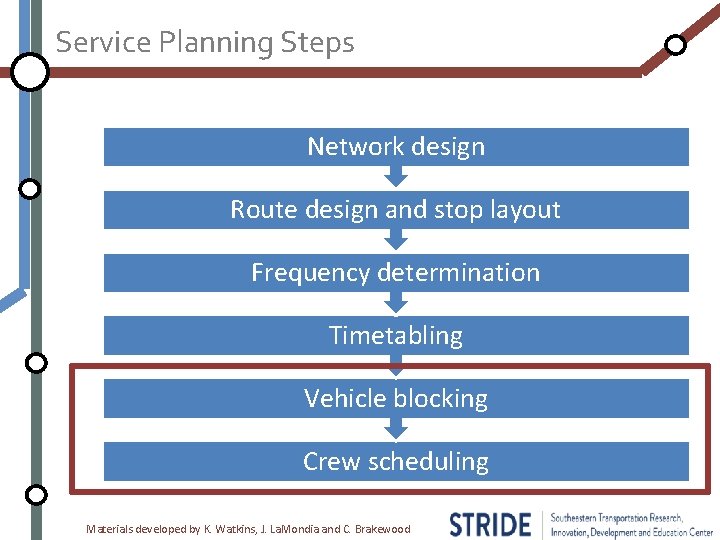
Service Planning Steps Network design Route design and stop layout Frequency determination Timetabling Vehicle blocking Crew scheduling Materials developed by K. Watkins, J. La. Mondia and C. Brakewood
Connecting to Last Lecture • Last time: – Determined schedule of service for routes in the service area • Now: – Select the number of vehicles and drivers to serve those routes Materials developed by K. Watkins, J. La. Mondia and C. Brakewood
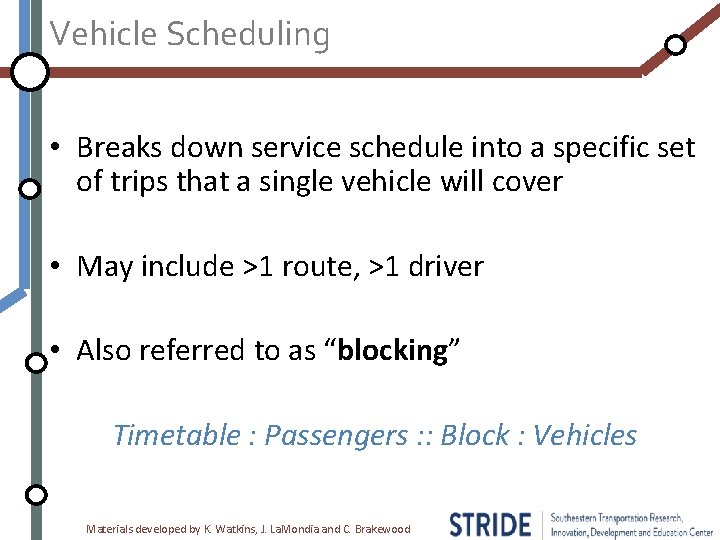
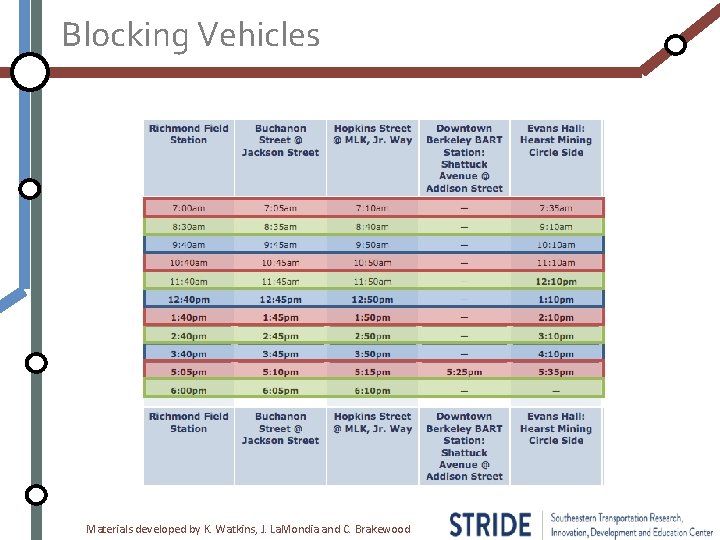
Vehicle Scheduling • Breaks down service schedule into a specific set of trips that a single vehicle will cover • May include >1 route, >1 driver • Also referred to as “blocking” Timetable : Passengers : : Block : Vehicles Materials developed by K. Watkins, J. La. Mondia and C. Brakewood
Why Important? • Blocking dictates the cost associated with operating a transit system on a given day – Vehicle operation – Worker assignments Materials developed by K. Watkins, J. La. Mondia and C. Brakewood
Components of Blocking • Pull-out time from depot • Sequence of trips from timetable – Including time at specific locations • Interline/Deadhead trips • Pull-in time to depot Materials developed by K. Watkins, J. La. Mondia and C. Brakewood
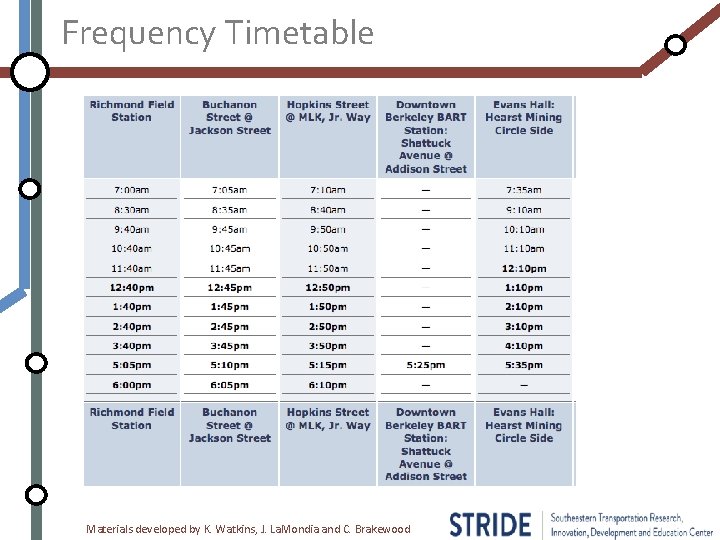
Frequency Timetable Materials developed by K. Watkins, J. La. Mondia and C. Brakewood
Blocking Vehicles Materials developed by K. Watkins, J. La. Mondia and C. Brakewood
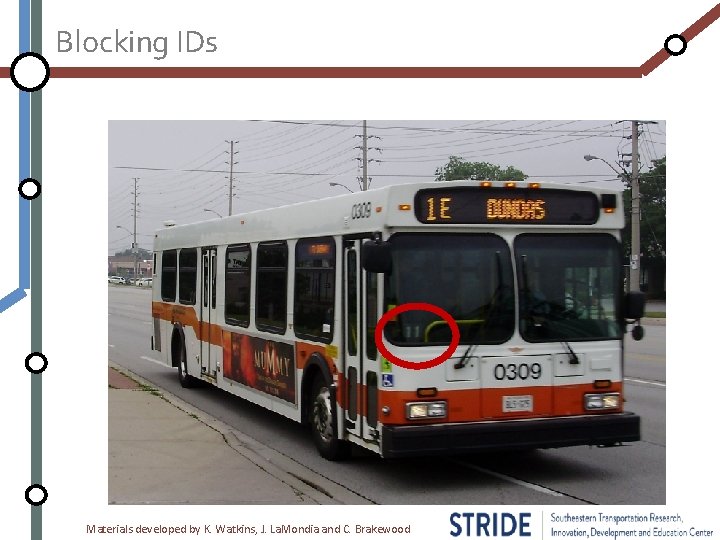
Blocking IDs Materials developed by K. Watkins, J. La. Mondia and C. Brakewood
Goal of Blocking • Minimize time, budget, distance traveled by all vehicles on network • Specifically concerned with: – Layover times – Deadhead time – Recovery time – Wastes money, utilize same drivers over multiple routes Materials developed by K. Watkins, J. La. Mondia and C. Brakewood
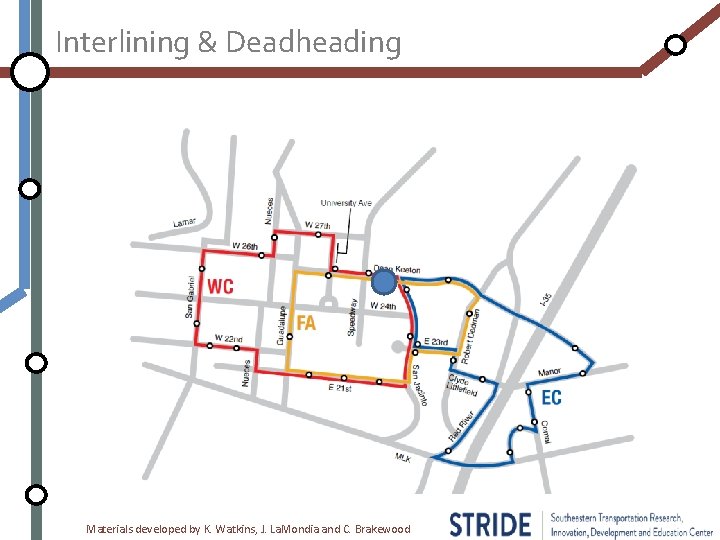
Blocking Policies • Layover & Recovery Times • Rest or break time for operators along a route • Buffer time built into the schedule to keep on-time • Interlining • Switch vehicle from one route to another within a major terminal • Deadheading • Switch vehicle from one route to another at a different terminal Materials developed by K. Watkins, J. La. Mondia and C. Brakewood
Interlining & Deadheading Materials developed by K. Watkins, J. La. Mondia and C. Brakewood
Constraints • Each trip in the timetable must be made by a vehicle • A vehicle cannot be assigned more than one trip at any point in time • If a vehicle must be repositioned for a trip, the time and distance it takes to get to the new start point must be considered Materials developed by K. Watkins, J. La. Mondia and C. Brakewood
Challenges to Blocking • Frequent bus service • More than 1 depot location • Coordination over multiple routes • # Vehicles = Cycle Time/ Headway Materials developed by K. Watkins, J. La. Mondia and C. Brakewood
Easy Blocking Solution • Have a set of vehicles run on single cycles around each route all day – First in-first out rule – Not efficient – Not cost-effective Materials developed by K. Watkins, J. La. Mondia and C. Brakewood
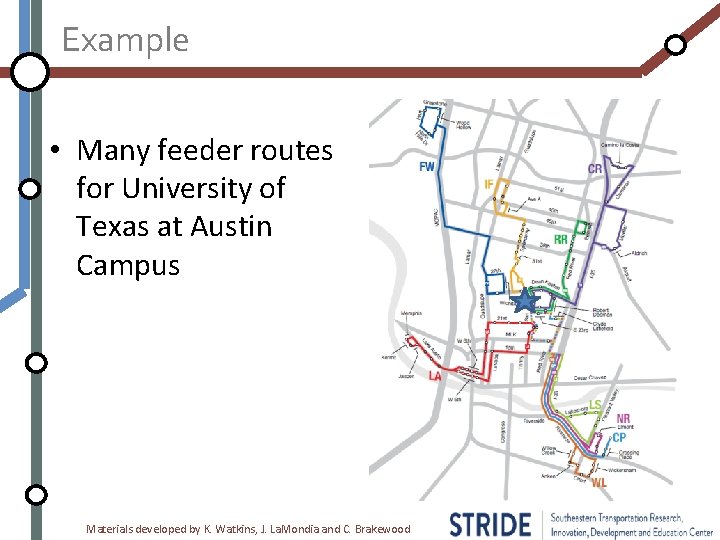
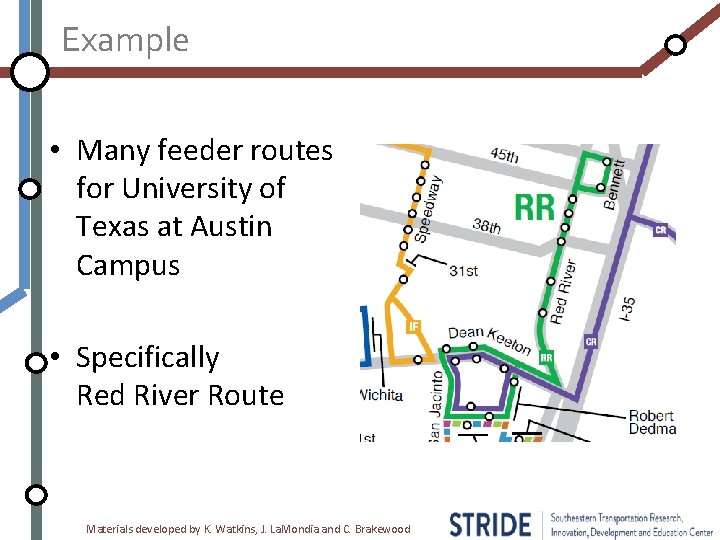
Example • Many feeder routes for University of Texas at Austin Campus Materials developed by K. Watkins, J. La. Mondia and C. Brakewood
Example • Many feeder routes for University of Texas at Austin Campus • Specifically Red River Route Materials developed by K. Watkins, J. La. Mondia and C. Brakewood
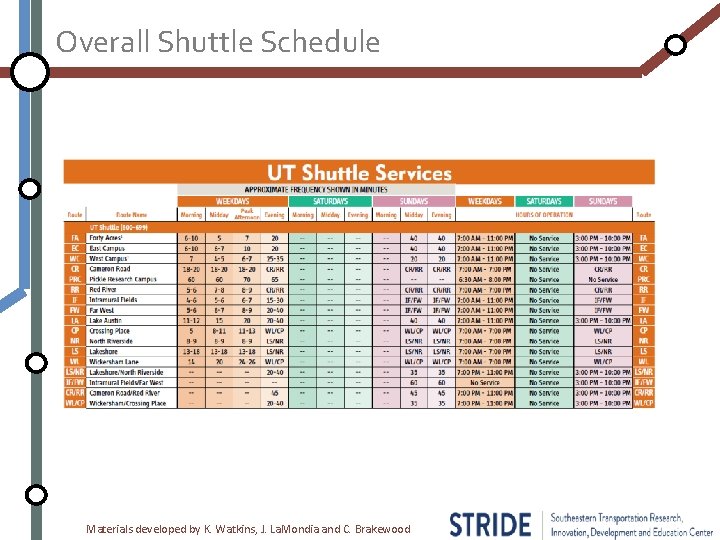
Overall Shuttle Schedule Materials developed by K. Watkins, J. La. Mondia and C. Brakewood
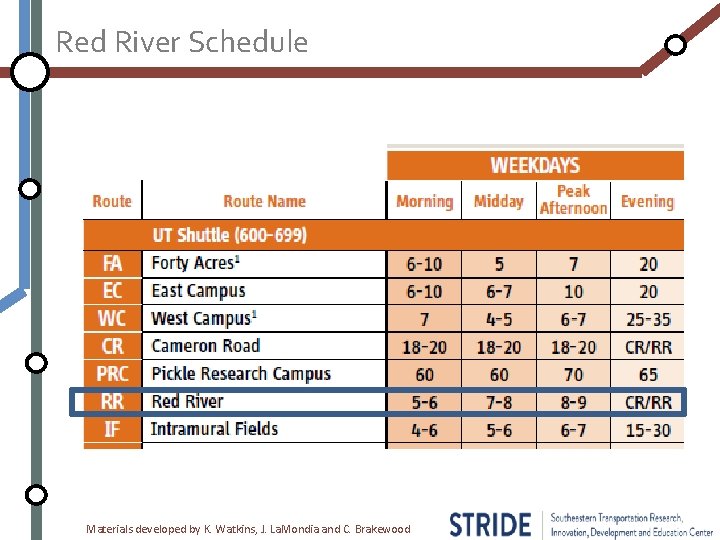
Red River Schedule Materials developed by K. Watkins, J. La. Mondia and C. Brakewood
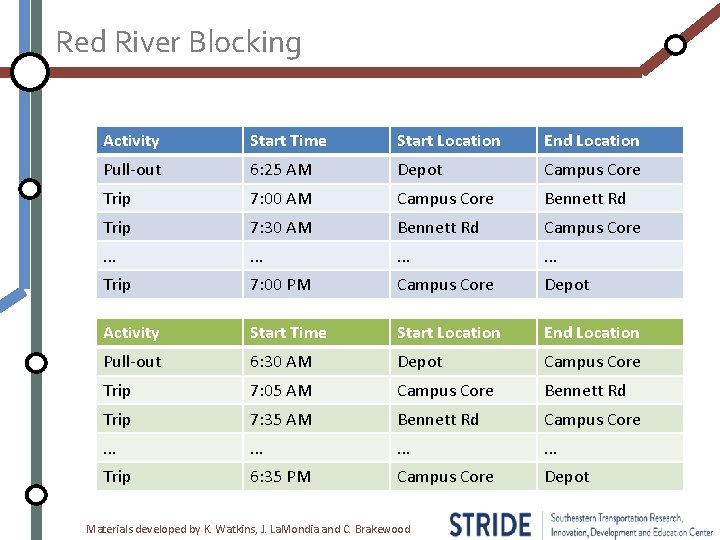
Red River Blocking Activity Start Time Start Location End Location Pull-out 6: 25 AM Depot Campus Core Trip 7: 00 AM Campus Core Bennett Rd Trip 7: 30 AM Bennett Rd Campus Core . . . Trip 7: 00 PM Campus Core Depot Activity Start Time Start Location End Location Pull-out 6: 30 AM Depot Campus Core Trip 7: 05 AM Campus Core Bennett Rd Trip 7: 35 AM Bennett Rd Campus Core . . . Trip 6: 35 PM Campus Core Depot Materials developed by K. Watkins, J. La. Mondia and C. Brakewood
Crew Scheduling • Once the vehicles are blocked, we get to now assign drivers to operate them! • Come up with work shifts – Minimum total labor costs that still meet service requirements Materials developed by K. Watkins, J. La. Mondia and C. Brakewood
Why Important? • Scheduling is critical for allocating funds efficiently • Ineffective methods generate – Too much overtime – Too much guaranteed time • Leads to financial instability Materials developed by K. Watkins, J. La. Mondia and C. Brakewood
A Significant Share of Operating Costs • 60 -70% of total operating costs are for drivers • Small reductions in number of operators or total work hours can save significant funds for an agency Materials developed by K. Watkins, J. La. Mondia and C. Brakewood
Challenges • Cannot just assign one driver to one vehicle for the day – Vehicle operates longer than typical 8 -hour work period – Driver may not get sufficient break time during layovers Materials developed by K. Watkins, J. La. Mondia and C. Brakewood
Driver “Duties” • The work shifts for drivers • Also called “runs” • Can be: – One-piece duty • A single block over an 8 -hr period of time – Multiple-piece duty • More than 1 block over an 8 -hr period of time Materials developed by K. Watkins, J. La. Mondia and C. Brakewood
Run-cutting • Process of breaking up vehicle blocking into individual pieces and set duties • In the past: pieces of paper • Today: with computers Materials developed by K. Watkins, J. La. Mondia and C. Brakewood
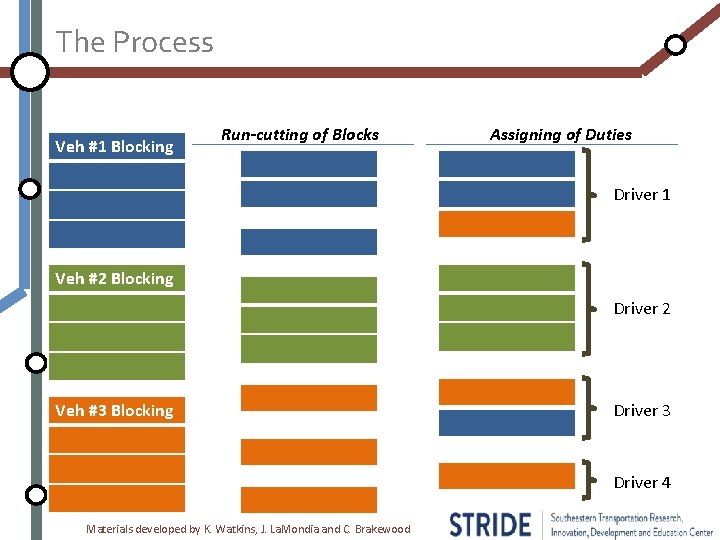
The Process • Run-cut each vehicle block into pieces of work • Assemble pieces of work into duties – Based on worker constraints Materials developed by K. Watkins, J. La. Mondia and C. Brakewood
The Process Veh #1 Blocking Run-cutting of Blocks Assigning of Duties Driver 1 Veh #2 Blocking Driver 2 Veh #3 Blocking Driver 3 Driver 4 Materials developed by K. Watkins, J. La. Mondia and C. Brakewood
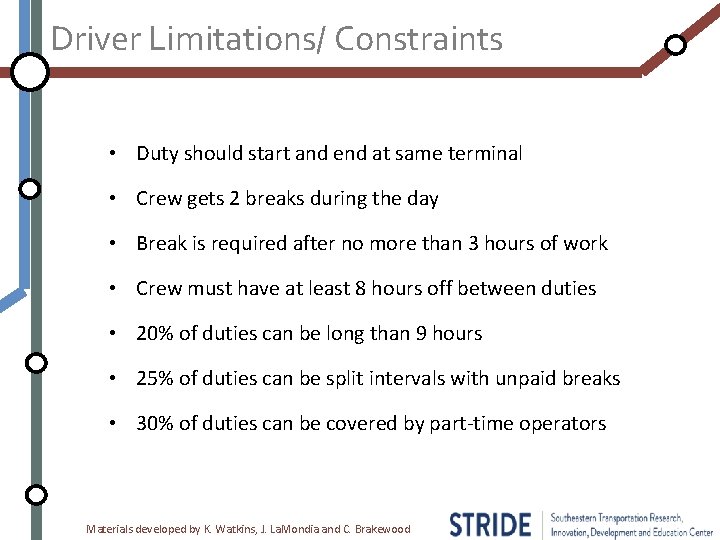
Driver Limitations/ Constraints • Duty should start and end at same terminal • Crew gets 2 breaks during the day • Break is required after no more than 3 hours of work • Crew must have at least 8 hours off between duties • 20% of duties can be long than 9 hours • 25% of duties can be split intervals with unpaid breaks • 30% of duties can be covered by part-time operators Materials developed by K. Watkins, J. La. Mondia and C. Brakewood
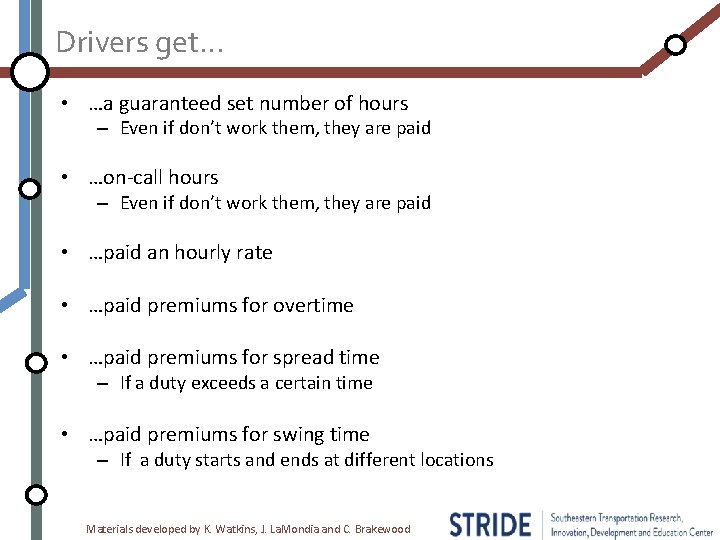
Drivers get… • …a guaranteed set number of hours – Even if don’t work them, they are paid • …on-call hours – Even if don’t work them, they are paid • …paid an hourly rate • …paid premiums for overtime • …paid premiums for spread time – If a duty exceeds a certain time • …paid premiums for swing time – If a duty starts and ends at different locations Materials developed by K. Watkins, J. La. Mondia and C. Brakewood
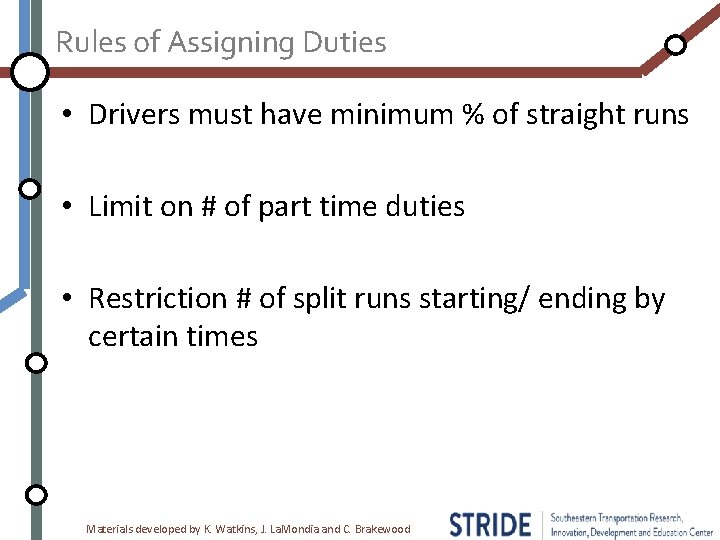
Rules of Assigning Duties • Drivers must have minimum % of straight runs • Limit on # of part time duties • Restriction # of split runs starting/ ending by certain times Materials developed by K. Watkins, J. La. Mondia and C. Brakewood
How do we come up with run-cutting pieces? • It’s an optimization problem! – Find the most cost effective run-cutting option – Based on meeting a set of constraints/ objectives • Need a computer to help solve Materials developed by K. Watkins, J. La. Mondia and C. Brakewood
Objectives • What goals would you have with your schedule to get it to be the smallest cost possible? Materials developed by K. Watkins, J. La. Mondia and C. Brakewood
Objectives • Minimize number of drivers hired by company • Maximize number of full 8 hour shifts • Minimize shifts over 8 hours • Maximize number of shifts with contiguous days off • Maximize number of shifts with Saturday-Sunday off Materials developed by K. Watkins, J. La. Mondia and C. Brakewood
Assigning Process • It’s a bidding war! • Those with seniority go first – Get to pick their duties for the next period • Happens 2 -3 times per year Materials developed by K. Watkins, J. La. Mondia and C. Brakewood
Assignment Option #1 • Cafeteria-style, or “a-la-carte” • Drivers pick individual duties on a day-by-day basis • Do not pick duties on days you want off • Some rules need to be followed Materials developed by K. Watkins, J. La. Mondia and C. Brakewood
Assignment Option #2 • Rostering, or “packaged” • Scheduler puts together weekly duty packages, called rosters • Drivers pick a roster from the options given Materials developed by K. Watkins, J. La. Mondia and C. Brakewood
Cost Awareness • Cafeteria-style – Operators are more invested in their work because they scheduled it – Better attendance, fewer accidents, fewer complaints, etc. • Rostering – Really cost-effective – Best when guarantees are lifted as well Materials developed by K. Watkins, J. La. Mondia and C. Brakewood
Conclusions • Vehicle blocking and driver duties are complex processes. • Both are critical to financial stability of agencies. • Many options for organizing vehicles and drivers. – Most likely use computers to assist. Materials developed by K. Watkins, J. La. Mondia and C. Brakewood
Reference Materials in this lecture were taken from: • Mark Hickman, Fundamentals of Transportation wikibook, “Network Design & Frequency”, http: //en. wikibooks. org/wiki/Fundamentals_of_T ransportation/Network_Design_and_Frequency • UC Berkeley Bear Transit Schedules and Multi. Modal Transportation Map, (2009), Trillium Solutions, http: //www. trilliumtransit. com/2009/09/07/ucberkeley-bear-transit-schedules-and-multi-modal -transportation-map/ Materials developed by K. Watkins, J. La. Mondia and C. Brakewood