
Unit 5 Splay Trees Motivation for Splay Trees

- Slides: 27
Unit - 5 Splay Trees
Motivation for Splay Trees Problems with AVL Trees extra storage/complexity for height fields ugly delete code Solution: splay trees blind adjusting version of AVL trees amortized time for all operations is O(log n) worst case time is O(n) insert/find always rotates node to the root! Splay Trees CSE 326 Autumn 2001 2
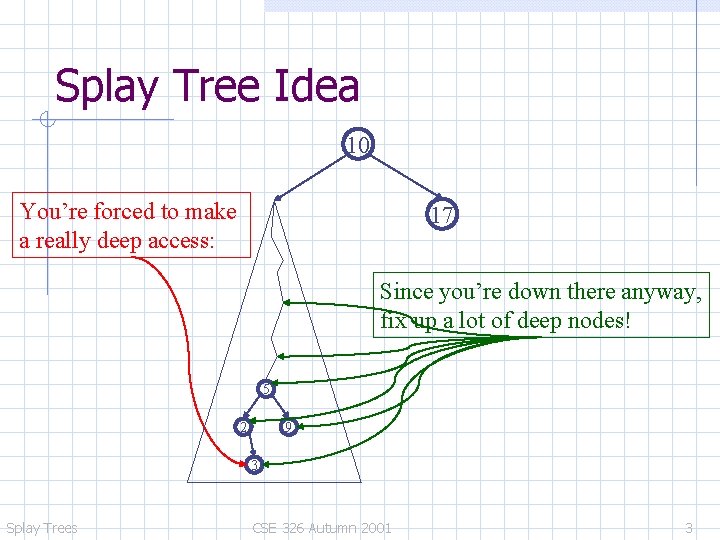
Splay Tree Idea 10 You’re forced to make a really deep access: 17 Since you’re down there anyway, fix up a lot of deep nodes! 5 2 9 3 Splay Trees CSE 326 Autumn 2001 3
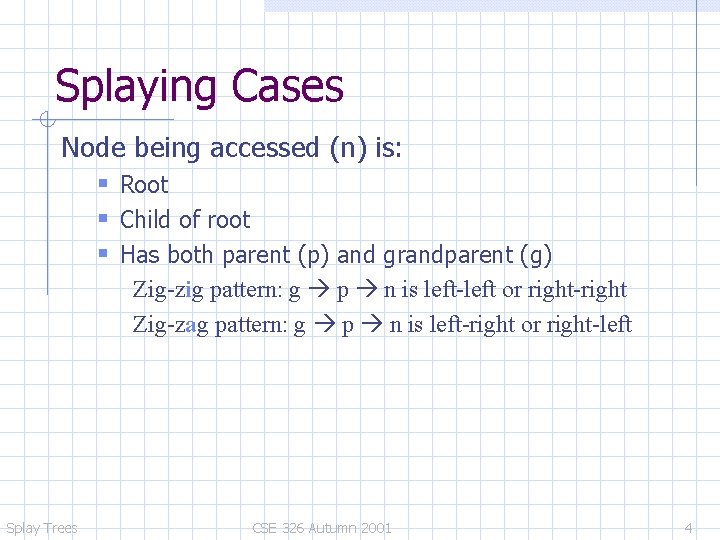
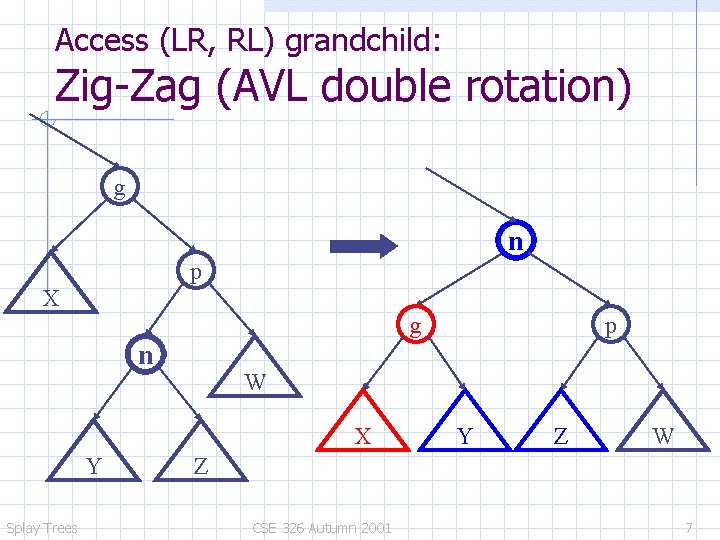
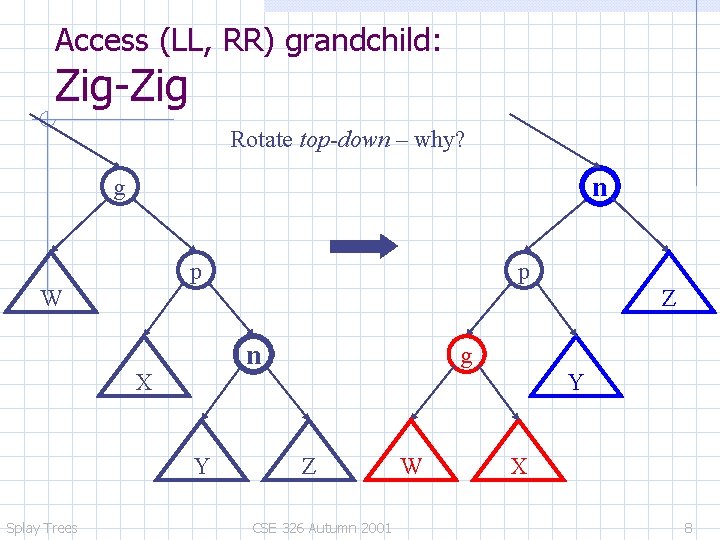
Splaying Cases Node being accessed (n) is: Root Child of root Has both parent (p) and grandparent (g) Zig-zig pattern: g p n is left-left or right-right Zig-zag pattern: g p n is left-right or right-left Splay Trees CSE 326 Autumn 2001 4
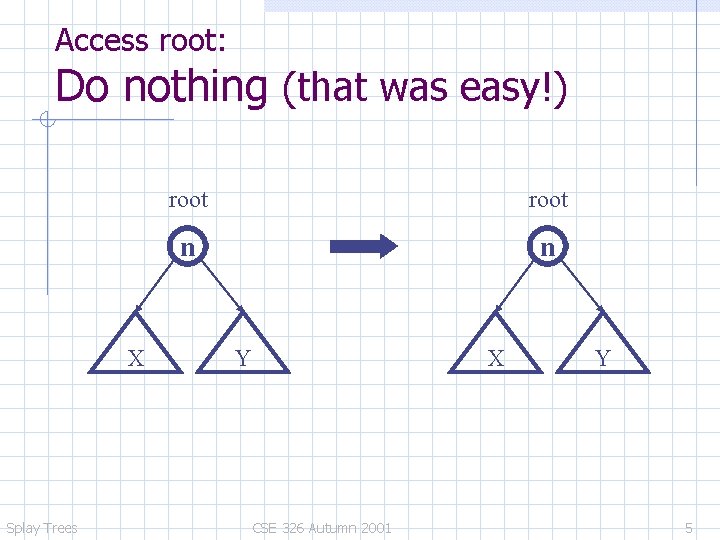
Access root: Do nothing (that was easy!) X Splay Trees root n n Y X CSE 326 Autumn 2001 Y 5
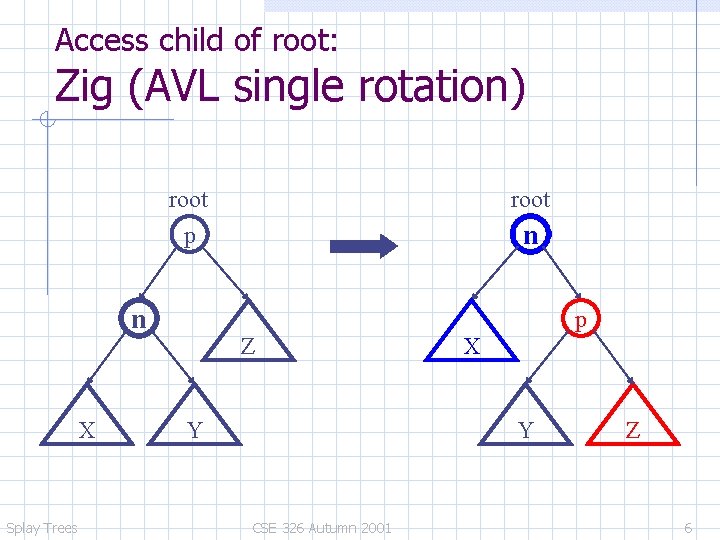
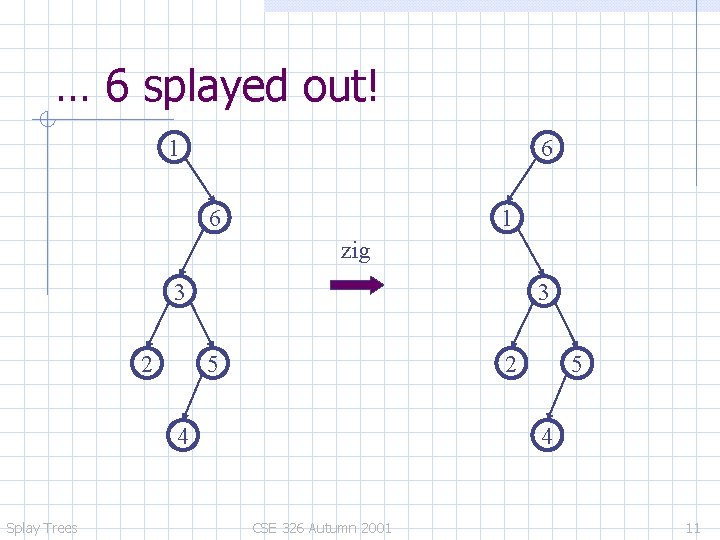
Access child of root: Zig (AVL single rotation) root p n X Splay Trees root n p Z Y X Y CSE 326 Autumn 2001 Z 6
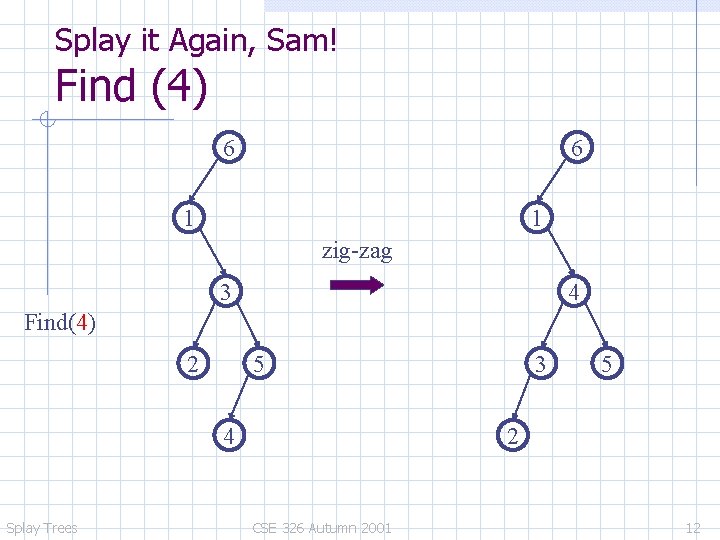
Access (LR, RL) grandchild: Zig-Zag (AVL double rotation) g n p X g n W X Y Splay Trees p Y Z W Z CSE 326 Autumn 2001 7
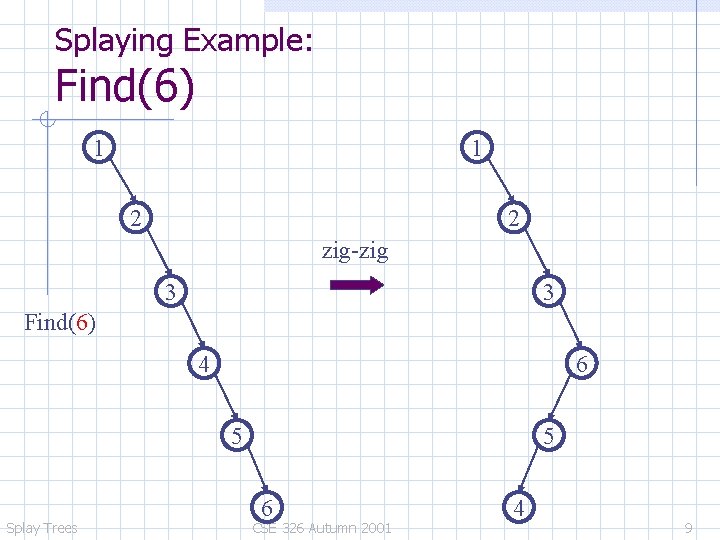
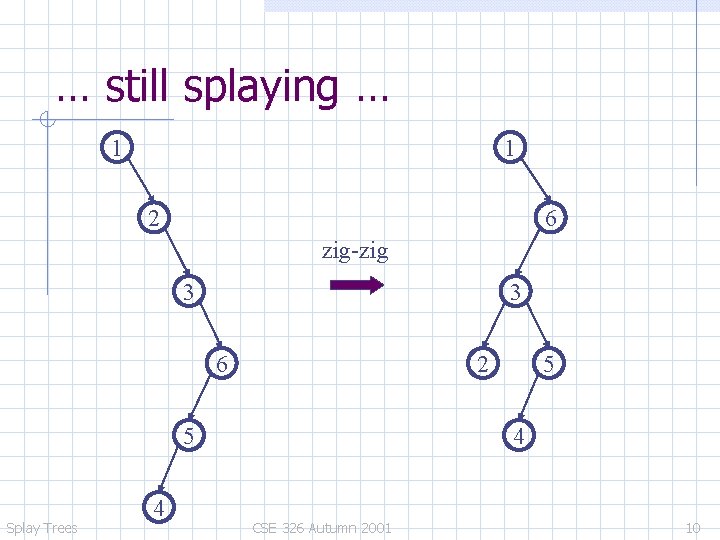
Access (LL, RR) grandchild: Zig-Zig Rotate top-down – why? n g p p W Z n X Y Splay Trees g Y Z CSE 326 Autumn 2001 W X 8
Splaying Example: Find(6) 1 1 2 2 zig-zig 3 3 Find(6) 6 4 5 5 Splay Trees 6 CSE 326 Autumn 2001 4 9
… still splaying … 1 1 2 6 zig-zig 3 3 6 2 5 Splay Trees 4 5 4 CSE 326 Autumn 2001 10
… 6 splayed out! 6 1 1 6 zig 3 2 3 5 2 4 Splay Trees 5 4 CSE 326 Autumn 2001 11
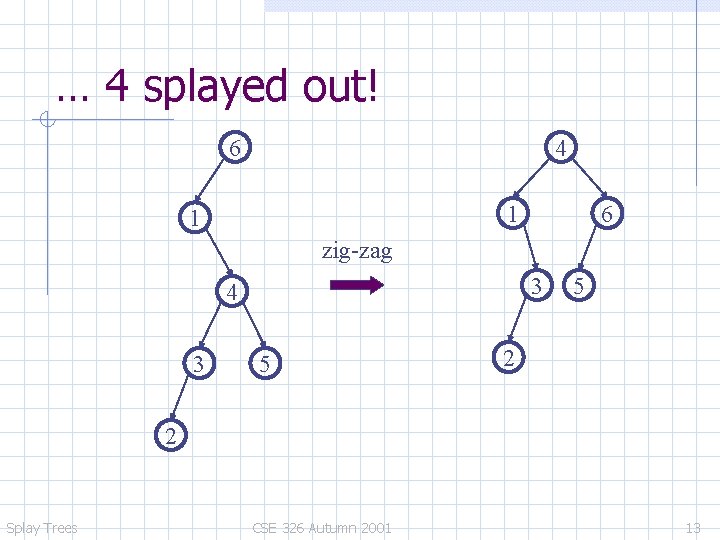
Splay it Again, Sam! Find (4) 6 6 1 1 zig-zag 3 4 Find(4) 2 5 4 Splay Trees 3 5 2 CSE 326 Autumn 2001 12
… 4 splayed out! 6 4 1 1 6 zig-zag 3 4 3 5 5 2 2 Splay Trees CSE 326 Autumn 2001 13
Why Splaying Helps If a node n on the access path is at depth d before the splay, it’s at about depth d/2 after the splay Exceptions are the root, the child of the root, and the node splayed Overall, nodes which are below nodes on the access path tend to move closer to the root Splaying gets amortized O(log n) performance. (Maybe not now, but soon, and for the rest of the operations. ) Splay Trees CSE 326 Autumn 2001 14
Splay Operations: Find the node in normal BST manner Splay the node to the root Splay Trees CSE 326 Autumn 2001 15
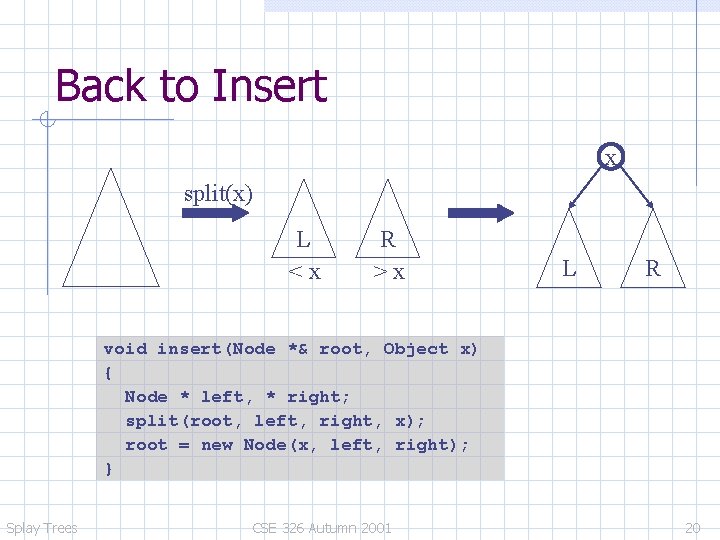
Splay Operations: Insert Ideas? Can we just do BST insert? Splay Trees CSE 326 Autumn 2001 16
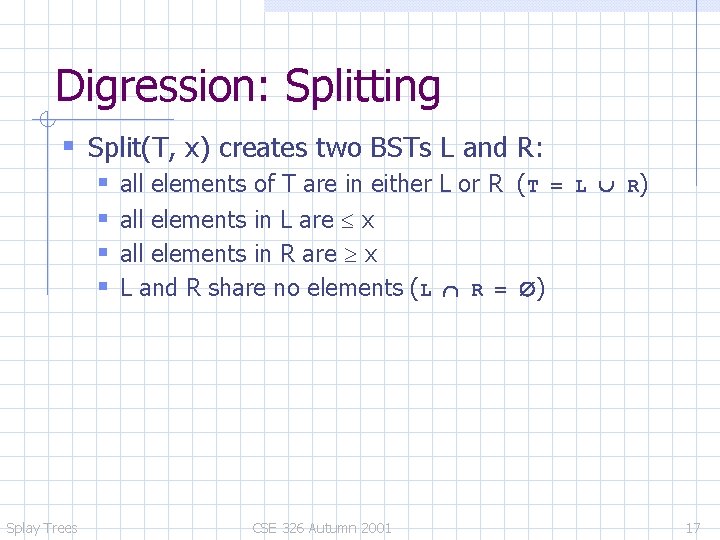
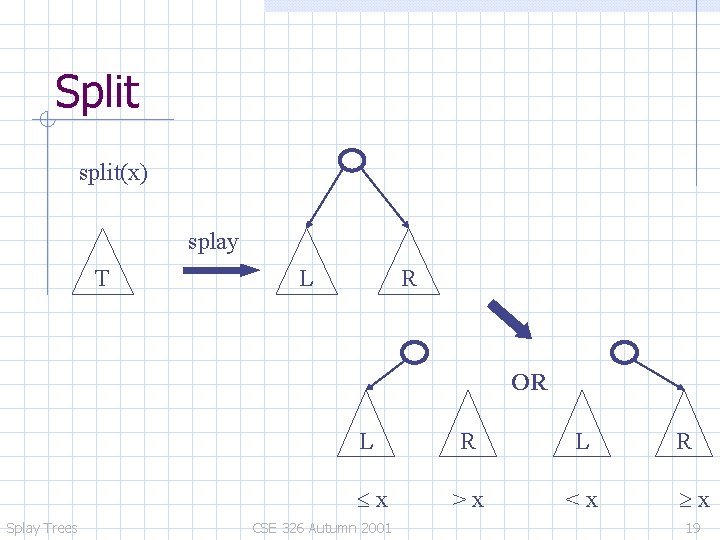
Digression: Splitting Split(T, x) creates two BSTs L and R: Splay Trees all elements of T are in either L or R (T = L R) all elements in L are x all elements in R are x L and R share no elements (L R = ) CSE 326 Autumn 2001 17
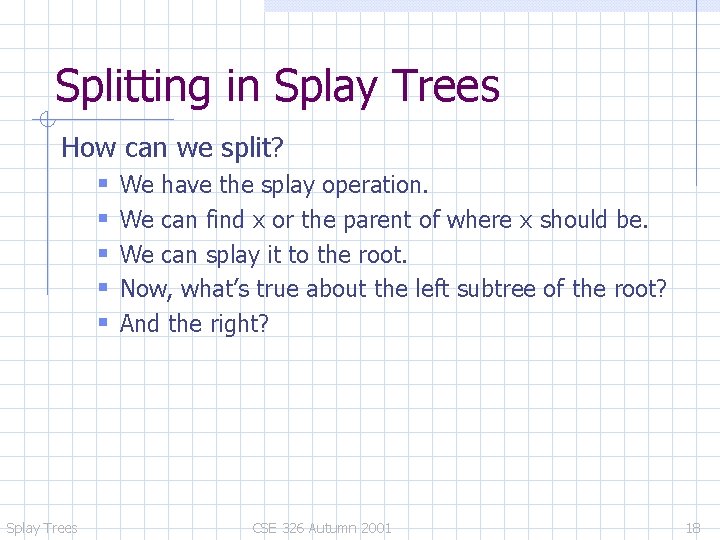
Splitting in Splay Trees How can we split? We have the splay operation. We can find x or the parent of where x should be. We can splay it to the root. Now, what’s true about the left subtree of the root? And the right? Splay Trees CSE 326 Autumn 2001 18
Split split(x) splay T L R OR Splay Trees L R L x >x <x CSE 326 Autumn 2001 R x 19
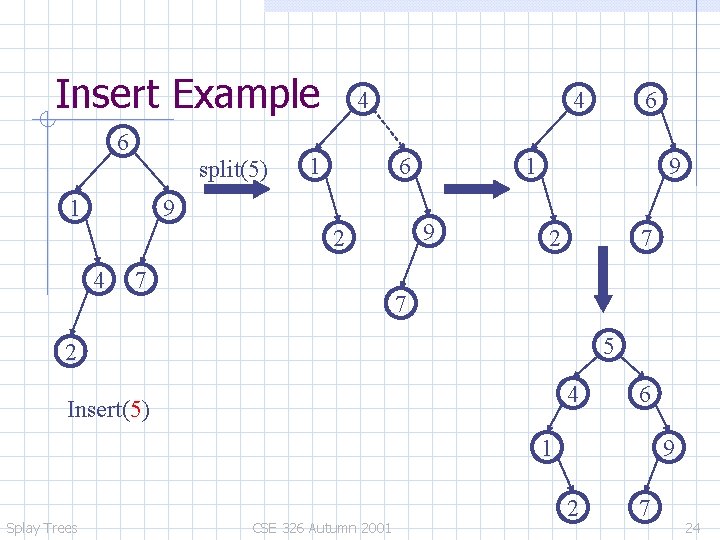
Back to Insert x split(x) L <x R >x L R void insert(Node *& root, Object x) { Node * left, * right; split(root, left, right, x); root = new Node(x, left, right); } Splay Trees CSE 326 Autumn 2001 20
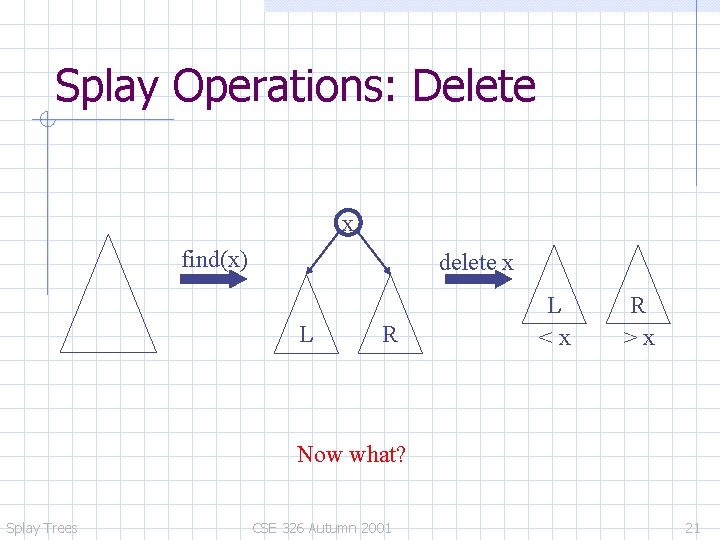
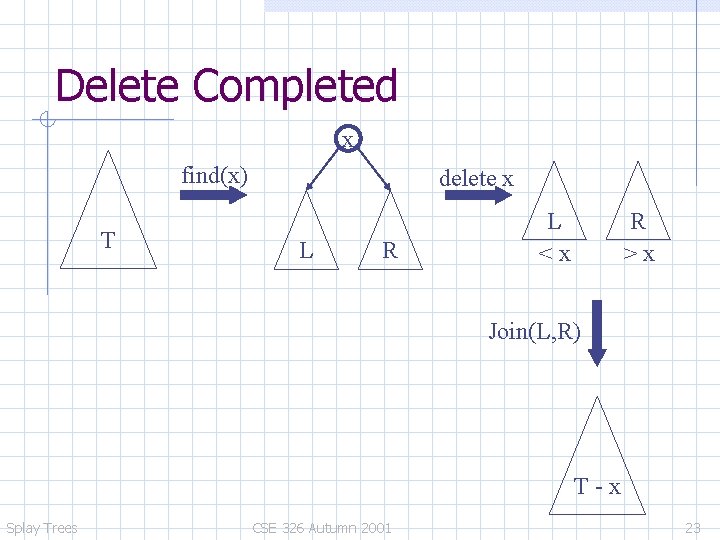
Splay Operations: Delete x find(x) delete x L R L <x R >x Now what? Splay Trees CSE 326 Autumn 2001 21
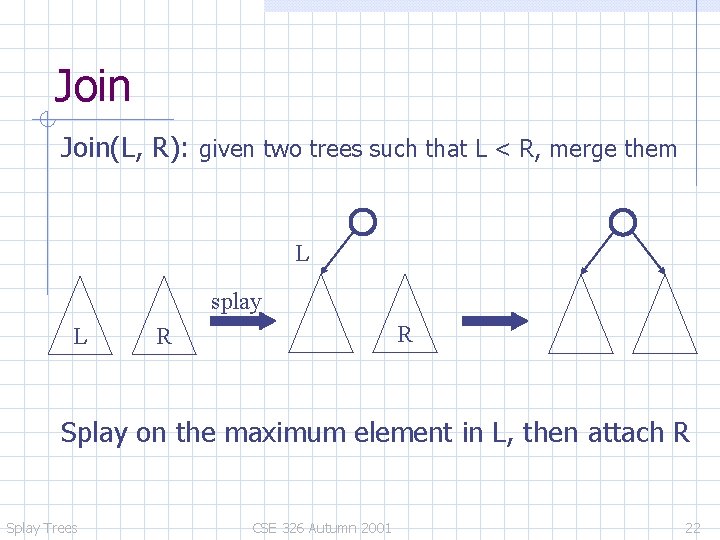
Join(L, R): given two trees such that L < R, merge them L splay L R R Splay on the maximum element in L, then attach R Splay Trees CSE 326 Autumn 2001 22
Delete Completed x find(x) T delete x L R L <x R >x Join(L, R) T-x Splay Trees CSE 326 Autumn 2001 23
Insert Example 6 split(5) 1 4 6 9 4 7 1 9 2 6 9 2 7 7 5 2 4 Insert(5) 6 1 Splay Trees CSE 326 Autumn 2001 9 2 7 24
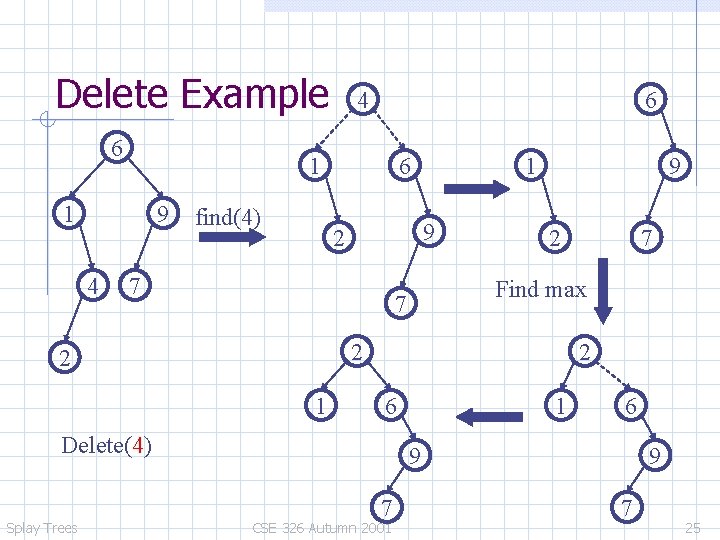
Delete Example 6 6 1 1 9 4 4 find(4) 6 9 2 7 9 2 2 1 7 Find max 7 2 2 6 Delete(4) Splay Trees 1 1 6 9 7 CSE 326 Autumn 2001 9 7 25
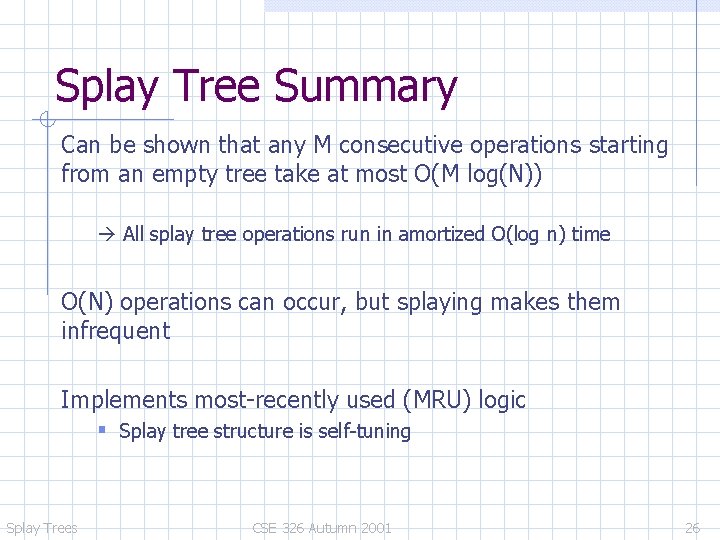
Splay Tree Summary Can be shown that any M consecutive operations starting from an empty tree take at most O(M log(N)) All splay tree operations run in amortized O(log n) time O(N) operations can occur, but splaying makes them infrequent Implements most-recently used (MRU) logic Splay tree structure is self-tuning Splay Trees CSE 326 Autumn 2001 26
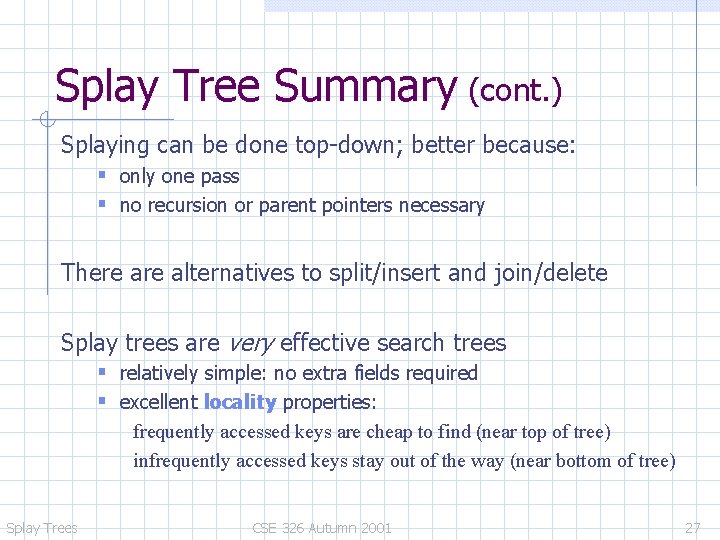
Splay Tree Summary (cont. ) Splaying can be done top-down; better because: only one pass no recursion or parent pointers necessary There alternatives to split/insert and join/delete Splay trees are very effective search trees relatively simple: no extra fields required excellent locality properties: frequently accessed keys are cheap to find (near top of tree) infrequently accessed keys stay out of the way (near bottom of tree) Splay Trees CSE 326 Autumn 2001 27