
Unit 5 Some elements of superconductivity Ezio Todesco
- Slides: 39
Unit 5 Some elements of superconductivity Ezio Todesco European Organization for Nuclear Research (CERN) Lectures based on USPAS courses in 2009 -2015 with P. Ferracin, H. Felice, S. Prestemon and on University of Milano Bicocca courses in 2016 -2018 This lecture based also on M. Sorbi course at Milano University Thanks to L. Bottura and G. de Rijk for proposing and supporting this initiative All the units will use International System (meter, kilo, second, ampere) unless specified E. Todesco, June 2020
PLAN OF THE LECTURES Part 1 – From beam dynamics to magnet specifications Unit 1: The energy and specifications for cell dipole and quadrupole Unit 2: The luminosity and specifications for insertion region magnets Appendix A: Beam optics from stable motion to chaos Part 2 – Principles of electromagnets Unit 3: Multipolar expansion of magnetic field Unit 4: How to generate pure multipole field Part 3 – Basics of superconductivity Unit 5: Some elements of superconductivity Appendix B: About Maxwell equations, and scales in atomic physics Unit 6: Instabilities and margins Part 4 – Magnet design Cable and insulation – magnetic design – grading and iron – forces – structures - protection E. Todesco, June 2020 Unit 4 - 2
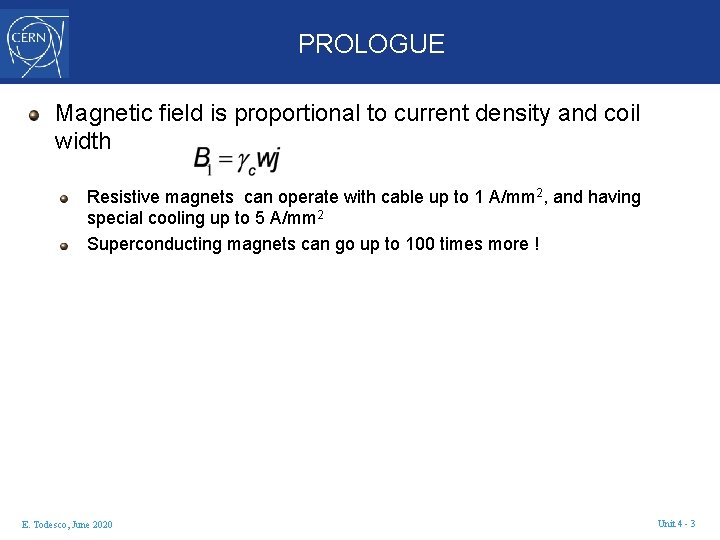
PROLOGUE Magnetic field is proportional to current density and coil width Resistive magnets can operate with cable up to 1 A/mm 2, and having special cooling up to 5 A/mm 2 Superconducting magnets can go up to 100 times more ! E. Todesco, June 2020 Unit 4 - 3
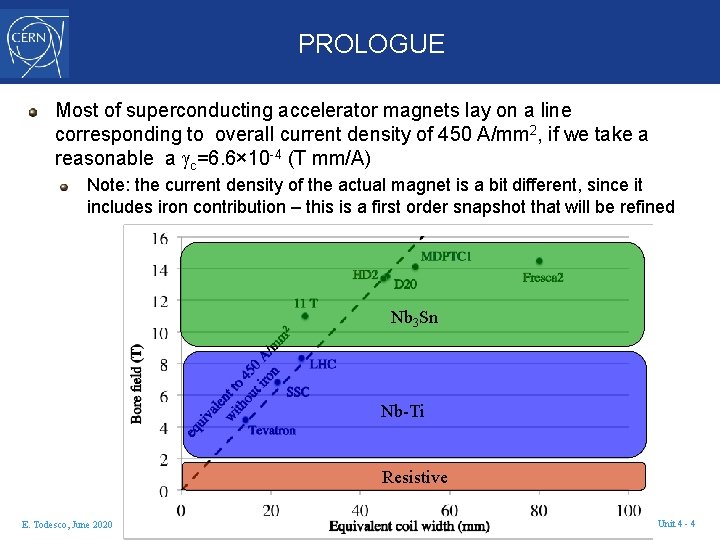
PROLOGUE Most of superconducting accelerator magnets lay on a line corresponding to overall current density of 450 A/mm 2, if we take a reasonable a gc=6. 6× 10 -4 (T mm/A) Note: the current density of the actual magnet is a bit different, since it includes iron contribution – this is a first order snapshot that will be refined Nb 3 Sn Nb-Ti Resistive E. Todesco, June 2020 Unit 4 - 4
PROLOGUE Most of superconducting accelerator magnets lay on a line corresponding to overall current density of 450 A/mm 2, if we take a reasonable a gc=6. 6× 10 -4 T mm/A What are the limitations to high current densities? First: superconducting state is destroyed by a combination of field and current density This will be the topic of this Unit 5 Second: superconducting state is limited by instabilities and operation requires margin This will be the topic of Unit 6, that also introduces the reasons for having such a complicated cables instead of having a bulk conductor Third: the electromagnetic forces push on the cables and the limit of the material can be reached This will be covered in the Unit 10 about forces Fourth: the energy has to be evacuated during a quench, and there is a limit on coil energy density This will be covered in the Unit 12 about protection E. Todesco, June 2020 Unit 4 - 5
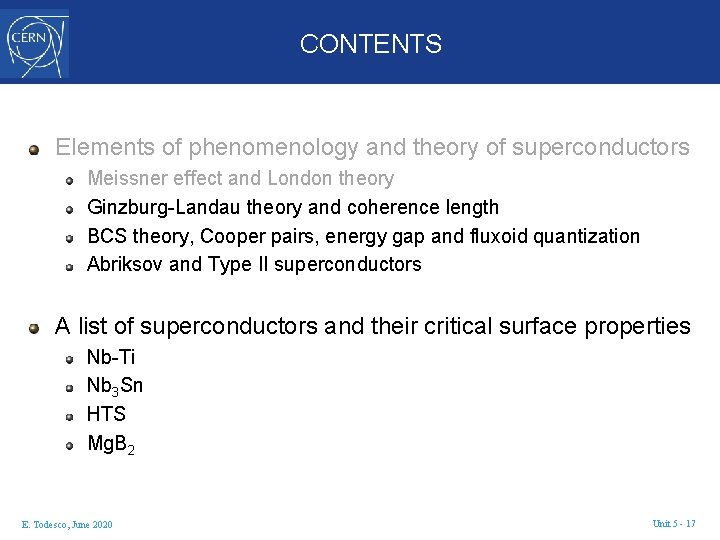
CONTENTS Elements of phenomenology and theory of superconductors required to “understand” the existence of a critical surface Meissner effect and London theory Needed to show that B limits current density Ginzburg-Landau theory and coherence length Coherence length needed to define type I and type II BCS theory, Cooper pairs, energy gap and fluxoid quantization Abriksov and Type II superconductors A list of superconductors and their critical surface properties Nb-Ti Nb 3 Sn HTS Mg. B 2 E. Todesco, June 2020 Unit 5 - 6
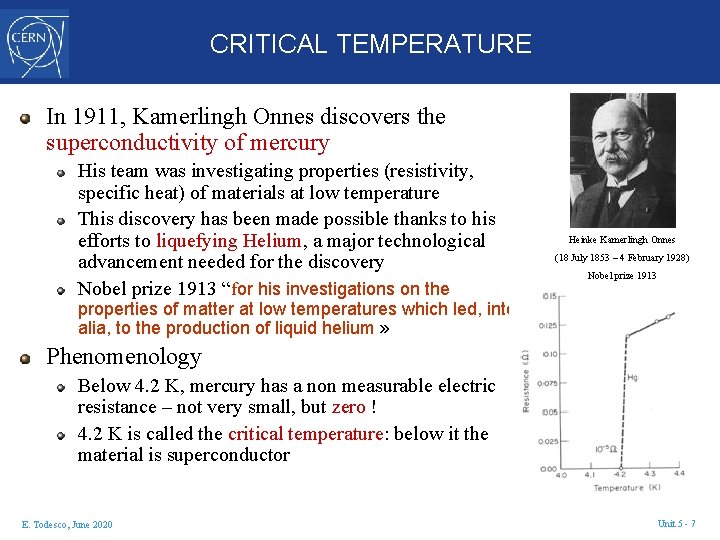
CRITICAL TEMPERATURE In 1911, Kamerlingh Onnes discovers the superconductivity of mercury His team was investigating properties (resistivity, specific heat) of materials at low temperature This discovery has been made possible thanks to his efforts to liquefying Helium, a major technological advancement needed for the discovery Nobel prize 1913 “for his investigations on the Heinke Kamerlingh Onnes (18 July 1853 – 4 February 1928) Nobel prize 1913 properties of matter at low temperatures which led, inter alia, to the production of liquid helium » Phenomenology Below 4. 2 K, mercury has a non measurable electric resistance – not very small, but zero ! 4. 2 K is called the critical temperature: below it the material is superconductor E. Todesco, June 2020 Unit 5 - 7
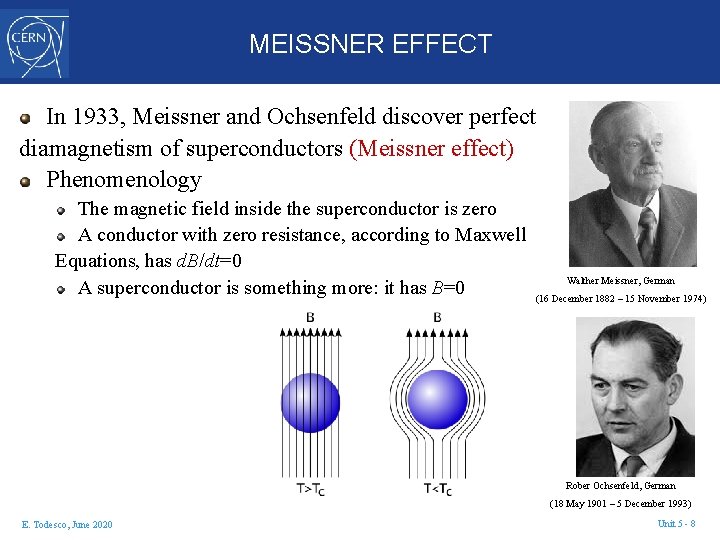
MEISSNER EFFECT In 1933, Meissner and Ochsenfeld discover perfect diamagnetism of superconductors (Meissner effect) Phenomenology The magnetic field inside the superconductor is zero A conductor with zero resistance, according to Maxwell Equations, has d. B/dt=0 A superconductor is something more: it has B=0 Walther Meissner, German (16 December 1882 – 15 November 1974) Rober Ochsenfeld, German (18 May 1901 – 5 December 1993) E. Todesco, June 2020 Unit 5 - 8
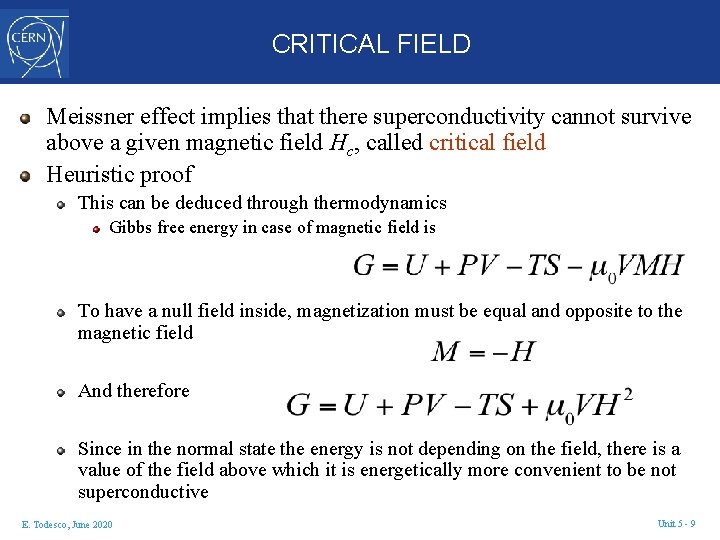
CRITICAL FIELD Meissner effect implies that there superconductivity cannot survive above a given magnetic field Hc, called critical field Heuristic proof This can be deduced through thermodynamics Gibbs free energy in case of magnetic field is To have a null field inside, magnetization must be equal and opposite to the magnetic field And therefore Since in the normal state the energy is not depending on the field, there is a value of the field above which it is energetically more convenient to be not superconductive E. Todesco, June 2020 Unit 5 - 9
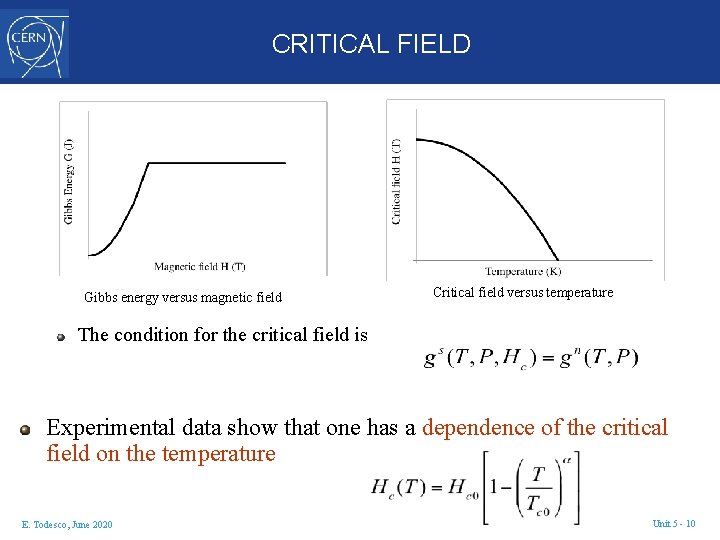
CRITICAL FIELD Gibbs energy versus magnetic field Critical field versus temperature The condition for the critical field is Experimental data show that one has a dependence of the critical field on the temperature E. Todesco, June 2020 Unit 5 - 10
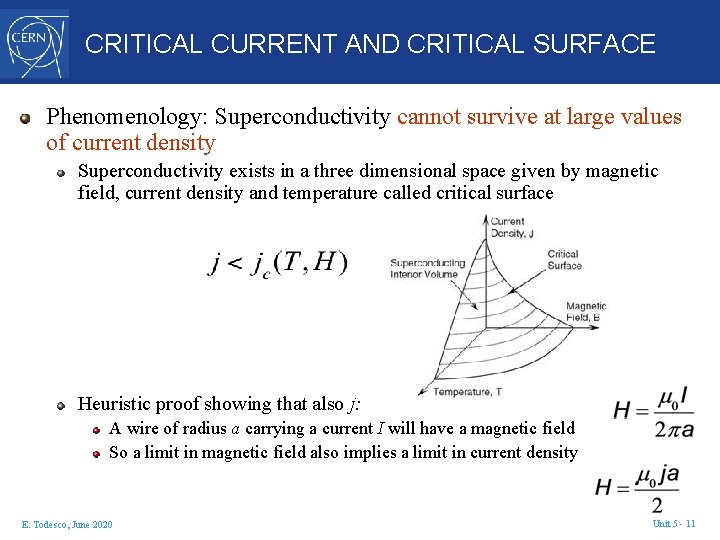
CRITICAL CURRENT AND CRITICAL SURFACE Phenomenology: Superconductivity cannot survive at large values of current density Superconductivity exists in a three dimensional space given by magnetic field, current density and temperature called critical surface Heuristic proof showing that also j: A wire of radius a carrying a current I will have a magnetic field So a limit in magnetic field also implies a limit in current density E. Todesco, June 2020 Unit 5 - 11
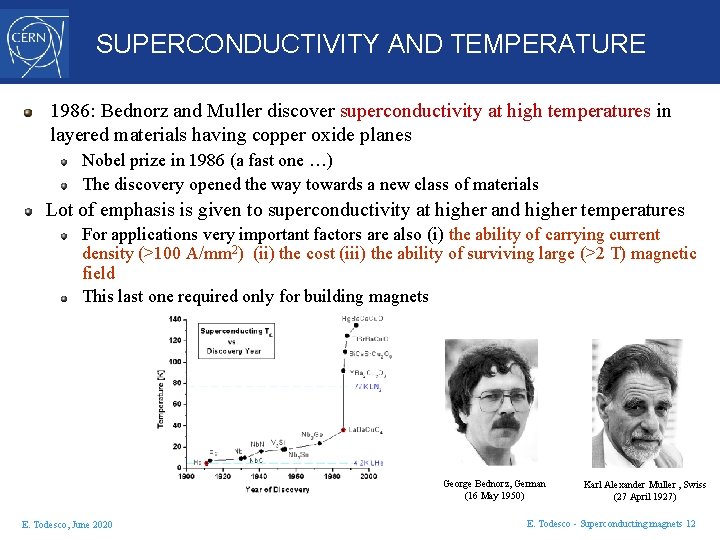
SUPERCONDUCTIVITY AND TEMPERATURE 1986: Bednorz and Muller discover superconductivity at high temperatures in layered materials having copper oxide planes Nobel prize in 1986 (a fast one …) The discovery opened the way towards a new class of materials Lot of emphasis is given to superconductivity at higher and higher temperatures For applications very important factors are also (i) the ability of carrying current density (>100 A/mm 2) (ii) the cost (iii) the ability of surviving large (>2 T) magnetic field This last one required only for building magnets George Bednorz, German (16 May 1950) E. Todesco, June 2020 Karl Alexander Muller , Swiss (27 April 1927) E. Todesco - Superconducting magnets 12
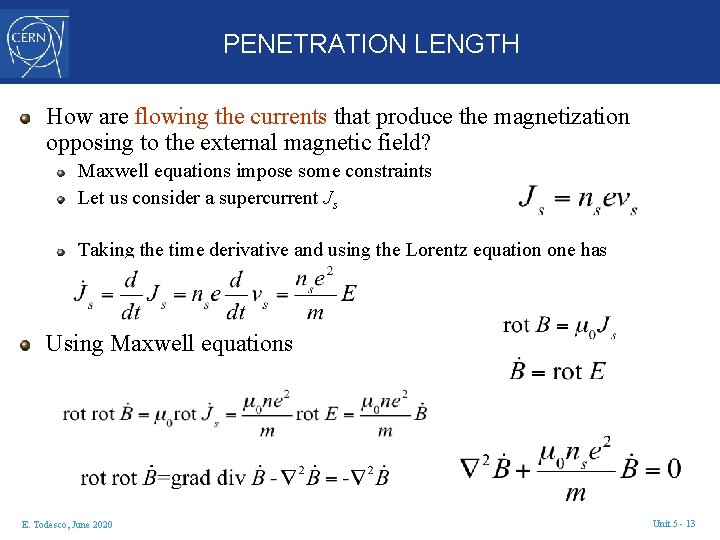
PENETRATION LENGTH How are flowing the currents that produce the magnetization opposing to the external magnetic field? Maxwell equations impose some constraints Let us consider a supercurrent Js Taking the time derivative and using the Lorentz equation one has Using Maxwell equations E. Todesco, June 2020 Unit 5 - 13
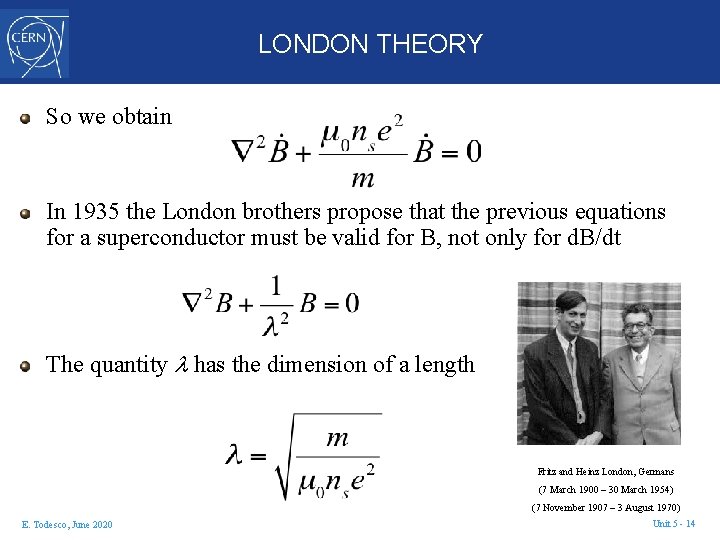
LONDON THEORY So we obtain In 1935 the London brothers propose that the previous equations for a superconductor must be valid for B, not only for d. B/dt The quantity l has the dimension of a length Fritz and Heinz London, Germans (7 March 1900 – 30 March 1954) (7 November 1907 – 3 August 1970) E. Todesco, June 2020 Unit 5 - 14
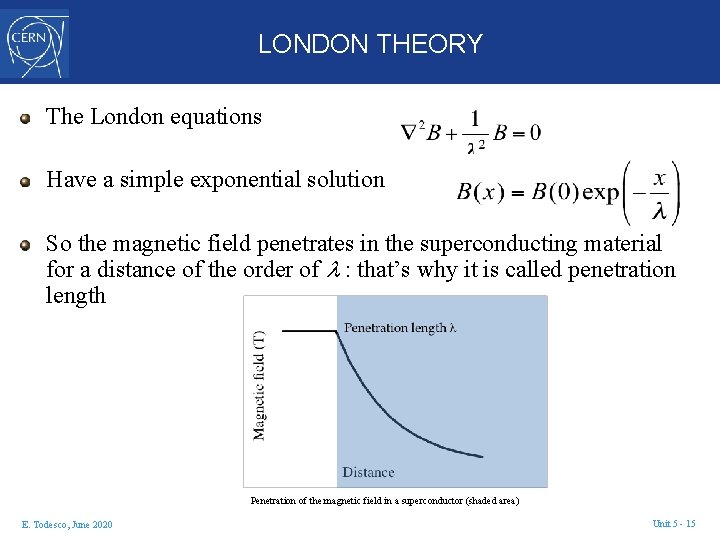
LONDON THEORY The London equations Have a simple exponential solution So the magnetic field penetrates in the superconducting material for a distance of the order of l : that’s why it is called penetration length Penetration of the magnetic field in a superconductor (shaded area) E. Todesco, June 2020 Unit 5 - 15
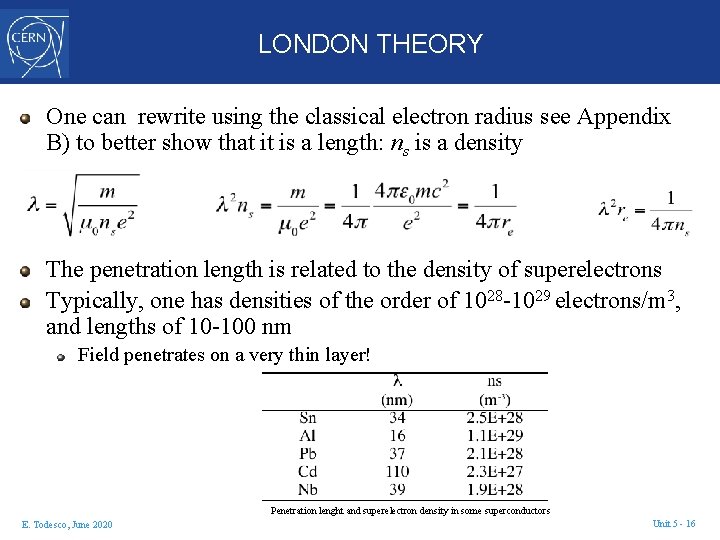
LONDON THEORY One can rewrite using the classical electron radius see Appendix B) to better show that it is a length: ns is a density The penetration length is related to the density of superelectrons Typically, one has densities of the order of 1028 -1029 electrons/m 3, and lengths of 10 -100 nm Field penetrates on a very thin layer! Penetration lenght and superelectron density in some superconductors E. Todesco, June 2020 Unit 5 - 16
CONTENTS Elements of phenomenology and theory of superconductors Meissner effect and London theory Ginzburg-Landau theory and coherence length BCS theory, Cooper pairs, energy gap and fluxoid quantization Abriksov and Type II superconductors A list of superconductors and their critical surface properties Nb-Ti Nb 3 Sn HTS Mg. B 2 E. Todesco, June 2020 Unit 5 - 17
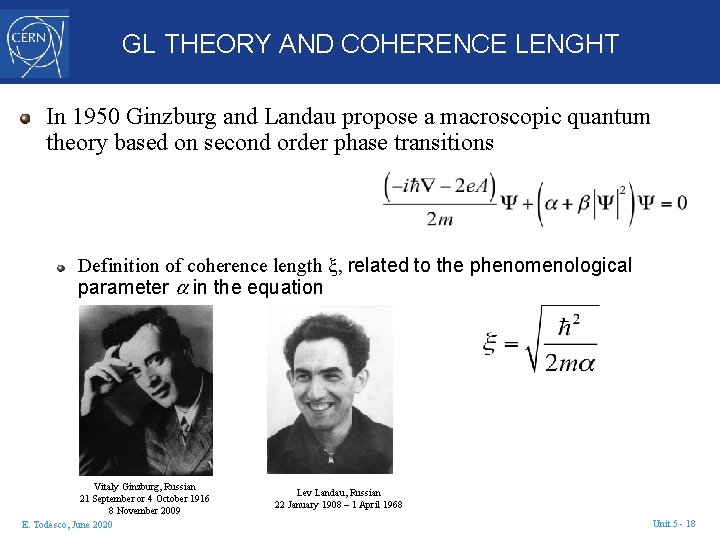
GL THEORY AND COHERENCE LENGHT In 1950 Ginzburg and Landau propose a macroscopic quantum theory based on second order phase transitions Definition of coherence length x, related to the phenomenological parameter a in the equation Vitaly Ginzburg, Russian 21 September or 4 October 1916 8 November 2009 E. Todesco, June 2020 Lev Landau, Russian 22 January 1908 – 1 April 1968 Unit 5 - 18
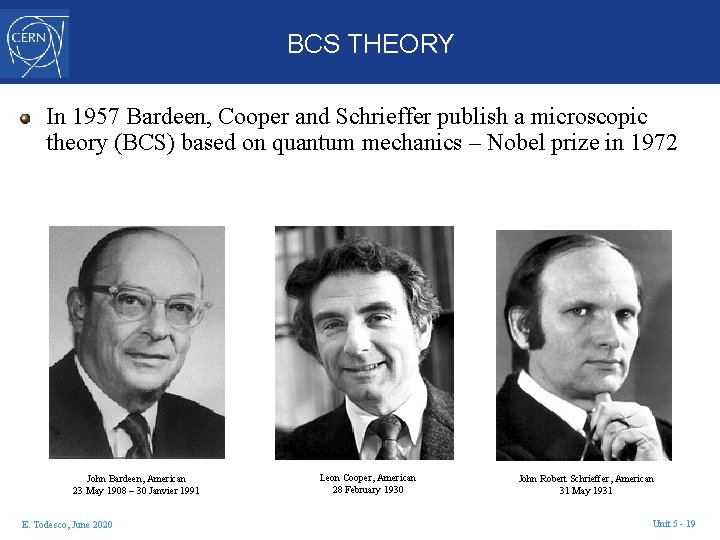
BCS THEORY In 1957 Bardeen, Cooper and Schrieffer publish a microscopic theory (BCS) based on quantum mechanics – Nobel prize in 1972 John Bardeen, American 23 May 1908 – 30 Janvier 1991 E. Todesco, June 2020 Leon Cooper, American 28 February 1930 John Robert Schrieffer, American 31 May 1931 Unit 5 - 19
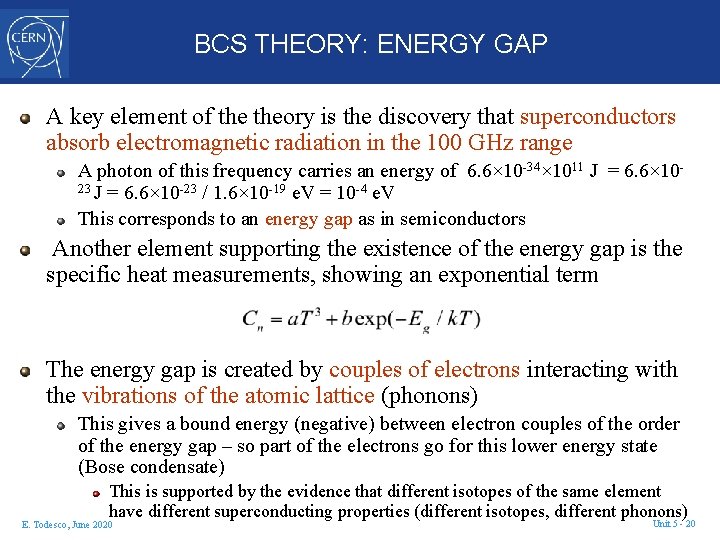
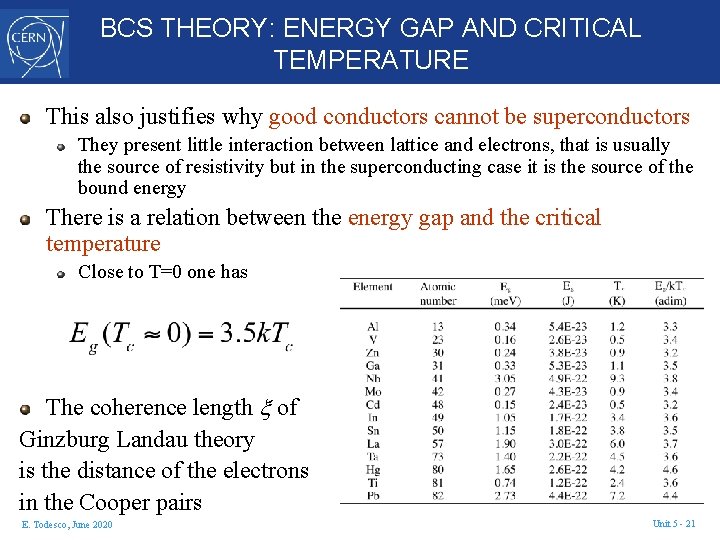
BCS THEORY: ENERGY GAP A key element of theory is the discovery that superconductors absorb electromagnetic radiation in the 100 GHz range A photon of this frequency carries an energy of 6. 6× 10 -34× 1011 J = 6. 6× 10²³ J = 6. 6× 10 -23 / 1. 6× 10 -19 e. V = 10 -4 e. V This corresponds to an energy gap as in semiconductors Another element supporting the existence of the energy gap is the specific heat measurements, showing an exponential term The energy gap is created by couples of electrons interacting with the vibrations of the atomic lattice (phonons) This gives a bound energy (negative) between electron couples of the order of the energy gap – so part of the electrons go for this lower energy state (Bose condensate) This is supported by the evidence that different isotopes of the same element have different superconducting properties (different isotopes, different phonons) E. Todesco, June 2020 Unit 5 - 20
BCS THEORY: ENERGY GAP AND CRITICAL TEMPERATURE This also justifies why good conductors cannot be superconductors They present little interaction between lattice and electrons, that is usually the source of resistivity but in the superconducting case it is the source of the bound energy There is a relation between the energy gap and the critical temperature Close to T=0 one has The coherence length x of Ginzburg Landau theory is the distance of the electrons in the Cooper pairs E. Todesco, June 2020 Unit 5 - 21
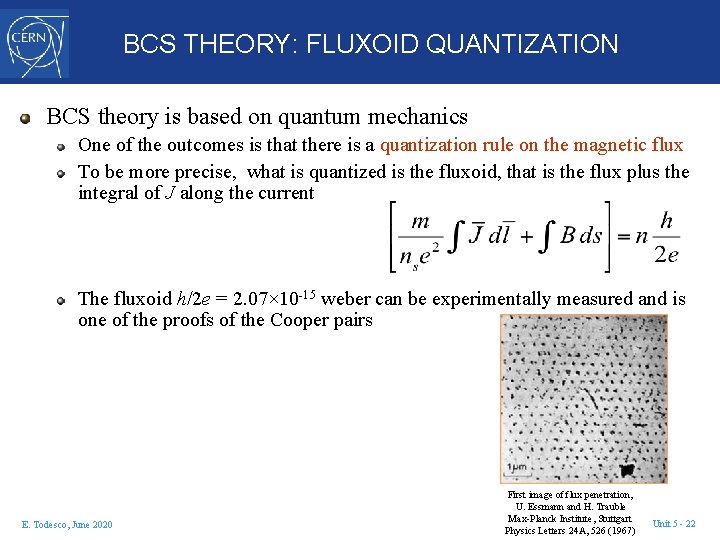
BCS THEORY: FLUXOID QUANTIZATION BCS theory is based on quantum mechanics One of the outcomes is that there is a quantization rule on the magnetic flux To be more precise, what is quantized is the fluxoid, that is the flux plus the integral of J along the current The fluxoid h/2 e = 2. 07× 10 -15 weber can be experimentally measured and is one of the proofs of the Cooper pairs E. Todesco, June 2020 First image of flux penetration, U. Essmann and H. Trauble Max-Planck Institute, Stuttgart Physics Letters 24 A, 526 (1967) Unit 5 - 22
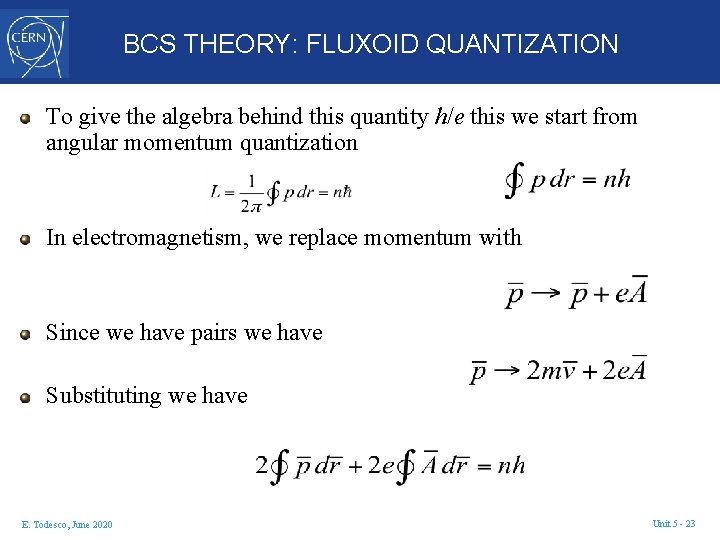
BCS THEORY: FLUXOID QUANTIZATION To give the algebra behind this quantity h/e this we start from angular momentum quantization In electromagnetism, we replace momentum with Since we have pairs we have Substituting we have E. Todesco, June 2020 Unit 5 - 23
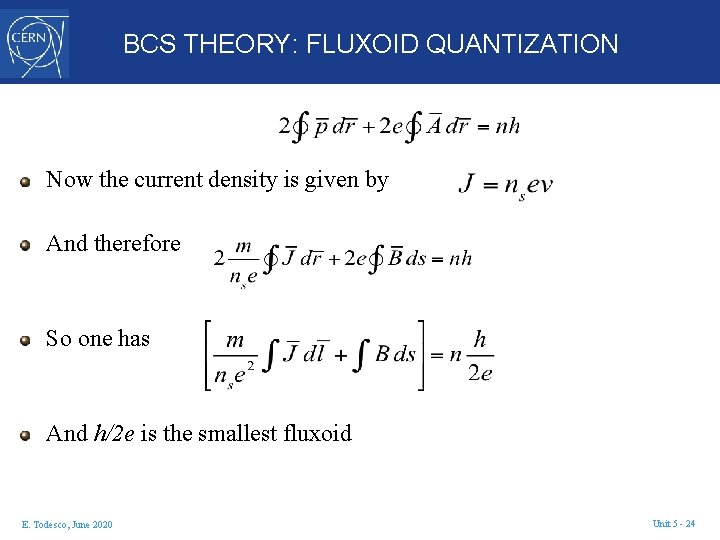
BCS THEORY: FLUXOID QUANTIZATION Now the current density is given by And therefore So one has And h/2 e is the smallest fluxoid E. Todesco, June 2020 Unit 5 - 24
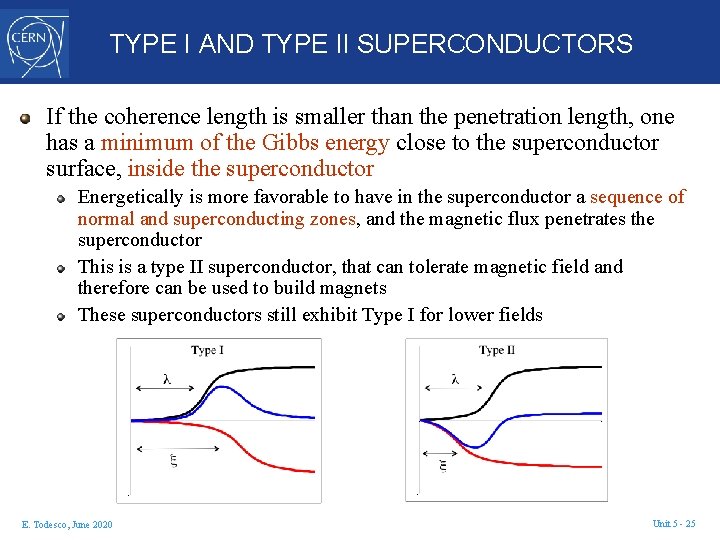
TYPE I AND TYPE II SUPERCONDUCTORS If the coherence length is smaller than the penetration length, one has a minimum of the Gibbs energy close to the superconductor surface, inside the superconductor Energetically is more favorable to have in the superconductor a sequence of normal and superconducting zones, and the magnetic flux penetrates the superconductor This is a type II superconductor, that can tolerate magnetic field and therefore can be used to build magnets These superconductors still exhibit Type I for lower fields E. Todesco, June 2020 Unit 5 - 25
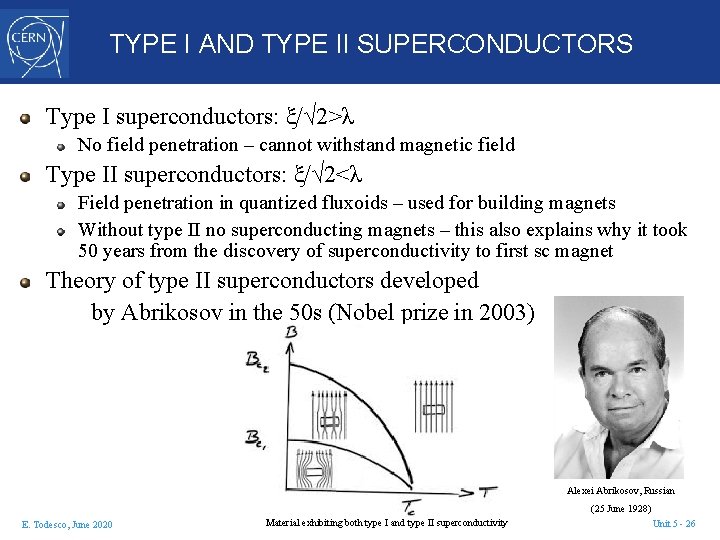
TYPE I AND TYPE II SUPERCONDUCTORS Type I superconductors: ξ/√ 2>λ No field penetration – cannot withstand magnetic field Type II superconductors: ξ/√ 2<λ Field penetration in quantized fluxoids – used for building magnets Without type II no superconducting magnets – this also explains why it took 50 years from the discovery of superconductivity to first sc magnet Theory of type II superconductors developed by Abrikosov in the 50 s (Nobel prize in 2003) Alexei Abrikosov, Russian (25 June 1928) E. Todesco, June 2020 Material exhibiting both type I and type II superconductivity Unit 5 - 26
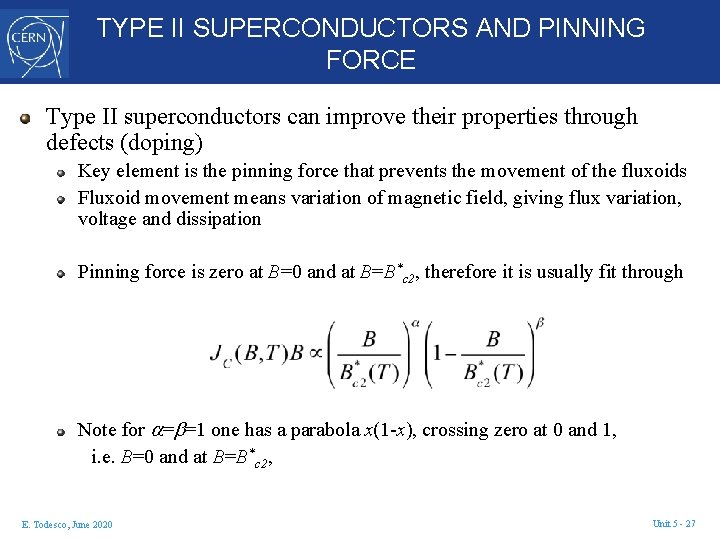
TYPE II SUPERCONDUCTORS AND PINNING FORCE Type II superconductors can improve their properties through defects (doping) Key element is the pinning force that prevents the movement of the fluxoids Fluxoid movement means variation of magnetic field, giving flux variation, voltage and dissipation Pinning force is zero at B=0 and at B=B*c 2, therefore it is usually fit through Note for a=b=1 one has a parabola x(1 -x), crossing zero at 0 and 1, i. e. B=0 and at B=B*c 2, E. Todesco, June 2020 Unit 5 - 27
CONTENTS Elements of phenomenology and theory of superconductors Meissner effect and London theory Ginzburg-Landau theory and coherence length BCS theory, Cooper pairs, energy gap and fluxoid quantization Abriksov and Type II superconductors A list of superconductors and their critical surface properties Nb-Ti Nb 3 Sn HTS Mg. B 2 E. Todesco, June 2020 Unit 5 - 28
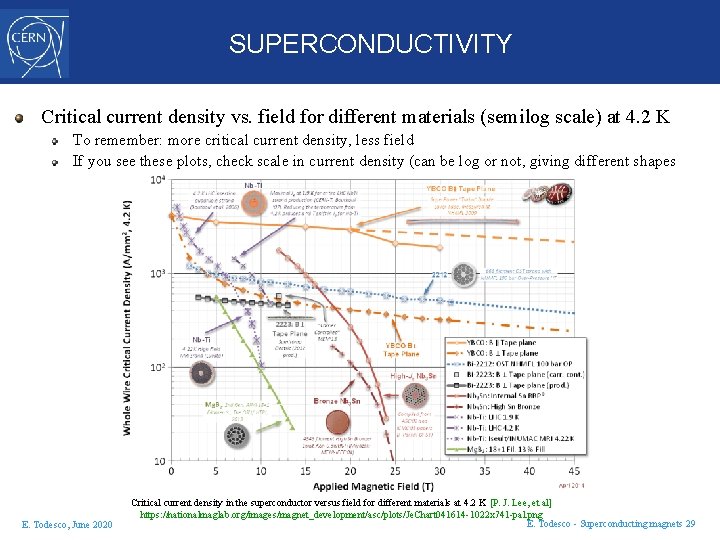
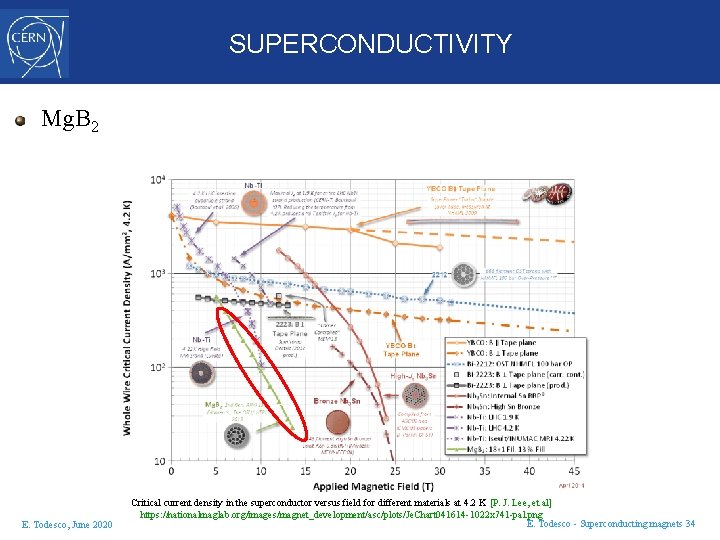
SUPERCONDUCTIVITY Critical current density vs. field for different materials (semilog scale) at 4. 2 K To remember: more critical current density, less field If you see these plots, check scale in current density (can be log or not, giving different shapes E. Todesco, June 2020 Critical current density in the superconductor versus field for different materials at 4. 2 K [P. J. Lee, et al] https: //nationalmaglab. org/images/magnet_development/asc/plots/Je. Chart 041614 -1022 x 741 -pal. png E. Todesco - Superconducting magnets 29
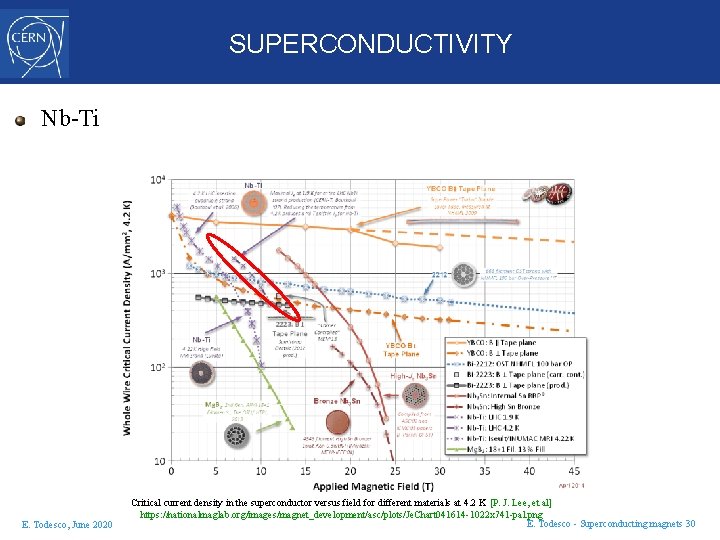
SUPERCONDUCTIVITY Nb-Ti E. Todesco, June 2020 Critical current density in the superconductor versus field for different materials at 4. 2 K [P. J. Lee, et al] https: //nationalmaglab. org/images/magnet_development/asc/plots/Je. Chart 041614 -1022 x 741 -pal. png E. Todesco - Superconducting magnets 30
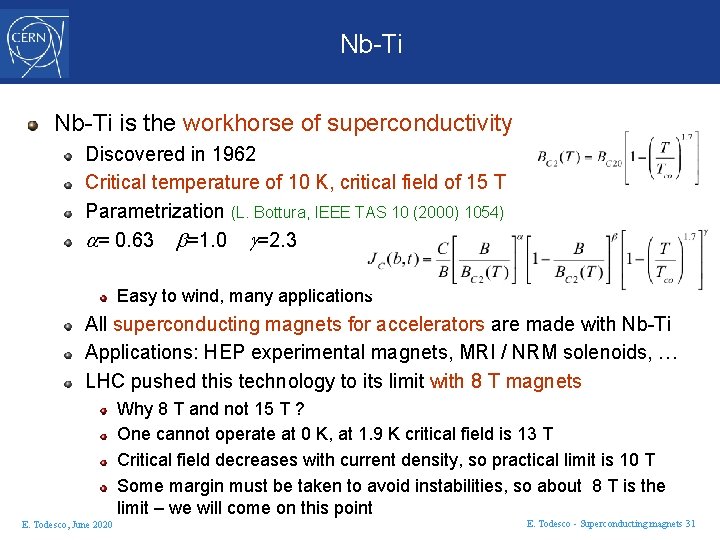
Nb-Ti is the workhorse of superconductivity Discovered in 1962 Critical temperature of 10 K, critical field of 15 T Parametrization (L. Bottura, IEEE TAS 10 (2000) 1054) a= 0. 63 b=1. 0 g=2. 3 Easy to wind, many applications All superconducting magnets for accelerators are made with Nb-Ti Applications: HEP experimental magnets, MRI / NRM solenoids, … LHC pushed this technology to its limit with 8 T magnets Why 8 T and not 15 T ? One cannot operate at 0 K, at 1. 9 K critical field is 13 T Critical field decreases with current density, so practical limit is 10 T Some margin must be taken to avoid instabilities, so about 8 T is the limit – we will come on this point E. Todesco, June 2020 E. Todesco - Superconducting magnets 31
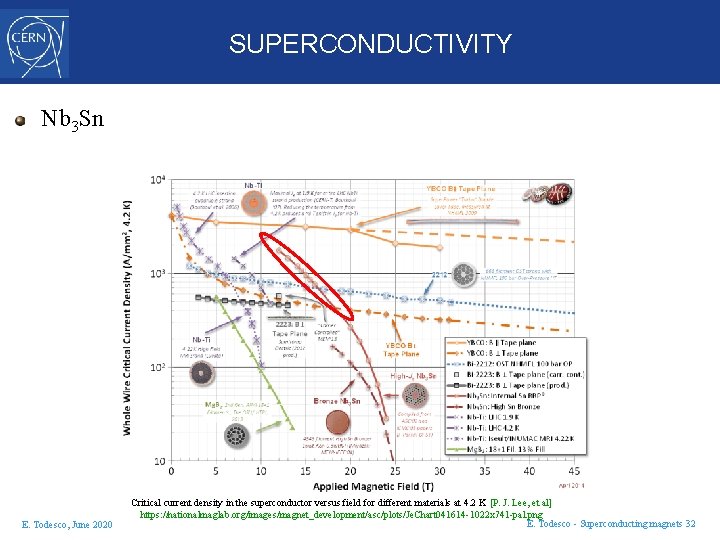
SUPERCONDUCTIVITY Nb 3 Sn E. Todesco, June 2020 Critical current density in the superconductor versus field for different materials at 4. 2 K [P. J. Lee, et al] https: //nationalmaglab. org/images/magnet_development/asc/plots/Je. Chart 041614 -1022 x 741 -pal. png E. Todesco - Superconducting magnets 32
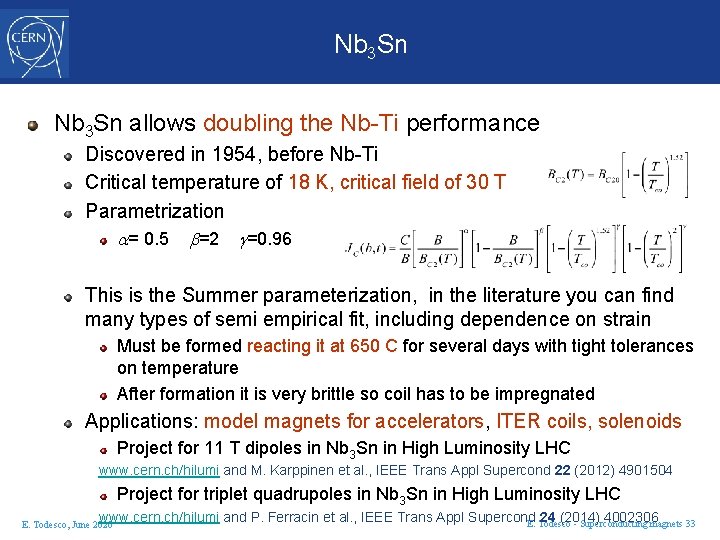
Nb 3 Sn allows doubling the Nb-Ti performance Discovered in 1954, before Nb-Ti Critical temperature of 18 K, critical field of 30 T Parametrization a= 0. 5 b=2 g=0. 96 This is the Summer parameterization, in the literature you can find many types of semi empirical fit, including dependence on strain Must be formed reacting it at 650 C for several days with tight tolerances on temperature After formation it is very brittle so coil has to be impregnated Applications: model magnets for accelerators, ITER coils, solenoids Project for 11 T dipoles in Nb 3 Sn in High Luminosity LHC www. cern. ch/hilumi and M. Karppinen et al. , IEEE Trans Appl Supercond 22 (2012) 4901504 Project for triplet quadrupoles in Nb 3 Sn in High Luminosity LHC www. cern. ch/hilumi and P. Ferracin et al. , IEEE Trans Appl Supercond 24 (2014) 4002306 E. Todesco - Superconducting magnets 33 E. Todesco, June 2020
SUPERCONDUCTIVITY Mg. B 2 E. Todesco, June 2020 Critical current density in the superconductor versus field for different materials at 4. 2 K [P. J. Lee, et al] https: //nationalmaglab. org/images/magnet_development/asc/plots/Je. Chart 041614 -1022 x 741 -pal. png E. Todesco - Superconducting magnets 34
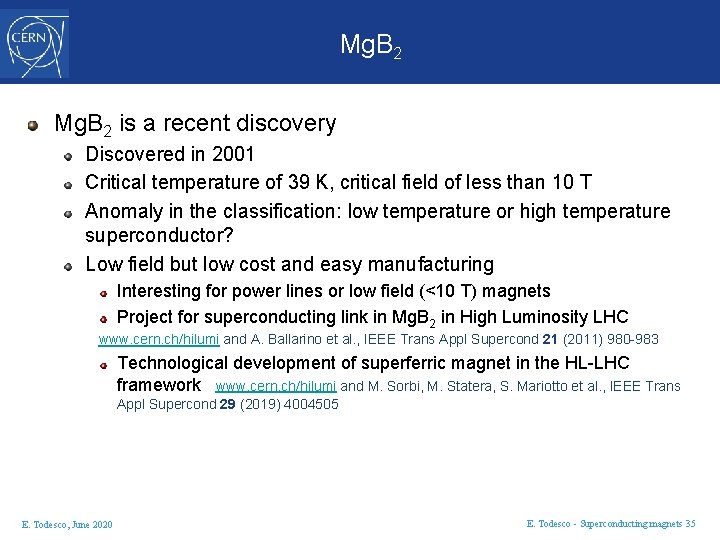
Mg. B 2 is a recent discovery Discovered in 2001 Critical temperature of 39 K, critical field of less than 10 T Anomaly in the classification: low temperature or high temperature superconductor? Low field but low cost and easy manufacturing Interesting for power lines or low field (<10 T) magnets Project for superconducting link in Mg. B 2 in High Luminosity LHC www. cern. ch/hilumi and A. Ballarino et al. , IEEE Trans Appl Supercond 21 (2011) 980 -983 Technological development of superferric magnet in the HL-LHC framework www. cern. ch/hilumi and M. Sorbi, M. Statera, S. Mariotto et al. , IEEE Trans Appl Supercond 29 (2019) 4004505 E. Todesco, June 2020 E. Todesco - Superconducting magnets 35
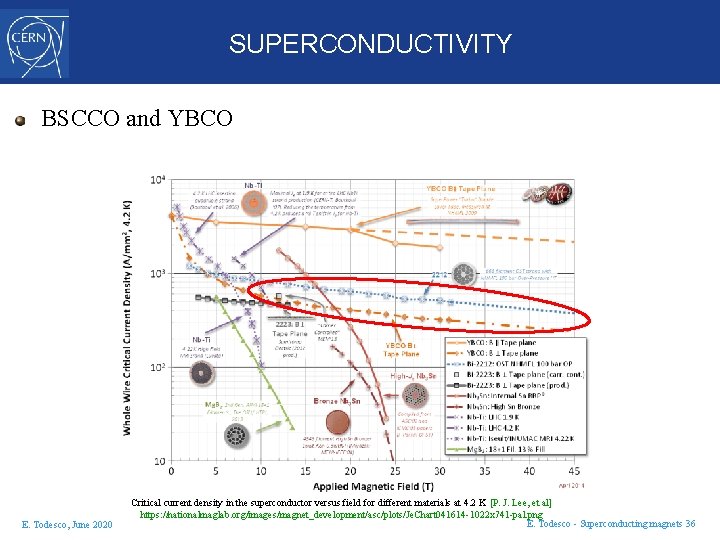
SUPERCONDUCTIVITY BSCCO and YBCO E. Todesco, June 2020 Critical current density in the superconductor versus field for different materials at 4. 2 K [P. J. Lee, et al] https: //nationalmaglab. org/images/magnet_development/asc/plots/Je. Chart 041614 -1022 x 741 -pal. png E. Todesco - Superconducting magnets 36
BSCCO AND YBCO BSSCO and YBCO are the two main HTS (high temperature superconductors Discovered in 1988/86 Large critical temperature ≈100 K Very large critical field above 150 T Flat critical surface (little dependence on field) Large progress in reaching good current density Both expensive (more than 10 times Nb-Ti …) Drawbacks: YBCO round wires are not trivial – most application on tapes BSCCO requires a heat treatment at 800 C , and 100 bar of oxygen to increase j NMR/MRI solenoids with HTS tapes have been developed Projects of dipole inserts for accelerator magnets are onging in many labs (LBNL, CERN, CEA, …) E. Todesco - Superconducting magnets 37 E. Todesco, June 2020
CONCLUSIONS We discussed some elements of superconductivity Recent theory, slowly built after the experimental discovery Its fundamental lay in quantum mechanics – Cooper pairs Long time from discovery to first magnets (44 years !) Superconductivity is destroyed by: temperature, current density, magnetic field Critical surface is j(B, T) giving values below which the superconducting state exists Fluxoid quantization having the factor 2 is a strong proof of Cooper pair existence For making magnets it is fundamental to have penetration of magnetic field Type II superconductors E. Todesco, June 2020 Unit 5 - 38
CONCLUSIONS Everybody thinks that the Holy Graal is superconductivity at room temperature In reality for certain applications there are two aspects that are much more critical Ability of carrying current density (including insulation) of the order of 100 -1000 A/mm 2 to have compact devices For making magnets: to survive magnetic field to have high field devices with zero consumption And in all cases: to be cheap (and this is not the case) Unit 6 will explain how superconductivity has special limits that require a very peculiar shape of conductor A bulk superconductor does not work – this is also an important element of its cost E. Todesco, June 2020 Unit 5 - 39