
Unit 5 Signal Description Unit 5 Signal Description
- Slides: 20
Unit 5 Signal Description
Unit 5 Signal Description
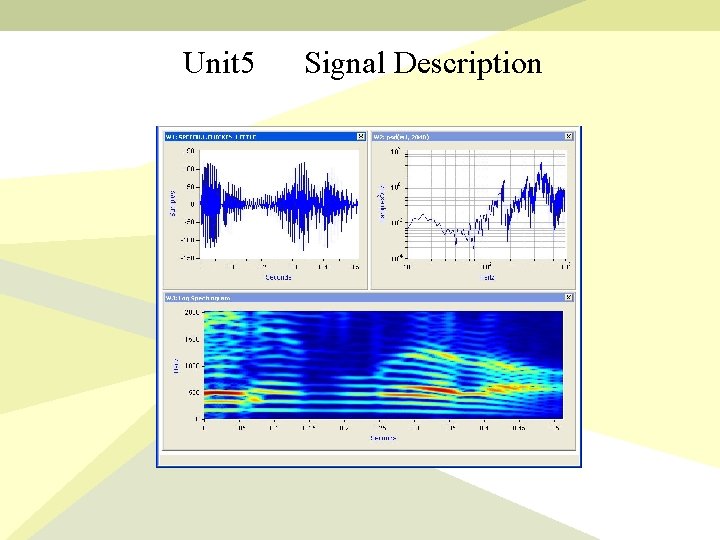
Unit 5 Signal Description As another example, consider the human vocal (有声的, 发音的)mechanism, which produces speech by creating fluctuations(波动,涨落,起伏) on acoustic (声音的,听 觉的)pressure. Different sounds correspond to different patterns in the variations of acoustic pressure, and the human vocal system produces intelligible (可理解的,明白易懂的, 清楚的) speech by generating particular sequences of these patterns. 另一个例子,考虑人的声道系统,该系统根据在声压 上的起伏变化而产生语音信号。不同的语音相应有不同的 声压变化波形,声道系统产生的可识别语音就对应着一串 特定的波形。
Unit 5 Signal Description Signal are represented mathematically as functions of one or more independent variables. For example, a speech signal can be represented mathematically by acoustic pressure as a function of time, and a picture can be represented by brightness as a function of two spatial variables. 在数学上,信号可以表示为一个或者多个变量的函数。 例如,一个语音信号可以表示为声压随时间变化的函数; 一张黑白照片可以表示为亮度随二维空间变量变化的函数。
Unit 5 Signal Description For example, in geophysics(地球物理学), signals representing variations with depth of physical quantities such as density, porosity(孔隙率,多孔性), and electrical resistivity(电阻率)are used to study the structure of the earth. Also, knowledge of the variations of pressure, temperature and wind speed with altitude are extremely important in meteorological(与气象学有关的,气象的) investigations. 例如,在地球物理学研究中,用于研究地球结构的一些 物理量像密度、气隙度和电阻率等就是随地球深度变化的 信号;在气象观察中,有关气压、温度和风速随高度变化 也是很重要的一类信号。
Unit 5 Signal Description Throughout this context, we will be considering two basic types of signals: continuous-time signals and discrete-time signals. In the case of continuous-time signals the independent variable is continuous, and thus these signals are defined for a continuum of values of the independent variable. On the other hand, discrete-time signals are defined only at discrete times, and consequently, for these signals, the independent variable takes on only a discrete set of values. 全文将考虑两种基本类型的信号:连续时间信号和离散 时间信号。连续时间信号的自变量是连续的,因此这些信 号定义为自变量的连续值。另一方面,离散时间信号只定 义在离散时间点上,因此,对这些信号,自变量只在一系 列离散的值上出现。
Unit 5 Signal Description Other examples of discrete-time signals can be found on demographic (人口统计学的)studies in which various attributes, such as average budget, crime rate, or pounds of fish caught, are tabulated(把(数字、事实)列成表)against such discrete variable as family size, total population, or type of fishing vessel(渔船,渔轮), respectively. 在人口统计学的研究中还可以找到其他离散时间信号的 例子,例如像平均预算、犯罪率或捕鱼量等都可以分别对 家庭大小、总人口或捕鱼船的类型等离散变量列成表格形 式。
Unit 5 Signal Description To distinguish between continuous-time and discrete-time signals, we will use the symbol to denote the continuous-time independent variable and to denote the discrete-time independent variable. In addition, for continuous-time signals we will enclose the independent variable in parentheses ( • ), whereas for discrete-time signals we will use brackets [ • ] to enclose the independent variable. 句中parentheses特指“圆括号”。 为了区分连续时间信号和离散时间信号,我们用t表示连续 时间变量,而用n表示离散时间变量。另外,连续时间信号 将自变量放在圆括号(·)中,而离散时间信号,我们用方 括号[·]来表示自变量。
Unit 5 Signal Description Because of their speed, computational power, and flexibility, modern digital processors are use to implement many practical systems, ranging from digital autopilots to digital audio system. Such systems require the use of discrete-time sequences representing sampled versions of continuous-time signals—e. g. , aircraft position, velocity, and heading for an autopilot(自动导航装置,自动驾驶仪)or speech and music for an audio system. 由于近代数字处理器在速度、计算能力及灵活性等方面 的进展,因此被用来实现许多这样的实际系统,其范围 涉及从数字自动驾驶仪到一般的数字音频系统。这样的 系统要用离散时间序列来表达连续时间信号的样本描述 ——如,飞机的位置、速度和航向,或是音频系统的语 音和音乐。
Unit 5 Signal Description Also, pictures in newspapers—or in this text, for that matter— actually consist of a very fine grid(格子,格栏)of points, and each of these points represents a sample of the brightness of the corresponding point in the original image. No matter what the source of the data, however, the signal x[n] is defined only for integer values of n. It makes no more sense to refer to the th sample of a digital speech signal than it does to refer to the average budget for a family with family members. 同样,报纸以及本文中所用的照片实际上也都是由很多细 小的点格所组成的,其中每一点就代表着相应于原照片上 该点亮度的采样。无论这些离散时间信号的来源是什么, 信号x[n]总是在n的整数值上有定义,因此像所谓一个数字 语音信号的第 个样本,以及对某一个家庭的 个家庭成 员的平均预算等等都是毫无意义的。
Unit 5 Signal Description We can develop a representation of signals as linear combinations of a set of basic signals. For this alternative representation we use complex exponentials(复指数). The resulting representations are known as the continuoustime and discrete-time Fourier series and transform. As we will see, these can be used to construct broad and useful classes of signals. 我们可以将信号表达成一系列基本信号的线性组合。 在这种表达中,我们用到了复指数。最终的表达方式是 连续时间和离散时间的傅里叶级数和傅里叶变换。这样 可以建立广泛而有用的信号分类。
Unit 5 Signal Description Fourier series representation of continuous-time periodic signals If a signal is periodic, for some positive value of T, for all t (5. 1) The fundamental period(基本周期,基波周期)of x( t ) is the minimum positive, nonzero value of T for which eq. (5. 1) is satisfied, and the value is referred to as the fundamental frequency(基本频率,基频). If x( t ) can be expressed as a linear combination of harmonically related complex exponentials of the form …… 如果信号是周期的,则存在正值T, 对一切t (5. 1) x( t ) 的基波周期就是满足式(5. 1)的最小非零正值T, 称为基频。如果x(t)能表达成相关谐波复指数形式的线性组合 ……
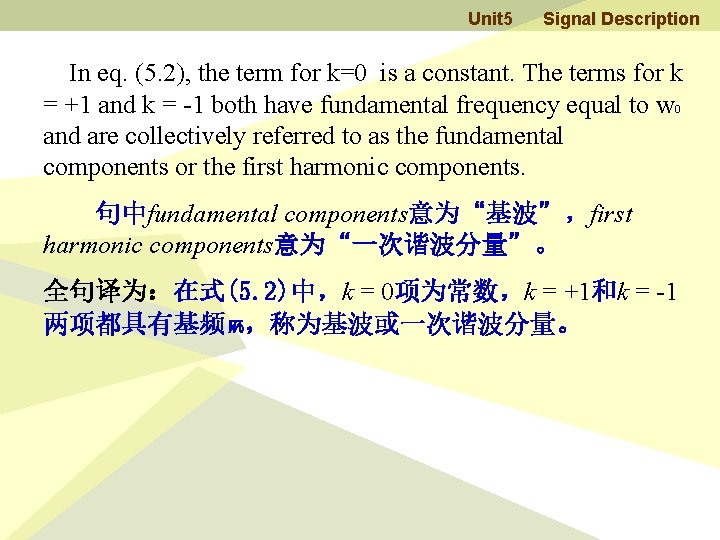
Unit 5 Signal Description In eq. (5. 2), the term for k=0 is a constant. The terms for k = +1 and k = -1 both have fundamental frequency equal to w 0 and are collectively referred to as the fundamental components or the first harmonic components. 句中fundamental components意为“基波”,first harmonic components意为“一次谐波分量”。 全句译为:在式(5. 2)中,k = 0项为常数,k = +1和k = -1 两项都具有基频w 0,称为基波或一次谐波分量。
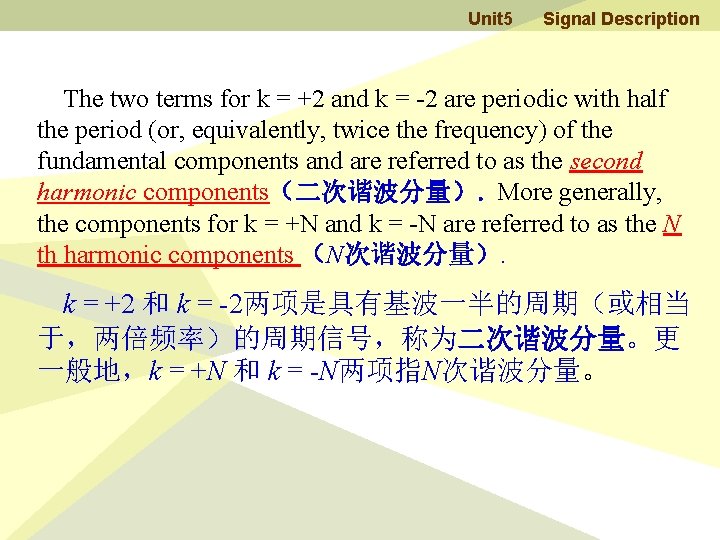
Unit 5 Signal Description The two terms for k = +2 and k = -2 are periodic with half the period (or, equivalently, twice the frequency) of the fundamental components and are referred to as the second harmonic components(二次谐波分量). More generally, the components for k = +N and k = -N are referred to as the N th harmonic components (N次谐波分量). k = +2 和 k = -2两项是具有基波一半的周期(或相当 于,两倍频率)的周期信号,称为二次谐波分量。更 一般地,k = +N 和 k = -N两项指N次谐波分量。
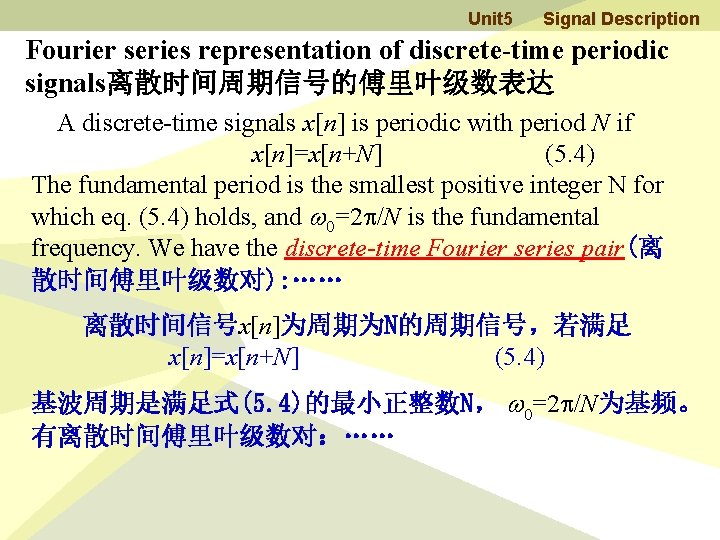
Unit 5 Signal Description Fourier series representation of discrete-time periodic signals离散时间周期信号的傅里叶级数表达 A discrete-time signals x[n] is periodic with period N if x[n]=x[n+N] (5. 4) The fundamental period is the smallest positive integer N for which eq. (5. 4) holds, and w 0=2 p/N is the fundamental frequency. We have the discrete-time Fourier series pair(离 散时间傅里叶级数对): …… 离散时间信号x[n]为周期为N的周期信号,若满足 x[n]=x[n+N] (5. 4) 基波周期是满足式(5. 4)的最小正整数N, w 0=2 p/N为基频。 有离散时间傅里叶级数对:……
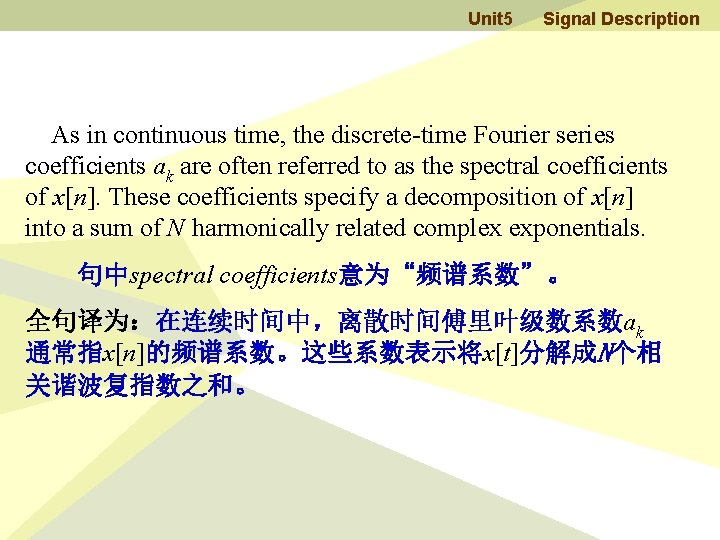
Unit 5 Signal Description As in continuous time, the discrete-time Fourier series coefficients ak are often referred to as the spectral coefficients of x[n]. These coefficients specify a decomposition of x[n] into a sum of N harmonically related complex exponentials. 句中spectral coefficients意为“频谱系数”。 全句译为:在连续时间中,离散时间傅里叶级数系数ak 通常指x[n]的频谱系数。这些系数表示将x[t]分解成N个相 关谐波复指数之和。
Unit 5 Signal Description Fourier transform representation of continuous-time aperiodic(非周期性的)signals 连续时间非周期信号的傅里叶变换 More precisely, in the Fourier series representation of a periodic signal, as the period increases the fundamental frequency decreases and the harmonically related components become closer in frequency. As the period becomes infinite, the frequency components form a continuum and the Fourier series sum becomes an integral. 更精确地讲,在对周期信号的傅里叶级数表达中,随着周期的 增加,基频减小,谐波分量在频率上更加靠近。当频率变成无 穷大,频率分量形成一个连续体,傅里叶级数求和变成一个积 分。
Unit 5 Signal Description Equations (5. 7) and (5. 8) are referred to as the Fourier transform pair(傅里叶变换对), with the function X(jw) referred to as the Fourier Transform or Fourier integral of x(t) and eq. (5. 7) as the inverse Fourier transform(傅里叶反变换) equation. 式(5. 7) 和(5. 8)是傅里叶变换对,其中函数X(jw)是x(t) 的傅里叶变换或傅里叶积分,式(5. 7)称傅里叶反变换。
Unit 5 Signal Description Fourier transform representation of discrete-time aperiodic signals 离散时间非周期信号的傅里叶变换 Where, since X(ejw) ejwnn is periodic with period , the internal of integration can be taken as any interval of length. 句中internal of integration意为“积分区间”, interval of length意为“区间长度”。 译为:其中,因为X (ejw) ejwn是周期为 2 p的周期信号,积 分区间可取任意区间长度 2 p 。
Unit 5 Signal Description Equations (5. 9) and (5. 10) are the discrete-time counterparts of eqs. (5. 7) and (5. 8). The function X(ejw) is referred to as the discrete-time Fourier transform and the pair of equations as the discrete-time Fourier transform pair. As in continuous time, the Fourier transform X(ejw) will often be referred to as the spectrum of x[n], because it provides us with the information on how x[n] is composed of complex exponentials at different frequencies. 式(5. 9)和式(5. 10)是式(5. 7)和(5. 8)在离散时间情况下 所对应的关系。函数X(ejw)称为离散时间傅里叶变换,这 一对式子就是离散时间傅里叶变换对。像在连续时间情况 一样,傅里叶变换X(ejw) 往往被称为x[n]的频谱,因为它 告诉我们x[n]是怎样由这些不同频率的复指数序列组成的。